
British Acts and Colonial Reactions Cause and Effect
British Acts and Colonial Reactions Cause and Effect
The Navigation Acts (1650) • Colonists were required to transport goods only on British ships • Certain goods (sugar, tobacco, indigo, furs) could only go to England. • Imported goods must be purchased from England or pay taxes in British port if purchased from a foreign nation. • Purpose: To make England a wealthy nation
The Navigations Acts (1650)… • COLONIAL REACTION: -many colonists ignored these laws. Smuggling was prominent. • BRITISH RESPONSE: - Passed Sugar Act and Writs of Assistance

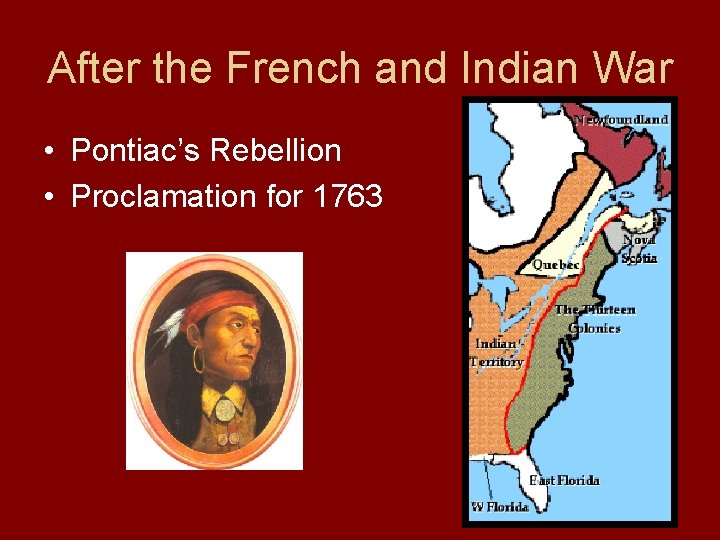
After the French and Indian War • Pontiac’s Rebellion • Proclamation for 1763

Britain’s Empty Treasury • WARS COST MONEY • How about the colonies?
Proclamation of 1763 • Prohibited all settlement and fur trapping west of the Appalachian Mountains • Britain passed this law to pacify the Indians and to save them the expense of protecting colonists who settled on the frontier. • The colonists resented the Proclamation. Many defied the Proclamation and moved anyway.
Writs of Assistance (1764) • Legal papers which gave custom officials the right to search any building for any reason. • The writs were an attempt to stop smuggling. • The colonists complained that these writs violated their rights as English subjects.
Sugar Act (1764) • Reduced the tax on sugar/molasses but also provided for stricter enforcement of the Navigation Acts by sending suspected smugglers to England for trial with Crownappointed judges (not jury). • This law was an attempt to stop smuggling by lowering the tax and give the British government the tools to crackdown on smugglers.
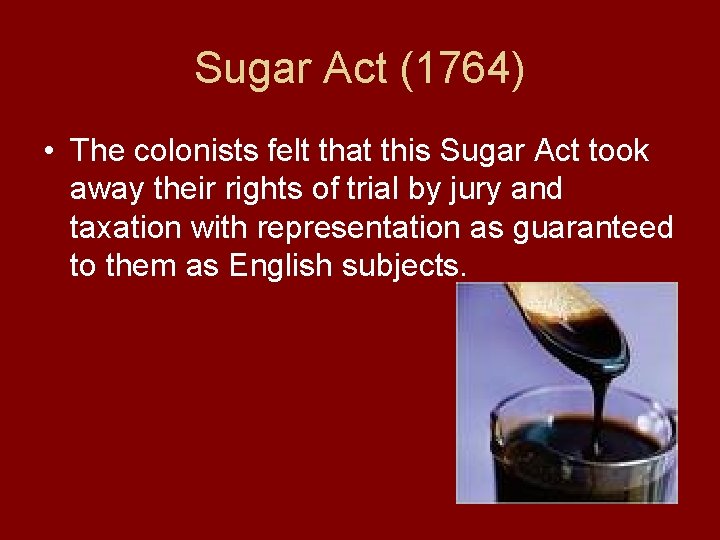
Sugar Act (1764) • The colonists felt that this Sugar Act took away their rights of trial by jury and taxation with representation as guaranteed to them as English subjects.
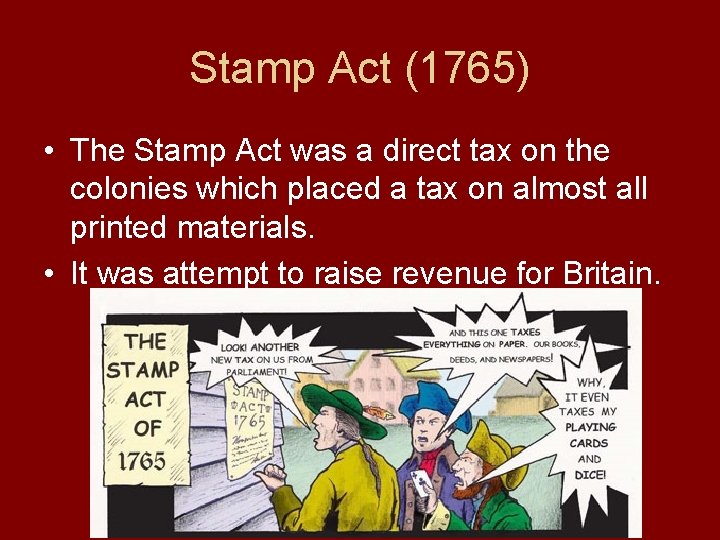
Stamp Act (1765) • The Stamp Act was a direct tax on the colonies which placed a tax on almost all printed materials. • It was attempt to raise revenue for Britain.
Why Were the Colonists So Angry? • People in Britain were shocked at the uproar in the colonies. • Britain had spent a great deal of $$$ protecting the colonists from the French • British paid 26 TIMES the taxes of the colonists.
Here’s Why… • Britain taxing the colonies went against the long-established British principle of no taxation without representation (see Magna Carta 1215) • ONLY the colonists or their elected representatives had the right to pass taxes • No colonial representation in Parliament = No British taxes • Colonists were willing to pay taxes passed by colonial legislatures
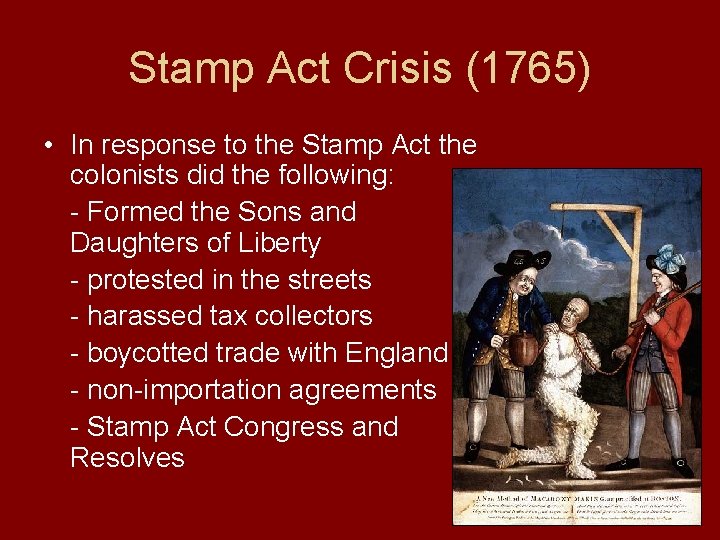
Stamp Act Crisis (1765) • In response to the Stamp Act the colonists did the following: - Formed the Sons and Daughters of Liberty - protested in the streets - harassed tax collectors - boycotted trade with England - non-importation agreements - Stamp Act Congress and Resolves
A Call for Unity • The Stamp Act crisis brought a sense of unity to the colonies. • Critic of the law called for delegates from every colony to meet in New York. • The purpose of this “Stamp Act Congress” was to consider action against the hated Stamp Act. • Delegates from nine colonies sent delegates.

The Stamp Act Congress • Drew up petitions, or letters, to King George III and to Parliament. • These petitions rejected the Stamp Act and asserted that Parliament had no right to tax the colonies. • Parliament paid little attention to these petitions.
The Stamp Act Congress • Besides petitions, the colonists took more direct action. • They called for a boycott (to refuse to buy certain goods or services) of British goods • The boycott took its toll, trade fell off by 14%. • British merchants and workers suffered. • Finally, in 1766 Parliament repealed (cancelled) the Stamp Act
Stamp Act (1765) • In reaction to the protests of the Stamp Act the British government repealed the law. • In its place, they passed the Declaratory Act.
Declaratory Act (1766) • The Declaratory Act repealed the Stamp Act but also asserted British authority to tax the colonists in “all cases whatsoever”. • The British asserted their authority to tax the colonists whenever they wanted. • The colonists considered this act a victory.
“We have… got you excused this one time; pray be a good boy for the future, do what your papa and mama bid you… and then all your acquaintances will love you, and praise you, and give you pretty things. ” An open letter to the colonists from British merchants following the repeal of the Stamp Act
Townshend Act (1767) • Placed duties (taxes) on glass, paper, paint, lead, and tea brought into the colonies. • These duties were to be paid in gold or silver only and paid at the port of entry. • Also, suspended the New York legislature. • The Townshend Act was an effort by England’s new Finance Minister to tax the colonies “without offense”.
Townshend Acts (1767) • This act challenged the colonists basic notions of taxation without representation and liberty. In response, the colonists renewed their boycotts of British goods. • Five colonists killed in a clash with British troops in 1770 known as “The Boston Massacre”. • The Townshend Act was repealed one month after the Boston Massacre.
Tea Act (1773) • Kept the tax on tea and gave the East India Company a monopoly over the American tea trade. • The British kept the tax on tea to show the colonists it still had the right to tax them.
Tea Act (1773) • In response to the Tea Act the colonials: - organized Committees of Correspondence - The Boston Tea Party was staged by the Sons of Liberty. • The King was furious. Parliament passed four new laws (Intolerable Acts) to punish the colonists.
Intolerable Acts (1774) also called the Coercive Acts • These acts were meant to punish Boston for the Boston Tea Party and to isolate Boston from the rest of the colonies. • 1. Closed Boston harbor until the colonists paid for all the tea they dumped. • 2. Greatly restricted colonial government • 3. Allowed British commanders to house troops wherever necessary. • 4. Allowed British officials accused of crimes to stand trial in England.
Intolerable Acts (1774) • Colonists sent supplies to aid Boston; Boycotted British goods; Established the First Continental Congress • Britain stood firm and tension between Britain and the American colonies increased; the colonists prepared for war; Fighting begins at Lexington and Concord (the shot heard ‘round the world)

- Slides: 28