
Britain in the 17 th century The End
Britain in the 17 th century
The End of The House of Tudor l 1603 Ø Change in domestic policy - attempt to unify Britain in religious aspects - attempt to establish the King as absolute authority King James Bible published as authorized translation into English Ø Queen Elizabeth I dies, James IV of Scotland becomes James 1 st of England
Domestic Religious Challenges l l l Ø England: Anglican, King head of church Scotland: Presbyterian, self-organized Ireland: majority Catholic House of Stuart favours Catholicism more or less openly
Foreign Religious Challenges l Ø Ø Great European opponent: France is a strong power on the continent Language at court is French France is catholic to overcome parliament and still be able to rule, Charles I accepts money from French King to lead Britain back to Catholicism. (Charles II does so, too)
Civil War l l Several revolts begin in 1639 in Scotland Public Unrest sweeps through all of ENgland, Scotland Ireland until 1653 Monarchy in England is overthrown in 1649 and is not restored before 1660. In 1660, Charles II is asked by parliament to return from his exile in France to rule as King
Glorious Revolution in 1688 l l Catholic King James II is forced to leave England William III of Orange, successful resistance leader against France, becomes William III of England
Society in the 17 th century l Ø Education for men in the divine language of learning Latin Scientific discourse is Latin Hobbes and Newton publish their works (e. g. Leviathan and Naturalis Principia Mathematica) in Latin
Most famous works of 17 th century literature
A century of change - - - 17 th century is a century of change in literature Until the beginning of the century, nearly 20. 000 books had been printed 17 th century is a century of creativity in literature

17 th century literature
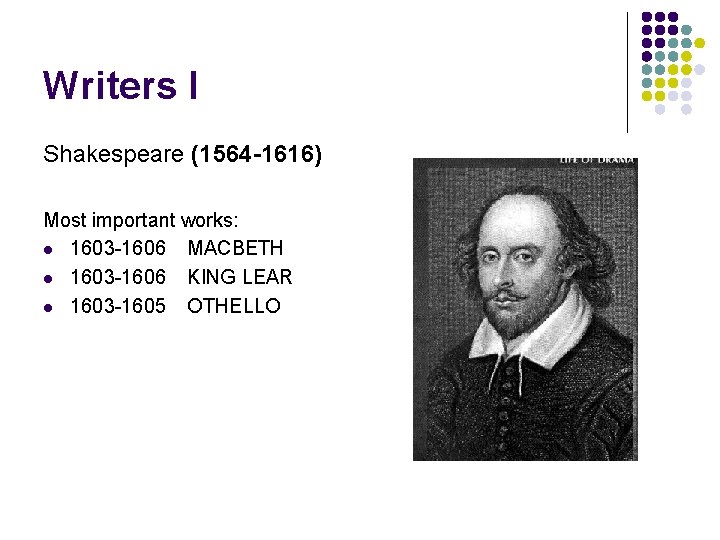
Writers I Shakespeare (1564 -1616) Most important works: l 1603 -1606 MACBETH l 1603 -1606 KING LEAR l 1603 -1605 OTHELLO
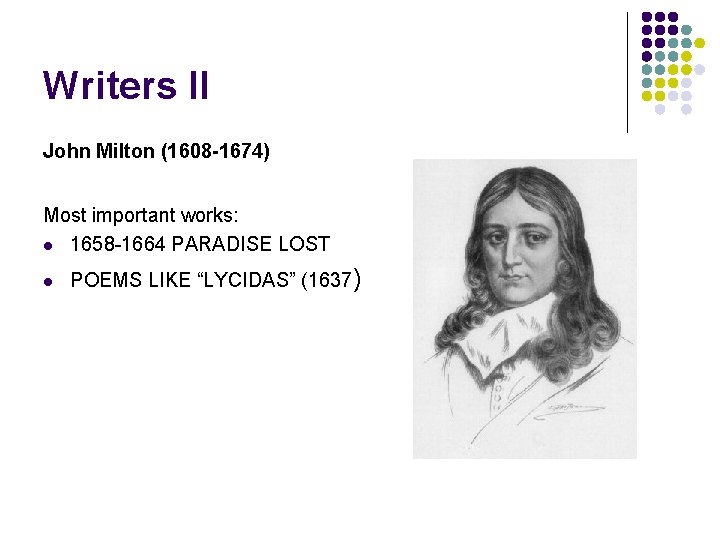
Writers II John Milton (1608 -1674) Most important works: l 1658 -1664 PARADISE LOST l POEMS LIKE “LYCIDAS” (1637)
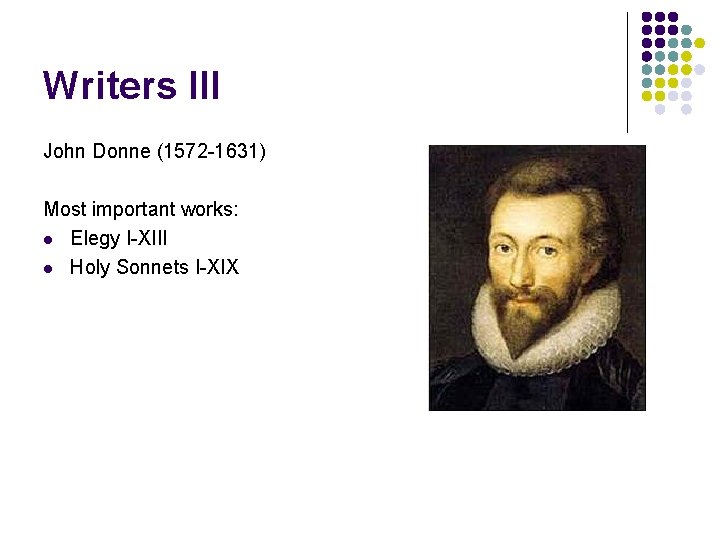
Writers III John Donne (1572 -1631) Most important works: l Elegy I-XIII l Holy Sonnets I-XIX
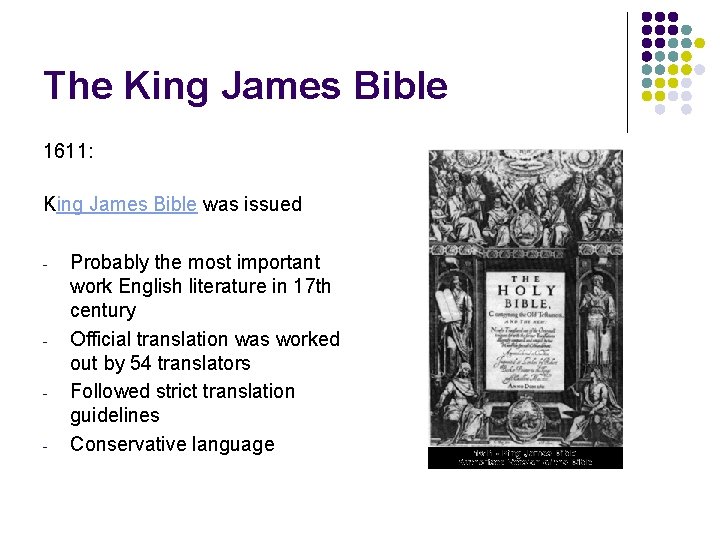
The King James Bible 1611: King James Bible was issued - - Probably the most important work English literature in 17 th century Official translation was worked out by 54 translators Followed strict translation guidelines Conservative language
Changes in Grammar l l l THOU: THEE vs. YE: YOU „DO“-constructions ITS vs. HIS

THOU: THEE vs. YE: YOU l l l Thou (intimate / biblical / quaker style) You (polite, the norm) The use of Thou and you remained variable according to mood, formality of context and topic
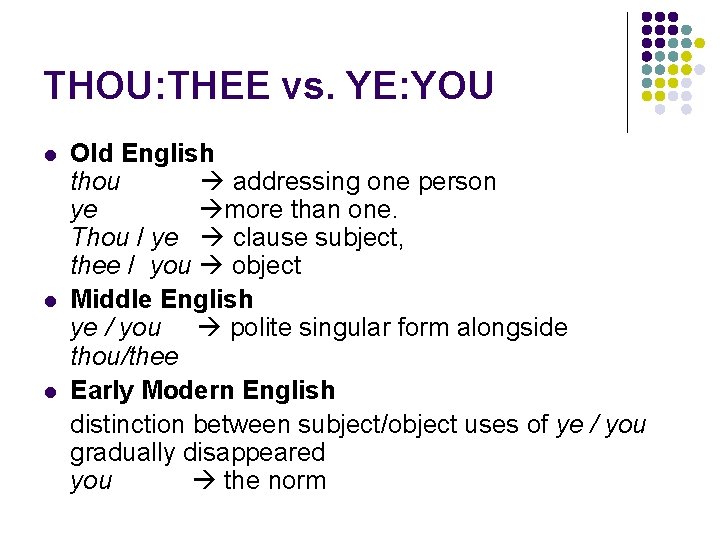
THOU: THEE vs. YE: YOU l l l Old English thou addressing one person ye more than one. Thou / ye clause subject, thee / you object Middle English ye / you polite singular form alongside thou/thee Early Modern English distinction between subject/object uses of ye / you gradually disappeared you the norm
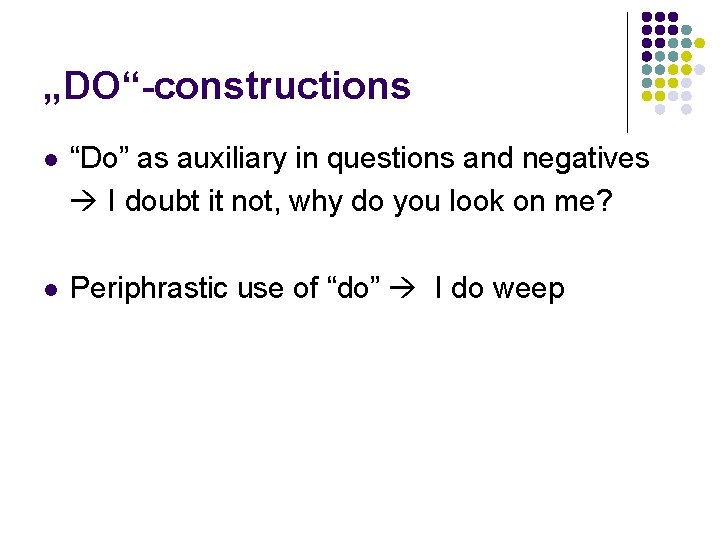
„DO“-constructions l “Do” as auxiliary in questions and negatives I doubt it not, why do you look on me? l Periphrastic use of “do” I do weep
ITS vs. HIS l The possessive pronoun of the third person singular neuter changed l It his It its l (<17 th century) (>17 th century, it’s 1800)
Developments in Vocabulary
General Facts l l l English vocabulary immensely expanded during Early Modern English period Numerous loan-words (especially from Latin, Greek and French) Reasons: l l l Renaissance had brought back interest for classical, pre. Christian culture Need for new words (e. g. in the fields of science and theology) Printing Want for “enriching” English language Fashion
General Facts l Absolute numbers of new lexemes need to be treated carefully l l l Printing invented more texts new words of Middle English Period e. g. might have been missed Existence of a word tells nothing about the frequency of its use Many of the words were short-lived
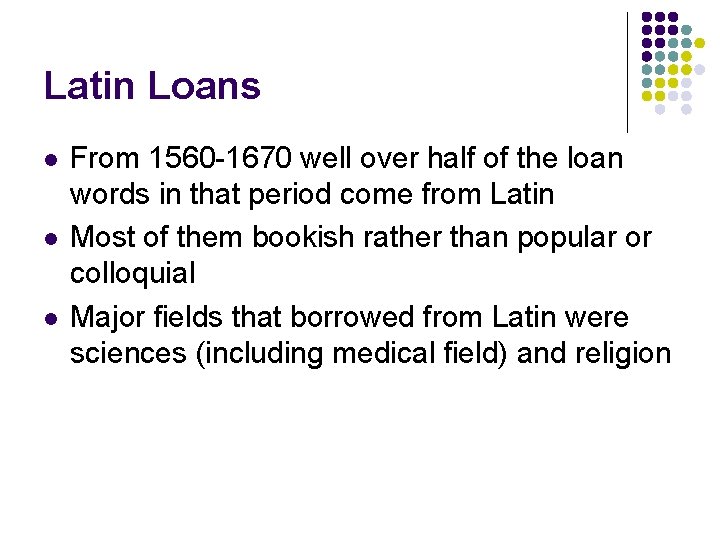
Latin Loans l l l From 1560 -1670 well over half of the loan words in that period come from Latin Most of them bookish rather than popular or colloquial Major fields that borrowed from Latin were sciences (including medical field) and religion
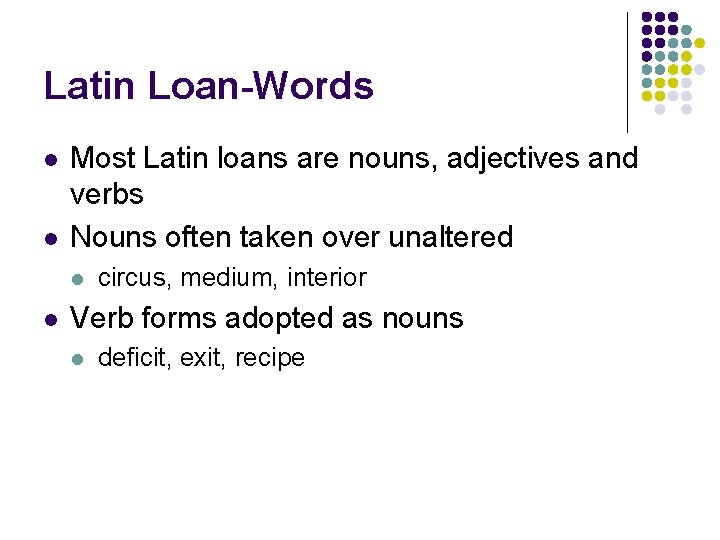
Latin Loan-Words l l Most Latin loans are nouns, adjectives and verbs Nouns often taken over unaltered l l circus, medium, interior Verb forms adopted as nouns l deficit, exit, recipe
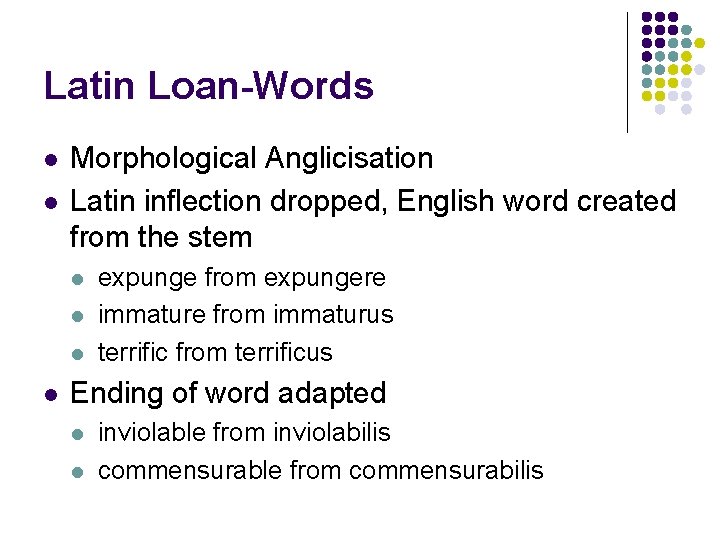
Latin Loan-Words l l Morphological Anglicisation Latin inflection dropped, English word created from the stem l l expunge from expungere immature from immaturus terrific from terrificus Ending of word adapted l l inviolable from inviolabilis commensurable from commensurabilis
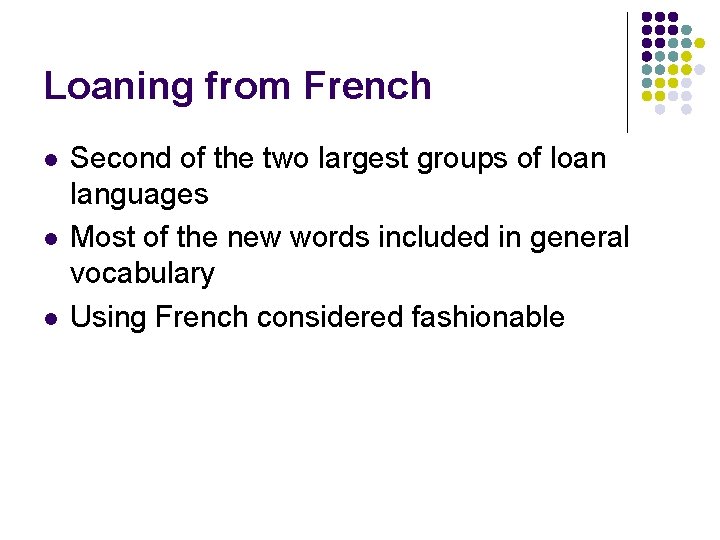
Loaning from French l l l Second of the two largest groups of loan languages Most of the new words included in general vocabulary Using French considered fashionable
French Loan-Words l French loan words do not depart much from their sources l l Many ‘social’ loans l l l entrance, brochure madam moustache class champagne ballet Affixation l l counter from contre fidelity from fidelité
Inkhorn Controversy l Rapidly changing vocabulary brought along some problems, e. g. l l l different spelling of words in one book (writers followed their own instincts) understanding English language more difficult due to high number of new words Edmund Waller: “Poets that Lasting Marble seek Must carve in Latin or in Greek; We write in Sand…”
Inkhorn Controversy l l Inkhorn Controversy: Dispute about “good English” and how it should be spoken and written Critics were strictly against the making use of loanwords l l called writers who did so “Inkhorn Writers” called loan-words “Inkhorn Terms” Led to a strong want for standardization of English language (language change = language decay) Dictionaries appeared for so-called “hard words”
Changes of Meaning
Lexical Sets l Lexical items form sets. A change in one member of the set may affect the meaning of all the other
Lexical Sets l l Lexical items form sets. A change in one member of the set may affect the meaning of all the other Example: military ranks l l brigadier lieutenant-general
Overlapping Fields of Reference l Sets of related lexical items may have fields of reference that overlap.
Overlapping Fields of Reference l l Sets of related lexical items may have fields of reference that overlap. Example: words concerned with human faculties l l wit intelligence ingenuity genius
Gain and Loss of Meanings l Some words narrowed or widened their field of reference by losing or gaining meanings.
Gain and Loss of Meanings l l Some words narrowed or widened their field of reference by losing or gaining meanings. Examples: l l l back brave commodity foul secure
Generalization and Specialization l A word’s field of reference expands or contracts, when it gains or loses meaning. The meaning can become more general or more specialized.
Generalization and Specialization l l A word’s field of reference expands or contracts, when it gains or loses meaning. The meaning can become more general or more specialized. Sometimes the more general and the more specific meaning exist side by side
Generalization and Specialization l l l A word’s field of reference expands or contracts, when it gains or loses meaning. The meaning can become more general or more specialized. Sometimes the more general and the more specific meaning exist side by side If a word has several meanings, one of them may undergo generalization or specialization, while others remain unchanged, or are lost, and new meanings are acquired.
Generalization and Specialization l Examples: l gambit l accident l disease l self-conceit l probe
Connotations of Approval and Disapproval l Some words carry connotations of approval or disapproval. In some cases, such connotations have been gained or lost.
Connotations of Approval and Disapproval l l Some words carry connotations of approval or disapproval. In some cases, such connotations have been gained or lost. Examples of words where the implication of disapproval has been gained: l l mediocrity obsequious
Connotations of Approval and Disapproval l l Some words carry connotations of approval or disapproval. In some cases, such connotations have been gained or lost. Examples of words where the implication of disapproval has been lost: l l enthusiasm shrewd
Transfer l l Sometimes there is a leap to a remote semantic area, rather than a simple expansion or contraction of boundaries. A leap of this kind is often called transfer. There are several ways in which transfer takes place.
Transfer: Metaphor l l One of the common ways in which transfer takes place is by the figurative use of the word, which, if it happens often enough, leads to a permanent new meaning. Example: § cell
Transfer: Formal Influence l l Transfer can also arise by the influence of one word on another, because of formal resemblance between them. Examples: § § obnoxious demean
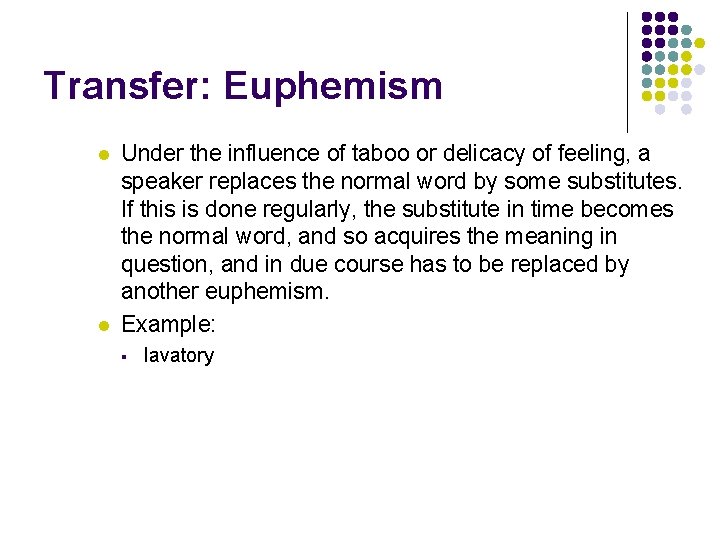
Transfer: Euphemism l l Under the influence of taboo or delicacy of feeling, a speaker replaces the normal word by some substitutes. If this is done regularly, the substitute in time becomes the normal word, and so acquires the meaning in question, and in due course has to be replaced by another euphemism. Example: § lavatory
Loss of Intensity l Loss of intensity arises from the common human habit of exaggerating for effect.
Generalization of Titles l Generalization has often taken place in polite terms of address and titles: words which at one time were restricted to small groups in the speechcommunity are now used much more widely.
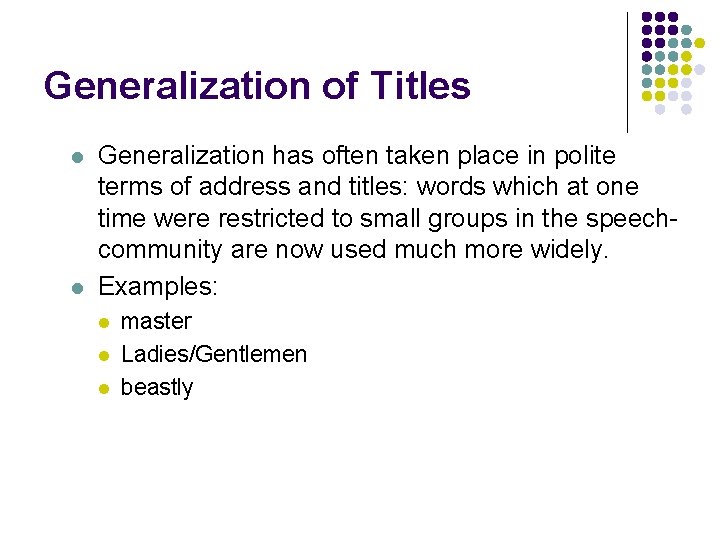
Generalization of Titles l l Generalization has often taken place in polite terms of address and titles: words which at one time were restricted to small groups in the speechcommunity are now used much more widely. Examples: l l l master Ladies/Gentlemen beastly
Differences in World View l A word may look familiar, but the assumptions behind it may be quite different. In the course of the 17 th century, under pressure of social and political change and of the new science, the old world view gave way to a different one.
Differences in World View l l A word may look familiar, but the assumptions behind it may be quite different. In the course of the 17 th century, under pressure of social and political change and of the new science, the old world view gave way to a different one. Example: Changes of meaning by the rise of science l anatomy
Differences in World View l l A word may look familiar, but the assumptions behind it may be quite different. In the course of the 17 th century, under pressure of social and political change and of the new science, the old world view gave way to a different one. Example: Changes of meaning by the loss of class connotation l gentleman l artificer l citizen
- Slides: 53