
Britain in 1948 After the end of World


Britain in 1948 After the end of World War II in 1945, politicians talked about Britain’s fight against the racist Nazi government. They said that Britain was a place where people of different ethnic backgrounds could live and work together. Many Commonwealth citizens had fought for Britain during the war and many had lost their lives. They had shown how important they were to the British Empire. In 1948, the British Nationality Act gave 800 million people in the Commonwealth the right to claim British Citizenship. Britain needed workers since many men had died in World War II. The NHS was launched in 1948 and needed labour and constantly advertised in Commonwealth countries to attract new workers.
Britain in 1948 Just after World War II ended in 1945, the first groups of Britain’s post war Caribbean immigrants settled in London. There were an estimated 492 that were passengers on the SS Empire Windrush. From the 1950 s into the 1960 s, there was a mass migration of workers from all over the English speaking Caribbean, particularly Jamaica, who settled in Britain. These immigrants were invited to fill labour requirements in London’s hospitals, transportation venues and railway development. They are widely viewed as having been a major contributing factor to the rebuilding of the post war London economy.
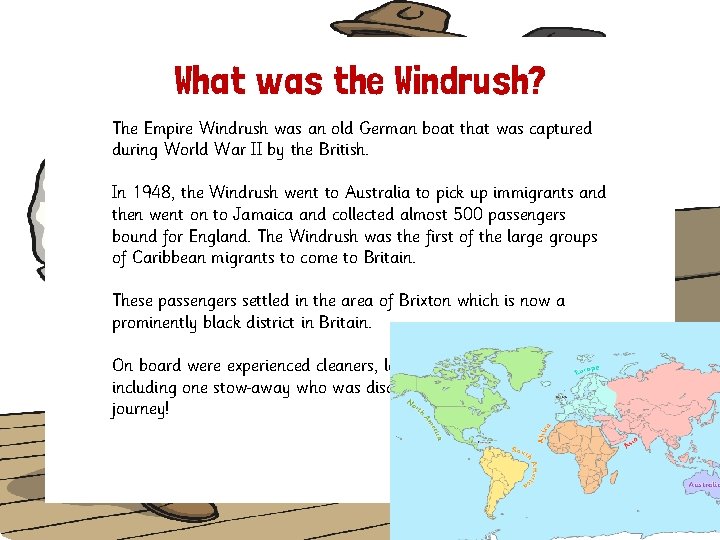
What was the Windrush? The Empire Windrush was an old German boat that was captured during World War II by the British. In 1948, the Windrush went to Australia to pick up immigrants and then went on to Jamaica and collected almost 500 passengers bound for England. The Windrush was the first of the large groups of Caribbean migrants to come to Britain. These passengers settled in the area of Brixton which is now a prominently black district in Britain. On board were experienced cleaners, labourers, nurses, etc. including one stow away who was discovered a week into the journey!

Was it only the Windrush ship that bought Caribbean migrants to Britain? The arrival of the Windrush was the start of a period of migration from the Caribbean to Britain that did not slow down until 1962. By 1955, 18, 000 Jamaicans had moved to Britain. This outward flow of people to settle in Britain was an important event in the history of the West Indies. Caribbean migrants have become a vital part of British society and, in the process, transformed important aspects of British life.
What Was it Like to be a Windrush Passenger? Passengers on the Windrush were told that they would all be welcome in Britain, the ‘mother country’. Was this their experience after arriving in Britain?


Life As a Caribbean Immigrant in 1950’s Britain Black and Asian immigrants faced varying degrees of hostility and racial prejudice in post war Britain. Surveys conducted in the mid 1960 s, revealed that four out of five British people felt that 'too many immigrants had been let into the country'. There was, and still is, a minority of racists, who believe in the idea of 'keeping Britain white' and banning all immigration. This view has rarely resulted in violence. It is largely confined to poor areas where local white and black communities compete for scarce jobs and housing.
Windrush Square, Brixton In 1998, the area in front of the Tate Library in Brixton was renamed "Windrush Square" to mark the 50 th anniversary of the arrival of the Windrush.
In the 21 st century, Britain is a multi racial society. The huge contributions made by the various immigrant communities to Britain's economic and social development since the Second World War are now widely recognised. Their role in creating a more diverse and tolerant society is indisputable.

- Slides: 13