
BristolMyers Squibb has obtained the appropriate permissions to
Bristol-Myers Squibb has obtained the appropriate permissions to externally share this material with Healthcare Professionals upon request.
Check. Mate 227 CT 077 2018 CHICAGO, IL Nivolumab + Ipilimumab vs Platinum-Doublet Chemotherapy as First-line Treatment for Advanced Non-Small Cell Lung Cancer: Initial Results From Check. Mate 227 Matthew D. Hellmann, 1 Tudor-Eliade Ciuleanu, 2 Adam Pluzanski, 3 Jong Seok Lee, 4 Gregory A. Otterson, 5 Clarisse Audigier-Valette, 6 Elisa Minenza, 7 Helena Linardou, 8 Sjaak Burgers, 9 Pamela Salman, 10 Hossein Borghaei, 11 Suresh S. Ramalingam, 12 Julie Brahmer, 13 Martin Reck, 14 Kenneth J. O’Byrne, 15 William J. Geese, 16 George Green, 16 Han Chang, 16 Joseph Szustakowski, 16 Prabhu Bhagavatheeswaran, 16 Diane Healey, 16 Yali Fu, 16 Faith Nathan, 16 Luis Paz-Ares 17 1 Memorial Sloan Kettering Cancer Center Hospital, New York, NY, USA; 2 Prof. Dr. Ion Chiricuta Institute of Oncology and Universitatea de Medicina si Farmacie Iuliu Hatieganu, Cluj-napoca, Romania; 3 Centrum Onkologii–Instytut im. Marii Sklodowskiej-Curie, Warsaw, Poland; 4 Seoul National University Bundang Hospital, Seoul, South Korea; 5 The Ohio State University, Columbus, OH, USA; 6 Hôpital Sainte Musse, Toulon, France; 7 Ospedale Santa Maria della Misericordia, Perugia, Italy; 8 First Department of Oncology, Metropolitan Hospital, Athens, Greece; 9 Antoni Van Leeuwenhoek Ziekenhuis, Amsterdam, the Netherlands; 10 Fundación Arturo López Pérez, Santiago, Chile; 11 Fox Chase Cancer Center, Philadelphia, PA, USA; 12 Winship Cancer Institute, Emory University, Atlanta, GA, USA; 13 Sidney Kimmel Comprehensive Cancer Center at Johns Hopkins, Baltimore, MD, USA; 14 Lungen. Clinic Grosshansdorf, Airway Research Center North, German Center for Lung Research, Grosshansdorf, Germany; 15 Princess Alexandra Hospital, Brisbane, QLD, Australia; 16 Bristol-Myers Squibb, Princeton, NJ, USA; 17 Hospital Universitario 12 de Octubre, Centro Nacional de Investigaciones Oncológicas, Universidad Complutense, & Ciber. Onc, Madrid, Spain ID 1506 IT 18 NP 01399 -01
Check. Mate 227: Nivo + Ipi in 1 L NSCLC With High TMB (≥ 10 mut/Mb) Disclosure Information Matthew D. Hellmann, MD I have the following financial relationships to disclose: Consultant for: Astra. Zeneca, Bristol-Myers Squibb, Genentech/Roche, Janssen, Merck, Mirati Therapeutics, Novartis, and Shattuck Labs Grant/Research support from: Bristol-Myers Squibb I will discuss the following off label use and/or investigational use in my presentation: First-line treatment of NSCLC with nivolumab + ipilimumab 3
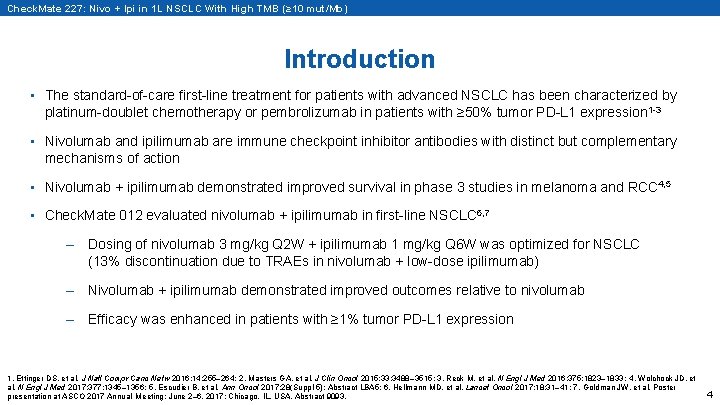
Check. Mate 227: Nivo + Ipi in 1 L NSCLC With High TMB (≥ 10 mut/Mb) Introduction • The standard-of-care first-line treatment for patients with advanced NSCLC has been characterized by platinum-doublet chemotherapy or pembrolizumab in patients with ≥ 50% tumor PD-L 1 expression 1 -3 • Nivolumab and ipilimumab are immune checkpoint inhibitor antibodies with distinct but complementary mechanisms of action • Nivolumab + ipilimumab demonstrated improved survival in phase 3 studies in melanoma and RCC 4, 5 • Check. Mate 012 evaluated nivolumab + ipilimumab in first-line NSCLC 6, 7 – Dosing of nivolumab 3 mg/kg Q 2 W + ipilimumab 1 mg/kg Q 6 W was optimized for NSCLC (13% discontinuation due to TRAEs in nivolumab + low-dose ipilimumab) – Nivolumab + ipilimumab demonstrated improved outcomes relative to nivolumab – Efficacy was enhanced in patients with ≥ 1% tumor PD-L 1 expression 1. Ettinger DS, et al. J Natl Compr Canc Netw 2016; 14: 255– 264; 2. Masters GA, et al. J Clin Oncol 2015; 33: 3488– 3515; 3. Reck M, et al. N Engl J Med 2016; 375: 1823– 1833; 4. Wolchock JD, et al. N Engl J Med 2017; 377: 1345– 1356; 5. Escudier B, et al. Ann Oncol 2017; 28(Suppl 5): Abstract LBA 5; 6. Hellmann MD, et al. Lancet Oncol 2017; 18: 31– 41; 7. Goldman JW, et al. Poster presentation at ASCO 2017 Annual Meeting; June 2– 6, 2017; Chicago, IL, USA. Abstract 9093. 4
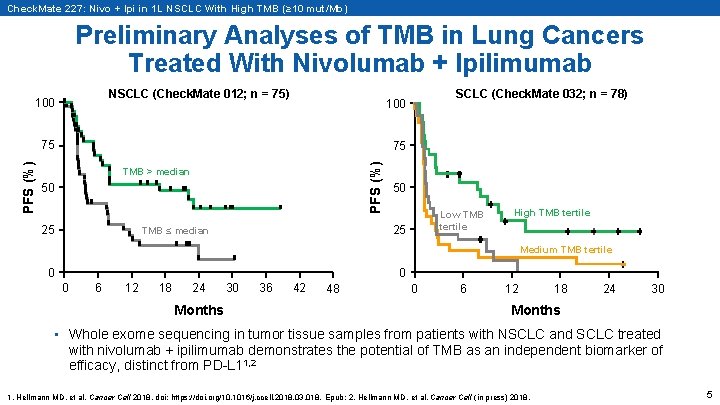
Check. Mate 227: Nivo + Ipi in 1 L NSCLC With High TMB (≥ 10 mut/Mb) Preliminary Analyses of TMB in Lung Cancers Treated With Nivolumab + Ipilimumab NSCLC (Check. Mate 012; n = 75) 100 75 75 PFS (%) SCLC (Check. Mate 032; n = 78) 100 TMB > median 50 25 50 Low TMB tertile 25 TMB ≤ median High TMB tertile Medium TMB tertile 0 0 0 6 12 18 24 Months 30 36 42 48 0 6 12 18 24 30 Months • Whole exome sequencing in tumor tissue samples from patients with NSCLC and SCLC treated with nivolumab + ipilimumab demonstrates the potential of TMB as an independent biomarker of efficacy, distinct from PD-L 11, 2 1. Hellmann MD, et al. Cancer Cell 2018. doi: https: //doi. org/10. 1016/j. ccell. 2018. 03. 018. Epub; 2. Hellmann MD, et al. Cancer Cell (in press) 2018. 5
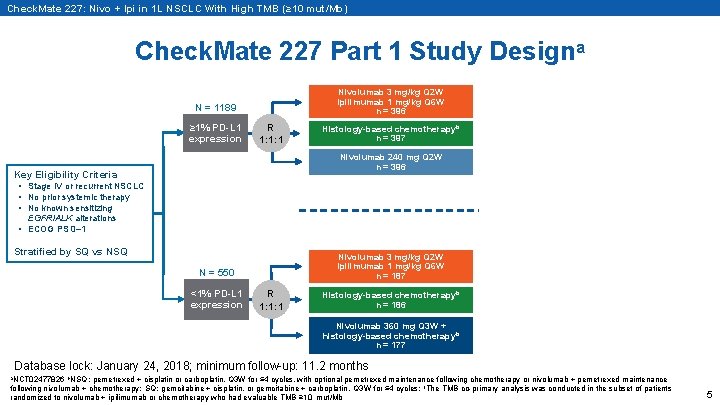
Check. Mate 227: Nivo + Ipi in 1 L NSCLC With High TMB (≥ 10 mut/Mb) Check. Mate 227 Part 1 Study Designa Nivolumab 3 mg/kg Q 2 W Ipilimumab 1 mg/kg Q 6 W n = 396 N = 1189 ≥ 1% PD-L 1 expression R 1: 1: 1 Histology-based chemotherapyb n = 397 Nivolumab 240 mg Q 2 W n = 396 Key Eligibility Criteria • Stage IV or recurrent NSCLC • No prior systemic therapy • No known sensitizing EGFR/ALK alterations • ECOG PS 0– 1 Stratified by SQ vs NSQ Nivolumab 3 mg/kg Q 2 W Ipilimumab 1 mg/kg Q 6 W n = 187 N = 550 <1% PD-L 1 expression R 1: 1: 1 Histology-based chemotherapyb n = 186 Nivolumab 360 mg Q 3 W + histology-based chemotherapyb n = 177 Database lock: January 24, 2018; minimum follow-up: 11. 2 months a. NCT 02477826 b. NSQ: pemetrexed + cisplatin or carboplatin, Q 3 W for ≤ 4 cycles, with optional pemetrexed maintenance following chemotherapy or nivolumab + pemetrexed maintenance following nivolumab + chemotherapy; SQ: gemcitabine + cisplatin, or gemcitabine + carboplatin , Q 3 W for ≤ 4 cycles; c. The TMB co-primary analysis was conducted in the subset of patients randomized to nivolumab + ipilimumab or chemotherapy who had evaluable TMB ≥ 10 mut/Mb 5
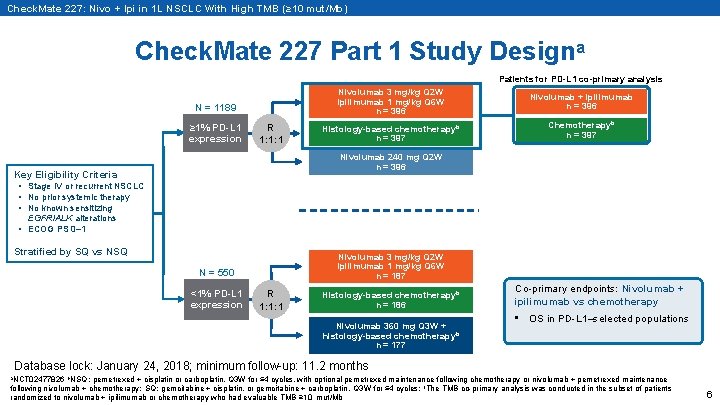
Check. Mate 227: Nivo + Ipi in 1 L NSCLC With High TMB (≥ 10 mut/Mb) Check. Mate 227 Part 1 Study Designa Patients for PD-L 1 co-primary analysis N = 1189 ≥ 1% PD-L 1 expression R 1: 1: 1 Nivolumab 3 mg/kg Q 2 W Ipilimumab 1 mg/kg Q 6 W n = 396 Nivolumab + ipilimumab n = 396 Histology-based chemotherapyb n = 397 Chemotherapyb n = 397 Nivolumab 240 mg Q 2 W n = 396 Key Eligibility Criteria • Stage IV or recurrent NSCLC • No prior systemic therapy • No known sensitizing EGFR/ALK alterations • ECOG PS 0– 1 Stratified by SQ vs NSQ Nivolumab 3 mg/kg Q 2 W Ipilimumab 1 mg/kg Q 6 W n = 187 N = 550 <1% PD-L 1 expression R 1: 1: 1 Histology-based chemotherapyb n = 186 Nivolumab 360 mg Q 3 W + histology-based chemotherapyb n = 177 Co-primary endpoints: Nivolumab + ipilimumab vs chemotherapy • OS in PD-L 1–selected populations Database lock: January 24, 2018; minimum follow-up: 11. 2 months a. NCT 02477826 b. NSQ: pemetrexed + cisplatin or carboplatin, Q 3 W for ≤ 4 cycles, with optional pemetrexed maintenance following chemotherapy or nivolumab + pemetrexed maintenance following nivolumab + chemotherapy; SQ: gemcitabine + cisplatin, or gemcitabine + carboplatin , Q 3 W for ≤ 4 cycles; c. The TMB co-primary analysis was conducted in the subset of patients randomized to nivolumab + ipilimumab or chemotherapy who had evaluable TMB ≥ 10 mut/Mb 6
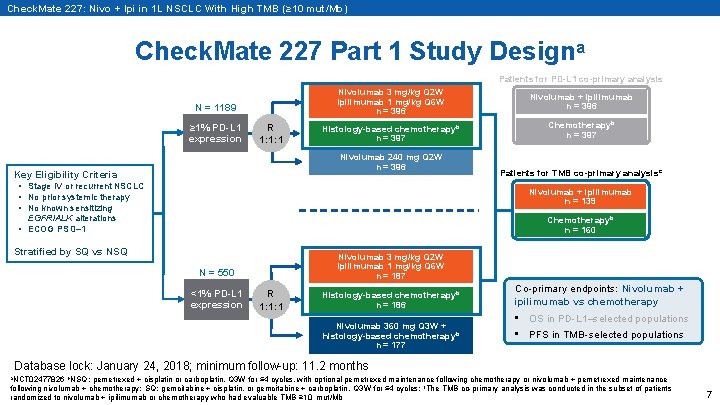
Check. Mate 227: Nivo + Ipi in 1 L NSCLC With High TMB (≥ 10 mut/Mb) Check. Mate 227 Part 1 Study Designa Patients for PD-L 1 co-primary analysis N = 1189 ≥ 1% PD-L 1 expression R 1: 1: 1 Nivolumab 3 mg/kg Q 2 W Ipilimumab 1 mg/kg Q 6 W n = 396 Nivolumab + ipilimumab n = 396 Histology-based chemotherapyb n = 397 Chemotherapyb n = 397 Nivolumab 240 mg Q 2 W n = 396 Key Eligibility Criteria • Stage IV or recurrent NSCLC • No prior systemic therapy • No known sensitizing Patients for TMB co-primary analysisc Nivolumab + ipilimumab n = 139 EGFR/ALK alterations Chemotherapyb n = 160 • ECOG PS 0– 1 Stratified by SQ vs NSQ Nivolumab 3 mg/kg Q 2 W Ipilimumab 1 mg/kg Q 6 W n = 187 N = 550 <1% PD-L 1 expression R 1: 1: 1 Histology-based chemotherapyb n = 186 Nivolumab 360 mg Q 3 W + histology-based chemotherapyb n = 177 Co-primary endpoints: Nivolumab + ipilimumab vs chemotherapy • OS in PD-L 1–selected populations • PFS in TMB-selected populations Database lock: January 24, 2018; minimum follow-up: 11. 2 months a. NCT 02477826 b. NSQ: pemetrexed + cisplatin or carboplatin, Q 3 W for ≤ 4 cycles, with optional pemetrexed maintenance following chemotherapy or nivolumab + pemetrexed maintenance following nivolumab + chemotherapy; SQ: gemcitabine + cisplatin, or gemcitabine + carboplatin , Q 3 W for ≤ 4 cycles; c. The TMB co-primary analysis was conducted in the subset of patients randomized to nivolumab + ipilimumab or chemotherapy who had evaluable TMB ≥ 10 mut/Mb 7
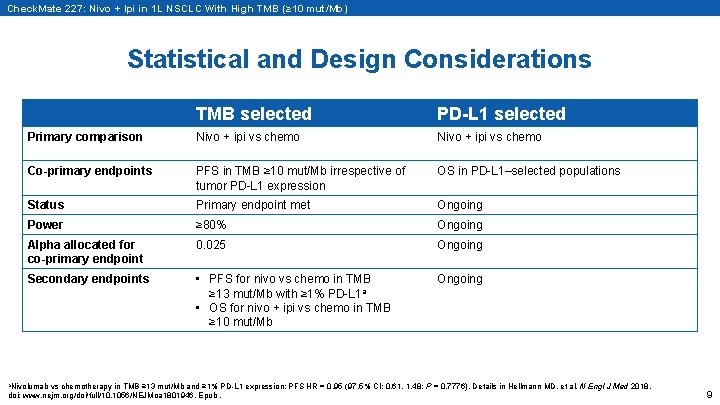
Check. Mate 227: Nivo + Ipi in 1 L NSCLC With High TMB (≥ 10 mut/Mb) Statistical and Design Considerations TMB selected PD-L 1 selected Primary comparison Nivo + ipi vs chemo Co-primary endpoints PFS in TMB ≥ 10 mut/Mb irrespective of tumor PD-L 1 expression OS in PD-L 1–selected populations Status Primary endpoint met Ongoing Power ≥ 80% Ongoing Alpha allocated for co-primary endpoint 0. 025 Ongoing Secondary endpoints • PFS for nivo vs chemo in TMB ≥ 13 mut/Mb with ≥ 1% PD-L 1 a • OS for nivo + ipi vs chemo in TMB ≥ 10 mut/Mb Ongoing a. Nivolumab vs chemotherapy in TMB ≥ 13 mut/Mb and ≥ 1% PD-L 1 expression: PFS HR = 0. 95 (97. 5% CI: 0. 61, 1. 48; P = 0. 7776). Details in Hellmann MD, et al. N doi: www. nejm. org/doi/full/10. 1056/NEJMoa 1801946. Epub. Engl J Med 2018. 9
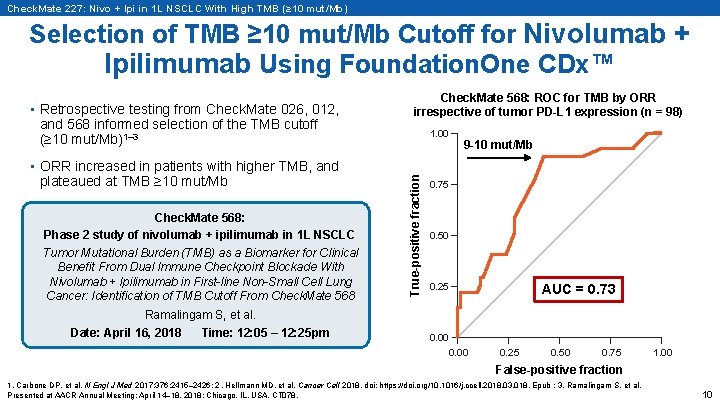
Check. Mate 227: Nivo + Ipi in 1 L NSCLC With High TMB (≥ 10 mut/Mb) Selection of TMB ≥ 10 mut/Mb Cutoff for Nivolumab + Ipilimumab Using Foundation. One CDx™ • ORR increased in patients with higher TMB, and plateaued at TMB ≥ 10 mut/Mb Check. Mate 568: Phase 2 study of nivolumab + ipilimumab in 1 L NSCLC Tumor Mutational Burden (TMB) as a Biomarker for Clinical Benefit From Dual Immune Checkpoint Blockade With Nivolumab + Ipilimumab in First-line Non-Small Cell Lung Cancer: Identification of TMB Cutoff From Check. Mate 568: ROC for TMB by ORR irrespective of tumor PD-L 1 expression (n = 98) 1. 00 True-positive fraction • Retrospective testing from Check. Mate 026, 012, and 568 informed selection of the TMB cutoff (≥ 10 mut/Mb)1– 3 9 -10 mut/Mb 0. 75 0. 50 0. 25 AUC = 0. 73 Ramalingam S, et al. Date: April 16, 2018 Time: 12: 05 – 12: 25 pm 0. 00 0. 25 0. 50 0. 75 1. 00 False-positive fraction 1. Carbone DP, et al. N Engl J Med 2017: 376; 2415– 2426; 2. Hellmann MD, et al. Cancer Cell 2018. doi: https: //doi. org/10. 1016/j. ccell. 2018. 03. 018. Epub ; 3. Ramalingam S, et al. Presented at AACR Annual Meeting; April 14– 18, 2018; Chicago, IL, USA. CT 078. 10
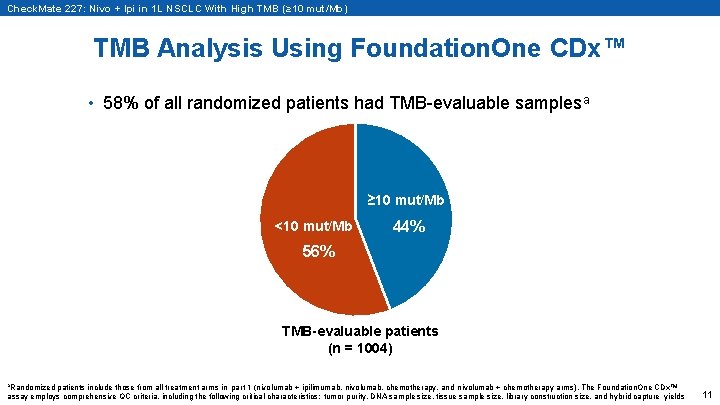
Check. Mate 227: Nivo + Ipi in 1 L NSCLC With High TMB (≥ 10 mut/Mb) TMB Analysis Using Foundation. One CDx™ • 58% of all randomized patients had TMB-evaluable samplesa ≥ 10 mut/Mb <10 mut/Mb 44% 56% TMB-evaluable patients (n = 1004) a. Randomized patients include those from all treatment arms in part 1 (nivolumab + ipilimumab, nivolumab, chemotherapy, and nivolumab + chemotherapy arms). The Foundation. One CDx™ assay employs comprehensive QC criteria, including the following critical characteristics: tumor purity, DNA sample size, tissue sample size, library construction size, and hybrid capture yields 11
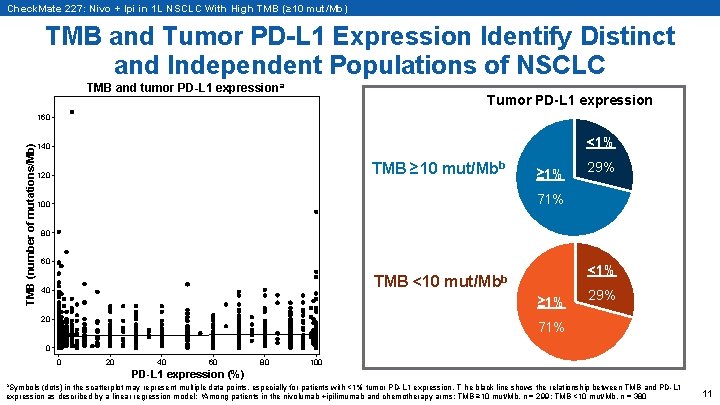
Check. Mate 227: Nivo + Ipi in 1 L NSCLC With High TMB (≥ 10 mut/Mb) TMB and Tumor PD-L 1 Expression Identify Distinct and Independent Populations of NSCLC TMB and tumor PD-L 1 expressiona Tumor PD-L 1 expression TMB (number of mutations/Mb) 160 140 TMB ≥ 10 mut/Mbb 120 ≥ 1% <1% 29% 71% 100 80 60 TMB <10 mut/Mbb 40 20 <1% 29% ≥ 1% 71% 0 0 20 40 60 80 100 PD-L 1 expression (%) a. Symbols (dots) in the scatterplot may represent multiple data points, especially for patients with <1% tumor PD-L 1 expression. T he black line shows the relationship between TMB and PD-L 1 expression as described by a linear regression model; b. Among patients in the nivolumab +ipilimumab and chemotherapy arms; TMB ≥ 10 mut/Mb, n = 299; TMB <10 mut/Mb, n = 380 11
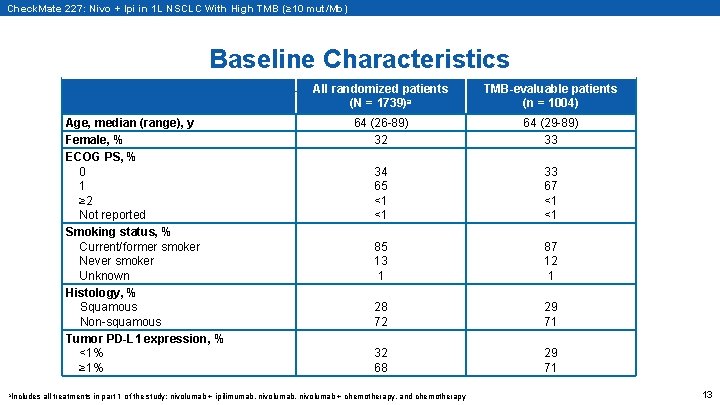
Check. Mate 227: Nivo + Ipi in 1 L NSCLC With High TMB (≥ 10 mut/Mb) Baseline Characteristics Age, median (range), y Female, % ECOG PS, % 0 1 ≥ 2 Not reported Smoking status, % Current/former smoker Never smoker Unknown Histology, % Squamous Non-squamous Tumor PD-L 1 expression, % <1% ≥ 1% All randomized patients (N = 1739)a TMB-evaluable patients (n = 1004) 64 (26 -89) 32 64 (29 -89) 33 34 65 <1 <1 33 67 <1 <1 85 13 1 87 12 1 28 72 29 71 32 68 29 71 a. Includes all treatments in part 1 of the study: nivolumab + ipilimumab, nivolumab + chemotherapy, and chemotherapy 13
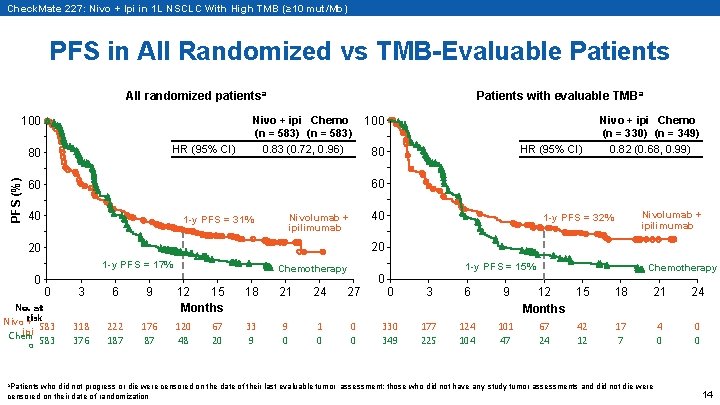
Check. Mate 227: Nivo + Ipi in 1 L NSCLC With High TMB (≥ 10 mut/Mb) PFS in All Randomized vs TMB-Evaluable Patients with evaluable TMBa All randomized patientsa 100 HR (95% CI) PFS (%) 80 Nivo + ipi Chemo (n = 583) 0. 83 (0. 72, 0. 96) HR (95% CI) 80 Nivo + ipi Chemo (n = 330) (n = 349) 0. 82 (0. 68, 0. 99) 60 60 40 40 Nivolumab + ipilimumab 1 -y PFS = 31% Nivolumab + ipilimumab 1 -y PFS = 32% 20 20 1 -y PFS = 17% 0 100 0 No. at Nivo risk + 583 ipi Chem 583 o 3 6 9 318 376 222 187 176 87 12 15 Months 18 21 24 27 120 48 33 9 9 0 1 0 0 0 67 20 a. Patients who did not progress or die were censored on the date of their last evaluable tumor censored on their date of randomization 1 -y PFS = 15% Chemotherapy 0 0 3 6 9 330 349 177 225 124 101 47 Chemotherapy 12 15 Months 67 24 42 12 18 21 24 17 7 4 0 0 0 assessment; those who did not have any study tumor assessments and did not die were 14
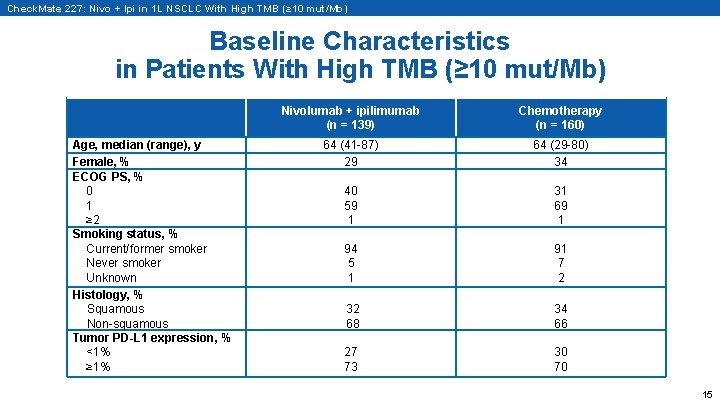
Check. Mate 227: Nivo + Ipi in 1 L NSCLC With High TMB (≥ 10 mut/Mb) Baseline Characteristics in Patients With High TMB (≥ 10 mut/Mb) Age, median (range), y Female, % ECOG PS, % 0 1 ≥ 2 Smoking status, % Current/former smoker Never smoker Unknown Histology, % Squamous Non-squamous Tumor PD-L 1 expression, % <1% ≥ 1% Nivolumab + ipilimumab (n = 139) Chemotherapy (n = 160) 64 (41 -87) 29 64 (29 -80) 34 40 59 1 31 69 1 94 5 1 91 7 2 32 68 34 66 27 73 30 70 15
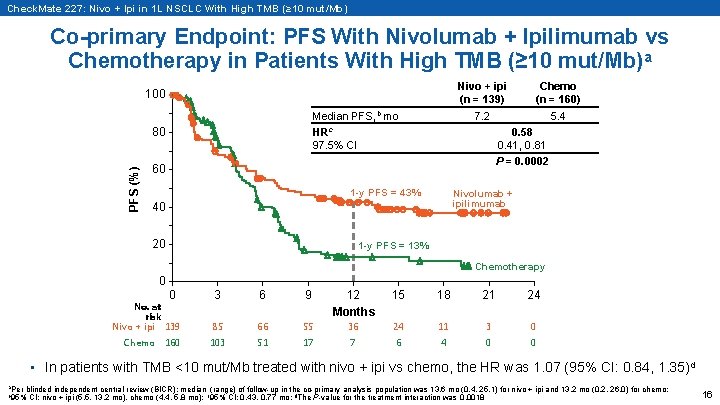
Check. Mate 227: Nivo + Ipi in 1 L NSCLC With High TMB (≥ 10 mut/Mb) Co-primary Endpoint: PFS With Nivolumab + Ipilimumab vs Chemotherapy in Patients With High TMB (≥ 10 mut/Mb)a Nivo + ipi (n = 139) 7. 2 Chemo (n = 160) 5. 4 0. 58 0. 41, 0. 81 P = 0. 0002 100 Median PFS, b mo HRc 97. 5% CI PFS (%) 80 60 1 -y PFS = 43% Nivolumab + ipilimumab 40 20 1 -y PFS = 13% Chemotherapy 0 0 No. at risk Nivo + ipi 139 Chemo 160 3 6 9 12 Months 15 18 21 24 85 66 55 36 24 11 3 0 103 51 17 7 6 4 0 0 • In patients with TMB <10 mut/Mb treated with nivo + ipi vs chemo, the HR was 1. 07 (95% CI: 0. 84, 1. 35)d a. Per blinded independent central review (BICR); median (range) of follow-up in the co-primary analysis population was 13. 6 mo (0. 4, 25. 1) for nivo + ipi and 13. 2 mo (0. 2, 26. 0) for chemo; b 95% CI: nivo + ipi (5. 5, 13. 2 mo), chemo (4. 4, 5. 8 mo); c 95% CI: 0. 43, 0. 77 mo; d. The P-value for the treatment interaction was 0. 0018 16
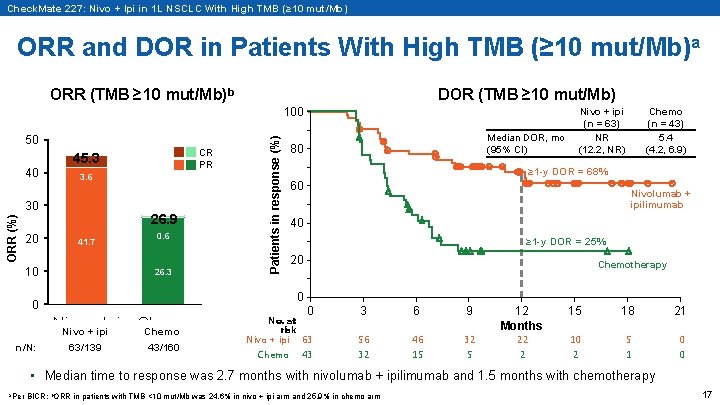
Check. Mate 227: Nivo + Ipi in 1 L NSCLC With High TMB (≥ 10 mut/Mb) ORR and DOR in Patients With High TMB (≥ 10 mut/Mb)a ORR (TMB ≥ 10 mut/Mb)b DOR (TMB ≥ 10 mut/Mb) 50 40 45. 3 3. 6 ORR (%) 30 20 CR PR 26. 9 41. 7 10 0. 6 26. 3 Patients in response (%) 100 Median DOR, mo (95% CI) 80 Chemo (n = 43) 5. 4 (4. 2, 6. 9) ≥ 1 -y DOR = 68% 60 Nivolumab + ipilimumab 40 ≥ 1 -y DOR = 25% 20 Chemotherapy 0 0 n/N: Nivo + ipi (n = 63) NR (12. 2, NR) Nivo + Ipi Nivo + ipi Chemo 63/139 43/160 0 No. at risk Nivo + ipi 63 Chemo 43 3 6 9 12 Months 15 18 21 56 46 32 22 10 5 0 32 15 5 2 2 1 0 • Median time to response was 2. 7 months with nivolumab + ipilimumab and 1. 5 months with chemotherapy a Per BICR; b. ORR in patients with TMB <10 mut/Mb was 24. 6% in nivo + ipi arm and 25. 9% in chemo arm 17
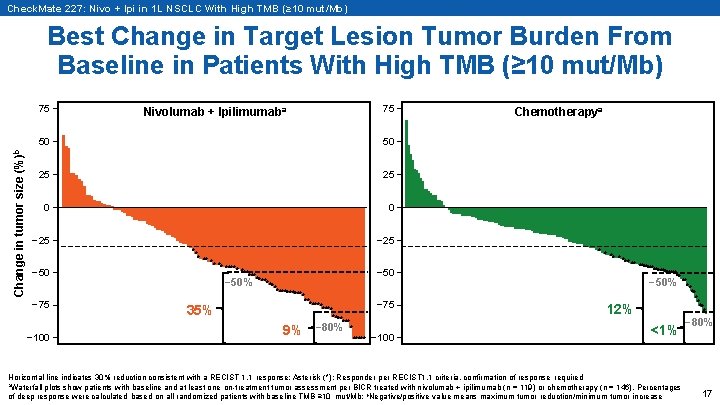
Check. Mate 227: Nivo + Ipi in 1 L NSCLC With High TMB (≥ 10 mut/Mb) Best Change in Target Lesion Tumor Burden From Baseline in Patients With High TMB (≥ 10 mut/Mb) Change in tumor size (%)b 75 Nivolumab + Ipilimumab a 75 50 50 25 25 0 0 − 25 − 50 − 75 − 100 ** * * ** ***** 35% − 25 *** − 50% ******* − 75 ***** *** 9% − 80% * − 100 ***** Chemotherapya ** ***** ******* − 50%**** ** ** 12% * <1% Horizontal line indicates 30% reduction consistent with a RECIST 1. 1 response; Asterisk (*): Responder per RECIST 1. 1 criteria, confirmation of response required a. Waterfall plots show patients with baseline and at least one on-treatment tumor assessment per BICR treated with nivolumab + ipilimumab (n = 119) or chemotherapy (n = 146). Percentages of deep response were calculated based on all randomized patients with baseline TMB ≥ 10 mut/Mb; b. Negative/positive value means maximum tumor reduction/minimum tumor increase − 80% 17
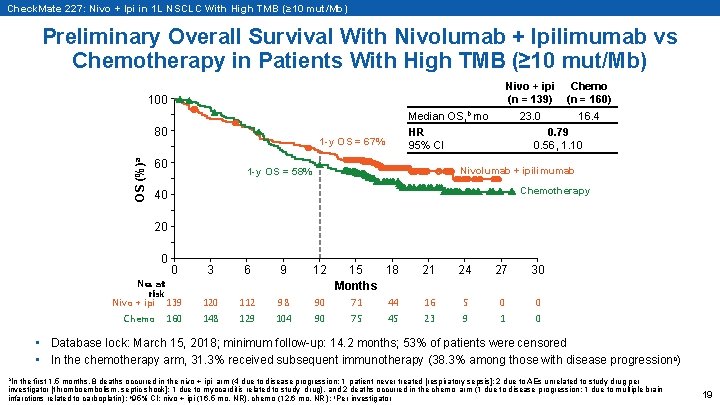
Check. Mate 227: Nivo + Ipi in 1 L NSCLC With High TMB (≥ 10 mut/Mb) Preliminary Overall Survival With Nivolumab + Ipilimumab vs Chemotherapy in Patients With High TMB (≥ 10 mut/Mb) Nivo + ipi Chemo (n = 139) (n = 160) 23. 0 16. 4 0. 79 0. 56, 1. 10 100 OS (%)a 80 Median OS, b mo HR 95% CI 1 -y OS = 67% 60 Nivolumab + ipilimumab 1 -y OS = 58% Chemotherapy 40 20 0 0 No. at risk Nivo + ipi 139 Chemo 160 3 6 9 12 15 18 Months 120 112 98 90 71 148 129 104 90 75 21 24 27 30 44 16 5 0 0 45 23 9 1 0 • Database lock: March 15, 2018; minimum follow-up: 14. 2 months; 53% of patients were censored • In the chemotherapy arm, 31. 3% received subsequent immunotherapy (38. 3% among those with disease progressionc) a. In the first 1. 5 months, 8 deaths occurred in the nivo + ipi arm (4 due to disease progression; 1 patient never treated [respiratory sepsis]; 2 due to AEs unrelated to study drug per investigator [thromboembolism, septic shock]; 1 due to myocarditis related to study drug), and 2 deaths occurred in the chemo arm (1 due to disease progression; 1 due to multiple brain infarctions related to carboplatin ); b 95% CI: nivo + ipi (16. 5 mo, NR), chemo (12. 6 mo, NR ); c. Per investigator 19
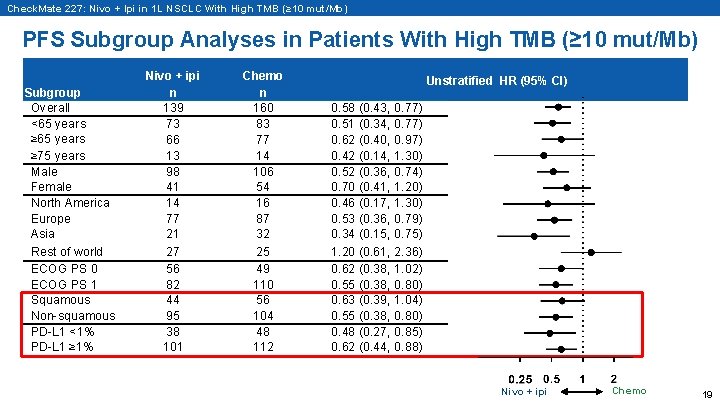
Check. Mate 227: Nivo + Ipi in 1 L NSCLC With High TMB (≥ 10 mut/Mb) PFS Subgroup Analyses in Patients With High TMB (≥ 10 mut/Mb) Subgroup Overall <65 years ≥ 75 years Male Female North America Europe Asia Rest of world ECOG PS 0 ECOG PS 1 Squamous Non-squamous PD-L 1 <1% PD-L 1 ≥ 1% Nivo + ipi n 139 73 66 13 98 41 14 77 21 27 56 82 44 95 38 101 Chemo n 160 83 77 14 106 54 16 87 32 25 49 110 56 104 48 112 Unstratified HR (95% CI) 0. 58 (0. 43, 0. 77) 0. 51 (0. 34, 0. 77) 0. 62 (0. 40, 0. 97) 0. 42 (0. 14, 1. 30) 0. 52 (0. 36, 0. 74) 0. 70 (0. 41, 1. 20) 0. 46 (0. 17, 1. 30) 0. 53 (0. 36, 0. 79) 0. 34 (0. 15, 0. 75) 1. 20 (0. 61, 2. 36) 0. 62 (0. 38, 1. 02) 0. 55 (0. 38, 0. 80) 0. 63 (0. 39, 1. 04) 0. 55 (0. 38, 0. 80) 0. 48 (0. 27, 0. 85) 0. 62 (0. 44, 0. 88) Nivo + ipi Chemo 19
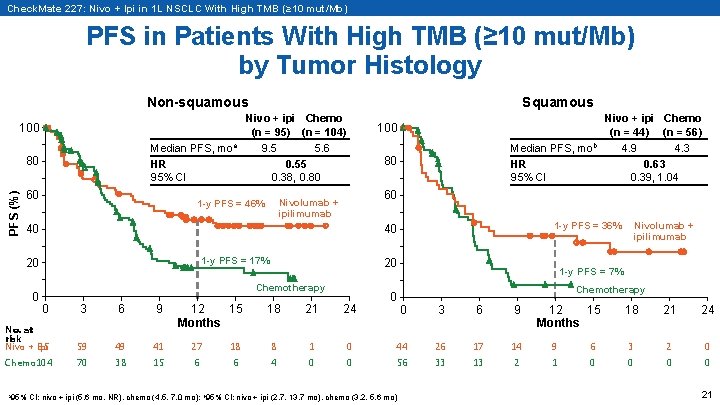
Check. Mate 227: Nivo + Ipi in 1 L NSCLC With High TMB (≥ 10 mut/Mb) PFS in Patients With High TMB (≥ 10 mut/Mb) by Tumor Histology Non-squamous 100 Median PFS, moa HR 95% CI PFS (%) 80 60 Squamous Nivo + ipi Chemo (n = 95) (n = 104) 9. 5 5. 6 0. 55 0. 38, 0. 80 100 80 60 Nivolumab + ipilimumab 1 -y PFS = 46% 40 1 -y PFS = 17% 20 Chemotherapy 0 3 6 9 12 15 Months No. at risk Nivo + ipi 95 59 49 41 27 Chemo 104 70 38 15 6 18 21 24 18 8 1 6 4 0 Nivolumab + ipilimumab 1 -y PFS = 36% 40 20 0 Median PFS, mob HR 95% CI Nivo + ipi Chemo (n = 44) (n = 56) 4. 9 4. 3 0. 63 0. 39, 1. 04 1 -y PFS = 7% Chemotherapy 0 0 3 6 9 0 44 26 17 14 9 0 56 33 13 2 1 a 95% CI: nivo + ipi (5. 6 mo, NR), chemo (4. 5, 7. 0 mo); b 95% CI: nivo + ipi (2. 7, 13. 7 mo), chemo (3. 2, 5. 6 mo) 12 15 Months 18 21 24 6 3 2 0 0 0 21
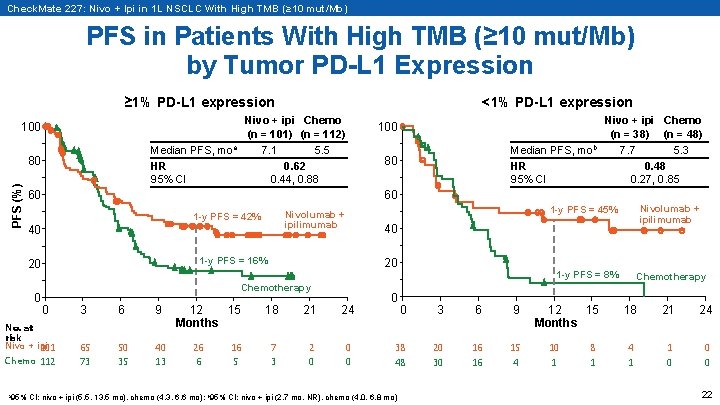
Check. Mate 227: Nivo + Ipi in 1 L NSCLC With High TMB (≥ 10 mut/Mb) PFS in Patients With High TMB (≥ 10 mut/Mb) by Tumor PD-L 1 Expression ≥ 1% PD-L 1 expression Nivo + ipi Chemo (n = 101) (n = 112) 7. 1 5. 5 0. 62 0. 44, 0. 88 100 Median PFS, moa HR 95% CI PFS (%) 80 <1% PD-L 1 expression 100 80 60 60 40 40 1 -y PFS = 16% 20 20 Chemotherapy 0 3 6 9 12 15 Months No. at risk Nivo + ipi 101 65 50 40 26 Chemo 112 73 35 13 6 Nivolumab + ipilimumab 1 -y PFS = 45% Nivolumab + ipilimumab 1 -y PFS = 42% 0 Median PFS, mob HR 95% CI Nivo + ipi Chemo (n = 38) (n = 48) 7. 7 5. 3 0. 48 0. 27, 0. 85 0 1 -y PFS = 8% 0 3 6 9 0 38 20 16 15 10 0 48 30 16 4 1 18 21 24 16 7 2 5 3 0 a 95% CI: nivo + ipi (5. 5, 13. 5 mo), chemo (4. 3, 6. 6 mo); b 95% CI: nivo + ipi (2. 7 mo, NR), chemo (4. 0, 6. 8 mo) 12 15 Months Chemotherapy 18 21 24 8 4 1 0 1 1 0 0 22
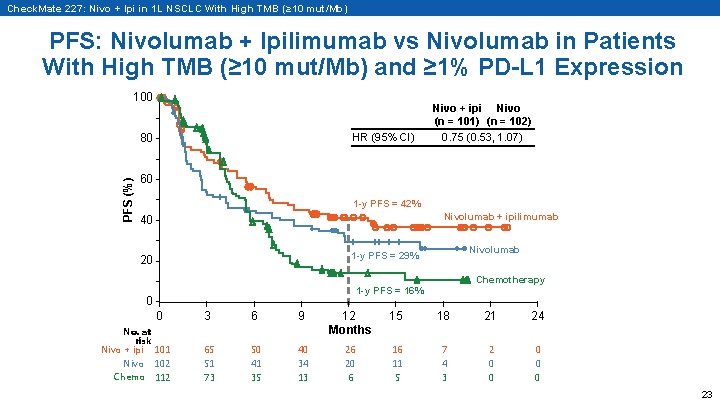
Check. Mate 227: Nivo + Ipi in 1 L NSCLC With High TMB (≥ 10 mut/Mb) PFS: Nivolumab + Ipilimumab vs Nivolumab in Patients With High TMB (≥ 10 mut/Mb) and ≥ 1% PD-L 1 Expression 100 PFS (%) 80 HR (95% CI) Nivo + ipi Nivo (n = 101) (n = 102) 0. 75 (0. 53, 1. 07) 60 1 -y PFS = 42% Nivolumab + ipilimumab 40 Nivolumab 1 -y PFS = 29% 20 Chemotherapy 1 -y PFS = 16% 0 3 6 9 12 Months 15 18 21 24 No. at risk Nivo + ipi 101 65 50 40 26 16 7 2 0 102 51 41 34 20 11 4 0 0 112 73 35 13 6 5 3 0 0 0 Nivo Chemo 23
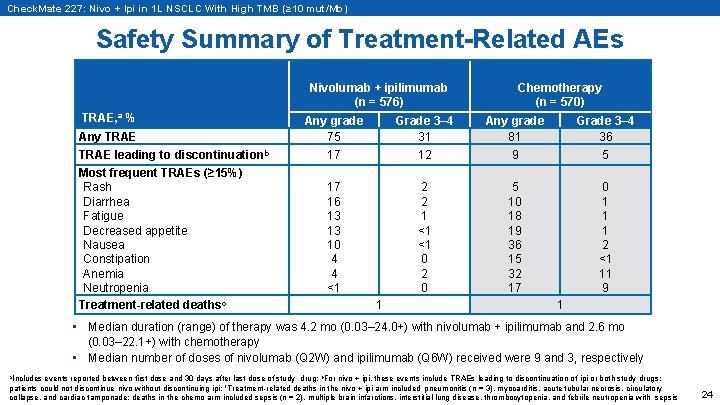
Check. Mate 227: Nivo + Ipi in 1 L NSCLC With High TMB (≥ 10 mut/Mb) Safety Summary of Treatment-Related AEs Nivolumab + ipilimumab (n = 576) TRAE, a % Any TRAE leading to discontinuation b Most frequent TRAEs (≥ 15%) Rash Diarrhea Fatigue Decreased appetite Nausea Constipation Anemia Neutropenia Treatment-related deathsc Chemotherapy (n = 570) Any grade 75 Grade 3– 4 31 Any grade 81 Grade 3– 4 36 17 12 9 5 17 16 13 13 10 4 4 <1 2 2 1 <1 <1 0 2 0 5 10 18 19 36 15 32 17 0 1 1 1 2 <1 11 9 1 1 • Median duration (range) of therapy was 4. 2 mo (0. 03– 24. 0+) with nivolumab + ipilimumab and 2. 6 mo (0. 03– 22. 1+) with chemotherapy • Median number of doses of nivolumab (Q 2 W) and ipilimumab (Q 6 W) received were 9 and 3, respectively a. Includes events reported between first dose and 30 days after last dose of study drug; b. For nivo + ipi, these events include TRAEs leading to discontinuation of ipi or both study drugs; patients could not discontinue nivo without discontinuing ipi; c. Treatment-related deaths in the nivo + ipi arm included pneumonitis (n = 3), myocarditis, acute tubular necrosis, circulatory collapse, and cardiac tamponade; deaths in the chemo arm included sepsis (n = 2), multiple brain infarctions, interstitial lung disease, thrombocytopenia, and febrile neutropenia with sepsis 24
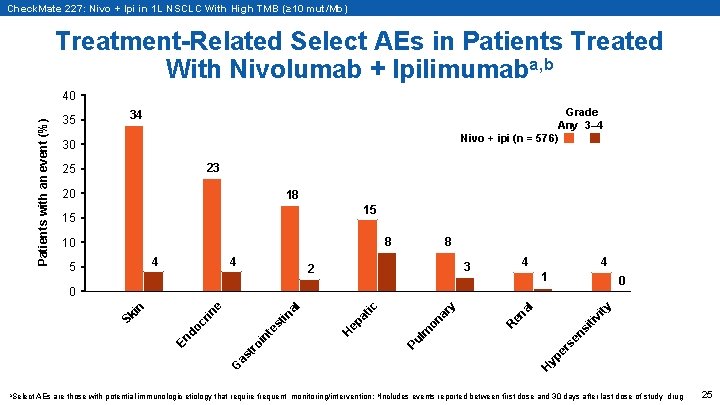
Check. Mate 227: Nivo + Ipi in 1 L NSCLC With High TMB (≥ 10 mut/Mb) Treatment-Related Select AEs in Patients Treated With Nivolumab + Ipilimumaba, b Patients with an event (%) 40 35 Grade Any 3– 4 Nivo + ipi (n = 576) 34 30 23 25 20 18 15 15 8 10 4 4 5 8 4 4 3 2 1 0 ity H yp er se ns i R tiv en al y lm on ar ic Pu tr as G a. Select AEs are those with potential immunologic etiology that require frequent H ep at al in st oi nt e do c En Sk in rin e 0 monitoring/intervention; b. Includes events reported between first dose and 30 days after last dose of study drug 25
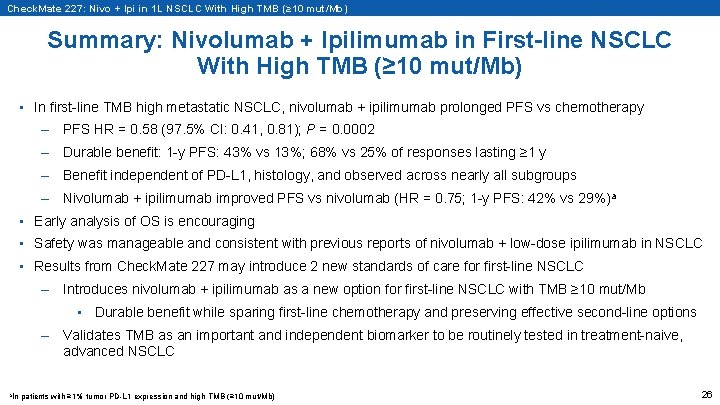
Check. Mate 227: Nivo + Ipi in 1 L NSCLC With High TMB (≥ 10 mut/Mb) Summary: Nivolumab + Ipilimumab in First-line NSCLC With High TMB (≥ 10 mut/Mb) • In first-line TMB high metastatic NSCLC, nivolumab + ipilimumab prolonged PFS vs chemotherapy – PFS HR = 0. 58 (97. 5% CI: 0. 41, 0. 81); P = 0. 0002 – Durable benefit: 1 -y PFS: 43% vs 13%; 68% vs 25% of responses lasting ≥ 1 y – Benefit independent of PD-L 1, histology, and observed across nearly all subgroups – Nivolumab + ipilimumab improved PFS vs nivolumab (HR = 0. 75; 1 -y PFS: 42% vs 29%)a • Early analysis of OS is encouraging • Safety was manageable and consistent with previous reports of nivolumab + low-dose ipilimumab in NSCLC • Results from Check. Mate 227 may introduce 2 new standards of care for first-line NSCLC – Introduces nivolumab + ipilimumab as a new option for first-line NSCLC with TMB ≥ 10 mut/Mb • Durable benefit while sparing first-line chemotherapy and preserving effective second-line options – Validates TMB as an important and independent biomarker to be routinely tested in treatment-naive, advanced NSCLC a. In patients with ≥ 1% tumor PD-L 1 expression and high TMB (≥ 10 mut/Mb) 26
26
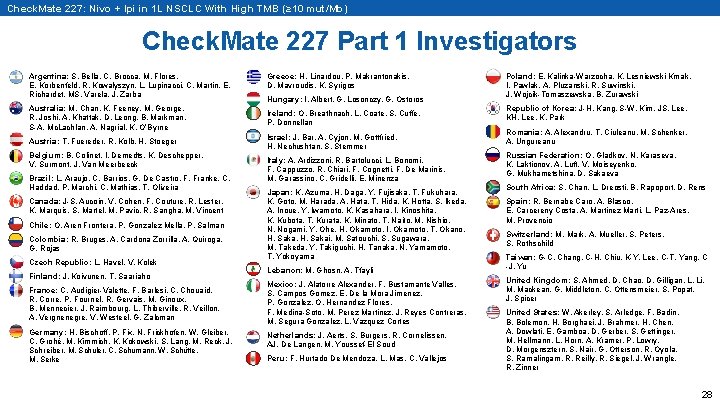
Check. Mate 227: Nivo + Ipi in 1 L NSCLC With High TMB (≥ 10 mut/Mb) Check. Mate 227 Part 1 Investigators Argentina: S. Bella, C. Brocca, M. Flores, E. Korbenfeld, R. Kowalyszyn, L. Lupinacci, C. Martin, E. Richardet, MS. Varela, J. Zarba Greece: H. Linardou, P. Makrantonakis, D. Mavroudis, K. Syrigos Hungary: I. Albert, G. Losonczy, G. Ostoros Australia: M. Chan, K. Feeney, M. George, R. Joshi, A. Khattak, D. Leong, B. Markman, S-A. Mc. Lachlan, A. Nagrial, K. O’Byrne Ireland: O. Breathnach, L. Coate, S. Cuffe, P. Donnellan Austria: T. Fuereder, R. Kolb, H. Stoeger Israel: J. Bar, A. Cyjon, M. Gottfried, H. Nechushtan, S. Stemmer Belgium: B. Colinet, I. Demedts, K. Deschepper, V. Surmont, J. Van Meerbeeck Brazil: L. Araujo, C. Barrios, G. De Castro, F. Franke, C. Haddad, P. Marchi, C. Mathias, T. Oliveira Canada: J-S. Aucoin, V. Cohen, F. Couture, R. Lester, K. Marquis, S. Martel, M. Pavic, R. Sangha, M. Vincent Chile: O. Aren Frontera, P. Gonzalez Mella, P. Salman Colombia: R. Bruges, A. Cardona Zorrilla, A. Quiroga, G. Rojas Czech Republic: L. Havel, V. Kolek Finland: J. Koivunen, T. Saariaho France: C. Audigier-Valette, F. Barlesi, C. Chouaid, R. Corre, P. Fournel, R. Gervais, M. Ginoux, B. Mennecier, J. Raimbourg, L. Thiberville, R. Veillon, A. Vergnenegre, V. Westeel, G. Zalcman Germany: H. Bischoff, P. Fix, N. Frickhofen, W. Gleiber, C. Grohé, M. Kimmich, K. Kokowski, S. Lang, M. Reck, J. Schreiber, M. Schuler, C. Schumann, W. Schütte, M. Serke Italy: A. Ardizzoni, R. Bartolucci, L. Bonomi, F. Cappuzzo, R. Chiari, F. Cognetti, F. De Marinis, M. Garassino, C. Gridelli, E. Minenza Japan: K. Azuma, H. Daga, Y. Fujisaka, T. Fukuhara, K. Goto, M. Harada, A. Hata, T. Hida, K. Hotta, S. Ikeda, A. Inoue, Y. Iwamoto, K. Kasahara, I. Kinoshita, K. Kubota, T. Kurata, K. Minato, T. Naito, M. Nishio, N. Nogami, Y. Ohe, H. Okamoto, I. Okamoto, T. Okano, H. Saka, H. Sakai, M. Satouchi, S. Sugawara, M. Takeda, Y. Takiguchi, H. Tanaka, N. Yamamoto, T. Yokoyama Lebanon: M. Ghosn, A. Tfayli Mexico: J. Alatorre Alexander, F. Bustamante Valles, S. Campos Gomez, E. De la Mora Jimenez, P. Gonzalez, O. Hernandez Flores, F. Medina-Soto, M. Perez Martinez, J. Reyes Contreras, M. Segura Gonzalez, L. Vazquez Cortes Netherlands: J. Aerts, S. Burgers, R. Cornelissen, AJ. De Langen, M. Youssef-El Soud Peru: F. Hurtado De Mendoza, L. Mas, C. Vallejos Poland: E. Kalinka-Warzocha, K. Lesniewski-Kmak, I. Pawlak, A. Pluzanski, R. Suwinski, J. Wojcik-Tomaszewska, B. Zurawski Republic of Korea: J-H. Kang, S-W. Kim, JS. Lee, KH. Lee, K. Park Romania: A. Alexandru, T. Ciuleanu, M. Schenker, A. Ungureanu Russian Federation: O. Gladkov, N. Karaseva, K. Laktionov, A. Luft, V. Moiseyenko, G. Mukhametshina, D. Sakaeva South Africa: S. Chan, L. Dreosti, B. Rapoport, D. Rens Spain: R. Bernabe Caro, A. Blasco, E. Carcereny Costa, A. Martinez Marti, L. Paz-Ares, M. Provencio Switzerland: M. Mark, A. Mueller, S. Peters, S. Rothschild Taiwan: G-C. Chang, C-H. Chiu, K-Y. Lee, C-T. Yang, C -J. Yu United Kingdom: S. Ahmed, D. Chao, D. Gilligan, L. Li, M. Mackean, G. Middleton, C. Ottensmeier, S. Popat, J. Spicer United States: W. Akerley, S. Arledge, F. Badin, B. Bolemon, H. Borghaei, J. Brahmer, H. Chen, A. Dowlati, E. Gamboa, D. Gerber, S. Gettinger, M. Hellmann, L. Horn, A. Kramer, P. Lowry, D. Morgensztern, S. Nair, G. Otterson, R. Oyola, S. Ramalingam, R. Reilly, R. Siegel, J. Wrangle, R. Zinner 28
Check. Mate 227: Nivo + Ipi in 1 L NSCLC With High TMB (≥ 10 mut/Mb) Acknowledgments • The patients and families who made this trial possible • The clinical study teams who participated in the trial • Suresh Alaparthy, Judith Bushong, and Christopher Coira (Bristol-Myers Squibb) for their contributions as protocol managers of this study and Haolan Lu (Bristol-Myers Squibb) for contributions to the statistical analysis plan • Foundation Medicine for collaborative development of the Foundation. One CDx™ assay • Dako for collaborative development of the automated PD-L 1 IHC 28 -8 pharm. Dx assay • Bristol-Myers Squibb (Princeton, NJ) and ONO Pharmaceutical Company Ltd. (Osaka, Japan) • All authors contributed to and approved the presentation; writing and editorial assistance was provided by Kerry K. Brinkman, Ph. D, of Evidence Scientific Solutions Inc, funded by Bristol-Myers Squibb 29
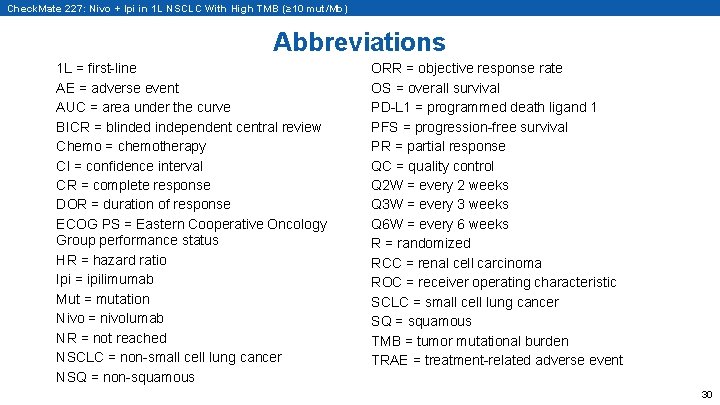
Check. Mate 227: Nivo + Ipi in 1 L NSCLC With High TMB (≥ 10 mut/Mb) Abbreviations 1 L = first-line AE = adverse event AUC = area under the curve BICR = blinded independent central review Chemo = chemotherapy CI = confidence interval CR = complete response DOR = duration of response ECOG PS = Eastern Cooperative Oncology Group performance status HR = hazard ratio Ipi = ipilimumab Mut = mutation Nivo = nivolumab NR = not reached NSCLC = non-small cell lung cancer NSQ = non-squamous ORR = objective response rate OS = overall survival PD-L 1 = programmed death ligand 1 PFS = progression-free survival PR = partial response QC = quality control Q 2 W = every 2 weeks Q 3 W = every 3 weeks Q 6 W = every 6 weeks R = randomized RCC = renal cell carcinoma ROC = receiver operating characteristic SCLC = small cell lung cancer SQ = squamous TMB = tumor mutational burden TRAE = treatment-related adverse event 30
Check. Mate 227: Nivo + Ipi in 1 L NSCLC With High TMB (≥ 10 mut/Mb) Back-up 31
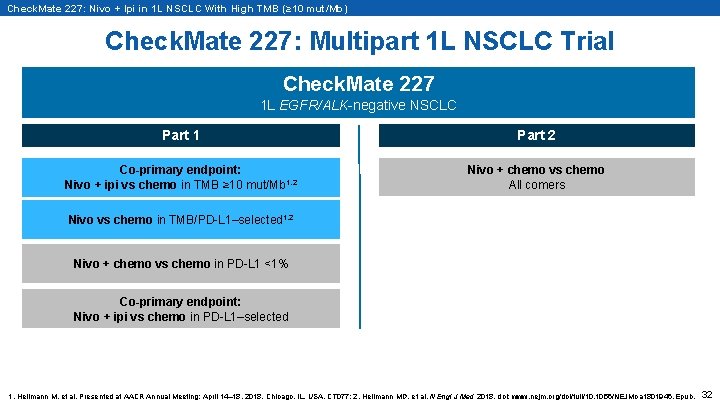
Check. Mate 227: Nivo + Ipi in 1 L NSCLC With High TMB (≥ 10 mut/Mb) Check. Mate 227: Multipart 1 L NSCLC Trial Check. Mate 227 1 L EGFR/ALK-negative NSCLC Part 1 Part 2 Co-primary endpoint: Nivo + ipi vs chemo in TMB ≥ 10 mut/Mb 1, 2 Nivo + chemo vs chemo All comers Nivo vs chemo in TMB/PD-L 1–selected 1, 2 Nivo + chemo vs chemo in PD-L 1 <1% Co-primary endpoint: Nivo + ipi vs chemo in PD-L 1–selected 1. Hellmann M, et al. Presented at AACR Annual Meeting; April 14– 18, 2018, Chicago, IL, USA. CT 077; 2. Hellmann MD, et al. N Engl J Med 2018. doi: www. nejm. org/doi/full/10. 1056/NEJMoa 1801946. Epub. 32
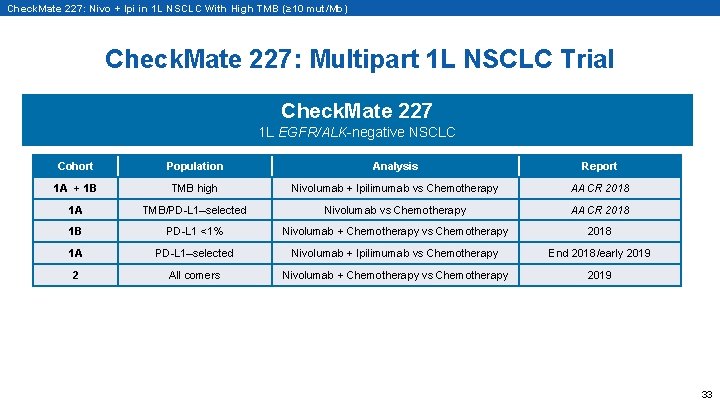
Check. Mate 227: Nivo + Ipi in 1 L NSCLC With High TMB (≥ 10 mut/Mb) Check. Mate 227: Multipart 1 L NSCLC Trial Check. Mate 227 1 L EGFR/ALK-negative NSCLC Cohort Population Analysis Report 1 A + 1 B TMB high Nivolumab + Ipilimumab vs Chemotherapy AACR 2018 1 A TMB/PD-L 1–selected Nivolumab vs Chemotherapy AACR 2018 1 B PD-L 1 <1% Nivolumab + Chemotherapy vs Chemotherapy 2018 1 A PD-L 1–selected Nivolumab + Ipilimumab vs Chemotherapy End 2018/early 2019 2 All comers Nivolumab + Chemotherapy vs Chemotherapy 2019 33
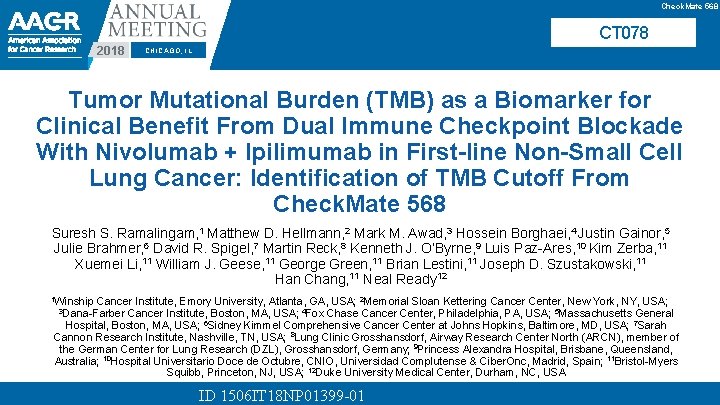
Check. Mate 568 CT 078 2018 CHICAGO, IL Tumor Mutational Burden (TMB) as a Biomarker for Clinical Benefit From Dual Immune Checkpoint Blockade With Nivolumab + Ipilimumab in First-line Non-Small Cell Lung Cancer: Identification of TMB Cutoff From Check. Mate 568 Suresh S. Ramalingam, 1 Matthew D. Hellmann, 2 Mark M. Awad, 3 Hossein Borghaei, 4 Justin Gainor, 5 Julie Brahmer, 6 David R. Spigel, 7 Martin Reck, 8 Kenneth J. O’Byrne, 9 Luis Paz-Ares, 10 Kim Zerba, 11 Xuemei Li, 11 William J. Geese, 11 George Green, 11 Brian Lestini, 11 Joseph D. Szustakowski, 11 Han Chang, 11 Neal Ready 12 1 Winship Cancer Institute, Emory University, Atlanta, GA, USA; 2 Memorial Sloan Kettering Cancer Center, New York, NY, USA; 3 Dana-Farber Cancer Institute, Boston, MA, USA; 4 Fox Chase Cancer Center, Philadelphia, PA, USA; 5 Massachusetts General Hospital, Boston, MA, USA; 6 Sidney Kimmel Comprehensive Cancer Center at Johns Hopkins, Baltimore, MD, USA; 7 Sarah Cannon Research Institute, Nashville, TN, USA; 8 Lung Clinic Grosshansdorf, Airway Research Center North (ARCN), member of the German Center for Lung Research (DZL), Grosshansdorf, Germany; 9 Princess Alexandra Hospital, Brisbane, Queensland, Australia; 10 Hospital Universitario Doce de Octubre, CNIO, Universidad Complutense & Ciber. Onc, Madrid, Spain; 11 Bristol-Myers Squibb, Princeton, NJ, USA; 12 Duke University Medical Center, Durham, NC, USA ID 1506 IT 18 NP 01399 -01
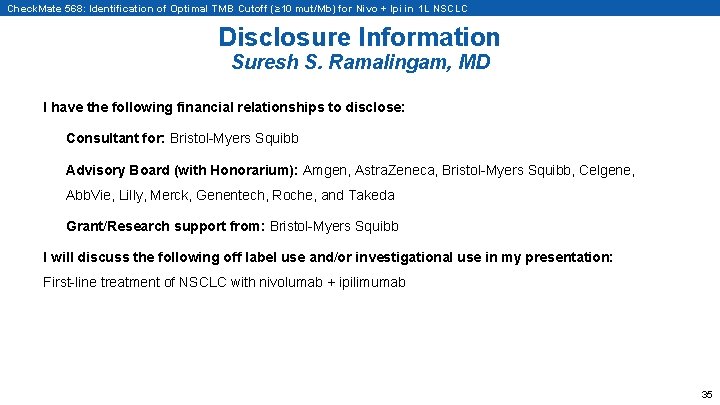
Check. Mate 568: Identification of Optimal TMB Cutoff (≥ 10 mut/Mb) for Nivo + Ipi in 1 L NSCLC Disclosure Information Suresh S. Ramalingam, MD I have the following financial relationships to disclose: Consultant for: Bristol-Myers Squibb Advisory Board (with Honorarium): Amgen, Astra. Zeneca, Bristol-Myers Squibb, Celgene, Abb. Vie, Lilly, Merck, Genentech, Roche, and Takeda Grant/Research support from: Bristol-Myers Squibb I will discuss the following off label use and/or investigational use in my presentation: First-line treatment of NSCLC with nivolumab + ipilimumab 35
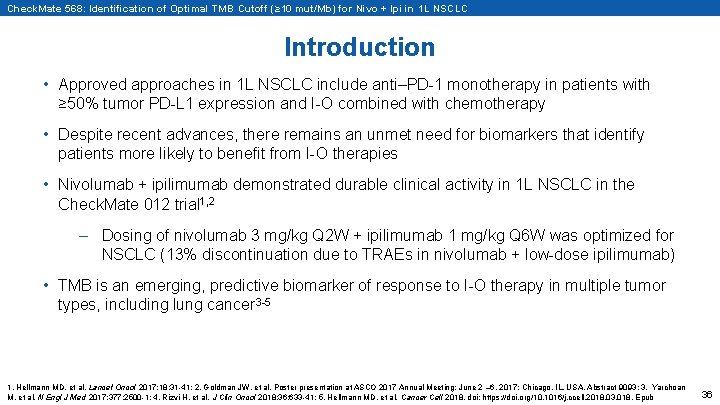
Check. Mate 568: Identification of Optimal TMB Cutoff (≥ 10 mut/Mb) for Nivo + Ipi in 1 L NSCLC Introduction • Approved approaches in 1 L NSCLC include anti–PD-1 monotherapy in patients with ≥ 50% tumor PD-L 1 expression and I-O combined with chemotherapy • Despite recent advances, there remains an unmet need for biomarkers that identify patients more likely to benefit from I-O therapies • Nivolumab + ipilimumab demonstrated durable clinical activity in 1 L NSCLC in the Check. Mate 012 trial 1, 2 – Dosing of nivolumab 3 mg/kg Q 2 W + ipilimumab 1 mg/kg Q 6 W was optimized for NSCLC (13% discontinuation due to TRAEs in nivolumab + low-dose ipilimumab) • TMB is an emerging, predictive biomarker of response to I-O therapy in multiple tumor types, including lung cancer 3 -5 1. Hellmann MD, et al. Lancet Oncol 2017; 18: 31 -41; 2. Goldman JW, et al. Poster presentation at ASCO 2017 Annual Meeting; June 2 – 6, 2017; Chicago, IL, USA. Abstract 9093; 3. Yarchoan M, et al. N Engl J Med 2017; 377: 2500 -1; 4. Rizvi H, et al. J Clin Oncol 2018; 36: 633 -41; 5. Hellmann MD, et al. Cancer Cell 2018. doi: https: //doi. org/10. 1016/j. ccell. 2018. 03. 018. Epub 36
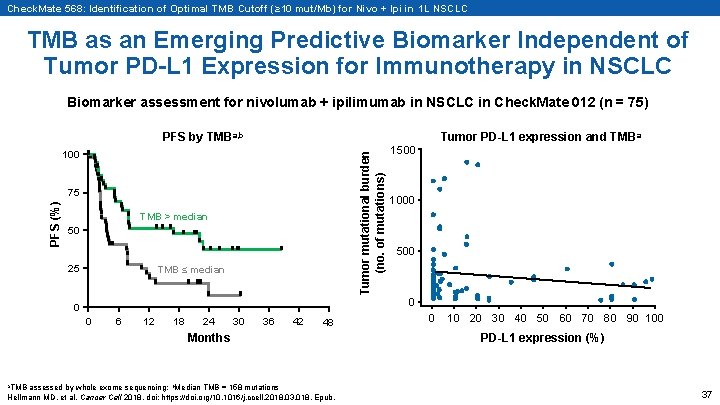
Check. Mate 568: Identification of Optimal TMB Cutoff (≥ 10 mut/Mb) for Nivo + Ipi in 1 L NSCLC TMB as an Emerging Predictive Biomarker Independent of Tumor PD-L 1 Expression for Immunotherapy in NSCLC Biomarker assessment for nivolumab + ipilimumab in NSCLC in Check. Mate 012 (n = 75) Tumor mutational burden (no. of mutations) PFS by TMBa, b 100 PFS (%) 75 TMB > median 50 25 TMB ≤ median Tumor PD-L 1 expression and TMBa 1500 1000 500 0 6 12 18 24 30 36 42 48 Months a. TMB assessed by whole exome sequencing; b. Median TMB = 158 mutations Hellmann MD, et al. Cancer Cell 2018. doi: https: //doi. org/10. 1016/j. ccell. 2018. 03. 018. Epub. 0 10 20 30 40 50 60 70 80 90 100 PD-L 1 expression (%) 37
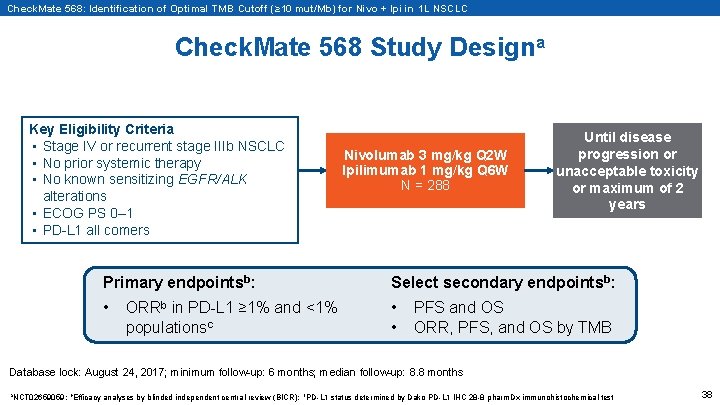
Check. Mate 568: Identification of Optimal TMB Cutoff (≥ 10 mut/Mb) for Nivo + Ipi in 1 L NSCLC Check. Mate 568 Study Designa Key Eligibility Criteria • Stage IV or recurrent stage IIIb NSCLC • No prior systemic therapy • No known sensitizing EGFR/ALK alterations • ECOG PS 0– 1 • PD-L 1 all comers Nivolumab 3 mg/kg Q 2 W Ipilimumab 1 mg/kg Q 6 W N = 288 Until disease progression or unacceptable toxicity or maximum of 2 years Primary endpointsb: Select secondary endpointsb: • • • ORRb in PD-L 1 ≥ 1% and <1% populationsc PFS and OS ORR, PFS, and OS by TMB Database lock: August 24, 2017; minimum follow-up: 6 months; median follow-up: 8. 8 months a. NCT 02659059; b. Efficacy analyses by blinded independent central review (BICR); c. PD-L 1 status determined by Dako PD-L 1 IHC 28 -8 pharm. Dx immunohistochemical test 38
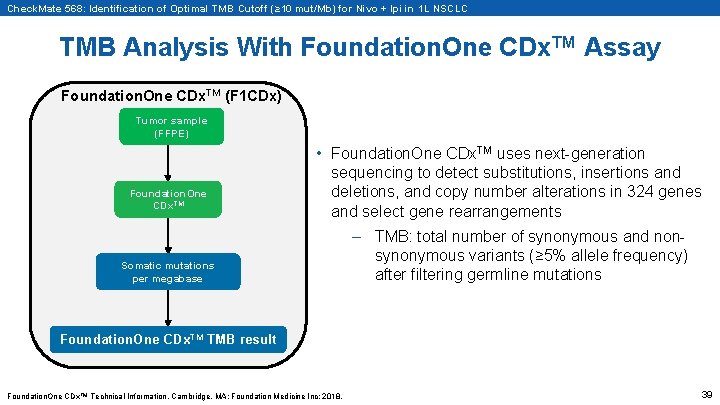
Check. Mate 568: Identification of Optimal TMB Cutoff (≥ 10 mut/Mb) for Nivo + Ipi in 1 L NSCLC TMB Analysis With Foundation. One CDx. TM Assay Foundation. One CDx. TM (F 1 CDx) Tumor sample (FFPE) Foundation. One CDx. TM • Foundation. One CDx. TM uses next-generation sequencing to detect substitutions, insertions and deletions, and copy number alterations in 324 genes and select gene rearrangements Somatic mutations per megabase – TMB: total number of synonymous and nonsynonymous variants (≥ 5% allele frequency) after filtering germline mutations Foundation. One CDx. TM TMB result Foundation. One CDx™ Technical Information. Cambridge, MA: Foundation Medicine Inc; 2018. 39
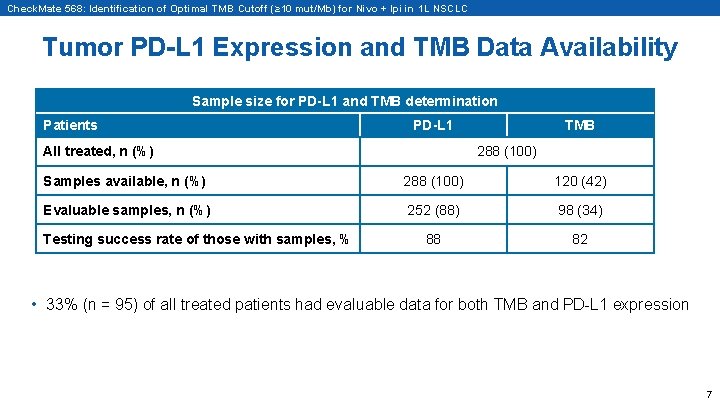
Check. Mate 568: Identification of Optimal TMB Cutoff (≥ 10 mut/Mb) for Nivo + Ipi in 1 L NSCLC Tumor PD-L 1 Expression and TMB Data Availability Sample size for PD-L 1 and TMB determination Patients PD-L 1 All treated, n (%) TMB 288 (100) Samples available, n (%) 288 (100) 120 (42) Evaluable samples, n (%) 252 (88) 98 (34) 88 82 Testing success rate of those with samples, % • 33% (n = 95) of all treated patients had evaluable data for both TMB and PD-L 1 expression 7
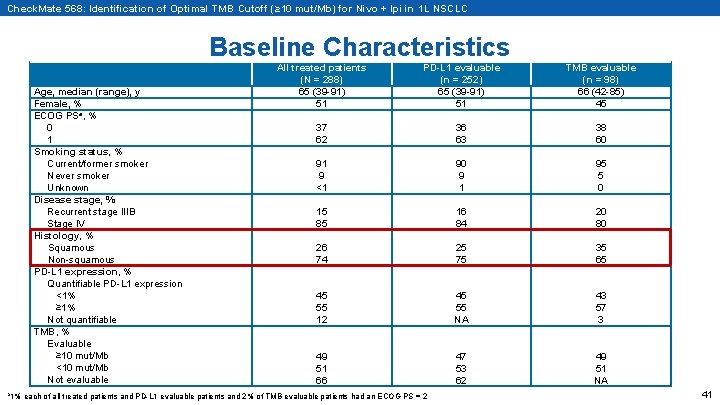
Check. Mate 568: Identification of Optimal TMB Cutoff (≥ 10 mut/Mb) for Nivo + Ipi in 1 L NSCLC Baseline Characteristics Age, median (range), y Female, % ECOG PSa, % 0 1 Smoking status, % Current/former smoker Never smoker Unknown Disease stage, % Recurrent stage IIIB Stage IV Histology, % Squamous Non-squamous PD-L 1 expression, % Quantifiable PD-L 1 expression <1% ≥ 1% Not quantifiable TMB, % Evaluable ≥ 10 mut/Mb <10 mut/Mb Not evaluable All treated patients (N = 288) 65 (39 -91) 51 PD-L 1 evaluable (n = 252) 65 (39 -91) 51 TMB evaluable (n = 98) 66 (42 -85) 45 37 62 36 63 38 60 91 9 <1 90 9 1 95 5 0 15 85 16 84 20 80 26 74 25 75 35 65 45 55 12 45 55 NA 43 57 3 49 51 66 47 53 62 49 51 NA a 1% each of all treated patients and PD-L 1 evaluable patients and 2% of TMB evaluable patients had an ECOG PS = 2 41
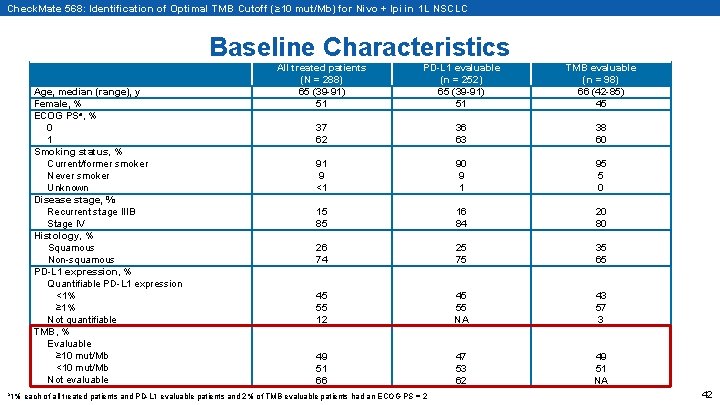
Check. Mate 568: Identification of Optimal TMB Cutoff (≥ 10 mut/Mb) for Nivo + Ipi in 1 L NSCLC Baseline Characteristics Age, median (range), y Female, % ECOG PSa, % 0 1 Smoking status, % Current/former smoker Never smoker Unknown Disease stage, % Recurrent stage IIIB Stage IV Histology, % Squamous Non-squamous PD-L 1 expression, % Quantifiable PD-L 1 expression <1% ≥ 1% Not quantifiable TMB, % Evaluable ≥ 10 mut/Mb <10 mut/Mb Not evaluable All treated patients (N = 288) 65 (39 -91) 51 PD-L 1 evaluable (n = 252) 65 (39 -91) 51 TMB evaluable (n = 98) 66 (42 -85) 45 37 62 36 63 38 60 91 9 <1 90 9 1 95 5 0 15 85 16 84 20 80 26 74 25 75 35 65 45 55 12 45 55 NA 43 57 3 49 51 66 47 53 62 49 51 NA a 1% each of all treated patients and PD-L 1 evaluable patients and 2% of TMB evaluable patients had an ECOG PS = 2 42
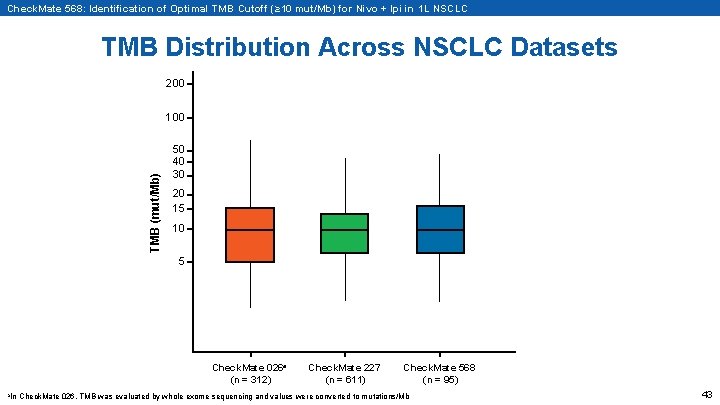
Check. Mate 568: Identification of Optimal TMB Cutoff (≥ 10 mut/Mb) for Nivo + Ipi in 1 L NSCLC TMB Distribution Across NSCLC Datasets 200 TMB (mut/Mb) 100 50 40 30 20 15 10 5 Check. Mate 026 a (n = 312) Check. Mate 227 (n = 611) Check. Mate 568 (n = 95) a. In Check. Mate 026, TMB was evaluated by whole exome sequencing and values were converted to mutations/Mb 43
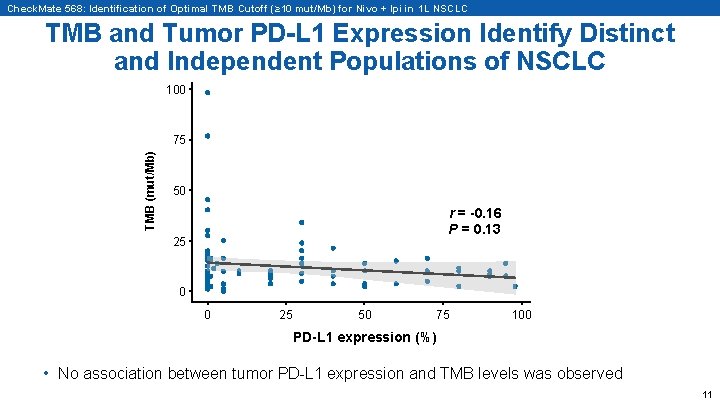
Check. Mate 568: Identification of Optimal TMB Cutoff (≥ 10 mut/Mb) for Nivo + Ipi in 1 L NSCLC TMB and Tumor PD-L 1 Expression Identify Distinct and Independent Populations of NSCLC 100 TMB (mut/Mb) 75 50 r = -0. 16 P = 0. 13 25 0 0 25 50 75 100 PD-L 1 expression (%) • No association between tumor PD-L 1 expression and TMB levels was observed 11
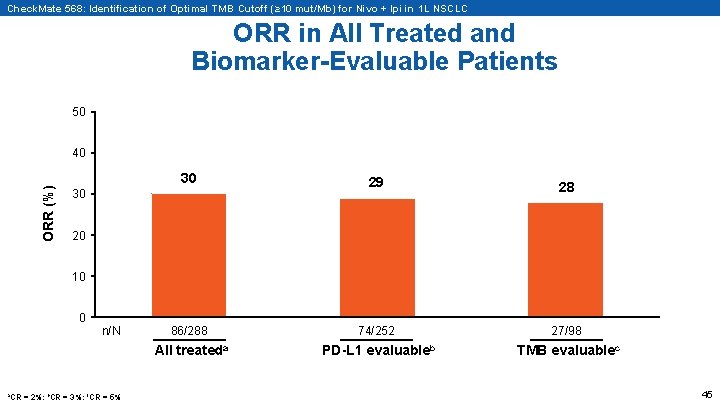
Check. Mate 568: Identification of Optimal TMB Cutoff (≥ 10 mut/Mb) for Nivo + Ipi in 1 L NSCLC ORR in All Treated and Biomarker-Evaluable Patients 50 ORR (%) 40 30 29 28 86/288 74/252 27/98 All treateda PD-L 1 evaluableb TMB evaluablec 30 20 10 0 n/N a. CR = 2%; b. CR = 3%; c. CR = 5% 45
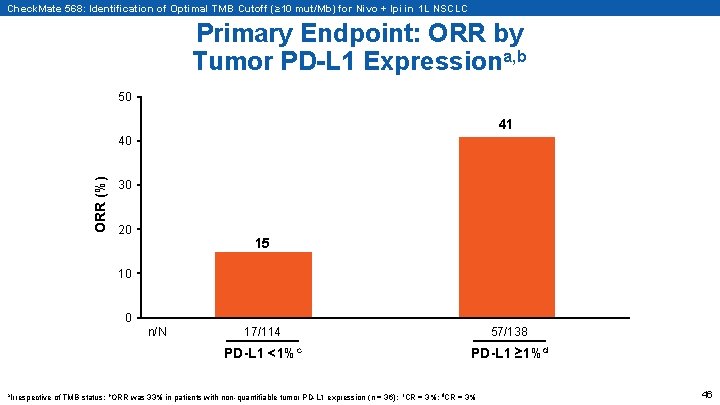
Check. Mate 568: Identification of Optimal TMB Cutoff (≥ 10 mut/Mb) for Nivo + Ipi in 1 L NSCLC Primary Endpoint: ORR by Tumor PD-L 1 Expressiona, b 50 41 ORR (%) 40 30 3 20 15 3 10 0 n/N 17/114 57/138 PD-L 1 <1%c PD-L 1 ≥ 1%d a. Irrespective of TMB status; b. ORR was 33% in patients with non-quantifiable tumor PD-L 1 expression (n = 36); c. CR = 3%; d. CR = 3% 46
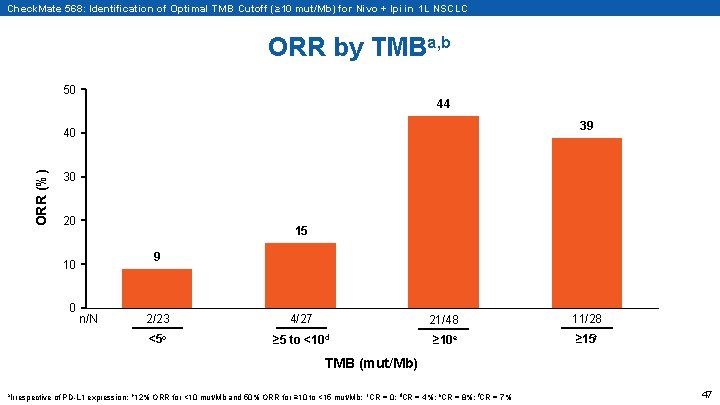
Check. Mate 568: Identification of Optimal TMB Cutoff (≥ 10 mut/Mb) for Nivo + Ipi in 1 L NSCLC ORR by TMBa, b 50 44 39 ORR (%) 40 30 20 15 9 10 0 n/N 2/23 4/27 21/48 11/28 <5 c ≥ 5 to <10 d ≥ 10 e ≥ 15 f TMB (mut/Mb) a. Irrespective of PD-L 1 expression; b 12% ORR for <10 mut/Mb and 50% ORR for ≥ 10 to <15 mut/Mb; c. CR = 0; d. CR = 4%; e. CR = 8%; f. CR = 7% 47
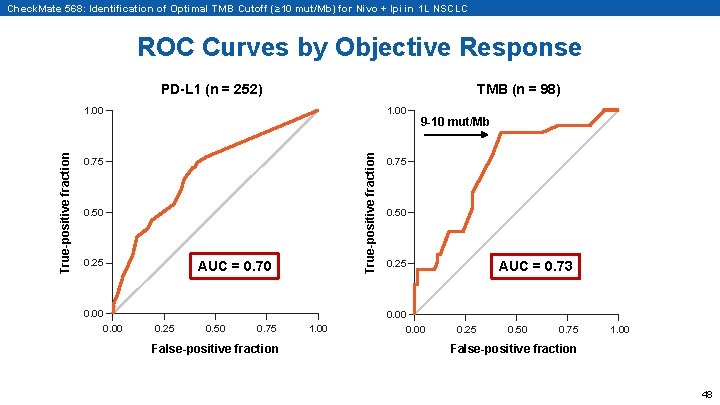
Check. Mate 568: Identification of Optimal TMB Cutoff (≥ 10 mut/Mb) for Nivo + Ipi in 1 L NSCLC ROC Curves by Objective Response PD-L 1 (n = 252) TMB (n = 98) 1. 00 True-positive fraction 1. 00 0. 75 0. 50 0. 25 AUC = 0. 70 0. 00 0. 25 0. 50 0. 75 False-positive fraction 1. 00 9 -10 mut/Mb 0. 75 0. 50 0. 25 0. 00 AUC = 0. 73 0. 25 0. 50 0. 75 1. 00 False-positive fraction 48
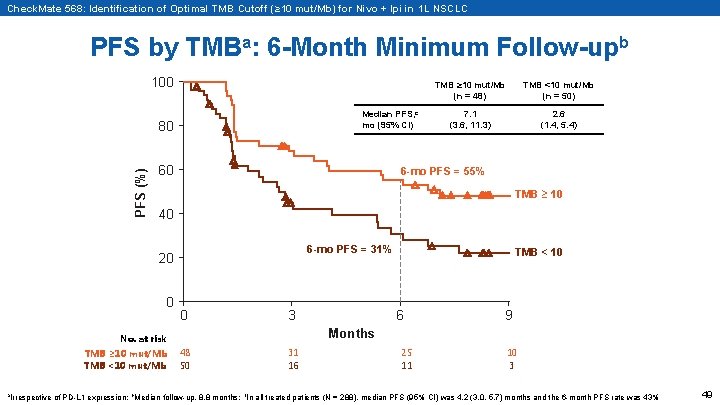
Check. Mate 568: Identification of Optimal TMB Cutoff (≥ 10 mut/Mb) for Nivo + Ipi in 1 L NSCLC PFS by TMBa: 6 -Month Minimum Follow-upb 100 Median PFS, c mo (95% CI) PFS (%) 80 60 TMB ≥ 10 mut/Mb (n = 48) TMB <10 mut/Mb (n = 50) 7. 1 (3. 6, 11. 3) 2. 6 (1. 4, 5. 4) 6 -mo PFS = 55% TMB ≥ 10 40 6 -mo PFS = 31% 20 0 0 3 6 9 Months No. at risk TMB ≥ 10 mut/Mb TMB < 10 48 50 31 16 25 11 10 3 a. Irrespective of PD-L 1 expression; b. Median follow-up, 8. 8 months; c. In all treated patients (N = 288), median PFS (95% CI) was 4. 2 (3. 0, 5. 7) months and the 6 -month PFS rate was 43% 49
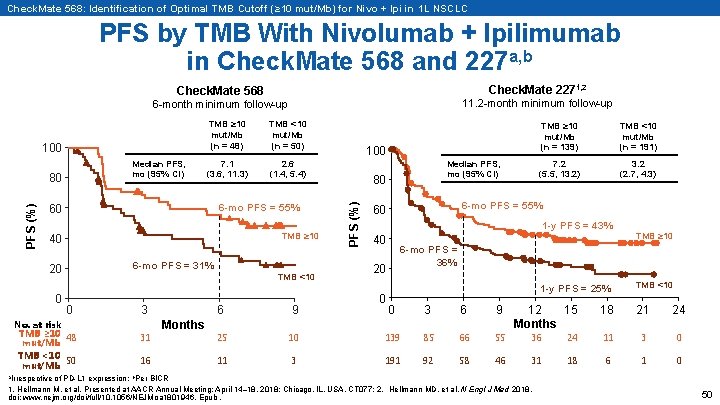
Check. Mate 568: Identification of Optimal TMB Cutoff (≥ 10 mut/Mb) for Nivo + Ipi in 1 L NSCLC PFS by TMB With Nivolumab + Ipilimumab in Check. Mate 568 and 227 a, b Check. Mate 568 Check. Mate 2271, 2 6 -month minimum follow-up 11. 2 -month minimum follow-up Median PFS, mo (95% CI) PFS (%) 80 TMB <10 mut/Mb (n = 50) 7. 1 (3. 6, 11. 3) 2. 6 (1. 4, 5. 4) 60 6 -mo PFS = 55% TMB ≥ 10 40 6 -mo PFS = 31% 20 0 TMB <10 0 No. at risk TMB ≥ 10 48 mut/Mb TMB <10 mut/Mb 50 3 31 Months 16 100 Median PFS, mo (95% CI) 80 PFS (%) 100 TMB ≥ 10 mut/Mb (n = 48) TMB ≥ 10 mut/Mb (n = 139) TMB <10 mut/Mb (n = 191) 7. 2 (5. 5, 13. 2) 3. 2 (2. 7, 4. 3) 6 -mo PFS = 55% 60 1 -y PFS = 43% 40 6 -mo PFS = 36% 20 0 1 -y PFS = 25% 0 3 6 9 10 139 85 66 55 36 3 191 92 58 46 31 6 9 25 11 TMB ≥ 10 12 15 Months TMB <10 18 21 24 24 11 3 0 18 6 1 0 a. Irrespective of PD-L 1 expression; b. Per BICR 1. Hellmann M, et al. Presented at AACR Annual Meeting; April 14– 18, 2018; Chicago, IL, USA. CT 077; 2. Hellmann MD, et al. N Engl J Med 2018. doi: www. nejm. org/doi/full/10. 1056/NEJMoa 1801946. Epub. 50
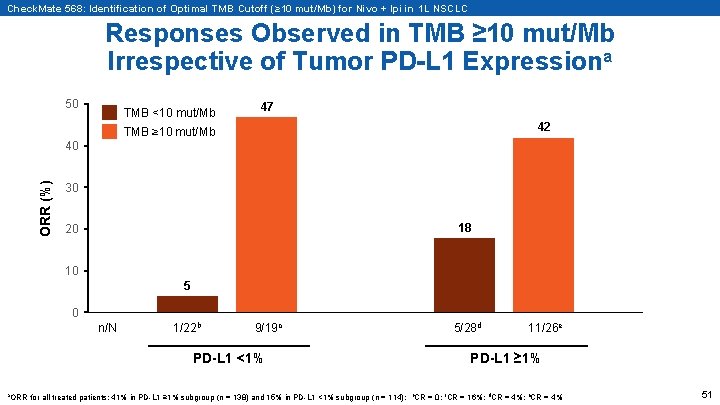
Check. Mate 568: Identification of Optimal TMB Cutoff (≥ 10 mut/Mb) for Nivo + Ipi in 1 L NSCLC Responses Observed in TMB ≥ 10 mut/Mb Irrespective of Tumor PD-L 1 Expressiona 50 TMB <10 mut/Mb 47 42 TMB ≥ 10 mut/Mb ORR (%) 40 30 18 20 10 5 0 n/N 1/22 b 9/19 c PD-L 1 <1% 5/28 d 11/26 e PD-L 1 ≥ 1% a. ORR for all treated patients: 41% in PD-L 1 ≥ 1% subgroup (n = 138) and 15% in PD-L 1 <1% subgroup (n = 114); b. CR = 0; c. CR = 16%; d. CR = 4%; e. CR = 4% 51
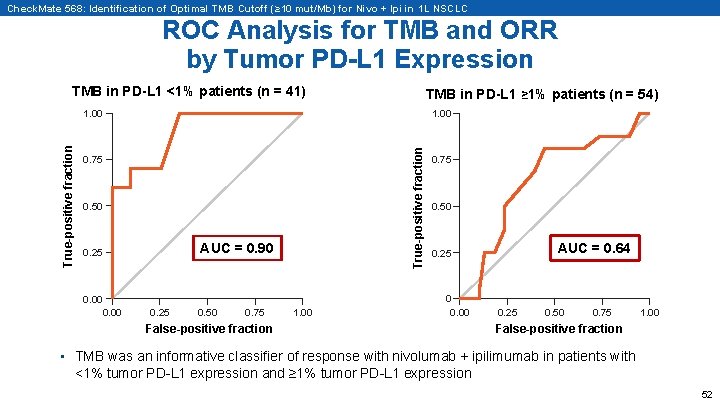
Check. Mate 568: Identification of Optimal TMB Cutoff (≥ 10 mut/Mb) for Nivo + Ipi in 1 L NSCLC ROC Analysis for TMB and ORR by Tumor PD-L 1 Expression TMB in PD-L 1 <1% patients (n = 41) TMB in PD-L 1 ≥ 1% patients (n = 54) 1. 00 True-positive fraction 1. 00 0. 75 0. 50 AUC = 0. 90 0. 25 0. 00 0. 25 0. 50 0. 75 False-positive fraction 1. 00 0. 75 0. 50 AUC = 0. 64 0. 25 0 0. 00 0. 25 0. 50 0. 75 1. 00 False-positive fraction • TMB was an informative classifier of response with nivolumab + ipilimumab in patients with <1% tumor PD-L 1 expression and ≥ 1% tumor PD-L 1 expression 52
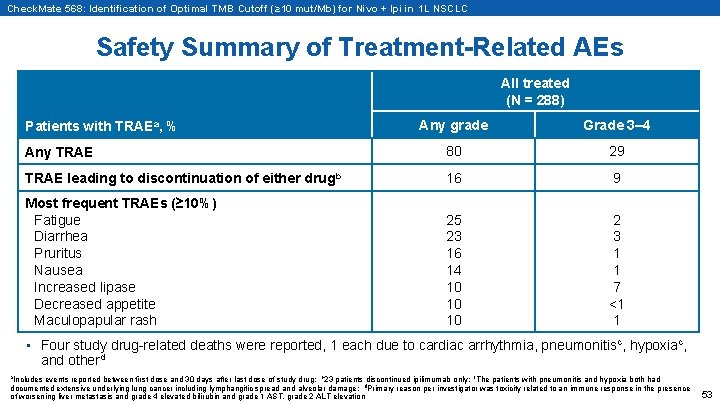
Check. Mate 568: Identification of Optimal TMB Cutoff (≥ 10 mut/Mb) for Nivo + Ipi in 1 L NSCLC Safety Summary of Treatment-Related AEs All treated (N = 288) Any grade Grade 3– 4 Any TRAE 80 29 TRAE leading to discontinuation of either drugb 16 9 Most frequent TRAEs (≥ 10%) Fatigue Diarrhea Pruritus Nausea Increased lipase Decreased appetite Maculopapular rash 25 23 16 14 10 10 10 2 3 1 1 7 <1 1 Patients with TRAEa, % • Four study drug-related deaths were reported, 1 each due to cardiac arrhythmia, pneumonitisc, hypoxiac, and otherd a. Includes events reported between first dose and 30 days after last dose of study drug; b 23 patients discontinued ipilimumab only; c. The patients with pneumonitis and hypoxia both had documented extensive underlying lung cancer including lymphangitic spread and alveolar damage; d. Primary reason per investigator was toxicity related to an immune response in the presence of worsening liver metastasis and grade 4 elevated bilirubin and grade 1 AST, grade 2 ALT elevation 53
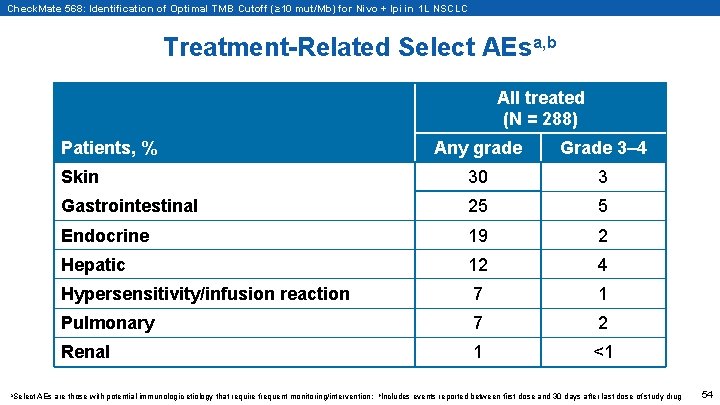
Check. Mate 568: Identification of Optimal TMB Cutoff (≥ 10 mut/Mb) for Nivo + Ipi in 1 L NSCLC Treatment-Related Select AEsa, b All treated (N = 288) Any grade Grade 3– 4 Skin 30 3 Gastrointestinal 25 5 Endocrine 19 2 Hepatic 12 4 Hypersensitivity/infusion reaction 7 1 Pulmonary 7 2 Renal 1 <1 Patients, % a. Select AEs are those with potential immunologic etiology that require frequent monitoring/intervention; b. Includes events reported between first dose and 30 days after last dose of study drug 54
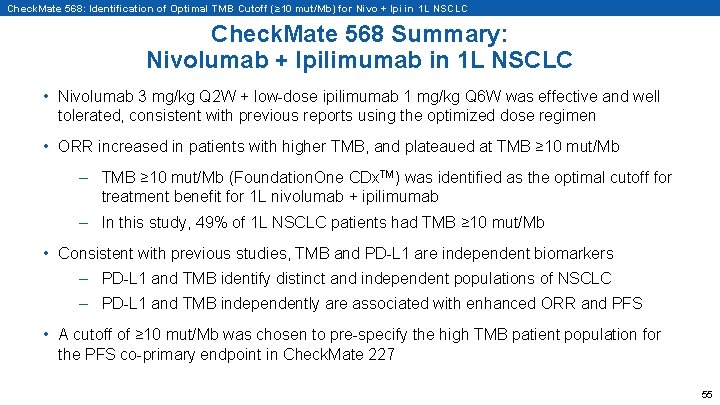
Check. Mate 568: Identification of Optimal TMB Cutoff (≥ 10 mut/Mb) for Nivo + Ipi in 1 L NSCLC Check. Mate 568 Summary: Nivolumab + Ipilimumab in 1 L NSCLC • Nivolumab 3 mg/kg Q 2 W + low-dose ipilimumab 1 mg/kg Q 6 W was effective and well tolerated, consistent with previous reports using the optimized dose regimen • ORR increased in patients with higher TMB, and plateaued at TMB ≥ 10 mut/Mb – TMB ≥ 10 mut/Mb (Foundation. One CDx. TM) was identified as the optimal cutoff for treatment benefit for 1 L nivolumab + ipilimumab – In this study, 49% of 1 L NSCLC patients had TMB ≥ 10 mut/Mb • Consistent with previous studies, TMB and PD-L 1 are independent biomarkers – PD-L 1 and TMB identify distinct and independent populations of NSCLC – PD-L 1 and TMB independently are associated with enhanced ORR and PFS • A cutoff of ≥ 10 mut/Mb was chosen to pre-specify the high TMB patient population for the PFS co-primary endpoint in Check. Mate 227 55
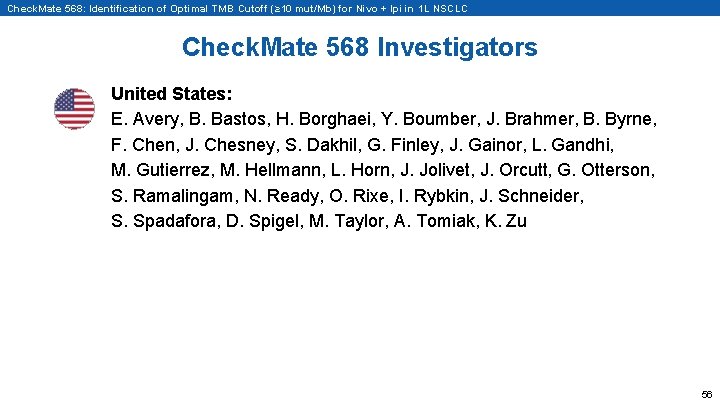
Check. Mate 568: Identification of Optimal TMB Cutoff (≥ 10 mut/Mb) for Nivo + Ipi in 1 L NSCLC Check. Mate 568 Investigators United States: E. Avery, B. Bastos, H. Borghaei, Y. Boumber, J. Brahmer, B. Byrne, F. Chen, J. Chesney, S. Dakhil, G. Finley, J. Gainor, L. Gandhi, M. Gutierrez, M. Hellmann, L. Horn, J. Jolivet, J. Orcutt, G. Otterson, S. Ramalingam, N. Ready, O. Rixe, I. Rybkin, J. Schneider, S. Spadafora, D. Spigel, M. Taylor, A. Tomiak, K. Zu 56
Check. Mate 568: Identification of Optimal TMB Cutoff (≥ 10 mut/Mb) for Nivo + Ipi in 1 L NSCLC Acknowledgments • The patients and families who made this trial possible • The clinical study teams who participated in the trial • The protocol managers for this study, Jessica Proszynski and Katleen Van Hoefs, and Wenhua Hu for contributions for statistical analyses • Foundation Medicine for collaborative development of Foundation. One CDx™ assay • Dako for collaborative development of the automated PD-L 1 IHC 28 -8 pharm. Dx assay • Bristol-Myers Squibb (Princeton, NJ) and ONO Pharmaceutical Company Ltd. (Osaka, Japan) • All authors contributed to and approved the presentation; writing and editorial assistance was provided by Kerry K. Brinkman, Ph. D, and Leah Bernstein, Ph. D, of Evidence Scientific Solutions Inc, funded by Bristol-Myers Squibb 57
Abbreviations 1 L = first-line AE = adverse event ALK = anaplastic lymphoma kinase ALT = alanine aminotransferase AST = aspartate transaminase AUC = area under the curve CI = confidence interval CR = complete response ECOG PS = Eastern Cooperative Oncology Group performance status EGFR = epidermal growth factor receptor I-O = immuno-oncology Mut = mutation NA = not applicable NSCLC = non-small cell lung cancer ORR = objective response rate OS = overall survival PD-1 = programmed death-1 PD-L 1 = programmed death ligand 1 PFS = progression-free survival Q 2 W = every 2 weeks Q 6 W = every 6 weeks ROC = receiver operating characteristic TRAE = treatment-related adverse event TMB = tumor mutational burden 58
- Slides: 58