
Bringing the Courtroom into the Classroom Experiential learning
Bringing the Courtroom into the Classroom Experiential learning with Moot Court and Mock Trials COSMA Presentation 2018 Vickie Byler Ed. D
Challenges We Face in the Classroom Engaging students Transfer of knowledge from class to world Measuring outcomes Creating experiences to prepare them for their future in Sport Management
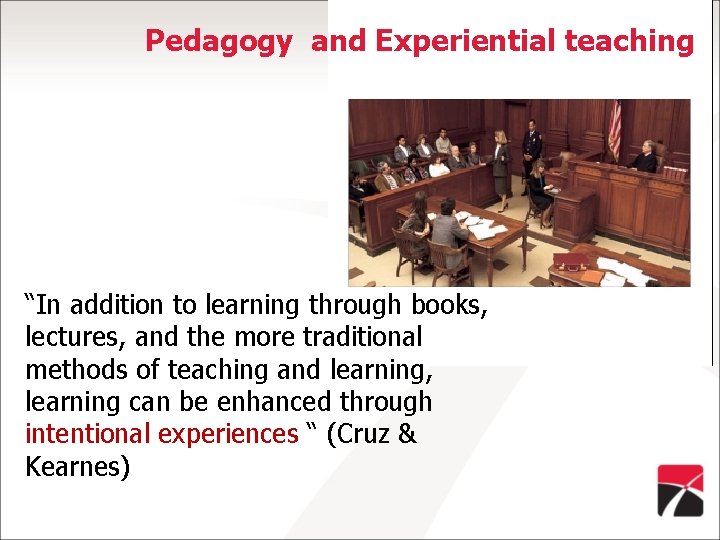
Pedagogy and Experiential teaching “In addition to learning through books, lectures, and the more traditional methods of teaching and learning, learning can be enhanced through intentional experiences “ (Cruz & Kearnes)
“Experiential learning is also built upon the foundation of interdisciplinary and constructivist learning. Experiential methodology doesn’t treat each subject as being walled off in it’s own room, unconnected to other subjects”(Wurdinger, 2005, p. 24). Moot Court and Mock Trials allow the opportunity for collaboration with many other departments on campus.
“Constructivist theory of learning is that the Outcomes of the learning process are varied and often unpredictable. Learners play a critical role in assessing their own learning” (Wurdinger, 2005, p. 69). Each student addresses the problem in a different way and each takes away different experiences.
Characteristics of Experiential Learning • Balance between experiential activities and underlying content or theory • Safe place for students to work (no judgement) • Meaningful to the student • Connections between the learning and the world (Chapman, Mc. Phee, & Proudman, 1995)
• • Reflection (bring theory to life) Fully immersed in the experience Analysis of their own values Meaningful relationships self, teacher, world • Learning outside comfort zones (Chapman, Mc. Phee, & Proudman, 1995)
Mock Trial And Moot Court Sometimes these words are used interchangeably but Mock Trial: Full trial experience Moot Court: usually appeal cases with oral arguments presented. Both are beneficial in sport law or business classes.
According to Black’s Law Dictionary “Moot Court means a fictitious court held usually in law schools to argue hypothetical cases…” Moot Court and mock trials are experiential exercises that allow students to step off the page in the text book and into the court room. “In the heart is the art of advocacy” (Graves & Vaughan) According to Black’s Law dictionary an advocate pleads for another in an attempt to persuade listeners of the other’s cause (Black’s Law Dictionary).
Pedagogical Benefits • Capture the students interest! They become fully engaged. • Controversy brings energy into the classroom. • Competition brings out the best work in most students (Bretsen 2006). • Discussing current issues that students are facing draws students into the conversation. • These experiences also pull them far out of their comfort zone and stretch them to grow.
Pedagogy and Competition Do they fit together? “the competitive aspects of the Moot are a crucial element of its pedagogical success-much the same manner that law school exams or other graded performance are a crucial element of the pedagogical success of a typical law school course. While the exam or grade itself may be of questionable value or reliability, its role in spurring student efforts in the educational endeavor seems clear” (Graves & Vaughan 2006)
• • • Student Skills that are Developed through the Experience Problem solving Written and oral communication skills Research Critical Analysis Attention to detail Explore real life situations Working in groups Ability to think on their feet Look at both sides of an issue with open eyes Be an advocate even when you may not personally take the same stand
Transferable skills • These same elements have been found in the Mac. Crate report which lists the 10 skills needed for the legal profession (Mac. Crate 1992) • Many of the same elements are needed in the business world (Bowditch, Buono and Stewart 2012) • Both also recommend the best way to teach these skills is an “experiential approach” “active learning” “simulations” rather than lecturing.
Transferable skills continued • “Moot court competition is usually a part of every Law student’s experience but undergraduate students in almost any field can benefit” (Cruz& Kearnes). • “Probably the greatest benefit of moot court experiences is the personal development of the students” (Cruz & Kearnes)
How to Incorporate Moot Court Experience in your Classroom • Build the syllabus with assignments that are woven into the semester as content is covered. • Develop work teams & schedule times in the syllabus devoted to assignments and teaching on the case. • Students create google docs that can be shared. • Extensive time outside of class is required to complete assignments and prepare for the case. • Case builds, confidence builds, excitement builds
Assignments for the Semester • • Legal Briefs Complaint and Response Opening Arguments Witness list, questions and responses Supporting Documents (2 -3) Case Precedent (at least 2) Closing Arguments Full Trial as the final
Content to explore during the semester Students learn how to; • Research a case Ø Google case law, WESTLAW, LEXIS, Find Law. com • Read, write and present a legal brief • Identify legal terms • Analyze both sides of an issue • Craft a claim and a response • Select and prep witnesses • Create opening and closing arguments • Create and present supporting documents • Think critically as to what your opponent will present and counter their actions
Professor’s Role • • • Find a good case/issue Select good teams Provide some basic background on the case Set high expectations! Establish ground rules for the semester Select a lead communicator for each team Select semester long assignments and rubrics and a time line for submission Select date and time for actual court Allow time during the semester for group work and facilitate this time
Professor Role Continued • Collaborate with other departments on campus and in the community to help the class explore the issue from all angles. • Mentor both groups during the process • Work to build good working teams during the semester • Build a repertoire of cases to use
The Role of the Student • Work as part of a team. • Research the case and surrounding issues. • Craft assignments using critical thinking skills and proper oral and written communication • Build their part of the case and defend it despite their personal beliefs about the issue. • Seek advice and collaborate with other faculty and staff to explore the issue. • Submit each assignment on a timely basis
Role of the Student Continued • Prepare for the actual court and actively participate in the event. • Reflect on their own experience and participate in a time of class reflection on the experience. • Transfer skills into life experiences. • Use their gifts on the team (Bretsen) Ø Extroverts, introverts, attention to detail, oral and written communication etc.
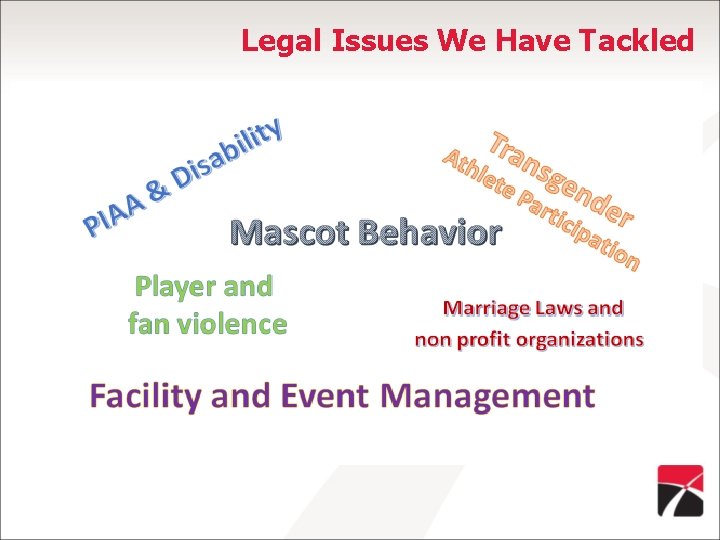
Legal Issues We Have Tackled
Research on Professor Student Experience “The collaborative work in preparation for the competition and during the competition breaks down many of the pedagogical barriers between student and teacher which are inherent in the standard classroom, and allows students and teachers the opportunity to participate in small group learning and dynamic problem solving. ” (Weaver 2000)
Assessment • Rubrics are designed for each piece of the experience. • Segments are turned in over the course of the semester. • Individual grades are given for each assignment but each is also a draft of the final product. • This allows for feedback along the way, mentoring and ensures that groups are ready.
What Students Say about their Experience Students shared that the Moot Experience… • “Helped them improve their ability to reason through issues and find solutions” • • • “Helped them see the other side of an issue” “Develop research skills” “Improve their ability to speak and write persuasively” “Improve my level of self confidence” Many believe these skills are “transferrable to other areas of life” • “challenged them in a way that different from any other course” (Salimbene and Mongell)
LBC student survey results
How did your initial reaction to Moot Court compare with your final thoughts? • I thought it would just be another assignment, but I ended up getting really invested in it and wanting to win the case. • I had talked to a few people that had already taken the course and they always talked about the Moot Court and the amount of work it takes to be thoroughly prepared for that. So right off the bat, I was dreading the aspect of the course. However, once getting the facts of the case and looking at the unique circumstances, it was fun to break things down and try to get into that lawyer mindset. Looking back on it, I felt like the Moot Court was a perfect way of capping off the semester with a fun activity that we had been preparing for months. • My initial response in comparison to my final thoughts of Moot Court were very different. Initially, I was not sure where to begin with this project. It was a new concept for me to think critically in this way, so in the beginning it was hard to understand the expectations for this project. As time went on and towards the end of Moot Court I was able to pull everything together that I had learned throughout Sport Law and through research, that allowed me to not only further the process of the project, but my knowledge on the topic overall.
How was the Moot Court a culminating experience that challenged you? • It provided a real-life scenario to use what we had been learning in the classroom. It was hands on so it made us want to really put time and effort into it, and it was a fun, competitive end goal to look forward to during the semester. • It was certainly a culminating experience to prepare all semester towards one goal. We all had different roles to play that would ultimately dictate who won the case. There was a lot of pressure to perform and apply all we had worked for in that small amount of time. I felt like each person on my team was prepared and reacted in manners that showed our preparation and also tested our knowledge and readiness for the case. • This project was a challenge for me. Before taking this class I was unfamiliar with many things involving court cases and the law, besides what I had watched on television shows. This project allowed me to further my knowledge in the area of law and challenged me to do as much research as possible in order for my team to win the case.
Did or How did the Moot Court experience make you think critically? • “You definitely have to think of all the different angles that can be played by the opposition. So seeing if from their POV was different and required to think critically about what points they would/could make. But it is always fun to see how you would take it and the points you would make about the case if you were given the opposite side of the case”. • “This experience challenged all of us to see all the different facets and sides of an issue. It made me realize just how many laws and legal issues there can be in sport and that it is important to look at things from different perspectives. It also required learning to be prepared but also to have the ability to think on our feet and work well under pressure”.
What did you think about or learn from the Moot Court experience? • “Quite honestly, it made me wish I had done more education in law because I enjoyed it so much. I learned that things aren't always what they seem, life isn't fair but we still need to defend what we believe is right, there are so many laws in sport that we never think about, and professionalism and respect for the law is very important in sports and must be something we think about and prepare for as employees, employers, and professionals in the sport industry”. • “Whenever I think of a courtroom and the legal aspect of sports, I automatically think of the movies where the lawyer makes a point that just breaks open the case. However, there are so many small details that can derail a case that you never even thought of. Now, I can look back on this and apply it to my own personal life and career. There are times that the minor details can change everything in my career, and preparing for those and knowing how to quickly react to when these happen is probably the best experience I was able to take away from the Moot Court”. • “Throughout the Moot Court experience I learned a lot. It was interesting, because I did not only learn a lot about my side of the case, but also the other perspective from the other side of the case. My team did not only do research for our team, but we also researched ideas and areas that the other team was researching in order to be prepared for whatever the other team through our way”.
References Bell, K. (2002). Using moot courts in the classroom (cases, controversy, and the court). Social Education, 66, 42 -45. Bowidtch, J. , Buono, & Stewart (2012). A Primer on Organizational Behavior. Hoboken, NJ: Wiley. Bretsen, Stephen N. (2006) Bringing the Appellate Court to the Classroom. Christian Business Academy Review, 1, pp. 1931 -1958. Carlson, J. Lon; Skaggs, N. (2000). Learning by Trial and Error: A case for moot courts. Journal of Economic Education, Vol. 31 Issue 2, p 145 -155. Chapman, S. , Mc. Phee, P. , & Proudman, B. (1995). What is Experiential Education? . In Warren, K. (ed. ), Theory of Experiential Education (pp. 235 -248). Dubuque: Kendall/Hunt Publishing Company. Garner, B. A. (ed). (1999). Black’s Law Dictionary (7 th ed. ). St. Paul, MN: West. Graves & Vaughn, (2006). The Willem C. Vis International Commercial Arbitration Moot: Making the Most of an Extraordinary Educational Opportunity, 10 Vindobona, J. Int’l Com. L & ARB. 173, 1990.
References Kearnes, J. , & da Cruz, B. (2006). Mooting as pedagogy. APSA Teaching and Learning Conference. Retrieved from http: //citation. allacademic. com/meta/p 101364_index. html Mac. Crate, R. (1992). Legal education and professional development – An educational continuum, report of the task force on law schools and the profession: Narrowing the gap. Illinois: American Bar Association. Mc. Devitt, W. J. (2009). Active learning through appellate simulation: A simple recipe for a business law course. Journal of Legal Studies Education, 26, 245– 262. doi: 10. 1111/j. 1744 -1722. 2009. 01057. x Salimbene, F. , & Mongell, A. (2009). It’s not just for law school anymore: Moot court and the enhancement of business student skills. ALSB Annual Conference. Retrieved from: http: //www. acmamootcourt. org/resources Weaver, M. (2000). Preparing students for an undergraduate moot court tournament. 2000 Annual Meeting of the American Political Science Association.
- Slides: 32