
Brigitte Prudhomme DBA Associated Professor of Marketing Universit

Brigitte Prud’homme, DBA Associated Professor of Marketing Université de Moncton, New-Brunswick, Canada Affiliate researcher of Institut de recherche sur les PME What themes of the 2030 Agenda for Sustainable Development are considered priorities by NB’s different actors in tourism and which should be included in NB’S tourism strategy?
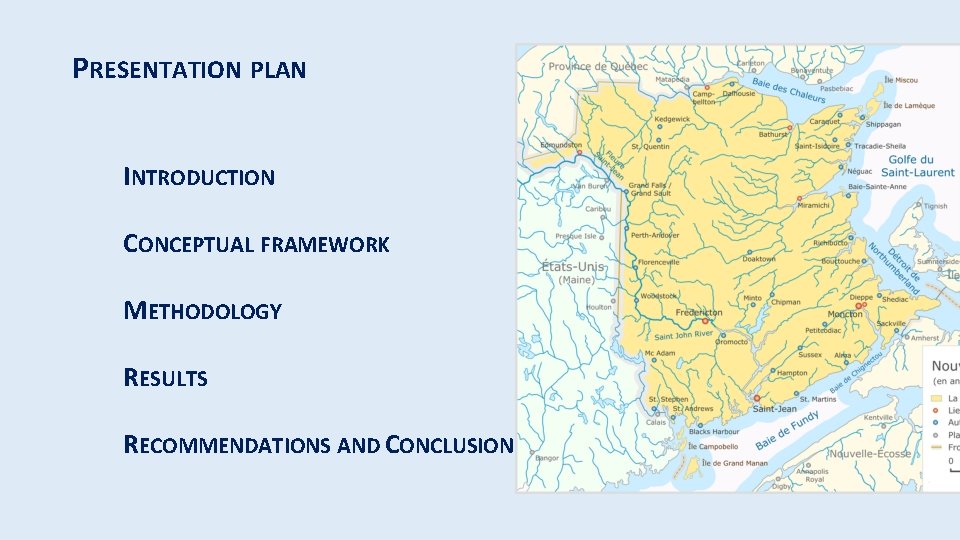
PRESENTATION PLAN INTRODUCTION CONCEPTUAL FRAMEWORK METHODOLOGY RESULTS RECOMMENDATIONS AND CONCLUSION
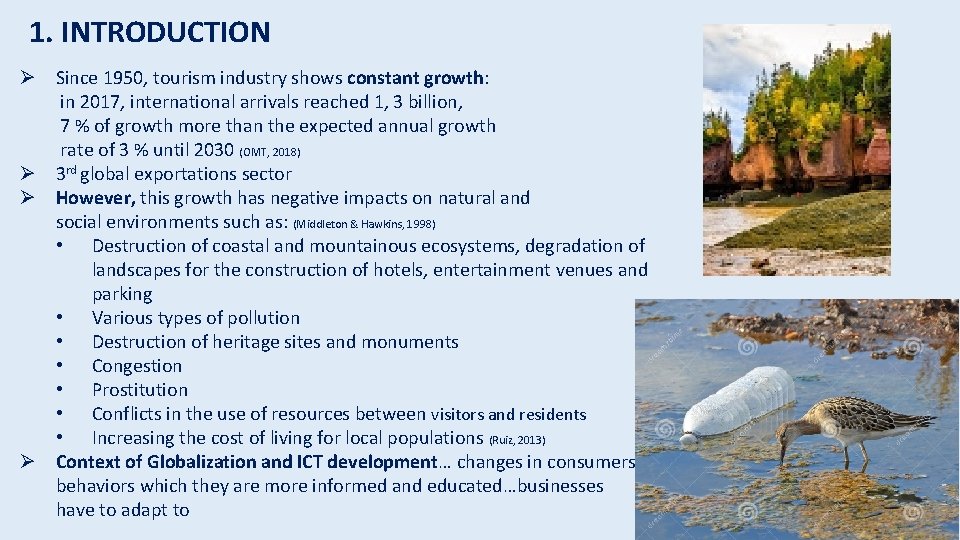
1. INTRODUCTION Ø Since 1950, tourism industry shows constant growth: in 2017, international arrivals reached 1, 3 billion, 7 % of growth more than the expected annual growth rate of 3 % until 2030 (OMT, 2018) Ø 3 rd global exportations sector Ø However, this growth has negative impacts on natural and social environments such as: (Middleton & Hawkins, 1998) • Destruction of coastal and mountainous ecosystems, degradation of landscapes for the construction of hotels, entertainment venues and parking • Various types of pollution • Destruction of heritage sites and monuments • Congestion • Prostitution • Conflicts in the use of resources between visitors and residents • Increasing the cost of living for local populations (Ruiz, 2013) Ø Context of Globalization and ICT development… changes in consumers’ behaviors which they are more informed and educated…businesses have to adapt to
1. INTRODUCTION (SUITE) Ø New strategy of tourism in Canada (Innovation, Science and Economic Development Canada, 2017) • • • Growth first! More inclusive (ex. : access for disabled persons, LGBT community) Preservation and Accessibility to National parks Ø New strategy of tourism in NB (Tourism, Heritage and Culture, 2017) • • Economic growth, technology, research Strategy of other Atlantic provinces included dimensions of Sustainable Development Ø In New-Brunswick, two consecutive years of growth, in 2017 increased of 4 % (Gov. NB, 2017) Ø However, tourism relies on nature and culture to develop (Lindberg, 1991) and "qualitative changes in the environment, services and relations with the population (conflict) lead to the trivialization of places” (Gagnon, 2002, p. 18), avoidance by tourists and the decline of a destination Ø Research question: WHAT THEMES OF THE 2030 AGENDA FOR SUSTAINABLE DEVELOPMENT ARE PRIORITIZED BY THE DIFFERENT ACTORS IN TOURISM AND WHICH SHOULD BE INCLUDED IN NB’S TOURISM STRATEGY?
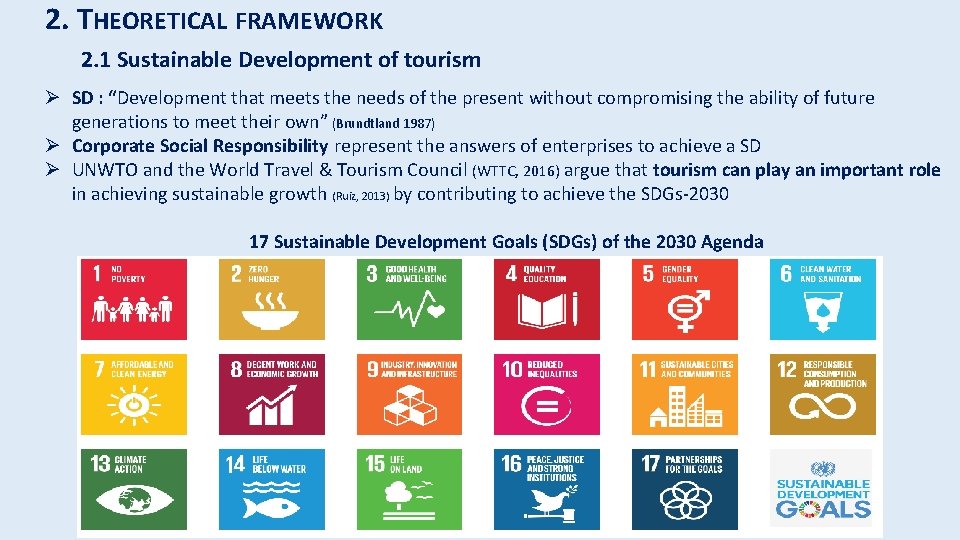
2. THEORETICAL FRAMEWORK 2. 1 Sustainable Development of tourism Ø SD : “Development that meets the needs of the present without compromising the ability of future generations to meet their own” (Brundtland 1987) Ø Corporate Social Responsibility represent the answers of enterprises to achieve a SD Ø UNWTO and the World Travel & Tourism Council (WTTC, 2016) argue that tourism can play an important role in achieving sustainable growth (Ruiz, 2013) by contributing to achieve the SDGs-2030 17 Sustainable Development Goals (SDGs) of the 2030 Agenda
2. THEORETICAL FRAMEWORK 2. 2 Evolution of Consumers’ Behaviors Ø On one hand, firms lost consumers’ confidence by few unethical decisions and on the other hand, more and more of consumers are choosing suppliers of products and services that have adopted practices less harmful to natural and social environments Ø Shared value brings benefits for the society and the environment (Porter and Kramer, 2011) Ø Furthermore: • Customers’ responsible domestic behaviors influence selection hotel criteria and hotel SD orientation is significantly important among these criteria (Prud’homme and Raymond, 2013) • Customers’ loyalty (Martinez and del Bosque, 2013)
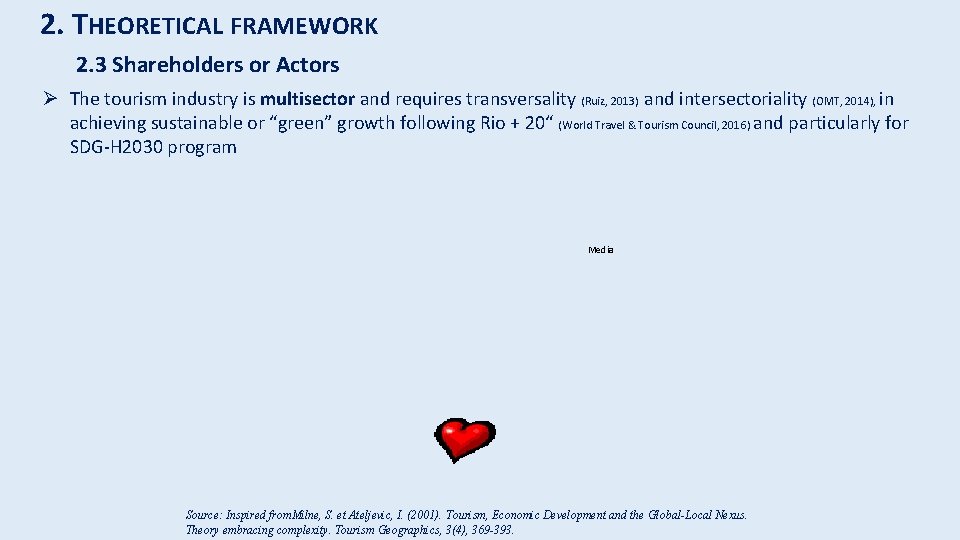
2. THEORETICAL FRAMEWORK 2. 3 Shareholders or Actors Ø The tourism industry is multisector and requires transversality (Ruiz, 2013) and intersectoriality (OMT, 2014), in achieving sustainable or “green” growth following Rio + 20“ (World Travel & Tourism Council, 2016) and particularly for SDG-H 2030 program Media Source: Inspired from. Milne, S. et Ateljevic, I. (2001). Tourism, Economic Development and the Global-Local Nexus. Theory embracing complexity. Tourism Geographics, 3(4), 369 -393.
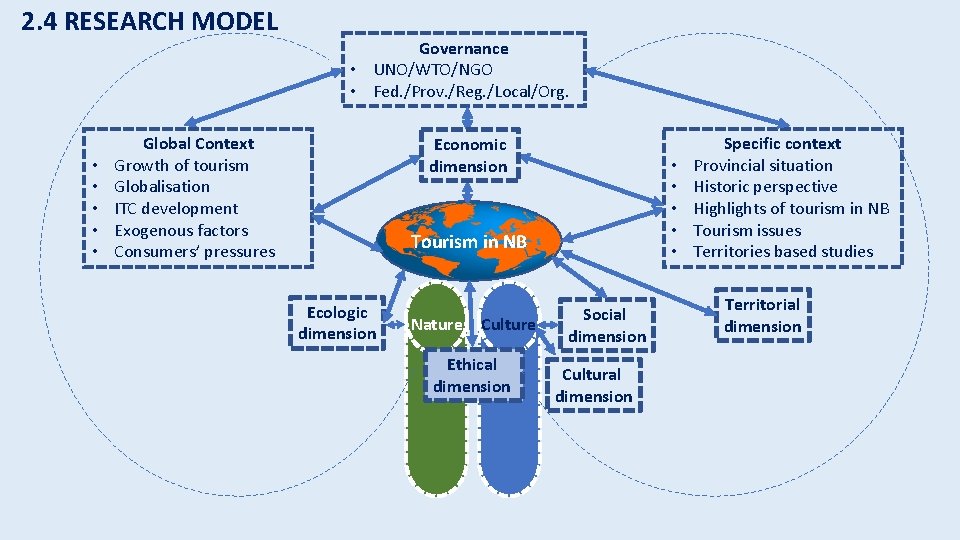
2. 4 RESEARCH MODEL • • • Governance • UNO/WTO/NGO • Fed. /Prov. /Reg. /Local/Org. Global Context Growth of tourism Globalisation ITC development Exogenous factors Consumers’ pressures Economic dimension • • • Tourism in NB Ecologic dimension Nature Culture Ethical dimension Social dimension Cultural dimension Specific context Provincial situation Historic perspective Highlights of tourism in NB Tourism issues Territories based studies Territorial dimension
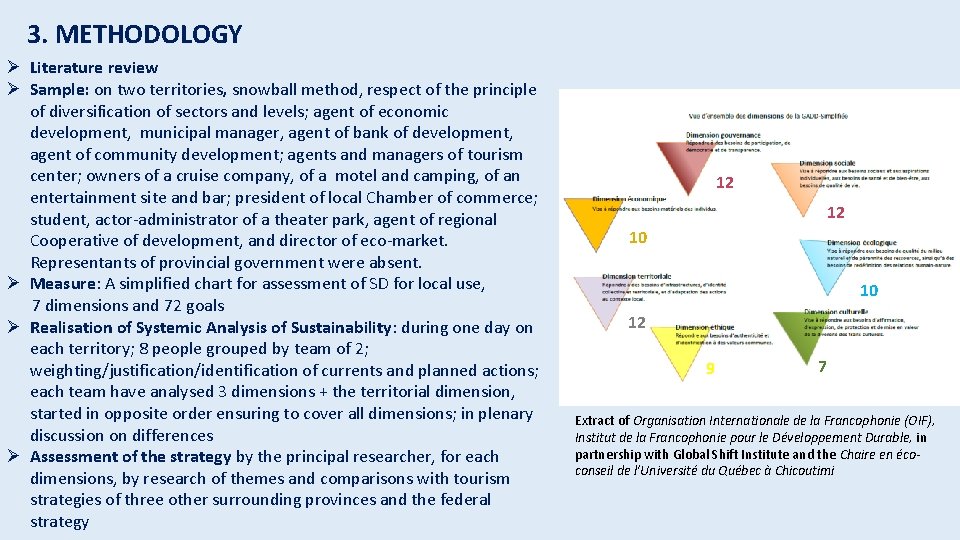
3. METHODOLOGY Ø Literature review Ø Sample: on two territories, snowball method, respect of the principle of diversification of sectors and levels; agent of economic development, municipal manager, agent of bank of development, agent of community development; agents and managers of tourism center; owners of a cruise company, of a motel and camping, of an entertainment site and bar; president of local Chamber of commerce; student, actor-administrator of a theater park, agent of regional Cooperative of development, and director of eco-market. Representants of provincial government were absent. Ø Measure: A simplified chart for assessment of SD for local use, 7 dimensions and 72 goals Ø Realisation of Systemic Analysis of Sustainability: during one day on each territory; 8 people grouped by team of 2; weighting/justification/identification of currents and planned actions; each team have analysed 3 dimensions + the territorial dimension, started in opposite order ensuring to cover all dimensions; in plenary discussion on differences Ø Assessment of the strategy by the principal researcher, for each dimensions, by research of themes and comparisons with tourism strategies of three other surrounding provinces and the federal strategy 12 12 10 10 12 9 7 Extract of Organisation Internationale de la Francophonie (OIF), Institut de la Francophonie pour le Développement Durable, in partnership with Global Shift Institute and the Chaire en écoconseil de l’Université du Québec à Chicoutimi
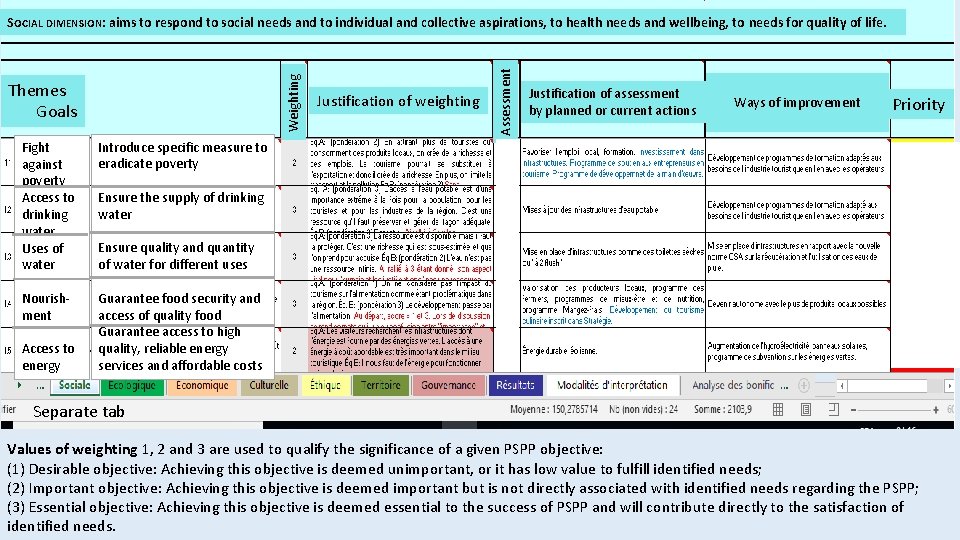
Themes Goals Justification of weighting Assessment Weighting SOCIAL DIMENSION: aims to respond to social needs and to individual and collective aspirations, to health needs and wellbeing, to needs for quality of life. Justification of assessment by planned or current actions Ways of improvement Priority Fight against poverty Access to drinking water Uses of water Introduce specific measure to eradicate poverty Act Ensure the supply of drinking water React Ensure quality and quantity of water for different uses React Nourishment Guarantee food security and access of quality food Guarantee access to high quality, reliable energy services and affordable costs Access to energy Act React Separate tab Values of weighting 1, 2 and 3 are used to qualify the significance of a given PSPP objective: (1) Desirable objective: Achieving this objective is deemed unimportant, or it has low value to fulfill identified needs; (2) Important objective: Achieving this objective is deemed important but is not directly associated with identified needs regarding the PSPP; (3) Essential objective: Achieving this objective is deemed essential to the success of PSPP and will contribute directly to the satisfaction of identified needs.
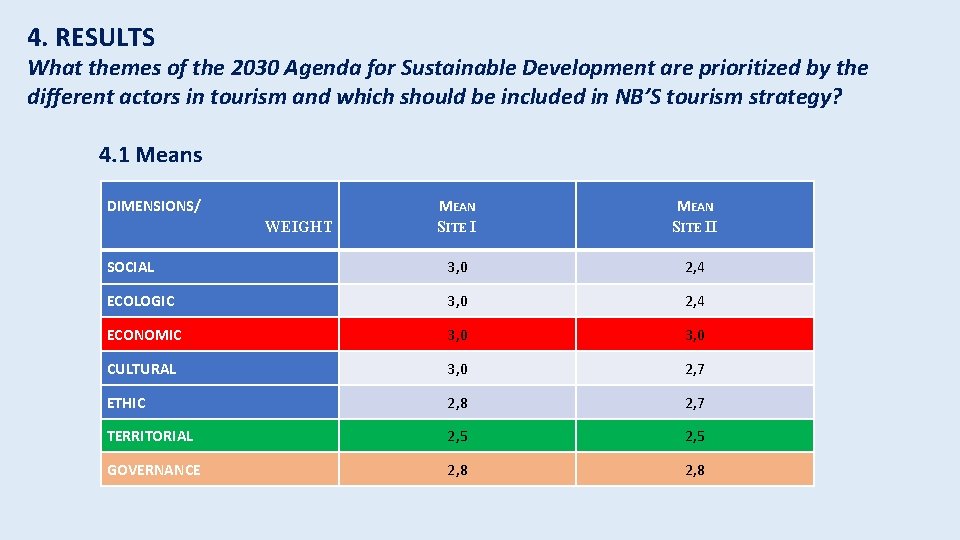
4. RESULTS What themes of the 2030 Agenda for Sustainable Development are prioritized by the different actors in tourism and which should be included in NB’S tourism strategy? 4. 1 Means DIMENSIONS/ MEAN SITE II SOCIAL 3, 0 2, 4 ECOLOGIC 3, 0 2, 4 ECONOMIC 3, 0 CULTURAL 3, 0 2, 7 ETHIC 2, 8 2, 7 TERRITORIAL 2, 5 GOVERNANCE 2, 8 WEIGHT
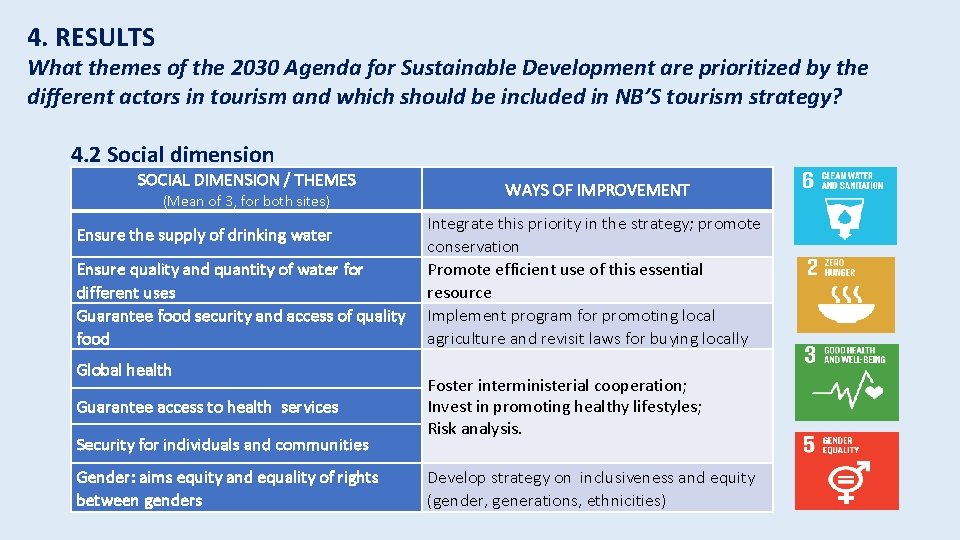
4. RESULTS What themes of the 2030 Agenda for Sustainable Development are prioritized by the different actors in tourism and which should be included in NB’S tourism strategy? 4. 2 Social dimension SOCIAL DIMENSION / THEMES (Mean of 3, for both sites) Ensure the supply of drinking water Ensure quality and quantity of water for different uses Guarantee food security and access of quality food Global health Guarantee access to health services Security for individuals and communities Gender: aims equity and equality of rights between genders WAYS OF IMPROVEMENT Integrate this priority in the strategy; promote conservation Promote efficient use of this essential resource Implement program for promoting local agriculture and revisit laws for buying locally Foster interministerial cooperation; Invest in promoting healthy lifestyles; Risk analysis. Develop strategy on inclusiveness and equity (gender, generations, ethnicities)
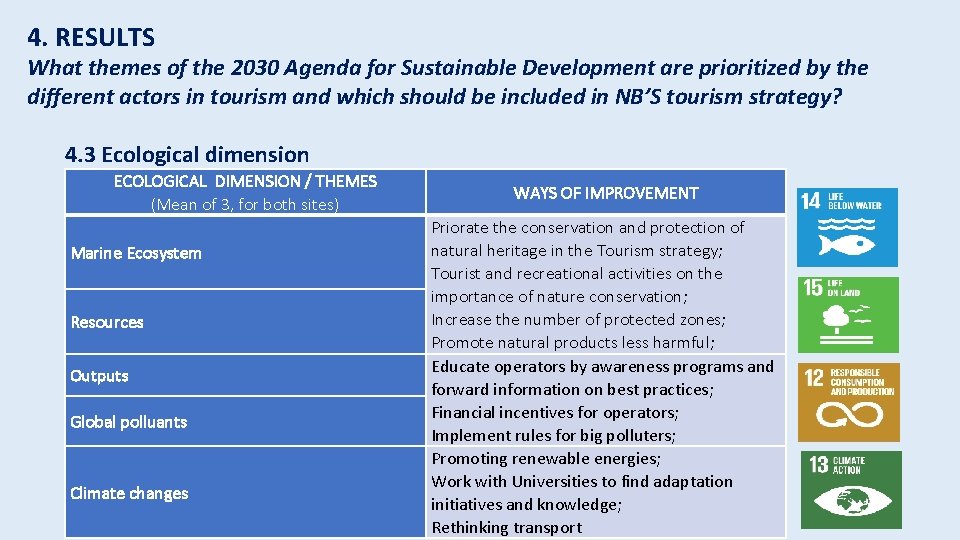
4. RESULTS What themes of the 2030 Agenda for Sustainable Development are prioritized by the different actors in tourism and which should be included in NB’S tourism strategy? 4. 3 Ecological dimension ECOLOGICAL DIMENSION / THEMES (Mean of 3, for both sites) Marine Ecosystem Resources Outputs Global polluants Climate changes WAYS OF IMPROVEMENT Priorate the conservation and protection of natural heritage in the Tourism strategy; Tourist and recreational activities on the importance of nature conservation; Increase the number of protected zones; Promote natural products less harmful; Educate operators by awareness programs and forward information on best practices; Financial incentives for operators; Implement rules for big polluters; Promoting renewable energies; Work with Universities to find adaptation initiatives and knowledge; Rethinking transport
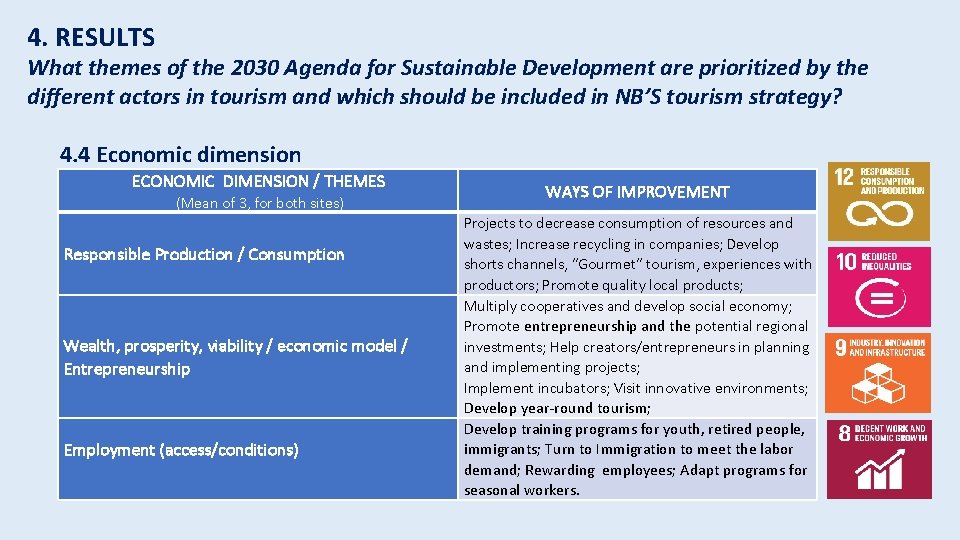
4. RESULTS What themes of the 2030 Agenda for Sustainable Development are prioritized by the different actors in tourism and which should be included in NB’S tourism strategy? 4. 4 Economic dimension ECONOMIC DIMENSION / THEMES (Mean of 3, for both sites) Responsible Production / Consumption Wealth, prosperity, viability / economic model / Entrepreneurship Employment (access/conditions) WAYS OF IMPROVEMENT Projects to decrease consumption of resources and wastes; Increase recycling in companies; Develop shorts channels, “Gourmet” tourism, experiences with productors; Promote quality local products; Multiply cooperatives and develop social economy; Promote entrepreneurship and the potential regional investments; Help creators/entrepreneurs in planning and implementing projects; Implement incubators; Visit innovative environments; Develop year-round tourism; Develop training programs for youth, retired people, immigrants; Turn to Immigration to meet the labor demand; Rewarding employees; Adapt programs for seasonal workers.
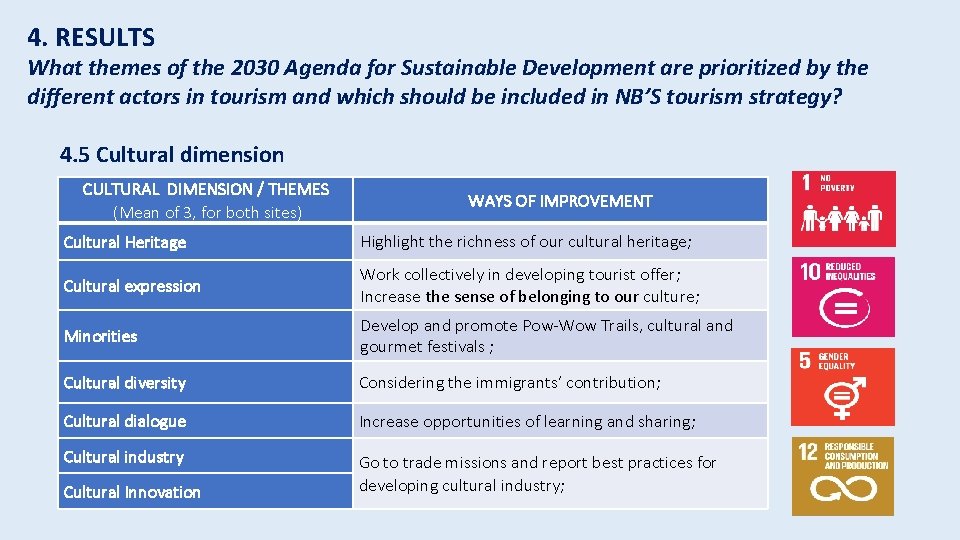
4. RESULTS What themes of the 2030 Agenda for Sustainable Development are prioritized by the different actors in tourism and which should be included in NB’S tourism strategy? 4. 5 Cultural dimension CULTURAL DIMENSION / THEMES (Mean of 3, for both sites) WAYS OF IMPROVEMENT Cultural Heritage Highlight the richness of our cultural heritage; Cultural expression Work collectively in developing tourist offer; Increase the sense of belonging to our culture; Minorities Develop and promote Pow-Wow Trails, cultural and gourmet festivals ; Cultural diversity Considering the immigrants’ contribution; Cultural dialogue Increase opportunities of learning and sharing; Cultural industry Go to trade missions and report best practices for developing cultural industry; Cultural Innovation
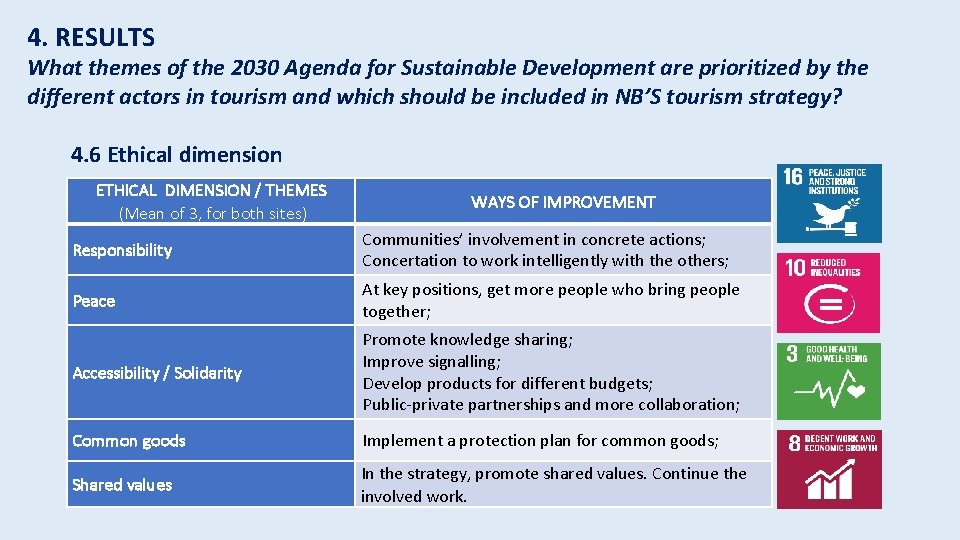
4. RESULTS What themes of the 2030 Agenda for Sustainable Development are prioritized by the different actors in tourism and which should be included in NB’S tourism strategy? 4. 6 Ethical dimension ETHICAL DIMENSION / THEMES (Mean of 3, for both sites) WAYS OF IMPROVEMENT Responsibility Communities’ involvement in concrete actions; Concertation to work intelligently with the others; Peace At key positions, get more people who bring people together; Accessibility / Solidarity Promote knowledge sharing; Improve signalling; Develop products for different budgets; Public-private partnerships and more collaboration; Common goods Implement a protection plan for common goods; Shared values In the strategy, promote shared values. Continue the involved work.
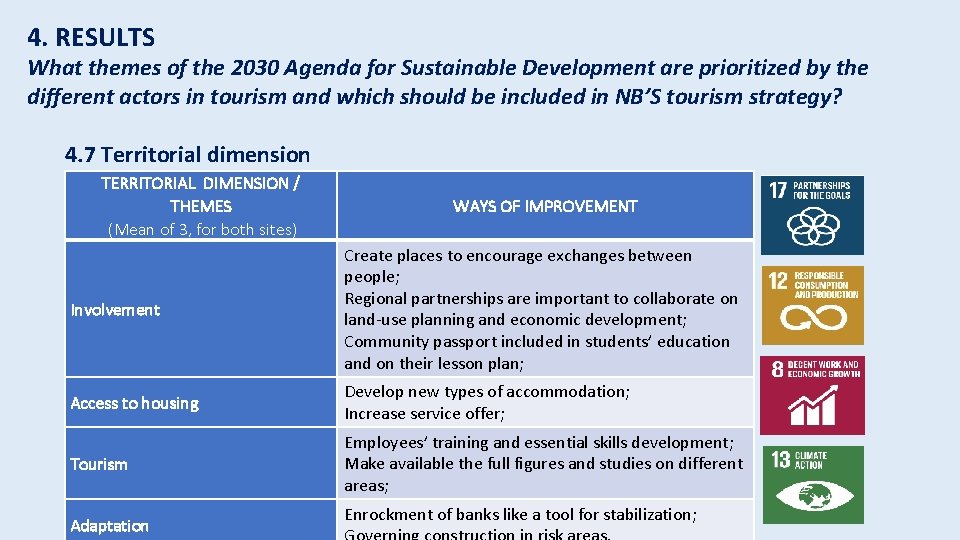
4. RESULTS What themes of the 2030 Agenda for Sustainable Development are prioritized by the different actors in tourism and which should be included in NB’S tourism strategy? 4. 7 Territorial dimension TERRITORIAL DIMENSION / THEMES (Mean of 3, for both sites) WAYS OF IMPROVEMENT Involvement Create places to encourage exchanges between people; Regional partnerships are important to collaborate on land-use planning and economic development; Community passport included in students’ education and on their lesson plan; Access to housing Develop new types of accommodation; Increase service offer; Tourism Employees’ training and essential skills development; Make available the full figures and studies on different areas; Adaptation Enrockment of banks like a tool for stabilization;
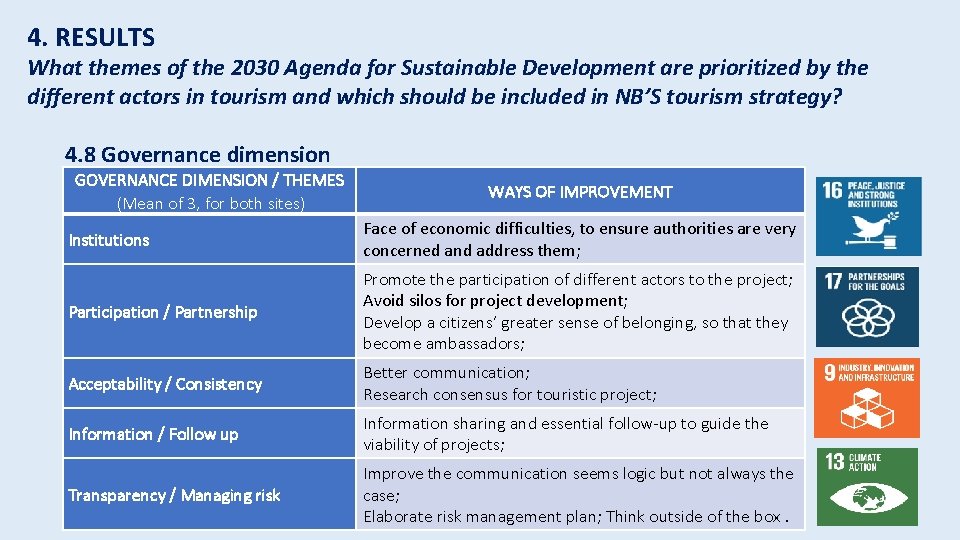
4. RESULTS What themes of the 2030 Agenda for Sustainable Development are prioritized by the different actors in tourism and which should be included in NB’S tourism strategy? 4. 8 Governance dimension GOVERNANCE DIMENSION / THEMES (Mean of 3, for both sites) WAYS OF IMPROVEMENT Institutions Face of economic difficulties, to ensure authorities are very concerned and address them; Participation / Partnership Promote the participation of different actors to the project; Avoid silos for project development; Develop a citizens’ greater sense of belonging, so that they become ambassadors; Acceptability / Consistency Better communication; Research consensus for touristic project; Information / Follow up Information sharing and essential follow-up to guide the viability of projects; Transparency / Managing risk Improve the communication seems logic but not always the case; Elaborate risk management plan; Think outside of the box.
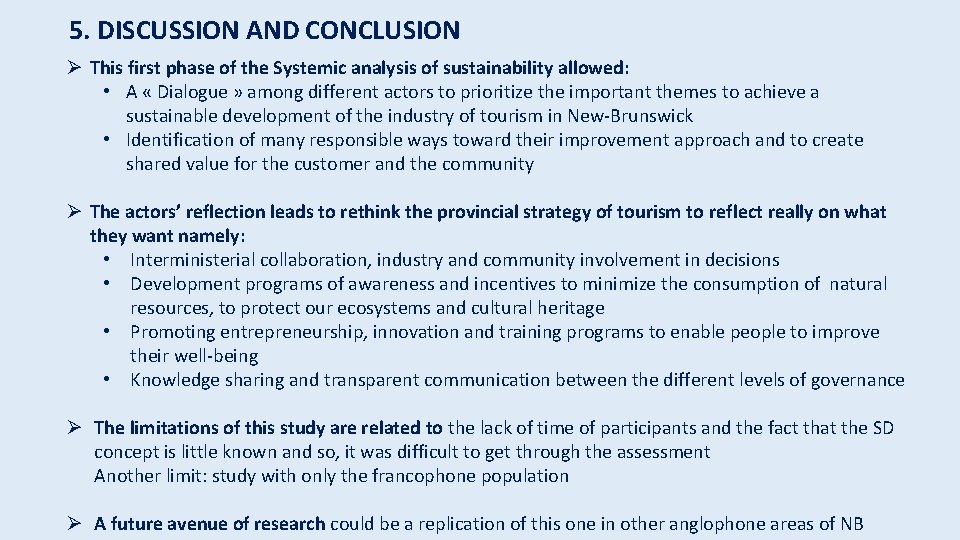
5. DISCUSSION AND CONCLUSION Ø This first phase of the Systemic analysis of sustainability allowed: • A « Dialogue » among different actors to prioritize the important themes to achieve a sustainable development of the industry of tourism in New-Brunswick • Identification of many responsible ways toward their improvement approach and to create shared value for the customer and the community Ø The actors’ reflection leads to rethink the provincial strategy of tourism to reflect really on what they want namely: • Interministerial collaboration, industry and community involvement in decisions • Development programs of awareness and incentives to minimize the consumption of natural resources, to protect our ecosystems and cultural heritage • Promoting entrepreneurship, innovation and training programs to enable people to improve their well-being • Knowledge sharing and transparent communication between the different levels of governance Ø The limitations of this study are related to the lack of time of participants and the fact that the SD concept is little known and so, it was difficult to get through the assessment Another limit: study with only the francophone population Ø A future avenue of research could be a replication of this one in other anglophone areas of NB
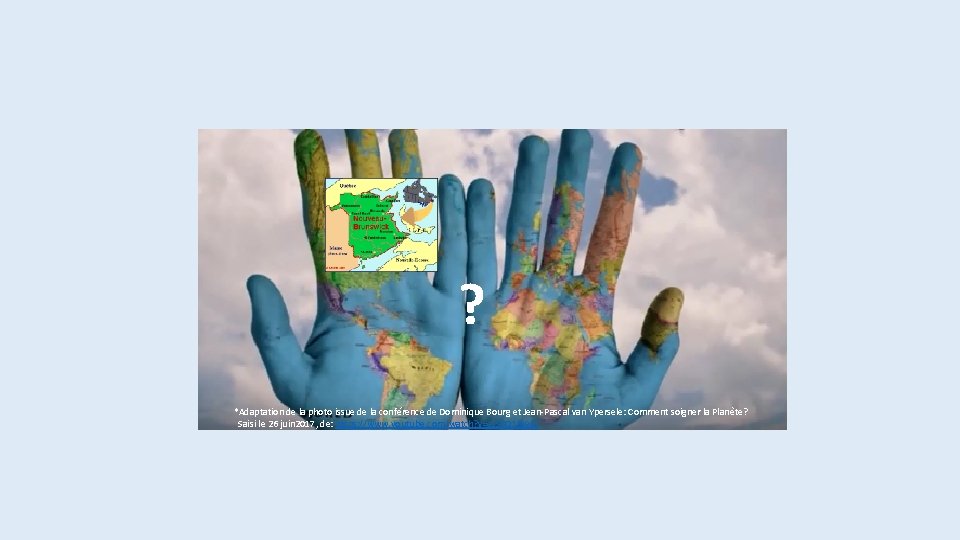
? *Adaptation de la photo issue de la conférence de Dominique Bourg et Jean-Pascal van Ypersele: Comment soigner la Planète? Saisi le 26 juin 2017, de: https: //www. youtube. com/watch? v=e. JS 3 Q 1 fg 9 CI
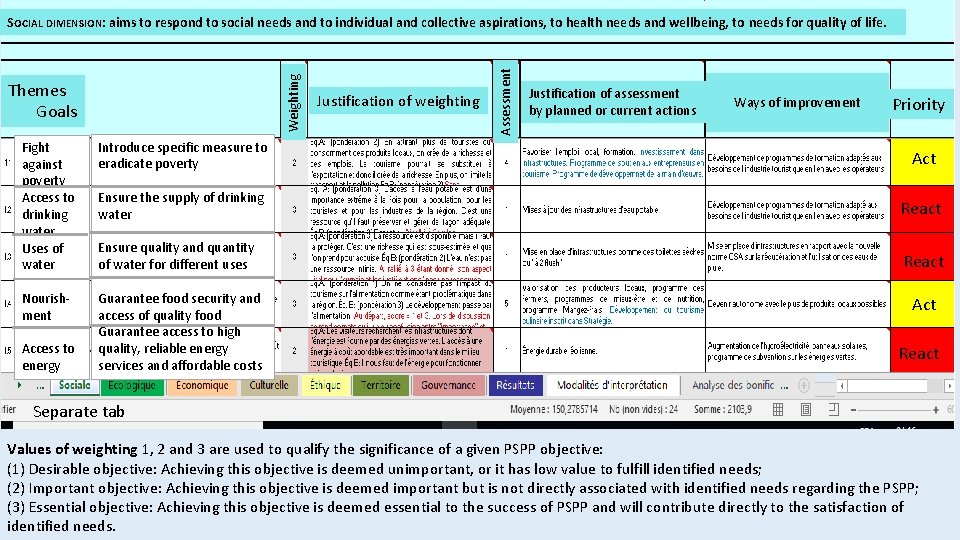
Themes Goals Justification of weighting Assessment Weighting SOCIAL DIMENSION: aims to respond to social needs and to individual and collective aspirations, to health needs and wellbeing, to needs for quality of life. Justification of assessment by planned or current actions Ways of improvement Priority Fight against poverty Access to drinking water Uses of water Introduce specific measure to eradicate poverty Act Ensure the supply of drinking water React Ensure quality and quantity of water for different uses React Nourishment Guarantee food security and access of quality food Guarantee access to high quality, reliable energy services and affordable costs Access to energy Act React Separate tab Values of weighting 1, 2 and 3 are used to qualify the significance of a given PSPP objective: (1) Desirable objective: Achieving this objective is deemed unimportant, or it has low value to fulfill identified needs; (2) Important objective: Achieving this objective is deemed important but is not directly associated with identified needs regarding the PSPP; (3) Essential objective: Achieving this objective is deemed essential to the success of PSPP and will contribute directly to the satisfaction of identified needs.
- Slides: 21