
BRIGHT LIGHTS OF SARAJEVO EDEXCEL IGCSE ANTHOLOGY B
BRIGHT LIGHTS OF SARAJEVO: EDEXCEL IGCSE ANTHOLOGY B 30 OCTOBER 2020 Jonathan Peel JLS 2016

After the hours that Sarajevans pass beyond the tone of voice and match-lit flare test Queuing with empty canisters of gas and he’s about, I think, to take her hand to get the refills they wheel home in prams, and lead her away from where they stand or queuing for the precious meagre grams on two shells scars, where, in 1992 of bread they’re rationed to each day, Serb mortars massacred the breadshop queue and often dodging snipers on the way, and blood-dunked crusts of shredded bread or struggling up sometimes eleven flights lay on this pavement with the broken dead. of stairs with water, then you’d think the nights And at their feet in holes made by the mortar of Sarajevo would be totally devoid that caused the massacre, now full of water of people walking streets Serb shells destroyed, from the rain that’s poured down half the day, but tonight in Sarajevo that’s just not the case– though now even the smallest clouds have cleared away, The young go walking at a strollers pace, leaving the Sarajevo star-filled evening sky black shapes impossible to mark ideally bright and clear for the bombers eye, as Muslim, Serb or Croat in such dark, in those two rain-full shell-holes the boy sees in unlit streets you can’t distinguish who fragments of the splintered Pleiades, calls bread hjleb or hleb or calls it kruh, sprinkled on those death-deep, death-dark wells All takes the evening air with a strollers stride, splashed on the pavement by Serb mortar shells. no torches guide them, but they don’t collide The dark boy-shape leads dark-girl shape away except as one of the flirtatious ploys to share one coffee in a candlelit café when a girl’s dark shape is fancied by a boy’s. until the curfew, and he holds her hand Then the tender radar of the tone of voice behind AID flour-sacks refilled with sand. shows by its signals she approves his choice. Then match or lighter to a cigarette to check in her eyes if he’s made progress yet. And I see a pair who’ve certainly progressed Jonathan Peel JLS 2016 Tony Harrison

PHASE 1 Read the poem silently. Do not talk and do not be distracted by anything. As you read, remember to feel the text in your mouth. You can still “speak” the words without talking. With a pencil underline or ring anything you find interesting. Pause Read it again, and this time let yourself dwell on points of interest. Annotate the poem in front of you. What stands out? Let’s talk. Jonathan Peel JLS 2016
PHASE 2 In simple terms, what is this poem about? During the Bosnian civil war in 1992 Sarajevo was besieged. This poem is written by an observer who notices a young couple among the detritus of war. One night, in the most unlikely circumstances, love is triumphant. Jonathan Peel JLS 2016
PHASE 3: SCASI SETTING Answer these questions: Where is the poem set? What time of day is it? When is it? What is the prevailing atmosphere? For each, find An example and explain the choice of language. Jonathan Peel JLS 2016
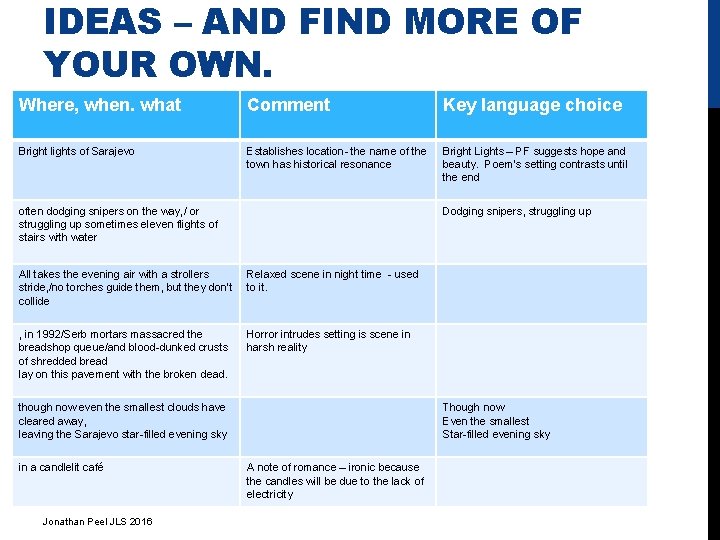
IDEAS – AND FIND MORE OF YOUR OWN. Where, when. what Comment Key language choice Bright lights of Sarajevo Establishes location- the name of the town has historical resonance Bright Lights – PF suggests hope and beauty. Poem’s setting contrasts until the end often dodging snipers on the way, / or struggling up sometimes eleven flights of stairs with water Dodging snipers, struggling up All takes the evening air with a strollers stride, /no torches guide them, but they don’t collide Relaxed scene in night time - used to it. , in 1992/Serb mortars massacred the breadshop queue/and blood-dunked crusts of shredded bread lay on this pavement with the broken dead. Horror intrudes setting is scene in harsh reality though now even the smallest clouds have cleared away, leaving the Sarajevo star-filled evening sky in a candlelit café Jonathan Peel JLS 2016 Though now Even the smallest Star-filled evening sky A note of romance – ironic because the candles will be due to the lack of electricity
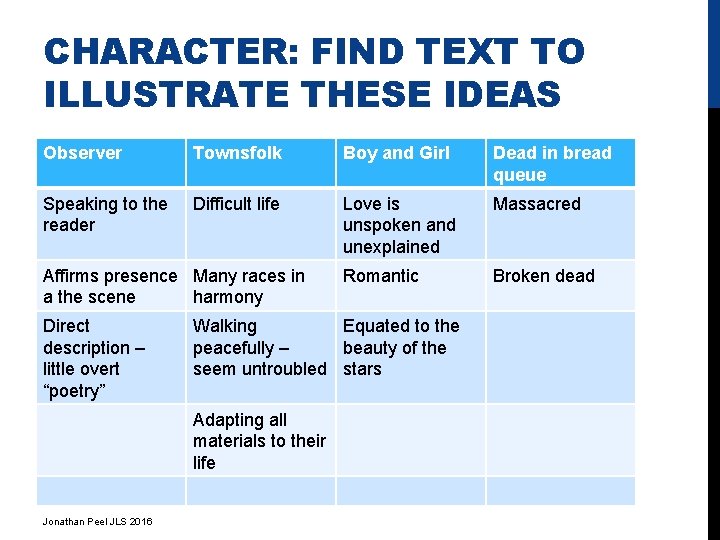
CHARACTER: FIND TEXT TO ILLUSTRATE THESE IDEAS Observer Townsfolk Boy and Girl Dead in bread queue Speaking to the reader Difficult life Love is unspoken and unexplained Massacred Romantic Broken dead Affirms presence Many races in a the scene harmony Direct description – little overt “poetry” Walking Equated to the peacefully – beauty of the seem untroubled stars Adapting all materials to their life Jonathan Peel JLS 2016
ACTION Look at the verbs of action in the opening of Stanza 1: queuing, rationed, wheel home, dodging, struggling. What sort of action is suggested by this lexis? Then look at these words from a little later in the poem: strolling, stroller’s stride, don’t collide, flirtatious, tender radar. What do you notice about this set of words and how does it affect the “feel” of the poem? TASK: In stanza 2, find similar examples of the juxtaposition of ideas of war and ideas of love shown by the choice of language. Jonathan Peel JLS 2016
STYLE You have read 3 poems thus far – Disabled, -Out, out and Unknown Girl. What do you notice about the language chosen here? Harrison was working as a war correspondent poet in Sarajevo in 1992. How might his language reflect that he is writing news in poetic form? Look at the sentence length. Why do you think Harrison is telling his story ion such long sentences? Each couplet rhymes. How might this reflect the message of the poem? There is much enjambment which allows the poem to feel almost like natural speech. Why might this be? Jonathan Peel JLS 2016
IDEAS Questions need to be asked? Who or what are the bright lights of Sarajevo? Civil war sets people against themselves and family against family. How does Harrison gently show the reader that this behaviour is not being seen in Sarajevo? What might be the significance of the water in the mortar holes in ll 33 ff? What is Harrison suggesting here? What is Harrison’s final message in this poem concerning the war? Jonathan Peel JLS 2016
- Slides: 10