
BRIGHT FIELD MICROSCOPY OBJECTIVES TO BE ABLE TO
BRIGHT FIELD MICROSCOPY
OBJECTIVES TO BE ABLE TO • DEFINE BRIGHT FIELD MICROSCOPY • TO CALCULATE TOTAL MAGINIFICATION • TO IDENTIFY THE PARTS OF A COMPOUND MICROSCOPE • TO GIVE THE FUNCTION OF EACH PART • TO KNOW THE USE OF MICROMETER • TO STATE THE USES OF BRIGHT FIELD MICROSCOPY
BRIGHT FIELD MICROSCOPY • ILLUMINATED FROM BELOW • OBSERVED FROM ABOVE • WHITE LIGHT IS USED FOR ILLUMINATION • SPECIMEN APPEARS DARK • BACKGROUND IS BRIGHT
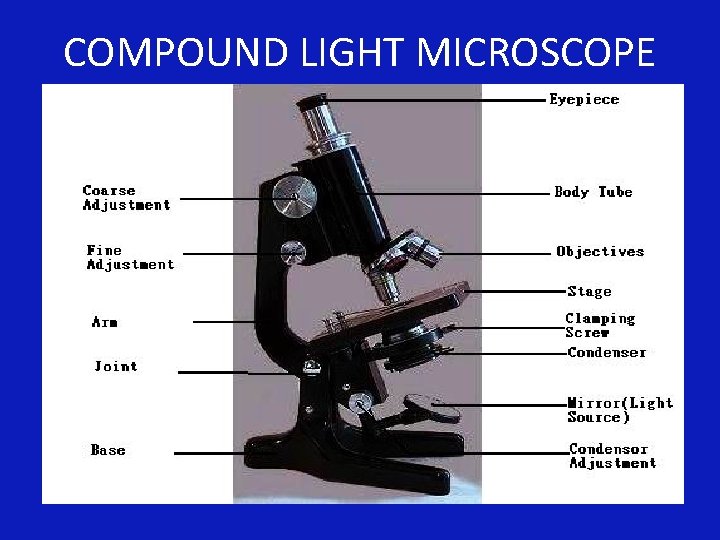
COMPOUND LIGHT MICROSCOPE
PARTS OF A MICROSCOPE • Head/Body houses the optical parts in the upper part of the microscope • Base of the microscope supports the microscope and houses the illuminator • Arm connects to the base and supports the microscope head. It is also used to carry the microscope.
PARTS OF A MICROSCOPE • Eyepiece or Ocular : have a magnifying power of 10 x. Monocular Binocular • Objective Lenses : Lenses closer to the objective • Nosepiece houses the objectives. • Coarse and Fine Focus knobs are used to focus the microscope.
PARTS OF A MICROSCOPE • Stage is where the specimen is placed. • Illuminator is the light source for a microscope • Condenser is used to collect and focus the light • Iris Diaphragm controls the amount of light reaching the specimen. • Condenser Focus Knob moves the condenser up or down
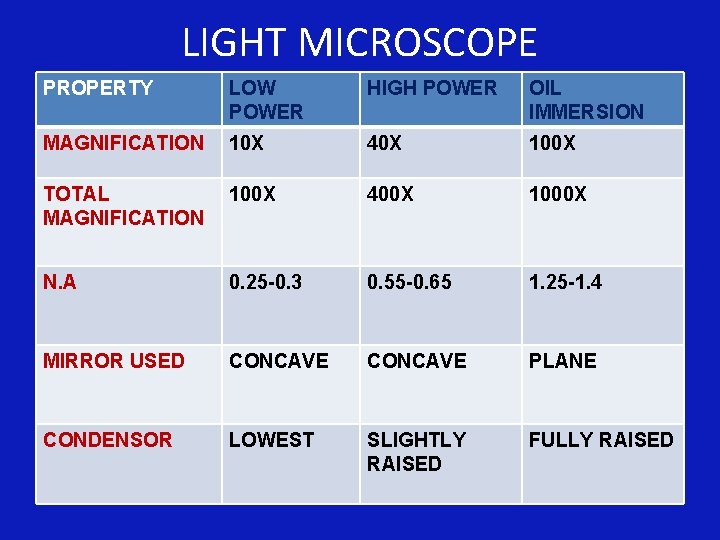
LIGHT MICROSCOPE PROPERTY LOW POWER HIGH POWER OIL IMMERSION MAGNIFICATION 10 X 40 X 100 X TOTAL MAGNIFICATION 100 X 400 X 1000 X N. A 0. 25 -0. 3 0. 55 -0. 65 1. 25 -1. 4 MIRROR USED CONCAVE PLANE CONDENSOR LOWEST SLIGHTLY RAISED FULLY RAISED
TERMS TO KNOW Working distance • It is the distance between the objective and the slide • The distance decreases with increasing magnification Limit of Resolution : the lesser the better Wavelength of light 2 x Numerical Aperture
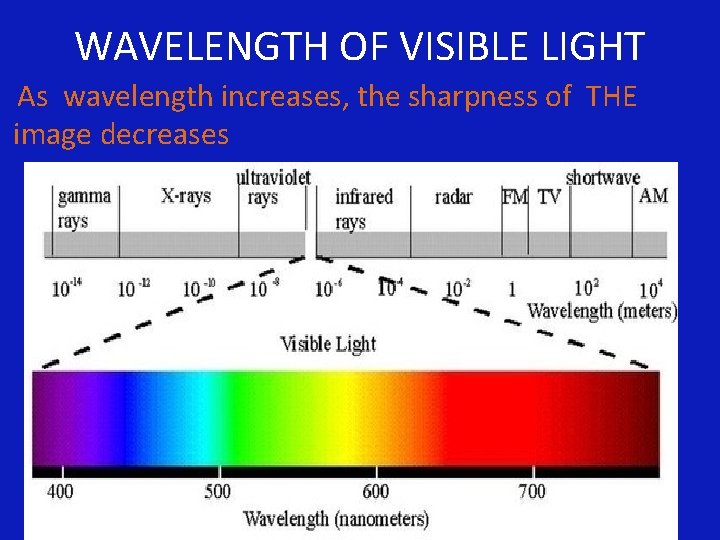
WAVELENGTH OF VISIBLE LIGHT As wavelength increases, the sharpness of THE image decreases
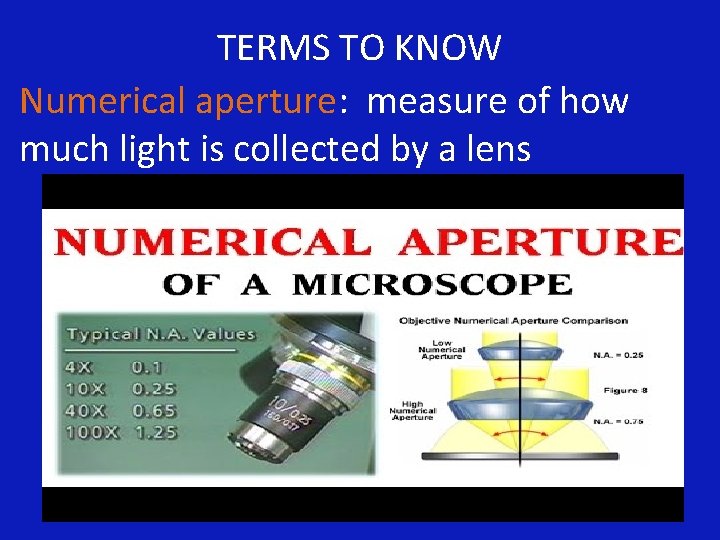
TERMS TO KNOW Numerical aperture: measure of how much light is collected by a lens
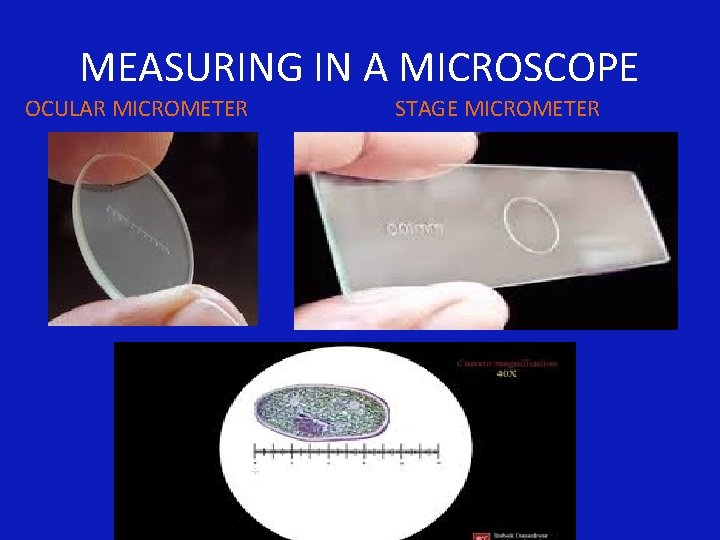
MEASURING IN A MICROSCOPE OCULAR MICROMETER STAGE MICROMETER
ADVANTAGES • • • TO OBSERVE STAINED SPECIMENS TO OBSERVE LIVING CELLS TO OBSERVE MOTILITY OF CELLS TO OBSERVE NORMAL BEHAVIOUR OF CELLS EASE OF USE EASE OF SAMPLE PREPARATION
LIMITATIONS • • • Low contrast of most biological samples. The practical limit to magnification Clarity decreases as the magnification increases. Samples that are naturally colorless Samples often have to be stained before viewing.
CHECK YOUR UNDERSTANDING 1. Immersion oil prevents the _____ of light. 2. The high power objective has a magnification of _____ X 3. The area on the slide observed when looking through the ocular is called the ___ __ ___. 4. If the 10 X objective is in use the total magnification is ______X. 5. The part of the microscope that regulates the intensity of light on the specimen______. (40, 100, CONDENSER, FIELD OFVIEW, REFRACTION)
- Slides: 15