
BRIEFING SESSION ATTENDANCE PANEL Session Outline LCC Sickness
BRIEFING SESSION ATTENDANCE PANEL
Session Outline • LCC Sickness Absence Policy • What does non-attendance mean to the Organisation? • Progress and Initiatives on Sickness Absence • Case Review Meetings • Employment Law Awareness • Attendance Panel • Appeals Process • Sources of Support
LCC Sickness Absence Policy • Lancashire County Council is committed to providing an efficient, economical and effective service. To achieve this aim, a high level of attendance from employees is essential. • Whilst recognising that employees may be prevented from attending work through ill health, the Authority has a duty to maintain service delivery and minimise disruption.
What Does Non-Attendance mean to the Organisation? • The overall figure for Sickness Absence for 2005/6 was 10. 47 days person • In 2005/6 short-term absence accounted for approx 35% of total lost time • In 2005/6 long-term absence (over 3 calendar wks in duration) accounted for approx 65% of all lost time • Sickness Absence costs the County Council around £ 19 m per year
Initiatives on Sickness Absence • Introduce more operational managers into Attendance Panels • Publicise the number of Attendance Panel dismissals & ill health retirements • Provide similar information (to 2) to address staff perceptions of effectiveness of Attendance Policies • Ensure attendance & management issues are on Team Briefing Agendas & on Management Team Agendas
Initiatives on Sickness Absence • Explore the use of more preventative measures • Identify with Occupational Health early intervention options (stress cases) and also determine if automatic referral is always the best response • Identify if comparative data available from other Local Authorities at a general service level and publicise
Initiatives on Sickness Absence • Review targets for improvements in respect of Directorate performance and identify accountable officers • Identify how officers are going to be accountable • Review suggested timeframes to identify if case reviews can be undertaken earlier in process • Include in discussions with TU proposal to remove LCC extension of sick pay arrangements
Progress on Sickness Absence • Numerous initiatives are ongoing within Dir/DSO’s to address levels of sickness including more vigorous monitoring of absence levels and awareness raising • Extra resources have been allocated to help reduce delays in obtaining occupational health appointments • A review of existing Policy and practice has been undertaken and it is envisaged that the new Policy will encourage earlier line management intervention
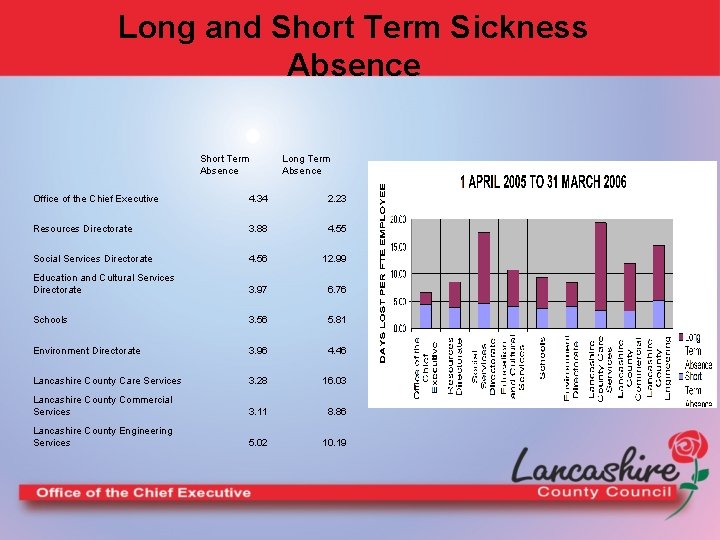
Long and Short Term Sickness Absence Short Term Absence Long Term Absence Office of the Chief Executive 4. 34 2. 23 Resources Directorate 3. 88 4. 55 Social Services Directorate 4. 56 12. 99 Education and Cultural Services Directorate 3. 97 6. 76 Schools 3. 56 5. 81 Environment Directorate 3. 96 4. 46 Lancashire County Care Services 3. 28 16. 03 Lancashire County Commercial Services 3. 11 8. 86 Lancashire County Engineering Services 5. 02 10. 19
Case Review Meetings • Where a period of absence exceeds 8 weeks a report will be referred to a Dir/DSO level Case Review Meeting chaired by a second tier officer (or other senior nominated officer) • In attendance at the meeting will be the employee and his/her representative, the line manager (or senior line manager) and a representative from HR
Case Review Process The Chair of the meeting will have placed before him/her: - • A record of the employee’s absence history • All correspondence relating to action taken to date • Current medical evidence and any previous advice
Case Review Process The purpose of the Case Review Meeting is to ensure that everything possible has been done to facilitate an early return to work During the course of the meeting the following issues will be considered: - • The circumstances surrounding the absence from work • Any action taken to date to facilitate a return • Any barriers (perceived or otherwise) preventing a return to work • Available medical opinion • Any reasonable adjustments and/or other progressive actions to facilitate a return to work
Referrals to Attendance Panel • A referral may be made to Panel where continuous sickness absence exceeds three months • Referrals at an early stage (e. g. three months) are likely to be made where an employee has had other significant periods of absence during the previous twelve months • All cases where absence due to sickness exceeds six months in any twelve month period will be reported to Attendance Panel • Following stage three of the unacceptable repeated absence procedure
Disability Discrimination Act 1995 (DDA) • Defines disability as ‘A physical or mental impairment which has a substantial and longterm adverse effect on his/her ability to carry out normal day-to-day activities’ • (NB. People who have Cancer, HIV or MS are covered by DDA from the point of diagnosis. People with a past disability or severe disfigurement are also covered by the Act
DDA 2004 Changes • Direct Discrimination • Failure to make reasonable adjustments • Disability Related Discrimination
General Employment Law Awareness Dismissal and the need for Consistency – • Officers on Attendance Panels are normally expected to dismiss employees whose absences are expected to continue over the next three to six months with no prospect of a return to work • Where an employee is dismissed by the Attendance Panel the notice period will commence with immediate effect from the date of the Panel Hearing
General Employment Law Awareness Capability – • The Capability Procedure should be dealt with separately to the Sickness Absence Policy. The Attendance Panel will not consider matters which relate to Capability, only sickness absence • Capability Procedure deals with all instances where the capability of an employee to perform their duties to an acceptable standard is seriously in question.
Role of the Attendance Panel Options available to Panel include: - • To note progress/action proposed by the employing Dir/DSO • To defer consideration of a case pending medical advice or a search for alternative employment • To comment on the quality of reports presented to Panel by the Dir/DSO via Corporate HR
Role of the Attendance Panel – cont’d Options available to Panel include: - • To recommend any further action to be undertaken by the Dir/DSO and/or employee • To dismiss an employee with due notice or with pay in lieu of notice
Attendance Panel • Meeting of Panel • Panel Composition • Chair • Clerk
Attendance Panel Cont’d • Panel Cases • Report • Other information
Role Of Chair • Introduction • Process • Decision
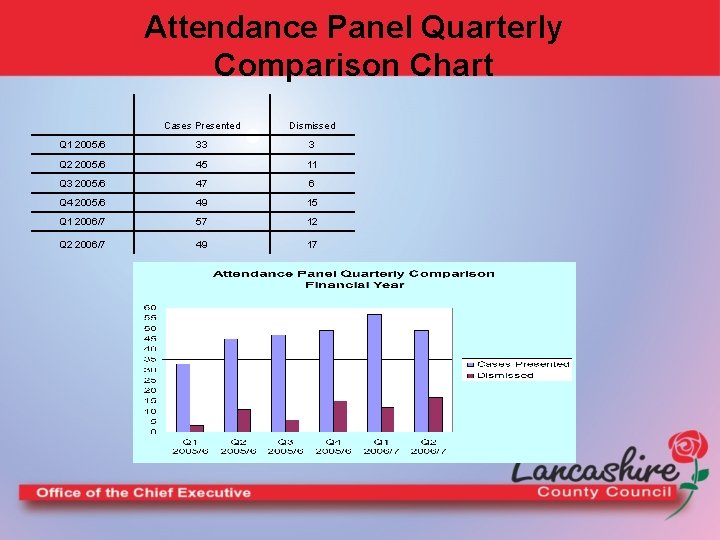
Attendance Panel Quarterly Comparison Chart Cases Presented Dismissed Q 1 2005/6 33 3 Q 2 2005/6 45 11 Q 3 2005/6 47 6 Q 4 2005/6 49 15 Q 1 2006/7 57 12 Q 2 2006/7 49 17
Appeals Process Officers on Appeals Panels are normally only expected to overturn decisions of Attendance Panels where: - • There has been a failure to follow procedure • Where new medical evidence has come to light indicating the employees ability to return to work • Where dismissal has occurred where the employee gave evidence that he/she could reasonably be expected to return to work within the termination notice period
Appeals Process • If an employee does wish to appeal, they must inform the Clerk to the Attendance Panel of this in writing within five working days of receipt of the written notification • The employee will be invited to attend an Appeal Hearing and can be accompanied by a work colleague or trade union representative • The employee must take all reasonable steps to attend that meeting.
Appeals Process Cont’d • The appeal hearing need not take place before the dismissal takes effect • The Appeal will be heard by a Panel of three senior officers with no previous involvement in the case • After the Appeal meeting, the employing Directorate/DSO must inform the employee of the final decision
Sources of Support • Senior Management • HR Team • Employee Welfare & Counselling • Occupational Health Unit
Coming to the Right Decision Has the following been considered: • Sickness Absence Procedure • How long has the employee been off sick? • What is the prognosis for a return to the workplace? • Is there a reasonable expectation of a return to work • Is there a previous history of non-return to work?
Coming to the Right Decision – Cont’d • Has reasonable time been allowed to assess/implement reasonable adjustments? • Have DDA issues been fully considered? • Consider the County Council’s expectation of absence tolerance (expectation of length of time) • Are there any special circumstances for deferral/non-dismissal?

QUESTIONS
- Slides: 30