
Briefing MultiStakeholder Collaboration in PatientReported Outcomes Measurement Statewide
Briefing: Multi-Stakeholder Collaboration in Patient-Reported Outcomes Measurement Statewide Quality Advisory Committee Meeting June 17, 2013 Linda Shaughnessy, Project Director - MHQP
Briefing: Multi-stakeholder Collaboration in Patient-Reported Outcomes Measurement I. About MHQP II. Highlights: Spring 2013 MHQP PRO Measurement Meeting Perspectives Issues & Challenges Opportunities for Collaboration III. Considerations © MHQP 2013 2
About Massachusetts Health Quality Partners © MHQP 2013 Established in 1995 A broad based coalition of physicians, hospitals, health plans, purchasers, patient and public representatives, academics, and government agencies MHQP's mission: Drive measureable improvements in health care quality, patients’ experiences of care, and use of resources in Massachusetts through patient and public engagement and broad-based collaboration among health care stakeholders 3

Quality Measurement Landscape Patient-Centered Measures Provider-Focused Measures Clinical Quality – Process, Structural and Safety Examples: • Recommended care provided for pneumonia, heart failure, heart attack, • Blood pressure control • Computer Physician Order Entry (CPOE) • Patient safety practices Outcomes Examples • Readmissions • Mortality © MHQP 2013 Chart/Claims-Based data Patient Experience Examples: • Hospital stay • Care at your doctor’s office Care Coordination/Transitions Examples: • Medication reconciliation • Discharge record – hospital to home or other care setting Patient-Reported Outcomes Area/Examples: • Health status (physical, social, emotional health – fatigue, pain scale, anxiety depression, social function at school or work ) • Functional status (ability to resume to desired activities of daily living post a hip or knee procedure) Patient-reported data (questionnaires or surveys) 4

Patient Reported Outcomes Measurement Patient-Reported Outcomes Measurement Area/Examples: • Health status (physical, social, emotional health – fatigue, pain scale, anxiety depression, social function at school or work ) • Functional status (ability to resume to desired activities of daily living post a surgical procedure) Working definition: Patients’ feedback on their feelings about their physical, mental and social health or what they are able to do (functional status) as they are dealing with chronic diseases or conditions; or when they are undergoing a treatment or a procedure Patient-Reported Outcomes Measure (PROMs) • Measure tool or instrument (survey) used to collect Patient Reported Outcomes data Critical Success Factor: Engaging the Patient © MHQP 2013 5
MHQP Multi-Stakeholder Collaboration in PRO Measurement - Spring 2013 Meeting To understand stakeholder perspectives, priorities and current experiences in PRO measurement To identify critical issues and challenges faced in advancing PRO measurement work To develop next steps and collaborative engagement in PRO measurement to: Provide better care Activate patients in improving their health Align multi-stakeholder resources and objectives © MHQP 2013 6
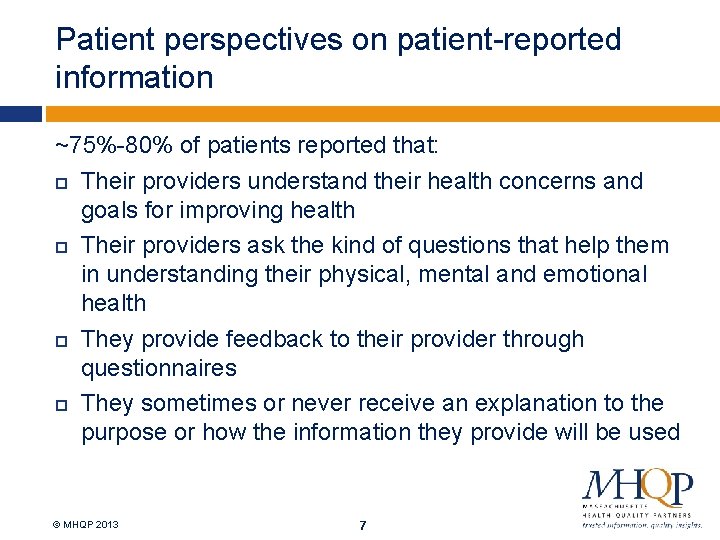
Patient perspectives on patient-reported information ~75%-80% of patients reported that: Their providers understand their health concerns and goals for improving health Their providers ask the kind of questions that help them in understanding their physical, mental and emotional health They provide feedback to their provider through questionnaires They sometimes or never receive an explanation to the purpose or how the information they provide will be used © MHQP 2013 7
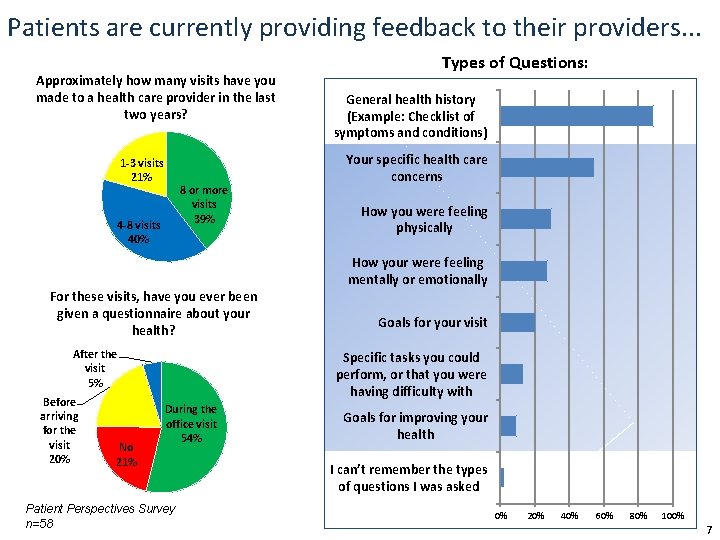
Patients are currently providing feedback to their providers. . . Approximately how many visits have you made to a health care provider in the last two years? 1 -3 visits 21% 8 or more visits 39% 4 -8 visits 40% Types of Questions: General health history (Example: Checklist of symptoms and conditions) Your specific health care concerns How you were feeling physically How your were feeling mentally or emotionally For these visits, have you ever been given a questionnaire about your health? After the visit 5% Before arriving for the visit 20% No 21% Goals for your visit Specific tasks you could perform, or that you were having difficulty with During the office visit 54% Patient Perspectives Survey n=58 Goals for improving your health I can’t remember the types of questions I was asked 0% 20% 40% 60% 80% 100% 7
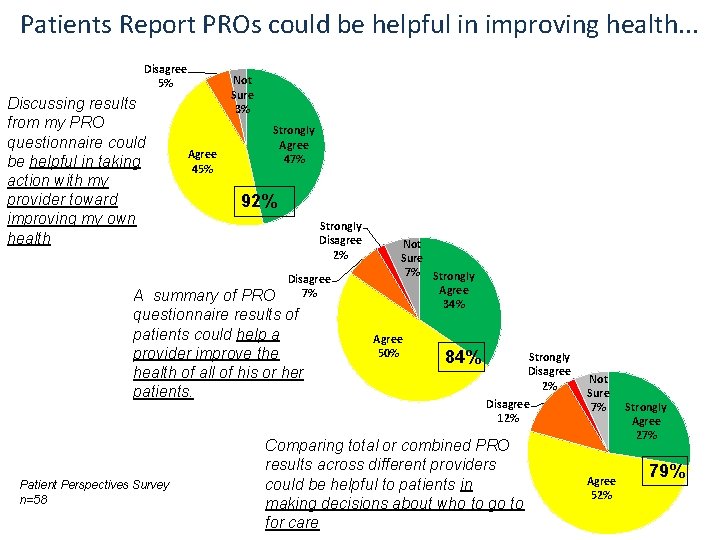
Patients Report PROs could be helpful in improving health. . . Disagree 5% Discussing results from my PRO questionnaire could be helpful in taking action with my provider toward improving my own health Not Sure 3% Agree 45% Strongly Agree 47% 92% Strongly Disagree 2% Disagree 7% A summary of PRO questionnaire results of patients could help a provider improve the health of all of his or her patients. Patient Perspectives Survey n=58 Not Sure 7% Strongly Agree 34% Agree 50% 84% Strongly Disagree 2% Disagree 12% Comparing total or combined PRO results across different providers could be helpful to patients in making decisions about who to go to for care Not Sure 7% Agree 52% Strongly Agree 27% 79%
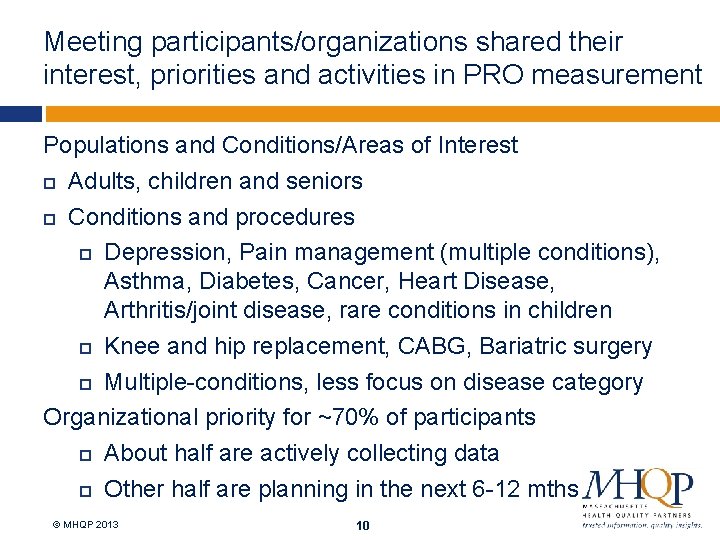
Meeting participants/organizations shared their interest, priorities and activities in PRO measurement Populations and Conditions/Areas of Interest Adults, children and seniors Conditions and procedures Depression, Pain management (multiple conditions), Asthma, Diabetes, Cancer, Heart Disease, Arthritis/joint disease, rare conditions in children Knee and hip replacement, CABG, Bariatric surgery Multiple-conditions, less focus on disease category Organizational priority for ~70% of participants About half are actively collecting data Other half are planning in the next 6 -12 mths © MHQP 2013 10
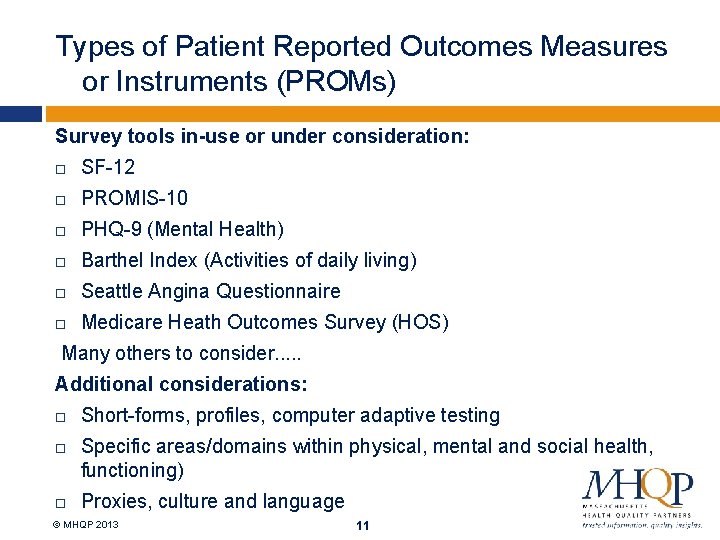
Types of Patient Reported Outcomes Measures or Instruments (PROMs) Survey tools in-use or under consideration: SF-12 PROMIS-10 PHQ-9 (Mental Health) Barthel Index (Activities of daily living) Seattle Angina Questionnaire Medicare Heath Outcomes Survey (HOS) Many others to consider. . . Additional considerations: Short-forms, profiles, computer adaptive testing Specific areas/domains within physical, mental and social health, functioning) Proxies, culture and language © MHQP 2013 11
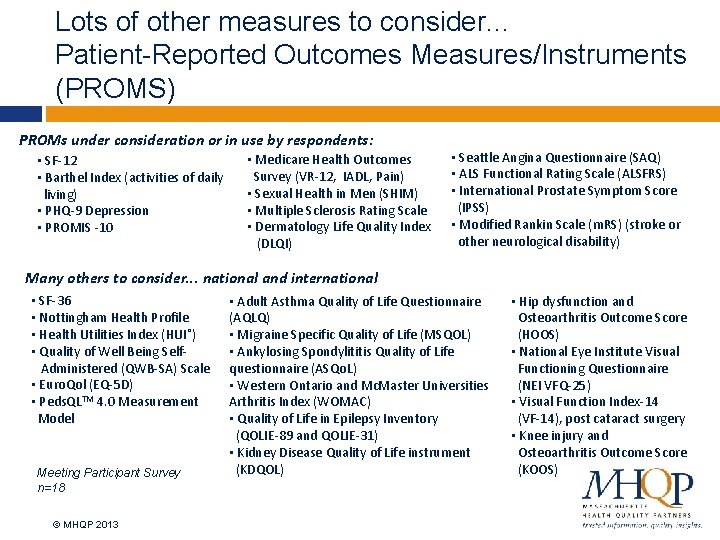
Lots of other measures to consider. . . Patient-Reported Outcomes Measures/Instruments (PROMS) PROMs under consideration or in use by respondents: • SF-12 • Barthel Index (activities of daily living) • PHQ-9 Depression • PROMIS -10 • Medicare Health Outcomes Survey (VR-12, IADL, Pain) • Sexual Health in Men (SHIM) • Multiple Sclerosis Rating Scale • Dermatology Life Quality Index (DLQI) • Seattle Angina Questionnaire (SAQ) • ALS Functional Rating Scale (ALSFRS) • International Prostate Symptom Score (IPSS) • Modified Rankin Scale (m. RS) (stroke or other neurological disability) Many others to consider. . . national and international • SF-36 • Nottingham Health Profile • Health Utilities Index (HUI®) • Quality of Well Being Self. Administered (QWB-SA) Scale • Euro. Qol (EQ-5 D) • Peds. QLTM 4. 0 Measurement Model Meeting Participant Survey n=18 © MHQP 2013 • Adult Asthma Quality of Life Questionnaire (AQLQ) • Migraine Specific Quality of Life (MSQOL) • Ankylosing Spondylititis Quality of Life questionnaire (ASQo. L) • Western Ontario and Mc. Master Universities Arthritis Index (WOMAC) • Quality of Life in Epilepsy Inventory (QOLIE-89 and QOLIE-31) • Kidney Disease Quality of Life instrument (KDQOL) • Hip dysfunction and Osteoarthritis Outcome Score (HOOS) • National Eye Institute Visual Functioning Questionnaire (NEI VFQ-25) • Visual Function Index-14 (VF-14), post cataract surgery • Knee injury and Osteoarthritis Outcome Score (KOOS)
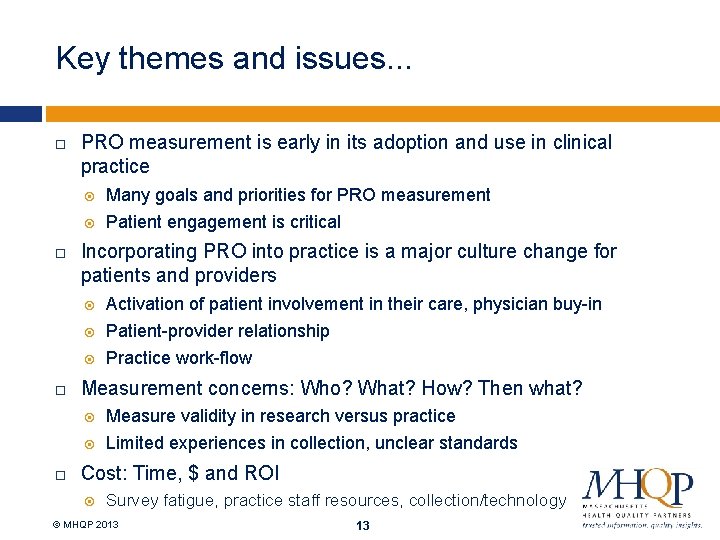
Key themes and issues. . . PRO measurement is early in its adoption and use in clinical practice Many goals and priorities for PRO measurement Patient engagement is critical Incorporating PRO into practice is a major culture change for patients and providers Activation of patient involvement in their care, physician buy-in Patient-provider relationship Practice work-flow Measurement concerns: Who? What? How? Then what? Measure validity in research versus practice Limited experiences in collection, unclear standards Cost: Time, $ and ROI Survey fatigue, practice staff resources, collection/technology © MHQP 2013 13
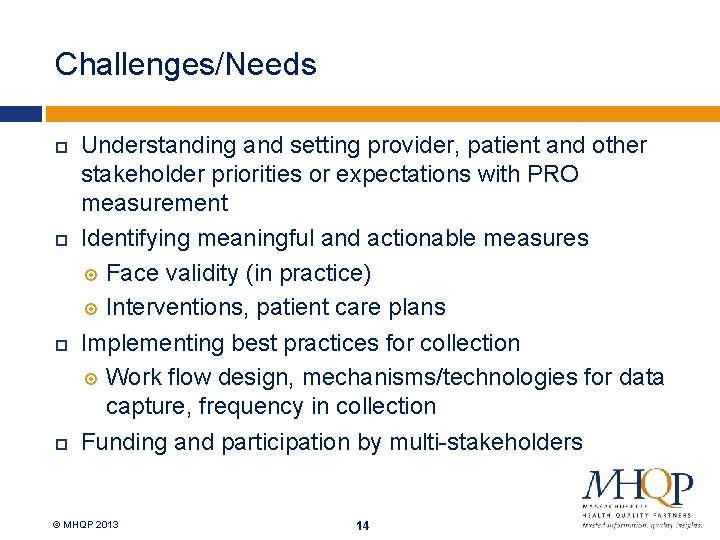
Challenges/Needs Understanding and setting provider, patient and other stakeholder priorities or expectations with PRO measurement Identifying meaningful and actionable measures Face validity (in practice) Interventions, patient care plans Implementing best practices for collection Work flow design, mechanisms/technologies for data capture, frequency in collection Funding and participation by multi-stakeholders © MHQP 2013 14
Multi-stakeholder Opportunities for Collaboration Conduct further understanding of the PRO landscape, active measurement activity and best practices Align and leverage patient resources to incorporate authentic patient engagement and involvement in PRO measurement Engage multi-stakeholders including patients in the selection of PRO measure(s) Pilot test: Feasibility of measure/instruments Data collection work flow design or technologies Communication and dissemination of results Action plans, interventions by providers and patients to improve health © MHQP 2013 15
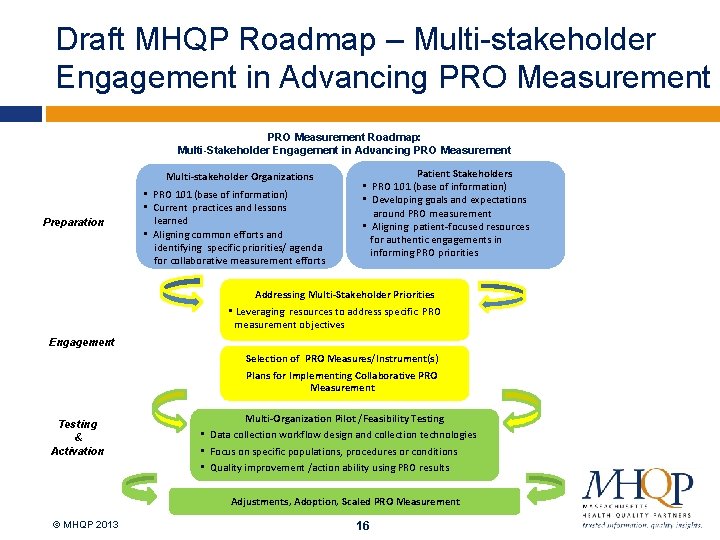
Draft MHQP Roadmap – Multi-stakeholder Engagement in Advancing PRO Measurement Roadmap: Multi-Stakeholder Engagement in Advancing PRO Measurement Multi-stakeholder Organizations Preparation • PRO 101 (base of information) • Current practices and lessons learned • Aligning common efforts and identifying specific priorities/ agenda for collaborative measurement efforts Patient Stakeholders • PRO 101 (base of information) • Developing goals and expectations around PRO measurement • Aligning patient-focused resources for authentic engagements in informing PRO priorities Addressing Multi-Stakeholder Priorities • Leveraging resources to address specific PRO measurement objectives Engagement Selection of PRO Measures/Instrument(s) Plans for Implementing Collaborative PRO Measurement Testing & Activation Multi-Organization Pilot /Feasibility Testing • Data collection workflow design and collection technologies • Focus on specific populations, procedures or conditions • Quality improvement /action ability using PRO results Adjustments, Adoption, Scaled PRO Measurement © MHQP 2013 16
Considerations. . . What are the SQAC priorities and objectives around PRO measurement? How can MHQP’s commitment to PRO measurement support the SQAC and overall PRO measurement objectives? What role can/will the SQAC play as part of the MHQP PROM Roadmap for Massachusetts? © MHQP 2013 17
Questions or more information? Contact: Linda Shaughnessy Project Director, Business Development and Performance Measurement Massachusetts Health Quality Partners lshaughnessy@MHQP. org 617 -600 -7590 © MHQP 2013 18
- Slides: 18