
BRIEFING Disaster Management Regulations 2020 Directions Municipal Operations
BRIEFING: Disaster Management Regulations, 2020 Directions: Municipal Operations and Governance Presented to the: Portfolio Committee on Co. GTA Parliament of RSA 29 May 2020
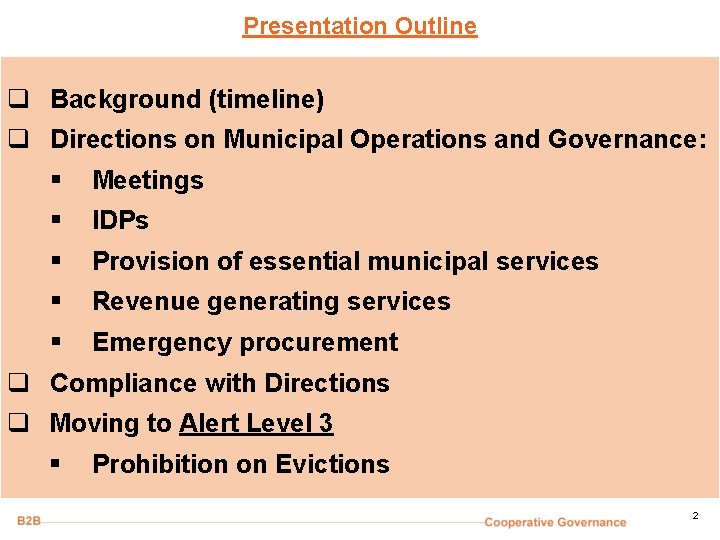
Presentation Outline q Background (timeline) q Directions on Municipal Operations and Governance: § Meetings § IDPs § Provision of essential municipal services § Revenue generating services § Emergency procurement q Compliance with Directions q Moving to Alert Level 3 § Prohibition on Evictions 2
1. BACKGROUND 3
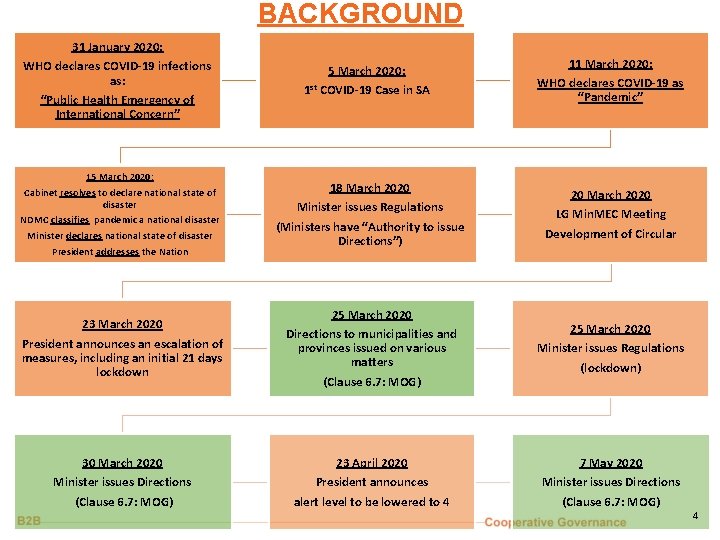
BACKGROUND 31 January 2020: WHO declares COVID-19 infections as: “Public Health Emergency of International Concern” 5 March 2020: 1 st COVID-19 Case in SA 11 March 2020: WHO declares COVID-19 as “Pandemic” 15 March 2020: Cabinet resolves to declare national state of disaster NDMC classifies pandemic a national disaster Minister declares national state of disaster President addresses the Nation 18 March 2020 Minister issues Regulations (Ministers have “Authority to issue Directions”) 20 March 2020 LG Min. MEC Meeting Development of Circular 23 March 2020 President announces an escalation of measures, including an initial 21 days lockdown 25 March 2020 Directions to municipalities and provinces issued on various matters (Clause 6. 7: MOG) 25 March 2020 Minister issues Regulations (lockdown) 30 March 2020 Minister issues Directions (Clause 6. 7: MOG) 23 April 2020 President announces alert level to be lowered to 4 7 May 2020 Minister issues Directions (Clause 6. 7: MOG) 4
2. DIRECTIONS 5

Directions on Municipal Operations and Governance (of 25 March 2020) q Provision of water and sanitation services q Communication, awareness and hygiene education q Waste management, cleansing and sanitisation q Municipal public spaces, facilities and offices q Isolation and quarantine q Municipal operations and governance q Institutional arrangements and development of COVID-19 response plans q Precautionary measure to mitigate employee health and safety risks 6
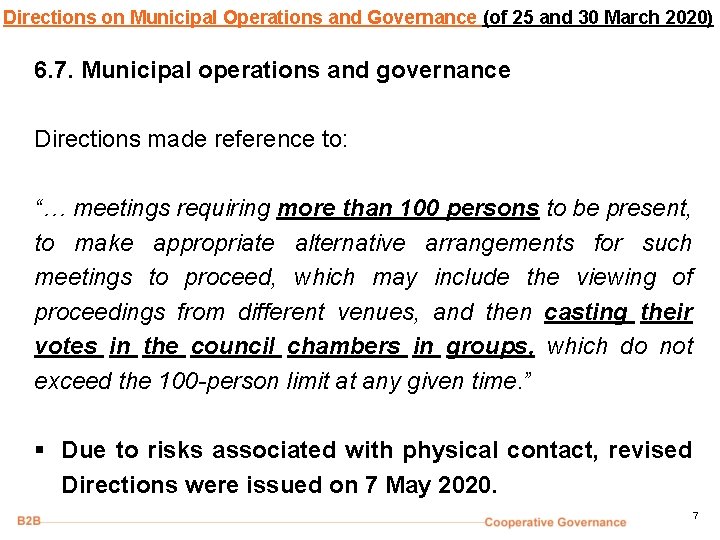
Directions on Municipal Operations and Governance (of 25 and 30 March 2020) 6. 7. Municipal operations and governance Directions made reference to: “… meetings requiring more than 100 persons to be present, to make appropriate alternative arrangements for such meetings to proceed, which may include the viewing of proceedings from different venues, and then casting their votes in the council chambers in groups, which do not exceed the 100 -person limit at any given time. ” § Due to risks associated with physical contact, revised Directions were issued on 7 May 2020. 7

Directions on Municipal Operations and Governance (of 7 May 2020) CLAUSE DETAILS 6. 7. 1 Municipalities and Entities are required to perform various functions (IDPs, provision of services, collection of revenue). 6. 7. 2 Essential municipal services to be provided under strict adherence to prescripts relating to gatherings, physical distancing, health and safety. 6. 7. 3 ALL meetings (council, tribunals and entities) must use teleconferencing and videoconferencing mediums. 6. 7. 4 Directions for Municipalities and Entities: (a) Council and committees of council to consider all business (IDPs, critical municipal services – roads/storm water, electricity, municipal: health/environmental services, waste management). (b) Comments invited on the IDP and Budget (no contact meetings). (c) Development Tribunal meetings to take place. (d) Revenue sections to operate (licences, trading services, clearance certificates, meter reading) – Note: e-Natis goes on-line from 1 June 2020. (e) Undertake emergency procurement (Treasury Instruction No. 5/2020). (f) ALL procurement undertaken during the national state of disaster to be reported to the first council meeting after the disaster. 8
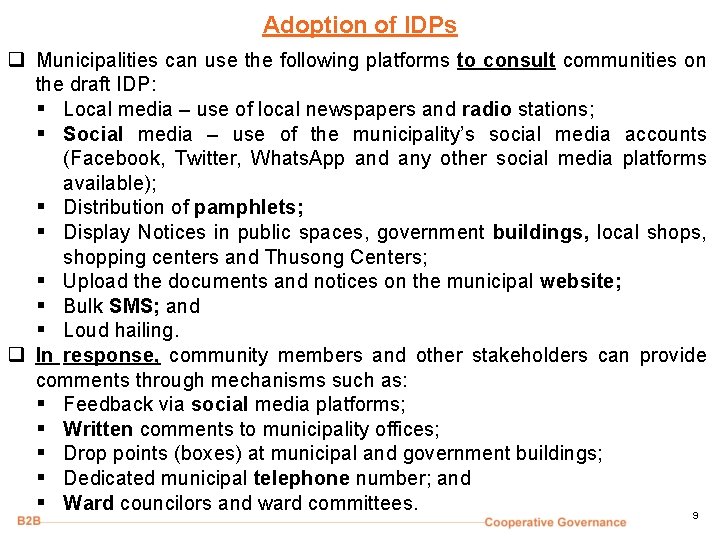
Adoption of IDPs q Municipalities can use the following platforms to consult communities on the draft IDP: § Local media – use of local newspapers and radio stations; § Social media – use of the municipality’s social media accounts (Facebook, Twitter, Whats. App and any other social media platforms available); § Distribution of pamphlets; § Display Notices in public spaces, government buildings, local shops, shopping centers and Thusong Centers; § Upload the documents and notices on the municipal website; § Bulk SMS; and § Loud hailing. q In response, community members and other stakeholders can provide comments through mechanisms such as: § Feedback via social media platforms; § Written comments to municipality offices; § Drop points (boxes) at municipal and government buildings; § Dedicated municipal telephone number; and § Ward councilors and ward committees. 9
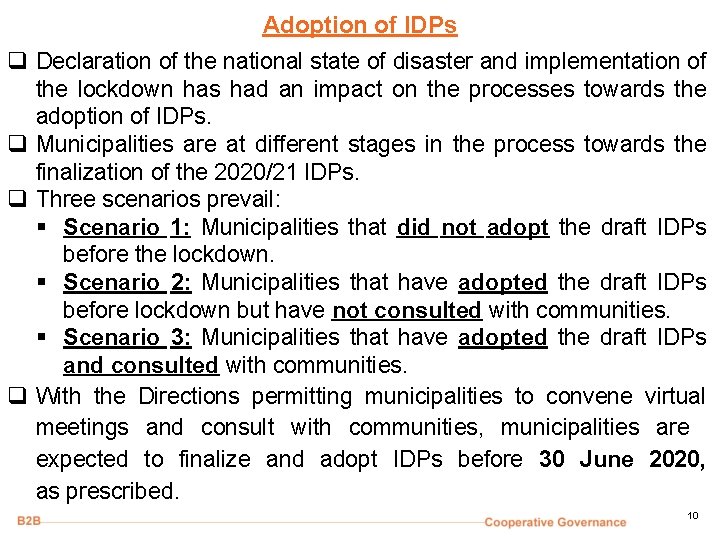
Adoption of IDPs q Declaration of the national state of disaster and implementation of the lockdown has had an impact on the processes towards the adoption of IDPs. q Municipalities are at different stages in the process towards the finalization of the 2020/21 IDPs. q Three scenarios prevail: § Scenario 1: Municipalities that did not adopt the draft IDPs before the lockdown. § Scenario 2: Municipalities that have adopted the draft IDPs before lockdown but have not consulted with communities. § Scenario 3: Municipalities that have adopted the draft IDPs and consulted with communities. q With the Directions permitting municipalities to convene virtual meetings and consult with communities, municipalities are expected to finalize and adopt IDPs before 30 June 2020, as prescribed. 10

Implications for Municipal Budgets q NT issued an Exemption Notice (in terms of Section 177(1)(b) of MFMA) on 30 March 2020. q In essence, municipalities and their entities are exempted from any timeline provisions in the MFMA, until such time that the state of disaster is lifted. q NT subsequently issued an Annexure to MFMA Circular 99 on 8 April 2020 to complement the Exemption Notice. 11

Operation of Revenue Generating Services q Municipalities must be encouraged to continue with revenue collection, but within the confines of all COVID-19 prescripts. q Impact of the pandemic and lockdown will put the finances of many businesses and households at risk and reduced ability to pay municipal bills. q Some municipalities have offered payment holidays, or reduced efforts to collect monies owed. These practices are not endorsed by national government – it will be more difficult to collect revenue in the future. q Municipalities are expected to do their best to collect revenue, while allowing for relief for the indigent and those with temporary payment problems, in line with their existing credit control and indigent policies / frameworks. 12
Emergency Procurement q National Treasury replaced initial measures relating to COVID-19 procurement (Instruction Note No. 3 of 2020/21 and Circular 101), with Instruction Note No. 5 of 2020/21 for PFMA, Circular 102 for MFMA institutions. q Replacement followed after concerns raised about the procurement process/approach, as it excluded some domestic suppliers and covered too wide an array of goods, especially locally manufactured goods. q Instruction Note and Circular: § Provides measures to open the supply of products to all suppliers conforming to the specifications, and being registered on the Central Supplier Database (CSD). § Outlines specifications for the required personal protective equipment (PPE) items, according to the DTI&C, Do. H, and WHO requirements. § Outlines maximum prices at which government will procure PPE items; and § Outlines the emergency procurement, monitoring and reporting requirements. q As a matter of emphasis, the Directions on MOG Directs all Municipalities to: “Report all procurement undertaken during the period of the national state of disaster to the first council meeting after the lapsing or the termination of the state of disaster. ” 13

3. COMPLIANCE 14

Are Municipalities Complying with the Directions? q Directions distributed to all municipalities via Provinces on 7 May 2020. q Subsequently requested all municipalities via Provinces to report any non-compliance with Directions. q In response, Provinces have indicated that the Directions were issued under cover of a Circular requesting municipalities to comply therewith. q No reports were received indicating non-compliance with the Directions by municipalities. q For municipalities that were experiencing challenges with the holding of virtual meetings, such challenges were directed to the State Information and Technology Agency (SITA) – some limitations of MS Teams. q A detailed report in this regard will be available in due course. 15
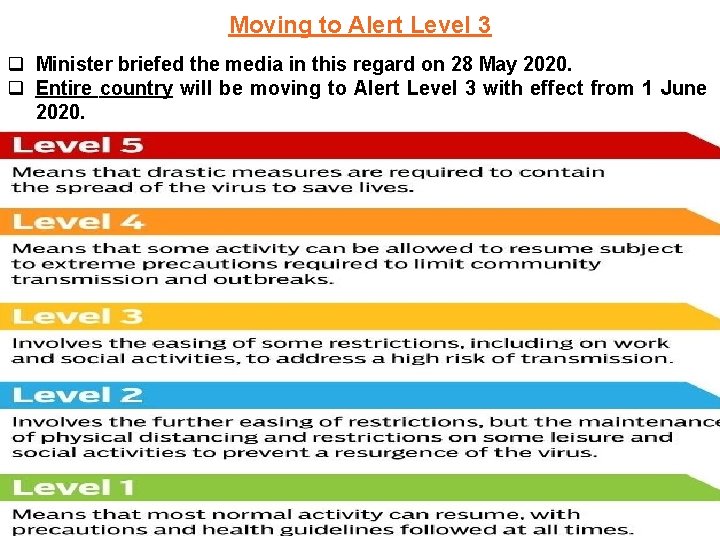
Moving to Alert Level 3 q Minister briefed the media in this regard on 28 May 2020. q Entire country will be moving to Alert Level 3 with effect from 1 June 2020. 16

17
Prohibition on Evictions Correspondence from the Centre for Applied Legal Studies (CALS): Alert Level 5 provided adequate protection against evictions, but Alert Level 4 dilutes this protection and makes it possible for evictions to occur. 18
Prohibition on Evictions q q q Due to hardship being experienced, people have been unable to pay rent for homes/property. While those with mortgages were given some relief by the banks together with reduction of interest rates, rental payers did not have similar relief. On 16 April 2020, the Regulations prohibited the eviction of a person from their home. Legal concerns subsequently raised about the wording of this provision Regulations usurping the powers of the court in so far as the granting of an order for eviction. Legal opinion was obtained which states that movement of persons may be regulated during the period of the State of Disaster but cannot take away the powers of courts (separation of powers) – Courts must consider the various factors relating to specific evictions during the lockdown. In making these Regulations, Government: § was guided by the need to protect people who may have lost their jobs during the lockdown. § must bear in mind there are many ordinary people (especially the elderly) dependent on rental income for their livelihoods, having improved their properties so that they could earn income. § In responding to the above, must balance the interests of all people when finalising the Regulations. 19 § acknowledge the role of the Courts.
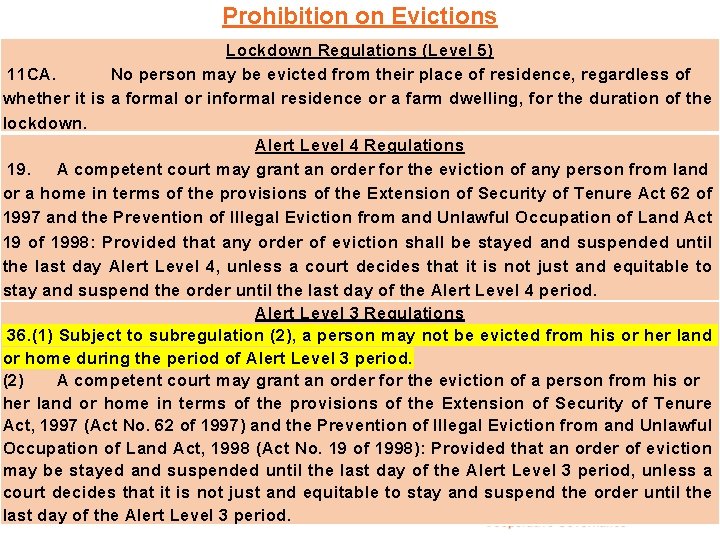
Prohibition on Evictions Lockdown Regulations (Level 5) 11 CA. No person may be evicted from their place of residence, regardless of whether it is a formal or informal residence or a farm dwelling, for the duration of the lockdown. Alert Level 4 Regulations 19. A competent court may grant an order for the eviction of any person from land or a home in terms of the provisions of the Extension of Security of Tenure Act 62 of 1997 and the Prevention of Illegal Eviction from and Unlawful Occupation of Land Act 19 of 1998: Provided that any order of eviction shall be stayed and suspended until the last day Alert Level 4, unless a court decides that it is not just and equitable to stay and suspend the order until the last day of the Alert Level 4 period. Alert Level 3 Regulations 36. (1) Subject to subregulation (2), a person may not be evicted from his or her land or home during the period of Alert Level 3 period. (2) A competent court may grant an order for the eviction of a person from his or her land or home in terms of the provisions of the Extension of Security of Tenure Act, 1997 (Act No. 62 of 1997) and the Prevention of Illegal Eviction from and Unlawful Occupation of Land Act, 1998 (Act No. 19 of 1998): Provided that an order of eviction may be stayed and suspended until the last day of the Alert Level 3 period, unless a court decides that it is not just and equitable to stay and suspend the order until the 20 last day of the Alert Level 3 period.
Access to COVID-19 Prescripts q All COVID-19 Regulations and Directions, as well as Disaster Management Guidelines and Notices may be accessed at: https: //www. gov. za/coronavirus/guidelines 21

Thank You!
- Slides: 22