
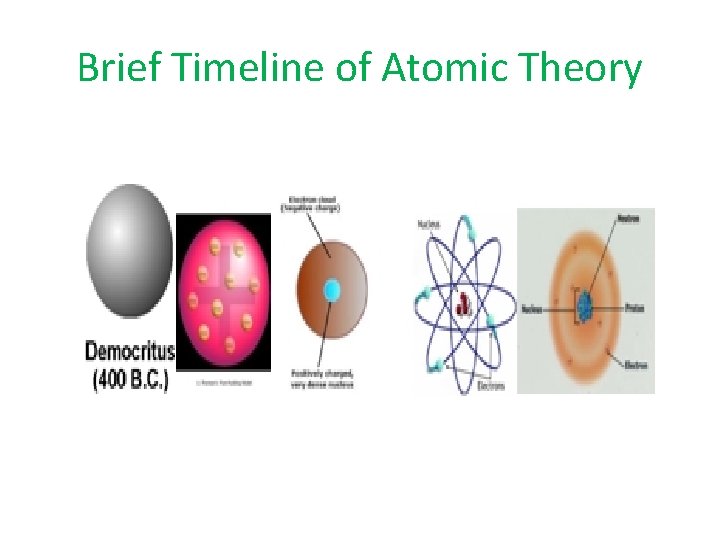
Brief Timeline of Atomic Theory Democritus 400 BC
Brief Timeline of Atomic Theory
Democritus • 400 BC • Greek philosopher
Hard Particle (Cannonball)Theory • Proposed that they world was made up of tiny, indivisible particles moving through a void of empty space • “atom” comes from the Greek word “atomos”, meaning indivisible (cannot be divided)
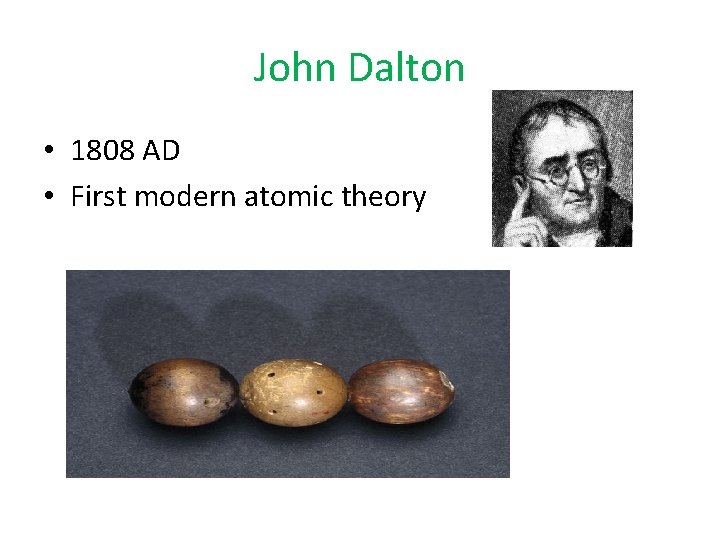
John Dalton • 1808 AD • First modern atomic theory
Daltons Atomic Theory 1. All matter is composed of tiny, indivisible particles called atoms 2. All atoms of an element are identical 3. Atoms of different elements are all different 4. Atoms combine in simple ratios to form compounds
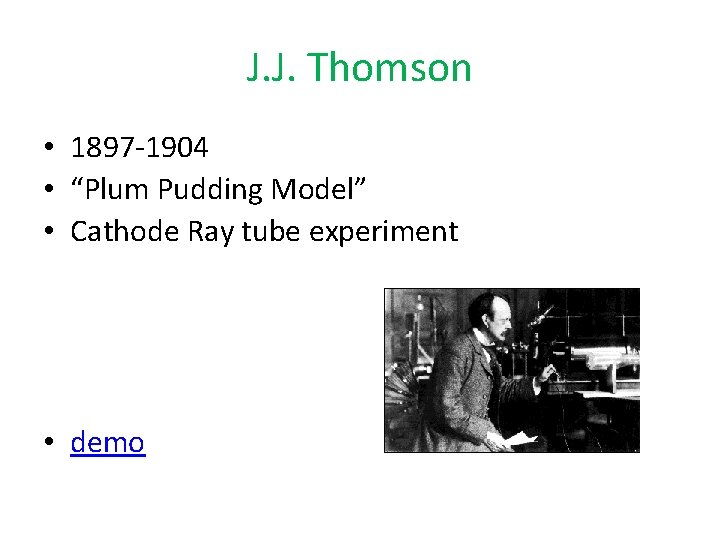
J. J. Thomson • 1897 -1904 • “Plum Pudding Model” • Cathode Ray tube experiment • demo
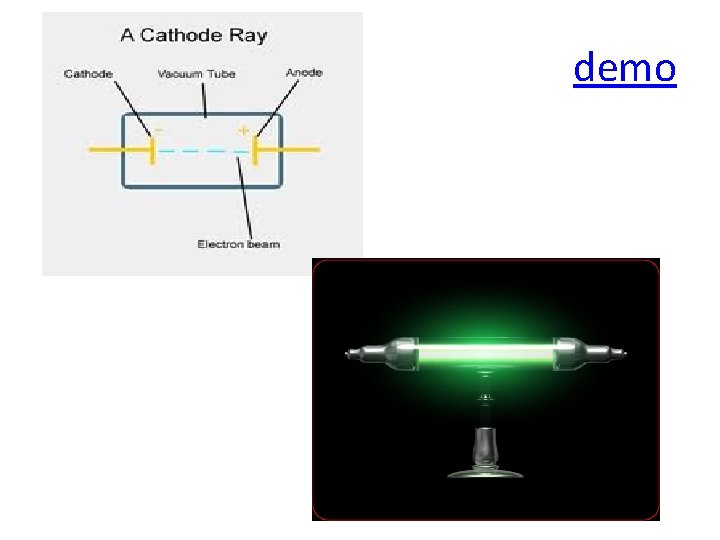
demo
Cathode Ray Tube • Thompson showed that cathode rays (electrons) were composed of negatively charged particles that separated from the gas atoms inside the tube • Significant because: this meant that atoms are not hard, indivisible particles. Atoms are composed of smaller “subatomic” particles
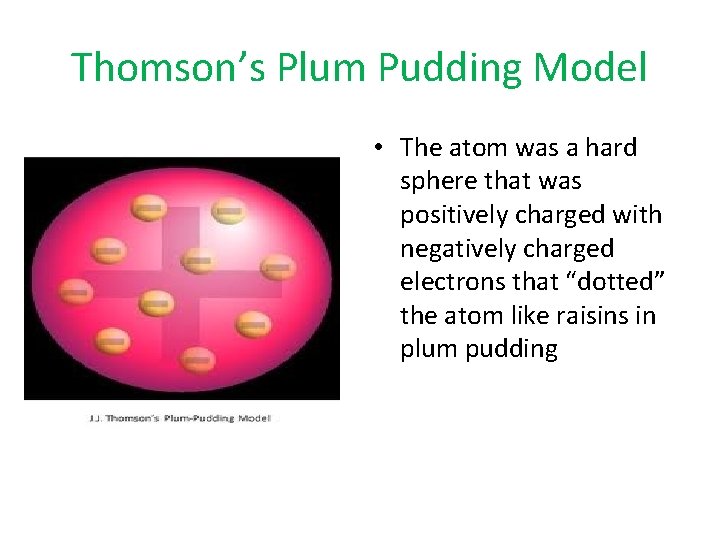
Thomson’s Plum Pudding Model • The atom was a hard sphere that was positively charged with negatively charged electrons that “dotted” the atom like raisins in plum pudding
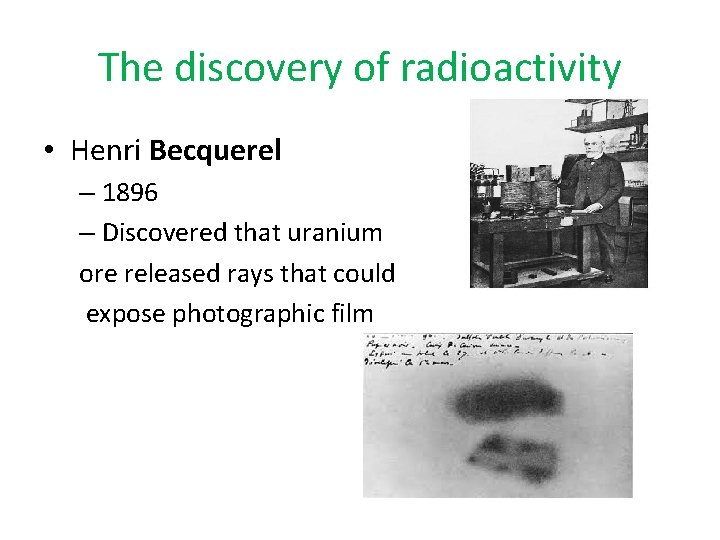
The discovery of radioactivity • Henri Becquerel – 1896 – Discovered that uranium ore released rays that could expose photographic film
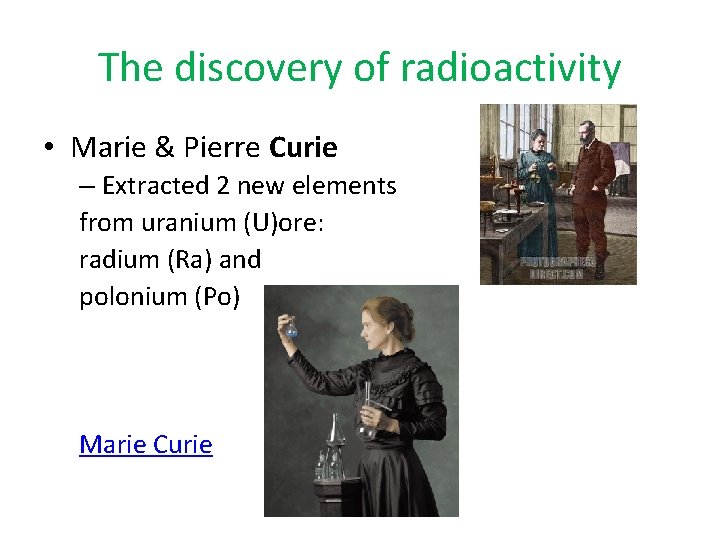
The discovery of radioactivity • Marie & Pierre Curie – Extracted 2 new elements from uranium (U)ore: radium (Ra) and polonium (Po) Marie Curie
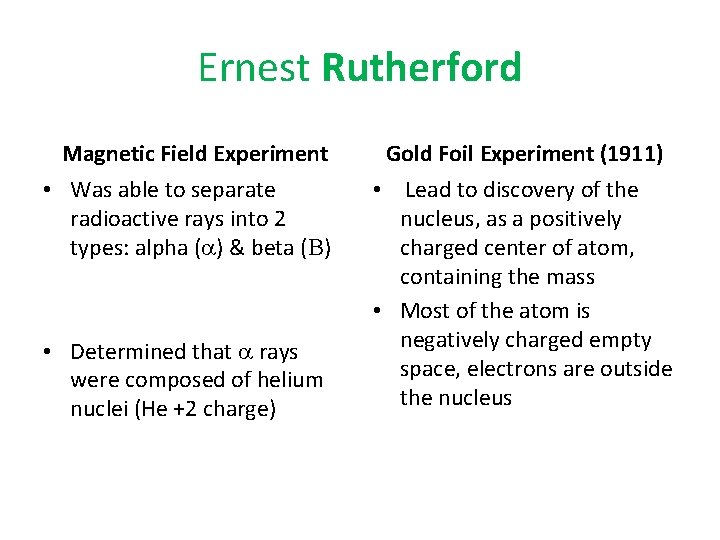
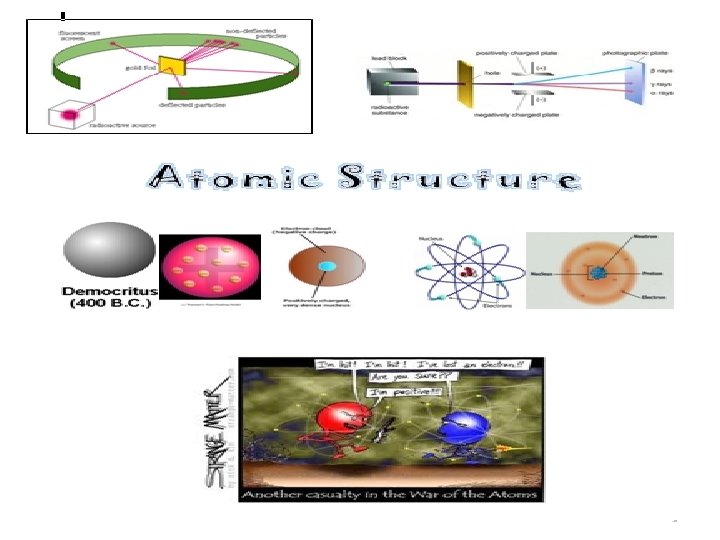
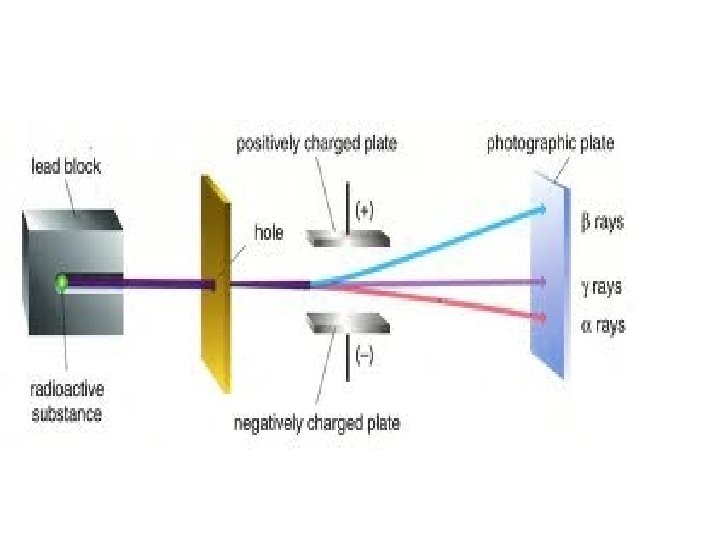
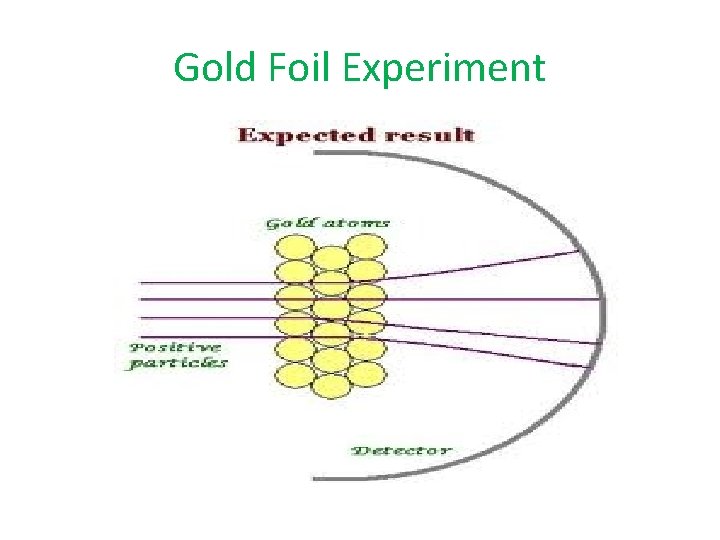
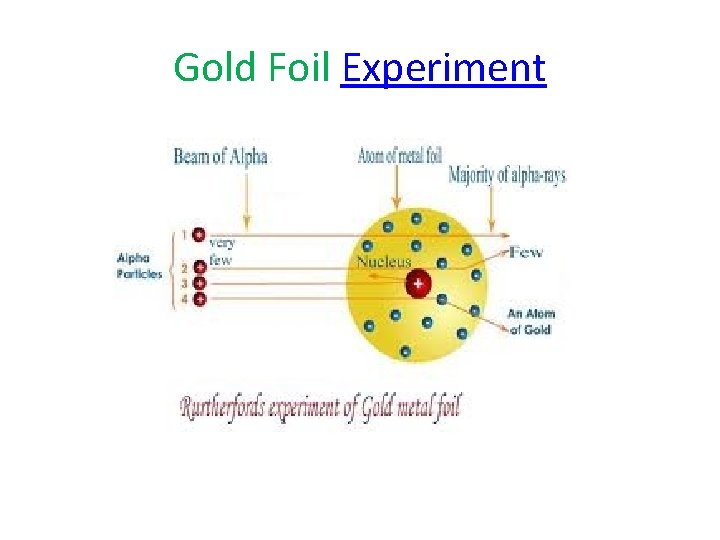
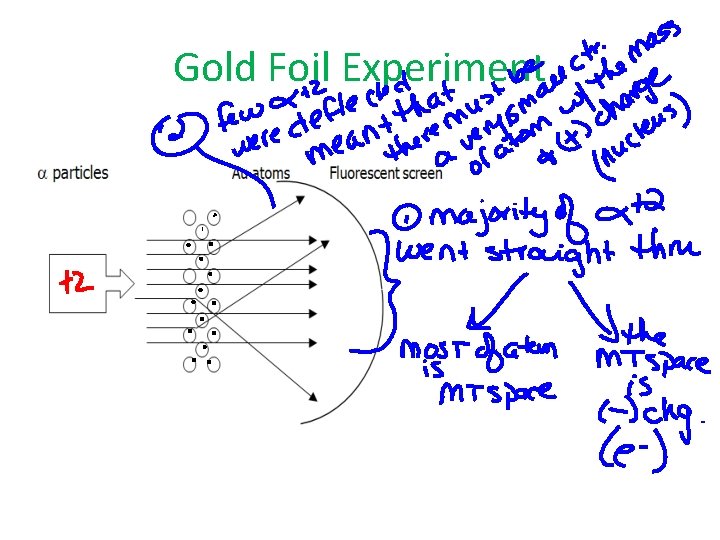
Ernest Rutherford Magnetic Field Experiment • Was able to separate radioactive rays into 2 types: alpha (a) & beta (B) • Determined that a rays were composed of helium nuclei (He +2 charge) Gold Foil Experiment (1911) • Lead to discovery of the nucleus, as a positively charged center of atom, containing the mass • Most of the atom is negatively charged empty space, electrons are outside the nucleus
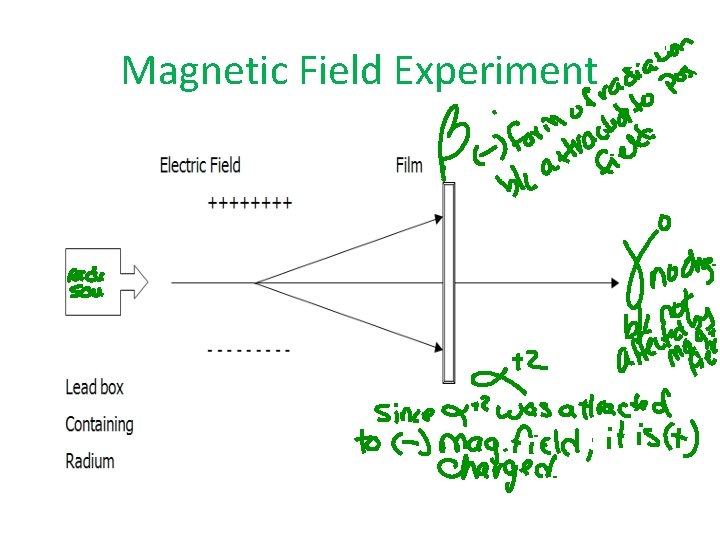
Magnetic Field Experiment
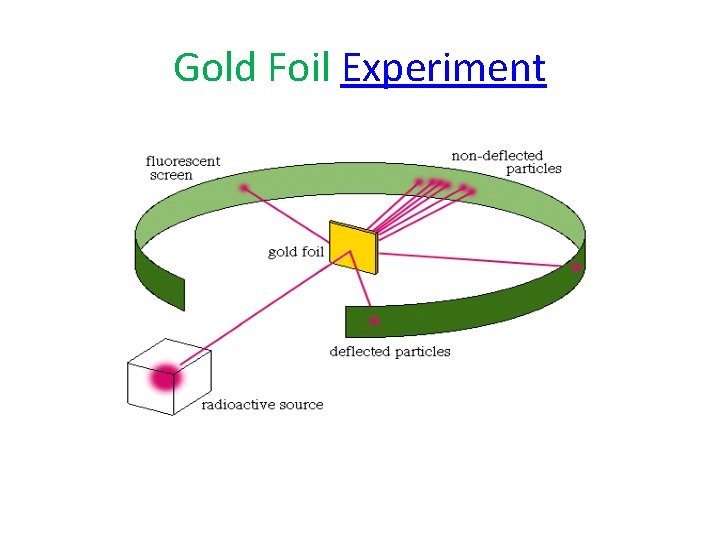
Gold Foil Experiment
Gold Foil Experiment
Gold Foil Experiment
Gold Foil Experiment
Rutherford’s Atomic Model
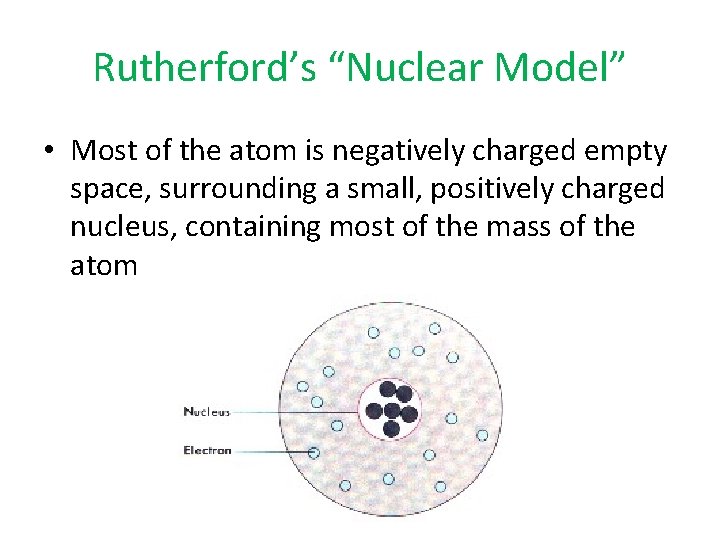
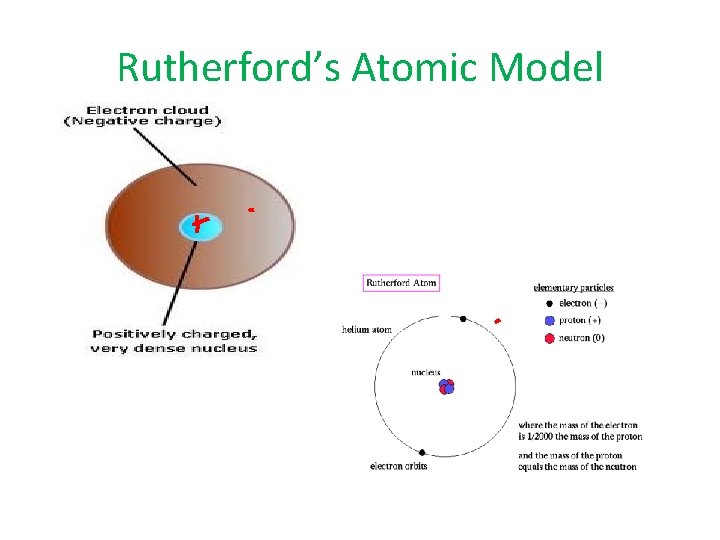
Rutherford’s “Nuclear Model” • Most of the atom is negatively charged empty space, surrounding a small, positively charged nucleus, containing most of the mass of the atom
Modern Theory of Atomic Structure • Developed by Niels Bohr, based on the science of nuclear physics • Bohr determined that an element's position on the periodic table was related to its electron configuration.
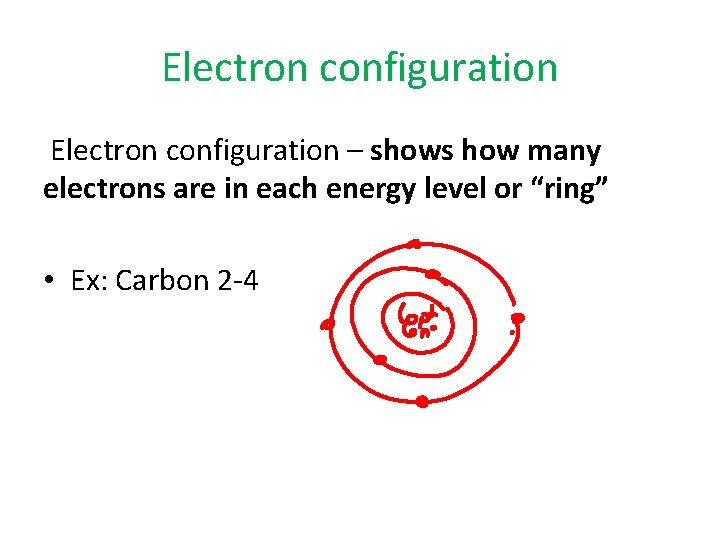
Electron configuration – shows how many electrons are in each energy level or “ring” • Ex: Carbon 2 -4
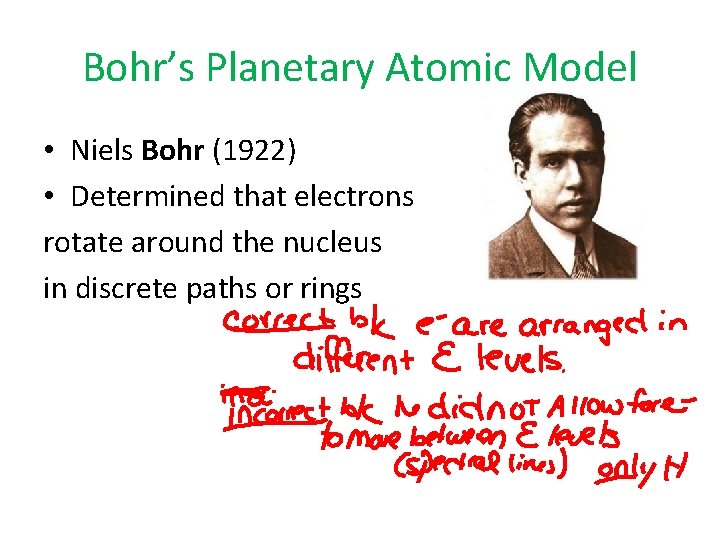
Bohr’s Planetary Atomic Model • Niels Bohr (1922) • Determined that electrons rotate around the nucleus in discrete paths or rings
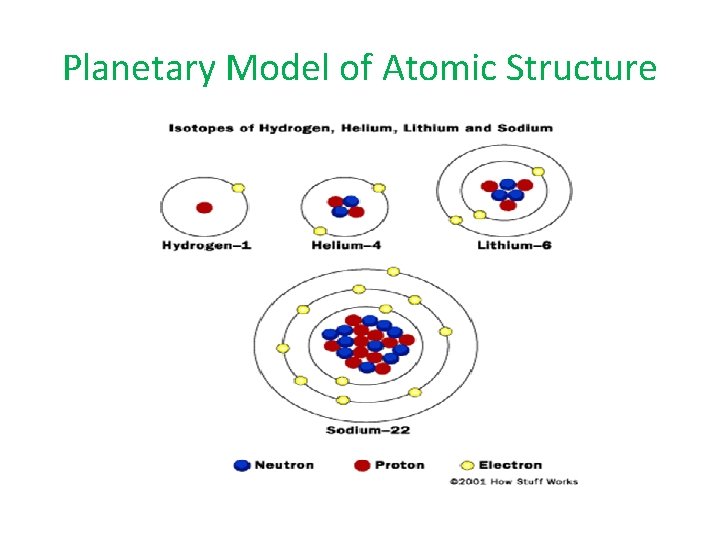
Planetary Model of Atomic Structure
Wave-Mechanical Model • Current (modern) theory of atomic structure • Moseley used x-ray analysis to calculate an integer for each element: these integers are the atomic numbers
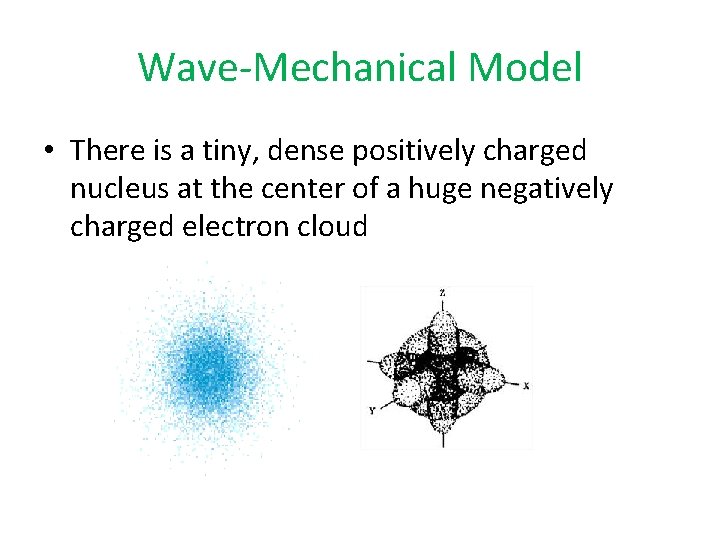
Wave-Mechanical Model • There is a tiny, dense positively charged nucleus at the center of a huge negatively charged electron cloud
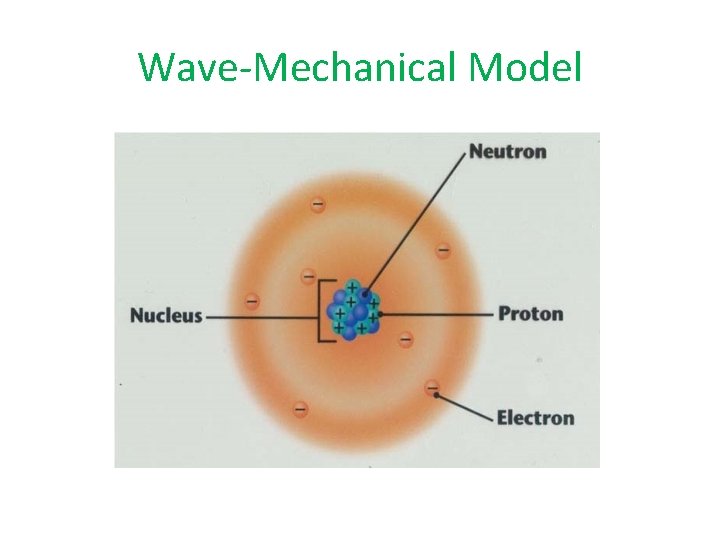
Wave-Mechanical Model
Orbital • Region of probability of finding an electron
“The whole point: ” • The modern model of the atom is the result of many investigations that have been revised over a long period of time by many scientists • Atomic theory song
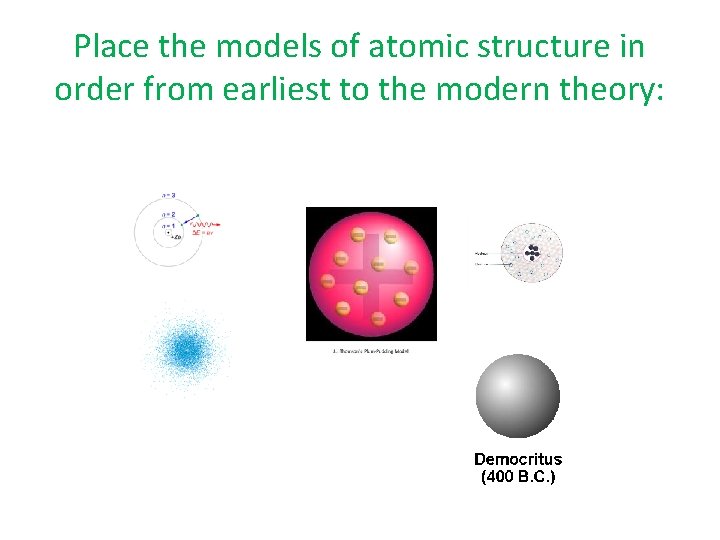
Place the models of atomic structure in order from earliest to the modern theory:
Basic Atomic Structure • The nucleus occupies less than 0. 01% of the total volume of an atom but accounts for 99. 97% of its mass. Thus most of an atom is EMPTY SPACE where the ELECTRONS are found, this is called an ELECTRON CLOUD. • One atomic mass unit is 1/12 TH THE MASS OF A CARBON-12 ATOM. This is the standard by which the masses of all other elements are determined. It is abbreviated “u”.
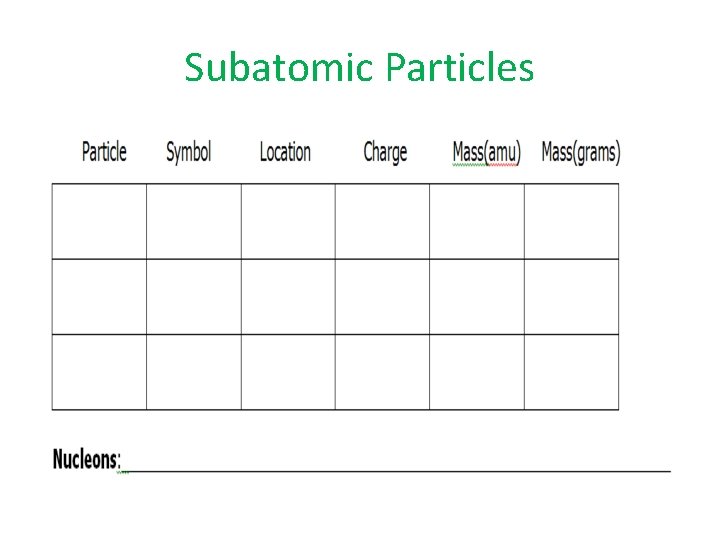
Subatomic Particles
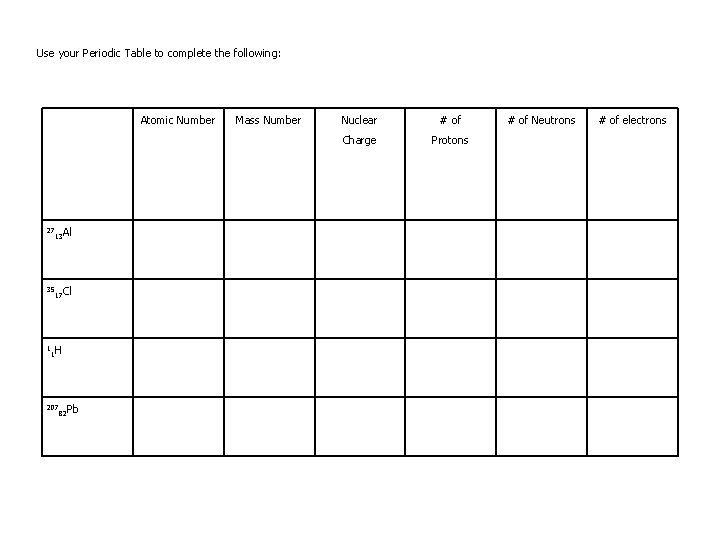
Use your Periodic Table to complete the following: Atomic Number 27 13 Al 35 17 Cl 1 1 H 207 82 Pb Mass Number Nuclear # of Charge Protons # of Neutrons # of electrons
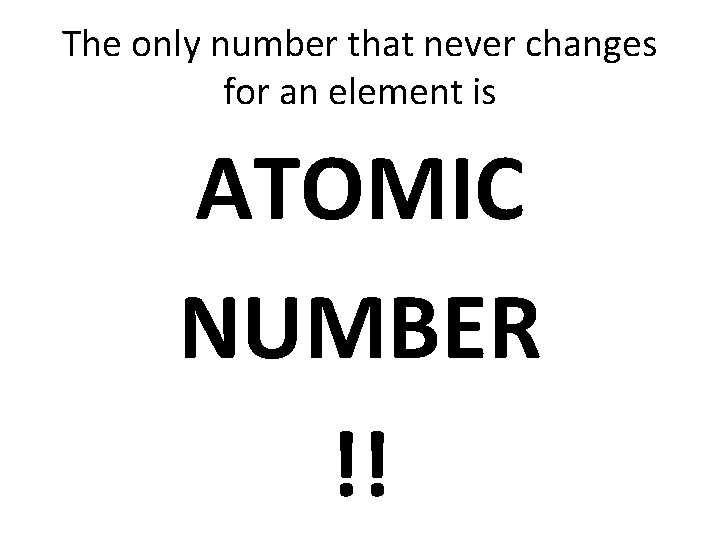
The only number that never changes for an element is ATOMIC NUMBER !!
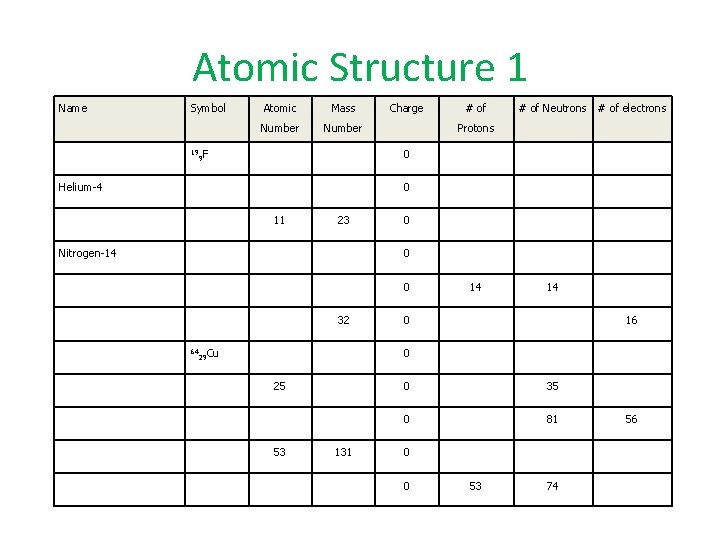
Atomic Structure 1 Name Symbol 19 Atomic Mass Number 9 F Charge # of Neutrons # of electrons Protons 0 Helium-4 0 11 23 Nitrogen-14 0 0 0 32 64 29 Cu 14 14 0 16 0 25 53 131 0 35 0 81 0 0 53 74 56
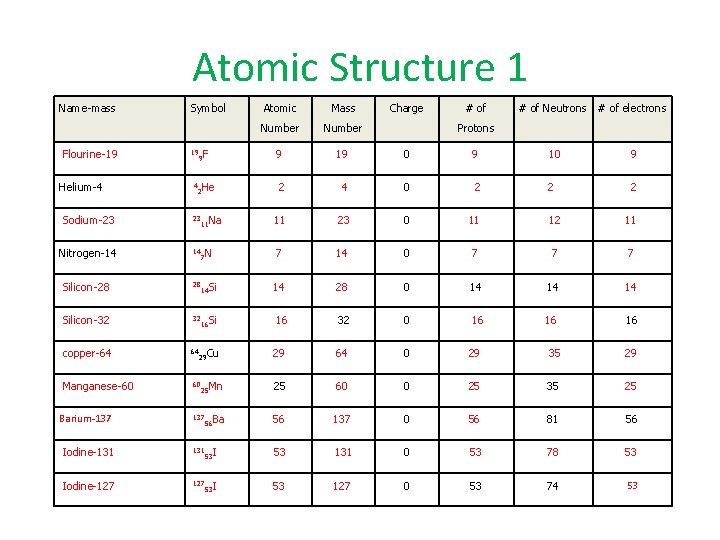
Atomic Structure 1 Name-mass Flourine-19 Helium-4 Symbol 19 4 9 F 2 He Atomic Mass Charge # of Number 9 19 0 2 4 0 2 # of Neutrons # of electrons 10 9 2 2 Protons 9 Sodium-23 23 11 Na 11 23 0 11 12 11 Nitrogen-14 14 7 N 7 14 0 7 7 7 Silicon-28 28 14 Si 14 28 0 14 14 14 Silicon-32 32 16 Si 32 0 16 16 16 29 64 0 29 35 29 25 Mn 25 60 0 25 35 25 137 56 Ba 56 137 0 56 81 56 Iodine-131 53 I 53 131 0 53 78 53 Iodine-127 53 I 53 127 0 53 74 53 copper-64 Manganese-60 Barium-137 64 29 Cu 60 16
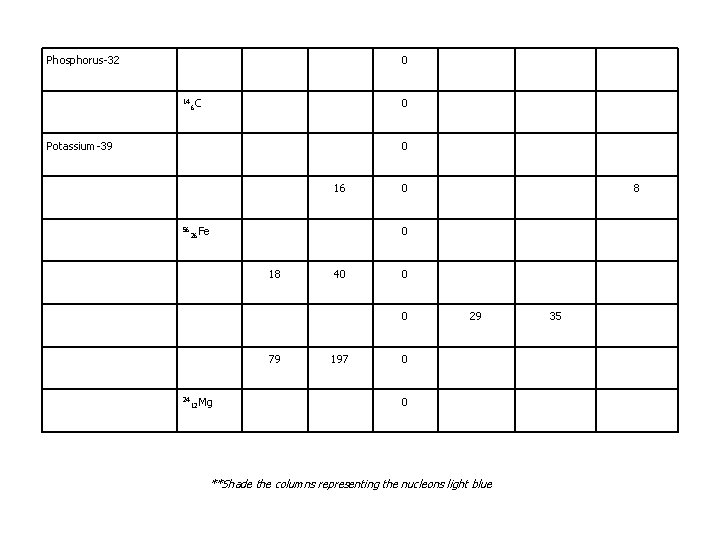
Phosphorus-32 0 14 6 C 0 Potassium-39 0 16 56 26 Fe 0 0 18 40 0 0 79 24 8 12 Mg 197 29 0 0 **Shade the columns representing the nucleons light blue 35
ISOTOPE • Forms of the same element having different mass due to different number of neutrons. • Indicated by “element name-mass”
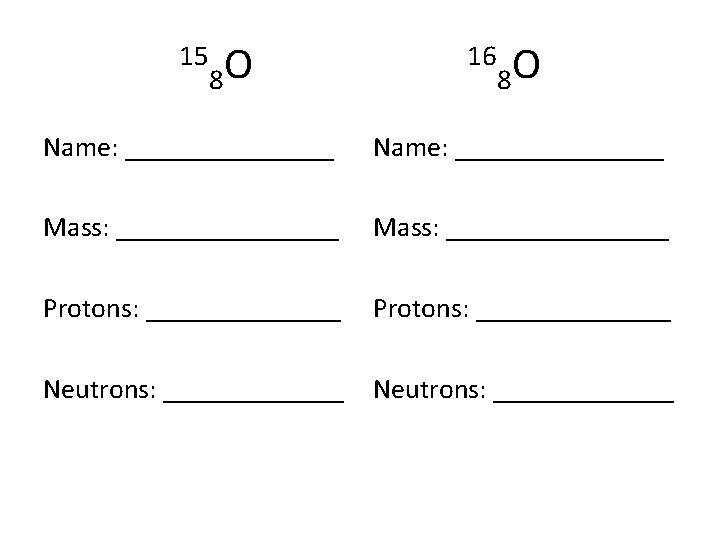

Practice: Name Symbol 235 U 238 U Carbon-12 Carbon-13 Atomic # Mass # # Protons # Neutrons # Electrons
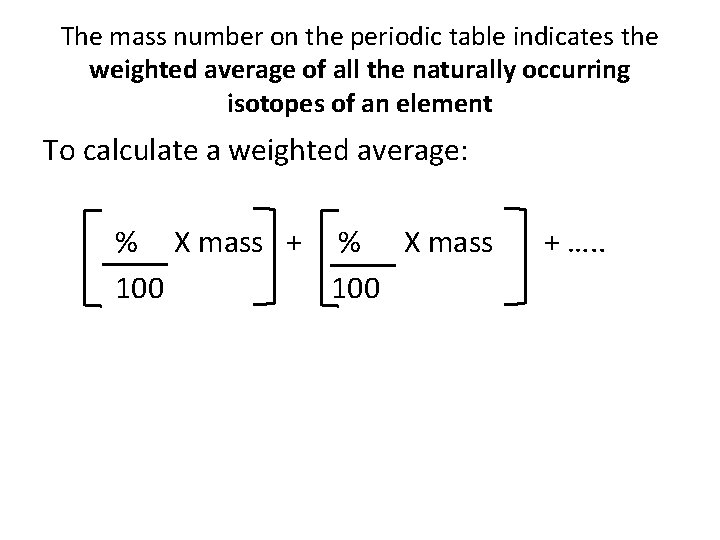
The mass number on the periodic table indicates the weighted average of all the naturally occurring isotopes of an element To calculate a weighted average: % X mass + % X mass 100 + …. .
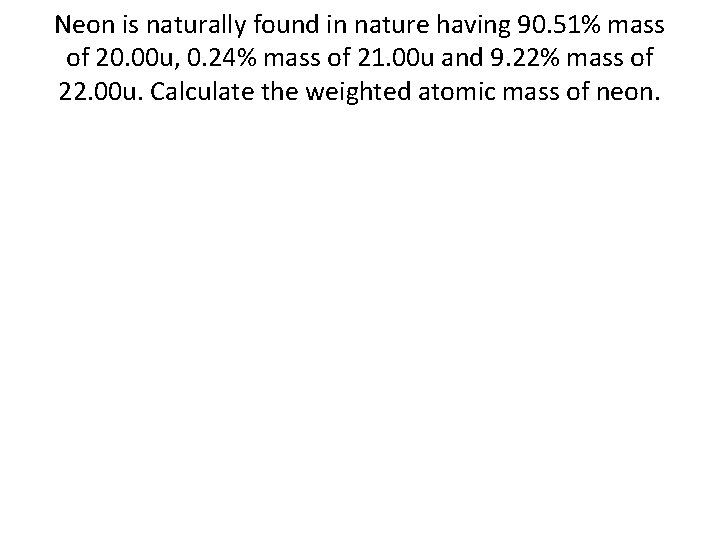
Neon is naturally found in nature having 90. 51% mass of 20. 00 u, 0. 24% mass of 21. 00 u and 9. 22% mass of 22. 00 u. Calculate the weighted atomic mass of neon.
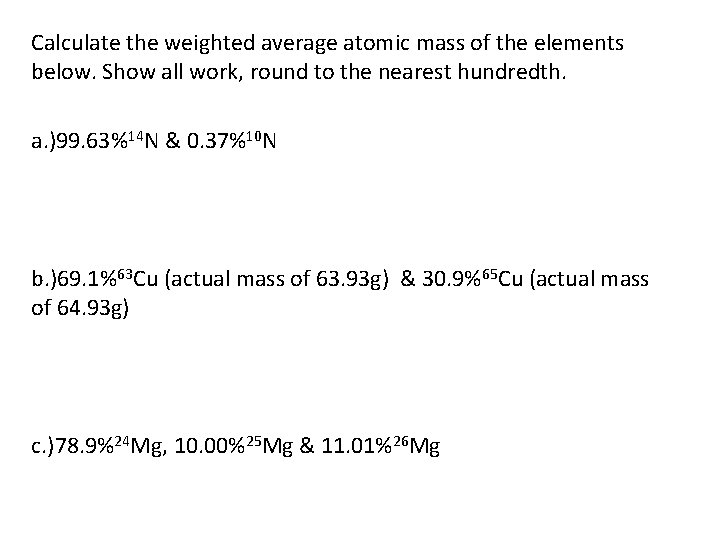
Calculate the weighted average atomic mass of the elements below. Show all work, round to the nearest hundredth. a. )99. 63%14 N & 0. 37%10 N b. )69. 1%63 Cu (actual mass of 63. 93 g) & 30. 9%65 Cu (actual mass of 64. 93 g) c. )78. 9%24 Mg, 10. 00%25 Mg & 11. 01%26 Mg
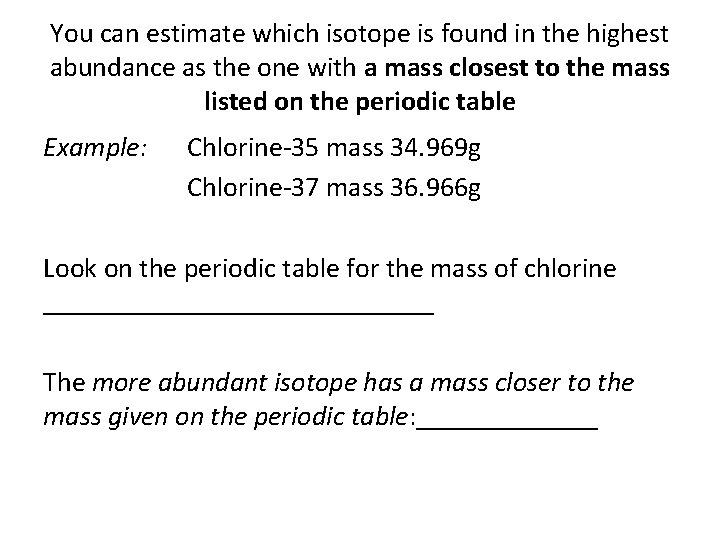
You can estimate which isotope is found in the highest abundance as the one with a mass closest to the mass listed on the periodic table Example: Chlorine-35 mass 34. 969 g Chlorine-37 mass 36. 966 g Look on the periodic table for the mass of chlorine ______________ The more abundant isotope has a mass closer to the mass given on the periodic table: _______
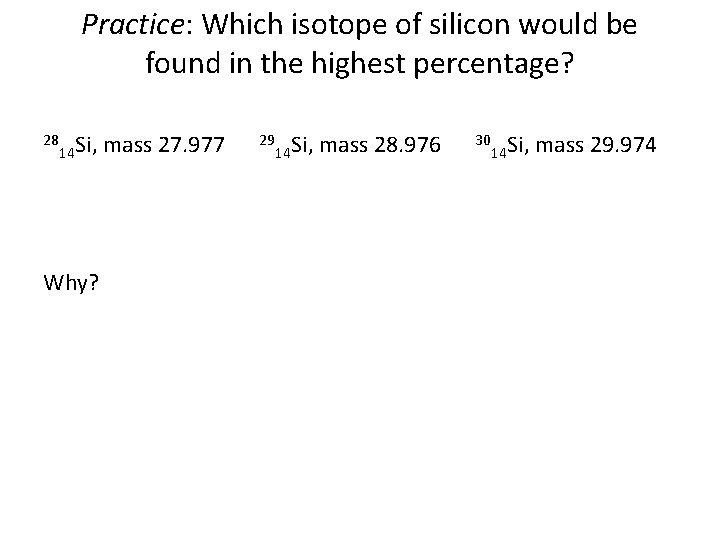
Practice: Which isotope of silicon would be found in the highest percentage? 28 14 Si, Why? mass 27. 977 29 14 Si, mass 28. 976 30 14 Si, mass 29. 974
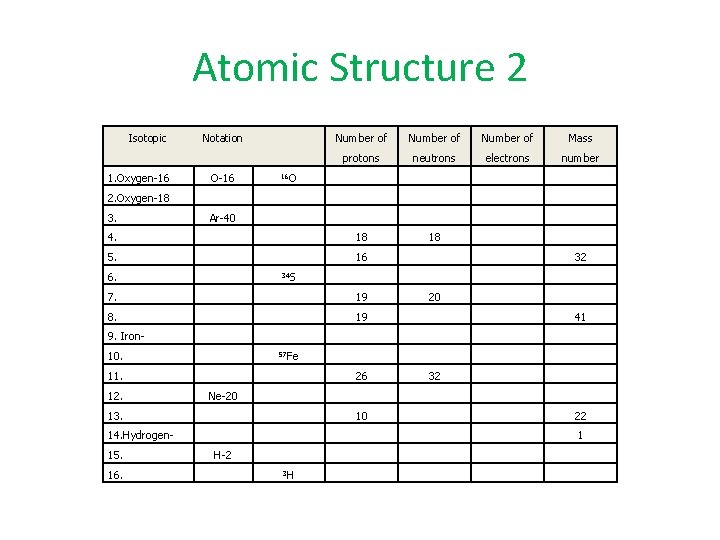
Atomic Structure 2 Isotopic Number of Mass protons neutrons electrons number 4. 18 18 5. 16 1. Oxygen-16 Notation O-16 16 O 2. Oxygen-18 3. Ar-40 6. 32 34 S 7. 19 8. 19 20 41 9. Iron 10. 57 Fe 11. 12. 26 Ne-20 13. 10 14. Hydrogen 15. 16. 32 22 1 H-2 3 H
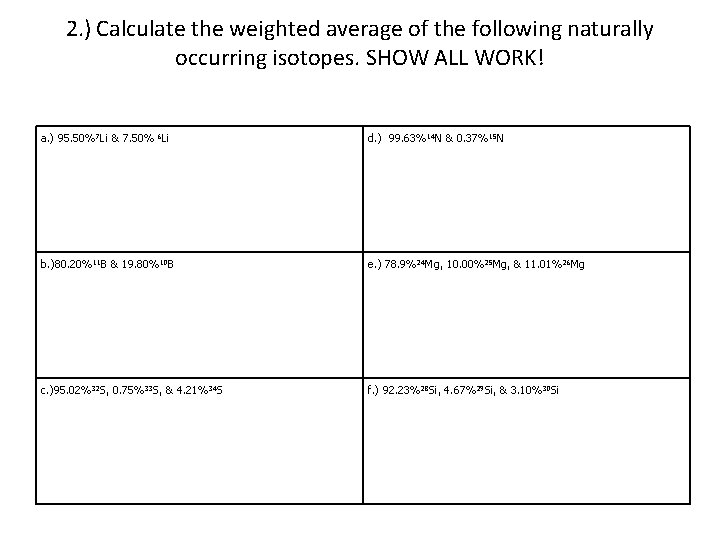
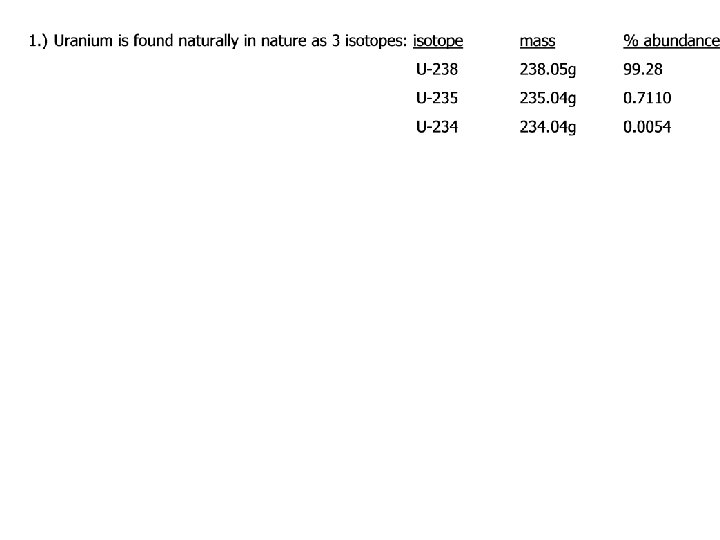
2. ) Calculate the weighted average of the following naturally occurring isotopes. SHOW ALL WORK! a. ) 95. 50%7 Li & 7. 50% 6 Li d. ) 99. 63%14 N & 0. 37%15 N b. )80. 20%11 B & 19. 80%10 B e. ) 78. 9%24 Mg, 10. 00%25 Mg, & 11. 01%26 Mg c. )95. 02%32 S, 0. 75%33 S, & 4. 21%34 S f. ) 92. 23%28 Si, 4. 67%29 Si, & 3. 10%30 Si
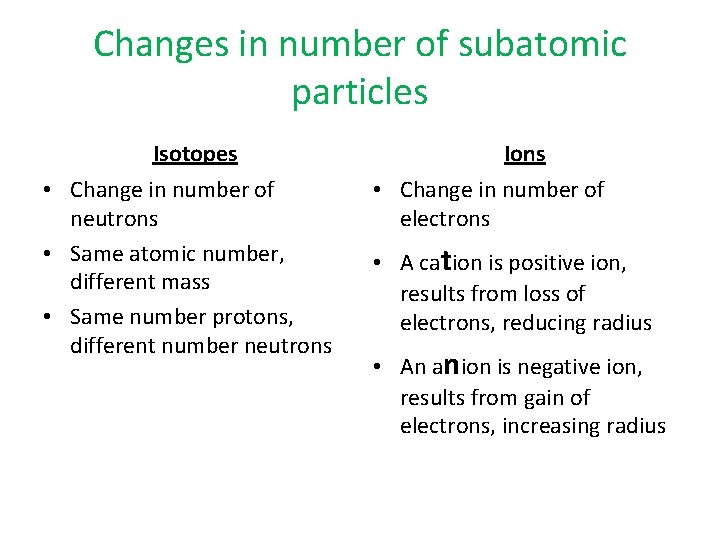
Changes in number of subatomic particles Isotopes • Change in number of neutrons • Same atomic number, different mass • Same number protons, different number neutrons Ions • Change in number of electrons • A cation is positive ion, results from loss of electrons, reducing radius • An anion is negative ion, results from gain of electrons, increasing radius
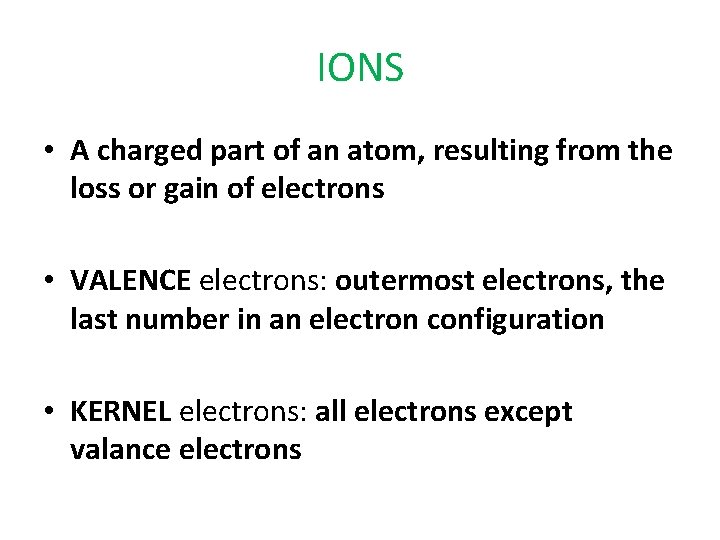
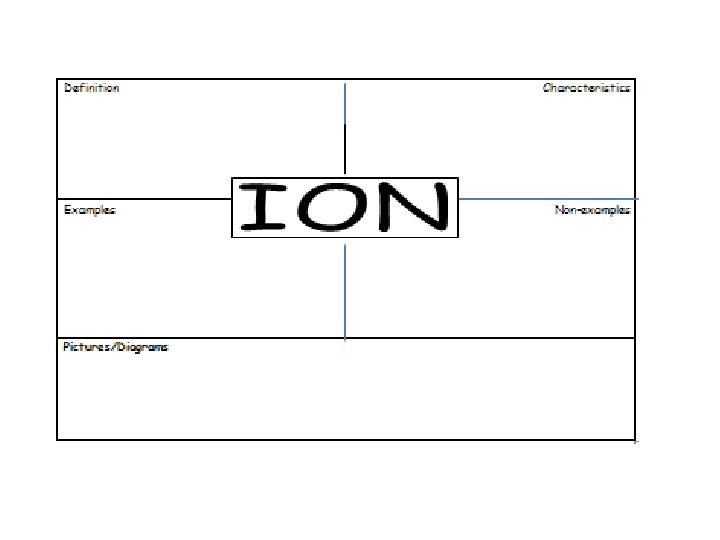
IONS • A charged part of an atom, resulting from the loss or gain of electrons • VALENCE electrons: outermost electrons, the last number in an electron configuration • KERNEL electrons: all electrons except valance electrons
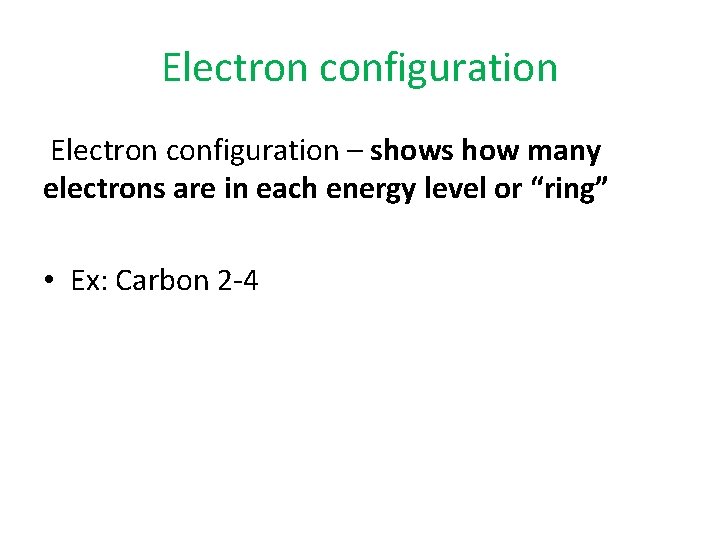
Electron configuration – shows how many electrons are in each energy level or “ring” • Ex: Carbon 2 -4
Electron configuration of sodium:
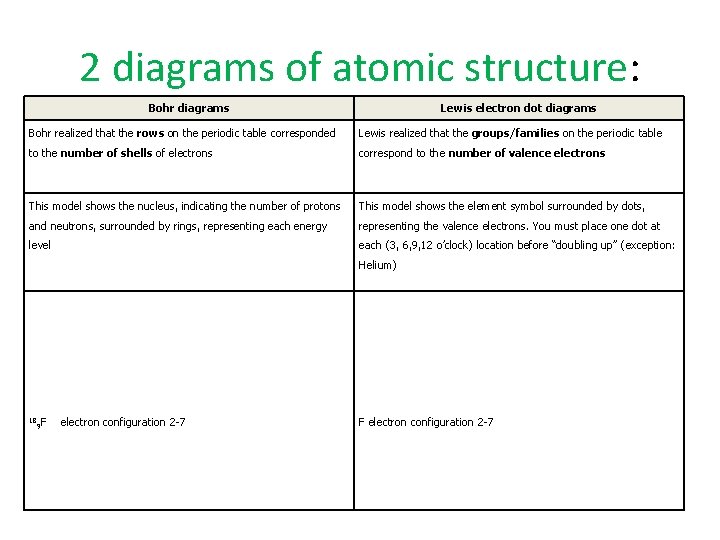
2 diagrams of atomic structure: Bohr diagrams Lewis electron dot diagrams Bohr realized that the rows on the periodic table corresponded Lewis realized that the groups/families on the periodic table to the number of shells of electrons correspond to the number of valence electrons This model shows the nucleus, indicating the number of protons This model shows the element symbol surrounded by dots, and neutrons, surrounded by rings, representing each energy representing the valence electrons. You must place one dot at level each (3, 6, 9, 12 o’clock) location before “doubling up” (exception: Helium) 18 9 F electron configuration 2 -7
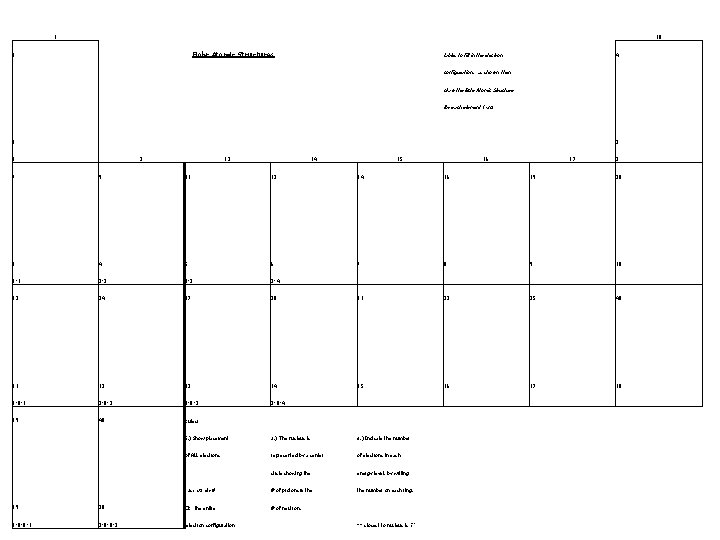
1 18 Bohr Atomic Structures 1 4 tables to fill in the electron configurations, as shown, then draw the Bohr Atomic Structure for each element 1 -20. 1 2 13 14 15 16 17 2 7 9 11 12 14 16 19 20 3 4 5 6 7 8 9 10 2 -1 2 -2 2 -3 2 -4 23 24 27 28 31 32 35 40 11 12 13 14 15 16 17 18 2 -8 -1 2 -8 -2 2 -8 -3 2 -8 -4 39 40 Rules: 19 20 2 -8 -8 -1 2 -8 -8 -2 1. ) Show placement 2. ) The nucleus is 3. ) Indicate the number of ALL electrons represented by a center of electrons in each circle showing the energy level, by writing *use atomic # # of protons & the number on each ring. OR the entire # of neutrons electron configuration ** closest to nucleus is 1 st
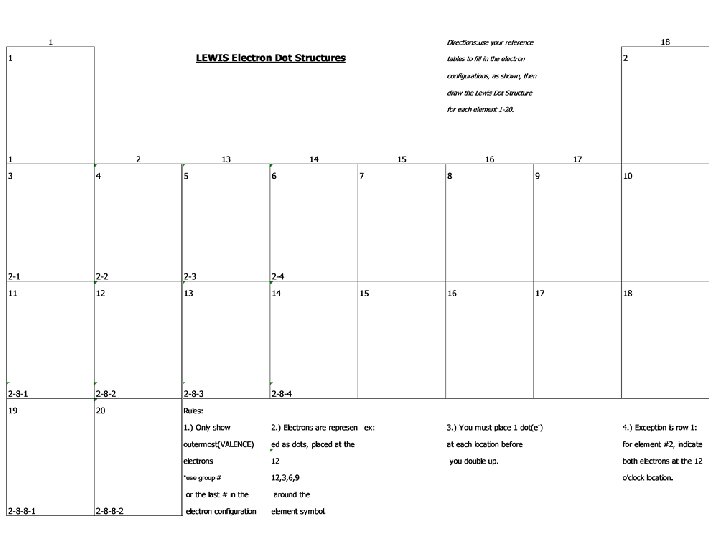
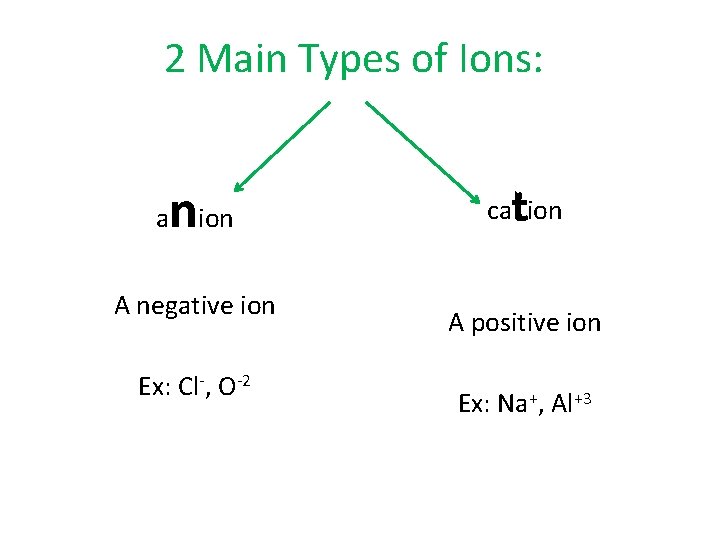
2 Main Types of Ions: a nion A negative ion Ex: Cl-, O-2 t ca ion A positive ion Ex: Na+, Al+3
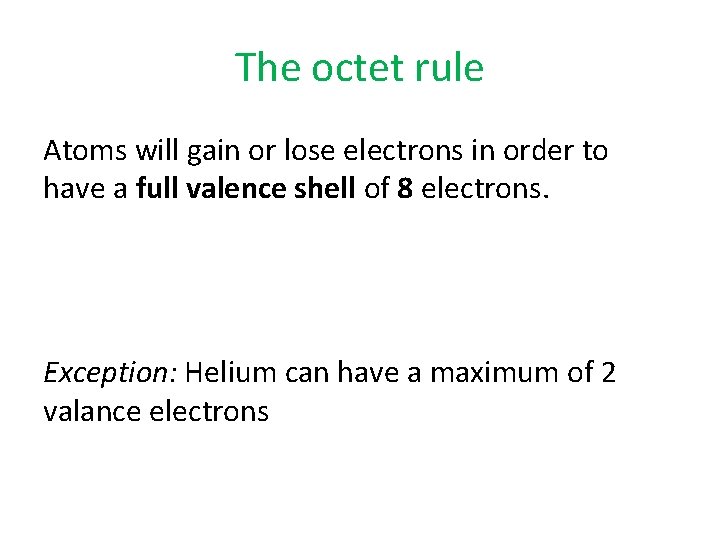
The octet rule Atoms will gain or lose electrons in order to have a full valence shell of 8 electrons. Exception: Helium can have a maximum of 2 valance electrons
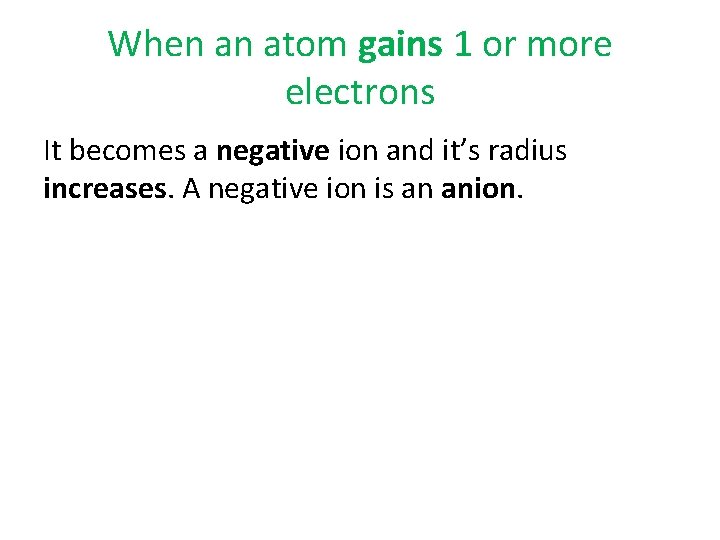
When an atom gains 1 or more electrons It becomes a negative ion and it’s radius increases. A negative ion is an anion.
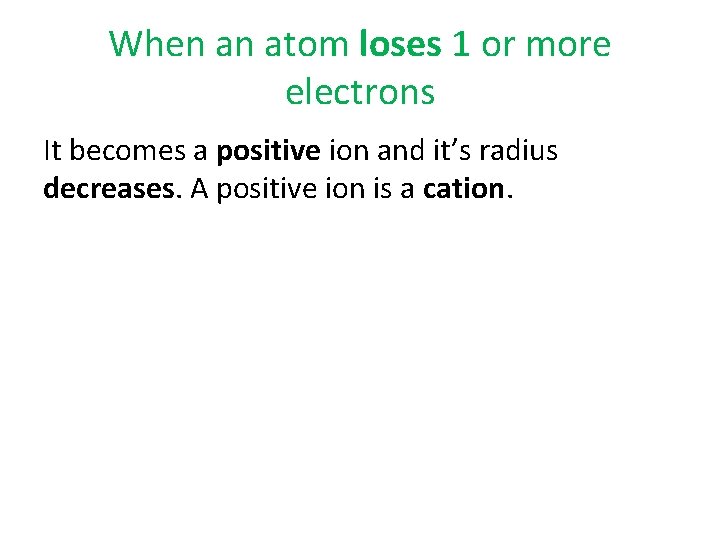
When an atom loses 1 or more electrons It becomes a positive ion and it’s radius decreases. A positive ion is a cation.
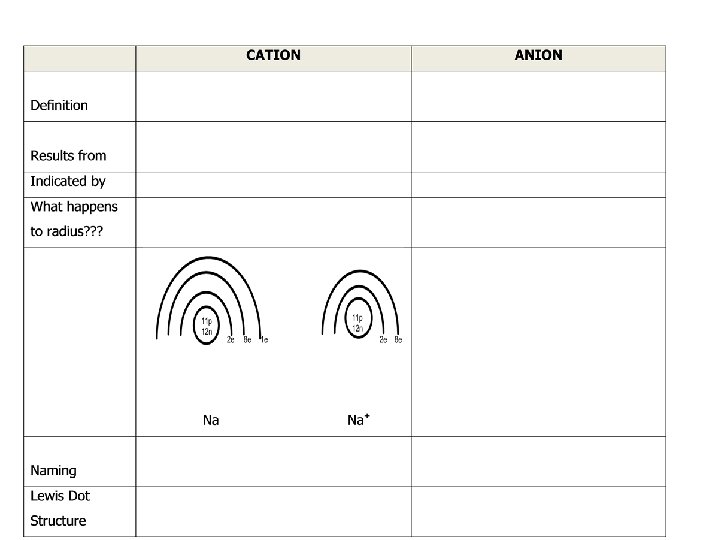
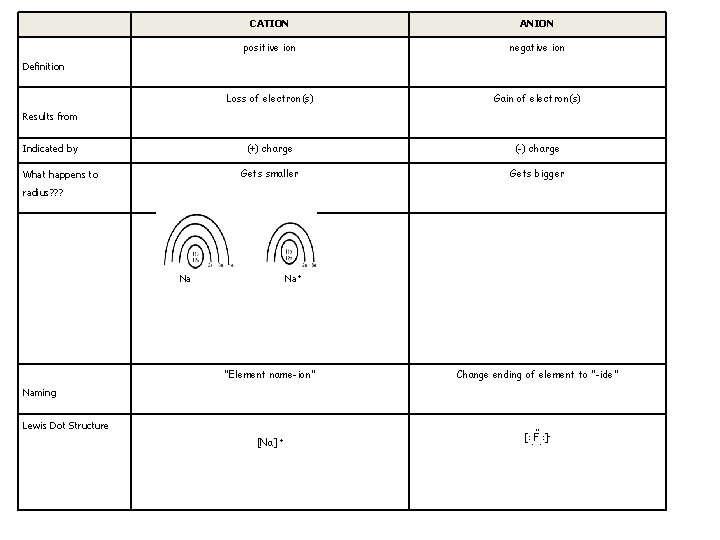
CATION ANION positive ion negative ion Loss of electron(s) Gain of electron(s) (+) charge (-) charge Gets smaller Gets bigger Definition Results from Indicated by What happens to radius? ? ? Na Na+ “Element name-ion” Change ending of element to “-ide” Naming . . Lewis Dot Structure [Na] + [: . F. : ]-
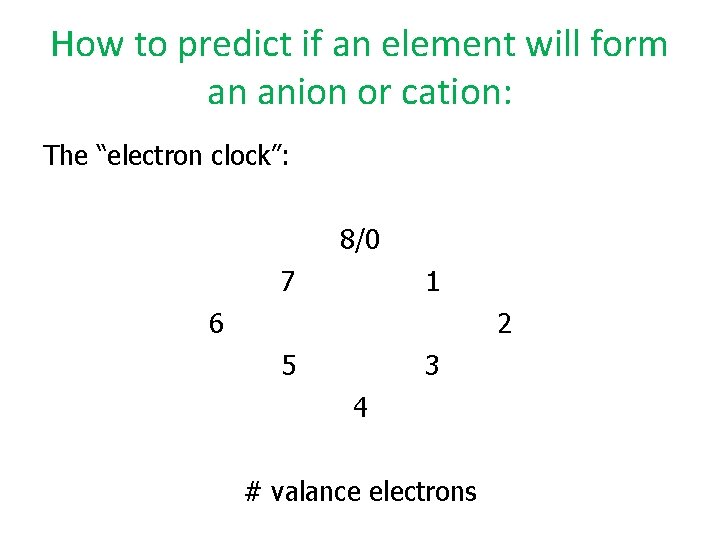
How to predict if an element will form an anion or cation: The “electron clock”: 8/0 7 1 6 2 5 3 4 # valance electrons
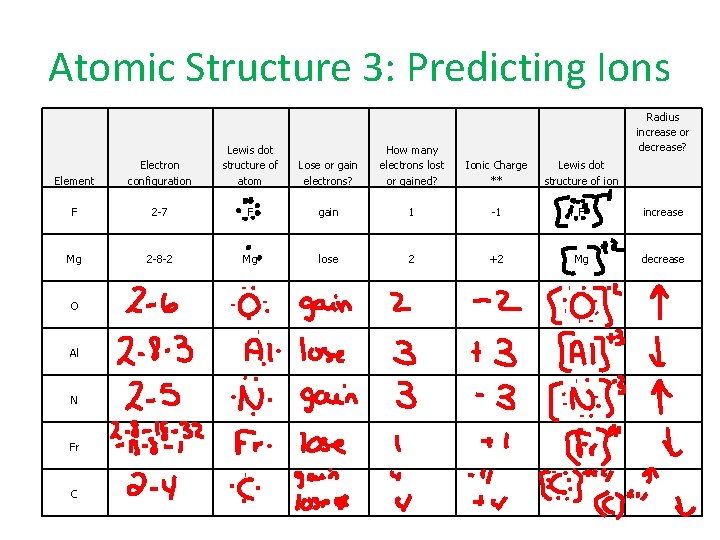
Atomic Structure 3: Predicting Ions Element Electron configuration Lewis dot structure of atom F 2 -7 Mg 2 -8 -2 O Al N Fr C Radius increase or decrease? Lose or gain electrons? How many electrons lost or gained? Ionic Charge ** Lewis dot structure of ion F gain 1 -1 F increase Mg lose 2 +2 Mg decrease
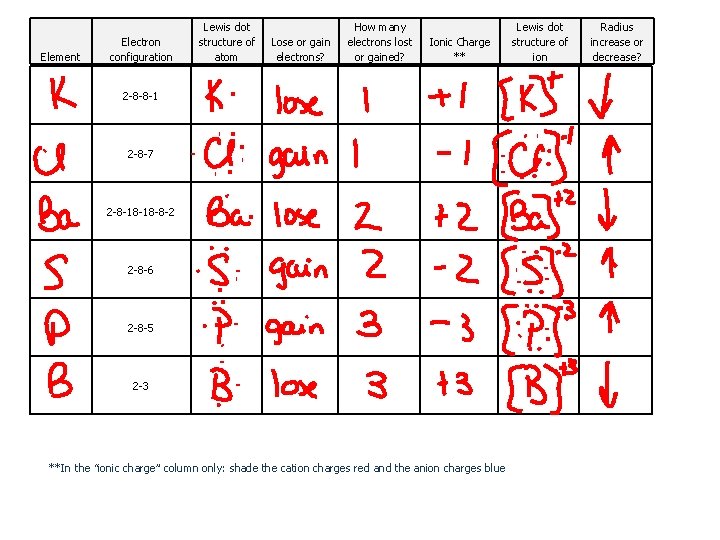
Element Electron configuration Lewis dot structure of atom Lose or gain electrons? How many electrons lost or gained? Ionic Charge ** 2 -8 -8 -1 2 -8 -7 2 -8 -18 -18 -8 -2 2 -8 -6 2 -8 -5 2 -3 **In the “ionic charge” column only: shade the cation charges red and the anion charges blue Lewis dot structure of ion Radius increase or decrease?
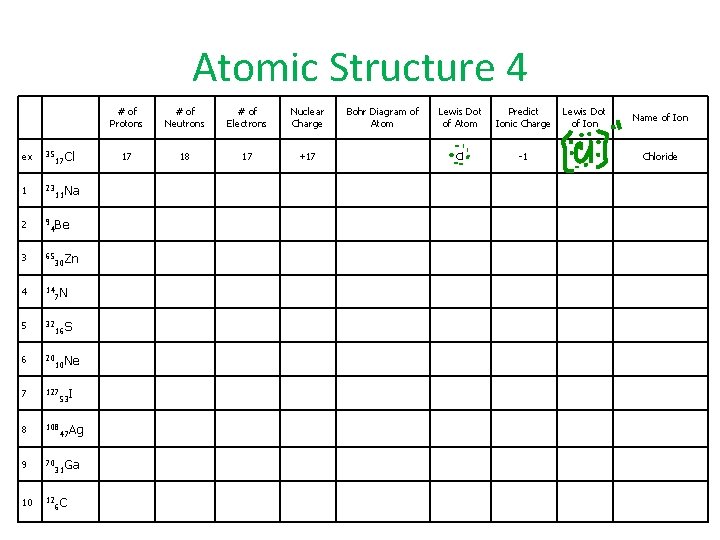
Atomic Structure 4 ex 35 Cl 17 1 23 Na 11 2 9 Be 4 3 65 Zn 30 4 14 N 7 5 32 S 16 6 20 Ne 10 7 127 I 53 8 108 Ag 47 9 70 Ga 31 10 12 C 6 # of Protons # of Neutrons # of Electrons Nuclear Charge 17 18 17 +17 Bohr Diagram of Atom Lewis Dot of Atom Predict Ionic Charge Cl -1 Lewis Dot of Ion Name of Ion Chloride
Atomic Spectra
Radiant Energy • Energy that travels through space as electromagnetic waves at the speed of light
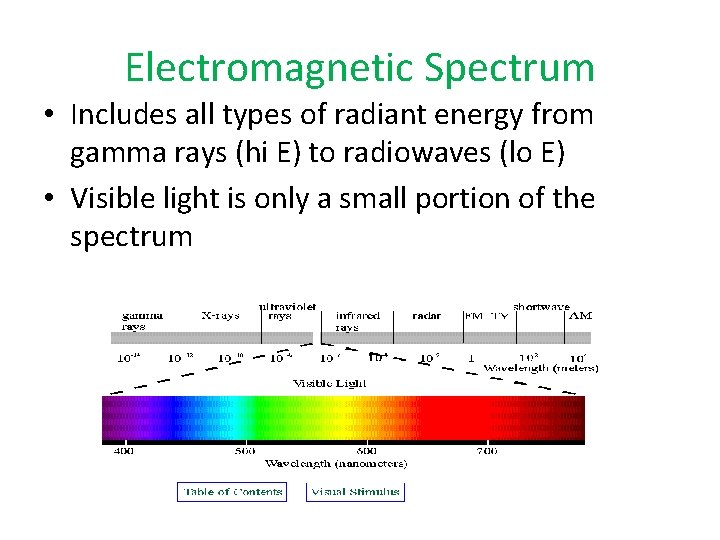
Electromagnetic Spectrum • Includes all types of radiant energy from gamma rays (hi E) to radiowaves (lo E) • Visible light is only a small portion of the spectrum
1 photon = 1 quantum Quanta: tiny packets of energy released or absorbed by objects *Einstein and Plank determined that energy is released or absorbed in a continuous flow of small packets or quantum/photons
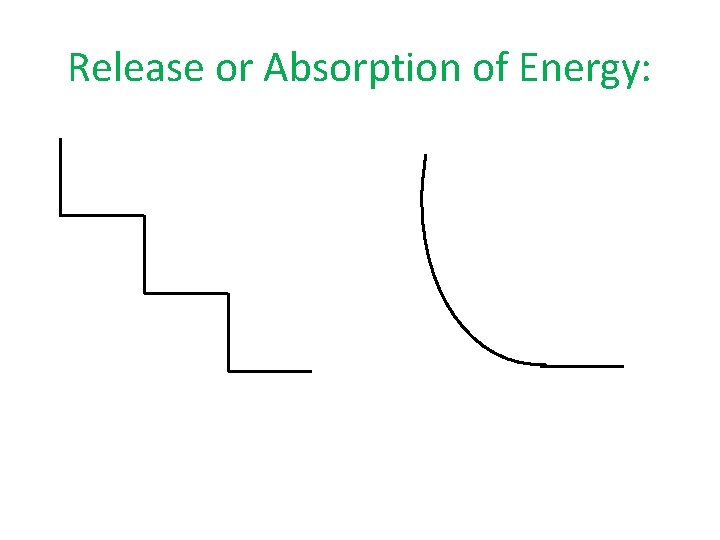
Release or Absorption of Energy:
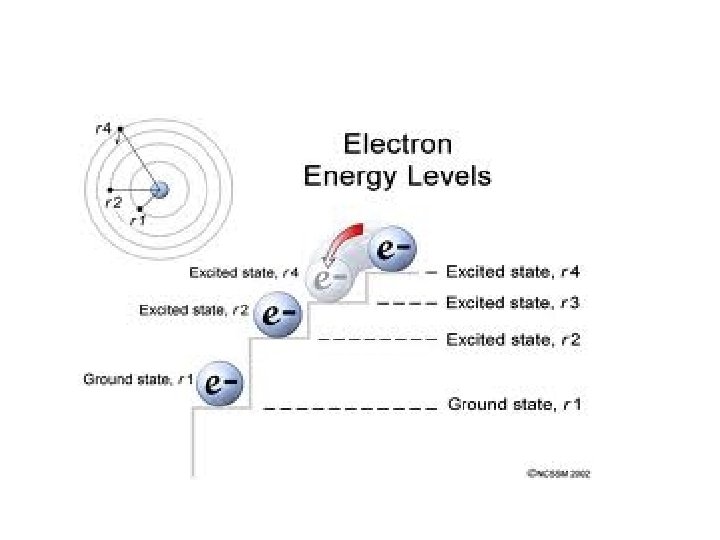
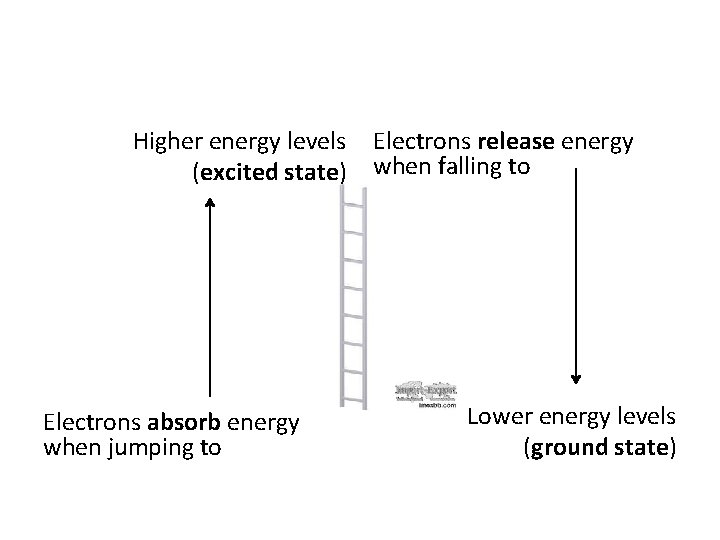
Higher energy levels (excited state) Electrons absorb energy when jumping to Electrons release energy when falling to Lower energy levels (ground state)
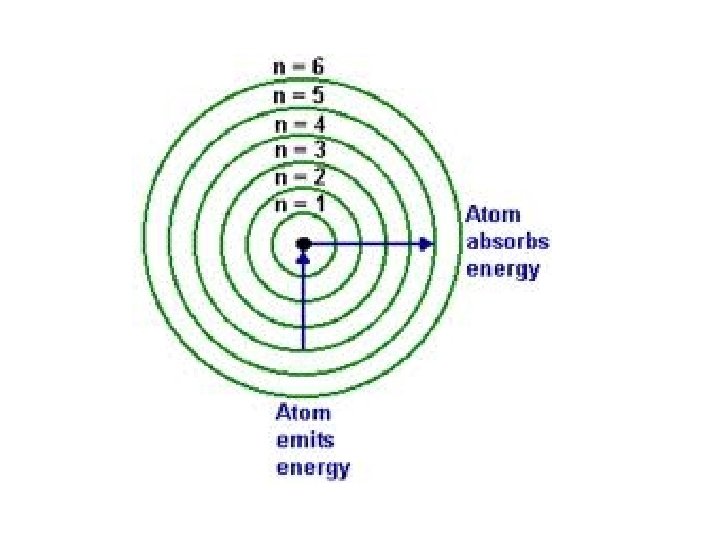
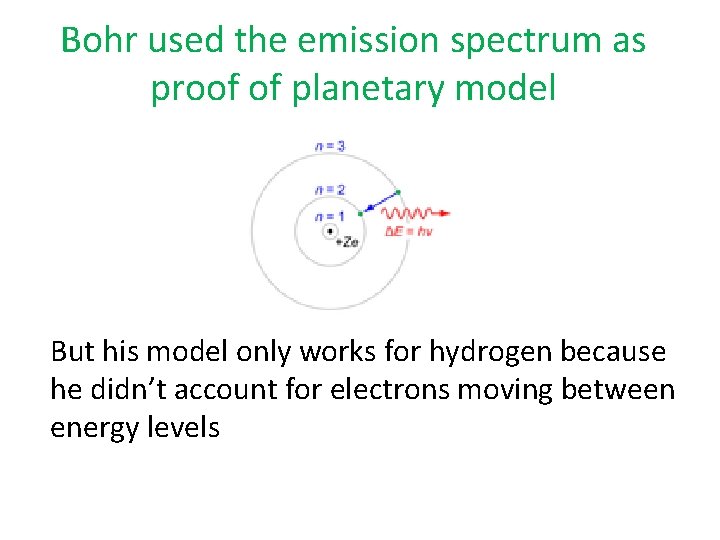
Bohr used the emission spectrum as proof of planetary model But his model only works for hydrogen because he didn’t account for electrons moving between energy levels
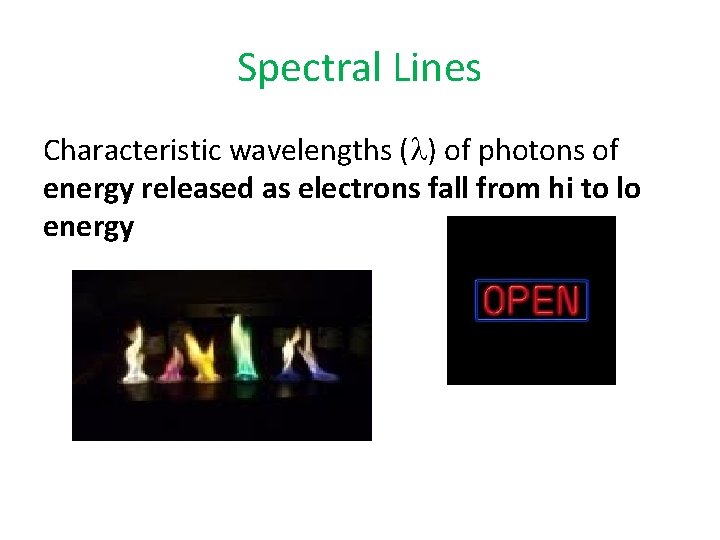
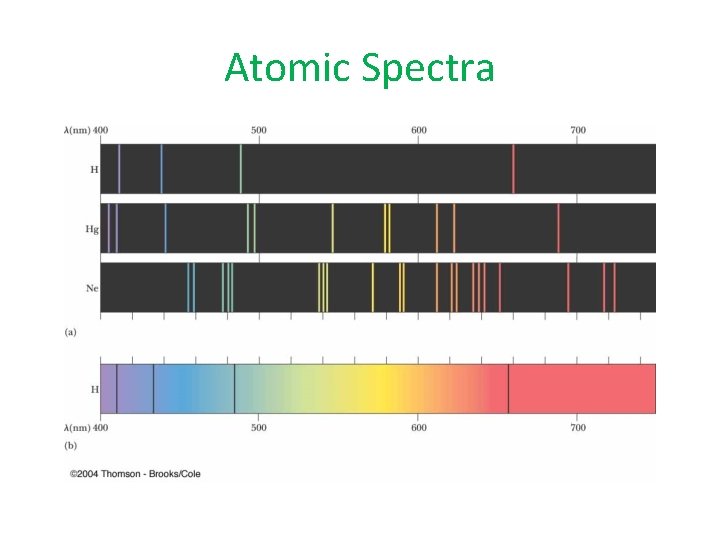
Spectral Lines Characteristic wavelengths (l) of photons of energy released as electrons fall from hi to lo energy
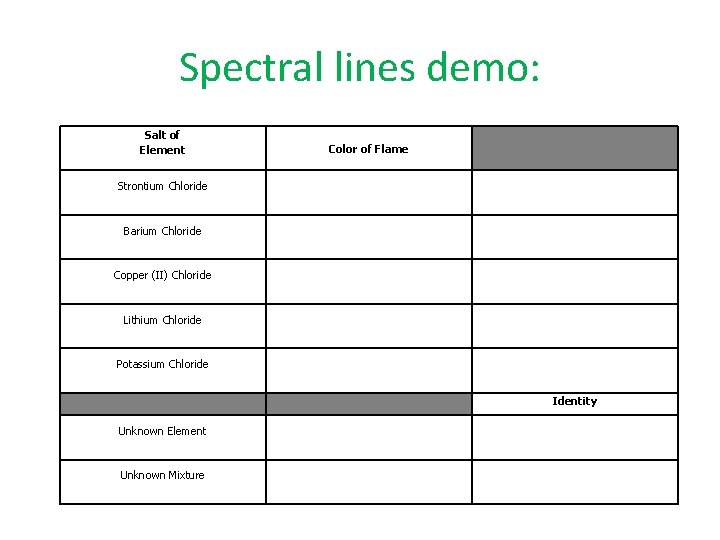
Spectral lines demo: Salt of Element Color of Flame Strontium Chloride Barium Chloride Copper (II) Chloride Lithium Chloride Potassium Chloride Identity Unknown Element Unknown Mixture
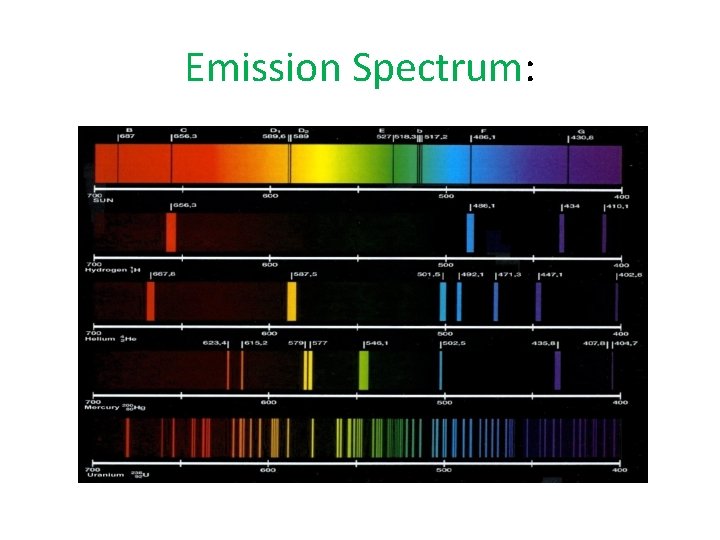
Emission Spectrum:
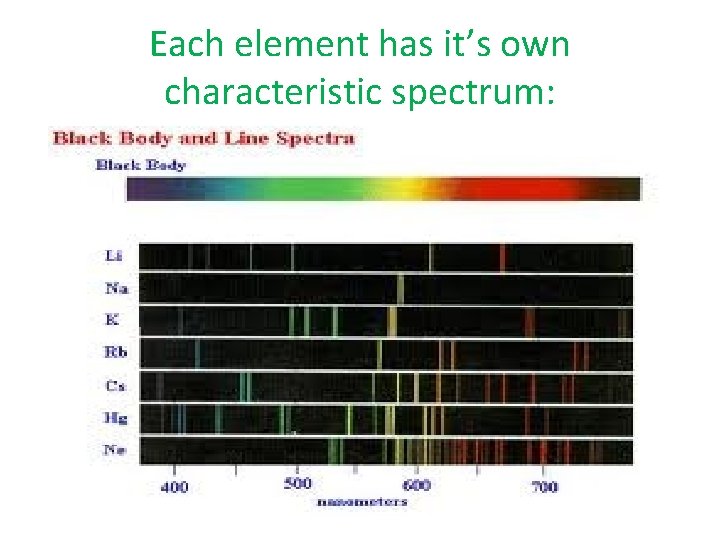
Each element has it’s own characteristic spectrum:
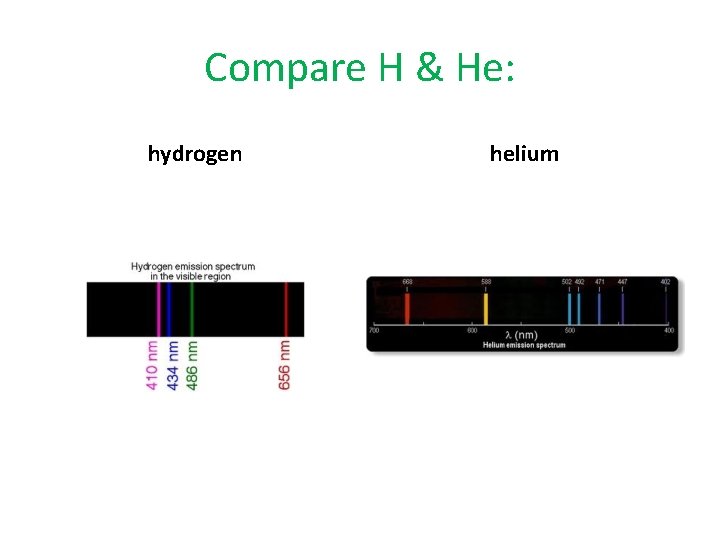
Compare H & He: hydrogen helium
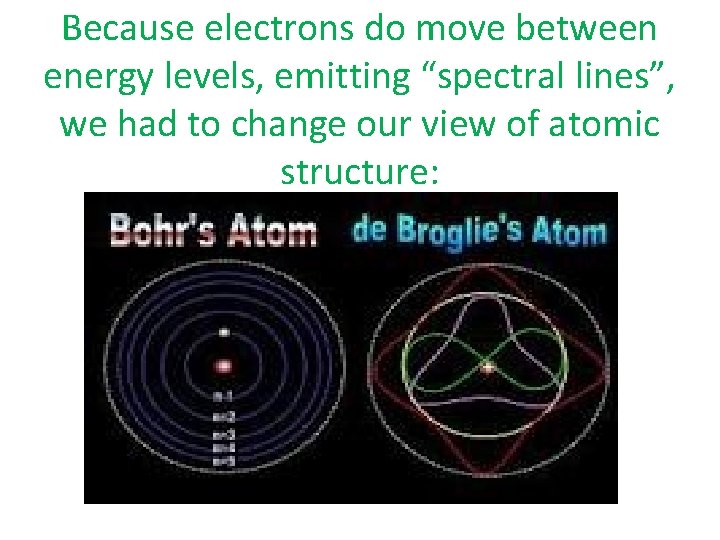
Because electrons do move between energy levels, emitting “spectral lines”, we had to change our view of atomic structure:
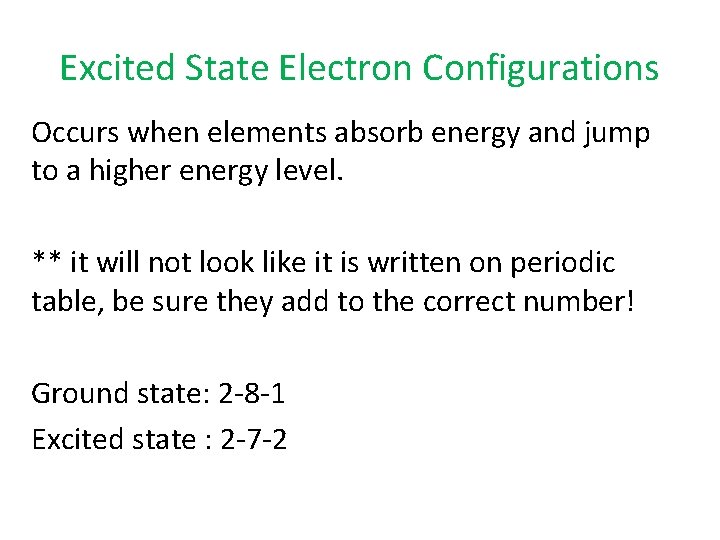
Excited State Electron Configurations Occurs when elements absorb energy and jump to a higher energy level. ** it will not look like it is written on periodic table, be sure they add to the correct number! Ground state: 2 -8 -1 Excited state : 2 -7 -2
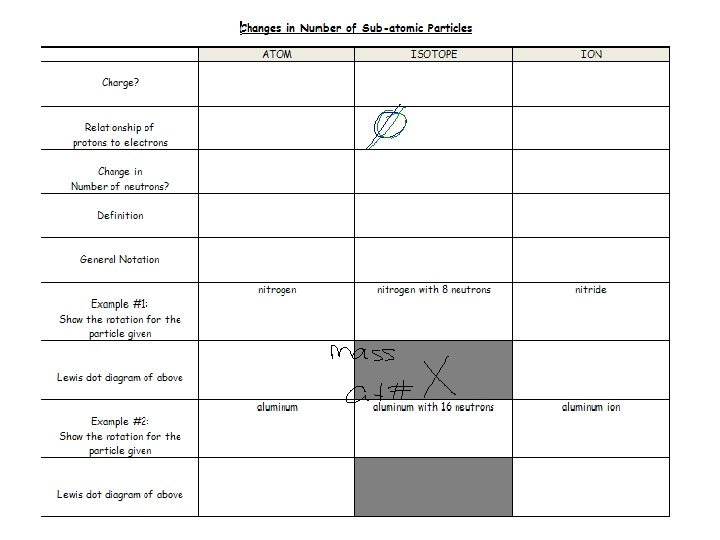
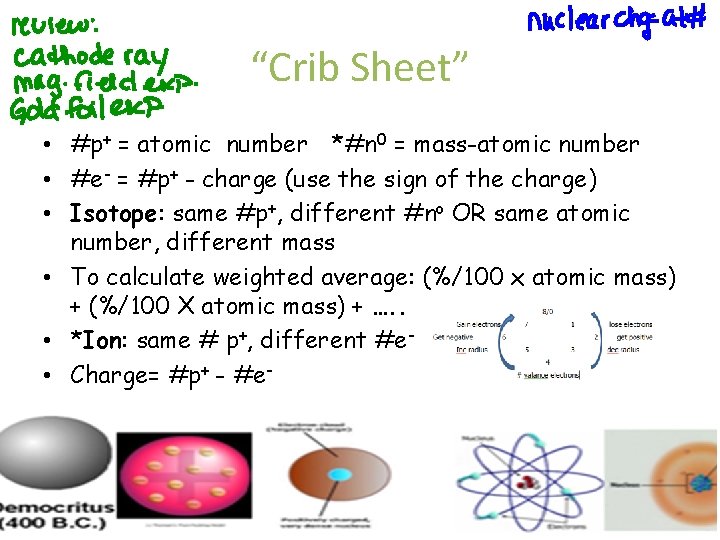
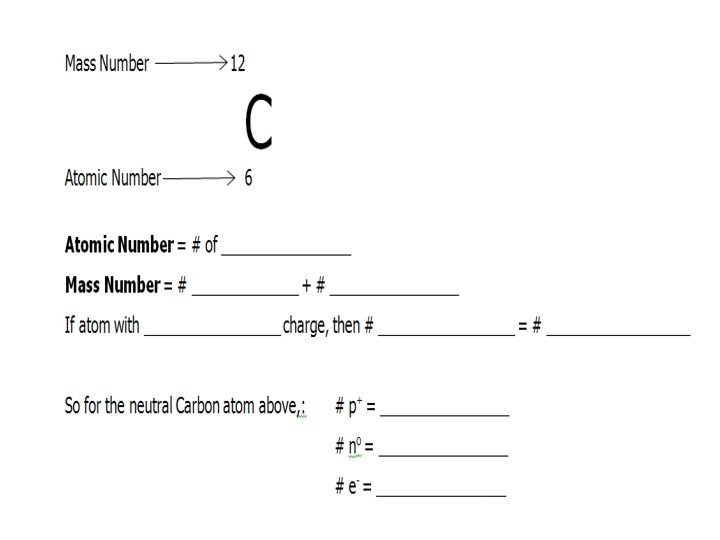
“Crib Sheet” • #p+ = atomic number *#n 0 = mass-atomic number • #e- = #p+ - charge (use the sign of the charge) • Isotope: same #p+, different #no OR same atomic number, different mass • To calculate weighted average: (%/100 x atomic mass) + (%/100 X atomic mass) + …. . • *Ion: same # p+, different #e • Charge= #p+ - #e-
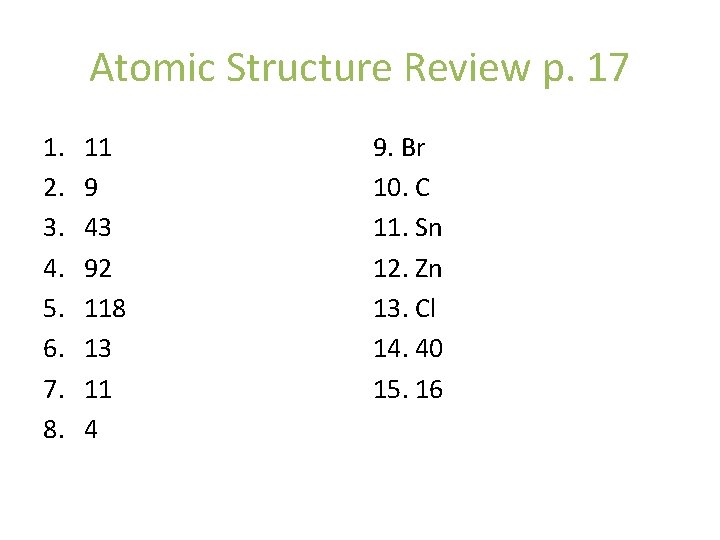
Atomic Structure Review p. 17 1. 2. 3. 4. 5. 6. 7. 8. 11 9 43 92 118 13 11 4 9. Br 10. C 11. Sn 12. Zn 13. Cl 14. 40 15. 16
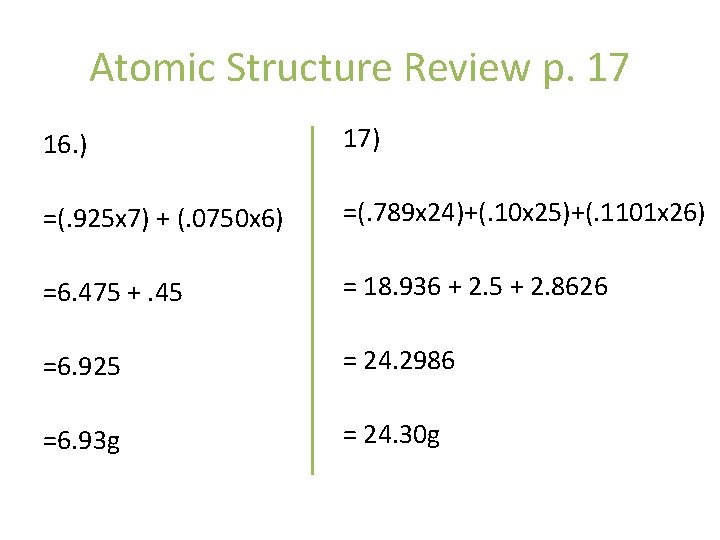
Atomic Structure Review p. 17 16. ) 17) =(. 925 x 7) + (. 0750 x 6) =(. 789 x 24)+(. 10 x 25)+(. 1101 x 26) =6. 475 +. 45 = 18. 936 + 2. 5 + 2. 8626 =6. 925 = 24. 2986 =6. 93 g = 24. 30 g
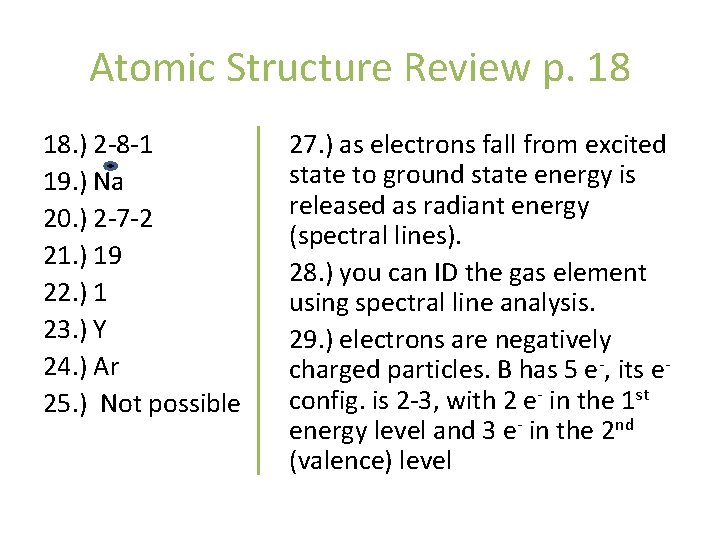
Atomic Structure Review p. 18 18. ) 2 -8 -1 19. ) Na 20. ) 2 -7 -2 21. ) 19 22. ) 1 23. ) Y 24. ) Ar 25. ) Not possible 27. ) as electrons fall from excited state to ground state energy is released as radiant energy (spectral lines). 28. ) you can ID the gas element using spectral line analysis. 29. ) electrons are negatively charged particles. B has 5 e-, its econfig. is 2 -3, with 2 e- in the 1 st energy level and 3 e- in the 2 nd (valence) level
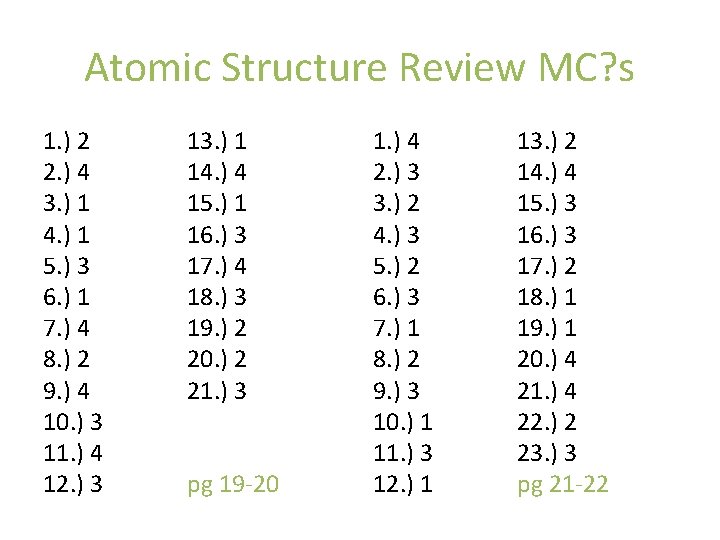
Atomic Structure Review MC? s 1. ) 2 2. ) 4 3. ) 1 4. ) 1 5. ) 3 6. ) 1 7. ) 4 8. ) 2 9. ) 4 10. ) 3 11. ) 4 12. ) 3 13. ) 1 14. ) 4 15. ) 1 16. ) 3 17. ) 4 18. ) 3 19. ) 2 20. ) 2 21. ) 3 pg 19 -20 1. ) 4 2. ) 3 3. ) 2 4. ) 3 5. ) 2 6. ) 3 7. ) 1 8. ) 2 9. ) 3 10. ) 1 11. ) 3 12. ) 1 13. ) 2 14. ) 4 15. ) 3 16. ) 3 17. ) 2 18. ) 1 19. ) 1 20. ) 4 21. ) 4 22. ) 2 23. ) 3 pg 21 -22
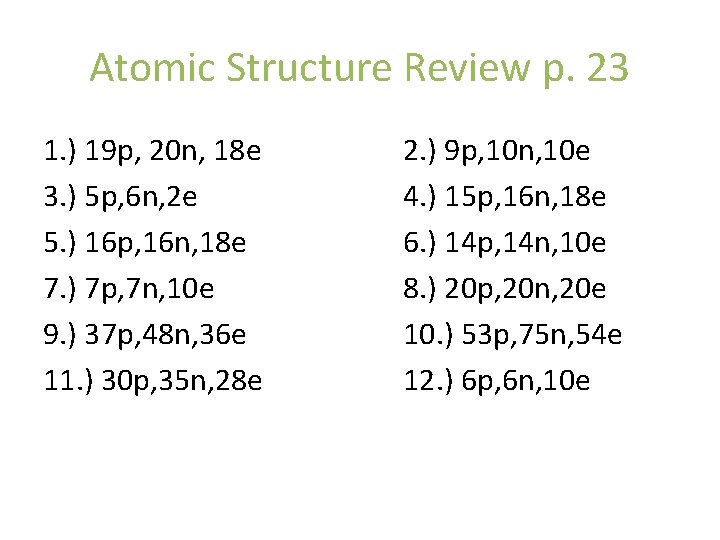
Atomic Structure Review p. 23 1. ) 19 p, 20 n, 18 e 3. ) 5 p, 6 n, 2 e 5. ) 16 p, 16 n, 18 e 7. ) 7 p, 7 n, 10 e 9. ) 37 p, 48 n, 36 e 11. ) 30 p, 35 n, 28 e 2. ) 9 p, 10 n, 10 e 4. ) 15 p, 16 n, 18 e 6. ) 14 p, 14 n, 10 e 8. ) 20 p, 20 n, 20 e 10. ) 53 p, 75 n, 54 e 12. ) 6 p, 6 n, 10 e
- Slides: 93