
Brief Overview of Self Help Treatment Joan Salmon
Brief Overview of Self. Help Treatment Joan Salmon, LCSW-R 11/20/2019
Working with communities to address the opioid crisis. ✧ SAMHSA’s State Targeted Response Technical Assistance (STR-TA) grant created the Opioid Response Network to assist STR grantees, individuals and other organizations by providing the resources and technical assistance they need locally to address the opioid crisis. ✧ Technical assistance is available to support the evidence- based prevention, treatment, and recovery of opioid use disorders. 2
Working with communities to address the opioid crisis. ✧ The Opioid Response Network (ORN) provides local, experienced consultants in prevention, treatment and recovery to communities and organizations to help address this opioid crisis. ✧ The ORN accepts requests for education and training. ✧ Each state/territory has a designated team, led by a regional Technology Transfer Specialist (TTS), who is an expert in implementing evidence-based practices. 3
Contact the Opioid Response Network ✧ To ask questions or submit a technical assistance request: • Visit www. Opioid. Response. Network. org • Email orn@aaap. org • Call 401 -270 -5900 4
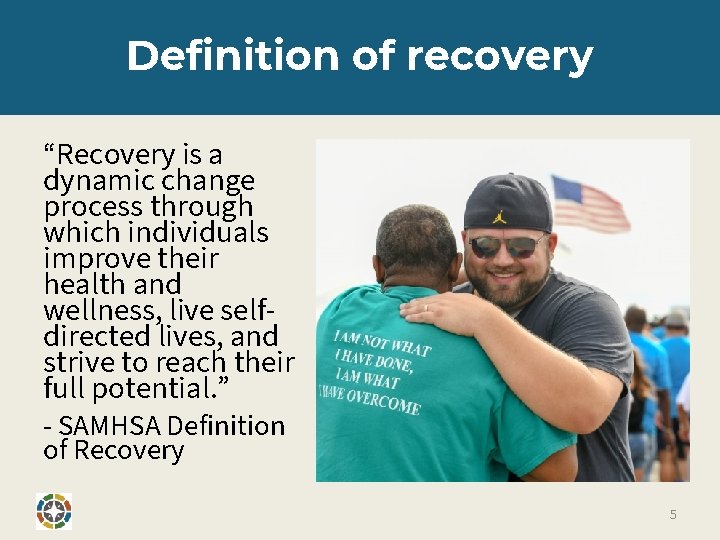
Definition of recovery “Recovery is a dynamic change process through which individuals improve their health and wellness, live selfdirected lives, and strive to reach their full potential. ” - SAMHSA Definition of Recovery 5
Recovery as remission ✧ More common than most people realize ✧ Scientific evidence indicates approximately 50 percent of adults (25 million people) are currently in stable remission (1 year or longer) ✧ Remission from a substance use disorder can take several years and multiple episodes of treatment, recovery support services, and/or mutual aid 6
Researchers say recovery… ✧ “. . is a lived experience of improved life quality and a sense of empowerment; that the principles of recovery focus on the central ideas of hope, choice, freedom and aspiration that are experienced rather than diagnosed and occur in real life settings rather than in clinical settings. Recovery is a process rather than an end state, with the goal being an ongoing quest for a better life. ” – David Best & Alexandre Laudet 8
Beyond remission ✧ Recovery goes beyond the remission of substance use disorder symptoms to include a positive change in the whole person ✧ ‘Abstinence’ from substances, though often necessary, is not always sufficient to define recovery ✧ People will choose their recovery pathway based on cultural values, socio-economic status, psychological and behavioral needs, and the nature of their substance use disorder 8

There are many paths of recovery Natural Recovery Mutual Aid Groups Medication. Assisted Recovery Peer-Based Recovery Supports Family Recovery Technology. Based Recovery Alternative Recovery Supports Faith-Based Recovery 9
Mutual Aid Treatment
Mutual Aid Overview ✧ ✧ There are many levels of treatment available to treat an individual with a SUD. Many choose to support their own recovery through the mutual aid route without ever being admitted into a clinical focused program. There are several programs in place but three that are very popular. – 12 -Step – SMART Recovery – Dharma Recovery 11
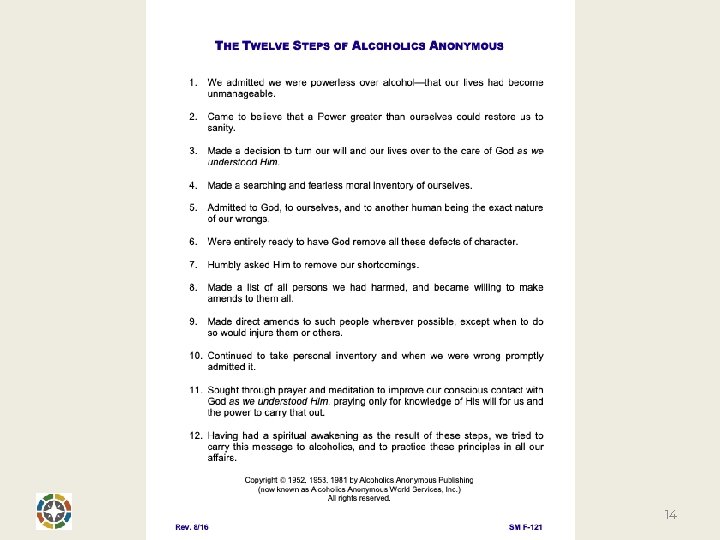
12 -Step Recovery ✧ Alcoholics Anonymous (AA) originated the idea for the 12 -Step model in 1935, when founder Bill Wilson wrote out the ideas that had been developing through his experience with and vision of alcoholism. ¹ ✧ He wrote about the positive effects experienced when people struggling with alcoholism shared their stories with one another. ² ✧ Wilson wrote what has become known as the Big Book of Alcoholics Anonymous for members to use as AA’s basic text, published in 1938. ¹ ✧ The principles were derived from Christian inspiration and other spiritual resources. 12
12 -Step Recovery con’t ✧ AA was founded on the belief that one alcoholic helping another can keep one, if not both sober. ✧ AA meetings are peer run and are used as a mutual support where members are expected to share. ✧ Members of AA support each other and use encouragement to help one another stay sober. Most individuals will obtain an sponsor to assist in the process. ✧ Other 12 -step groups, like Narcotics Anonymous and Gamblers Anonymous are based on the AA model of mutual support. ✧ Some people interpret the AA literature and language used at the meetings as religious and seek alternative recovery support. ✧ There are some other alternative 12 -step meetings available in NYC* 13
14
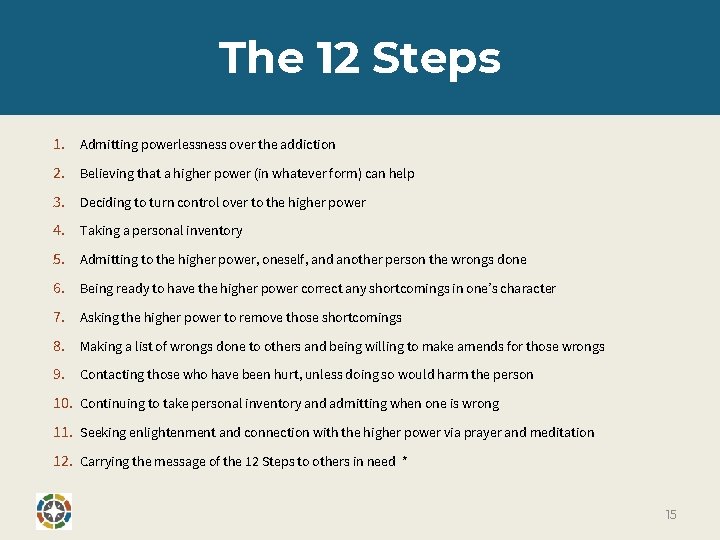
The 12 Steps 1. Admitting powerlessness over the addiction 2. Believing that a higher power (in whatever form) can help 3. Deciding to turn control over to the higher power 4. Taking a personal inventory 5. Admitting to the higher power, oneself, and another person the wrongs done 6. Being ready to have the higher power correct any shortcomings in one’s character 7. Asking the higher power to remove those shortcomings 8. Making a list of wrongs done to others and being willing to make amends for those wrongs 9. Contacting those who have been hurt, unless doing so would harm the person 10. Continuing to take personal inventory and admitting when one is wrong 11. Seeking enlightenment and connection with the higher power via prayer and meditation 12. Carrying the message of the 12 Steps to others in need * 15
SMART Recovery ✧ ✧ ✧ SMART stands for Self-Management and Recovery Training SMART recovery is an abstinence-oriented, not-for profit organization for individuals with addictive problems. The free mutual support meetings are focused on ideas and techniques to help individuals change their lives from destructive to constructive. The concept is built on scientific methods that are evidenced-based and validated. They do not use words like addict or alcoholic. 16
SMART Recovery Con’t ✧ ✧ ✧ The support groups are run by individuals that have been trained in the SMART model. CBT and MI are used within the SMART groups just to name a few techniques. Those who do not feel that 12 -steps are a good fit for them, particularly because of the religious focus, often find SMART as a helpful alternative. 17
Dharma Recovery ✧ ✧ Dharma recovery is based on the Buddhist teachings of Dharma The groups are peer lead and offer a powerful approach to healing from addiction and living a life of true freedom. * The community decides on the principles that they wish to follow themselves. They subscribe to the eightfold path to recovery. Understanding, communication, community, action, livelihood, service, mindfulness/ mediations and concentration/meditations. 18
Moderation Management ✧ ✧ ✧ Supports people who use substances and want to reduce their use, as well as make other positive lifestyle changes For people who have experienced mild to moderate levels of substance use-related problems Requires that participants begin with abstinence for 30 days and recommends AA or another abstinence program for those who have difficulty with this. 1 19
Barriers To Self-help & Mutual Aid ✧ ✧ ✧ Some groups don’t subscribe to the use of medication Some may need formal treatment in addition to the selfhelp model Some may live in a rural area that does not have mutual aid options Might have lack of transportation making it difficult to get to meetings Economic disadvantage – person working more than 1 job might find it hard to get to meetings Person must be self motivated 20
Further Resources ✧ ✧ Information about additional mutual aid groups: https: //facesandvoicesofrecovery. org/resources/m utual-aid-resources/ Blog post from Bill White (founder of AA) about people who opt out of traditional treatment regimens in their recovery: http: //www. williamwhitepapers. com/blog/2019/0 8/addiction-recovery-without-treatment. html 21
Questions?
- Slides: 22