
Brief Overview of Medications for OUD Kyle M
Brief Overview of Medications for OUD Kyle M. Kampman M. D. Professor, Department of Psychiatry Perelman School of Medicine kampman@pennmedicine. upenn. edu
How are Drug Use Disorders treated? Traditional approach: 1. Initiation of abstinence – detoxification 2. Psychosocial treatment 3. Participation in 12 step meetings
Why do we need medications? • Detoxification followed by counseling alone results in relapse in an overwhelming number of cases – VA trial 112 entered detox 6 were in treatment and opiate free at 90 days (Journal of Addictive Diseases, 2006; 25(4): 27 -35 ) – 516 patients tapered with buprenorphine over 7 or 28 days. Only 18% were opiate free at 1 month follow up and 13% opiate free at 3 months (Addiction 2009; 104(2): 256 -65)
Why do we need medications? • Detoxification followed by counseling alone increases the risk for overdose and death – 276 opiate addicted patients entered rehab, 24 overdosed and died over an 8 year follow up, 6 in the first 4 weeks (Drug Alcohol depend 2010; 108: 65 -69) – 137 detoxified opiate addicted patients were followed, 5 died within a year of discharge from rehab, 3 within the first 4 months (BMJ 2003; 326: 959 -60)
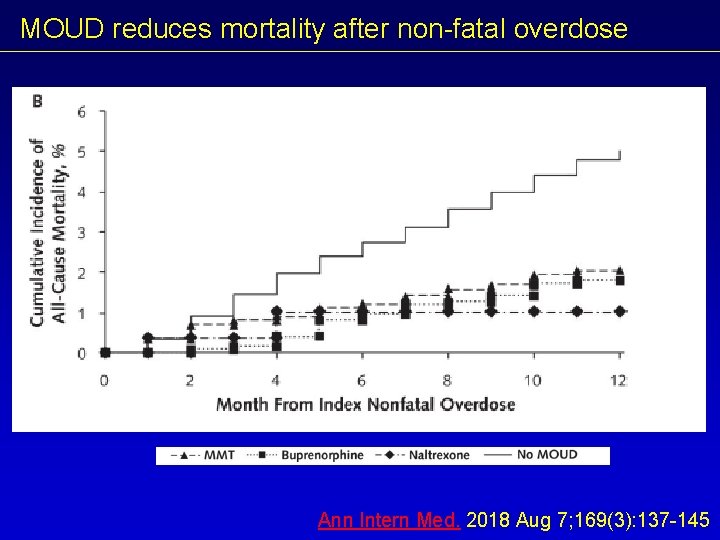
MOUD reduces mortality after non-fatal overdose Ann Intern Med. 2018 Aug 7; 169(3): 137 -145
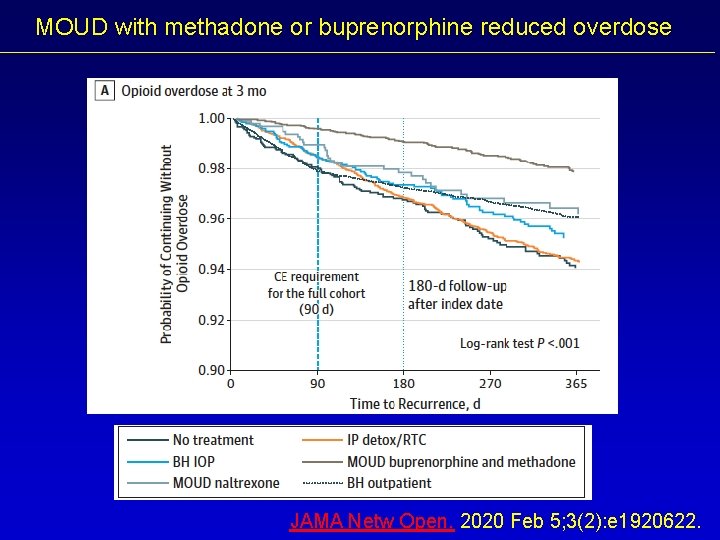
MOUD with methadone or buprenorphine reduced overdose JAMA Netw Open. 2020 Feb 5; 3(2): e 1920622.
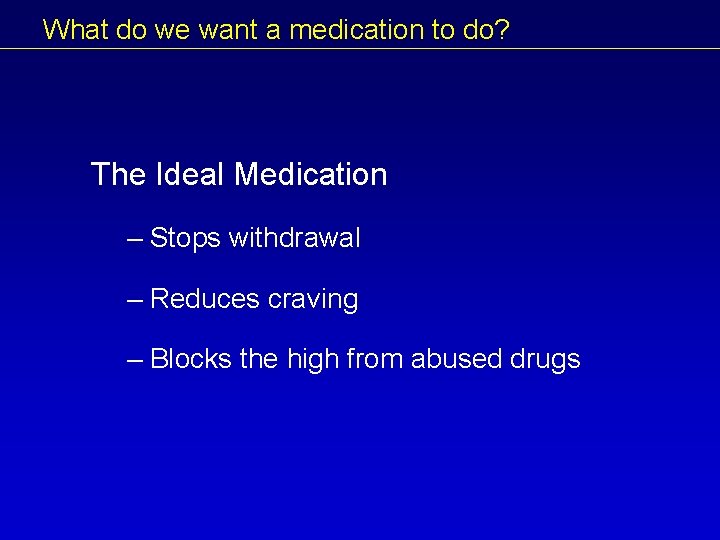
What do we want a medication to do? The Ideal Medication – Stops withdrawal – Reduces craving – Blocks the high from abused drugs
Methadone maintenance for OUD • Methadone is long acting opiate agonist – it attaches itself to the mu opiate receptor and activates it. • It is very effective at alleviating opiate withdrawal and craving • At low doses it will not block an opiate high, however, if the dose is gradually increased it will confer enough tolerance to prevent patients from experiencing pleasurable effects of heroin or abused prescription opiates. • Methadone is highly effective (Cochrane Database Syst Rev. 2009 Jul 8; (3)) • Methadone is dispensed exclusively at opiate treatment programs (OTP) under strict rules – Sometimes inconvenient – Exposes patients to conditioned reminders of drug use, causing craving – Dangerous itself in overdose
Buprenorphine for OUD • Mu opiate partial agonist with a higher affinity for the mu opiate receptor than heroin and abused prescription opioids • Effectively reduces withdrawal and craving • Blocks opiate high effectively • Safer to use than methadone, difficult to overdose and can be prescribed at a physicians office – More available than methadone – Less exposure to conditioned reminders of drug use so less craving – Daily dosing not required • Effective (Drug Alcohol Depend. 2010 Jan 1; 106(1): 56 -60) • Requires specialized training and a waiver from DEA • Prone to diversion and abuse – Implantable forms available – Injectables being tested
Buprenorphine adherence is often poor Adequate Adherence in Less Than 50% of Patients • In a trial involving subjects with opioid use disorder participating in office based buprenorphine treatment, it was found that only 48% of the subjects were adherent to the medication as defined as having 80% or more of their visits associated with a positive UDS for buprenorphine. (Am. J. Addict. , 2016, 25, 110– 117) • In an examination of medical and pharmacy claims data over a year, only 32% of patients participating in office based buprenorphine treatment took buprenorphine on 80% or more days. (J. Subst. Abuse Treat. , 2014, 46, 456– 462)
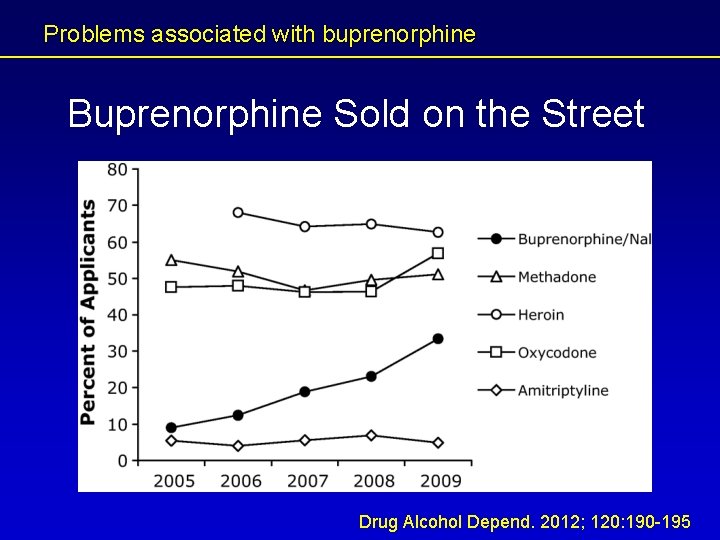
Problems associated with buprenorphine Buprenorphine Sold on the Street Drug Alcohol Depend. 2012; 120: 190 -195
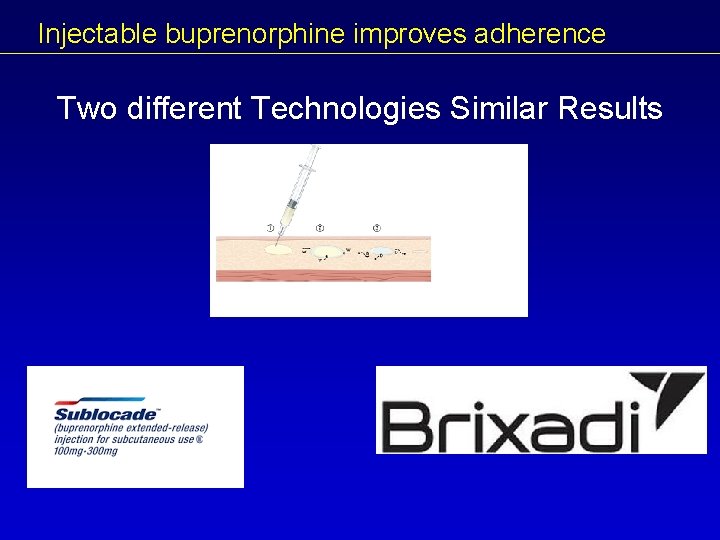
Injectable buprenorphine improves adherence Two different Technologies Similar Results
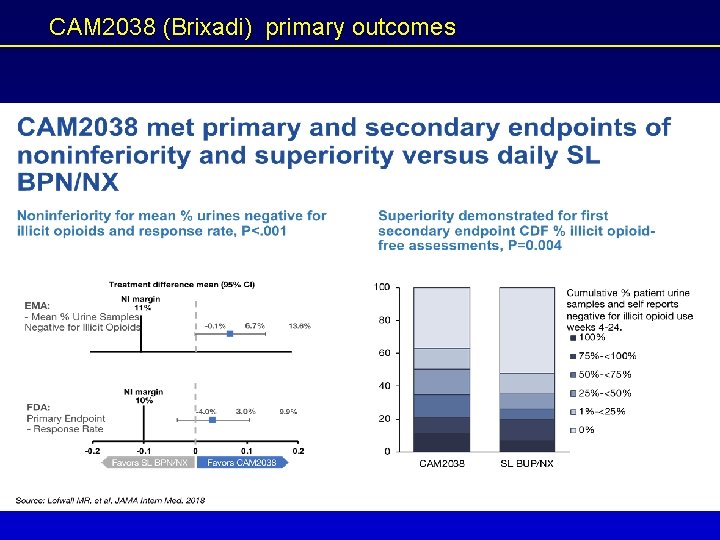
CAM 2038 (Brixadi) primary outcomes
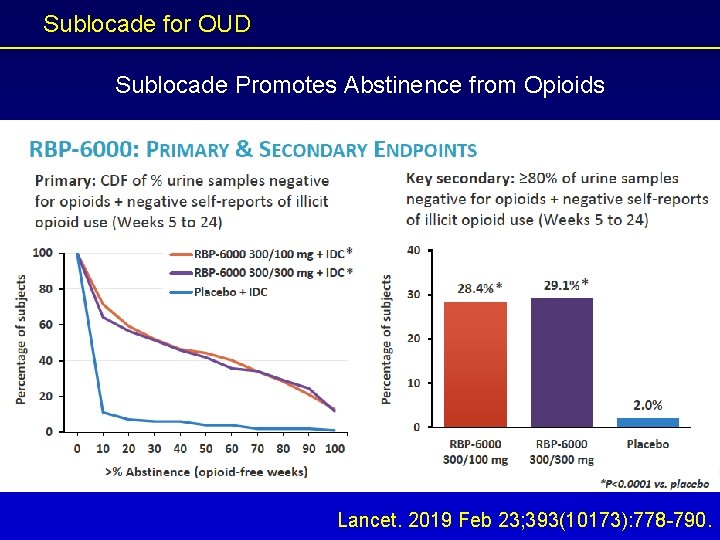
Sublocade for OUD Sublocade Promotes Abstinence from Opioids Lancet. 2019 Feb 23; 393(10173): 778 -790.
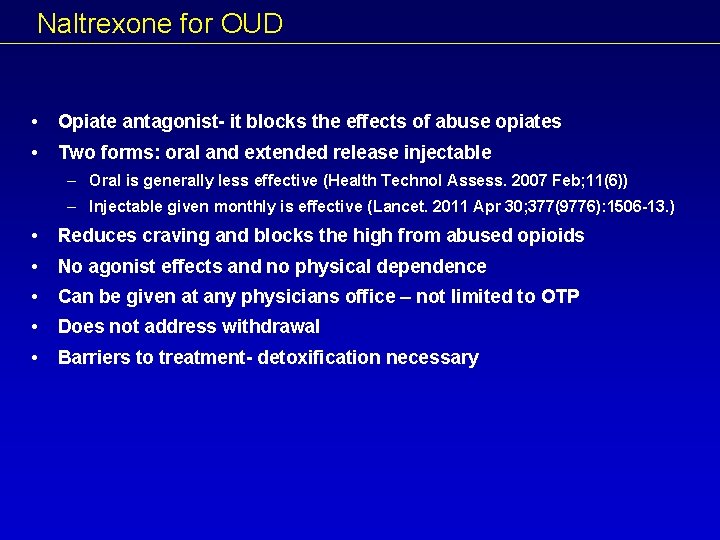
Naltrexone for OUD • Opiate antagonist- it blocks the effects of abuse opiates • Two forms: oral and extended release injectable – Oral is generally less effective (Health Technol Assess. 2007 Feb; 11(6)) – Injectable given monthly is effective (Lancet. 2011 Apr 30; 377(9776): 1506 -13. ) • Reduces craving and blocks the high from abused opioids • No agonist effects and no physical dependence • Can be given at any physicians office – not limited to OTP • Does not address withdrawal • Barriers to treatment- detoxification necessary
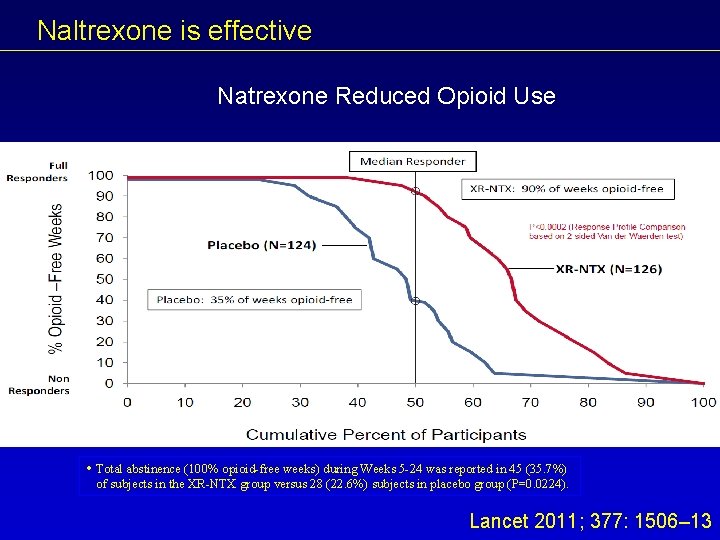
Naltrexone is effective Natrexone Reduced Opioid Use Total abstinence (100% opioid-free weeks) during Weeks 5 -24 was reported in 45 (35. 7%) of subjects in the XR-NTX group versus 28 (22. 6%) subjects in placebo group (P=0. 0224). Lancet 2011; 377: 1506– 13
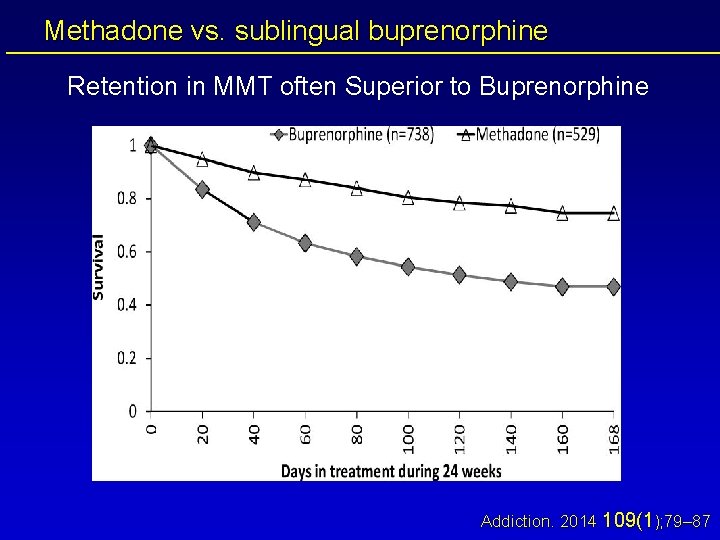
Methadone vs. sublingual buprenorphine Retention in MMT often Superior to Buprenorphine Addiction. 2014 109(1); 79– 87
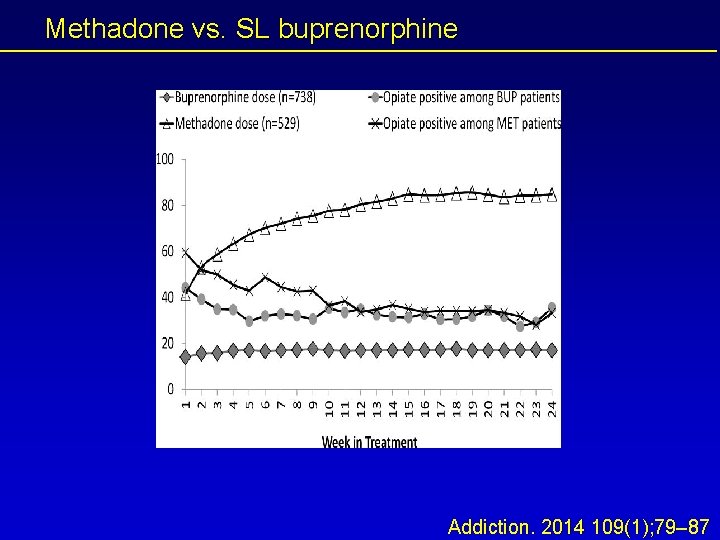
Methadone vs. SL buprenorphine Addiction. 2014 109(1); 79– 87
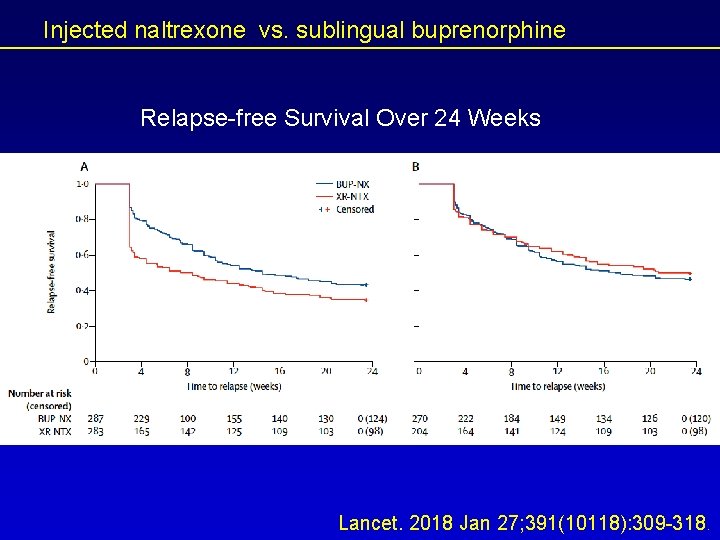
Injected naltrexone vs. sublingual buprenorphine Relapse-free Survival Over 24 Weeks Lancet. 2018 Jan 27; 391(10118): 309 -318.
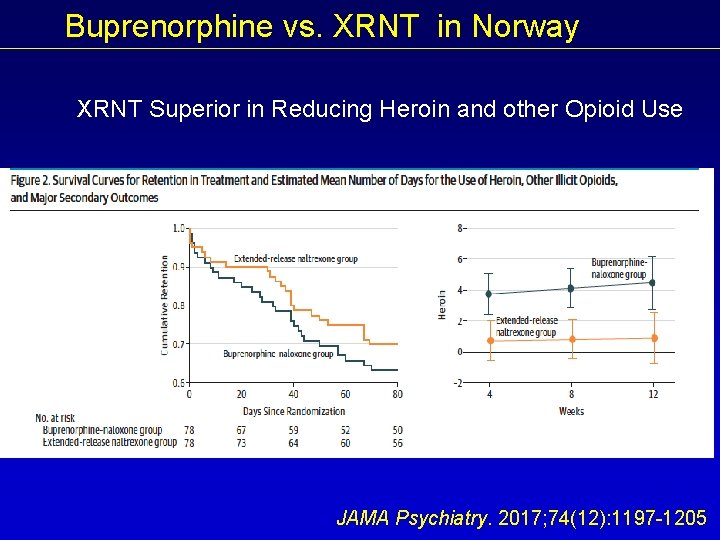
Buprenorphine vs. XRNT in Norway XRNT Superior in Reducing Heroin and other Opioid Use JAMA Psychiatry. 2017; 74(12): 1197 -1205
Discussion • • Detox alone can lead to relapse and death Methadone is an effective treatment • • • Inconvenient Poor therapeutic milieu Stigma Buprenorphine is effective • • Diversion poor adherence Injectables may be better Naltrexone is effective • • Detoxification may be a barrier Adherence can be a problem
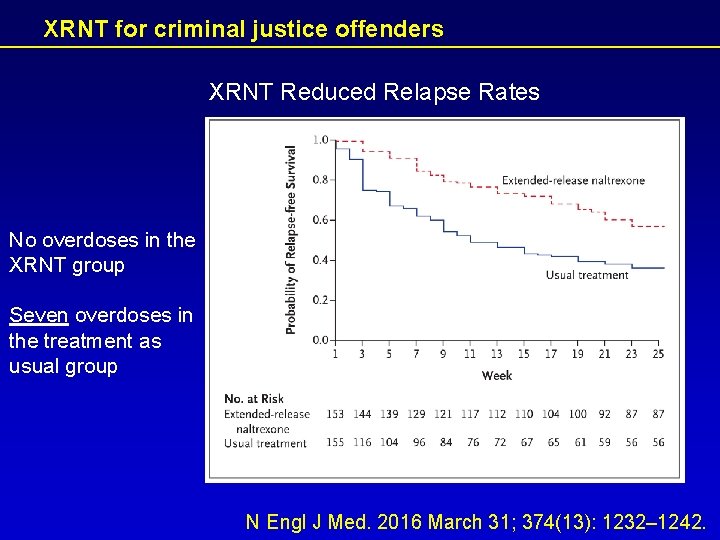
XRNT for criminal justice offenders XRNT Reduced Relapse Rates No overdoses in the XRNT group Seven overdoses in the treatment as usual group N Engl J Med. 2016 March 31; 374(13): 1232– 1242.
- Slides: 22