
Brief Introduction to NLP Natural Language and Knowledge
Brief Introduction to NLP Natural Language and Knowledge Processing Group Research Fellow: Keh-Yih Su
Table of Content • A Simple Example: Syntactic Machine Translation – Process Flow • Main Problems in NLP – Ambiguity & Ill-formedness • Main Tasks in NLP – Tasks required in NLP, Bottlenecks • Detailed Steps Overview – Analysis, Transfer and Generation • Applications Keh-Yih Su, 2017 -07 -03
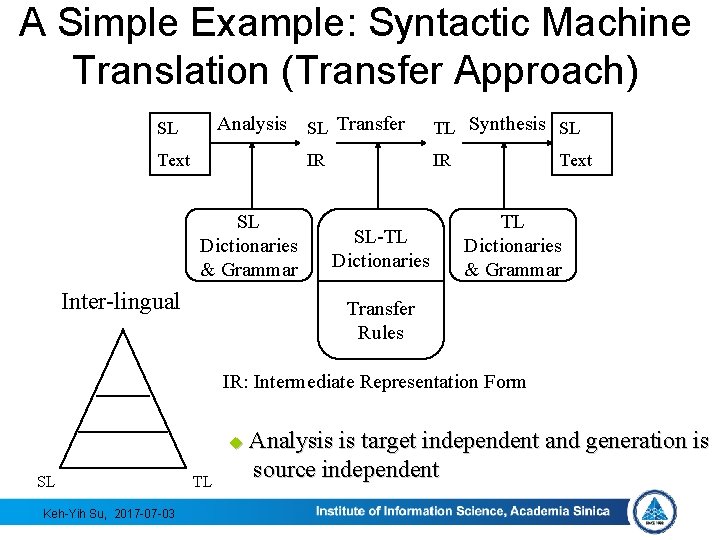
A Simple Example: Syntactic Machine Translation (Transfer Approach) Analysis SL Text SL Dictionaries & Grammar SL Transfer TL Synthesis SL IR IR SL-TL Dictionaries Inter-lingual Text TL Dictionaries & Grammar Transfer Rules IR: Intermediate Representation Form u Analysis SL Keh-Yih Su, 2017 -07 -03 TL is target independent and generation is source independent
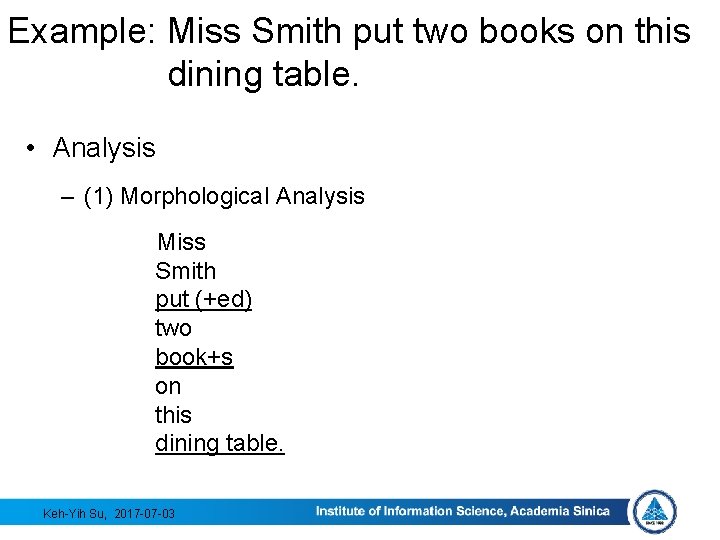
Example: Miss Smith put two books on this dining table. • Analysis – (1) Morphological Analysis Miss Smith put (+ed) two book+s on this dining table. Keh-Yih Su, 2017 -07 -03
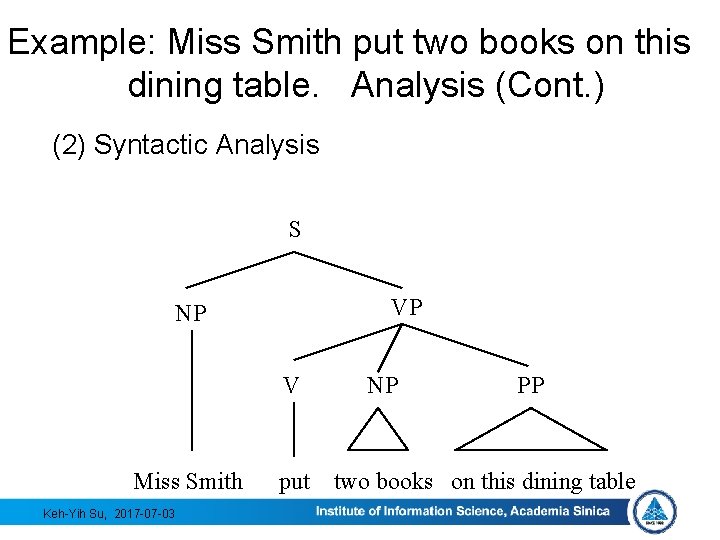
Example: Miss Smith put two books on this dining table. Analysis (Cont. ) (2) Syntactic Analysis S VP NP V Miss Smith Keh-Yih Su, 2017 -07 -03 NP PP put two books on this dining table
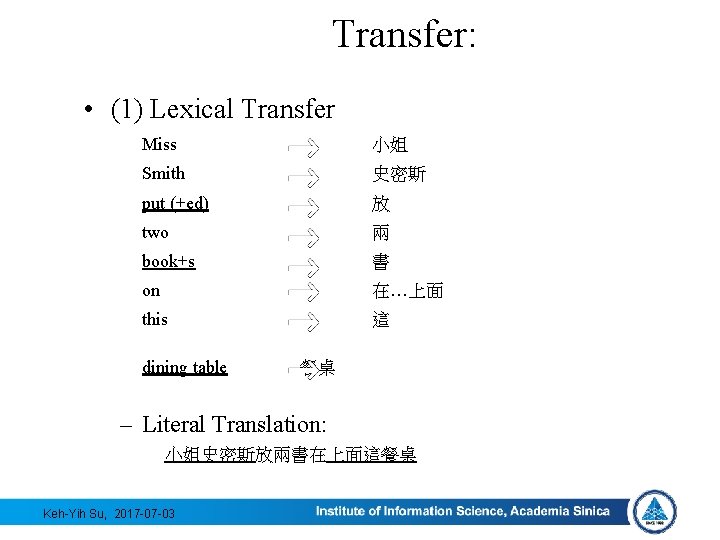
Transfer: • (1) Lexical Transfer Miss 小姐 Smith 史密斯 put (+ed) 放 two 兩 book+s 書 on 在…上面 this 這 dining table 餐桌 – Literal Translation: 小姐史密斯放兩書在上面這餐桌 Keh-Yih Su, 2017 -07 -03
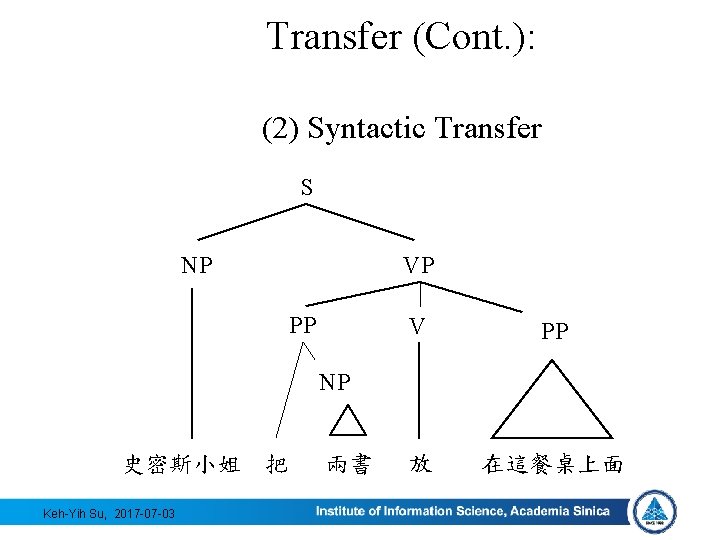
Transfer (Cont. ): (2) Syntactic Transfer S NP VP PP V PP 放 在這餐桌上面 NP 史密斯小姐 把 Keh-Yih Su, 2017 -07 -03 兩書
![position := initial + rate * 60 lexical analyzer [Aho 86] id 1 :=](http://slidetodoc.com/presentation_image_h2/b07b9ccc630fe8dc4f413a9af5323e3b/image-9.jpg "position := initial + rate * 60 lexical analyzer [Aho 86] id 1 :=")
position := initial + rate * 60 lexical analyzer [Aho 86] id 1 := id 2 + id 3 * 60 syntax analyzer := SYMBOL TABLE 1 position … 2 initial … 3 rate 4 Keh-Yih Su, 2017 -07 -03 … id 1 + id 2 * id 3 60 semantic analyzer := id 1 + id 2 * id 3 inttoreal 60
![C intermediate code generator [Aho 86] temp 1 temp 2 temp 3 id 1](http://slidetodoc.com/presentation_image_h2/b07b9ccc630fe8dc4f413a9af5323e3b/image-10.jpg "C intermediate code generator [Aho 86] temp 1 temp 2 temp 3 id 1")
C intermediate code generator [Aho 86] temp 1 temp 2 temp 3 id 1 := inttoreal (60) := id 3 * temp 1 := id 2 + temp 2 := temp 3 code optimizer temp 1 := id 3 * 60. 0 id 1 := id 2 + temp 1 code generator Binary Code Keh-Yih Su, 2017 -07 -03
![source program lexical [Aho 86] analyzer syntax analyzer semantic symbol-table manager analyzer intermediate code](http://slidetodoc.com/presentation_image_h2/b07b9ccc630fe8dc4f413a9af5323e3b/image-11.jpg "source program lexical [Aho 86] analyzer syntax analyzer semantic symbol-table manager analyzer intermediate code")
source program lexical [Aho 86] analyzer syntax analyzer semantic symbol-table manager analyzer intermediate code generator code optimizer code generator target program Keh-Yih Su, 2017 -07 -03 error handler
Table of Content • A Simple Example: Syntactic Machine Translation – Process Flow • Main Problems in NLP – Ambiguity & Ill-formedness • Main Tasks in NLP – Tasks required in NLP, Bottlenecks • Detailed Steps Overview – Analysis, Transfer and Generation • Applications Keh-Yih Su, 2017 -07 -03

Natural Language is more complicated • Ambiguity (岐義) --- For decoder – Many different ways to interpret a given sentence. – #1: “[I saw [the boy] [with a telescope]]" – #2: “[I saw [the boy [with a telescope]]]" • Ill-Formedness (不合設定, 非正規) --- For decoder – Language is involving, and no rule-set could completely cover various cases to appear tomorrow – New Words: Singlish, bioinformatics, etc. – New Usage: missing verb in "Which one? " … Keh-Yih Su, 2017 -07 -03
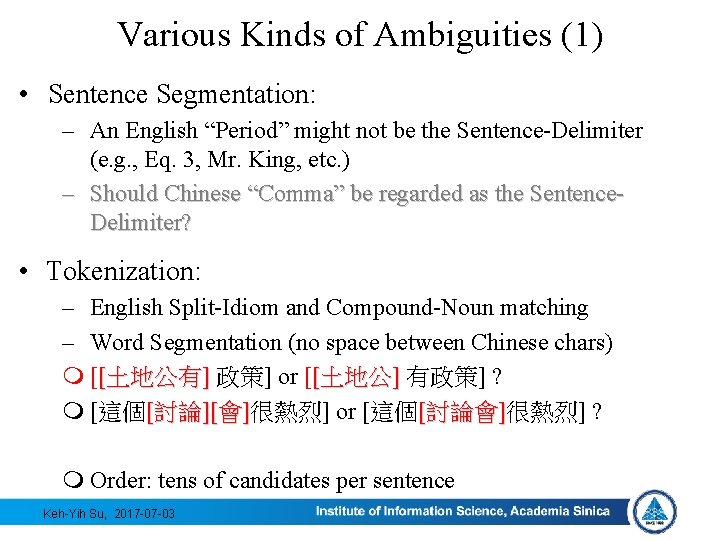
Various Kinds of Ambiguities (1) • Sentence Segmentation: – An English “Period” might not be the Sentence-Delimiter (e. g. , Eq. 3, Mr. King, etc. ) – Should Chinese “Comma” be regarded as the Sentence. Delimiter? • Tokenization: – English Split-Idiom and Compound-Noun matching – Word Segmentation (no space between Chinese chars) m [[土地公有] 政策] or [[土地公] 有政策] ? m [這個[討論][會]很熱烈] or [這個[討論會]很熱烈] ? m Order: tens of candidates per sentence Keh-Yih Su, 2017 -07 -03
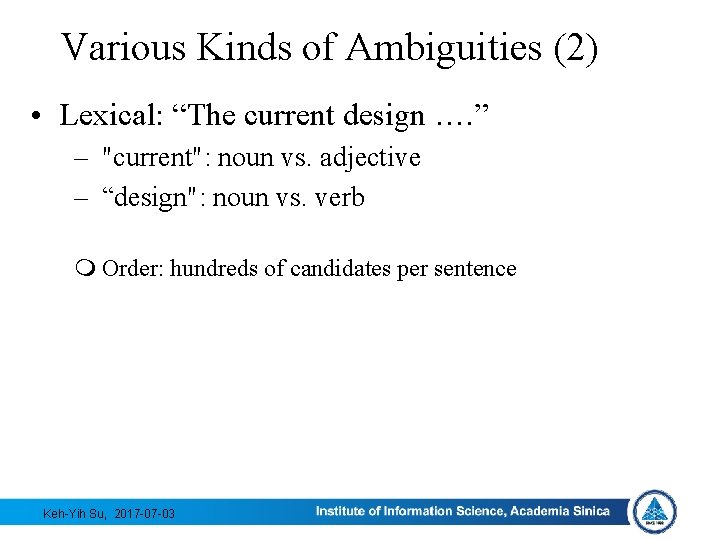
Various Kinds of Ambiguities (2) • Lexical: “The current design …. ” – "current": noun vs. adjective – “design": noun vs. verb m Order: hundreds of candidates per sentence Keh-Yih Su, 2017 -07 -03
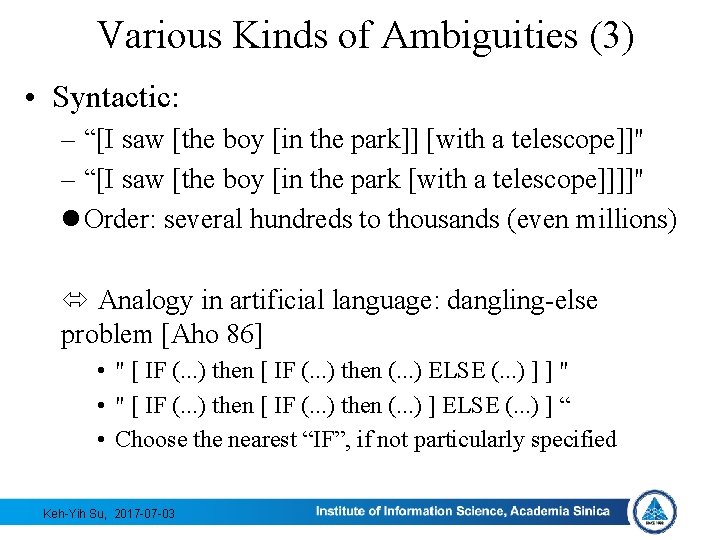
Various Kinds of Ambiguities (3) • Syntactic: – “[I saw [the boy [in the park]] [with a telescope]]" – “[I saw [the boy [in the park [with a telescope]]]]" l Order: several hundreds to thousands (even millions) Analogy in artificial language: dangling-else problem [Aho 86] • " [ IF (. . . ) then (. . . ) ELSE (. . . ) ] ] " • " [ IF (. . . ) then (. . . ) ] ELSE (. . . ) ] “ • Choose the nearest “IF”, if not particularly specified Keh-Yih Su, 2017 -07 -03
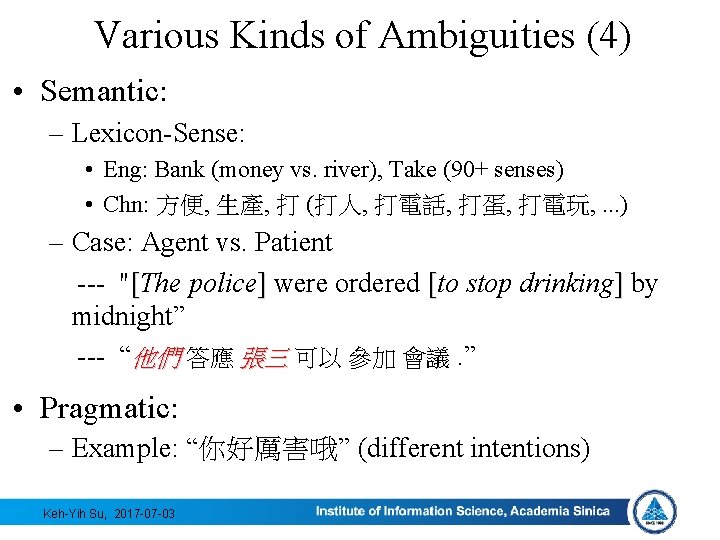
Various Kinds of Ambiguities (4) • Semantic: – Lexicon-Sense: • Eng: Bank (money vs. river), Take (90+ senses) • Chn: 方便, 生產, 打 (打人, 打電話, 打蛋, 打電玩, . . . ) – Case: Agent vs. Patient --- "[The police] were ordered [to stop drinking] by midnight” --- “他們 答應 張三 可以 參加 會議. ” • Pragmatic: – Example: “你好厲害哦” (different intentions) Keh-Yih Su, 2017 -07 -03
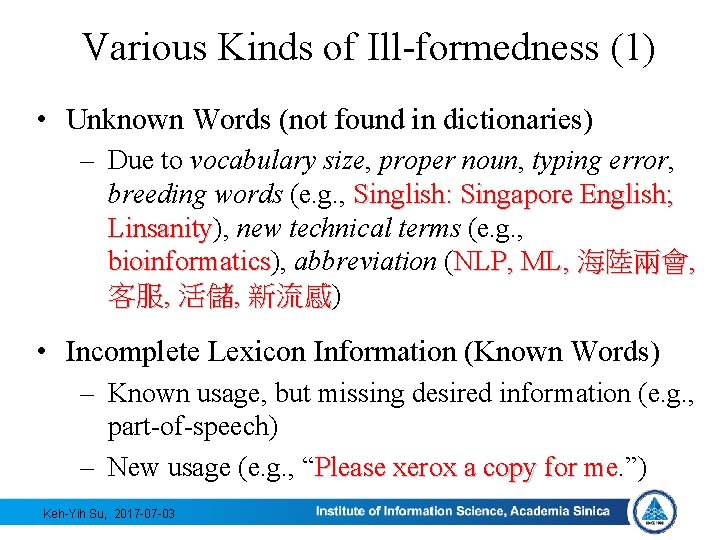
Various Kinds of Ill-formedness (1) • Unknown Words (not found in dictionaries) – Due to vocabulary size, proper noun, typing error, breeding words (e. g. , Singlish: Singapore English; Linsanity), Linsanity new technical terms (e. g. , bioinformatics), bioinformatics abbreviation (NLP, ML, 海陸兩會, 客服, 活儲, 新流感) 新流感 • Incomplete Lexicon Information (Known Words) – Known usage, but missing desired information (e. g. , part-of-speech) – New usage (e. g. , “Please xerox a copy for me. ”) me Keh-Yih Su, 2017 -07 -03
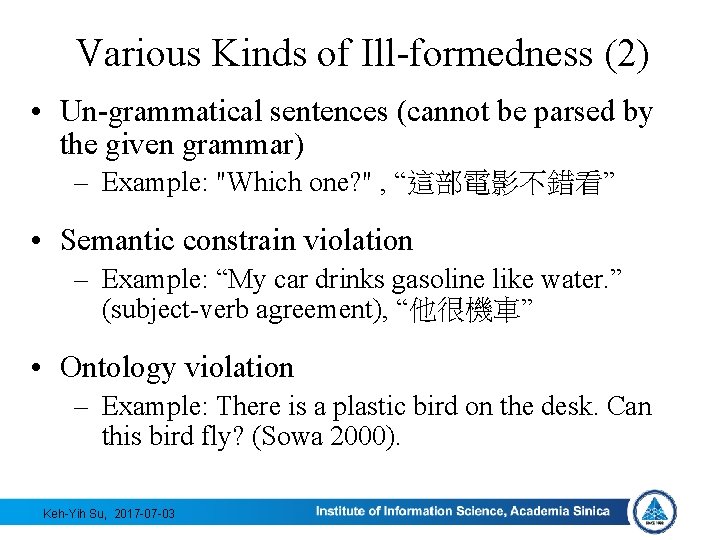
Various Kinds of Ill-formedness (2) • Un-grammatical sentences (cannot be parsed by the given grammar) – Example: "Which one? " , “這部電影不錯看” • Semantic constrain violation – Example: “My car drinks gasoline like water. ” (subject-verb agreement), “他很機車” • Ontology violation – Example: There is a plastic bird on the desk. Can this bird fly? (Sowa 2000). Keh-Yih Su, 2017 -07 -03
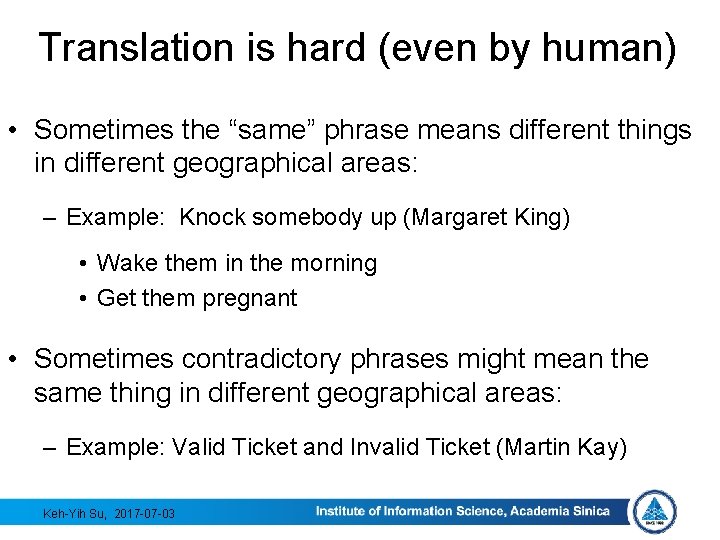
Translation is hard (even by human) • Sometimes the “same” phrase means different things in different geographical areas: – Example: Knock somebody up (Margaret King) • Wake them in the morning • Get them pregnant • Sometimes contradictory phrases might mean the same thing in different geographical areas: – Example: Valid Ticket and Invalid Ticket (Martin Kay) Keh-Yih Su, 2017 -07 -03
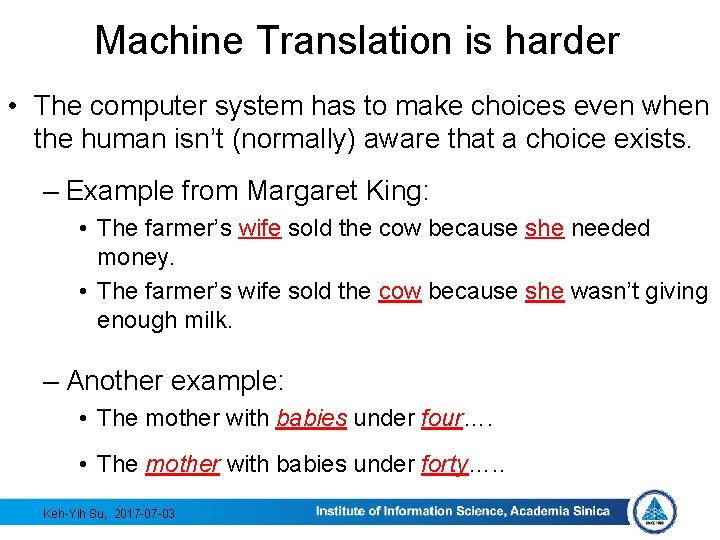
Machine Translation is harder • The computer system has to make choices even when the human isn’t (normally) aware that a choice exists. – Example from Margaret King: • The farmer’s wife sold the cow because she needed money. • The farmer’s wife sold the cow because she wasn’t giving enough milk. – Another example: • The mother with babies under four…. • The mother with babies under forty…. . Keh-Yih Su, 2017 -07 -03
Table of Content • A Simple Example: Syntactic Machine Translation – Process Flow • Main Problems in NLP – Ambiguity & Ill-formedness • Main Tasks in NLP – Tasks required in NLP, Bottlenecks • Detailed Steps Overview – Analysis, Transfer and Generation • Applications Keh-Yih Su, 2017 -07 -03
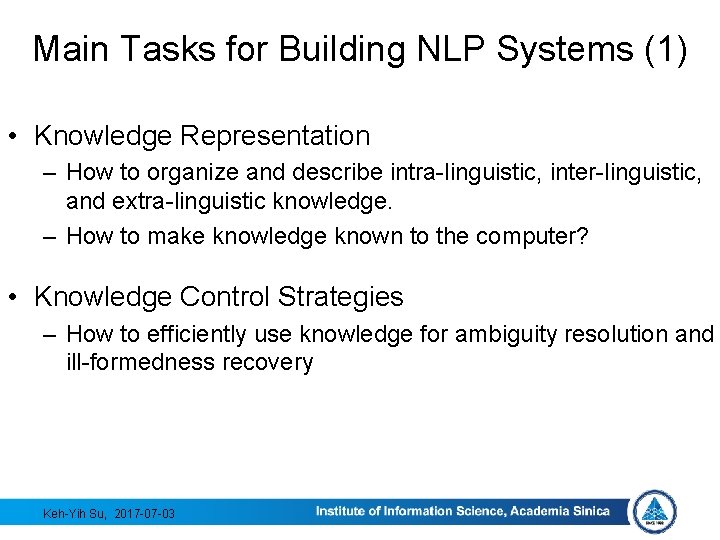
Main Tasks for Building NLP Systems (1) • Knowledge Representation – How to organize and describe intra-linguistic, inter-linguistic, and extra-linguistic knowledge. – How to make knowledge known to the computer? • Knowledge Control Strategies – How to efficiently use knowledge for ambiguity resolution and ill-formedness recovery Keh-Yih Su, 2017 -07 -03
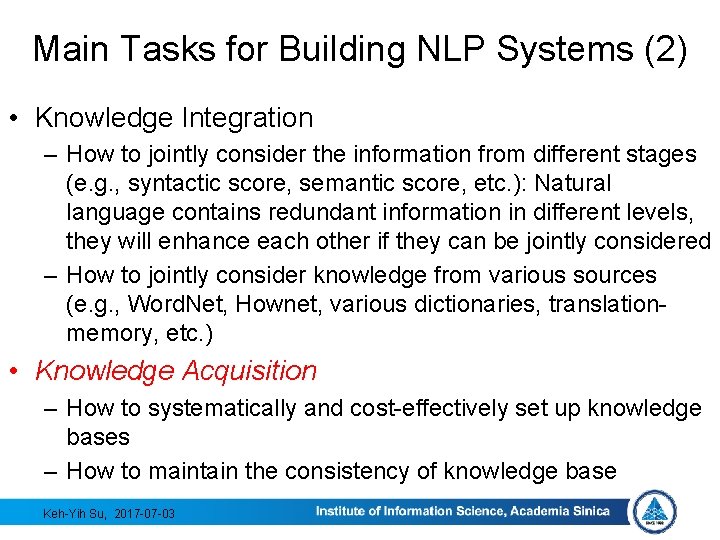
Main Tasks for Building NLP Systems (2) • Knowledge Integration – How to jointly consider the information from different stages (e. g. , syntactic score, semantic score, etc. ): Natural language contains redundant information in different levels, they will enhance each other if they can be jointly considered – How to jointly consider knowledge from various sources (e. g. , Word. Net, Hownet, various dictionaries, translationmemory, etc. ) • Knowledge Acquisition – How to systematically and cost-effectively set up knowledge bases – How to maintain the consistency of knowledge base Keh-Yih Su, 2017 -07 -03
Main Bottleneck: Knowledge Acquisition (1) • Knowledge Acquisition is usually the bottleneck – Language usage is complex (not governed by any simple and elegant model), and dynamic (which changes with different groups, locations, and time) – Required knowledge is huge, messy and fine-grained – Inducing rules by human is usually very expensive, and time-consuming – Consistency is difficult to maintain when the system scales up Keh-Yih Su, 2017 -07 -03
Main Bottleneck: Knowledge Acquisition (2) • Seesaw phenomenon is generally observed – Traditional rule-based approaches are very hard to ensure global improvement, even if it is possible. (Human can only jointly consider 5 -9 objects at the same time. ) • Need cheap and systematic ways to acquire knowledge – Complex problems need a large amount of knowledge, which is very difficult and expensive to build and maintain – Machine Learning seems to be the only way to go Keh-Yih Su, 2017 -07 -03
Acquisition and Representation (1) • Knowledge can be represented in different forms (e. g. , “the/det, design/v/n”) – Knowledge can be represented either explicitly (such as rules) or implicitly (such as parameters). • Example 1: IF [ Ci-1 is Det ], then [ Ci cannot be a Verb ] • Example 2: P(Ci = Verb | Ci-1= Det) = 0 • Example 3: weighting coefficients in neural-network – We usually classify various approaches by their associated Knowledge Representation Form (e. g. , Rule-Based, Example-Based, Statistics-Based, etc. ) Keh-Yih Su, 2017 -07 -03
Acquisition and Representation (2) • The Task of Knowledge Acquisition is closely coupled with its Knowledge Representation Form – Changing the Knowledge Representation Form usually also changes the way to acquire knowledge (Rules <= human, Parameters <= computer) • We should consider the Knowledge Representation Form from the Knowledge Acquisition point of view – Since Knowledge Acquisition is the bottleneck, we should consider it first – First select the suitable knowledge acquisition mode, then decide the corresponding appropriate knowledge representation form Keh-Yih Su, 2017 -07 -03
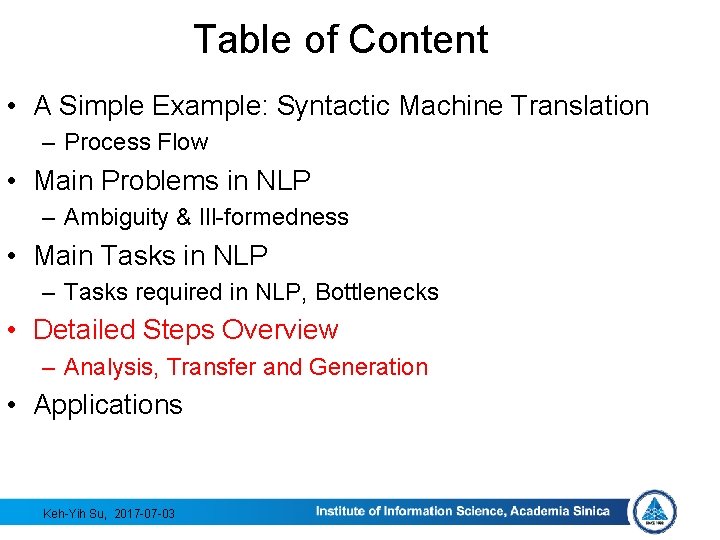
Table of Content • A Simple Example: Syntactic Machine Translation – Process Flow • Main Problems in NLP – Ambiguity & Ill-formedness • Main Tasks in NLP – Tasks required in NLP, Bottlenecks • Detailed Steps Overview – Analysis, Transfer and Generation • Applications Keh-Yih Su, 2017 -07 -03
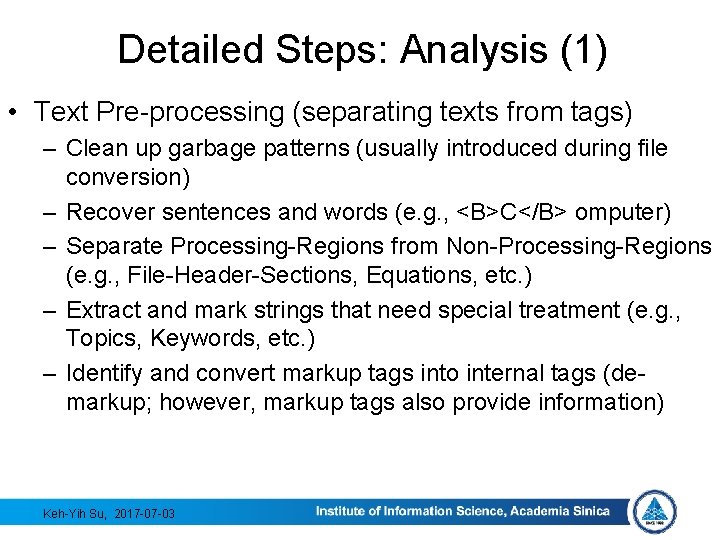
Detailed Steps: Analysis (1) • Text Pre-processing (separating texts from tags) – Clean up garbage patterns (usually introduced during file conversion) – Recover sentences and words (e. g. , <B>C</B> omputer) – Separate Processing-Regions from Non-Processing-Regions (e. g. , File-Header-Sections, Equations, etc. ) – Extract and mark strings that need special treatment (e. g. , Topics, Keywords, etc. ) – Identify and convert markup tags into internal tags (demarkup; however, markup tags also provide information) Keh-Yih Su, 2017 -07 -03
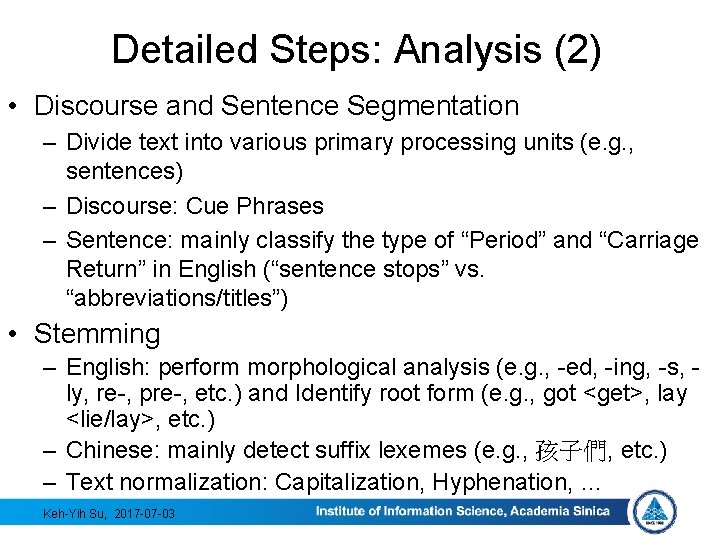
Detailed Steps: Analysis (2) • Discourse and Sentence Segmentation – Divide text into various primary processing units (e. g. , sentences) – Discourse: Cue Phrases – Sentence: mainly classify the type of “Period” and “Carriage Return” in English (“sentence stops” vs. “abbreviations/titles”) • Stemming – English: perform morphological analysis (e. g. , -ed, -ing, -s, ly, re-, pre-, etc. ) and Identify root form (e. g. , got <get>, lay <lie/lay>, etc. ) – Chinese: mainly detect suffix lexemes (e. g. , 孩子們, etc. ) – Text normalization: Capitalization, Hyphenation, … Keh-Yih Su, 2017 -07 -03
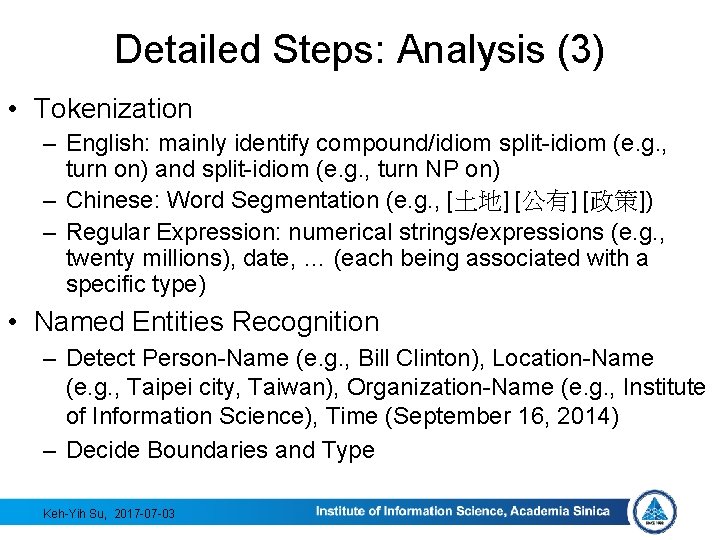
Detailed Steps: Analysis (3) • Tokenization – English: mainly identify compound/idiom split-idiom (e. g. , turn on) and split-idiom (e. g. , turn NP on) – Chinese: Word Segmentation (e. g. , [土地] [公有] [政策]) – Regular Expression: numerical strings/expressions (e. g. , twenty millions), date, … (each being associated with a specific type) • Named Entities Recognition – Detect Person-Name (e. g. , Bill Clinton), Location-Name (e. g. , Taipei city, Taiwan), Organization-Name (e. g. , Institute of Information Science), Time (September 16, 2014) – Decide Boundaries and Type Keh-Yih Su, 2017 -07 -03
Detailed Steps: Analysis (4) • Tagging – Assign Part-of-Speech (e. g. , n, v, adj, adv, etc. ) – Associated forms are basically independent of languages starting from this step • Parsing – Decide suitable syntactic relationship (e. g. , PP-Attachment) • Decide Word-Sense – Decide appropriate lexicon-sense (e. g. , River-Bank, Money. Bank, etc. ) • Assign Case-Label – Decide suitable semantic relationship (e. g. , Patient, Agent, etc. ) Keh-Yih Su, 2017 -07 -03
Detailed Steps: Analysis (5) • Anaphora Resolution – Pronoun reference (e. g. , “he” refers to “the president”) • Decide Discourse Structure – Decide suitable discourse segments relationship (e. g. , Evidence, Concession, Justification, etc. [Marcu 2000]. ) Keh-Yih Su, 2017 -07 -03
Detailed Steps: Analysis (6) • Convert into Logical Form (Optional) – Co-reference resolution (e. g. , “president” refers to “Bill Clinton”), scope resolution (e. g. , negation), Temporal Resolution (e. g. , today, last Friday), Spatial Resolution (e. g. , here, next), etc. – Determine IS-A (also Part-of) relationship, etc. – Mainly used in inference related applications (e. g. , Q&A, etc. ) Keh-Yih Su, 2017 -07 -03
Detailed Steps: Transfer (1) • Decide suitable Target Discourse Structure – For example: Evidence, Concession, Justification, etc. [Marcu 2000]. • Decide suitable Target Lexicon Senses – Sense Mapping may not be one-to-one (sense resolution might be different in different languages, e. g. “snow” has more senses in Eskimo) – Sense-Token Mapping may not be one-to-one (lexicon representation power might be different in different languages, e. g. , “DINK”, “睨”, etc). It could be 2 -1, 1 -2, etc. Keh-Yih Su, 2017 -07 -03
Detailed Steps: Transfer (2) • Decide suitable Target Sentence Structure – For example: verb nominalization, constitute promotion and demotion (usually occurs when Sense-Token-Mapping is not 1 -1) • Decide appropriate Target Case – Case Label might change after the structure has been modified – (Example) verb nominalization: “… that you (AGENT) invite me” “… your (POSS) invitation” Keh-Yih Su, 2017 -07 -03
Detailed Steps: Generation (1) • Adopt suitable Sentence Syntactic Pattern – Depend on Style (which is the distributions of lexicon selection and syntactic patterns adopted) • Adopt suitable Target Lexicon – Select from Synonym Set (depend on style) • Add “de” (Chinese), comma, tense, measure (Chinese), etc. – Morphological generation is required for target-specific tokens Keh-Yih Su, 2017 -07 -03
Detailed Steps: Generation (2) • Text Post-processing – Final string substitution (replace those markers of special strings) – Extract and export associated information (e. g. , Glossary, Index, etc. ) – Restore customer’s markup tags (re-markup) for saving typesetting work Keh-Yih Su, 2017 -07 -03
Common Phenomena in NLP • An early step might need information from later steps – For example, identifying split-idiom in the Tokenization step needs to verify a specified constituent (e. g. , turn NP on) – One way to handle that is to adopt a Black-Board approach; however, it is not efficient (ref. Verbmobile report [Wahlster 00]). • Output may not be unique – Zero, when a rule-based approach encounters ill-formed input – Usually several candidates are possible (even under Unification Grammar Formalism) Keh-Yih Su, 2017 -07 -03
Table of Content • A Simple Example: Syntactic Machine Translation – Process Flow • Main Problems in NLP – Ambiguity & Ill-formedness • Main Tasks in NLP – Tasks required in NLP, Bottlenecks • Detailed Steps Overview – Analysis, Transfer and Generation • Applications Keh-Yih Su, 2017 -07 -03
Applications (1) • NL/Document Analysis – Grammar/Spelling Checker – Document Classification/Clustering – Information Extraction • Company Profile, Recruiting Advertisement – – – – Sentiment Analysis (Opinion Mining) Document/Answer Recommendation Argumentation Mining Credibility Assessment Spam Filter Troll Detection … Keh-Yih Su, 2017 -07 -03
Applications (2) • NL Generation – Report Generator – Computer Novel Writer • Combining Analysis/Generation – Question Answering • Customer Service – Summarization – Writing Aid – E-Learning (AI + Education) Keh-Yih Su, 2017 -07 -03
Applications (3) • Cross-Lingual – Machine Translation – Cross-lingual Information Retrieval – Computer-Aided Language Learning (CALL) • User Interface – Dialog System (Chatbot) – Natural Language Interface • Database Access Keh-Yih Su, 2017 -07 -03
- Slides: 44