
Brief History of Forensic DNA Typing 1980 Ray
Brief History of Forensic DNA Typing • 1980 - Ray White describes first polymorphic RFLP marker • 1985 - Alec Jeffreys discovers multilocus VNTR probes • 1985 - first paper on PCR • 1988 - FBI starts DNA casework • 1991 - first STR paper • 1995 - FSS starts UK DNA database • 1998 - FBI launches CODIS database 1
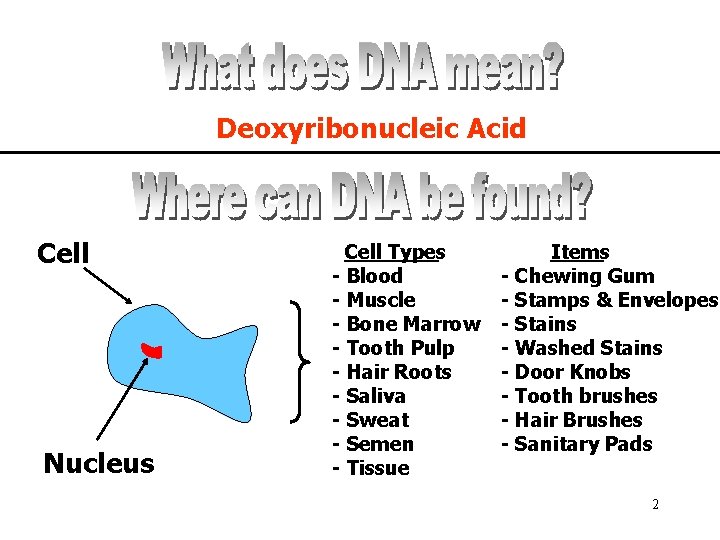
Deoxyribonucleic Acid Cell Nucleus Cell Types - Blood - Muscle - Bone Marrow - Tooth Pulp - Hair Roots - Saliva - Sweat - Semen - Tissue Items - Chewing Gum - Stamps & Envelopes - Stains - Washed Stains - Door Knobs - Tooth brushes - Hair Brushes - Sanitary Pads 2
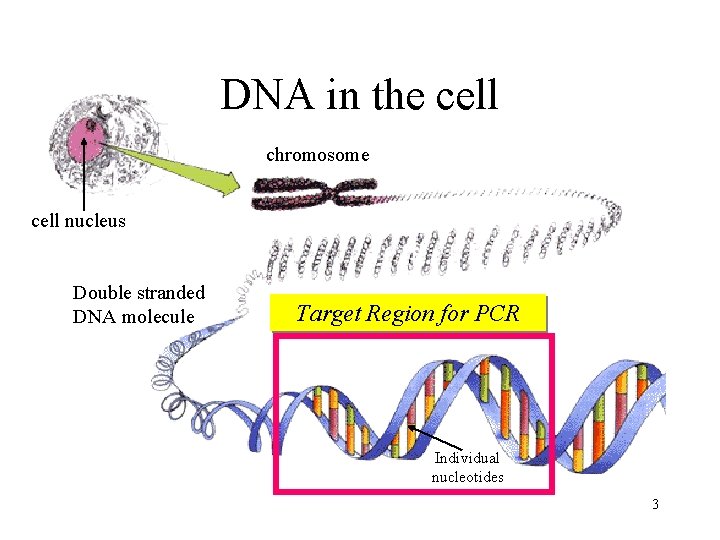
DNA in the cell chromosome cell nucleus Double stranded DNA molecule Target Region for PCR Individual nucleotides 3
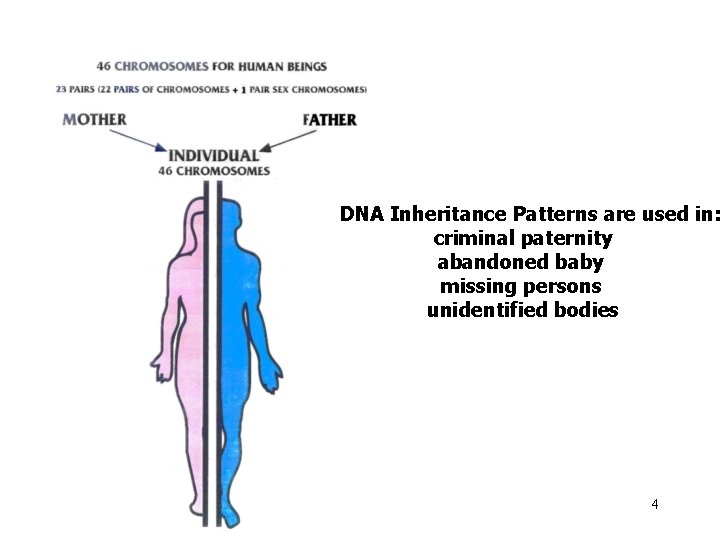
DNA Inheritance Patterns are used in: criminal paternity abandoned baby missing persons unidentified bodies 4
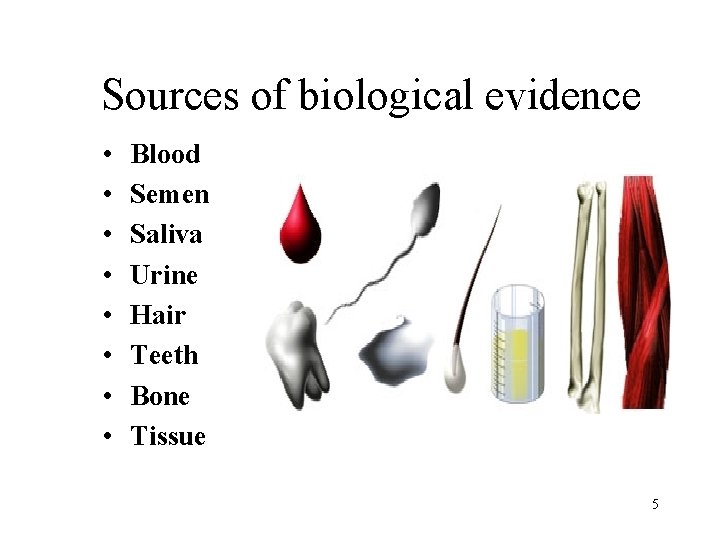
Sources of biological evidence • • Blood Semen Saliva Urine Hair Teeth Bone Tissue 5
DNA Use in Forensic Cases • Most are rape cases (>2 out of 3) • Looking for match between evidence and suspect • Must compare victim’s DNA profile Challenges • Mixtures must be resolved • DNA is often degraded • Inhibitors to PCR are often present 6
On the victim (female) • • • Vaginal swabs External genitalia swabs Rectal swabs Lick/kiss/bite areas Fingernail swabs Wood’s lamp positive areas 7
On the victim (male) • • • Penile swabs Rectal swabs Lick/kiss/bite areas Fingernail swabs Wood’s lamp positive areas 8
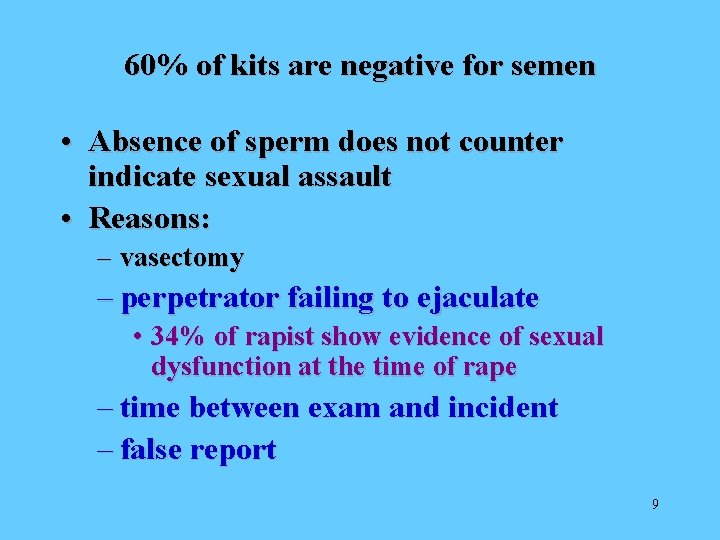
60% of kits are negative for semen • Absence of sperm does not counter indicate sexual assault • Reasons: – vasectomy – perpetrator failing to ejaculate • 34% of rapist show evidence of sexual dysfunction at the time of rape – time between exam and incident – false report 9
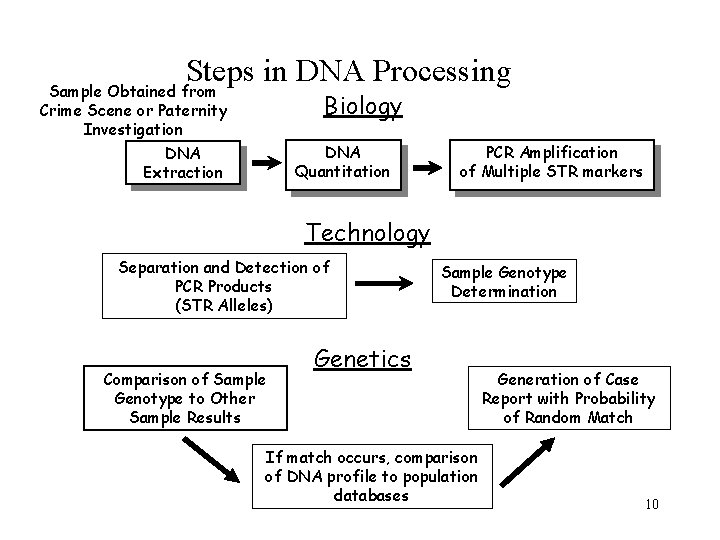
Steps in DNA Processing Sample Obtained from Crime Scene or Paternity Investigation Biology DNA Quantitation DNA Extraction PCR Amplification of Multiple STR markers Technology Separation and Detection of PCR Products (STR Alleles) Comparison of Sample Genotype to Other Sample Results Sample Genotype Determination Genetics If match occurs, comparison of DNA profile to population databases Generation of Case Report with Probability of Random Match 10
PCR (Polymerase Chain Reaction ) - Sequence Variation and Tandem Repeat Variation - Small sample required - Used in CODIS 11
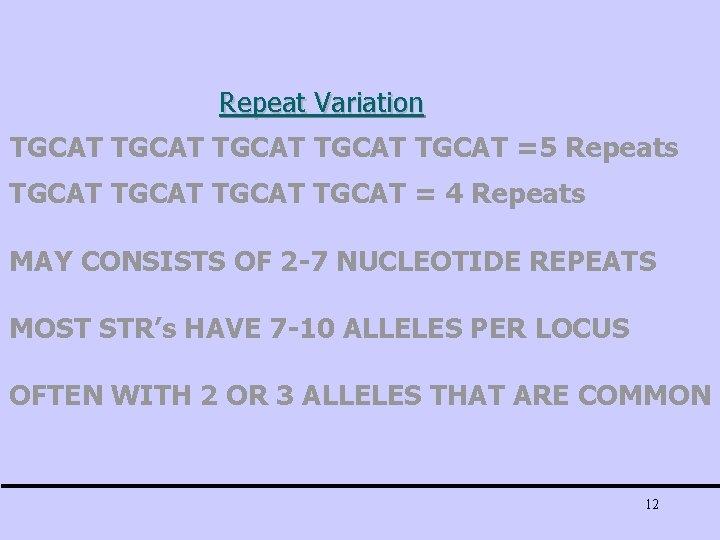
Repeat Variation TGCAT TGCAT =5 Repeats TGCAT = 4 Repeats MAY CONSISTS OF 2 -7 NUCLEOTIDE REPEATS MOST STR’s HAVE 7 -10 ALLELES PER LOCUS OFTEN WITH 2 OR 3 ALLELES THAT ARE COMMON 12
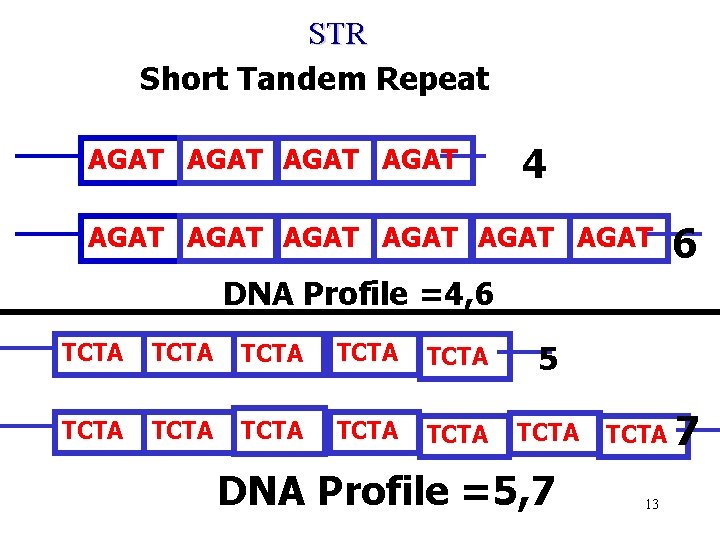
STR Short Tandem Repeat AGAT 4 AGAT AGAT 6 DNA Profile =4, 6 TCTA TCTA 5 TCTA TCTA DNA Profile =5, 7 TCTA 13 7
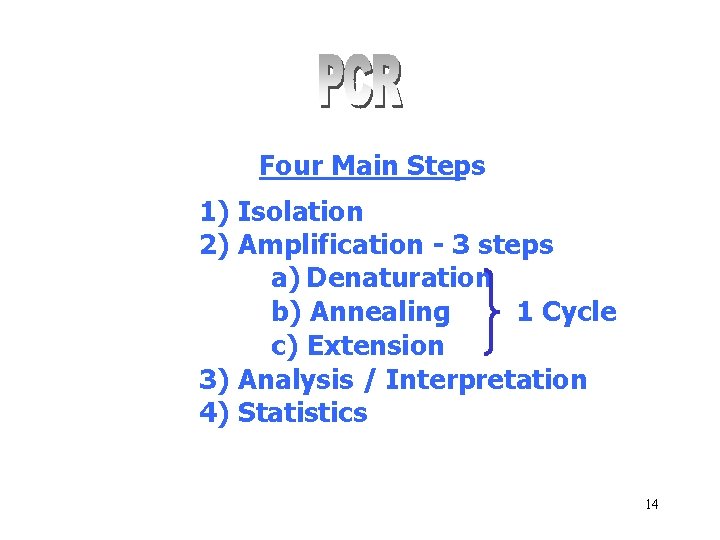
Four Main Steps 1) Isolation 2) Amplification - 3 steps a) Denaturation b) Annealing 1 Cycle c) Extension 3) Analysis / Interpretation 4) Statistics 14
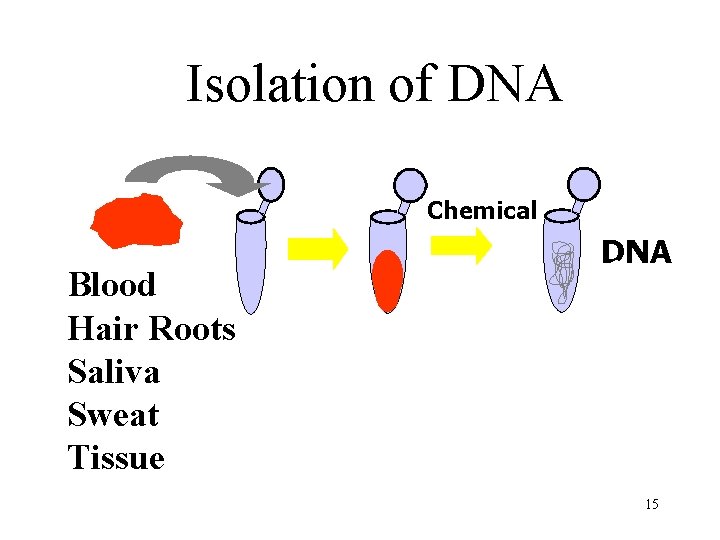
Isolation of DNA Chemical Blood Hair Roots Saliva Sweat Tissue DNA 15
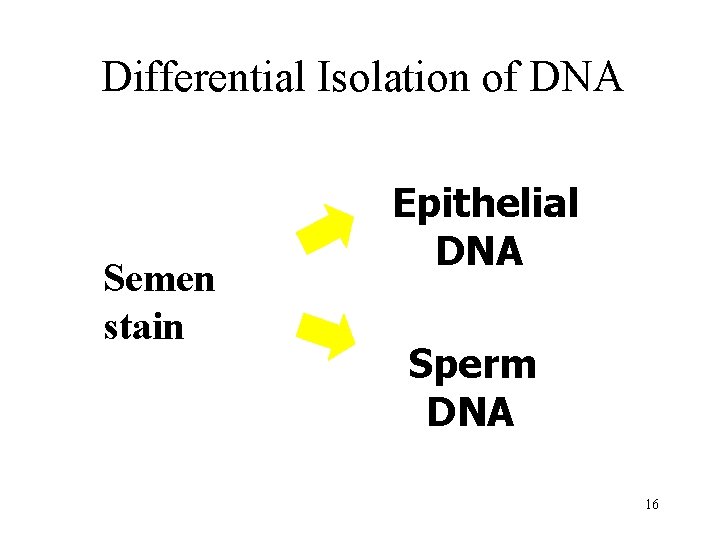
Differential Isolation of DNA Semen stain Remove Epithelial DNA Epithelial Chemic DNA al Differen t Sperm Chemic DNA al 16
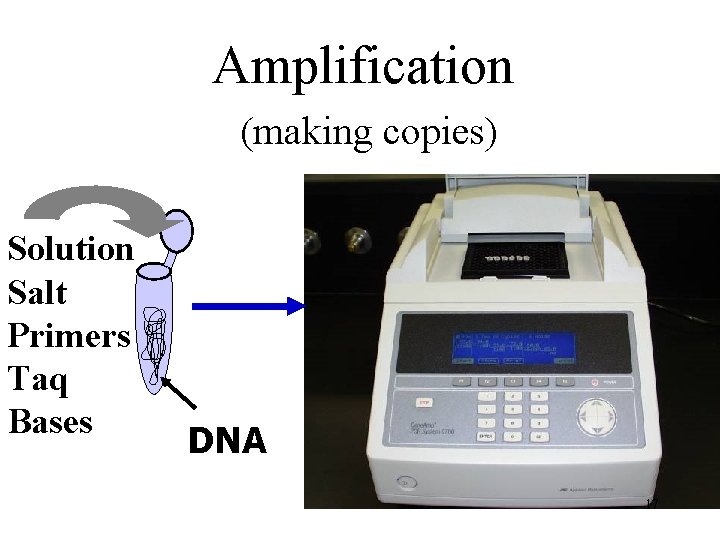
Amplification (making copies) Solution Salt Primers Taq Bases DNA 17
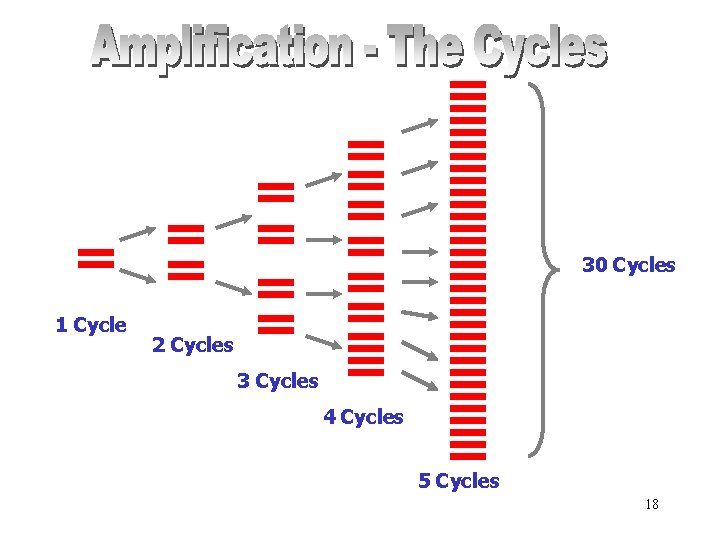
30 Cycles 1 Cycle 2 Cycles 3 Cycles 4 Cycles 5 Cycles 18
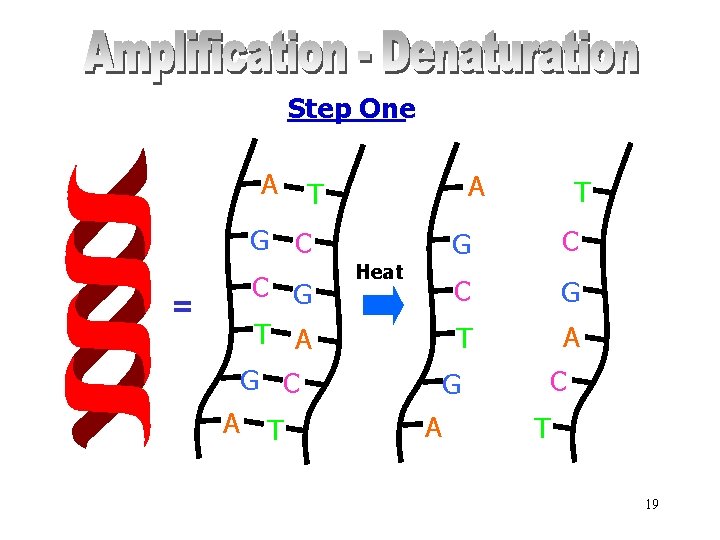
Step One A A T G C = C G T A G C A T Heat G C C G T A G A T C T 19
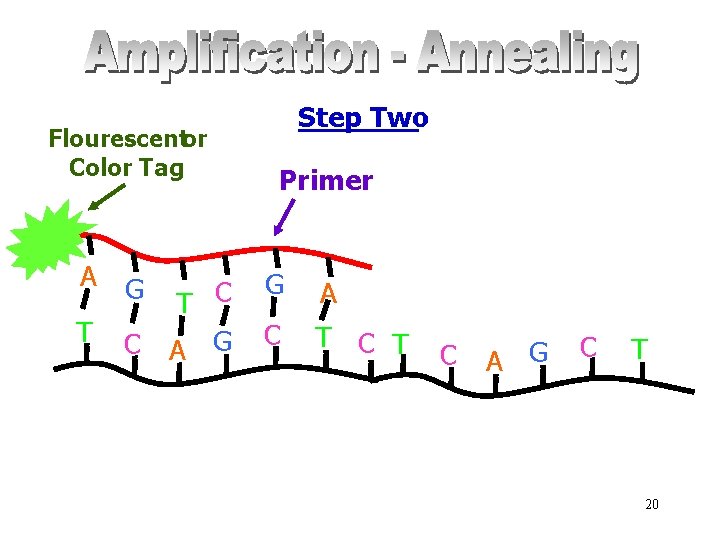
Flourescentor Color Tag A G T C A G Step Two Primer G A C T C A G C T 20
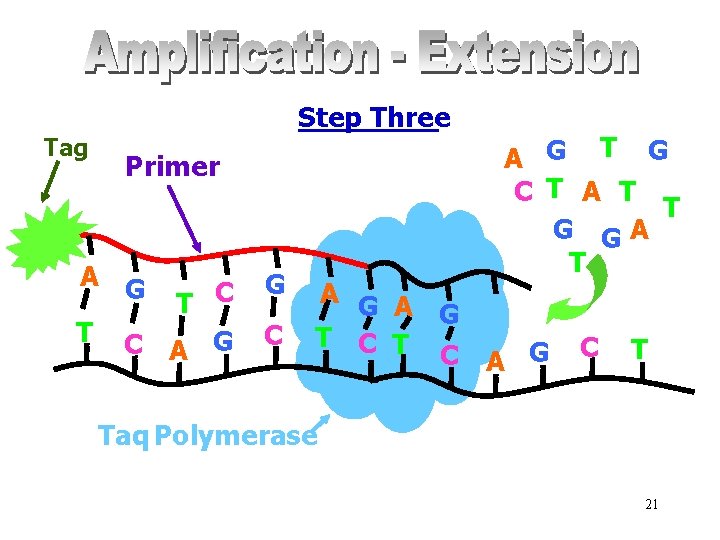
Tag Step Three Primer A G G T C C A G T G C T A T T G GA T A G T C A G C T Taq Polymerase 21
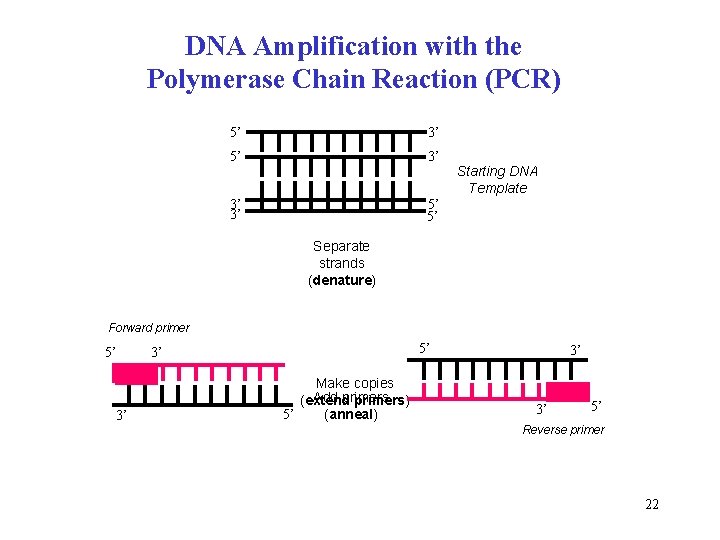
DNA Amplification with the Polymerase Chain Reaction (PCR) 5’ 3’ 3’ 3’ 5’ 5’ Starting DNA Template Separate strands (denature) Forward primer 5’ 3’ Make copies Add primers (extend primers) (anneal) 5’ 3’ 3’ 5’ Reverse primer 22
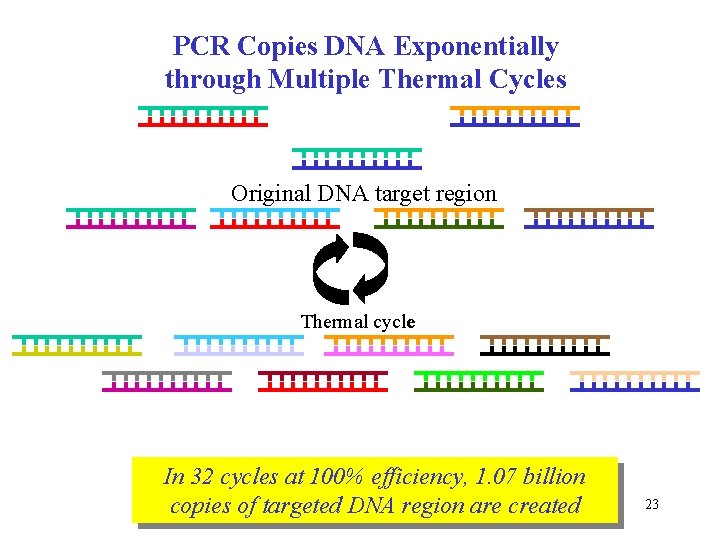
PCR Copies DNA Exponentially through Multiple Thermal Cycles Original DNA target region Thermal cycle In 32 cycles at 100% efficiency, 1. 07 billion copies of targeted DNA region are created 23
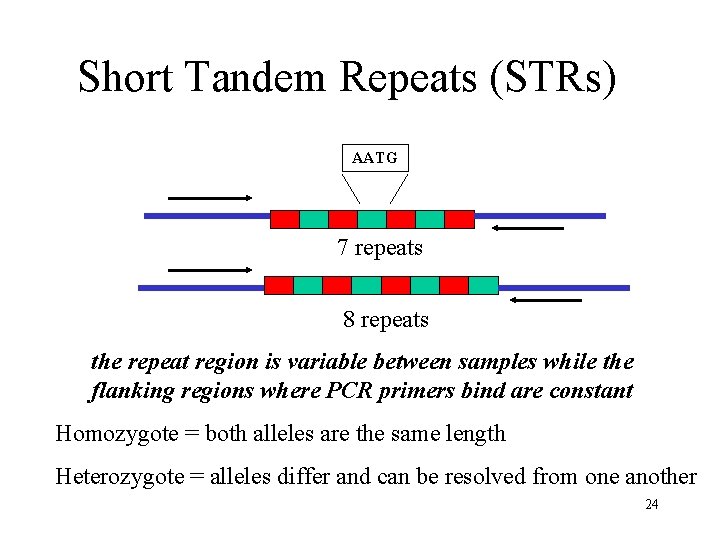
Short Tandem Repeats (STRs) AATG 7 repeats 8 repeats the repeat region is variable between samples while the flanking regions where PCR primers bind are constant Homozygote = both alleles are the same length Heterozygote = alleles differ and can be resolved from one another 24
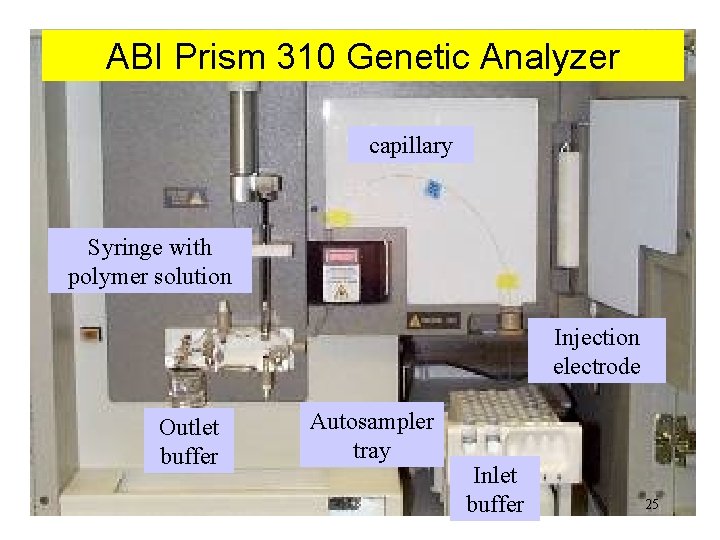
ABI Prism 310 Genetic Analyzer capillary Syringe with polymer solution Injection electrode Outlet buffer Autosampler tray Inlet buffer 25
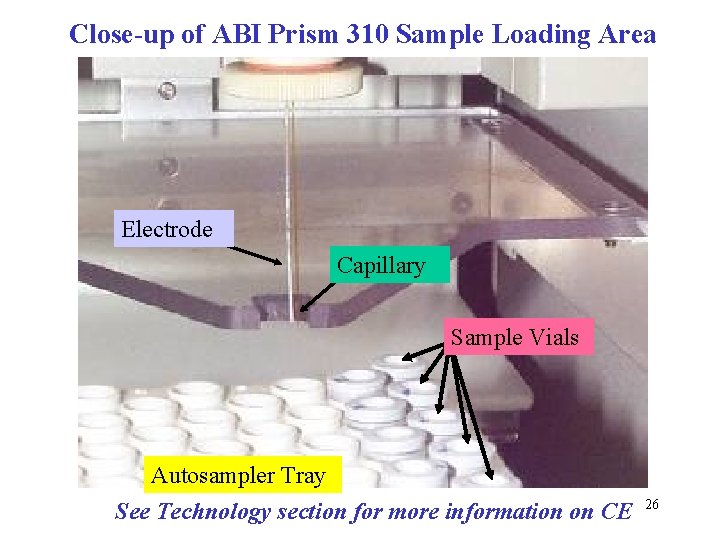
Close-up of ABI Prism 310 Sample Loading Area Electrode Capillary Sample Vials Autosampler Tray See Technology section for more information on CE 26
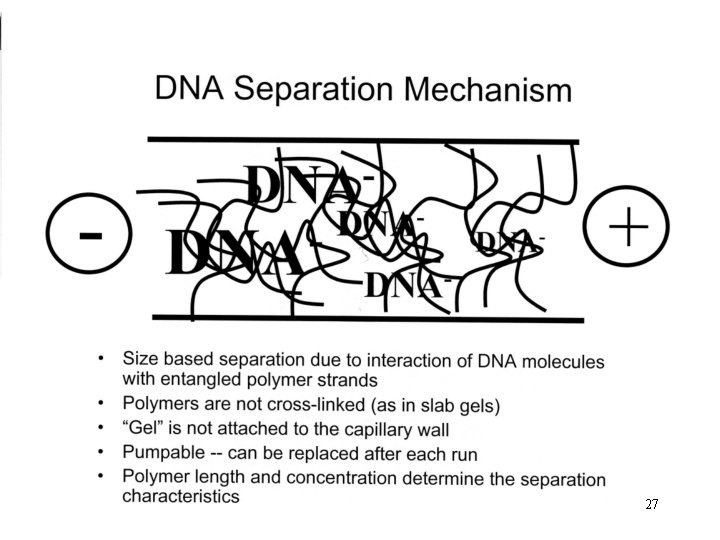
27
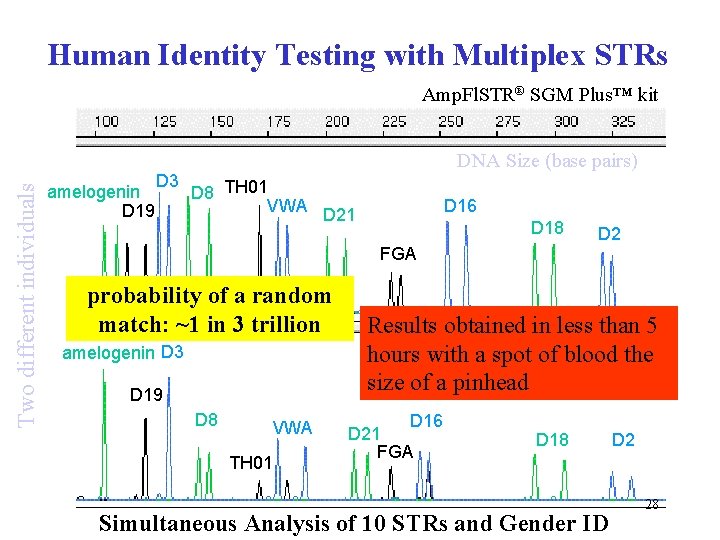
Human Identity Testing with Multiplex STRs Two different individuals Amp. Fl. STR® SGM Plus™ kit amelogenin D 19 D 3 DNA Size (base pairs) D 8 TH 01 VWA D 21 D 16 D 18 D 2 FGA probability of a random match: ~1 in 3 trillion amelogenin D 3 D 19 D 8 VWA TH 01 Results obtained in less than 5 hours with a spot of blood the size of a pinhead D 16 D 21 FGA D 18 Simultaneous Analysis of 10 STRs and Gender ID D 2 28
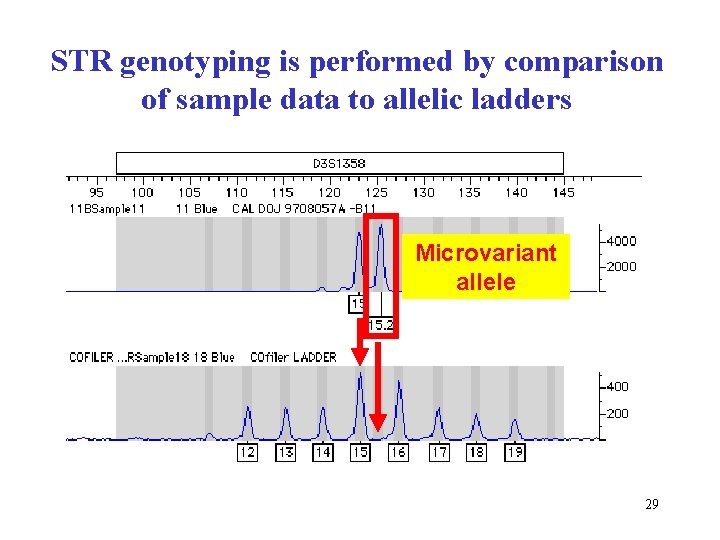
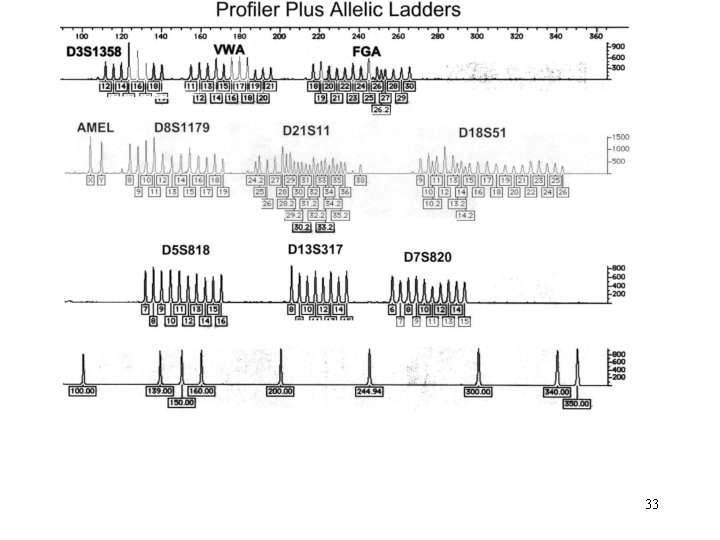
STR genotyping is performed by comparison of sample data to allelic ladders Microvariant allele 29
30
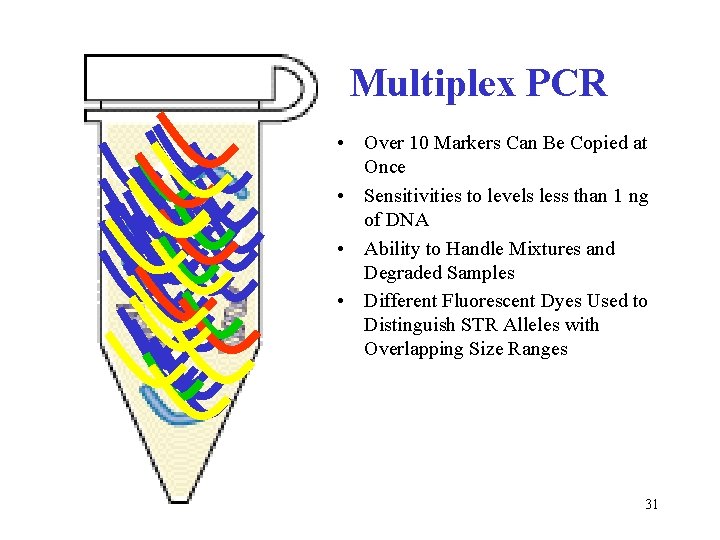
Multiplex PCR • Over 10 Markers Can Be Copied at Once • Sensitivities to levels less than 1 ng of DNA • Ability to Handle Mixtures and Degraded Samples • Different Fluorescent Dyes Used to Distinguish STR Alleles with Overlapping Size Ranges 31
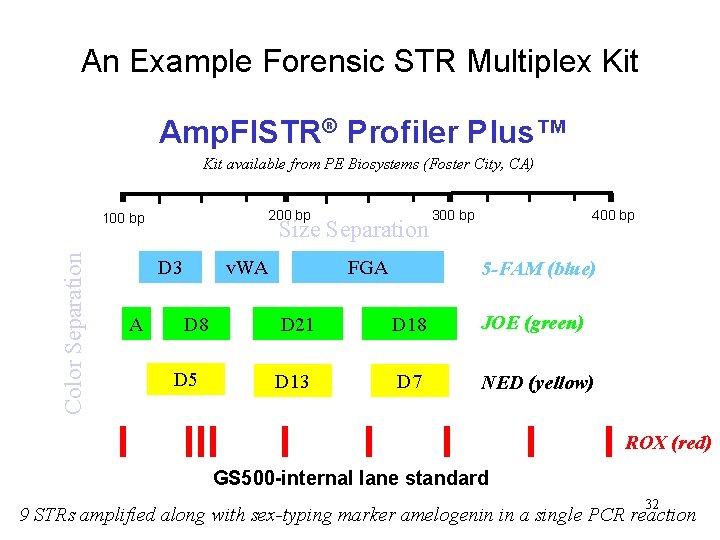
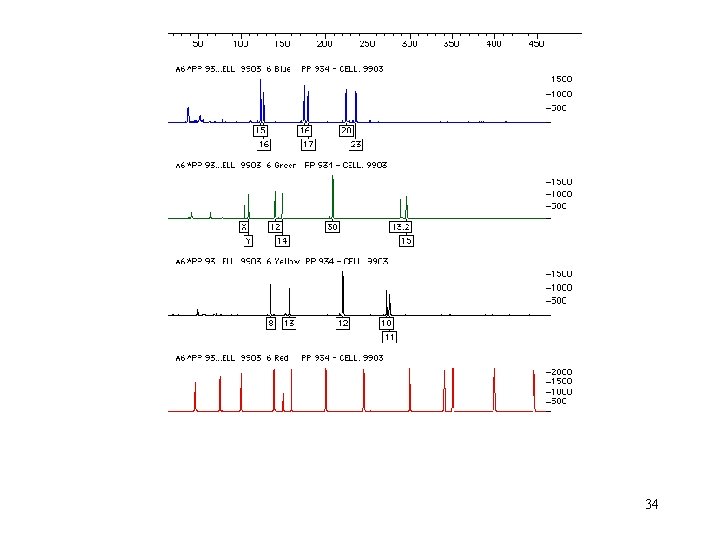
An Example Forensic STR Multiplex Kit Amp. Fl. STR® Profiler Plus™ Kit available from PE Biosystems (Foster City, CA) 200 bp Color Separation 100 bp Size Separation D 3 A v. WA D 8 D 5 FGA 300 bp 400 bp 5 -FAM (blue) D 21 D 18 JOE (green) D 13 D 7 NED (yellow) ROX (red) GS 500 -internal lane standard 32 9 STRs amplified along with sex-typing marker amelogenin in a single PCR reaction
33
34
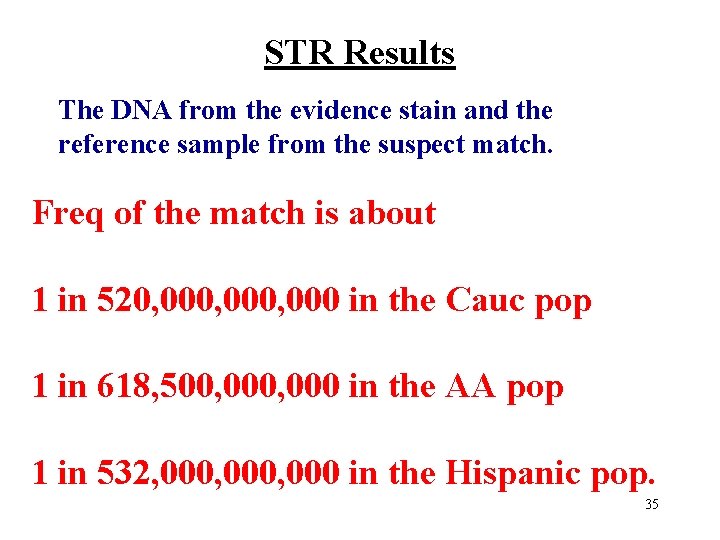
STR Results The DNA from the evidence stain and the reference sample from the suspect match. Freq of the match is about 1 in 520, 000, 000 in the Cauc pop 1 in 618, 500, 000 in the AA pop 1 in 532, 000, 000 in the Hispanic pop. 35
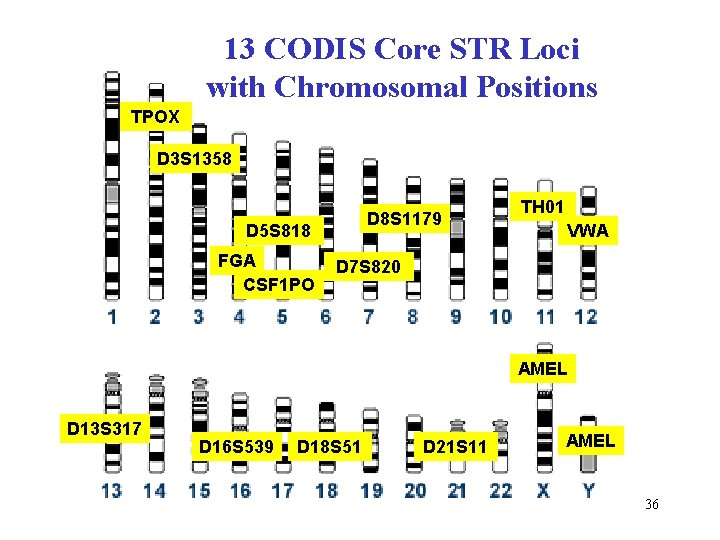
13 CODIS Core STR Loci with Chromosomal Positions TPOX D 3 S 1358 D 8 S 1179 D 5 S 818 FGA CSF 1 PO TH 01 VWA D 7 S 820 AMEL D 13 S 317 D 16 S 539 D 18 S 51 D 21 S 11 AMEL 36
Pet DNA • Snowball the cat owned by suspect – White cat hairs found on victim’s body – Matched cat hairs to those found on victim’s body – Meowplex for cats • LA Times March 16, 2002 – Ventura County woman sexually assaulted in her home – Victim described suspect – Police canvassed neighborhood found individual matching suspect – Dog hair recovered from his pants matching victim’s dog 37
Human Identity Testing • Forensic cases -- matching suspect with evidence • Paternity testing -- identifying father • Historical investigations – Possible offspring of Thomas Jefferson and Sally Hemmings • Missing persons investigations • Mass disasters -- putting pieces back together – Tsunami survivors – Infants returned to parents using DNA 38
Human Identity Testing • Military DNA “dog tag” – 4 sets of remains from WWI, WWII, Korea and Vietnam – All matched to family members – Future no more unknown soilders – Each soldier has a blood card stored in freezer – 4. 5 million samples • Convicted felon DNA databases • Innocence project – As of 3/8/07, 196 prisoners have been released – Thousands have come back as a match 39
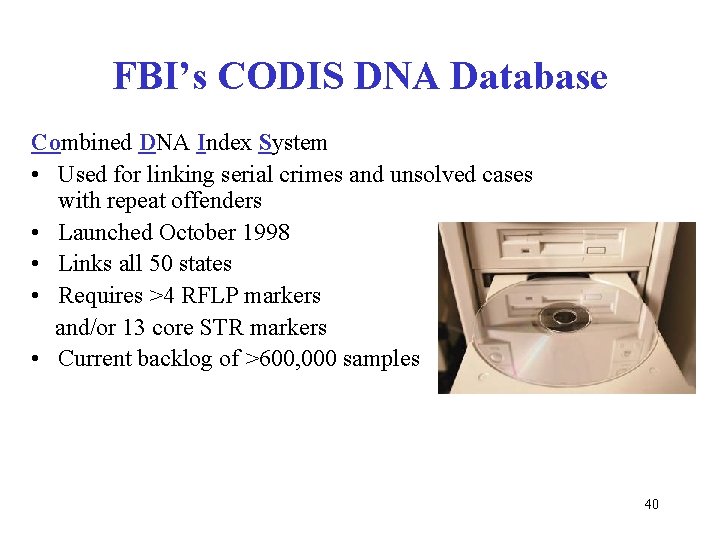
FBI’s CODIS DNA Database Combined DNA Index System • Used for linking serial crimes and unsolved cases with repeat offenders • Launched October 1998 • Links all 50 states • Requires >4 RFLP markers and/or 13 core STR markers • Current backlog of >600, 000 samples 40
1) Law requiring collection of convicted offender sample 2) Databasingof the DNA profile from offenders 3) DNA Typing of evidentiary samples a) Unknown suspect cases 4) Search a national database a) Compare samples to the database b) Compare cases to each other 41
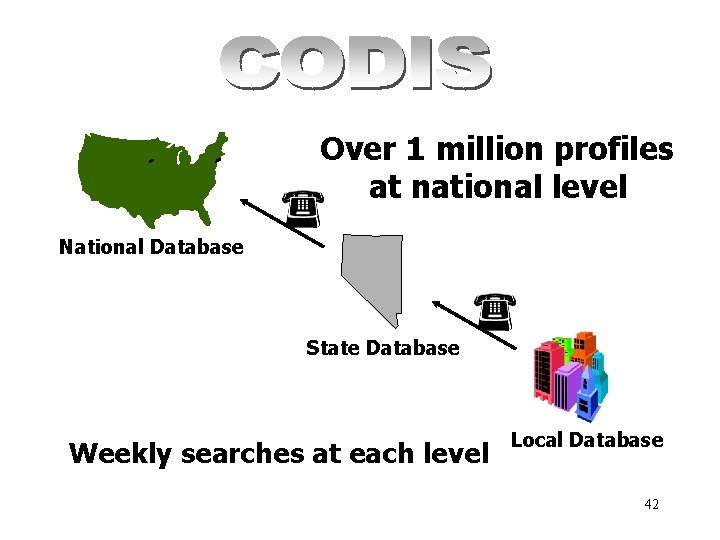
Over 1 million profiles at national level National Database State Database Weekly searches at each level Local Database 42
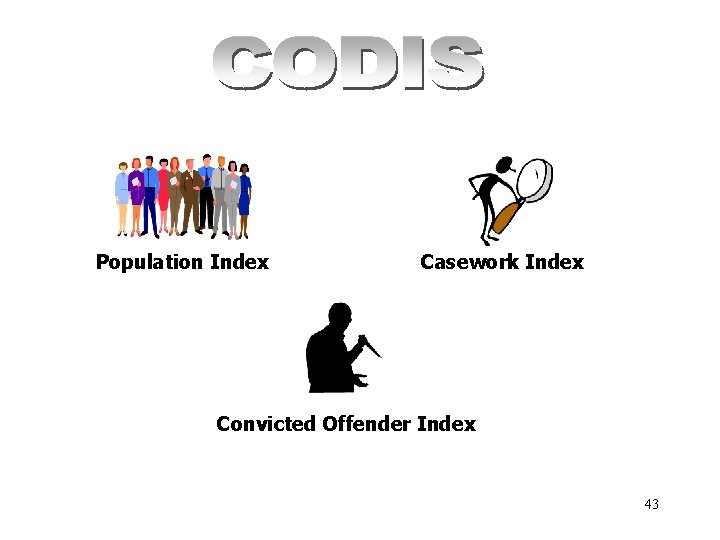
Population Index Casework Index Convicted Offender Index 43
HITS • Case to case--links 2 or more cases • aids investigation, one of the cases may be a solved case • Case to offender • links case to convicted offender 44
WHY THE CHANGE? • Database Successes 4 Virginia is averaging one “cold hit” per week in 2001. 4 Diversion of resources to other cases. z New Data 4 Approximately 85% of hits would have been missed if the databank were limited to only violent offenders 4 52% of Florida offenders linked to sexual assaults and homicides by DNA database matches have had prior burglary convictions. 45
WHY THE CHANGE? – Citizen Demand / Pubic Safety 4 Consider the following US Department of Justice statistics: ã The average rapist commits 8 -12 sexual assaults. ã Of 108, 580 persons released from prisons in 11 States in 1983, an estimated 62. 5% were rearrested for a felony or serious misdemeanor within 3 years ã 46. 8% were reconvicted, and 41. 4% returned to prison or jail. 46
DNA DATABASE SUCCESSES ü Virginia Database Statistics ~ Over 1100 DNA database hits ~ 85% of hits would have been missed if database limited to only violent offenders. ü Florida Database Statistics ~ 52% of Florida offenders linked to sexual assaults and homicides by DNA database matches have had prior burglary convictions. üNew York Database Statistics 1999 New York law expands DNA database to include many nonviolent felonies (including burglary and drug crimes). ~January 2002 Report “The First 100 Hits. ” Ü February 2000 – July 2001 Ü 104 crime scenes matched with 102 offenders. 47
- Slides: 47