
Brief History of Forensic DNA Typing 1980 Ray
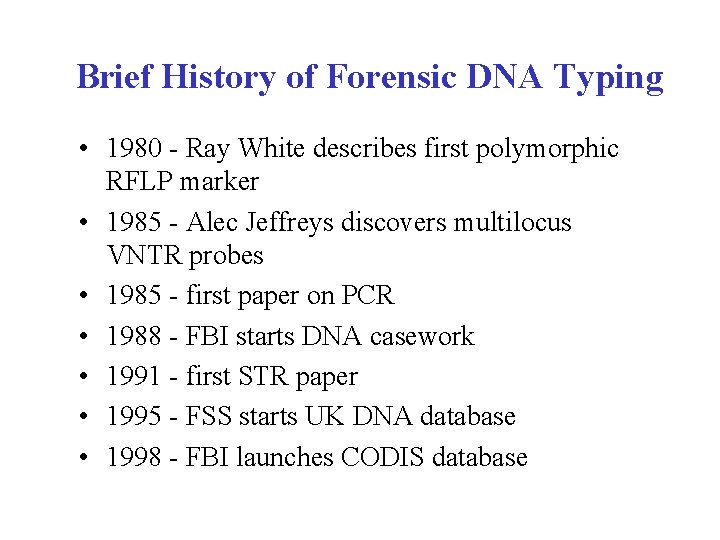
Brief History of Forensic DNA Typing • 1980 - Ray White describes first polymorphic RFLP marker • 1985 - Alec Jeffreys discovers multilocus VNTR probes • 1985 - first paper on PCR • 1988 - FBI starts DNA casework • 1991 - first STR paper • 1995 - FSS starts UK DNA database • 1998 - FBI launches CODIS database
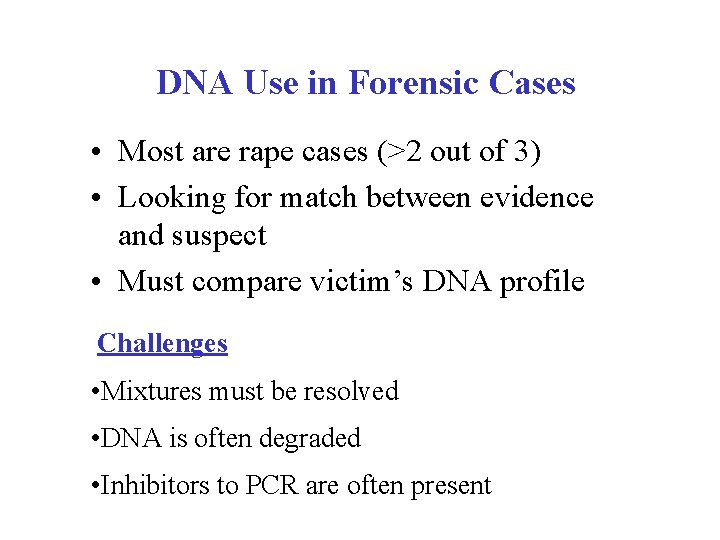
DNA Use in Forensic Cases • Most are rape cases (>2 out of 3) • Looking for match between evidence and suspect • Must compare victim’s DNA profile Challenges • Mixtures must be resolved • DNA is often degraded • Inhibitors to PCR are often present
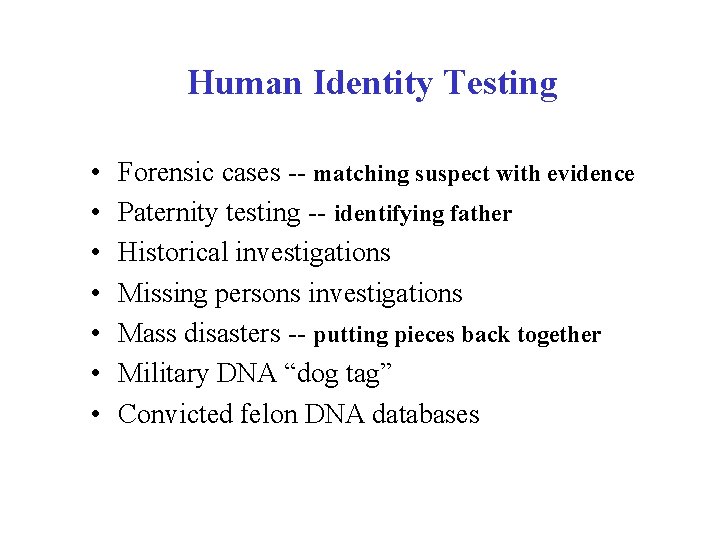
Human Identity Testing • • Forensic cases -- matching suspect with evidence Paternity testing -- identifying father Historical investigations Missing persons investigations Mass disasters -- putting pieces back together Military DNA “dog tag” Convicted felon DNA databases
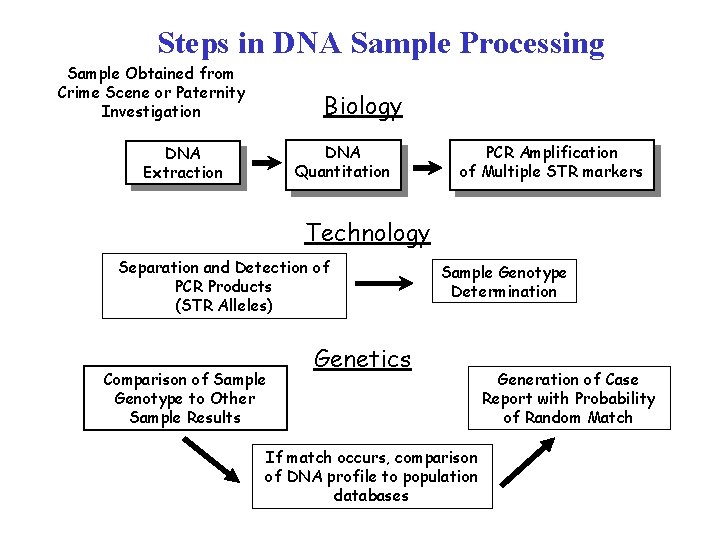
Steps in DNA Sample Processing Sample Obtained from Crime Scene or Paternity Investigation Biology DNA Quantitation DNA Extraction PCR Amplification of Multiple STR markers Technology Separation and Detection of PCR Products (STR Alleles) Comparison of Sample Genotype to Other Sample Results Sample Genotype Determination Genetics If match occurs, comparison of DNA profile to population databases Generation of Case Report with Probability of Random Match
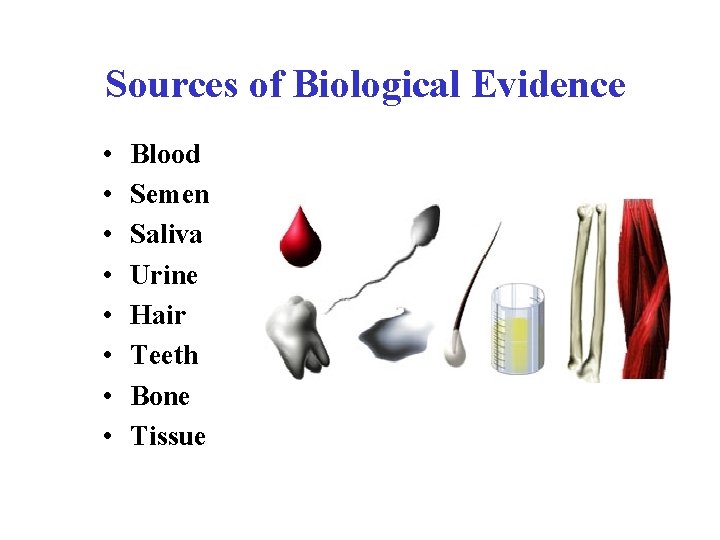
Sources of Biological Evidence • • Blood Semen Saliva Urine Hair Teeth Bone Tissue
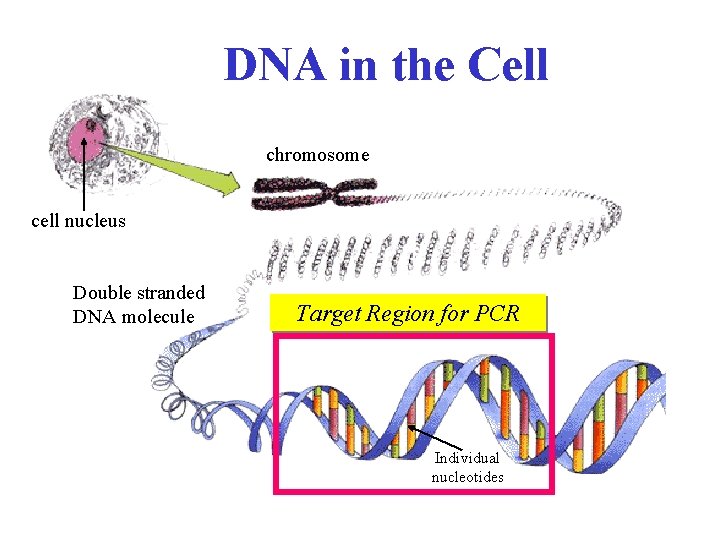
DNA in the Cell chromosome cell nucleus Double stranded DNA molecule Target Region for PCR Individual nucleotides
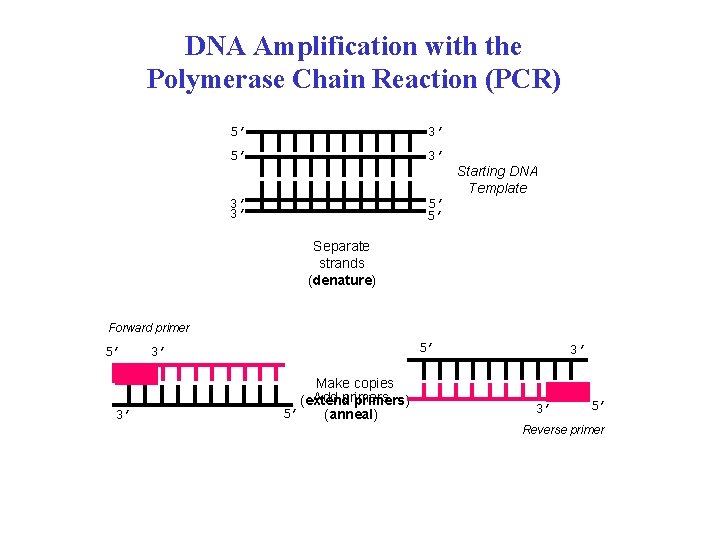
DNA Amplification with the Polymerase Chain Reaction (PCR) 5’ 3’ 3’ 3’ 5’ 5’ Starting DNA Template Separate strands (denature) Forward primer 5’ 3’ Make copies Add primers (extend primers) 5’ (anneal) 3’ 3’ 5’ Reverse primer
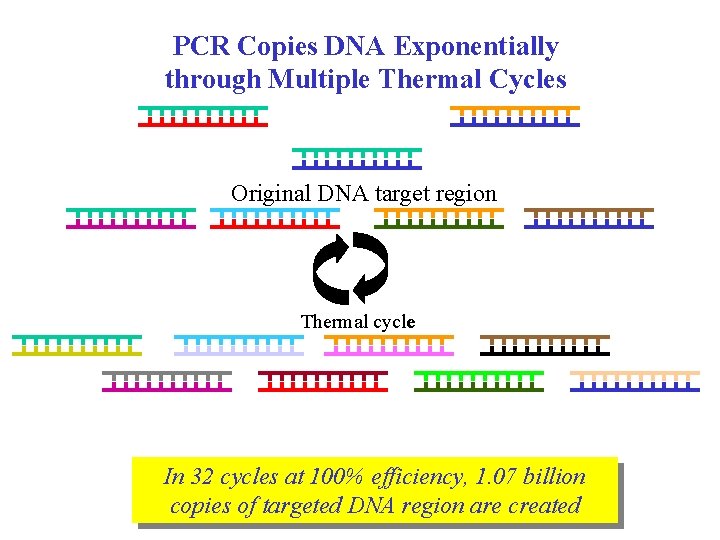
PCR Copies DNA Exponentially through Multiple Thermal Cycles Original DNA target region Thermal cycle In 32 cycles at 100% efficiency, 1. 07 billion copies of targeted DNA region are created
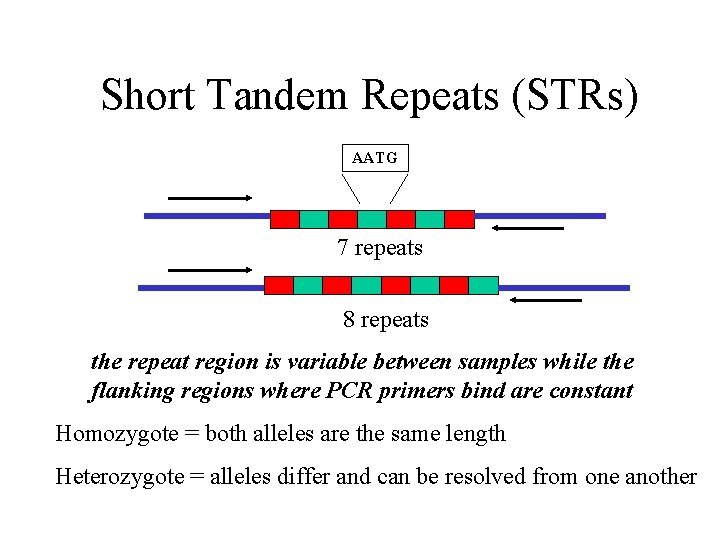
Short Tandem Repeats (STRs) AATG 7 repeats 8 repeats the repeat region is variable between samples while the flanking regions where PCR primers bind are constant Homozygote = both alleles are the same length Heterozygote = alleles differ and can be resolved from one another
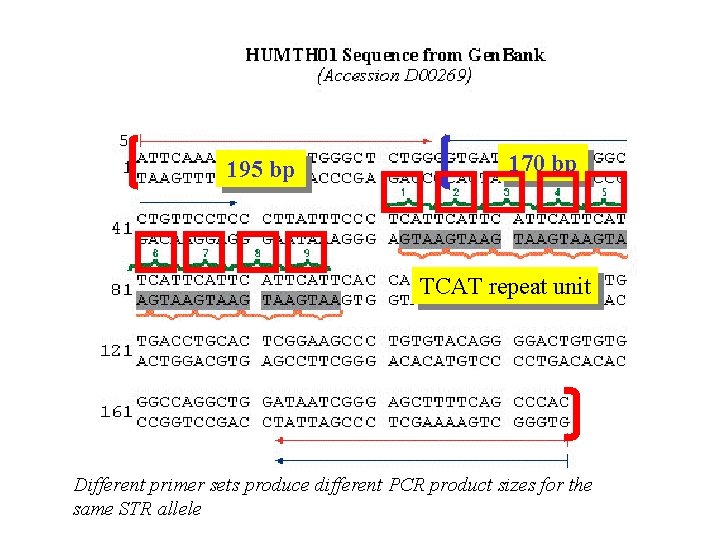
195 bp 170 bp TCAT repeat unit Different primer sets produce different PCR product sizes for the same STR allele
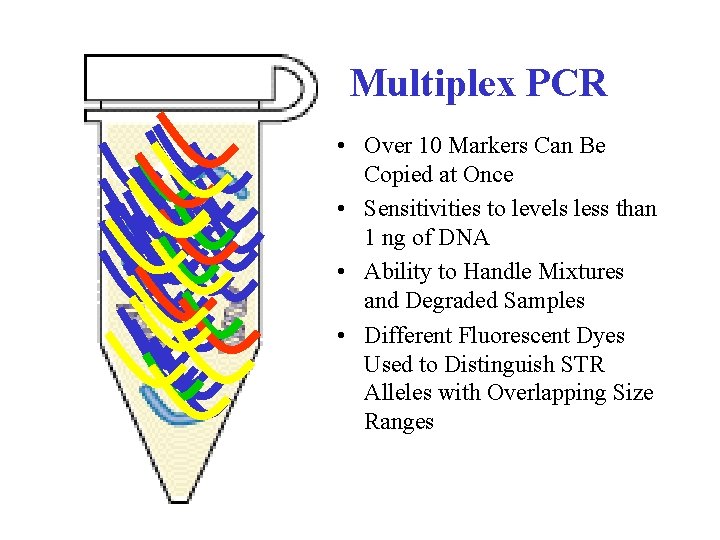
Multiplex PCR • Over 10 Markers Can Be Copied at Once • Sensitivities to levels less than 1 ng of DNA • Ability to Handle Mixtures and Degraded Samples • Different Fluorescent Dyes Used to Distinguish STR Alleles with Overlapping Size Ranges
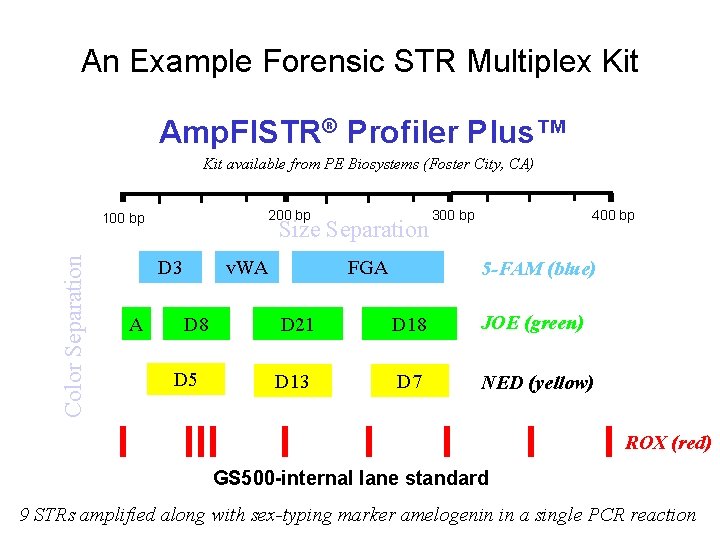
An Example Forensic STR Multiplex Kit Amp. Fl. STR® Profiler Plus™ Kit available from PE Biosystems (Foster City, CA) 200 bp Color Separation 100 bp Size Separation D 3 A v. WA D 8 D 5 FGA 300 bp 400 bp 5 -FAM (blue) D 21 D 18 JOE (green) D 13 D 7 NED (yellow) ROX (red) GS 500 -internal lane standard 9 STRs amplified along with sex-typing marker amelogenin in a single PCR reaction
Available Kits for STR Analysis • Kits make it easy for labs to just add DNA samples to a pre-made mix • 13 CODIS core loci – Profiler Plus and COfiler (PE Applied Biosystems) – Power. Plex 1. 1 and 2. 1 (Promega Corporation) • Increased power of discrimination – CTT (1994): 1 in 410 – SGM Plus™ (1999): 1 in 3 trillion – Power. Plex ™ 16 (2000): 1 in 2 x 10¹⁷
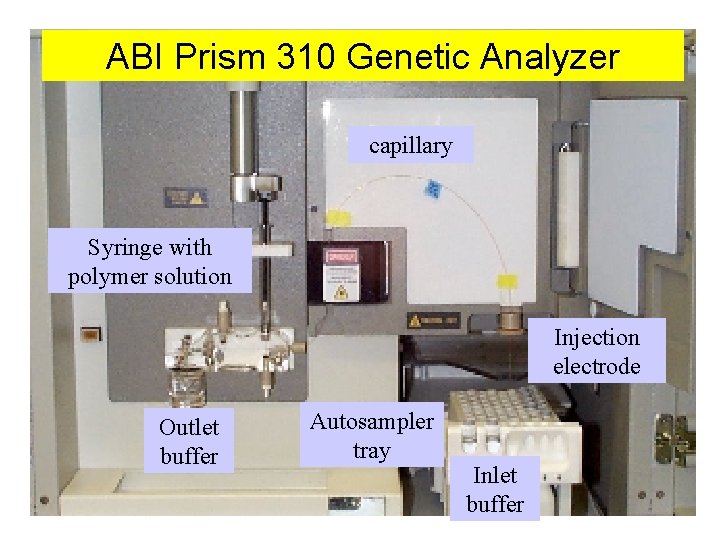
ABI Prism 310 Genetic Analyzer capillary Syringe with polymer solution Injection electrode Outlet buffer Autosampler tray Inlet buffer
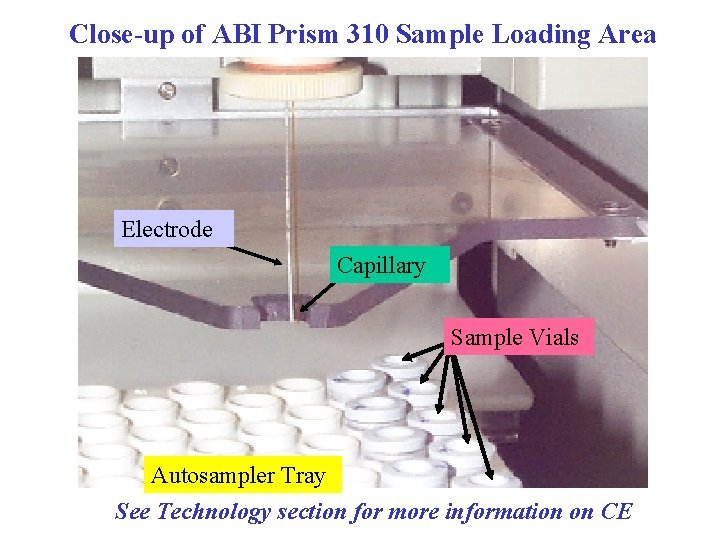
Close-up of ABI Prism 310 Sample Loading Area Electrode Capillary Sample Vials Autosampler Tray See Technology section for more information on CE
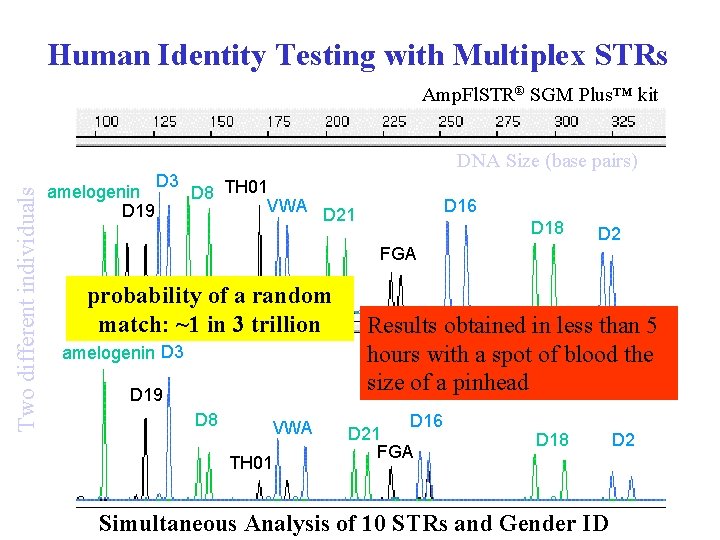
Human Identity Testing with Multiplex STRs Two different individuals Amp. Fl. STR® SGM Plus™ kit amelogenin D 19 D 3 DNA Size (base pairs) D 8 TH 01 VWA D 21 D 16 D 18 D 2 FGA probability of a random match: ~1 in 3 trillion amelogenin D 3 D 19 D 8 VWA TH 01 Results obtained in less than 5 hours with a spot of blood the size of a pinhead D 16 D 21 FGA D 18 Simultaneous Analysis of 10 STRs and Gender ID D 2
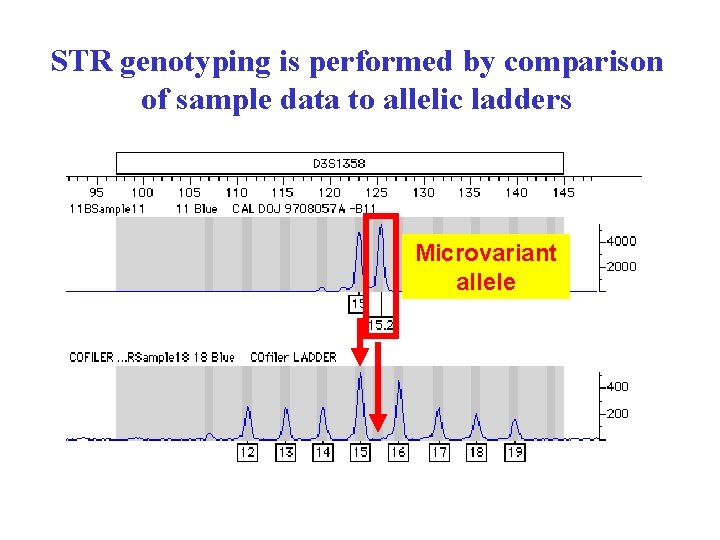
STR genotyping is performed by comparison of sample data to allelic ladders Microvariant allele
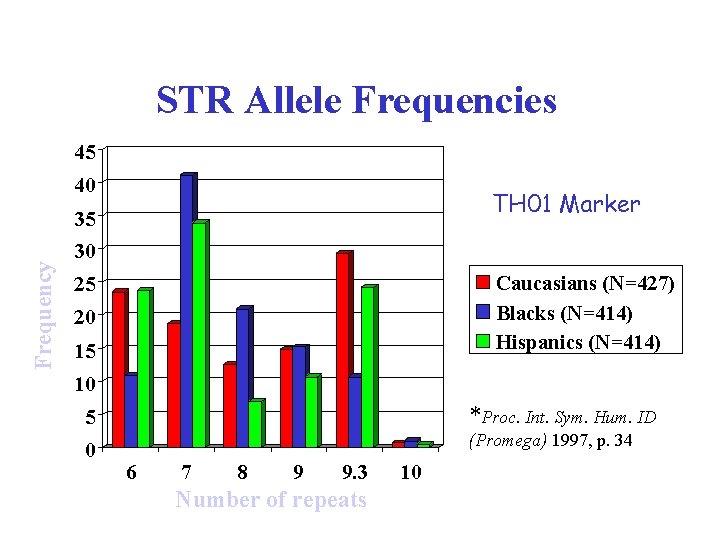
STR Allele Frequencies 45 40 TH 01 Marker Frequency 35 30 Caucasians (N=427) Blacks (N=414) Hispanics (N=414) 25 20 15 10 5 *Proc. Int. Sym. Hum. ID 0 (Promega) 1997, p. 34 6 7 8 9 9. 3 Number of repeats 10
FBI’s CODIS DNA Database Combined DNA Index System • Used for linking serial crimes and unsolved cases with repeat offenders • Launched October 1998 • Links all 50 states • Requires >4 RFLP markers and/or 13 core STR markers • Current backlog of >600, 000 samples
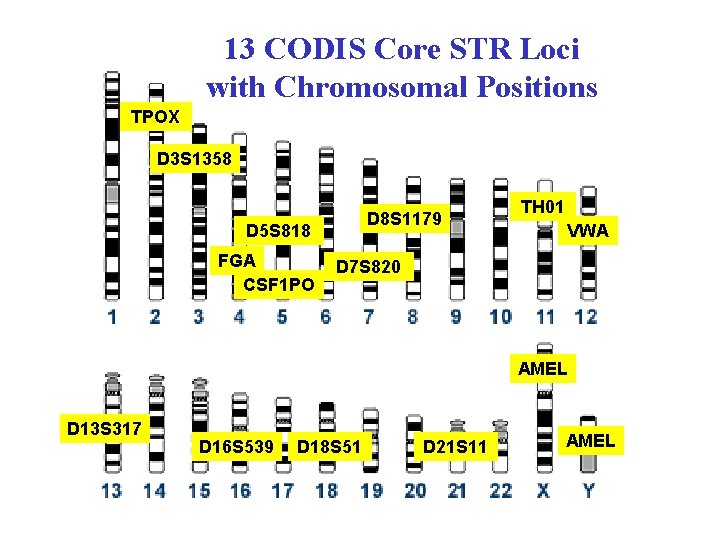
13 CODIS Core STR Loci with Chromosomal Positions TPOX D 3 S 1358 D 8 S 1179 D 5 S 818 FGA CSF 1 PO TH 01 VWA D 7 S 820 AMEL D 13 S 317 D 16 S 539 D 18 S 51 D 21 S 11 AMEL
- Slides: 20