
BRIEF HISTORY OF CALL Stages of CALL Stage
BRIEF HISTORY OF CALL

Stages of CALL Stage 1970 s-1980 s: Structural CALL 1980 s-1990 s: Communicative CALL 21 st Century: Integrative CALL Technology Mainframe PCs Multimedia and Internet English-Teaching Paradigm Grammar-Translation & Audio-Lingual Communicative Language Teaching Content-Based, ESP/EAP View of Language Structural (a formal structural system) Cognitive (a mentallyconstructed system) Soscio-cognitive (developed in social interaction) Principal Use of Computers Drill and Practice Communicative Exercises Authentic Discourse Principal Objective Accuracy Fluency Agency (Warschauer, 2004)
Theoretical Background • CALL is in use since 1960 from that of • tutor to that of tool. CALL is based on various teaching and learning theories depending on the era and its role. Internet is one of the most recent tools of CALL which is in use of EFL in last couple of years. It is based on “Integrative CALL” phase and socio-cognitive view.
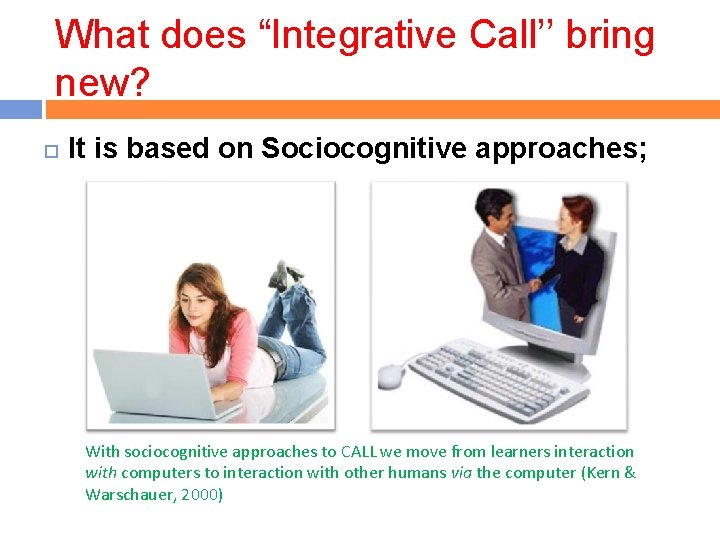
What does “Integrative Call’’ bring new? It is based on Sociocognitive approaches; With sociocognitive approaches to CALL we move from learners interaction with computers to interaction with other humans via the computer (Kern & Warschauer, 2000)
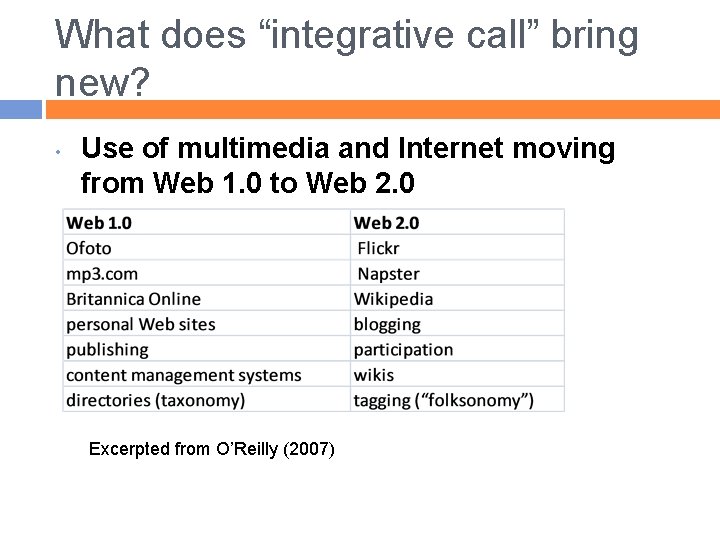
What does “integrative call” bring new? • Use of multimedia and Internet moving from Web 1. 0 to Web 2. 0 Excerpted from O’Reilly (2007)
Differences between Internet and World Wide Web Internet is a computer network connecting millions of computers all over the world. The web is a subset of the internet and dates back to 1993 s, however, Internet dates back to 1960 s.
Internet & ELT Internet provides various materials that meet different student abilities. Lee (2009): Internet-based activities are important in keeping the students interested and engaged in the current topic or activity. He suggests four kinds of activities to be used for this aim: conversation, retrieval of information and publication Felix (2012): The recent research based on constructivist learning approaches strongly suggest that the Internet and the Web have the potential to add something even to the best classroom teaching.
Advantages of Internet in ELT ü ü ü ü Macmanus (2010) lists these as; 5 Cs (communication, culture, connection, comparisons, community building) Motivational power Resource-based learning Control over learning Interactivity Publication Updatability
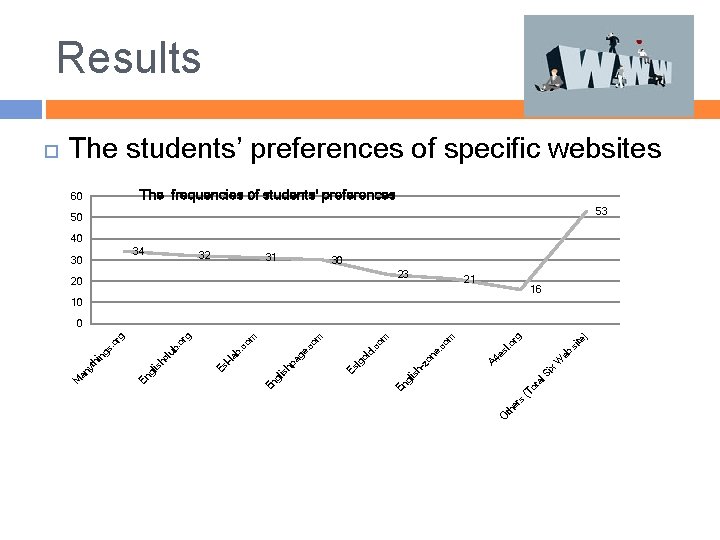
Results The students’ preferences of specific websites The frequencies of students' preferences 60 53 50 40 34 30 32 31 30 23 20 21 16 10 te ) si l. o O th e rs (T ot En gl is al S ix h- W eb A 4 es zo rg m co ne. . c ol d lg Es ag hp is En gl om om e. c om. c ab l-l Es hc l gl is En yt hi ng s ub. . o r or g g 0 M an
The good features of a website Testing the English level of the users. Friends from different cultures (forums, chats on the website) communicating with the native speakers.
Linder (2004) ‘ five basic possibilities of the networking English classroom’ Real time communication with other network users (using the internet as a telephone or video conferencing device, Chat) Deferred-time communication with other network users (email, mailing lists, newsgroups, and others) Source of information ( text, images, voice and sound, especially on the World Wide Web) Outlet for publication (text, images, voice and sound, especially on the World Wide Web) Distance teaching/ learning
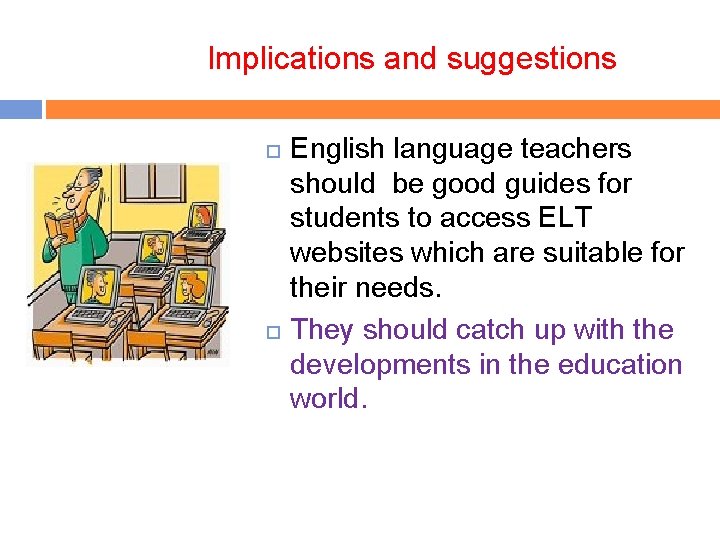
Implications and suggestions English language teachers should be good guides for students to access ELT websites which are suitable for their needs. They should catch up with the developments in the education world.
- Slides: 12