
Bridlington School Textiles Department The Big Question How
Bridlington School Textiles Department The Big Question : How can you use fine artists and textile artists to develop ideas for work based upon figures at home? Year 10 Previous Learning In year 9 you used a variety of techniques within a nature project with textiles artists for inspiration. Current Learning How can you develop your understanding of fine artists and work in the style of them with your own photographs? Next Learning How can you use a textiles artist to develop a drawn and stitched same from personal imagery?
Y 10 Textiles Home Learning - Artist Research You should research 2 artist’s who are inspired by figures, these are; - Henri Matisse (His CUTOUT works of art only) - Rosie James For each artist you will; - Collect and read information about the artist. - Produce a research document about the artist and their work. If you have access to a computer you can use a programme such as Power. Point or word to produce the document, if not you can produce a hand written document with cut out and/or drawn images. - Produce a piece of practical work based on the research that you have carried out. - Produce a piece of written work that evaluates/analyses the practical work you have done in comparison to the artists work.
ARTIST/S RESEARCH SHEET • Make the document on POWERPOINT (or Word if you don’t have Power. Point) • If you do not have access to a computer you can use the information in this booklet producing hand written pieces of work. CONTENTS OF THE SHEET 1. START by collecting information about the artist/s that you are researching, you will find information about these on websites and linked social media pages. On these pages you will find information about them, explanations regarding how and why they produce their work, examples of their work and quotations. Quotations can be taken from anything that they have said, it is likely they will have written some or all parts of their webpages, therefore they will be useful to take quotes from. ON THE RESEARCH SHEET YOU SHOULD INCLUDE • A title • 1 or more text boxes with YOUR OWN written comment in (max size 12 font). This should be written from the research that you have collected in point 1. Comments should include both factual information about the artist/s and also some of your own opinions where possible. • Images of the artists work – ideally these should relate to things that you have said in your written comment. For example if you have said the artist is inspired by nature (images of their work relating to nature) or they like using recycled materials (images of their work that uses recycling). • INCLUDE some basic facts about the artists. • INCLUDE at least 2 quotes that the artist has made about their own work. PLEASE LOOK AT THE EXAMPLE ON THE NEXT SLIDE BEFORE YOU START OF A COMPLETED RESEARCH SHEET FOR AN ARTIST CALLED CAROLYN SAXBY THAT YOU MAY HAVE SEEN BEFORE. THIS SHOULD REMIND YOU HOW TO PRODUCE A RESEARCH SHEET.

EXAMPLE OF COMPLETE RESEARCH SHEET Textiles Artist Saxby Carolyn Saxby is a textiles artist who works in a fusion of contemporary and country. She is inspired by the nature around her in St Ives, where she lives. She uses recycled materials to create her work. Nature inspires her and she experiments with using natural plant materials to manipulate fabrics. Research- Carolyn “I have been experimenting with using natural plant material to dye fabrics for use in my work” Often, Carolyn experiments with different medias to create different textures that she uses in surface design. The aesthetics of her work are the colours that she uses, the patterns that she makes and the way that she works from what she sees around her, where she lives. ‘I am inspired by so many things. Nature inspires me the most” ‘Recycling in textiles is very important to me. ’
ARTIST INFORMATION – HENRI MATISSE- Cutouts Henri Matisse is a giant of modern art. The final chapter in his career started when he began ‘carving into colour’ and his series of spectacular cut-outs was born. Matisse’s final artistic triumph. In the late 1940 s, in his late sixties when ill health prevented Matisse from painting he began ‘cutouts’. Henri Matisse turned almost exclusively to cut paper as his primary medium, and scissors as his chief implement, introducing a radically new operation that came to be called a cut-out. Matisse would have assistants paint paper for him then he would cut the painted sheets into forms of varying shapes and sizes—from the vegetal to the abstract—which he then arranged into lively compositions, striking for their play with colour and contrast. Initially, these compositions were of modest size but, over time, their scale grew along with Matisse’s ambitions for them, expanding into mural or room-size works. A brilliant final chapter in Matisse’s long career, the cutouts reflect both a renewed commitment to form and colour. From snow flowers to dancers, circus scenes and a famous snail, he produced a dazzling array of 120 works made between 1936 and 1954. Bold, exuberant and often large in scale, the cut-outs have an engaging simplicity coupled with incredible creative sophistication. https: //www. youtube. com/watch? v=G 4 NHDpa. QW 9 s ‘Creativity takes courage. ’ ‘It is not enough to place colours, however beautiful, one beside the other; colours must also react on one another. Otherwise, you have cacophony. ’ ‘Cutting into colour reminds me of the sculptor's direct carving. ’
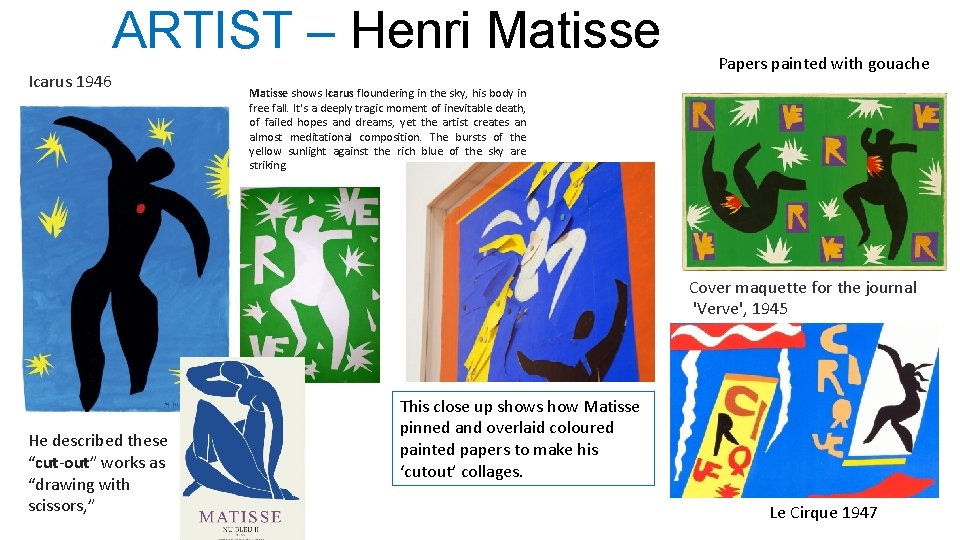
ARTIST – Henri Matisse Icarus 1946 Papers painted with gouache Matisse shows Icarus floundering in the sky, his body in free fall. It's a deeply tragic moment of inevitable death, of failed hopes and dreams, yet the artist creates an almost meditational composition. The bursts of the yellow sunlight against the rich blue of the sky are striking. Cover maquette for the journal 'Verve', 1945 He described these “cut-out” works as “drawing with scissors, ” This close up shows how Matisse pinned and overlaid coloured painted papers to make his ‘cutout’ collages. Le Cirque 1947
PRACTICAL TASKS – Henri Matisse 1. Look at the images of examples of Henri Matisse’s work, these are cut out painted papers of figures. 2. Start by making an accurate copy of one or more of his drawing studies. These can be simple outline drawings or if you have crayons at home you can add colour. 3. Take a photo of yourself full length in the mirror or a member of your family/ friend. Use the photo to draw your self/family/friend in a simplistic style like Matisse. Look carefully at how he angles and shapes sections of the figure, feet and hands. You could trace an outline of the figure first from your photo to work with. Add colour to the figure with ripped up sections of magazine colours to produce a collage. This will replicate the painted paper format Matisse uses. 4. Once you have completed both tasks complete written analysis on the next page to explain what you have done and how this connects with Henri Matisse. Top Tips for Drawing • Work on drawing paper. • Use pencil first working lightly so that you can easily rub out any mistakes. • You have the option to go over the pencil with black pen once you are happy with the drawing and add colour if you have them. • Focus on getting the shapes and sizes correct (proportion). • Add colour using magazines for a collage if this is possible. Extension Task 1. Try creating several figure collages of different members of your family.
Working in the style of an artist – Henri Matisse. PROVIDE SOME RESEARCH ABOUT THE ARTIST • Who is the artist you have looked at ? What do they do ? What are the characteristics of their work ? • Look closely at the work you have presented by the artist and reference what you see in the images. ____________________________________________________________________________________________________ ____________________________________________________________________________________________________ DISCUSS HOW YOU HAVE WORKED IN THE ARTISTS STYLE • What have you done that is similar to the artist? What similarities are there between your work and Henri Matisse’s? • Have you in any way developed your work beyond the artists ? ____________________________________________________________________________________________________ ____________________________________________________________________________________________________ Sentence Starters • I have looked at the work of ………………… • Henri Matisse is………………. . • I have been inspired by ……………. • This piece of work is based on …………… • I feel that my work ……………. . • I have worked in a similar style by ……………. . Connectives first of all however conclude similarly for example in other words finally and then next also afterwards Adjectives created interesting textured rotate detail developed blended bright eye-catching appealing contrasting bold produced constructed combined colourful detailed Specialist Vocabulary figures colourful detail ‘cutouts’ painted papers section simplify illustration layering collage outline circus inspiration pattern fine artist
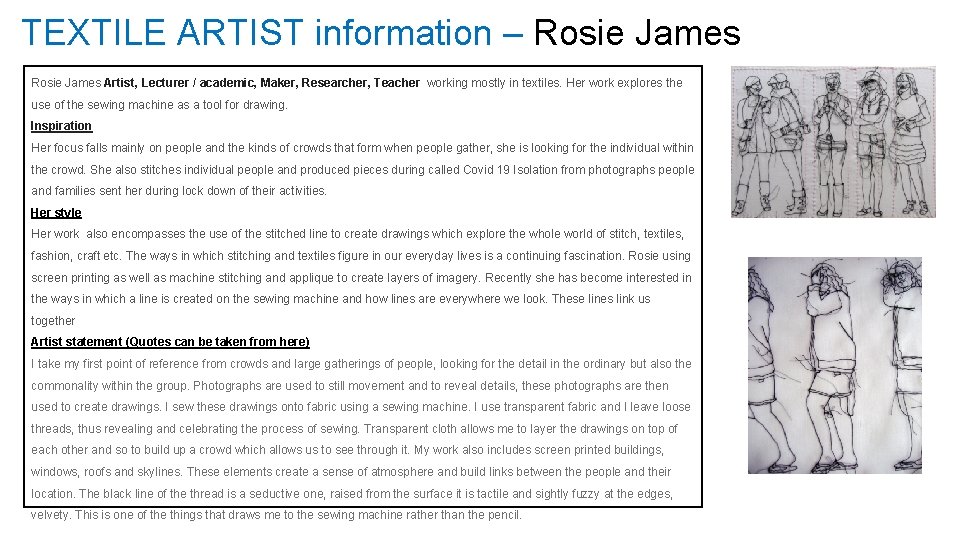
TEXTILE ARTIST information – Rosie James Artist, Lecturer / academic, Maker, Researcher, Teacher working mostly in textiles. Her work explores the use of the sewing machine as a tool for drawing. Inspiration Her focus falls mainly on people and the kinds of crowds that form when people gather, she is looking for the individual within the crowd. She also stitches individual people and produced pieces during called Covid 19 Isolation from photographs people and families sent her during lock down of their activities. Her style Her work also encompasses the use of the stitched line to create drawings which explore the whole world of stitch, textiles, fashion, craft etc. The ways in which stitching and textiles figure in our everyday lives is a continuing fascination. Rosie using screen printing as well as machine stitching and applique to create layers of imagery. Recently she has become interested in the ways in which a line is created on the sewing machine and how lines are everywhere we look. These lines link us together Artist statement (Quotes can be taken from here) I take my first point of reference from crowds and large gatherings of people, looking for the detail in the ordinary but also the commonality within the group. Photographs are used to still movement and to reveal details, these photographs are then used to create drawings. I sew these drawings onto fabric using a sewing machine. I use transparent fabric and I leave loose threads, thus revealing and celebrating the process of sewing. Transparent cloth allows me to layer the drawings on top of each other and so to build up a crowd which allows us to see through it. My work also includes screen printed buildings, windows, roofs and skylines. These elements create a sense of atmosphere and build links between the people and their location. The black line of the thread is a seductive one, raised from the surface it is tactile and sightly fuzzy at the edges, velvety. This is one of the things that draws me to the sewing machine rather than the pencil.
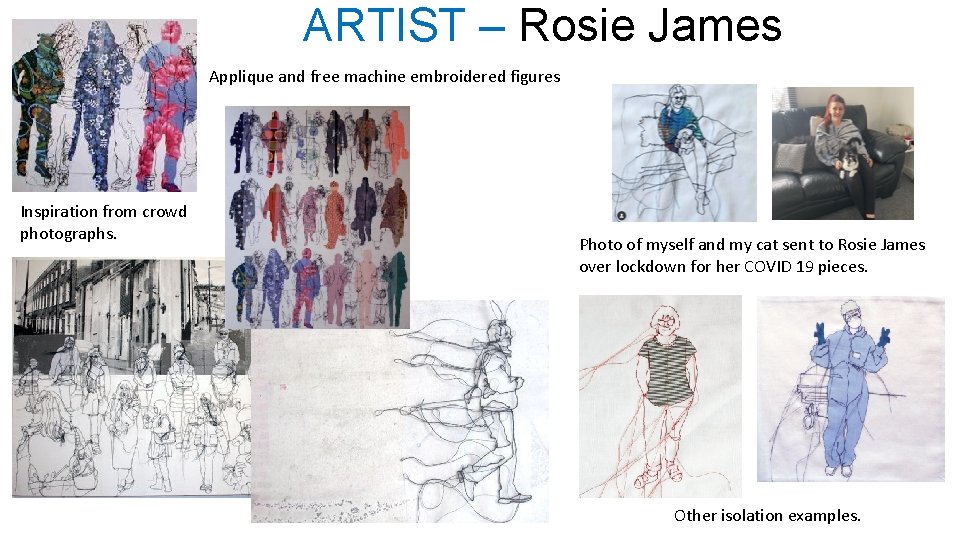
ARTIST – Rosie James Applique and free machine embroidered figures Inspiration from crowd photographs. Photo of myself and my cat sent to Rosie James over lockdown for her COVID 19 pieces. Other isolation examples.
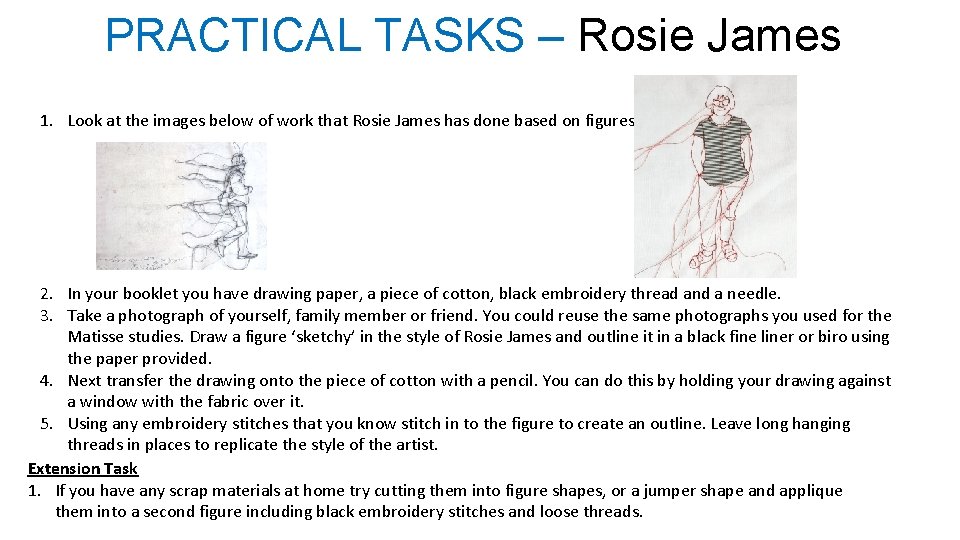
PRACTICAL TASKS – Rosie James 1. Look at the images below of work that Rosie James has done based on figures. 2. In your booklet you have drawing paper, a piece of cotton, black embroidery thread and a needle. 3. Take a photograph of yourself, family member or friend. You could reuse the same photographs you used for the Matisse studies. Draw a figure ‘sketchy’ in the style of Rosie James and outline it in a black fine liner or biro using the paper provided. 4. Next transfer the drawing onto the piece of cotton with a pencil. You can do this by holding your drawing against a window with the fabric over it. 5. Using any embroidery stitches that you know stitch in to the figure to create an outline. Leave long hanging threads in places to replicate the style of the artist. Extension Task 1. If you have any scrap materials at home try cutting them into figure shapes, or a jumper shape and applique them into a second figure including black embroidery stitches and loose threads.
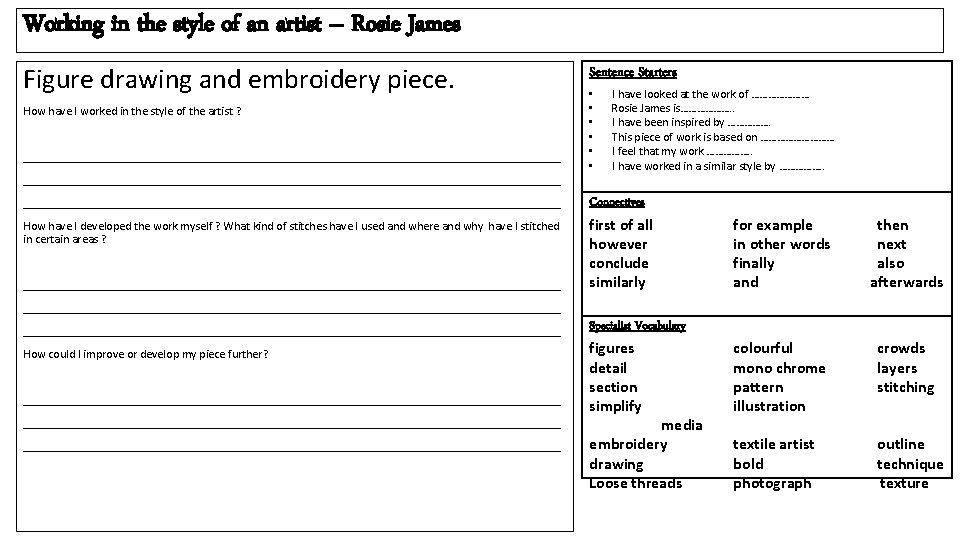
Working in the style of an artist – Rosie James Figure drawing and embroidery piece. How have I worked in the style of the artist ? __________________________________________________________________________________________ How have I developed the work myself ? What kind of stitches have I used and where and why have I stitched in certain areas ? _____________________________________________ Sentence Starters • I have looked at the work of ………………… • Rosie James is………………. . • I have been inspired by ……………. • This piece of work is based on …………… • I feel that my work ……………. . • I have worked in a similar style by ……………. . Connectives first of all however conclude similarly for example in other words finally and then next also afterwards colourful mono chrome pattern illustration crowds layers stitching textile artist bold photograph outline technique texture __________________________________________________________________________________________ How could I improve or develop my piece further? __________________________________________________________________________________________ Specialist Vocabulary figures detail section simplify media embroidery drawing Loose threads
- Slides: 12