
Bridlington School Textiles Department The Big Question How
Bridlington School Textiles Department The Big Question : How can you use cultural imagery with textile artist influences to produce drawings and textile plans at home? Year 11 Previous Learning In year 10 you developed the use of a wide variety of techniques with textile/ fine artist inspiration to produce personal outcomes. Current Learning Next Learning How can you develop your understanding of colour pattern and shape depicted within cultural imagery for producing drawings? How can you combine key characteristics from cultural imagery with artist techniques when planning samples?
Y 11 Textiles Home Learning - Artist Research You should research and collect animal art images produced by different cultures: Ideally choose two from the list below: - North American Indian - Oriental - Aboriginal - African You should research an artist who’s techniques and processes could be incorporated into Cultural animal piece; - Laura Edgar For the cultural research you will; - Collect and read information about the cultures. - Produce a research document about the cultures and how they produce their work. If you have access to a computer you can use a programme such as Power. Point or word to produce the document, if not you can produce a hand written document with cut out and/or drawn images. For the artist you will; - Collect and read information about the artist. - Produce a research document about the artist and their work. If you have access to a computer you can use a programme such as Power. Point or word to produce the document, if not you can produce a hand written document with cut out and/or drawn images. - Produce a drawing and practical piece plan based on the research that you have carried out linking the cultural images and artist together
CULTURAL RESEARCH SHEET • Make the document on POWERPOINT (or Word if you don’t have Power. Point) • If you do not have access to a computer you can use the information in this booklet producing hand written pieces of work. CONTENTS OF THE SHEET 1. START by collecting information about the cultures that you are researching, you will find information about these on websites which you can hopefully access with your phone if you don’t have a laptop. On these pages you will find information about different cultures, explanations regarding how and why they produce their work, for example Oriental art focuses heavily on birds often using watercolours. ON THE RESEARCH SHEET YOU SHOULD INCLUDE: • A title • 1 or more text boxes with YOUR OWN written comment in (max size 12 font). This should be written from the research that you have collected in point 1. Comments should include both factual information about the culture and also some of your own opinions where possible. • Images of the animal based cultural works – ideally these should relate to things that you have said in your written comment. For example if you have said that Oriental art focuses upon birds and often uses watercolours you should include examples that match this.
ARTIST RESEARCH SHEET • Make the document on POWERPOINT (or Word if you don’t have Power. Point) • If you do not have access to a computer you can use the information in this booklet producing hand written pieces of work. CONTENTS OF THE SHEET 1. START by collecting information about the artist/s that you are researching, you will find information about these on websites and linked social media pages. On these pages you will find information about them, explanations regarding how and why they produce their work, examples of their work and quotations. Quotations can be taken from anything that they have said, it is likely they will have written some or all parts of their webpages, therefore they will be useful to take quotes from. ON THE RESEARCH SHEET YOU SHOULD INCLUDE • A title • 1 or more text boxes with YOUR OWN written comment in (max size 12 font). This should be written from the research that you have collected in point 1. Comments should include both factual information about the artist/s and also some of your own opinions where possible. • Images of the artists work – ideally these should relate to things that you have said in your written comment. For example if you have said the artist is inspired by nature (images of their work relating to nature) or they like using recycled materials (images of their work that uses recycling). • INCLUDE some basic facts about the artists. • INCLUDE at least 2 quotes that the artist has made about their own work. PLEASE LOOK AT THE EXAMPLE ON THE NEXT SLIDE BEFORE YOU START OF A COMPLETED RESEARCH SHEET FOR AN ARTIST CALLED CAROLYN SAXBY THAT YOU MAY HAVE SEEN BEFORE. THIS SHOULD REMIND YOU HOW TO PRODUCE A RESEARCH SHEET. THIS FORMAT APPLIES FOR THE

EXAMPLE OF COMPLETE RESEARCH SHEET Textiles Artist Saxby Carolyn Saxby is a textiles artist who works in a fusion of contemporary and country. She is inspired by the nature around her in St Ives, where she lives. She uses recycled materials to create her work. Nature inspires her and she experiments with using natural plant materials to manipulate fabrics. Research- Carolyn “I have been experimenting with using natural plant material to dye fabrics for use in my work” Often, Carolyn experiments with different medias to create different textures that she uses in surface design. The aesthetics of her work are the colours that she uses, the patterns that she makes and the way that she works from what she sees around her, where she lives. ‘I am inspired by so many things. Nature inspires me the most” ‘Recycling in textiles is very important to me. ’
CULTURAL INFORMATION – Starting points for you to use if you don’t have access to the internet, if you do please expand upon them. ORIENTAL ART- East Asian art includes works from China, Japan, and Korea. Chinese painting Gongbi and Xieyi are two painting styles in Chinese painting. Gongbi means "meticulous", the rich colours and details in the pictures are their main features, Xieyi means 'freehand', its form is often exaggerated and unreal, with an emphasis on the author's emotional expression. Japanese and Chinese art often use Indian ink and watercolour wash on paper and silk, traditional paintings have also been found on cave walls. The murals are very broad in content, include Buddha statues, animals, paradise, angels and important historical events. Calligraphy also features within their work. NORTH AMERICAN INDIAN ART- Indigenous American visual arts include painting, basketry, textiles, photography, as well as monumental works, such as architecture, public sculpture, and murals. The southwestern United States and certain regions of the Andes have the highest concentration of pictographs (painted images) and Petroglyphs (carved images) Both pictographs and petroglyphs are known as rock art produced by Indigenous people. As well as painting animals North American Indians used animals on Totem poles they carved into trees. Totem poles were built by tribes these wooden towers, carved with images of animals and symbols, were monuments expressing a family's status within a tribe. Native American Symbols and Crests play an important part in their culture. Each animal, spirit and supernatural being represents and symbolizes different stories, traits, personality and values.
CULTURAL INFORMATION – AFRICAN ART- Rock art is the earliest art form in Africa. The earliest known rock art preserved in the Saharan sands in Niger dates as far back as 6500 BC. They are carvings known as petroglyphs and depict animals like giraffes that no longer exist in that area. African art comprises of wooden masks, paintings, pottery and textiles. Because of colonialism and slavery, African art found its way around the world. One of the main themes in the art of Ancient Africa is the human form and animals. Sometimes people were shown with animals or as part animal, part person. Because art is a way of identifying one’s self and culture, animals became a major subject matter for African artists. The paintings, sculptures and textiles depicting animals often did so in a way that either expressed their relationship to the human beings, or symbolised something about that person or tribe. For example, wild lions were known for their courage and regal-ness. Likewise, an elephant was associated with strength and power. Therefore, associating such an animal with a certain king or warrior, the artists granted that one the same stature. ABORIGINAL ART- Animals are central to Aboriginal survival as a food source. They are also absorbed into the culture as images of totemic power and into the Dreamtime Creation stories that link the people, land animals. What this means is that animals play a massive part in Aboriginal art, art began in caves when the Aborigines would carve stories into the walls to teach children about their local environment, survival and hunting. The use of symbols and carvings was an alternate way for them to write down stories of cultural significance. Symbols are used now by Aboriginal people in their art to preserve their culture and tradition. They are also used to depict various stories. There are several types of methods used in making Aboriginal art, including rock painting, dot painting, sculptures, and weaving. A variety of colours are used, except for red, which symbolises blood and is only used in other types of painting.
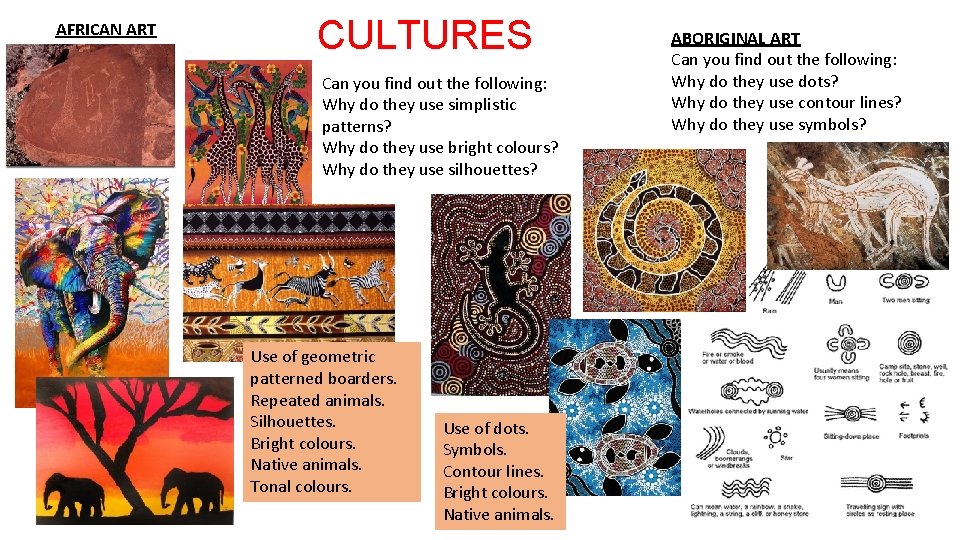
AFRICAN ART CULTURES Can you find out the following: Why do they use simplistic patterns? Why do they use bright colours? Why do they use silhouettes? Use of geometric patterned boarders. Repeated animals. Silhouettes. Bright colours. Native animals. Tonal colours. Use of dots. Symbols. Contour lines. Bright colours. Native animals. ABORIGINAL ART Can you find out the following: Why do they use dots? Why do they use contour lines? Why do they use symbols?
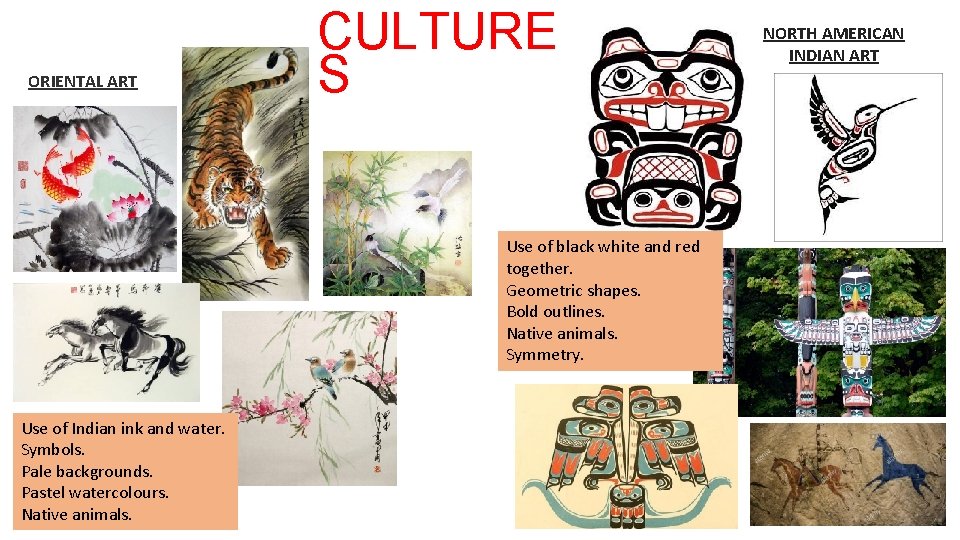
ORIENTAL ART CULTURE S Use of black white and red together. Geometric shapes. Bold outlines. Native animals. Symmetry. Use of Indian ink and water. Symbols. Pale backgrounds. Pastel watercolours. Native animals. NORTH AMERICAN INDIAN ART
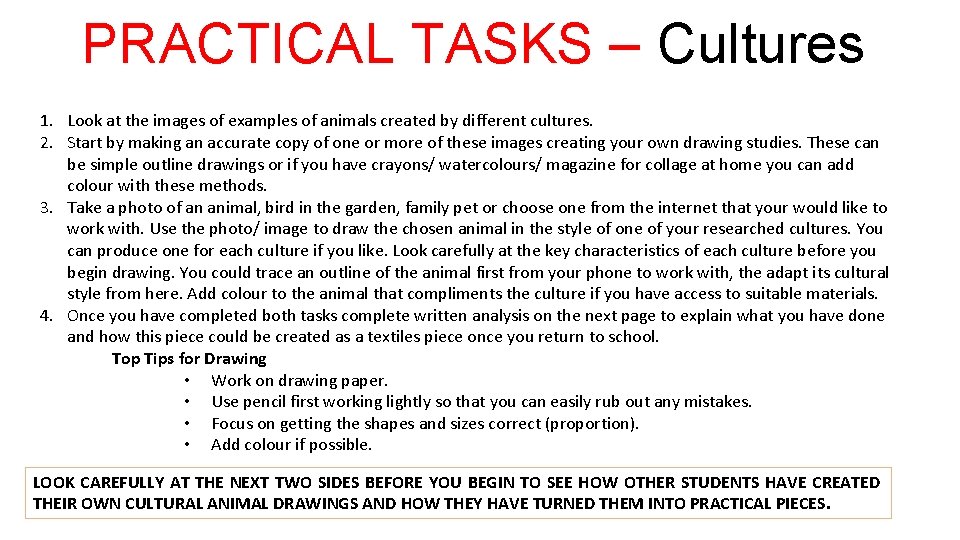
PRACTICAL TASKS – Cultures 1. Look at the images of examples of animals created by different cultures. 2. Start by making an accurate copy of one or more of these images creating your own drawing studies. These can be simple outline drawings or if you have crayons/ watercolours/ magazine for collage at home you can add colour with these methods. 3. Take a photo of an animal, bird in the garden, family pet or choose one from the internet that your would like to work with. Use the photo/ image to draw the chosen animal in the style of one of your researched cultures. You can produce one for each culture if you like. Look carefully at the key characteristics of each culture before you begin drawing. You could trace an outline of the animal first from your phone to work with, the adapt its cultural style from here. Add colour to the animal that compliments the culture if you have access to suitable materials. 4. Once you have completed both tasks complete written analysis on the next page to explain what you have done and how this piece could be created as a textiles piece once you return to school. Top Tips for Drawing • Work on drawing paper. • Use pencil first working lightly so that you can easily rub out any mistakes. • Focus on getting the shapes and sizes correct (proportion). • Add colour if possible. LOOK CAREFULLY AT THE NEXT TWO SIDES BEFORE YOU BEGIN TO SEE HOW OTHER STUDENTS HAVE CREATED THEIR OWN CULTURAL ANIMAL DRAWINGS AND HOW THEY HAVE TURNED THEM INTO PRACTICAL PIECES.
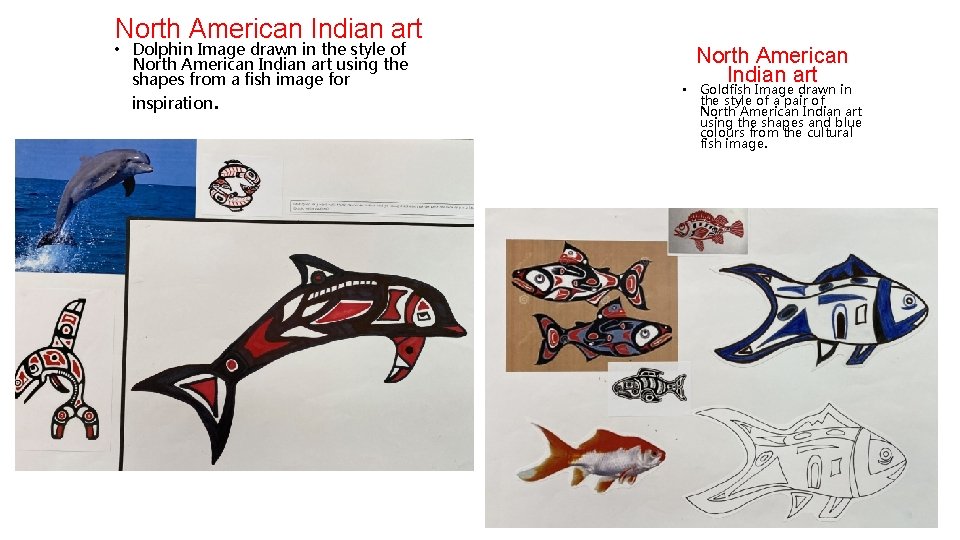
North American Indian art • Dolphin Image drawn in the style of North American Indian art using the shapes from a fish image for inspiration . North American Indian art • Goldfish Image drawn in the style of a pair of North American Indian art using the shapes and blue colours from the cultural fish image.
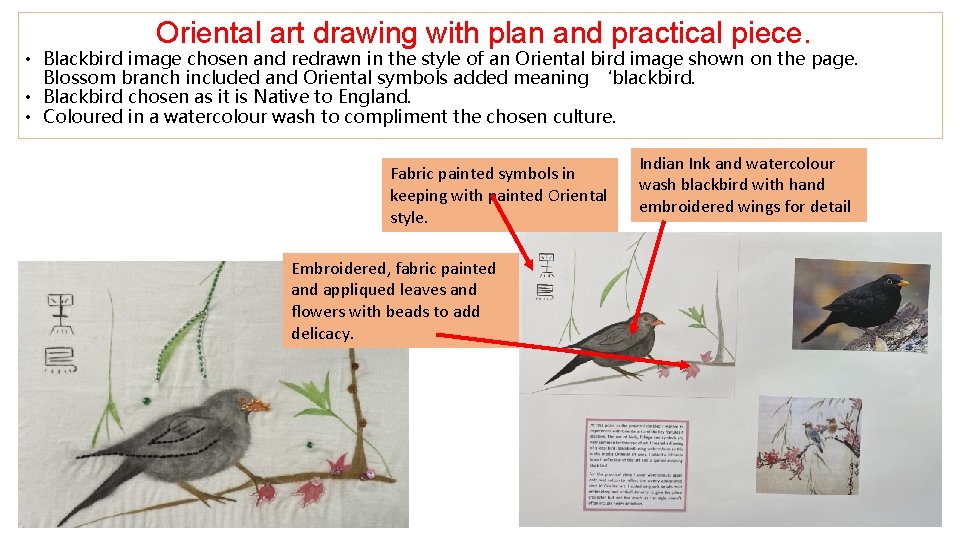
Oriental art drawing with plan and practical piece. • Blackbird image chosen and redrawn in the style of an Oriental bird image shown on the page. Blossom branch included and Oriental symbols added meaning ‘blackbird. • Blackbird chosen as it is Native to England. • Coloured in a watercolour wash to compliment the chosen culture. Fabric painted symbols in keeping with painted Oriental style. Embroidered, fabric painted and appliqued leaves and flowers with beads to add delicacy. Indian Ink and watercolour wash blackbird with hand embroidered wings for detail
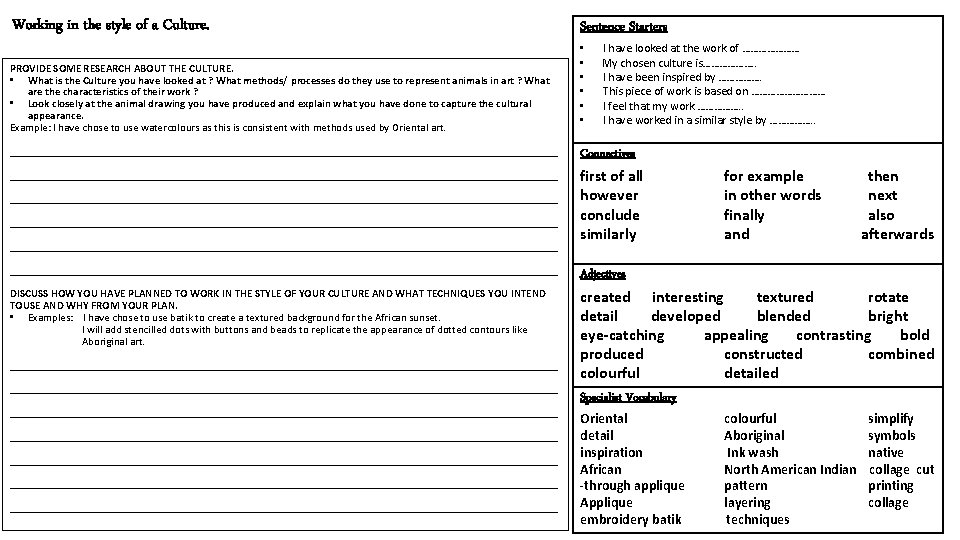
Working in the style of a Culture. PROVIDE SOME RESEARCH ABOUT THE CULTURE. • What is the Culture you have looked at ? What methods/ processes do they use to represent animals in art ? What are the characteristics of their work ? • Look closely at the animal drawing you have produced and explain what you have done to capture the cultural appearance. Example: I have chose to use watercolours as this is consistent with methods used by Oriental art. ____________________________________________________________________________________________________ ____________________________________________________________________________________________________ DISCUSS HOW YOU HAVE PLANNED TO WORK IN THE STYLE OF YOUR CULTURE AND WHAT TECHNIQUES YOU INTEND TOUSE AND WHY FROM YOUR PLAN. • Examples: I have chose to use batik to create a textured background for the African sunset. I will add stencilled dots with buttons and beads to replicate the appearance of dotted contours like Aboriginal art. ____________________________________________________________________________________________________ ____________________________________________________________________________________________________ Sentence Starters • • • I have looked at the work of ………………… My chosen culture is………………. . I have been inspired by ……………. This piece of work is based on …………… I feel that my work ……………. . I have worked in a similar style by ……………. . Connectives first of all however conclude similarly for example in other words finally and then next also afterwards Adjectives created interesting textured rotate detail developed blended bright eye-catching appealing contrasting bold produced constructed combined colourful detailed Specialist Vocabulary Oriental detail inspiration African -through applique Applique embroidery batik colourful Aboriginal Ink wash North American Indian pattern layering techniques simplify symbols native collage cut printing collage
ARTIST INFORMATION – LAURA EDGAR Laura Edgar is a textile artist & tutor based in Whitley Bay on the NE of England's coastline. She worked as a freelance textile designer creating embellished fabrics for the fashion market with a focus on embroidery. At present she works in the mediums of textiles and mixed media, exploring an eclectic mix of vintage, recycled fabrics incorporating embroidery and painting techniques to create original art, prints, accessories and cards. She works part time as a professional artist in the mediums of textiles and mixed media and with a focus on traditional and modern embroidery techniques, she creates original art pieces. Formats of art works include wall hangings, box canvas and framed pieces. Initial inspiration is noted through photographs and sketches, then a spontaneous approach and exploration and manipulation of chosen medium, results in works which can be abstract or more literal in form. She graduated as a textile designer having weaved, knit, printed and embroidered her way through her studies. 'I am fascinated by texture and find inspiration in the local coastline, the sea, the changing elements, decay, vintage ephemera, nostalgia etc. The eclectic range of mediums in which I work are fused by a signature use of atmospheric hues, collage and textural embellishment. ’ Laura loves nature, sea and landscapes, the elements and all things vintage. “I am absolutely spoiled for inspiration, ”
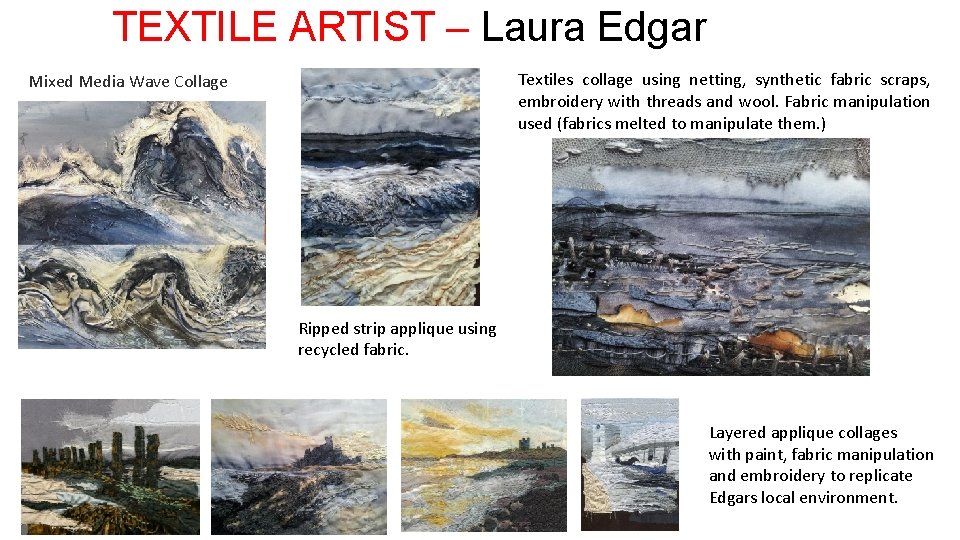
TEXTILE ARTIST – Laura Edgar Textiles collage using netting, synthetic fabric scraps, embroidery with threads and wool. Fabric manipulation used (fabrics melted to manipulate them. ) Mixed Media Wave Collage Ripped strip applique using recycled fabric. Layered applique collages with paint, fabric manipulation and embroidery to replicate Edgars local environment.
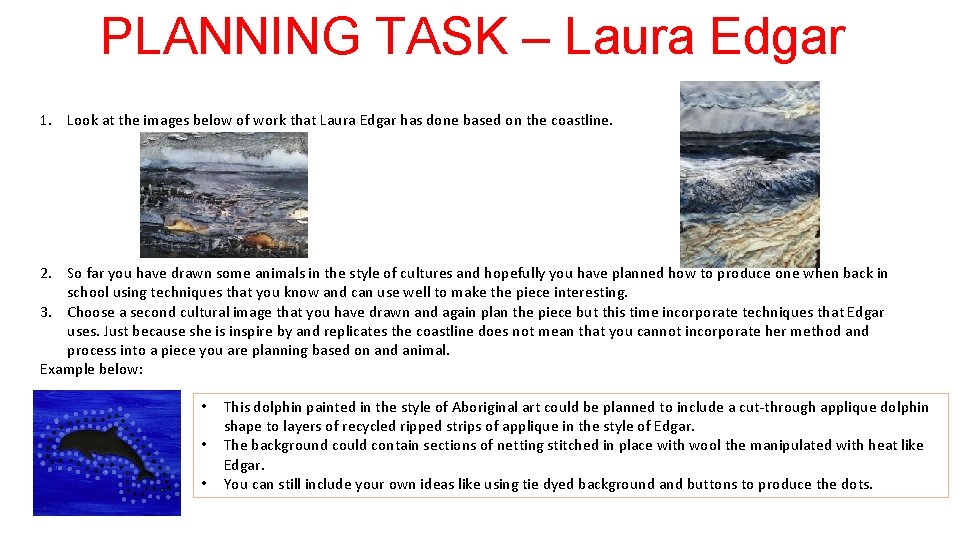
PLANNING TASK – Laura Edgar 1. Look at the images below of work that Laura Edgar has done based on the coastline. 2. So far you have drawn some animals in the style of cultures and hopefully you have planned how to produce one when back in school using techniques that you know and can use well to make the piece interesting. 3. Choose a second cultural image that you have drawn and again plan the piece but this time incorporate techniques that Edgar uses. Just because she is inspire by and replicates the coastline does not mean that you cannot incorporate her method and process into a piece you are planning based on and animal. Example below: • • • This dolphin painted in the style of Aboriginal art could be planned to include a cut-through applique dolphin shape to layers of recycled ripped strips of applique in the style of Edgar. The background could contain sections of netting stitched in place with wool the manipulated with heat like Edgar. You can still include your own ideas like using tie dyed background and buttons to produce the dots.
Working in the style of an artist and a culture combined. How have I worked in the style of the culture to produce my drawing ? __________________________________________________________________________________________ Sentence Starters • • • I have looked at the work of ………………… Laura Edgar is………………. . I have been inspired by ……………. This piece of work is based on …………… I feel that my work ……………. . I have worked in a similar style by ……………. . _____________________________________________ How have I planned to include my own technique ideas when making this piece? __________________________________________________________________________________________ Connectives first of all however conclude similarly for example in other words finally and then next also afterwards _____________________________________________ How have I developed my plan by incorporating methods Laura Edgar uses and how will this improve my piece? __________________________________________________________________________________________ Specialist Vocabulary combined detail section simplify embroidery drawing recycled colourful ripped strip applique pattern manipulation textile artist bold photograph processes layers stitching media outline technique texture
- Slides: 17