
Bridging the Knowledge Gap Integration of Special Education
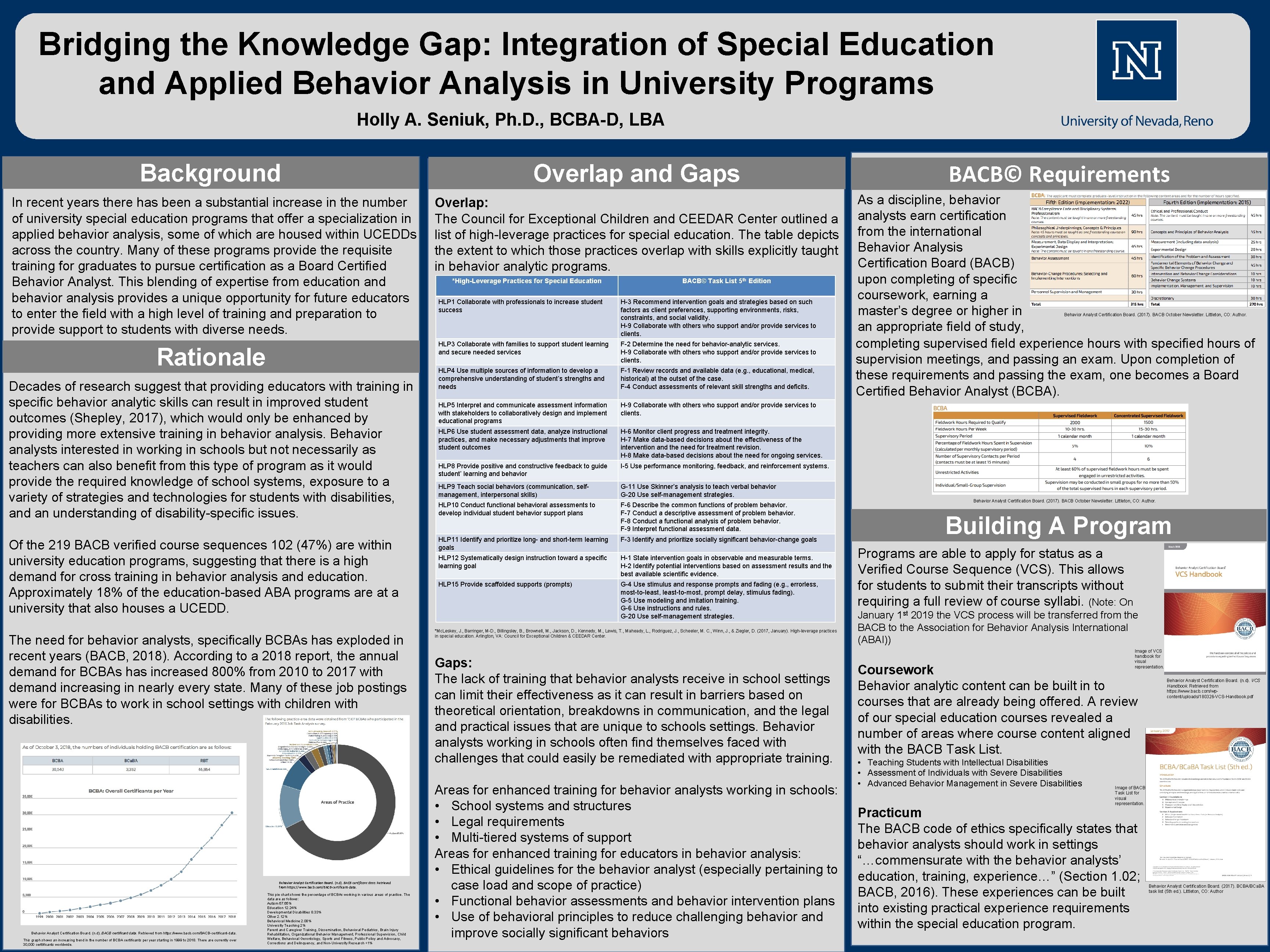
Bridging the Knowledge Gap: Integration of Special Education and Applied Behavior Analysis in University Programs Holly A. Seniuk, Ph. D. , BCBA-D, LBA Background In recent years there has been a substantial increase in the number of university special education programs that offer a specialization in applied behavior analysis, some of which are housed within UCEDDs across the country. Many of these programs provide the requisite training for graduates to pursue certification as a Board Certified Behavior Analyst. This blending of expertise from education and behavior analysis provides a unique opportunity for future educators to enter the field with a high level of training and preparation to provide support to students with diverse needs. Rationale Decades of research suggest that providing educators with training in specific behavior analytic skills can result in improved student outcomes (Shepley, 2017), which would only be enhanced by providing more extensive training in behavior analysis. Behavior analysts interested in working in schools but not necessarily as teachers can also benefit from this type of program as it would provide the required knowledge of school systems, exposure to a variety of strategies and technologies for students with disabilities, and an understanding of disability-specific issues. Of the 219 BACB verified course sequences 102 (47%) are within university education programs, suggesting that there is a high demand for cross training in behavior analysis and education. Approximately 18% of the education-based ABA programs are at a university that also houses a UCEDD. The need for behavior analysts, specifically BCBAs has exploded in recent years (BACB, 2018). According to a 2018 report, the annual demand for BCBAs has increased 800% from 2010 to 2017 with demand increasing in nearly every state. Many of these job postings were for BCBAs to work in school settings with children with disabilities. Behavior Analyst Certification Board. (n. d). BACB certificant data. Retrieved from https: //www. bacb. com/BACB-certificant-data. This graph shows an increasing trend in the number of BCBA certificants per year starting in 1999 to 2018. There are currently over 30, 000 certtificants worldwide. This pie chart shows the percentage of BCBAs working in various areas of practice. The data are as follows: Autism 67. 65% Education 12. 24% Developmental Disabilities 8. 33% Other 2. 12% Behavioral Medicine 2. 08% University Teaching 2% Parent and Caregiver Training, Dissemination, Behavioral Pediatrics, Brain Injury Rehabilitation, Organizational Behavior Management, Professional Supervision, Child Welfare, Behavioral Gerontology, Sports and Fitness, Public Policy and Advocacy, Corrections and Delinquency, and Non-University Research <1% Overlap and Gaps BACB© Requirements Overlap: The Council for Exceptional Children and CEEDAR Center outlined a list of high-leverage practices for special education. The table depicts the extent to which those practices overlap with skills explicitly taught in behavior analytic programs. As a discipline, behavior analysts earn certification from the international Behavior Analysis Certification Board (BACB) upon completing of specific coursework, earning a master’s degree or higher in an appropriate field of study, completing supervised field experience hours with specified hours of supervision meetings, and passing an exam. Upon completion of these requirements and passing the exam, one becomes a Board Certified Behavior Analyst (BCBA). *High-Leverage Practices for Special Education BACB© Task List 5 th Edition HLP 1 Collaborate with professionals to increase student success H-3 Recommend intervention goals and strategies based on such factors as client preferences, supporting environments, risks, constraints, and social validity. H-9 Collaborate with others who support and/or provide services to clients. HLP 3 Collaborate with families to support student learning and secure needed services F-2 Determine the need for behavior-analytic services. H-9 Collaborate with others who support and/or provide services to clients. HLP 4 Use multiple sources of information to develop a comprehensive understanding of student’s strengths and needs F-1 Review records and available data (e. g. , educational, medical, historical) at the outset of the case. F-4 Conduct assessments of relevant skill strengths and deficits. HLP 5 Interpret and communicate assessment information with stakeholders to collaboratively design and implement educational programs H-9 Collaborate with others who support and/or provide services to clients. HLP 6 Use student assessment data, analyze instructional practices, and make necessary adjustments that improve student outcomes H-6 Monitor client progress and treatment integrity. H-7 Make data-based decisions about the effectiveness of the intervention and the need for treatment revision. H-8 Make data-based decisions about the need for ongoing services. HLP 8 Provide positive and constructive feedback to guide student’ learning and behavior I-5 Use performance monitoring, feedback, and reinforcement systems. HLP 9 Teach social behaviors (communication, selfmanagement, interpersonal skills) G-11 Use Skinner’s analysis to teach verbal behavior G-20 Use self-management strategies. HLP 10 Conduct functional behavioral assessments to develop individual student behavior support plans F-6 Describe the common functions of problem behavior. F-7 Conduct a descriptive assessment of problem behavior. F-8 Conduct a functional analysis of problem behavior. F-9 Interpret functional assessment data. HLP 11 Identify and prioritize long- and short-term learning goals F-3 Identify and prioritize socially significant behavior-change goals HLP 12 Systematically design instruction toward a specific learning goal H-1 State intervention goals in observable and measurable terms. H-2 Identify potential interventions based on assessment results and the best available scientific evidence. HLP 15 Provide scaffolded supports (prompts) G-4 Use stimulus and response prompts and fading (e. g. , errorless, most-to-least, least-to-most, prompt delay, stimulus fading). G-5 Use modeling and imitation training. G-6 Use instructions and rules. G-20 Use self-management strategies. *Mc. Leskey, J. , Barringer, M-D. , Billingsley, B. , Brownell, M. , Jackson, D. , Kennedy, M. , Lewis, T. , Maheady, L. , Rodriguez, J. , Scheeler, M. C. , Winn, J. , & Ziegler, D. (2017, January). High-leverage practices in special education. Arlington, VA: Council for Exceptional Children & CEEDAR Center. Gaps: The lack of training that behavior analysts receive in school settings can limit their effectiveness as it can result in barriers based on theoretical orientation, breakdowns in communication, and the legal and practical issues that are unique to schools settings. Behavior analysts working in schools often find themselves faced with challenges that could easily be remediated with appropriate training. Areas for enhanced training for behavior analysts working in schools: • School systems and structures • Legal requirements • Multi-tiered systems of support Areas for enhanced training for educators in behavior analysis: • Ethical guidelines for the behavior analyst (especially pertaining to case load and scope of practice) • Functional behavior assessments and behavior intervention plans • Use of behavioral principles to reduce challenging behavior and improve socially significant behaviors Behavior Analyst Certification Board. (2017). BACB October Newsletter. Littleton, CO: Author. Building A Programs are able to apply for status as a Verified Course Sequence (VCS). This allows for students to submit their transcripts without requiring a full review of course syllabi. (Note: On January 1 st 2019 the VCS process will be transferred from the BACB to the Association for Behavior Analysis International (ABAI)) Image of VCS handbook for visual representation. Coursework Behavior analytic content can be built in to courses that are already being offered. A review of our special education courses revealed a number of areas where course content aligned with the BACB Task List. • Teaching Students with Intellectual Disabilities • Assessment of Individuals with Severe Disabilities • Advanced Behavior Management in Severe Disabilities Behavior Analyst Certification Board. (n. d). VCS Handbook. Retrieved from https: //www. bacb. com/wpcontent/uploads/180326 -VCS-Handbook. pdf Image of BACB Task List for visual representation. Practicum The BACB code of ethics specifically states that behavior analysts should work in settings “…commensurate with the behavior analysts’ education, training, experience…” (Section 1. 02; BACB, 2016). These experiences can be built into existing practical experience requirements within the special education program. Behavior Analyst Certification Board. (2017). BCBA/BCa. BA task list (5 th ed. ). Littleton, CO: Author
- Slides: 1