
Bridging the Generation Gap From Task Models to
Bridging the Generation Gap: From Task Models to User Interface Designs Stephanie Wilson and Peter Johnson Department of Computer Science Queen and Westfield College University of London S. Wilson and P. Johnson 1 CADUI'96 - 5 June 1996 - FUNDP Namur
Or. . . Design Guidelines and Task-Based Design S. Wilson and P. Johnson 2 CADUI'96 - 5 June 1996 - FUNDP Namur
Guidelines ¨ Directing principles to be followed to achieve a particular effect in some situation ¨ Expressed in different forms ¨ Flexibility. . . S. Wilson and P. Johnson 3 CADUI'96 - 5 June 1996 - FUNDP Namur
Flexibility in Guidelines Anybody out there? S. Wilson and P. Johnson 4 CADUI'96 - 5 June 1996 - FUNDP Namur
Guidelines in User Interface Design ¨ Directing principles to be followed during design or evaluation of a system to increase its usability ¨ General, abstract and broad in application or Specific, concrete and narrow in application ¨ Constructive or evaluative ¨ Emerge from theory or practice ¨ Largely concerned with later stages of design S. Wilson and P. Johnson 5 CADUI'96 - 5 June 1996 - FUNDP Namur

Overview ¨ Guidelines and user interface design ¨ Task-based design ¨ Guidelines in task-based design: ¨ Analysing work tasks ¨ Envisioning work tasks ¨ Designing interaction ¨ Conclusions S. Wilson and P. Johnson 6 CADUI'96 - 5 June 1996 - FUNDP Namur
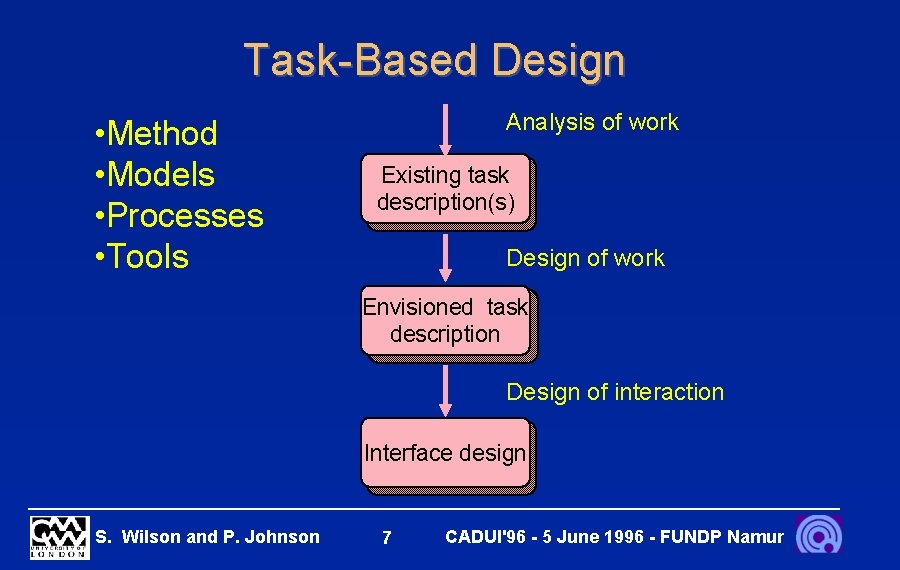
Task-Based Design • Method • Models • Processes • Tools Analysis of work Existing task description(s) Design of work Envisioned task description Design of interaction Interface design S. Wilson and P. Johnson 7 CADUI'96 - 5 June 1996 - FUNDP Namur
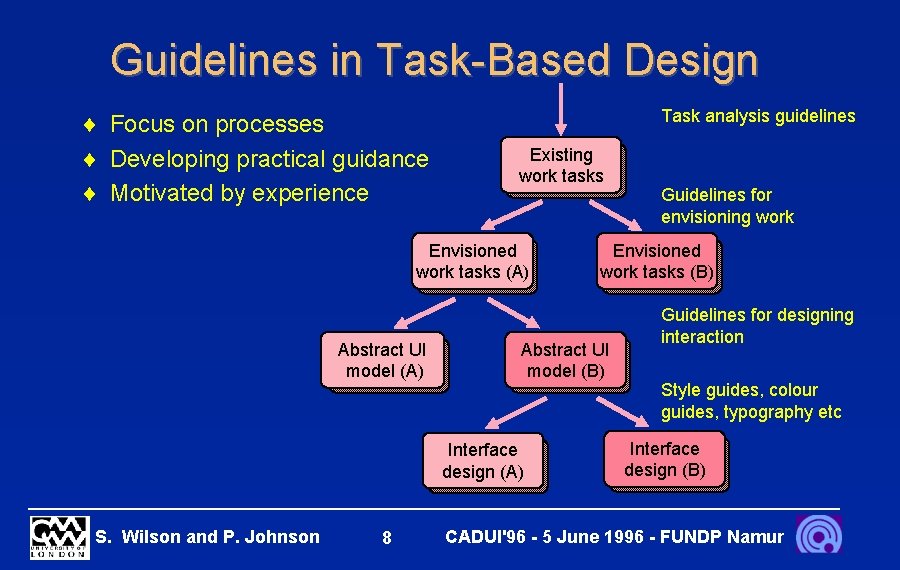
Guidelines in Task-Based Design ¨ Focus on processes ¨ Developing practical guidance ¨ Motivated by experience Task analysis guidelines Existing work tasks Envisioned work tasks (A) Abstract UI model (A) S. Wilson and P. Johnson 8 Envisioned work tasks (B) Abstract UI model (B) Interface design (A) Guidelines for envisioning work Guidelines for designing interaction Style guides, colour guides, typography etc Interface design (B) CADUI'96 - 5 June 1996 - FUNDP Namur
Analysing Work Tasks ¨ Analysing and modelling Specific Tasks ¨ Modelling Composite Tasks S. Wilson and P. Johnson 9 CADUI'96 - 5 June 1996 - FUNDP Namur
Specific Tasks ¨ Identify characteristics of specific tasks first ¨ Use more than one data collection technique ¨ Analyse many different users performing each task ¨ Identify all variations and individual differences in tasks S. Wilson and P. Johnson 10 CADUI'96 - 5 June 1996 - FUNDP Namur
Composite Task Models ¨ Produce a composite task model from each task description for the same goal ¨ Resolve conflicting descriptions ¨ Identify optional aspects of a task ¨ Identify compulsory aspects of a task ¨ Identify commonalities of behaviour and objects ¨ Identify constraints and dependencies ¨ Identify different objects and typical objects S. Wilson and P. Johnson 11 CADUI'96 - 5 June 1996 - FUNDP Namur
Envisioning Future Work Tasks ¨ Influences: existing task descriptions, problem statement, requirements, design ideas, design constraints ¨ Scoping the design ¨ Improving the work S. Wilson and P. Johnson 12 CADUI'96 - 5 June 1996 - FUNDP Namur
Scoping the Design ¨ Identify tasks that can be avoided or are unnecessary ¨ Identify tasks that can be carried out by system ¨ Identify tasks that can only be carried out by user ¨ Identify where user will interact with system to perform a task ¨ Introduce any new tasks S. Wilson and P. Johnson 13 CADUI'96 - 5 June 1996 - FUNDP Namur
Improving the Work ¨ Identify where sequences of activities can be made easier to perform ¨ Create more powerful objects by combining individual objects ¨ Restructure the task to bring together information required at the same point in the task ¨ Ensure that safety and security procedures are supported S. Wilson and P. Johnson 14 CADUI'96 - 5 June 1996 - FUNDP Namur
Creating an Interface Design ¨ Influences: task descriptions, requirements, design ideas, design constraints, design guidelines ¨ Task influences: ¨ Task decomposition information ¨ Action and object information ¨ Sequencing information S. Wilson and P. Johnson 15 CADUI'96 - 5 June 1996 - FUNDP Namur
Task Decomposition Information ¨ Reflect the goal, sub-goal and action decomposition in the interface structure ¨ Group interface components that support closely related parts of the task ¨ Group components either spatially or temporally ¨ Let the lowest level of task decomposition (actions) be the strongest determinant of interface structure S. Wilson and P. Johnson 16 CADUI'96 - 5 June 1996 - FUNDP Namur
Task Actions and Objects ¨ Use task objects to identify information to be displayed and/or manipulated ¨ Use task actions to identify commands ¨ Use action-object groupings to determine the ways in which information can be manipulated ¨ Support simple objects, and the actions applied to them, by standard widgets ¨ Support complex task objects by a group of standard widgets or by specialised widgets S. Wilson and P. Johnson 17 CADUI'96 - 5 June 1996 - FUNDP Namur
Task Sequence Information ¨ Reflect task sequencing in the dialogue structure ¨ Do not violate task sequencing in the interface design ¨. . . But constraints can be relaxed in situations where safety conditions will not be contravened S. Wilson and P. Johnson 18 CADUI'96 - 5 June 1996 - FUNDP Namur
Conclusions ¨ Importance of design processes in task-based and model-based approaches to design ¨ Practical guidance for designers ¨ Implications for tools and future work S. Wilson and P. Johnson 19 CADUI'96 - 5 June 1996 - FUNDP Namur
- Slides: 19