
Bridging the gaps in discharge processes No standardization
Bridging the gaps in discharge processes No standardization of discharge process § Patients were getting “lost to follow-up” (11% in pilot CCG), no safety netting in place § Huge variation in service quality & appointment frequency but overall oversubscribed Urology OP § GPs were not receiving adequate information on onward management of discharged patients § Patients were not being supported to self-manage Governed by a contracts and hospital-level SOP, the pathway now ensures: The decision and responsibility for transfer with Secondary Care (SOP, contracts). Patient has informed about transfer at last OPA. The practice will be informed of transfer and will receive a HNA and Treatment Summary outlining clear PSA thresholds and criteria for re-referral. Practices will write to patient confirming transfer and offer a Welcome Appointment to discuss holistic needs (LCS). Urology MDT audit of transferred patients which is ratified by primary care and acts as a safety net Primary care follow-up is to be offered to 100% of eligible patients. Monitored and evaluated by CCG /Federation (LCS). GPNs and GPs more confident in managing these patients as a long term condition
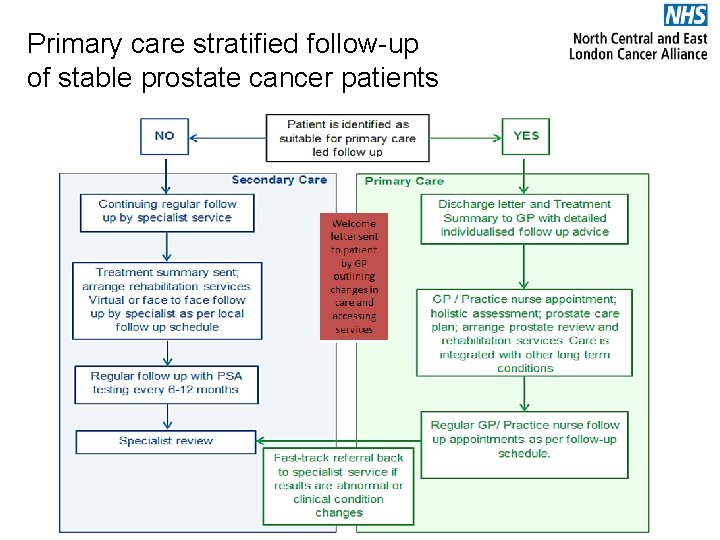
Primary care stratified follow-up of stable prostate cancer patients
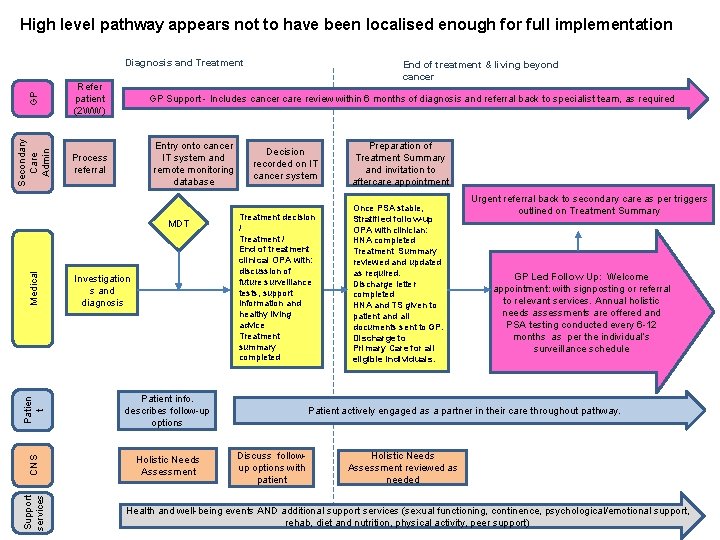
High level pathway appears not to have been localised enough for full implementation GP Refer patient (2 WW) Secondary Care Admin Diagnosis and Treatment Process referral GP Support - Includes cancer care review within 6 months of diagnosis and referral back to specialist team, as required Entry onto cancer IT system and remote monitoring database Patien t Investigation s and diagnosis Patient info. describes follow-up options CNS Medical MDT Holistic Needs Assessment Support services End of treatment & living beyond cancer Decision recorded on IT cancer system Treatment decision / Treatment / End of treatment clinical OPA with: discussion of future surveillance tests, support information and healthy living advice Treatment summary completed Preparation of Treatment Summary and invitation to aftercare appointment Once PSA stable, Stratified follow-up OPA with clinician: HNA completed Treatment Summary reviewed and updated as required. Discharge letter completed HNA and TS given to patient and all documents sent to GP. Discharge to Primary Care for all eligible individuals. Urgent referral back to secondary care as per triggers outlined on Treatment Summary GP Led Follow Up: Welcome appointment: with signposting or referral to relevant services. Annual holistic needs assessments are offered and PSA testing conducted every 6 -12 months as per the individual’s surveillance schedule Patient actively engaged as a partner in their care throughout pathway. Discuss followup options with patient Holistic Needs Assessment reviewed as needed Health and well-being events AND additional support services (sexual functioning, continence, psychological/emotional support, rehab, diet and nutrition, physical activity, peer support)

Cancer Patient pathway
8 Key Points 1 2 3 4 5 6 7 8 Maintain a prostate cancer follow-up register with an active recall system Offer a ‘welcome appointment’ to all newly transferred/discharged patients. Practice to start a holistic care plan and reviewed at subsequent follow-up consultations. Patients to be asked how they would like to receive their PSA results. Add all existing patients (those you have already following up) to the prostate cancer register. Contact the consultant is PSA thresholds are missing. Identify a named clinical lead (GP or Nurse) who should attend locally arranged training, complete a minimum 30 minute training session accredited by BMJ Learning and disseminate training material to other staff within the practice. Recommended modules available form your Cancer Lead GP or Macmillan GP. Signpost patient to resources to promote self-management of symptoms such as fatigue and incontinence as well as signposting to appropriate services to be made available for patients. Check PSA levels against patient specific “normal ranges”/parameters as per their Treatment Summary. Lab normal ranges may not reflect patient specific threshold. Inform patients of their specific PSA results according to patient’s specifications. Refer back to the Urology team if a specialist review is required. Practices to advise patients about the referral and to inform them if they haven’t received a clinic appointment within 14 days. Follow up any patient failing to make an appointment or failing to attend the review consultation.
- Slides: 5