
Bridging the Gap Between Bats and Transportation Projects
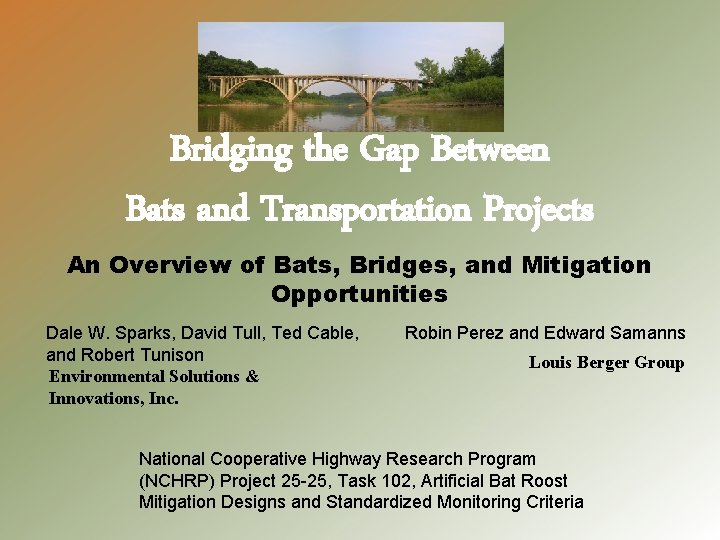
Bridging the Gap Between Bats and Transportation Projects An Overview of Bats, Bridges, and Mitigation Opportunities Dale W. Sparks, David Tull, Ted Cable, and Robert Tunison Environmental Solutions & Innovations, Inc. Robin Perez and Edward Samanns Louis Berger Group National Cooperative Highway Research Program (NCHRP) Project 25 -25, Task 102, Artificial Bat Roost Mitigation Designs and Standardized Monitoring Criteria
Acknowledgements: This study was conducted for the AASHTO Committee on Environment and Sustainability, with funding provided through the National Cooperative Highway Research Program (NCHRP) Project 25 -25, Task 102, Artificial Bat Roost Mitigation Designs and Standardized Monitoring Criteria. The NCHRP is supported by annual voluntary contributions from the state Departments of Transportation. Project 25 -25 is intended to fund quick response studies on behalf of the Committee on Environment and Sustainability. The report was prepared by Dale W. Sparks, David Tull, Ted Cable, and Robert Tunison of Environmental Solutions & Innovations, Inc. , and Robin Perez and Edward Samanns of Louis Berger Group. The work was guided by a technical working group that included: • • Timothy Hill, Ohio Department of Transportation Amy Bailey, California Department of Transportation Kris J. Gade, Arizona Department of Transportation Christine (Chris) Maguire, Oregon Department of Transportation Jeff S. Peterson Colorado Department of Transportation Mary Kay Solberg, Iowa Department of Transportation Kevin Moody, FHWA (Liaison) The project was managed by Ann Hartell NCHRP Senior Program Officer. Disclaimer: The opinions and conclusions expressed or implied are those of the research agency that performed the research and are not necessarily those of the Transportation Research Board or its sponsoring agencies. This report has not been reviewed or accepted by the Transportation Research Board Executive Committee or the Governing Board of the National Research Council.
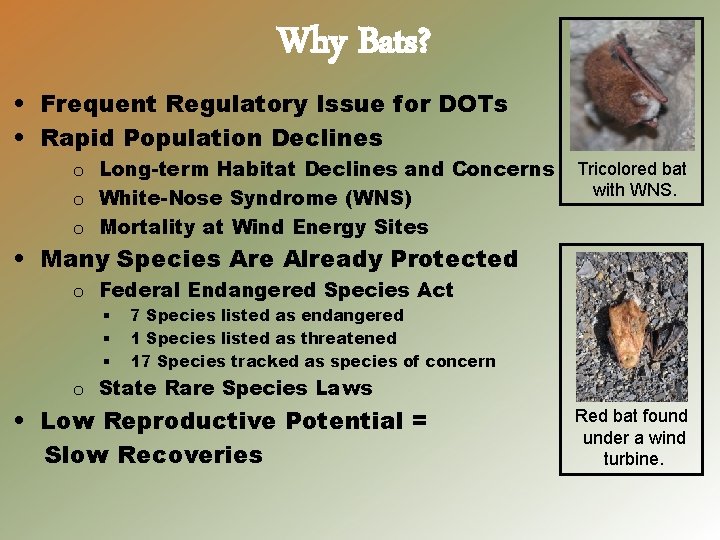
Why Bats? • Frequent Regulatory Issue for DOTs • Rapid Population Declines o Long-term Habitat Declines and Concerns o White-Nose Syndrome (WNS) o Mortality at Wind Energy Sites Tricolored bat with WNS. • Many Species Are Already Protected o Federal Endangered Species Act § § § 7 Species listed as endangered 1 Species listed as threatened 17 Species tracked as species of concern o State Rare Species Laws • Low Reproductive Potential = Slow Recoveries Red bat found under a wind turbine.

A Three-Step Program For Compliance • Inspection: Recognize Bat Habitat • Avoidance and Minimization of Negative Impacts • Mitigation for Unavoidable Impacts Bear in Mind These Flow Into Each Other
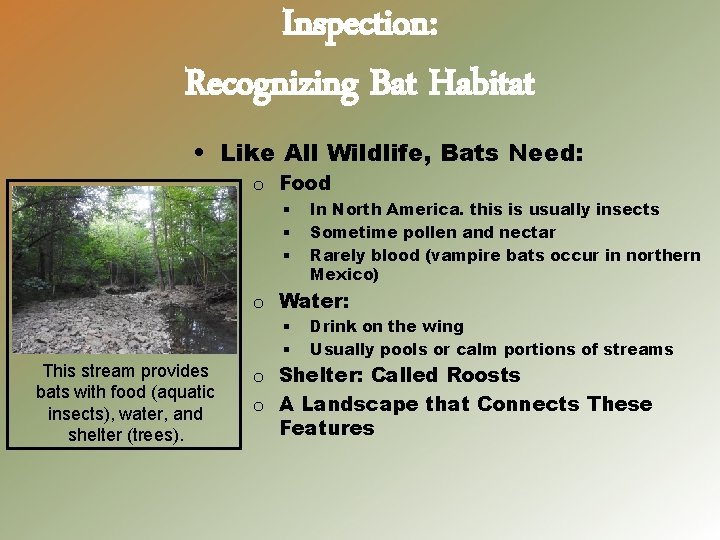
Inspection: Recognizing Bat Habitat • Like All Wildlife, Bats Need: o Food § § § In North America. this is usually insects Sometime pollen and nectar Rarely blood (vampire bats occur in northern Mexico) o Water: § § This stream provides bats with food (aquatic insects), water, and shelter (trees). Drink on the wing Usually pools or calm portions of streams o Shelter: Called Roosts o A Landscape that Connects These Features

Inspection: Recognizing Bat Habitat • Examples of Natural Roosts Trees provide bark and cavities. Caves are especially important in winter. Some bats live in rocky habitat.

Inspection: Recognizing Bat Habitat • Examples of Anthropogenic (Man-made) Roosts This mine is gated to protect bats from human disturbances during hibernation. Bat boxes are designed to attract bats. Big brown bats roosting in a bridge. Bats were caught as they left this house.

Inspection: Recognizing Bat Habitat • Finding Out if Bats are Present o Conduct Surveys § Place mist nets in appropriate habitat which may vary by season and location

Inspection: Recognizing Bat Habitat • Finding Out if Bats are Present o Conduct Surveys § Use harp traps across mine/cave entrances . Trapping a Mine Trapping a Batbox

Inspection: Recognizing Bat Habitat • Finding Out if Bats are Present o Conduct Surveys § Acoustic bat detectors Microphone Stand Bat Detector
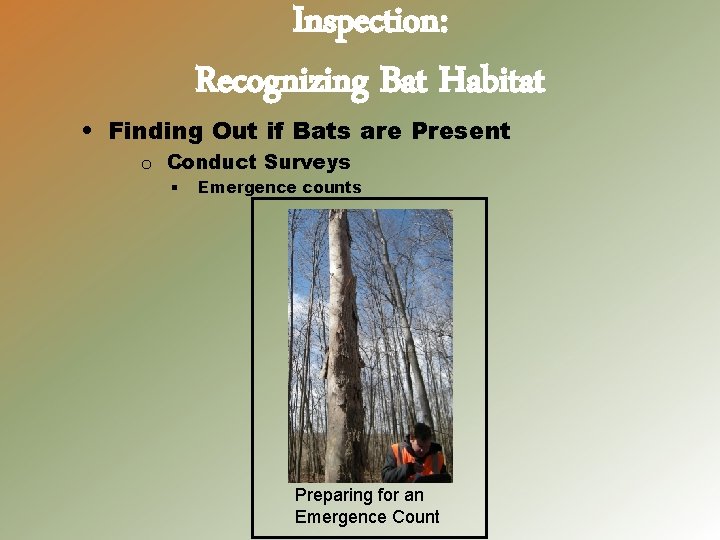
Inspection: Recognizing Bat Habitat • Finding Out if Bats are Present o Conduct Surveys § Emergence counts Preparing for an Emergence Count
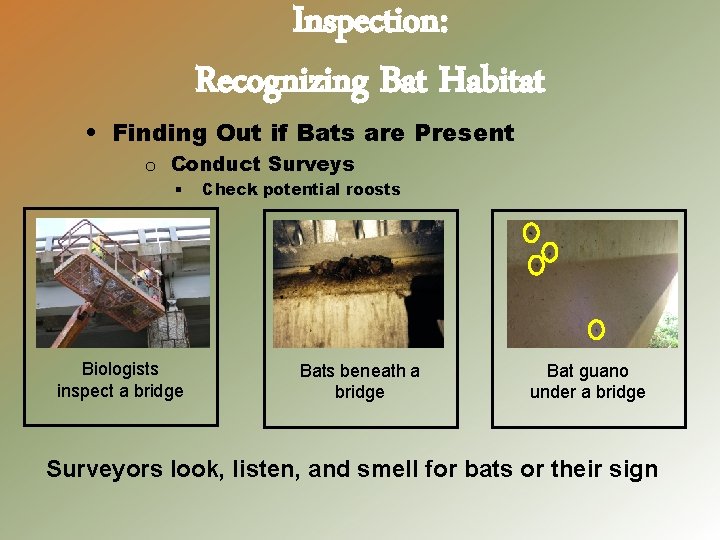
Inspection: Recognizing Bat Habitat • Finding Out if Bats are Present o Conduct Surveys § Biologists inspect a bridge Check potential roosts Bats beneath a bridge Bat guano under a bridge Surveyors look, listen, and smell for bats or their sign
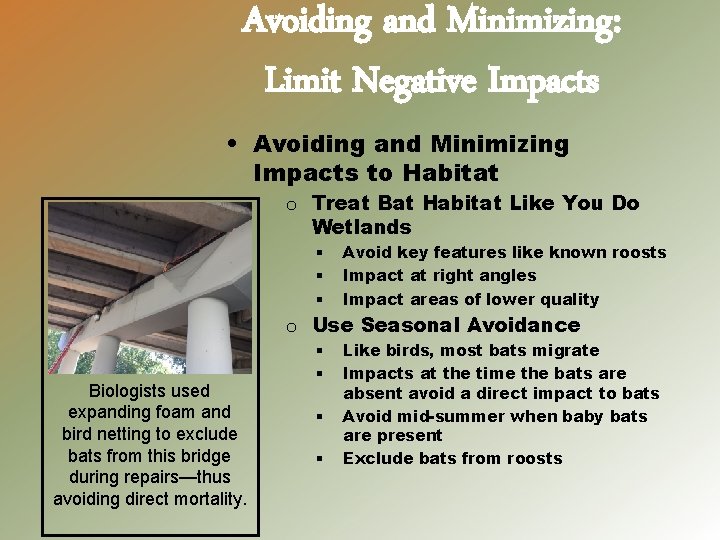
Avoiding and Minimizing: Limit Negative Impacts • Avoiding and Minimizing Impacts to Habitat o Treat Bat Habitat Like You Do Wetlands § § § Avoid key features like known roosts Impact at right angles Impact areas of lower quality o Use Seasonal Avoidance Biologists used expanding foam and bird netting to exclude bats from this bridge during repairs—thus avoiding direct mortality. § § Like birds, most bats migrate Impacts at the time the bats are absent avoid a direct impact to bats Avoid mid-summer when baby bats are present Exclude bats from roosts
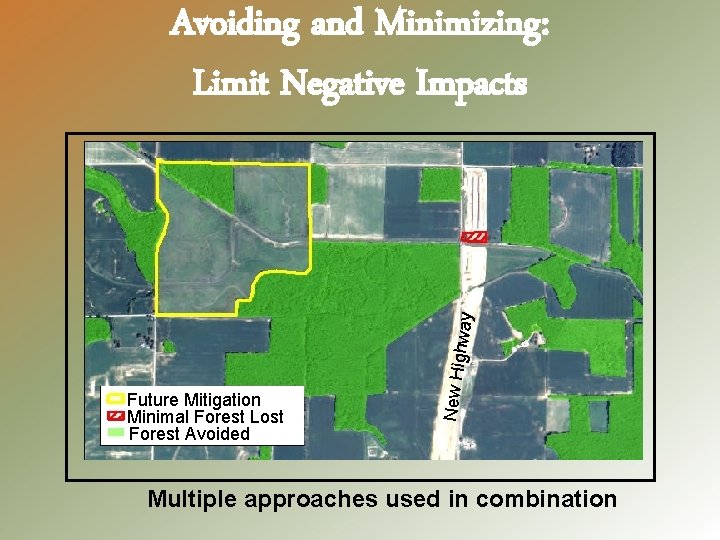
Future Mitigation Minimal Forest Lost Forest Avoided New Hi . ghway Avoiding and Minimizing: Limit Negative Impacts Multiple approaches used in combination
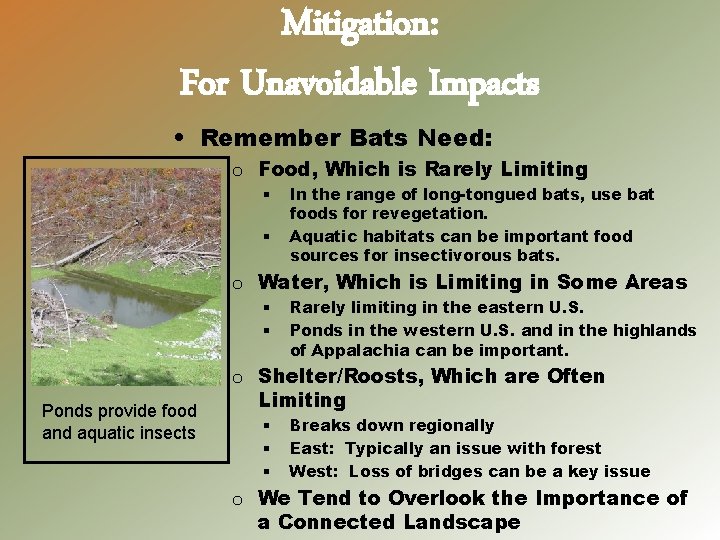
Mitigation: For Unavoidable Impacts • Remember Bats Need: o Food, Which is Rarely Limiting § § In the range of long-tongued bats, use bat foods for revegetation. Aquatic habitats can be important food sources for insectivorous bats. o Water, Which is Limiting in Some Areas § § Ponds provide food and aquatic insects Rarely limiting in the eastern U. S. Ponds in the western U. S. and in the highlands of Appalachia can be important. o Shelter/Roosts, Which are Often Limiting § § § Breaks down regionally East: Typically an issue with forest West: Loss of bridges can be a key issue o We Tend to Overlook the Importance of a Connected Landscape
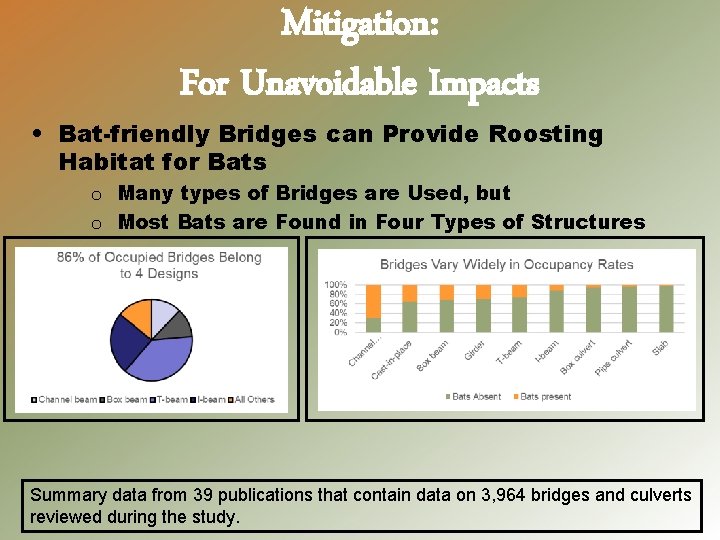
Mitigation: For Unavoidable Impacts • Bat-friendly Bridges can Provide Roosting Habitat for Bats o Many types of Bridges are Used, but o Most Bats are Found in Four Types of Structures Summary data from 39 publications that contain data on 3, 964 bridges and culverts reviewed during the study.
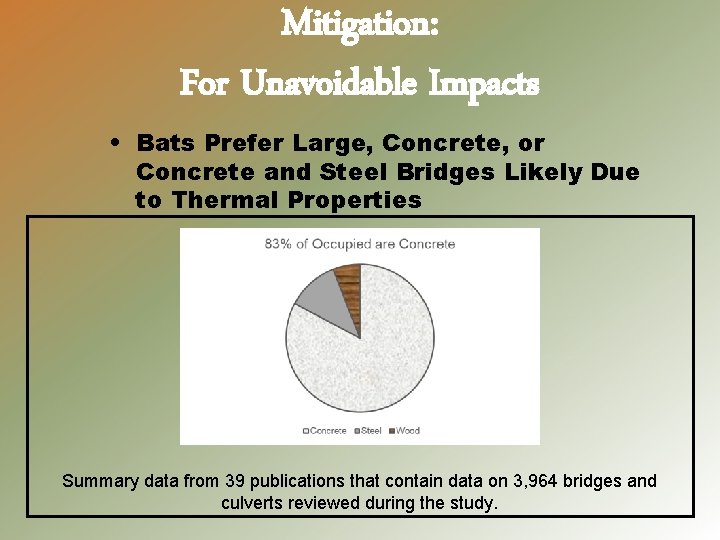
Mitigation: For Unavoidable Impacts • Bats Prefer Large, Concrete, or Concrete and Steel Bridges Likely Due to Thermal Properties Summary data from 39 publications that contain data on 3, 964 bridges and culverts reviewed during the study.
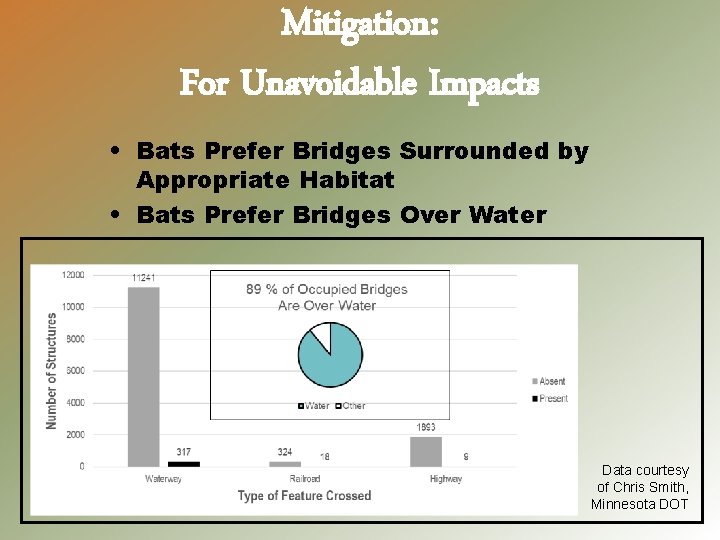
Mitigation: For Unavoidable Impacts • Bats Prefer Bridges Surrounded by Appropriate Habitat • Bats Prefer Bridges Over Water Data courtesy of Chris Smith, Minnesota DOT
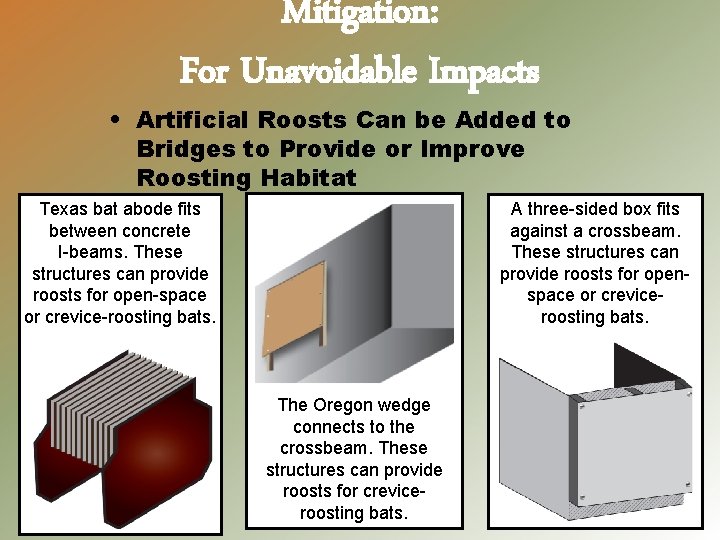
Mitigation: For Unavoidable Impacts • Artificial Roosts Can be Added to Bridges to Provide or Improve Roosting Habitat Texas bat abode fits between concrete I-beams. These structures can provide roosts for open-space or crevice-roosting bats. A three-sided box fits against a crossbeam. These structures can provide roosts for openspace or creviceroosting bats. The Oregon wedge connects to the crossbeam. These structures can provide roosts for creviceroosting bats.
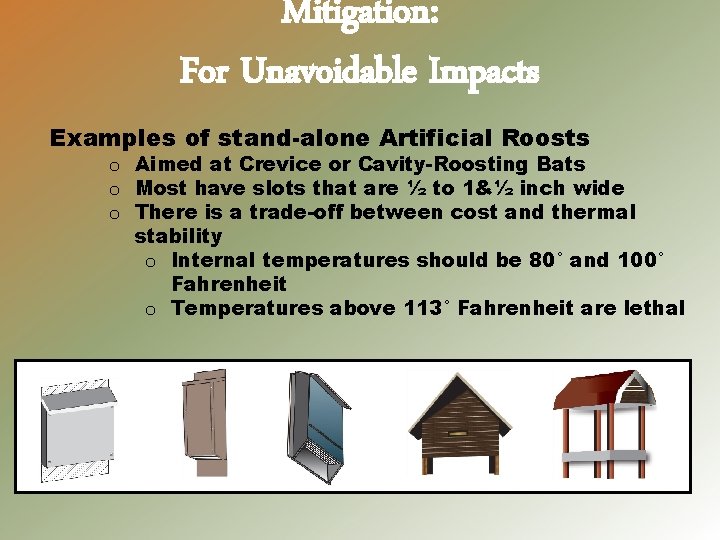
Mitigation: For Unavoidable Impacts Examples of stand-alone Artificial Roosts o Aimed at Crevice or Cavity-Roosting Bats o Most have slots that are ½ to 1&½ inch wide o There is a trade-off between cost and thermal stability o Internal temperatures should be 80° and 100° Fahrenheit o Temperatures above 113° Fahrenheit are lethal
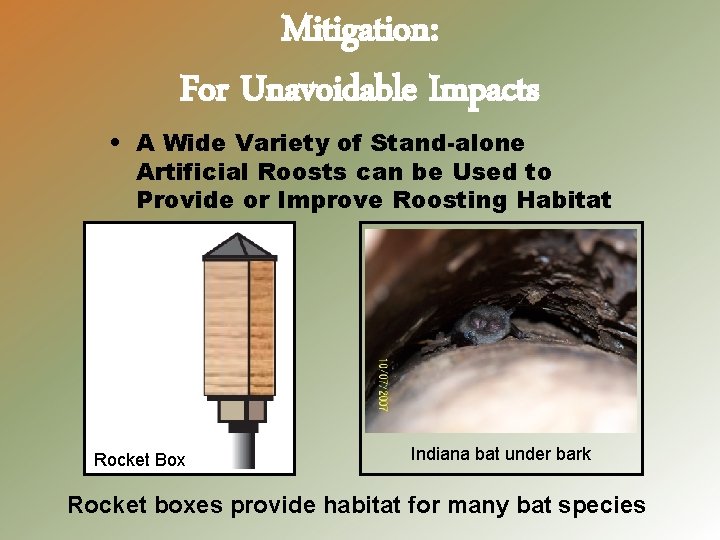
Mitigation: For Unavoidable Impacts • A Wide Variety of Stand-alone Artificial Roosts can be Used to Provide or Improve Roosting Habitat Rocket Box Indiana bat under bark Rocket boxes provide habitat for many bat species
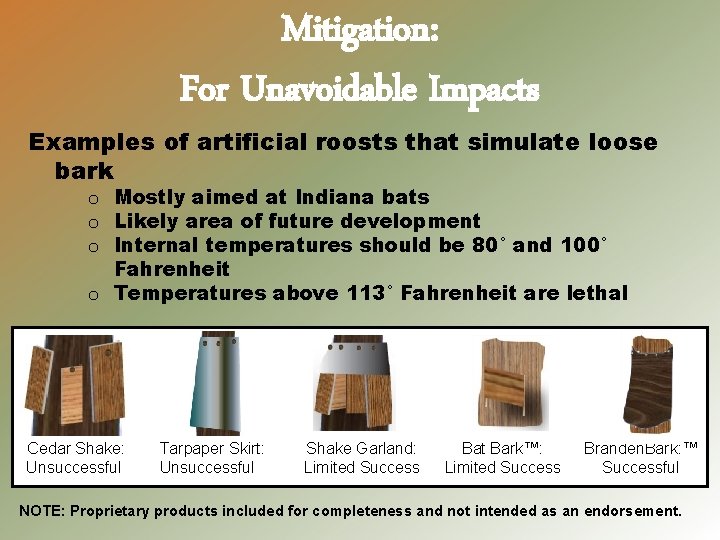
Mitigation: For Unavoidable Impacts Examples of artificial roosts that simulate loose bark o Mostly aimed at Indiana bats o Likely area of future development o Internal temperatures should be 80° and 100° Fahrenheit o Temperatures above 113° Fahrenheit are lethal Cedar Shake: Unsuccessful Tarpaper Skirt: Unsuccessful Shake Garland: Limited Success Bat Bark™: Limited Success Branden. Bark: ™ Successful NOTE: Proprietary products included for completeness and not intended as an endorsement.
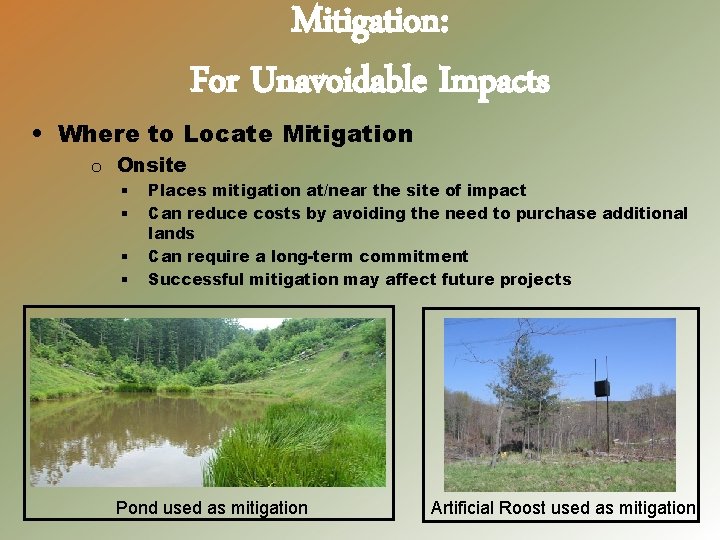
Mitigation: For Unavoidable Impacts • Where to Locate Mitigation o Onsite § § Places mitigation at/near the site of impact Can reduce costs by avoiding the need to purchase additional lands Can require a long-term commitment Successful mitigation may affect future projects Pond used as mitigation Artificial Roost used as mitigation
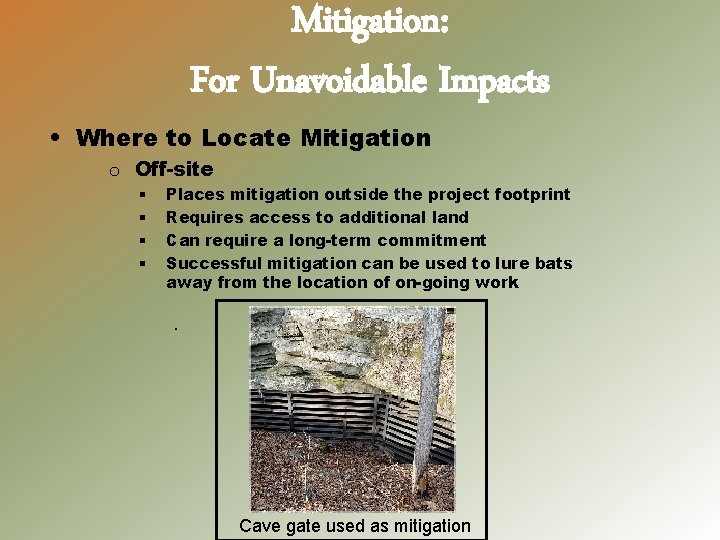
Mitigation: For Unavoidable Impacts • Where to Locate Mitigation o Off-site § § Places mitigation outside the project footprint Requires access to additional land Can require a long-term commitment Successful mitigation can be used to lure bats away from the location of on-going work . Cave gate used as mitigation
Mitigation: • Financial Approaches to Mitigation o Residual Properties § § o Project proponent purchases a site expressively for mitigation Long-term management can lead to unforeseen expenses Often donated to a conservation organization for management In Lieu Fee § § § o another use Fee-Simple Purchase § § § o Places mitigation on unused lands purchased for the project or owned by the agency Can greatly decrease the cost of mitigation if the land is not slated for Applicant pays a fee for impacts A third party uses that money to implement off-site mitigation Often very popular at first due to their simplicity Can create a market for high-value mitigation properties Many agencies move away from this system once properties have been purchased that have a high conservation value and low market value— initial successes can lead to long-term insolvency. Mitigation Banking § § § An entity (third party, department, etc. ) creates mitigation in advance Applicant purchases credits as they need them Over time, this approach can convert a series of incremental impacts into contiguous areas of high quality habitat
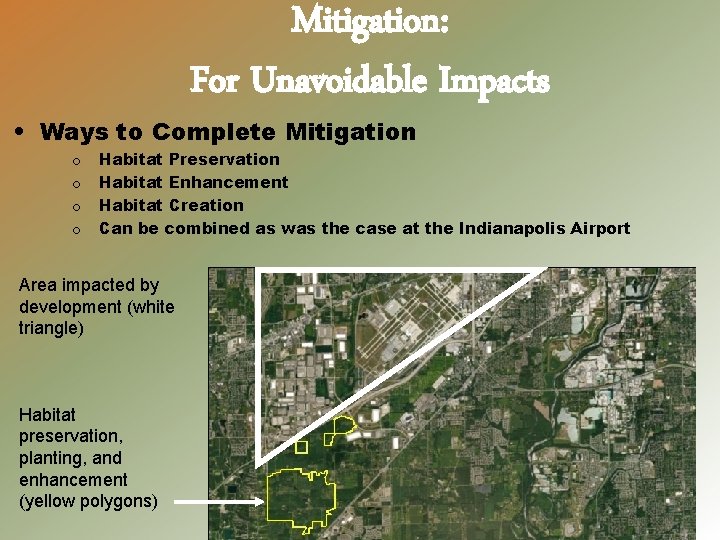
Mitigation: For Unavoidable Impacts • Ways to Complete Mitigation o o Habitat Preservation Habitat Enhancement Habitat Creation Can be combined as was the case at the Indianapolis Airport Area impacted by development (white triangle) Habitat preservation, planting, and enhancement (yellow polygons)
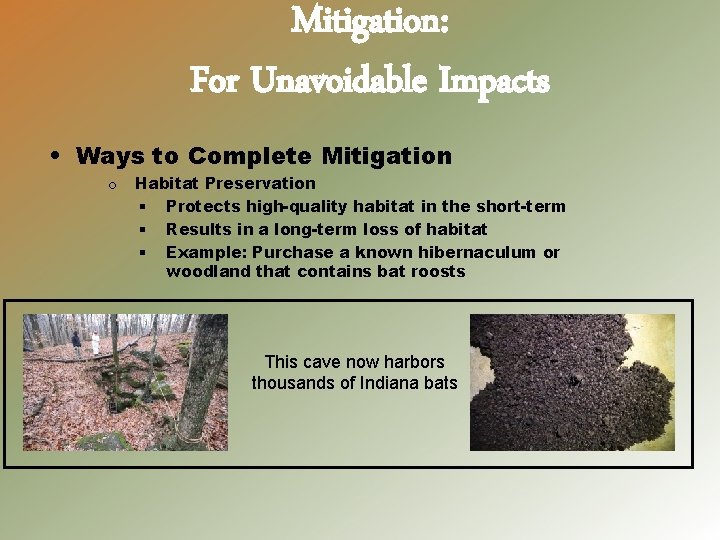
Mitigation: For Unavoidable Impacts • Ways to Complete Mitigation o Habitat Preservation § Protects high-quality habitat in the short-term § Results in a long-term loss of habitat § Example: Purchase a known hibernaculum or woodland that contains bat roosts This cave now harbors thousands of Indiana bats
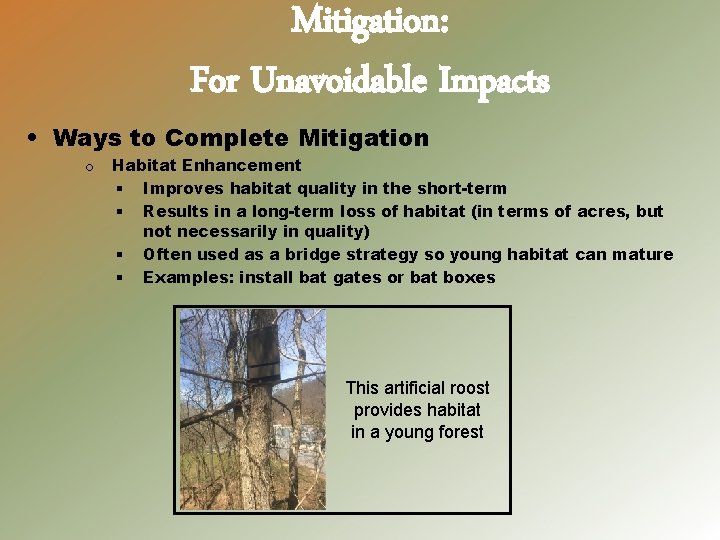
Mitigation: For Unavoidable Impacts • Ways to Complete Mitigation o Habitat Enhancement § Improves habitat quality in the short-term § Results in a long-term loss of habitat (in terms of acres, but not necessarily in quality) § Often used as a bridge strategy so young habitat can mature § Examples: install bat gates or bat boxes This artificial roost provides habitat in a young forest
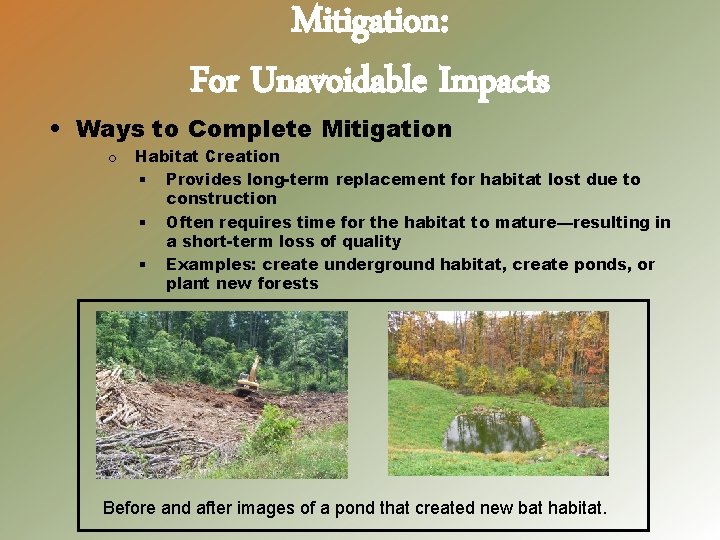
Mitigation: For Unavoidable Impacts • Ways to Complete Mitigation o Habitat Creation § Provides long-term replacement for habitat lost due to construction § Often requires time for the habitat to mature—resulting in a short-term loss of quality § Examples: create underground habitat, create ponds, or plant new forests Before and after images of a pond that created new bat habitat.
Points of Contacts Regarding Questions Dr. Dale W. Sparks, ESI dsparks@envsi. com Additional Contacts Mr. Edward Samanns, Louis Berger ed. samanns@wsp. com Dr. Ann Hartell, NCHRP ahartell@NAS. edu Final Report and BMP Manual Available At: https: //apps. trb. org/cmsfeed/TRBNet. Project. Display. asp? Project. ID=4098
- Slides: 30