
Bridging in Chinese and Frame Theory Jin Cui
Bridging in Chinese and Frame Theory Jin Cui University of Stuttgart University of Cologne
1. Definiteness in Chinese • Chinese does not have definite article. • Chinese does not have inflection. • Two ways in Chinese to express simple definiteness: a. To use a bare noun in some syntactical positions; b. To use the unstressed distal demonstrative „na“.
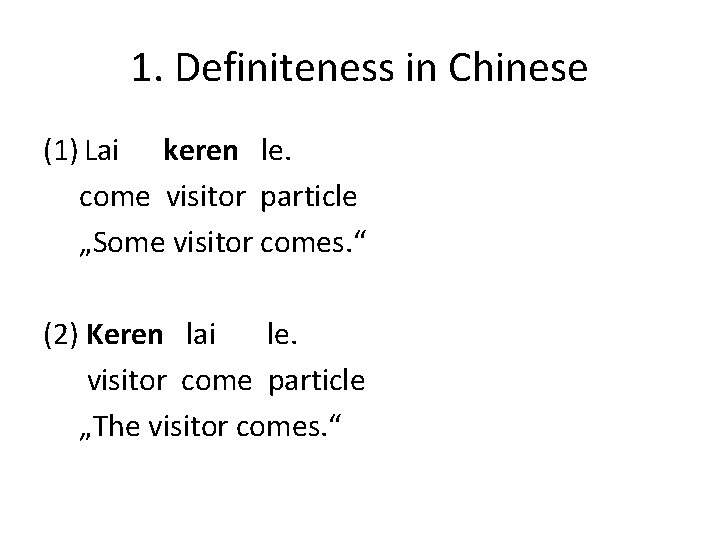
1. Definiteness in Chinese (1) Lai keren le. come visitor particle „Some visitor comes. “ (2) Keren lai le. visitor come particle „The visitor comes. “
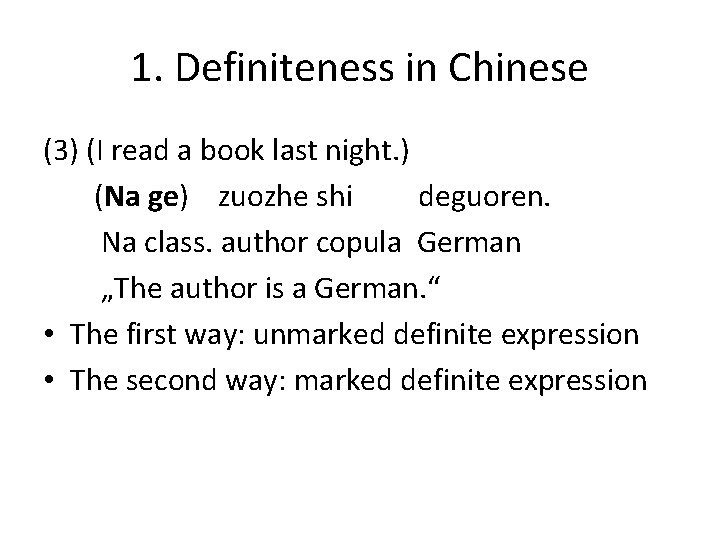
1. Definiteness in Chinese (3) (I read a book last night. ) (Na ge) zuozhe shi deguoren. Na class. author copula German „The author is a German. “ • The first way: unmarked definite expression • The second way: marked definite expression
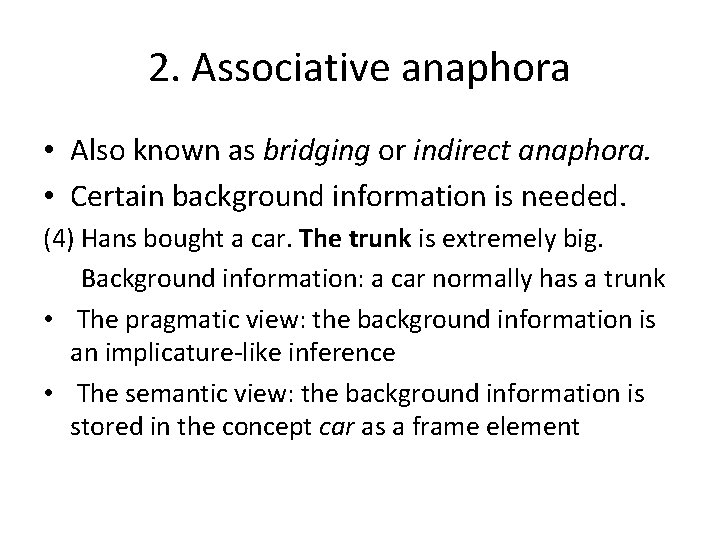
2. Associative anaphora • Also known as bridging or indirect anaphora. • Certain background information is needed. (4) Hans bought a car. The trunk is extremely big. Background information: a car normally has a trunk • The pragmatic view: the background information is an implicature-like inference • The semantic view: the background information is stored in the concept car as a frame element
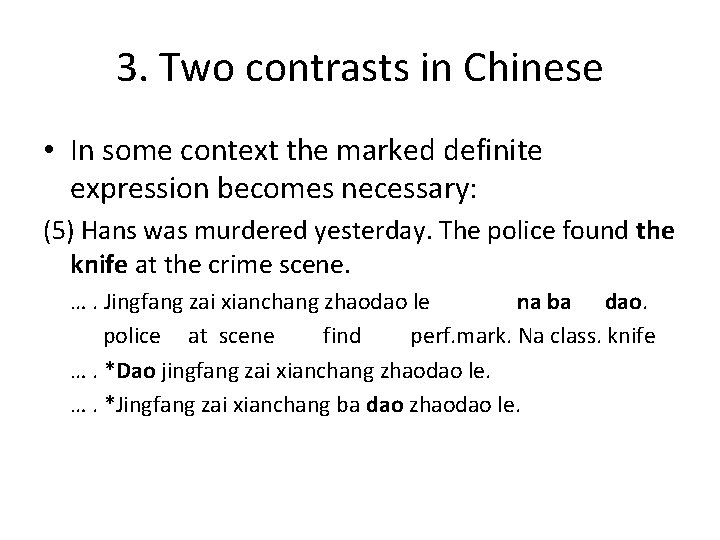
3. Two contrasts in Chinese • In some context the marked definite expression becomes necessary: (5) Hans was murdered yesterday. The police found the knife at the crime scene. …. Jingfang zai xianchang zhaodao le na ba dao. police at scene find perf. mark. Na class. knife …. *Dao jingfang zai xianchang zhaodao le. …. *Jingfang zai xianchang ba dao zhaodao le.
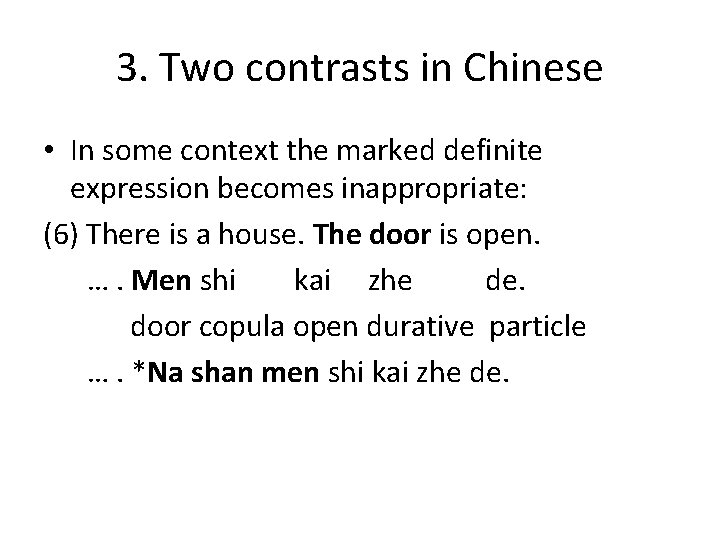
3. Two contrasts in Chinese • In some context the marked definite expression becomes inappropriate: (6) There is a house. The door is open. …. Men shi kai zhe de. door copula open durative particle …. *Na shan men shi kai zhe de.
Making sense of the contrasts… • Can they be generalized as categorical contrasts? • What is/are the main factor(s) which causes these contrasts?
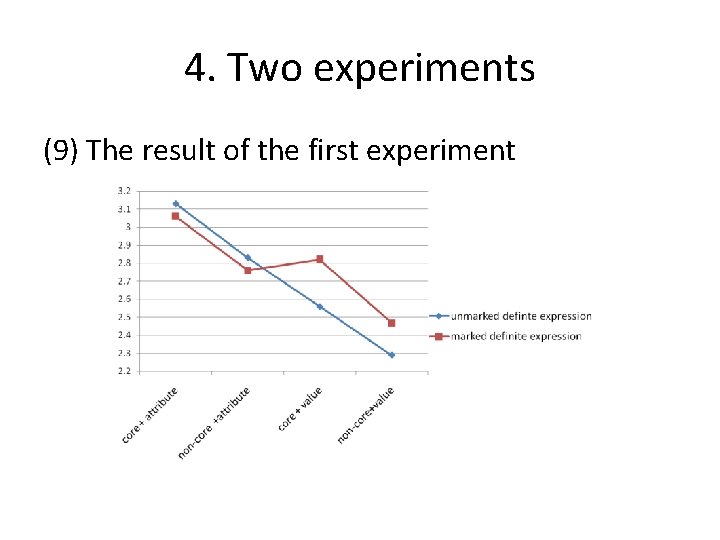
4. Two experiments • The first experiment: - Aim to test the first contrast - Adopted attribute-value-set from Barsalou (1992) and the differentiation between core and noncore frame element from Frame. Net as testparameters - Combined both parameters into a twodimensional table, as shown in (7)
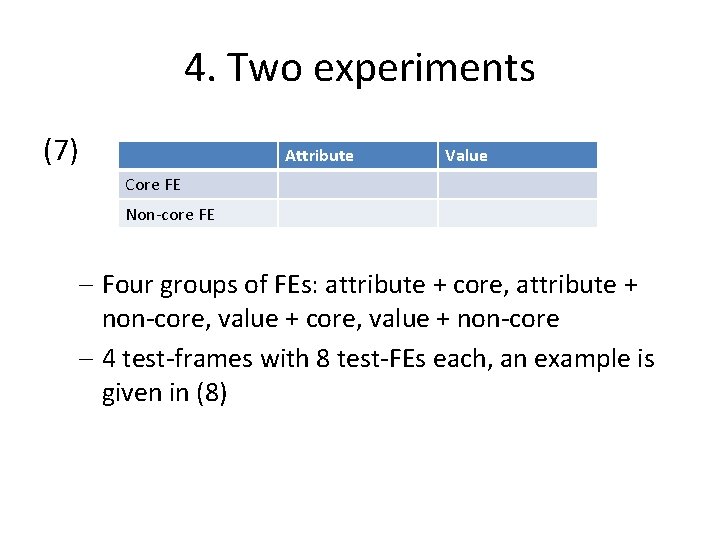
4. Two experiments (7) Attribute Value Core FE Non-core FE - Four groups of FEs: attribute + core, attribute + non-core, value + non-core - 4 test-frames with 8 test-FEs each, an example is given in (8)
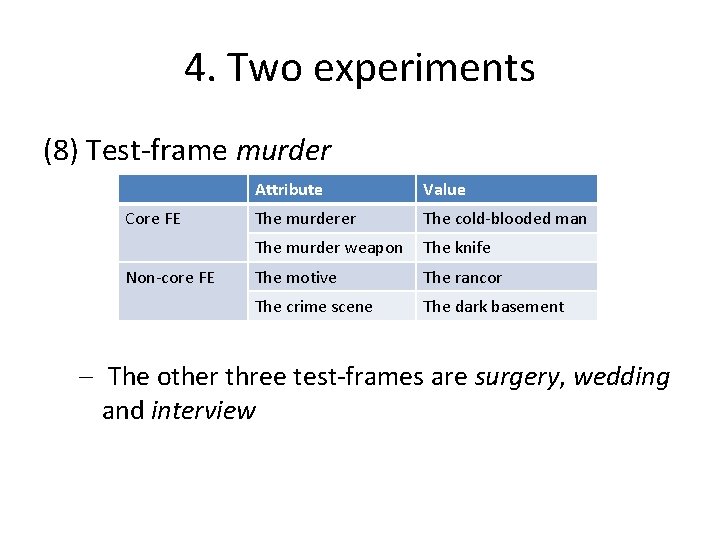
4. Two experiments (8) Test-frame murder Core FE Non-core FE Attribute Value The murderer The cold-blooded man The murder weapon The knife The motive The rancor The crime scene The dark basement - The other three test-frames are surgery, wedding and interview
4. Two experiments - Two Chinese sentences for each test-FE, once with the unmarked definite expression, once with the marked definite expression - 4 frames * 8 FEs * 2 sentences = 64 test-sentences - 80 native speakers of Chinese - 1 is the worst note, 4 is the best note - The result is illustrated in (9)
4. Two experiments (9) The result of the first experiment
4. Two experiments - Conclusion of the first experiment: i. The first contrast is confirmed as a categorical contrast; ii. The main factor causes this contrast is the attribute-value-set; iii. The differentiation between core FE and noncore FE is not relevant with regard to bridging in Chinese.
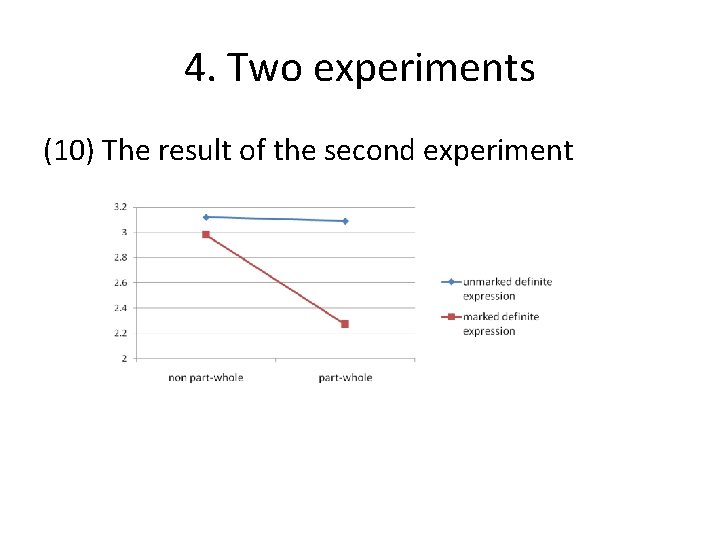
4. Two experiments • The second experiment - Aim to test the second contrast - Part-whole relation and non-part-whole relation as test-parameters - 4 test-frames with 4 test FEs each - 32 test-sentences - 40 native speakers of Chinese - The result is shown in (10)
4. Two experiments (10) The result of the second experiment
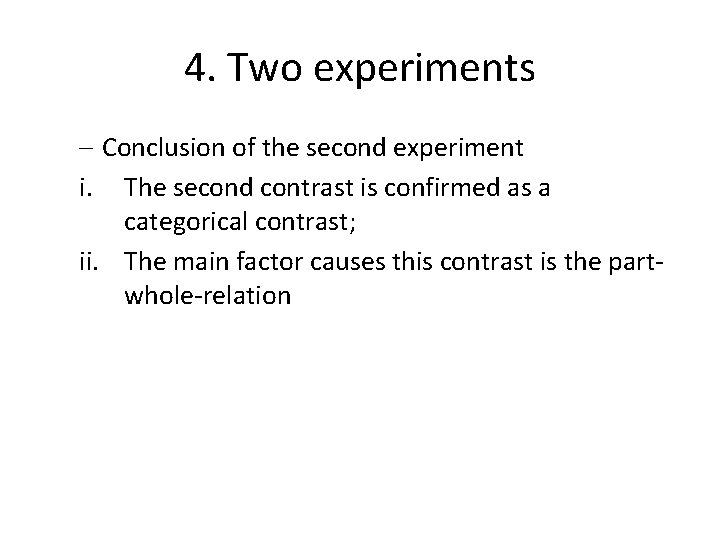
4. Two experiments - Conclusion of the second experiment i. The second contrast is confirmed as a categorical contrast; ii. The main factor causes this contrast is the partwhole-relation
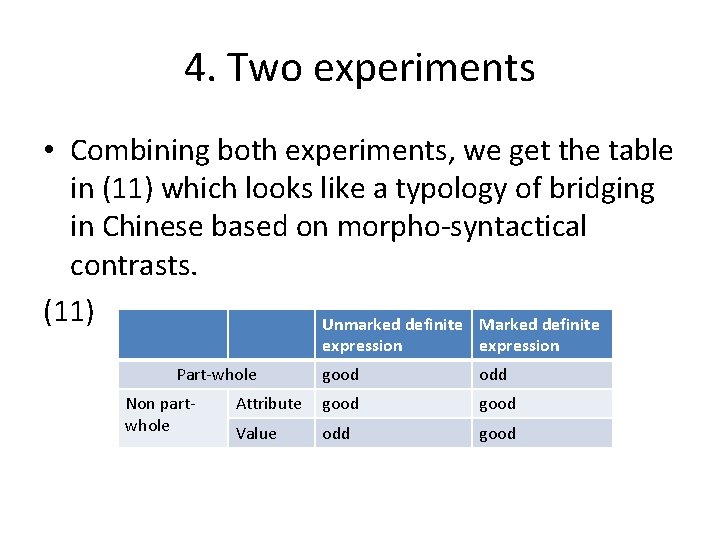
4. Two experiments • Combining both experiments, we get the table in (11) which looks like a typology of bridging in Chinese based on morpho-syntactical contrasts. (11) Unmarked definite Marked definite expression good odd Attribute good Value odd good Part-whole Non partwhole
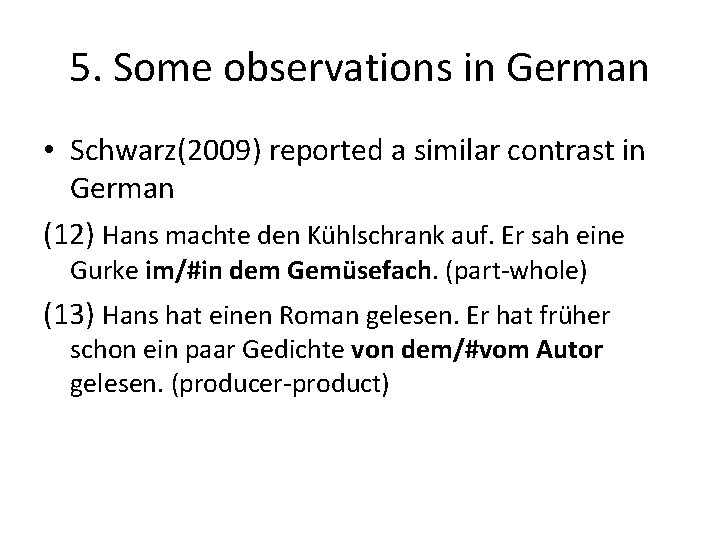
5. Some observations in German • Schwarz(2009) reported a similar contrast in German (12) Hans machte den Kühlschrank auf. Er sah eine Gurke im/#in dem Gemüsefach. (part-whole) (13) Hans hat einen Roman gelesen. Er hat früher schon ein paar Gedichte von dem/#vom Autor gelesen. (producer-product)
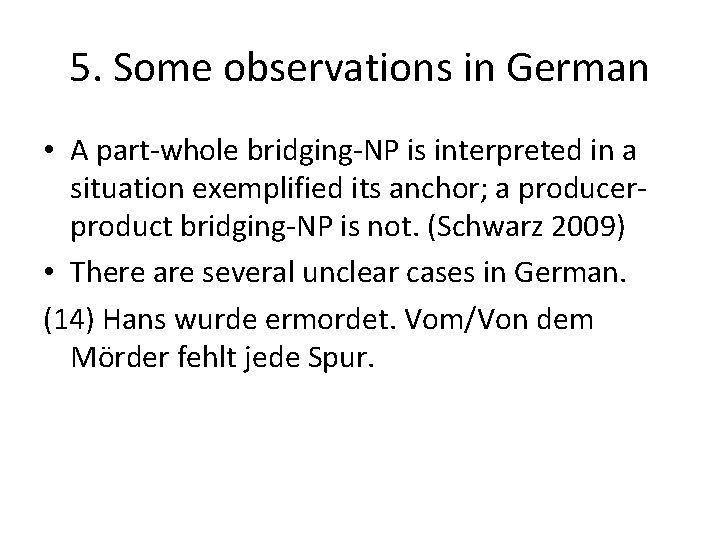
5. Some observations in German • A part-whole bridging-NP is interpreted in a situation exemplified its anchor; a producerproduct bridging-NP is not. (Schwarz 2009) • There are several unclear cases in German. (14) Hans wurde ermordet. Vom/Von dem Mörder fehlt jede Spur.
6. A situation-based analysis of the definite expressions in Chinese • I adopt the situation-based analysis in Schwarz(2009). • The unmarked definite expression is the default choice, if the bridging-NP can be situational interpreted. The marked definite expression is the primary choice, if no situational interpretation is allowed for the bridging-NP. • The part-whole bridging prefers the unmarked definite expression, because the referent is always present in the exemplified situation of the anchor.
6. A situation-based analysis of the definite expressions in Chinese • The attribute-based bridging accepts both definite expressions, because it is not necessary to understand the referent as being present in the exemplified situation of the anchor. • The value-based bridging prefers the marked definite expression, bacause it can never be interpreted via the existence in the situation exemplified the anchor.
7. Towards a modification of the frame theory • The part-whole relation is regarded in the standard theorie as the most common relation, which defines a FE, but not as a special type of FE. • Since we judge the bridging as a frame-based usage of definite article, we may hope that the different types of bridging can also be reflected by the frame structure. • The part-whole-relationship should therefore be regard as a special type of FE, thus it causes morphosyntactical contrasts both in Chinese and German.
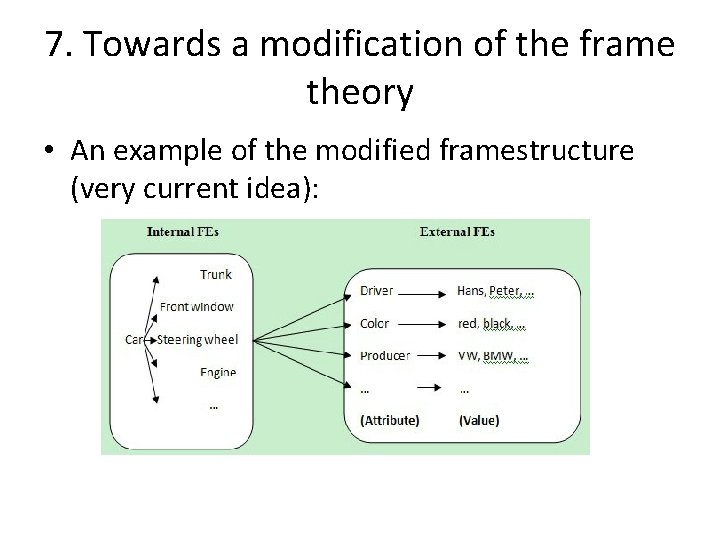
7. Towards a modification of the frame theory • An example of the modified framestructure (very current idea):
References: • • • Barsalou, Lawrence 1992. Frame, Concepts, and Conceptual Fields. In A. Lehrer and E. Kittay(eds. ) Frames, Fields, and Contrasts. Hillsdale, NJ: Erlbaum, 21 -74. Chen, Ping 2004. Identifiability and definiteness in Chinese. In Linguistics, 42, (6 ), 1129– 84. Erku, F. & Gundel, J. 1987. The pragmatics of indirect anaphors. In J. Verschueren & M. Bertuccelli. Papi (eds. ) The pragmatic perspective. J. Benjamins, Amsterdam: 533 -45. Fillmore, Charles J. & B. T. Atkins. 1992. Towards a Frame-based organization of the lexicon: the semantics of RISK and its neighbors. In Frames, Fields, and Contrasts: New Essays in Semantics and Lexical Organization, ed. by Adrienne Lehrer and Eva Kittay, 75 -102. Hillsdale: Lawrence Erlbaum. Hawkins, J. 1978. Definiteness and indefiniteness: A study in reference and grammaticality prediction. Croom Helm, London. Löbner, Sebastian 1998. Definite Associative Anaphora. Ms. Düsseldorf: Heinrich-Heine-Universität. http: //user. phil-fak. uni- duesseldorf. de/~loebner/publ/DAA-03. pdf Sanford, A. & Garrod, S. 1981. Understanding written language. John Wiley, Chichester. Schwarz, Florian 2009. Two types of definites in natural language. University of Massachusetts Amherst. Schwarz, Monika 2000. Indirekte Anaphern in Texten: Studien zur domänengebundenen Referenz und Kohärenz im Deutschen. Max Niemeyer Verlag
- Slides: 25