
Bridge Thermal Model Salient Features High conductivity 700
Bridge Thermal Model • Salient Features – High conductivity (700 W/m. K, 0. 5 mm thick) CC bridge material support for 0. 28 mm thick hybrid(1 W/m. K) – 40 chips @ 0. 25 W/chip – Detector 0. 28 mm thick, 148 W/m. K – Allcomp carbon foam for bridge support (isotropic 45 W/m. K) – Carbon Foam for tube support (45/45/45 W/m. K) • Reduced density over POCO foam (0. 2 g/cc versus 0. 5 g/cc) – Sandwich foam • Allcomp foam option, ~0. 1 g/cc @ 3 W/m. K • Comparison with Hybrid on 10 cm Detector – Thermal solution with both with inner tube wall at -28ºC • Simulates -30ºC with 8000 W/m 2 K • No change made to material properties in 10 cm detector with integrated hybrid W. O. Miller i. Ti VG 1
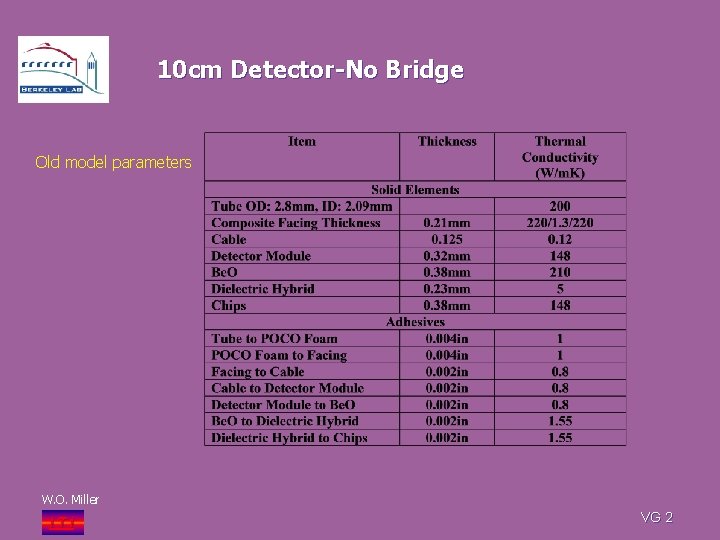
10 cm Detector-No Bridge Old model parameters W. O. Miller i. Ti VG 2
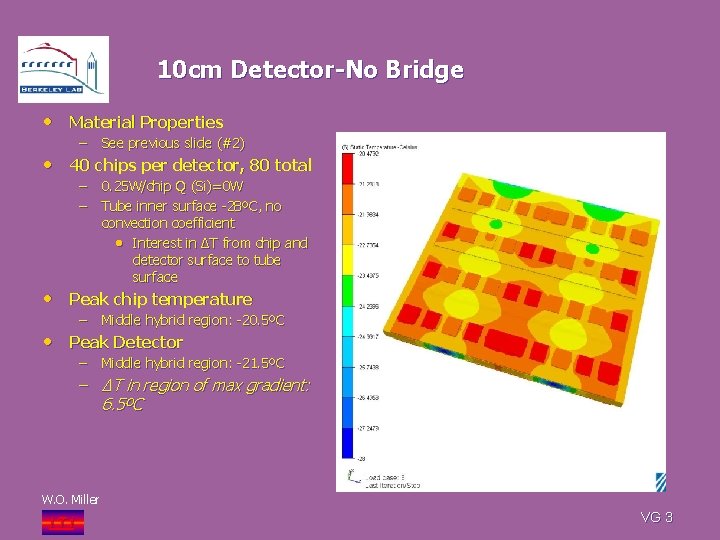
10 cm Detector-No Bridge • Material Properties – See previous slide (#2) • 40 chips per detector, 80 total – 0. 25 W/chip Q (Si)=0 W – Tube inner surface -28ºC, no convection coefficient • Interest in ΔT from chip and detector surface to tube surface • Peak chip temperature – Middle hybrid region: -20. 5ºC • Peak Detector – Middle hybrid region: -21. 5ºC – ΔT in region of max gradient: 6. 5ºC W. O. Miller i. Ti VG 3
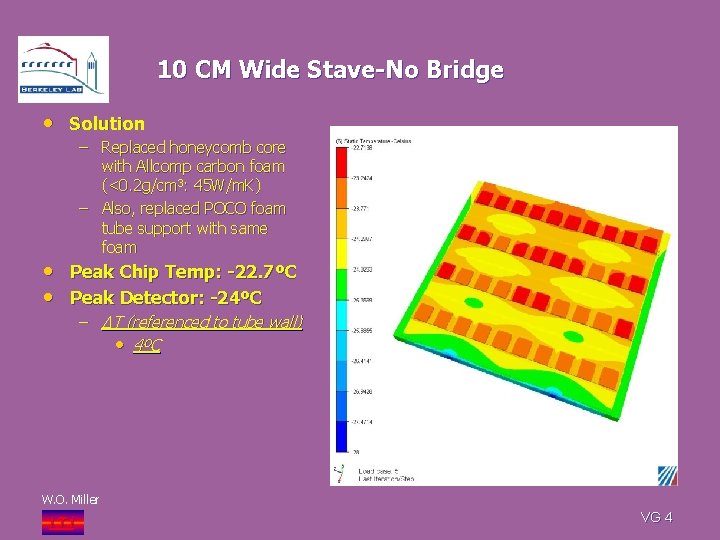
10 CM Wide Stave-No Bridge • Solution – Replaced honeycomb core with Allcomp carbon foam (<0. 2 g/cm 3: 45 W/m. K) – Also, replaced POCO foam tube support with same foam • Peak Chip Temp: -22. 7ºC • Peak Detector: -24ºC – ΔT (referenced to tube wall) • 4ºC W. O. Miller i. Ti VG 4
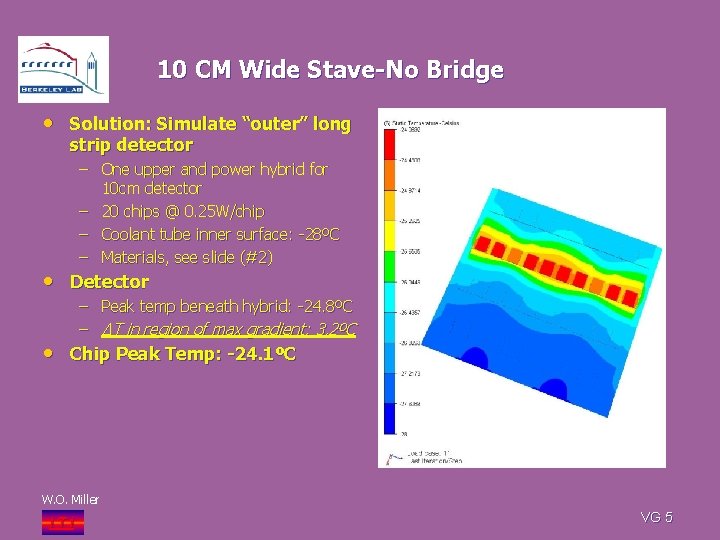
10 CM Wide Stave-No Bridge • Solution: Simulate “outer” long strip detector – One upper and power hybrid for 10 cm detector – 20 chips @ 0. 25 W/chip – Coolant tube inner surface: -28ºC – Materials, see slide (#2) • Detector – Peak temp beneath hybrid: -24. 8ºC – ΔT in region of max gradient: 3. 2ºC • Chip Peak Temp: -24. 1ºC W. O. Miller i. Ti VG 5

Thermal Bridge Model (1/2 of 10 cm) 1 mm air gap for bridge Wire bonds, simulated as thin solid, reduced K to 97 W/m. K 10 cm Al Cooling tube 0. 21 mm ID Chips 0. 38 mm thick (148 W/m. K) Separation between facings 4. 95 mm Foam bridge support W. O. Miller i. Ti VG 6

Bridge Thermal Model Enclosed bridge model in an air box. Air participates only through pure conduction. Air fills all cavities not occupied by a solid Air box W. O. Miller i. Ti VG 7
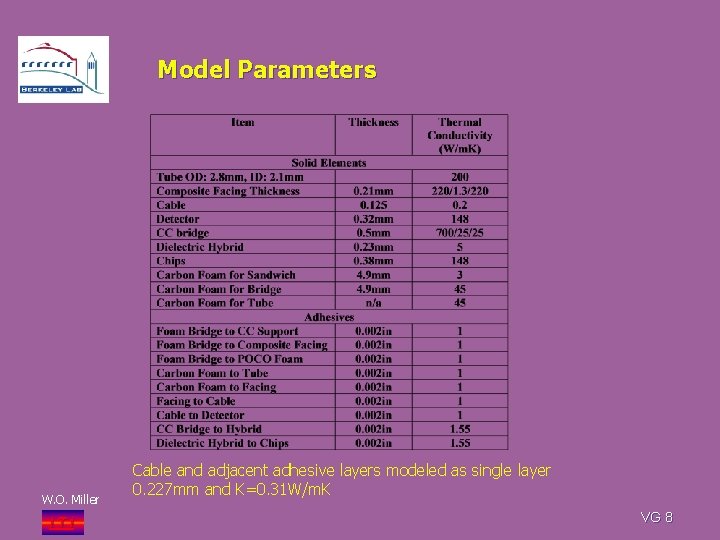
Model Parameters W. O. Miller i. Ti Cable and adjacent adhesive layers modeled as single layer 0. 227 mm and K=0. 31 W/m. K VG 8

Solution with -30ºC Tube 8000 W/m 2 K 0. 5 W/chip Q (Si)=0 Slight asymmetry caused by variance in interior coolant wall temperature Chip peak=-16. 5ºC Detector max=-21. 4ºC W. O. Miller i. Ti VG 9

Solution with -30ºC Tube 8000 W/m 2 K 0. 25 W/chip Q (Si)=0 Slight asymmetry caused by variance in interior coolant wall temperature Chip peak=-23. 3ºC Detector max=-25. 8ºC W. O. Miller i. Ti VG 10
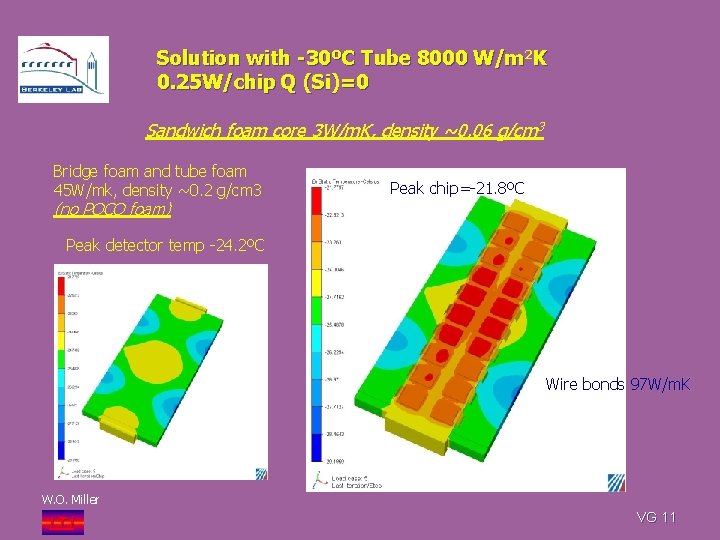
Solution with -30ºC Tube 8000 W/m 2 K 0. 25 W/chip Q (Si)=0 Sandwich foam core 3 W/m. K, density ~0. 06 g/cm 3 Bridge foam and tube foam 45 W/mk, density ~0. 2 g/cm 3 Peak chip=-21. 8ºC (no POCO foam) Peak detector temp -24. 2ºC Wire bonds 97 W/m. K W. O. Miller i. Ti VG 11
- Slides: 11