
BRIDGE S STRENGTH OF MATERIALS 101 MOST BASIC

BRIDGE S STRENGTH OF MATERIALS 101 (MOST BASIC KNOWLEDGE) This Photo by Unknown Author is licensed under CC BY-SA
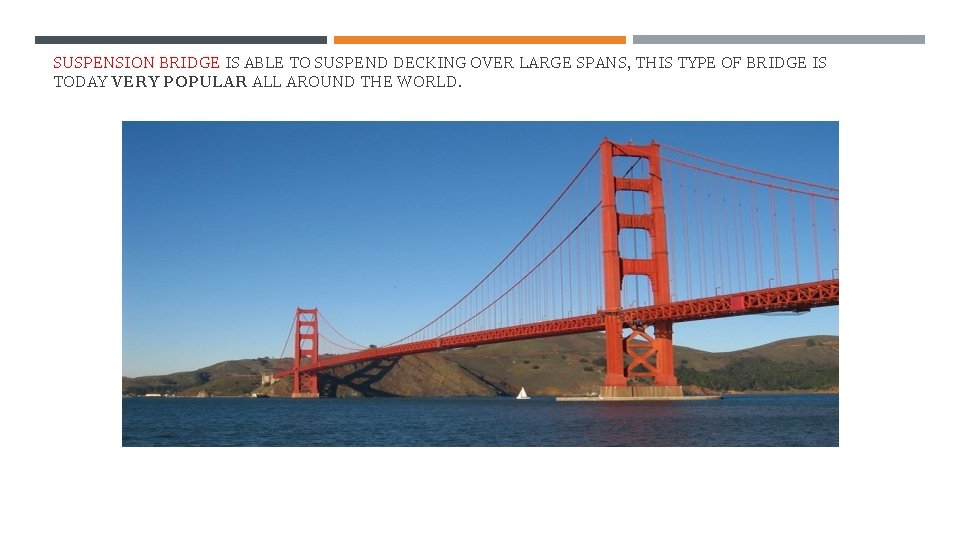
SUSPENSION BRIDGE IS ABLE TO SUSPEND DECKING OVER LARGE SPANS, THIS TYPE OF BRIDGE IS TODAY VERY POPULAR ALL AROUND THE WORLD.
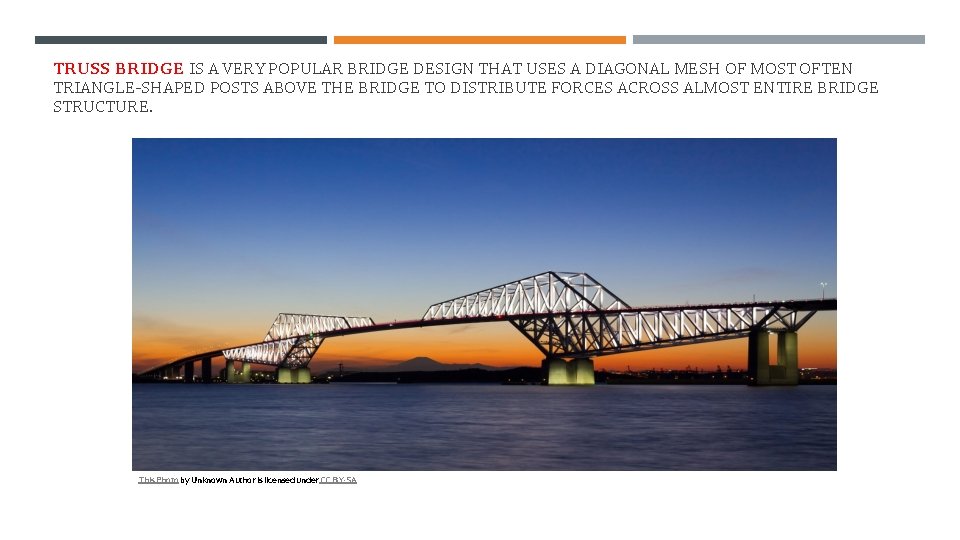
TRUSS BRIDGE IS A VERY POPULAR BRIDGE DESIGN THAT USES A DIAGONAL MESH OF MOST OFTEN TRIANGLE-SHAPED POSTS ABOVE THE BRIDGE TO DISTRIBUTE FORCES ACROSS ALMOST ENTIRE BRIDGE STRUCTURE. This Photo by Unknown Author is licensed under CC BY-SA

BEAM BRIDGES. BECAUSE OF THEIR SIMPLICITY, THEY WERE THE OLDEST BRIDGES KNOWN TO MAN. INITIALLY BUILT BY SIMPLY DROPPING WOODEN LOGS OVER SHORT RIVERS OR DITCHES
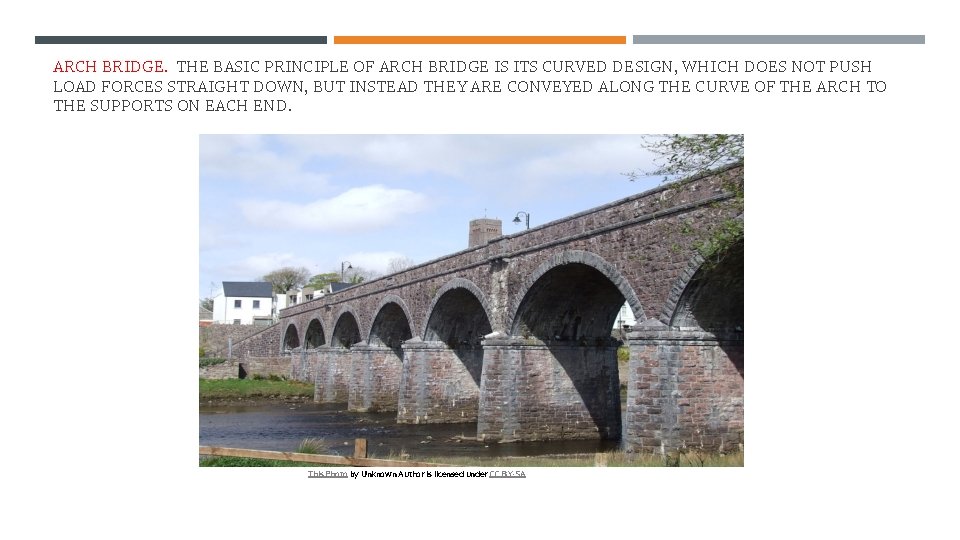
ARCH BRIDGE. THE BASIC PRINCIPLE OF ARCH BRIDGE IS ITS CURVED DESIGN, WHICH DOES NOT PUSH LOAD FORCES STRAIGHT DOWN, BUT INSTEAD THEY ARE CONVEYED ALONG THE CURVE OF THE ARCH TO THE SUPPORTS ON EACH END. This Photo by Unknown Author is licensed under CC BY-SA

What’s this? (compression, corrosion, tension, impact, fracture, metal fatigue, buckling, collapse, wear, thermal shock, investigation) 1. pressing together so that the volume is reduced 2. the force of one object striking another 3. removal of surface material by rubbing 4. a break into two or more pieces 5. temporary bending due to compression 6. expansion or contraction because of excessive heat or cold (2 words) 7. discovery and examination of facts about something 8. damage caused by continued loading (2 words) 9. disintegration due to a chemical reaction with water and oxygen 10. sudden falling down (of a structure) 11. a pulling or stretching force
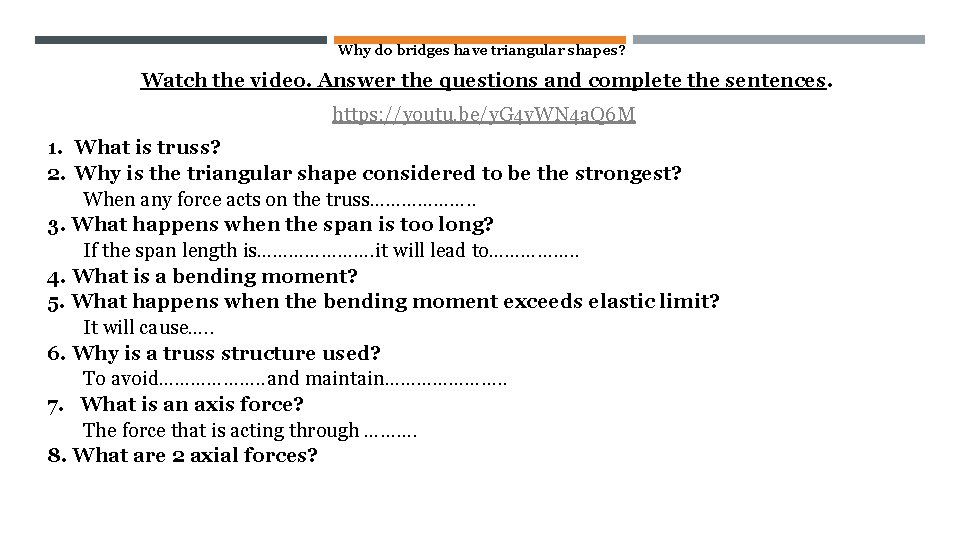
Why do bridges have triangular shapes? Watch the video. Answer the questions and complete the sentences. https: //youtu. be/y. G 4 v. WN 4 a. Q 6 M 1. What is truss? 2. Why is the triangular shape considered to be the strongest? When any force acts on the truss………………. . 3. What happens when the span is too long? If the span length is…………………. it will lead to……………. . 4. What is a bending moment? 5. What happens when the bending moment exceeds elastic limit? It will cause…. . 6. Why is a truss structure used? To avoid………………. . and maintain…………………. . 7. What is an axis force? The force that is acting through ………. 8. What are 2 axial forces?
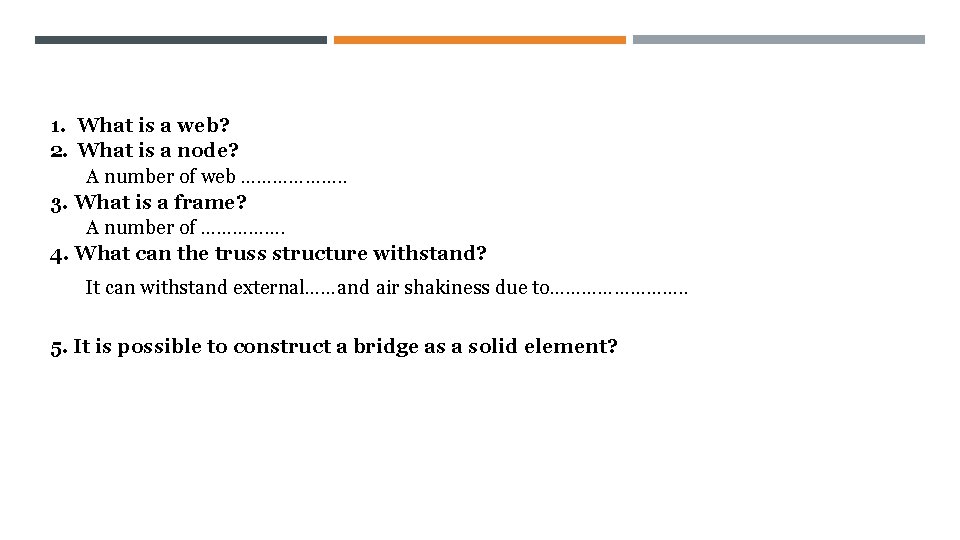
1. What is a web? 2. What is a node? A number of web ………………. . 3. What is a frame? A number of ……………. 4. What can the truss structure withstand? It can withstand external……and air shakiness due to…………. . 5. It is possible to construct a bridge as a solid element?
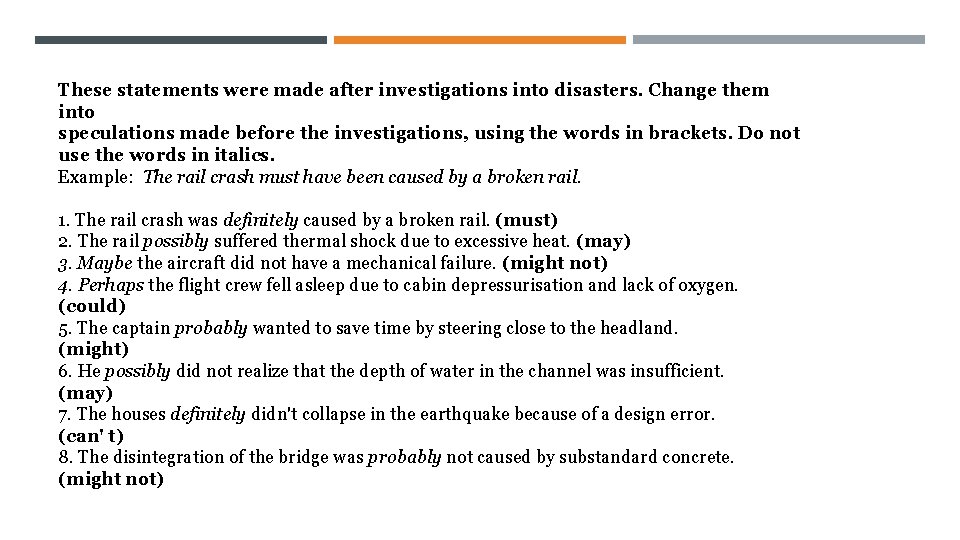
These statements were made after investigations into disasters. Change them into speculations made before the investigations, using the words in brackets. Do not use the words in italics. Example: The rail crash must have been caused by a broken rail. 1. The rail crash was definitely caused by a broken rail. (must) 2. The rail possibly suffered thermal shock due to excessive heat. (may) 3. Maybe the aircraft did not have a mechanical failure. (might not) 4. Perhaps the flight crew fell asleep due to cabin depressurisation and lack of oxygen. (could) 5. The captain probably wanted to save time by steering close to the headland. (might) 6. He possibly did not realize that the depth of water in the channel was insufficient. (may) 7. The houses definitely didn't collapse in the earthquake because of a design error. (can' t) 8. The disintegration of the bridge was probably not caused by substandard concrete. (might not)
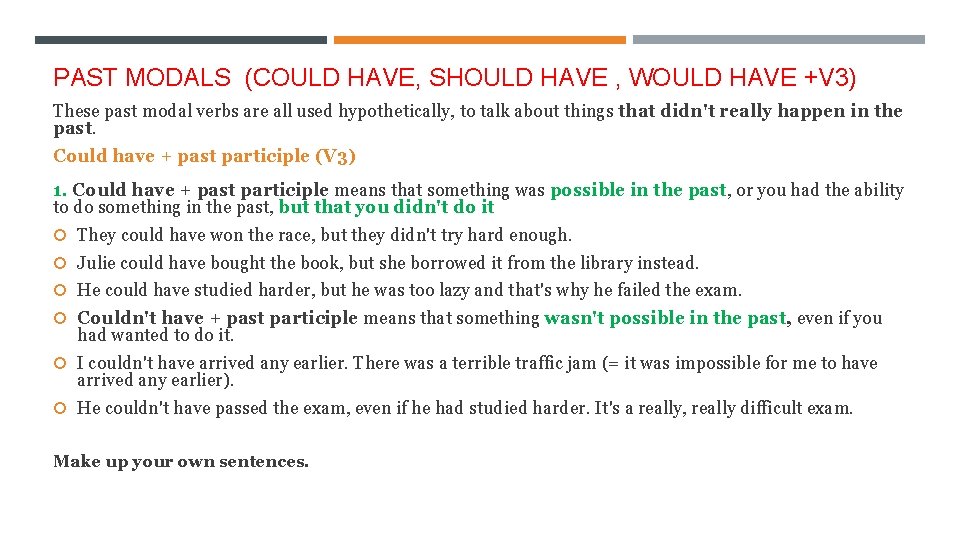
PAST MODALS (COULD HAVE, SHOULD HAVE , WOULD HAVE +V 3) These past modal verbs are all used hypothetically, to talk about things that didn't really happen in the past. Could have + past participle (V 3) 1. Could have + past participle means that something was possible in the past, or you had the ability to do something in the past, but that you didn't do it They could have won the race, but they didn't try hard enough. Julie could have bought the book, but she borrowed it from the library instead. He could have studied harder, but he was too lazy and that's why he failed the exam. Couldn't have + past participle means that something wasn't possible in the past, even if you had wanted to do it. I couldn't have arrived any earlier. There was a terrible traffic jam (= it was impossible for me to have arrived any earlier). He couldn't have passed the exam, even if he had studied harder. It's a really, really difficult exam. Make up your own sentences.
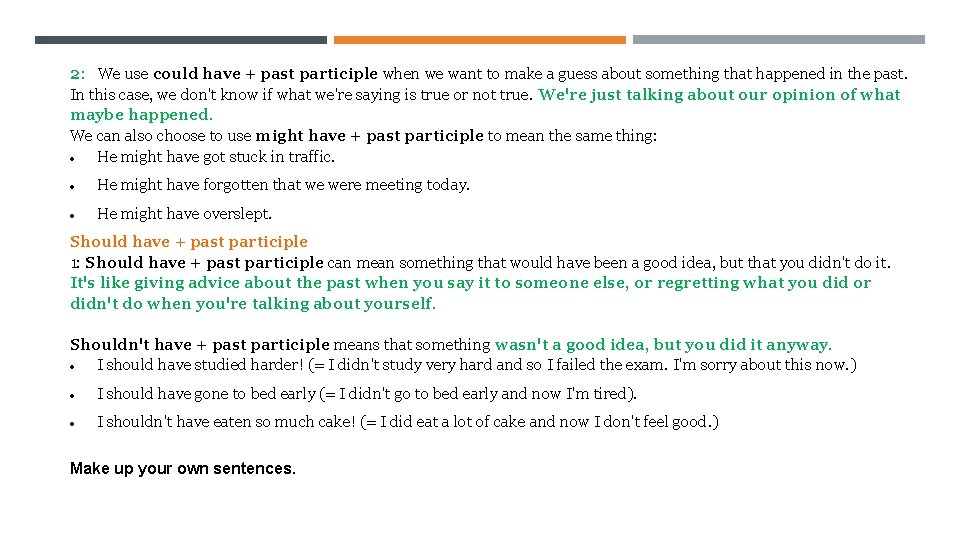
2: We use could have + past participle when we want to make a guess about something that happened in the past. In this case, we don't know if what we're saying is true or not true. We're just talking about our opinion of what maybe happened. We can also choose to use might have + past participle to mean the same thing: He might have got stuck in traffic. He might have forgotten that we were meeting today. He might have overslept. Should have + past participle 1: Should have + past participle can mean something that would have been a good idea, but that you didn't do it. It's like giving advice about the past when you say it to someone else, or regretting what you did or didn't do when you're talking about yourself. Shouldn't have + past participle means that something wasn't a good idea, but you did it anyway. I should have studied harder! (= I didn't study very hard and so I failed the exam. I'm sorry about this now. ) I should have gone to bed early (= I didn't go to bed early and now I'm tired). I shouldn't have eaten so much cake! (= I did eat a lot of cake and now I don't feel good. ) Make up your own sentences.
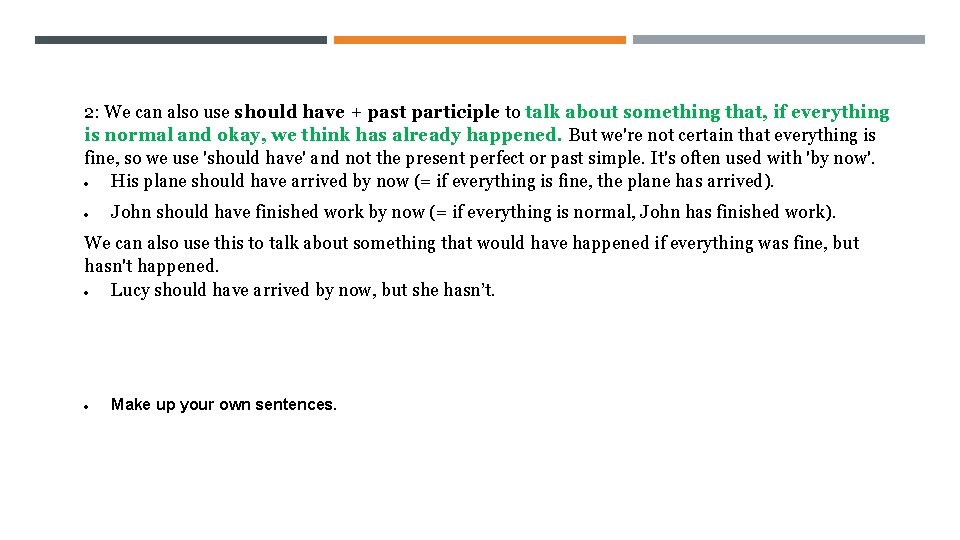
2: We can also use should have + past participle to talk about something that, if everything is normal and okay, we think has already happened. But we're not certain that everything is fine, so we use 'should have' and not the present perfect or past simple. It's often used with 'by now'. His plane should have arrived by now (= if everything is fine, the plane has arrived). John should have finished work by now (= if everything is normal, John has finished work). We can also use this to talk about something that would have happened if everything was fine, but hasn't happened. Lucy should have arrived by now, but she hasn’t. Make up your own sentences.
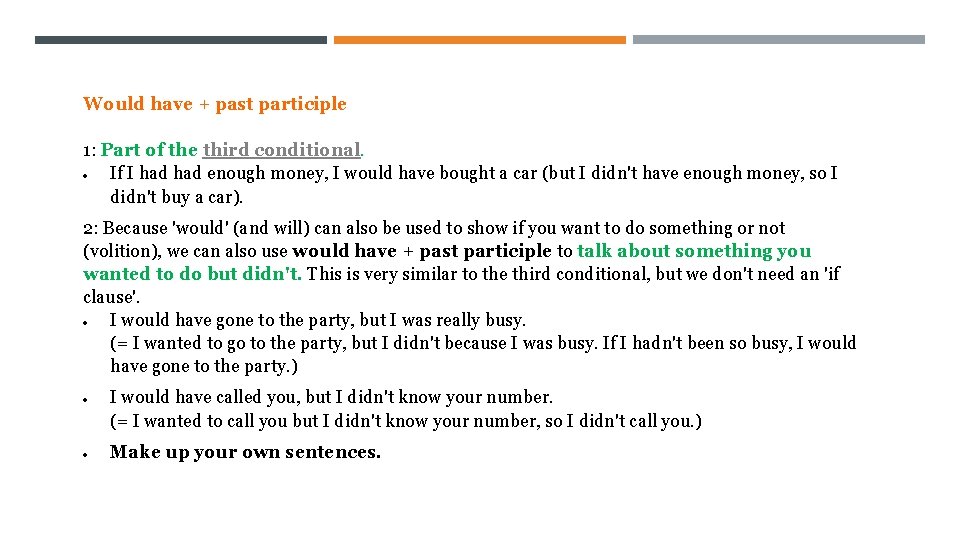
Would have + past participle 1: Part of the third conditional. If I had enough money, I would have bought a car (but I didn't have enough money, so I didn't buy a car). 2: Because 'would' (and will) can also be used to show if you want to do something or not (volition), we can also use would have + past participle to talk about something you wanted to do but didn't. This is very similar to the third conditional, but we don't need an 'if clause'. I would have gone to the party, but I was really busy. (= I wanted to go to the party, but I didn't because I was busy. If I hadn't been so busy, I would have gone to the party. ) I would have called you, but I didn't know your number. (= I wanted to call you but I didn't know your number, so I didn't call you. ) Make up your own sentences.
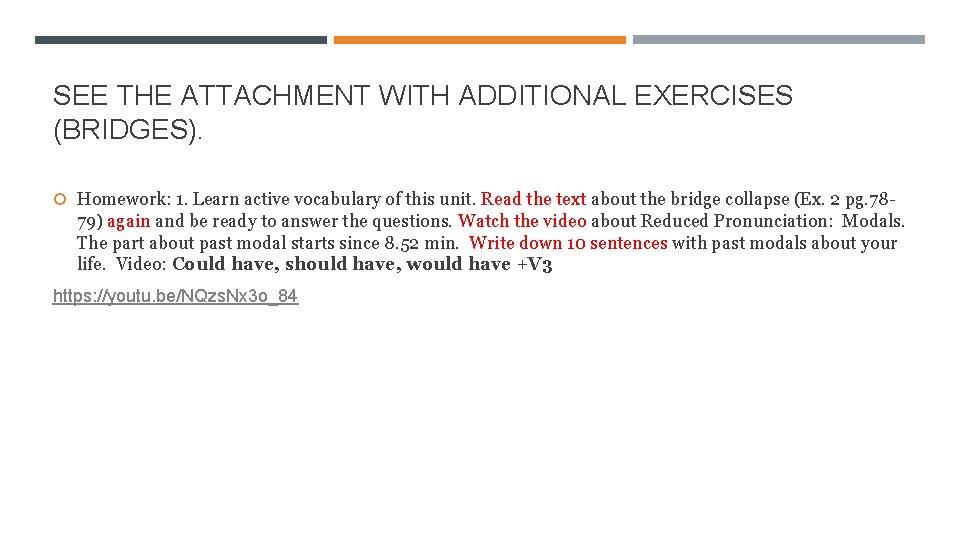
SEE THE ATTACHMENT WITH ADDITIONAL EXERCISES (BRIDGES). Homework: 1. Learn active vocabulary of this unit. Read the text about the bridge collapse (Ex. 2 pg. 78 - 79) again and be ready to answer the questions. Watch the video about Reduced Pronunciation: Modals. The part about past modal starts since 8. 52 min. Write down 10 sentences with past modals about your life. Video: Could have, should have, would have +V 3 https: //youtu. be/NQzs. Nx 3 o_84
- Slides: 15