
Bridge Refresher Topic 20 Provisions of accident manual
Bridge Refresher Topic 20 Provisions of accident manual 1
Provisions of IRBM 111. Action in case of emergency On receipt of intimation of the occurrence of an accident (including breaches) affecting any part of the bridge or approaches or restricting free passage of trains, the Bridge Inspector should proceed to site by the quickest available means. On the way he should collect information regarding the damage, the men and material requirement at site for restoration and arrange for their movement and seek instructions regarding the restoration form the Assistant Engineer. 2
Provisions of IRPWM 3
Provisions of IRPWM Para 1101(3). Action in case of emergency On The Indian Railways (Open Lines) Rule 2. 11 of General Rules, 1976 Edition enjoins that– (a) Every Railway Servant shall– (i) See that every exertion effort is made for ensuring the safety of the public; (ii) Promptly report to his superior any occurrence affecting the safe or proper working of the railway which may come to his notice; and (iii) Render on demand all possible assistance in the case of an accident or obstruction. 4
Provisions of IRPWM Para 1101(3). Action in case of emergency On The Indian Railways (Open Lines) Rule 2. 11 of General Rules, 1976 Edition enjoins that– (b) Every Railway Servant who observes– (i) that any signal is defective; (ii) any obstruction, failure, or threatened failure of any part of the way or works; (iii) anything wrong with a train; or (iv) any unusual circumstance likely to interfere with the safe running of trains or the safety of the public; (v) shall take immediate steps, such as the circumstances of the case may demand to prevent accident; and where necessary, advise the nearest Station Master by the quickest possible means: (vi) provided that in the case of a train having parted, he shall not show a stop hand signal but shall endeavour to attract the attention of the Driver or Guard by shouting, gesticulating, or other means. 5
Provisions of IRPWM Para 1103(1). Accidents Impairing Through Traffic– (1) Engineers to proceed to site– (a) On receipt of intimation of the occurrence of an accident resulting in damage to any part of the Way/Works/Bridges and affecting the free passage of trains, the concerned JE/SSE/P. Way or (Works) or (Bridge) and the Assistant Divisional Engineer shall proceed to the site of accident, by the quickest available means. On their way, they should collect information about the extent of damage to Permanent Way/Works/Bridges and arrange for movement of materials required for restoration. They should also collect additional staff and tools as required, the engineering tool van should be sent to the site, if so considered necessary, by the quickest means. 6
Duties of Engineering Supervisors at site Para 1104 of IRPWM 1. Reach the site of the accident by the quickest available means. 2. Take general charge of the situation until the arrival of an officer. 3. Ensure the occupied and obstructed lines are protected as per General Rules 6. 03 & 9. 10. 4. Make out a quick survey of causalities and injuries, ensure rendering of first aid to the injured, taking assistance of all available Railway Staff, Doctors and Volunteers on the train and near the site of accident. 5. Arrange to shift the injured persons to the nearest hospital with the help of available assistance, keeping their particulars as available and ask for further assistance if required. 6. Collect and record all important information relating to the accident, such as: (i) The condition of the track, with special reference to alignment, gauge, crosslevels, super-elevation, points of mount & drop, any sign of sabotage etc. (ii) The condition of rolling stock with special reference brake-power & braking gear. CONTD…
CONTD… (iii) All marks on sleepers, rails, locomotives & vehicles etc. specially for preservation of clues. (iv) Position of derailed vehicles (v) Position of block instruments. (vi) Position of derailed vehicles. (vii)Position of indications, keys levers etc. (viii)Prima facie cause of accident. 7. Ensure that all records and registers related to train movement are seized. 8. Obtain the statement of staff involved in the accident, as far as possible. 9. Prepare a rough sketch showing the position of derailed vehicles, track and OHE etc. 10. Make a quick survey of damage. 11. Remain at the site of accident for all possible assistance till relieved by another staff.
ACTION TO BE TAKEN ON REACHING SITE The first engineering official arriving at the site of accident, should take the following action : i. Protect the train : Any engineering staff available at the site of accident shall assist the guard driver to protect the train. The inspector that protection has been afforded to the train in front and rear. In case of double line, if the other line is also affected by the accident, steps should be taken to protect both the lines. If no infringement exists, trains must be controlled and passed cautiously on the unaffected track. i. First aid and Rescue : Render first aid to injured passengers and railway staff and rescue of trapped persons , take assistance from travelling medical practitioner. i. Examine the entire site : Examine the entire site inclusive of the track over which the train has passed immediately before derailing, noting down any unusual features observed, specially any part of vehicles or other materials lying on or near the track. i. Advice to nearest Station Master : After a rapid survey of the position, particulars should be sent to the nearest station master, about the accident. In case of a controlled sections, a field telephone should be got commissioned at once. i. Detailed Examination : Carry out a detailed examination of the wheel marks on the rail head, fastenings, sleepers & ballast, the wheel trail marks and the corresponding marks on the wheel sets of derailed and other vehicles to identify the wheel set which derailed first and to establish the initial point of derailment. CONTD…
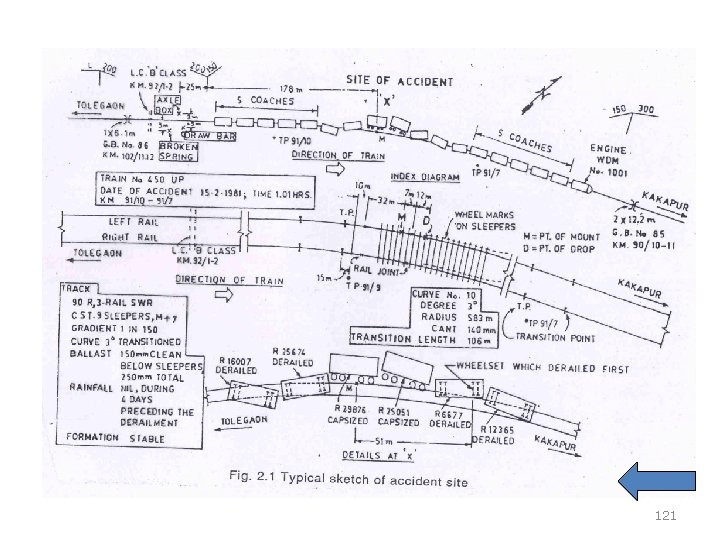
Vi Dimensional Sketch : Prepare a dimensioned sketch giving the full particulars of the site of accident including the track leading upto the point of derailment, path followed by derailed vehicles, place of mounting & drop, which pair of wheel and of which vehicles were first derailed and the position at which the derailed vehicle came to stand. vii. Preservation of Clues : Preserve clues which bear evidence of wheel marks specially at the point of mount & drop or other clues which may help in analyzing the cause of accident. vii. Recording of Track Geometry : Record of details of track and measurement of track geometry in the prescribed manner in presence of representatives of other departments. vii. Gang Charts : Examine the gang chart to ascertain the date when the track was last attended. vii. Vehicle Measurements : Record the measurement of the vehicle and its deficiency, if any, in the prescribed manner in presence of representatives of other departments. Also find out the history of repair of the vehicle. vii. Operating features : Investigate and record various operating features such as speed, train formation, loading condition of the vehicle etc. and the factors which might contribute to the derailment. vii. Preliminary report : Make out a preliminary report to be sent on to the immediate superior containing nature of accident, cause, particulars of loss of life/injuries if any, extent of damage, steps taken for resumption, probable date & time by which normal working to be resumed, assistance required like labour, material etc.
Provisions of Accident Manual 11
Chapters of Accident Manual • Chapter I: Definition & Classification of accidents • Chapter II : Reporting of Accidents • Chapter III : General Instructions & duties of various Rly officials in case of accidents. • Chapter IV : Relief Measures – B/D trains & medical equipment, list of hospitals, preliminary report, clearing operations • Chapter V : Procedure for dealing with cases of sabotage or train wrecking. • Chapter VI : Action to be taken in case of unusual occurrences • Chapter VII : Investigation & Inquiries • Chapter VIII : Disposal of Inquiry Reports 12
ACCIDENT Occurrence in the course of working of railway which does or may affect the safety of the Railway, its engine, rolling stock, permanent way and works, fixed installations, passengers or servants or which affects the safety of others or which does or may cause delay to a train or loss to the Railways. 14
SERIOUS ACCIDENT • Accident to a passenger train which is attended with loss of life or with grievous hurt to a passenger(s) in train, or with serious damage to rly property of the value exceeding Rs. 2 Crs. and any other accident which in the opinion of CRS requires the holding of inquiry by him. • Excludes – Passengers (trespassers) injured or killed by their own carelessness – LC accidents where no rly passenger or rly servant is killed/ grievously injured, unless CRS decides to conduct enquiry 15
• • Accidents falling under purview of sec 113 of Rly Act: Any acc attended with loss of human life or with grievous hurt. Reportable Train Accident : Any collision betn trains of which one is a pass carrying or Derailment of any train carrying pass or any part of such train or Acc attended with loss of human life in pass train wrecking/attempted wrecking or running over obstruction placed on line or pass falling out of train/fire in train. . 16
INJURIES Classified as • Grievous : as defined in Section 320 of Indian Penal Code – emasculation, permanent privation (eye sight, hearing, any member or joint, fracture/dislocation of bone or tooth etc. ) • Simple: incapacitate the person to follow his customary vocation during 48 hrs. after occurrence of accident. 18
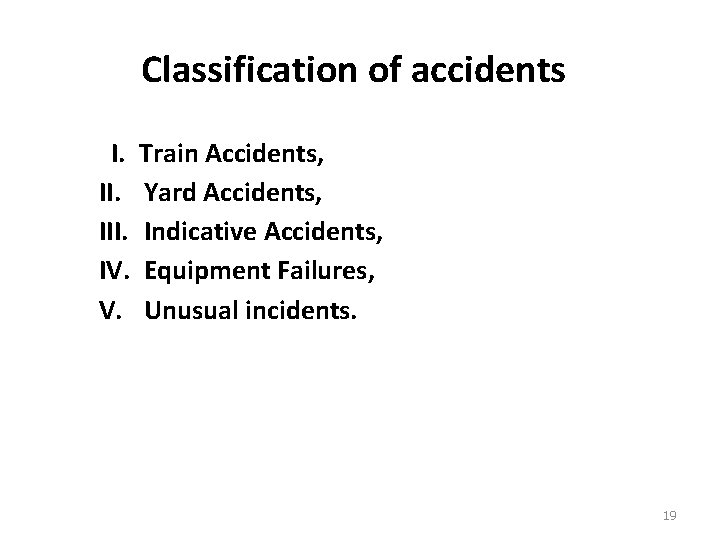
Classification of accidents I. III. IV. V. Train Accidents, Yard Accidents, Indicative Accidents, Equipment Failures, Unusual incidents. 19
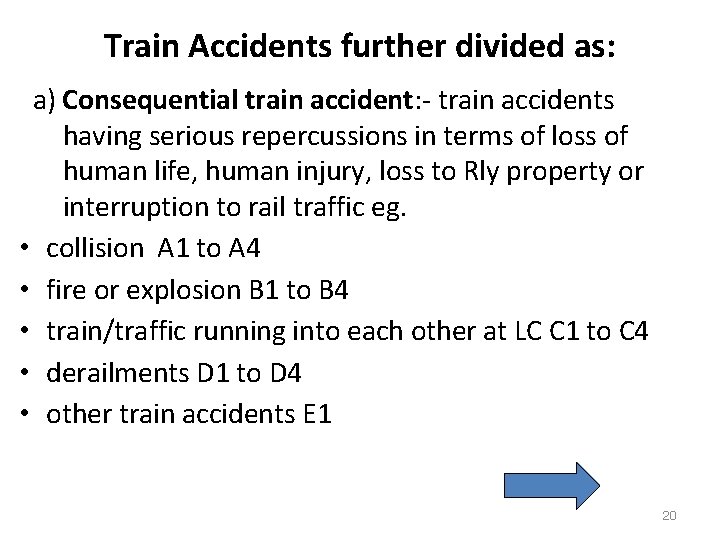
Train Accidents further divided as: a) Consequential train accident: - train accidents having serious repercussions in terms of loss of human life, human injury, loss to Rly property or interruption to rail traffic eg. • collision A 1 to A 4 • fire or explosion B 1 to B 4 • train/traffic running into each other at LC C 1 to C 4 • derailments D 1 to D 4 • other train accidents E 1 20
Classification of Accidents b) Other train accidents— train accidents which are not covered under the definition of consequential train accident and falls under category B 5, B 6, C 5 to C 8, D 5 & E 2 21
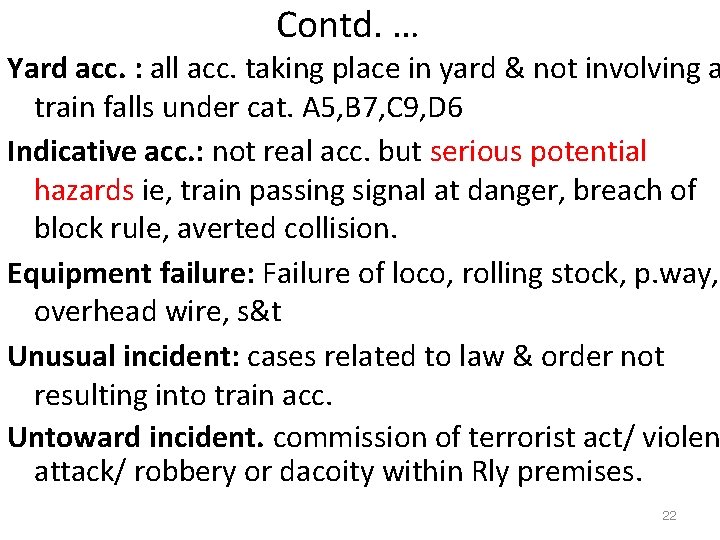
Contd. … Yard acc. : all acc. taking place in yard & not involving a train falls under cat. A 5, B 7, C 9, D 6 Indicative acc. : not real acc. but serious potential hazards ie, train passing signal at danger, breach of block rule, averted collision. Equipment failure: Failure of loco, rolling stock, p. way, overhead wire, s&t Unusual incident: cases related to law & order not resulting into train acc. Untoward incident. commission of terrorist act/ violen attack/ robbery or dacoity within Rly premises. 22
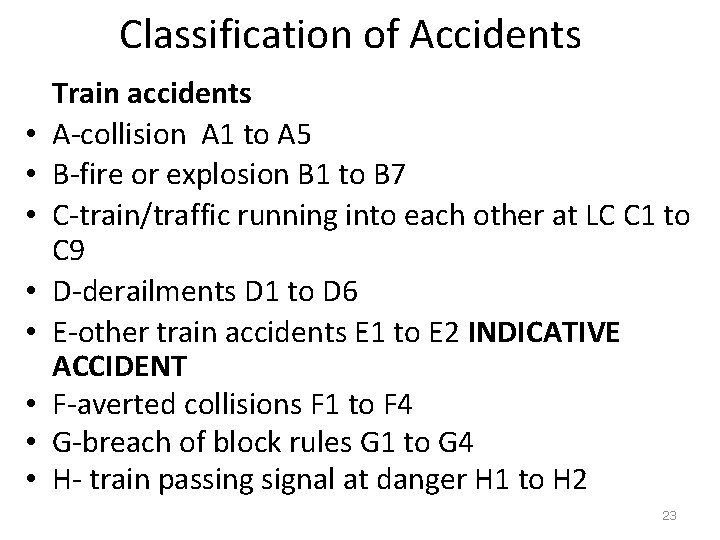
Classification of Accidents • • Train accidents A-collision A 1 to A 5 B-fire or explosion B 1 to B 7 C-train/traffic running into each other at LC C 1 to C 9 D-derailments D 1 to D 6 E-other train accidents E 1 to E 2 INDICATIVE ACCIDENT F-averted collisions F 1 to F 4 G-breach of block rules G 1 to G 4 H- train passing signal at danger H 1 to H 2 23
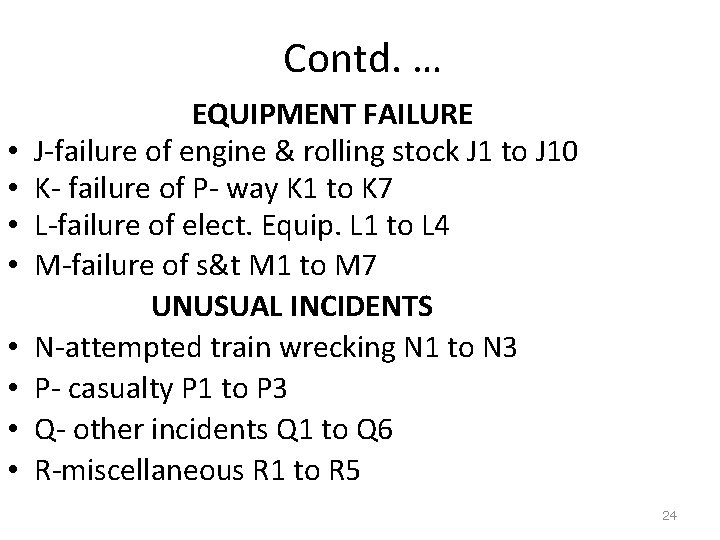
Contd. … • • EQUIPMENT FAILURE J-failure of engine & rolling stock J 1 to J 10 K- failure of P- way K 1 to K 7 L-failure of elect. Equip. L 1 to L 4 M-failure of s&t M 1 to M 7 UNUSUAL INCIDENTS N-attempted train wrecking N 1 to N 3 P- casualty P 1 to P 3 Q- other incidents Q 1 to Q 6 R-miscellaneous R 1 to R 5 24
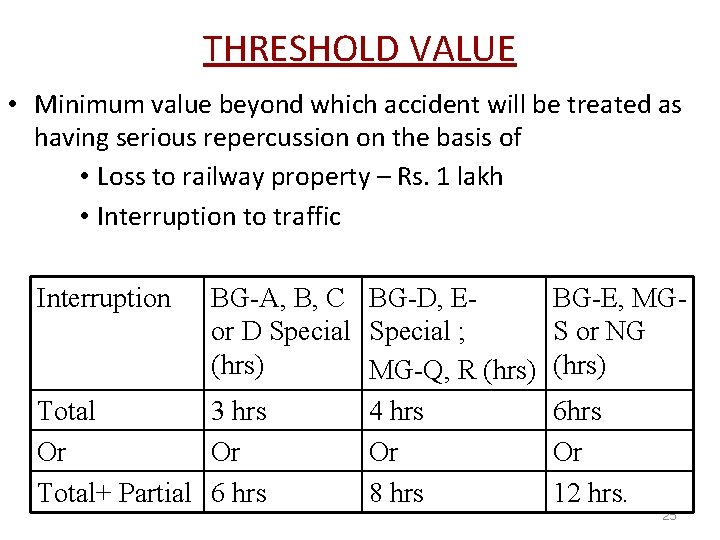
THRESHOLD VALUE • Minimum value beyond which accident will be treated as having serious repercussion on the basis of • Loss to railway property – Rs. 1 lakh • Interruption to traffic Interruption BG-A, B, C BG-D, Eor D Special ; (hrs) MG-Q, R (hrs) Total 3 hrs 4 hrs Or Or Or Total+ Partial 6 hrs 8 hrs BG-E, MGS or NG (hrs) 6 hrs Or 12 hrs. 25
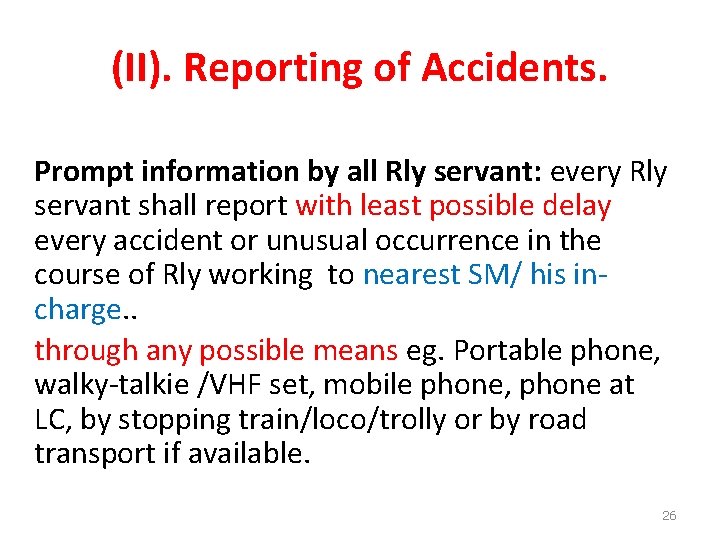
(II). Reporting of Accidents. Prompt information by all Rly servant: every Rly servant shall report with least possible delay every accident or unusual occurrence in the course of Rly working to nearest SM/ his incharge. . through any possible means eg. Portable phone, walky-talkie /VHF set, mobile phone, phone at LC, by stopping train/loco/trolly or by road transport if available. 26
Details to be given in First Information. Time & date of accident Train no/description of train(s) involved in acc Block section/station Location-kilometerage of acc site Gen description of acc site inc. Visibility, curve, gradient, Speed restriction or any other spl feature. • Whether medical van & B/D train required • Nature of accident • Whether any casualty/injury, nos persons injures/killed, any injury to passengers , Rly staff or others. • • • 27
Details to be given. . . Contd. • Any derailment occurred? in case of wagon derailed/capsized, whether loaded or empty, whether fouling to adjacent track or not? Whether any speed restriction required to traffic on adjacent line, any other inf. readily available. • Track condition: - appx. Track length damaged (from km to km). Extent of damage i. e. damage to sleepers, track fittings, bridge, tunnel, fixtures etc. • OHE - Damage to Mast/Portal cantilever, wires, insulation etc. 28
Details to be given. . . Contd. . • S&T - Damage to signal posts, S&T gears, signals, pts &xings, track circuits etc. • Rolling Stock - Damage to loco, wagons, coaches/vehicle. • LC acc - type of road vehicle : Tractor/Bus etc. involved & nos of persons injured / dead, nature of injuries. Whether the engine disabled & whether any derailment taken place. Whether road vehicle is entangled /obstructing the track. • Prima facie cause of the accident, if known. • Any other relevant information. 29
Advice to Rly Bd & Local Govt /CRS: - Accident falling within category of sect. 113 (I. R. Act 1989), occurs, DRM to draft message addressed to GM, COM, CSO, DM, SP(GRP) etc Containing following details: • Km/station or both, where acc occurred; • Time /date of accident; • Number/description of train or trains; • Nature of accident; • Nos of people killed/injured, specifying separately if passengers in train. • Cause of accident, if known; Probable detention to traffic 30
Reporting of accidents to the Commissioner of Railway Safety: In case of reportable train accidents, the CRS shall be promptly informed about the accident by CSO or by other Safety Officer nominated by CSO for the purpose 31
Advice to Press /Electronic Media: - • For serious acc, separate message to be addressed to Press/electronic media by CPRO/PRO after consulting GM/DRM. • Details of Press/electronic media to be given in disaster management plan of div/ Hq. • news about acc to local trains (being of interest only in specific localities) to be disseminated by DRM by transmitting required inf. quickly to local press tel. /other available means. • for more serious accn. , CPRO to supplement inf. given by DRM when instructed by GM/CSO 32
Advice to Press…. : -Contd… • Advice to press/electronic media/public at information centres must only be such as is verified. Whenever unverified information is given to higher authorities, it should be made quite clear that the information is an unverified one and must not be passed on to the Press or Public. • If any person from press/electronic media/Public Body approaches Station Master/other Rly official at any Station: request to be communicated to officer i/c in Control office/Central Control & his instructions to be obtained. 33
Advice to Press /Media: -Contd. . • Staff should not speak or air their views publicly regarding the loss of property, estimates of casualties and cause of the accident. • Even casual remarks from staff such as Guards, Drivers and Station Masters are likely to be quoted. • They should refrain from such casual utterances 34
Accidents reportable to Railway Board : • All consequential train Accidents. • Any yard accn with serious repercussion on movement of through / ML traffic resulting in dislocation more than threshold value. • Land slides, breaches, OHE breakdown etc. resulting in dislocation of traffic more than the threshold value. • Averted collisions. / SPD by Driver 35
Reporting of Acc by Div. to HQ. Sr. DSO/ADSO to advise to CSO after acc of following categories: • All train Accidents. • Any yard acc with serious repercussion on movement of traffic on through line resulting in dislocation more than threshold value. • Land slides/breaches/OHE breakdown etc. resulting in dislocation of traffic more than threshold value. /Averted collisions/Driver passing signal at danger. /Breach of block rules. /Untoward incidents. /Unusual incidents. 36
Accident Statistics: - Collection, Compilation of Monthly statement • Train/yard/indicative accidents under cat. A, B, C, D, E, F, G and H by Safety Br. of Div. /Zonal level. • Equipment failures under cat. J, K, L and M by Div. ctl on daily basis to be handed over to Safety Branch. • Unusual incidents under cat. N, P and Q by Security (RPF) Br. at Div. level and they shall take subsequent follow up action. 37
(III) General Instructions and duties of Railway officials Objectives to be achieved in case of an accident: • Protection of adjacent running lines; • Protection of site of accident; • Save life & alleviate suffering; • Protect property; • Provide succor/help to pass at site of acc; • Transportation of stranded pass. • Preservation of clue & ascertain cause of acc; • Restoration of through communication 38
Essential tenets of successful Accident Management: • All Rlymen whether on duty or otherwise, to involve in • • • rescue & relief operations. Utmost speed in rushing medical & other relief to site of accident. Utmost care, consideration & courtesy towards passengers involved in accident. Adequate & swift arrangements for supply of food, drinking water etc to affected pass. Preservation of clues. Proper planning of restoration operations/ proper execution. 39
Essential tenets …. . Contd… • Responsibilities of employees for restoration to be clearly defined to avoid any confusion. • Quick transmission of information, particularly details of dead/injured to relatives/others • Proper preservation & care of dead. • Security of passenger’s luggage/ Railway property. • Timely dissemination of information to passengers of evacuation arrangements, to relieve panic & create reassurance. • Proper liaison with Civil Administration & Press/electronic media 40
Essential tenets …. . Contd • Resources of all departments to be made available: • Every official to render all possible assistance • Depending on seriousness of accident, additional arrangements may be ordered by the GM /COM/CSO in the HQ and by DRM in the division: • Disaster Management cell to be manned by nominated Officers till restoration at Div/Hq who should be in constant touch with each other for regular flow of information. 41
Essential tenets …. . Contd • Enquiry-cum-Information Centers to be opened at site/other suitable locations as necessary for giving information to pass/make announcements regarding transhipment of pass, running of relief trains/medical aid etc. • Officer representing Safety dept to co-ordinate functioning of Disaster Management Cell. • Officer representing every other concerned dept to monitor information/rescue operation related to their individual dept & give constant feedback to in-charge of Disaster Management Cell & also liaison with field. . 42
Duties of Various Rly official. • • Guard Note date/time & exact site of accident. Ensure protection of adjacent line/lines & then protect same line by taking assistance of any qualified staff. . Asst Guard, Asst Driver, Gangmen, Gatemen etc. Quick survey of Casualties/injuries/damage to rolling stock, assistance required at site of accidents advise nearest SM/Controller. Render First Aid to injured persons/take action to save lives with assistance of Rly staff, doctors &/or volunteers available on train/near site of acc & make entry in Guard’s Journal. 43
Duties of Guard…. contd. . • Convey information through the quickest possible means giving details of accident and nature of assistance required to the Controller/Stations on either side. • Arrange protection of belongings of passengers and Railway property with the help of RPF/GRP and other Volunteers. • Post a Railway Servant to man the field telephone to ensure regular flow of information to the Control till arrival of ART and remain in general charge till replaced by a senior Railway Official. 44
Duties of Guard…. contd. . • Arrange to shift seriously injured passengers through road transport with local help to nearest hospitals whenever possible. • Arrange for Tea, Water & Refreshments to injured persons with help of Ticket Checking Staff & other commercial staff available. • Preserve & Safe-guard all clues of probable cause of accident 45
Duties of Loco Pilot/Asst. LP: • Switch on flasher light/dim head light of engine. • Sound short whistles frequently to warn driver of an approaching train. • arrange to protect adjacent & then same line. • Arrange to advise control/adjacent stations about accident by available means. • Take necessary tech precautions as prescribed/spl instructions to make train safe. • exchange information with Guard/Render all possible assistance to Guard/ assessment of damage to rolling stock & or loco & nature of assistance required. 46
Duties of Staff in the event of the Guard or Engine Crew being killed or seriously injured: • In the event of any train staff suffering casualties or incapacitated, due to injuries their duties must be carried out by other available competent staff. 47
Duties of Rly officials present Until such time as relief & assistance arrive, & he is replaced by more senior official, senior most Rly Official present to take charge, ensure that accident is reported properly to Controller/nearest Rly official & relief, if required, is asked for. . . He shall arrange to: • collect Rly men & volunteers at site & allot duties to each as best as possible under prevailing circumstances; • allot duties to Police/Military/Rly Security staff, & • organize relief with assistance of volunteers/Railwaymen. 48
Duties of Train Supdt/Conductors/TTEs / Catering Staff /AC Mechanic etc. at site: They shall be available at site for all assistance to passengers of the involved train and they shall • Be prompt in providing relief/re-assurance/ comfort to affected passengers. • Seek assistance of Doctors travelling on train to attend injured. • Arrange for refreshments/drinking water free of charge to affected passengers. 49
Duties of Train Supt/Conductors/TTEs etc. . Contd. . • give timely information to passengers. • collect details of dead/injured passengers. • record evidence of passengers with their names & addresses. • arrange for safeguard of Rly & Passengers property. • assist other rly staff & Medical Team to identify dead & in rendering first-aid to injured passengers. 50
Duties of Station Master. . . • Ensure that no other train enters affected sec. • Advise Controller of acc, indicating nature of medical & other assistance required. SM of adjacent station/other major station/Rly doctors to be advised, if available. • Take action to protect & safeguard Rly & public property. • collect medical aid, if required, locally from nearest hospitals, volunteer doctors, dispensaries &other doctors, • requisition help from local police & Magistrate • Report the accident to all concerned as prescribed in rules 51
Duties of Station Master. . . Contd. . • call off-duty Rly staff & Rly rescue volunteers registered at his station, allot them specific duties for relief & rescue. • arrange to provide all sort of assistance to affected passengers such as catering, drinking water, issue of complimentary passes, free messages to relatives etc. • open information counters & booths for giving information to public regarding names of injured/dead passengers & regulation/ diversion of trains etc. STD booths located at stations/adjacent areas should be utilised for giving relevant information 52
• Duties of SM : Contd. . arrange for whatever assistance required in connection with clearing arrangements, transhipment etc. & provide lights, refreshments, manual help & any other requirements which can be procured within his resources. • arrange for section to be cleared of unaffected vehicles as early as possible. If accident attributed to sabotage/suspected sabotage wait for instructions from officer i/c. • Remain on-duty taking orders from control & Officer i/c till accident is cleared or he is replaced by a competent person 53
Duties of SE (P. Way)/other P. Way staff : • protection of the track. • adequate labour with tools/ track materials as required. At night arrange adequate number of petromax/ lamps/portable Electric generators. • Adequate labour for rescue of passengers, unloading of wagons and track works. • Clearing operations, if required. • Joint observation and track measurements with other Sr. Supervisors in the format prescribed. 54
Duties of Officer-in-Charge at site: - Immediate assessment of • Nos of pass killed/injured: grievously/ simple. • Extent of damage. • Probable detn to traffic & restoration forecast. • Assistn required & relay to Officer I/C of ctl. • Prima-facie cause of acc & repeat to Div Ctl / HQ Ctl as early as possible & not later than 24 hrs. in any case • Arrange to operate Mobile Ctl Office provided with Ctl phone/Satellite phone/Rly Subscriber phone, BSNL/Public phone with STD/FAX facilities at acc. site duly manned 55
Duties of Officer I/C at site. . Contd. Depute officers and/or staff for specific duties in : • Assisting in rescue operation. • Noting down particulars of persons sent to hospitals/given first aid. • Assisting in preservation of clues. • Maintaining a log of events at site. • Assisting in transhipment work. • Assisting in Rly security work 56
Duties of Officer I/C at site: - Contd. • Arrange for ex-gratia payment. • Arrange for log of events & progress of restoration & also give the latest information to Div/central Ctl & DMC. • Catering for passengers/injured or otherwise. • Security of luggage of involved passenger & protection of area • Transhipment of passengers & arrangements of road vehicles for clearing stranded passengers. • Efficient communications including STD phones, mobile phones, for pass. at adjoining stations, walkie-talkie sets at site etc. 57
Duties of Sr. DEN/DEN: • Ensure that joint measurements taken/ sketches of accident site accurately drawn. • Ensure adequate labour/material/ their proper deployment for speedy restoration. • Depute one DEN/ADEN in Control Office for planning, reinforcement of labour/ material/staff. • Ensure that inspection notes & diary of ADEN/SE(P. Way), gang charts, mntc records etc. seized/secured. • Assist other depts in clearance of line & ensure that track is made & certified fit at the earliest. 58
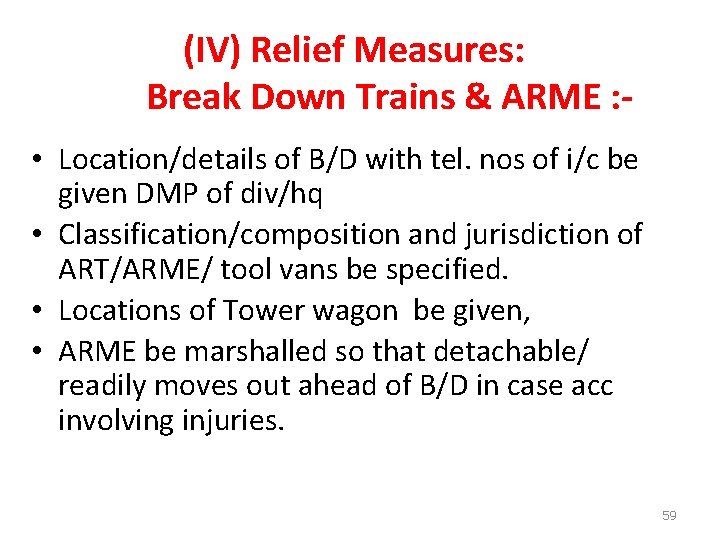
(IV) Relief Measures: Break Down Trains & ARME : • Location/details of B/D with tel. nos of i/c be given DMP of div/hq • Classification/composition and jurisdiction of ART/ARME/ tool vans be specified. • Locations of Tower wagon be given, • ARME be marshalled so that detachable/ readily moves out ahead of B/D in case acc involving injuries. 59
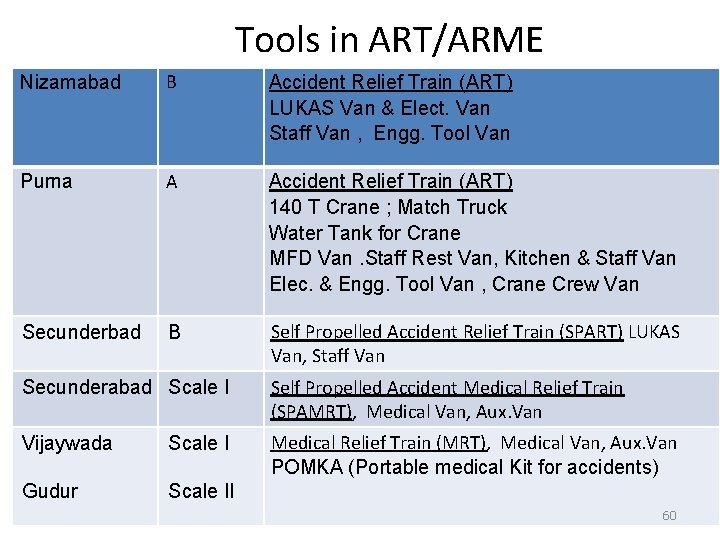
Tools in ART/ARME Nizamabad B Accident Relief Train (ART) LUKAS Van & Elect. Van Staff Van , Engg. Tool Van Purna A Accident Relief Train (ART) 140 T Crane ; Match Truck Water Tank for Crane MFD Van. Staff Rest Van, Kitchen & Staff Van Elec. & Engg. Tool Van , Crane Crew Van Secunderbad B Self Propelled Accident Relief Train (SPART) LUKAS Van, Staff Van Secunderabad Scale I Self Propelled Accident Medical Relief Train (SPAMRT), Medical Van, Aux. Van Vijaywada Scale I Medical Relief Train (MRT), Medical Van, Aux. Van POMKA (Portable medical Kit for accidents) Gudur Scale II 60
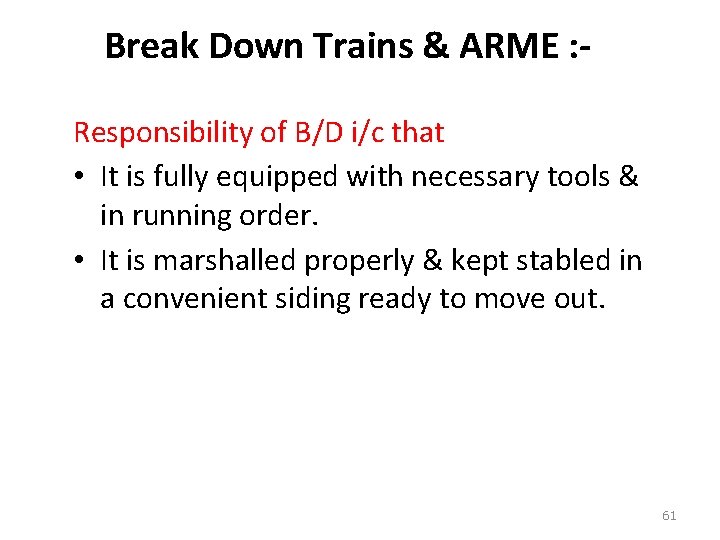
Break Down Trains & ARME : Responsibility of B/D i/c that • It is fully equipped with necessary tools & in running order. • It is marshalled properly & kept stabled in a convenient siding ready to move out. 61
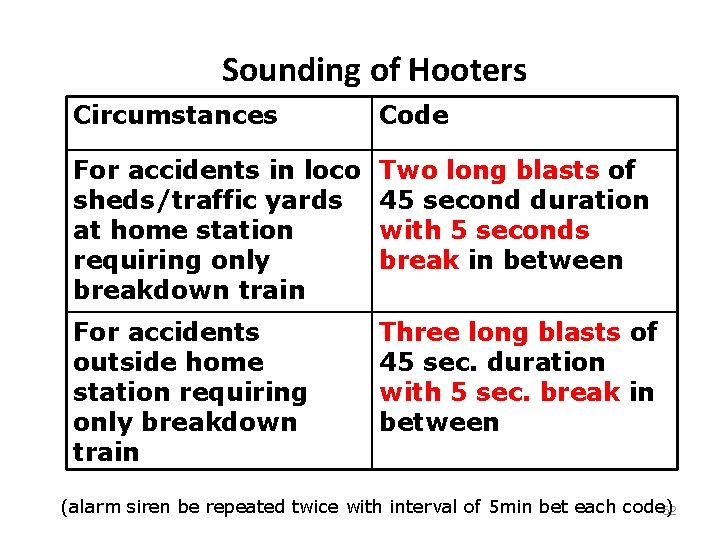
Sounding of Hooters Circumstances Code For accidents in loco sheds/traffic yards at home station requiring only breakdown train Two long blasts of 45 second duration with 5 seconds break in between For accidents outside home station requiring only breakdown train Three long blasts of 45 sec. duration with 5 sec. break in between (alarm siren be repeated twice with interval of 5 min bet each code) 62
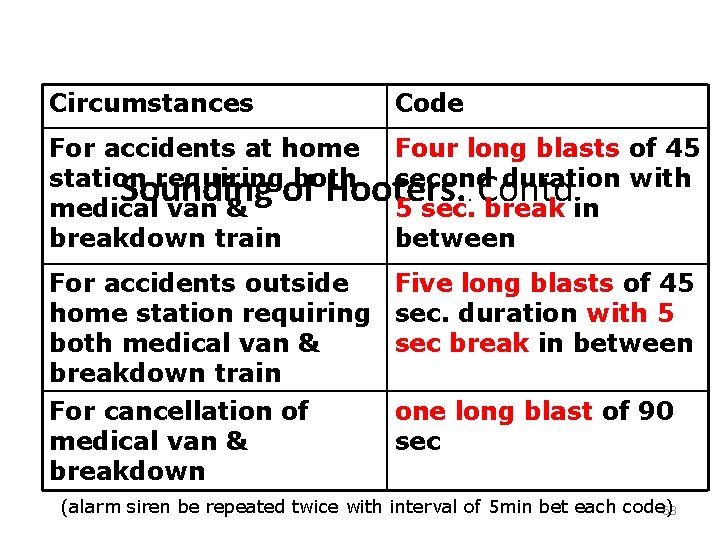
Circumstances Code For accidents at home Four long blasts of 45 station requiring both second duration with Sounding of Hooters. . Contd. medical van & 5 sec. break in breakdown train between For accidents outside home station requiring both medical van & breakdown train For cancellation of medical van & breakdown Five long blasts of 45 sec. duration with 5 sec break in between one long blast of 90 sec (alarm siren be repeated twice with interval of 5 min bet each code) 63
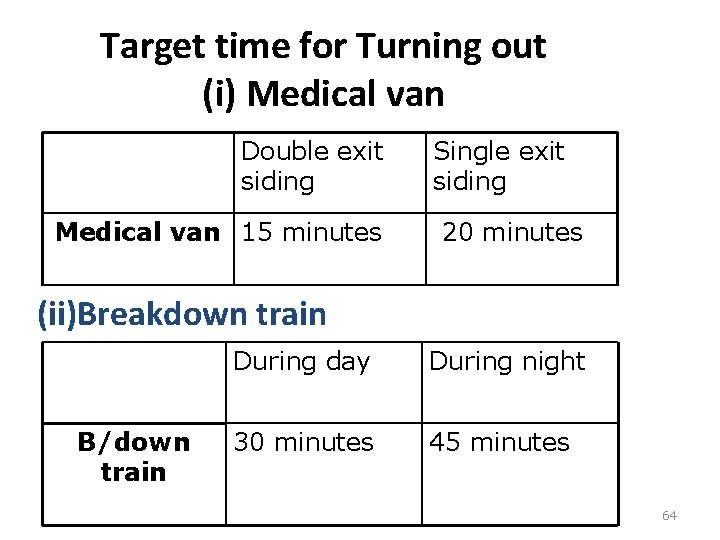
Target time for Turning out (i) Medical van Double exit siding Medical van 15 minutes Single exit siding 20 minutes (ii)Breakdown train B/down train During day During night 30 minutes 45 minutes 64
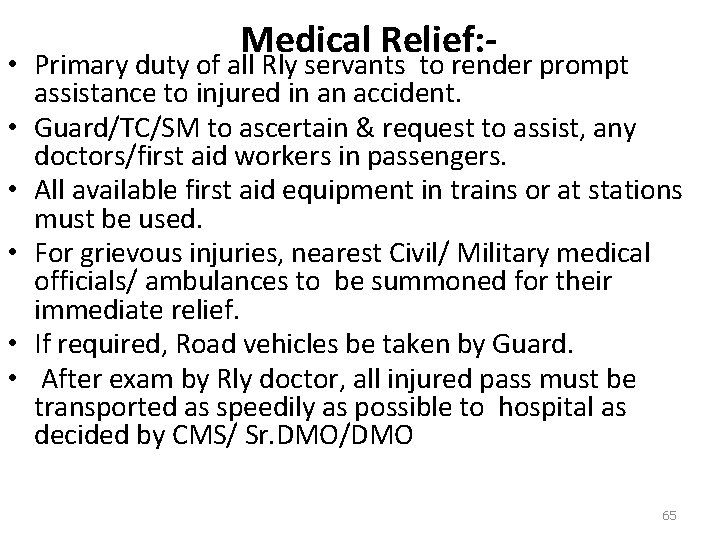
Medical Relief: - • Primary duty of all Rly servants to render prompt assistance to injured in an accident. • Guard/TC/SM to ascertain & request to assist, any doctors/first aid workers in passengers. • All available first aid equipment in trains or at stations must be used. • For grievous injuries, nearest Civil/ Military medical officials/ ambulances to be summoned for their immediate relief. • If required, Road vehicles be taken by Guard. • After exam by Rly doctor, all injured pass must be transported as speedily as possible to hospital as decided by CMS/ Sr. DMO/DMO 65
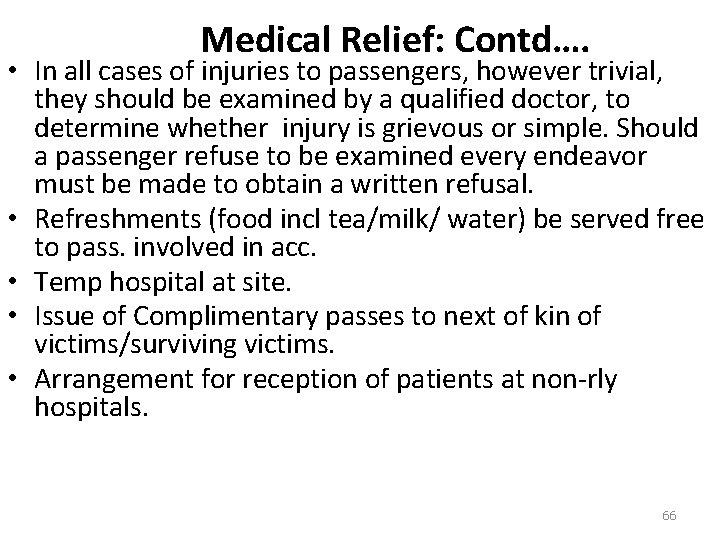
Medical Relief: Contd…. • In all cases of injuries to passengers, however trivial, they should be examined by a qualified doctor, to determine whether injury is grievous or simple. Should a passenger refuse to be examined every endeavor must be made to obtain a written refusal. • Refreshments (food incl tea/milk/ water) be served free to pass. involved in acc. • Temp hospital at site. • Issue of Complimentary passes to next of kin of victims/surviving victims. • Arrangement for reception of patients at non-rly hospitals. 66
Medical Relief : Contd… • Information of condition of pass. injured/ dead to their kith &kin free through telephone or Express telegrams, free of cost. • Every facility to be given to Rly doctors to reach site of acc with least possible delay • Ex-gratia payment to injured/next of kin. • Referring of injured to private hospitals, & Rly Dr to accompany injured, • Care of dead Bodies-Jointly decided with Police, Transportation be provided for taking charge of dead bodies by police till claimed by next of kin. RESPECT for dead bodies primary consideration, not be exposed to weather. . 67
Medical Relief : -Contd. . • Recording of information of injured/dead: • a responsible official be detailed by DRM to take details of injured/dead as mentioned and as indicated by the doctor such as Name, Full address, Ticket/Pass no with full particulars of journey, two marks of identifications, details of injuries, existing deformities & old scars. • No statement about nos/nature of casualties be given to public/press till all casualties/injuries are reconciled/verified correctly. Finally to be given by senior most Rly official on spot. 68
Noting of Imp facts at site: Any Officer/TI/SM/ Guard etc present at site/arriving first at site shall record relevant information: • Names/addresses of persons killed or injured, particulars of their injuries & tickets held, if available. • Obtain names/address of independent eyewitnesses & if possible, their statements duly attested. • to jointly examine all evidences, condition of track/rolling stock, BPC &preserve all clues for inquiry. 69
Noting of Imp facts at site: Contd. . • Measurement of track/rolling stock to be taken in specified proforma. • marks on sleepers, position of derailed vehicles, broken parts of track or vehicle & other particulars, which may have bearing on acc to be carefully noted & preserved. XL/G/ver. to be taken jointly in loaded/ Empty state. • not to interfere with rendering of Med. aid to injured/other relief measures to pass. • Senior most officer to ensure Jt observations correctly made out & signed by officials. 70
Clearing operations: - • Senior most officer to exercise supervision /coordination for restoration of traffic. • Due care during crane wkg, under competent officer. . • Where sabotage not suspected, clearance & restoration operations may be commenced even before the arrival of police, • but all relevant material & clues etc. must be carefully preserved to enable scene being reconstructed, if considered necessary 71
Clearing Operations: - Contd. . • In case sabotage suspected, clearance & restoration operation not be commenced until all -right signal from Police, • except when human life to be saved, in which case operations for clearing wreckage must go on continuously • until definitely known that all injured are extricated from the debris and established with medical testimony that only dead bodies remain, • care must however be taken to preserve clues etc. 72
Preservation of Clues: - • necessary to preserve all clues for helping CRS/accident enquiry committee, • Clearance to be limited to removal of deadbodies/injured persons from debris, • When circumstances compel removal of debris, in part/whole, notes to be recorded by senior most Officer present, • All sleepers, rails, S&T gears & other fittings removed from site to be carefully preserved for inspection by accident enquiry committee. 73
Information to Press/Media Nominated officer in liaison with CPRO to collect & disseminated information: • Brief description of the accident. • Time/date/Kilometerage of accident. • Train or trains involved. • composition of train, nos of vehicles derailed/capsized. • Brief account/ rough sketch showing condition & position of vehicles, with individual numbers, from which injured and killed were extricated. • Condition of lines at site of accident. 74
Information to Press/Media. . Contd…. • Railway officials at the site of accident/ No. of railway officials involved in restoration • No. of passengers killed/injured/ admitted in various hospitals. • Name/age/address of affected passengers. • Passengers evacuated. • Relief arrangements. • Description of injuries. • No. of passenger provided first aid. • Probable cause of accident. 75
Information to Press/Media…Contd… • Arrangements made for relatives of affected passengers. • Communication arrangements made. • Medical facilities at site. • Any medical aid received from outside. • Likely time restoration of traffic. • Any other trains regulated/diverted. • Information booths opened on railway. • Nature of enquiry ordered in accident. • In general, steps taken by railway for safe running of trains. 76
Procedure for dealing with case of sabotage or train wrecking Contd… Derailment/other serious consequences arises due to suspected sabotage or train wrecking, Guard along with Engine Crew/ other Railway Staff on board shall : • protect the train. • report acc to control office/adjacent stn. • render first aid to injured. • carefully examine track jointly with responsible passengers, & record duly signed by them. 78
Sabotage /train wrecking: Contd. . • ensure that portions of track, rails, fish plates, bolts and other fittings, appearing to have been tampered with are not touched or moved by any persons, and that these are closely protected till arrival of the Civil & Police Authorities. • SM of station adjacent to site of suspected sabotage or train wrecking must inform the local Civil Police, GRP and RPF authorities by quickest means available & give them all possible assistance to reach site as early as possible. 79
Sabotage /train wrecking. . Contd. Precautions by ADEN/SE(P. way) • Instruct the Gangmen proceeding to the site, not to carry any tools with them. • Ensure that tool boxes of Gangmen sent to site are not opened until checked by Police. • Instruct them not to touch or remove any portions of track, rails, fishplates, bolts and other fittings within the area of suspected sabotage or train wrecking till inspected by Railway, Civil and Police Authorities and photographs etc. taken. 80
Sabotage /train wrecking: Contd. . All concerned Officers & Senior Sup. in addition to their normal duties must : • Take note of casualties/injuries. • Prepare sketches of the accident. • collect evidence to throw light on cause • See that likely clues to cause of accident are not inadvertently removed through ignorance or curiosity. • arrange Photography/ vediography of portion of p. way, track, rails, f/p, bolts, & other fittings Engine & bogies of affected train as early as possible by Local Photographer / Videographer. 81
Handling of Wreckage: • Wreckage, etc. not to be disturbed until permission is given by Police • delay in arrival of Civil & Police officials at site, Senior most rly official at site may, at his discretion, jack up any portion of a coach or shift any property to the minimum extent necessary, after noting its original position by sketch, to extricate human beings trapped under. • Normal traffic, should however, not be permitted without consulting the police. 82
(VI). Unusual Occurrences. . • Every Rly servant, on duty/not, notices anything unusual/dangerous on train; hot axle/spring broken/flat tyre/brake binding/ load falling off/fire/any part of veh. Hanging/ detached loose part etc. in dangerous condition, must at once take steps to stop train & warn Guard & Driver. • If cant stop, inform nearest SM/GK/Rly official • Rly official to exhibit danger h/s to driver/Gd & make all efforts to stop train at once & if possible, by putting back signals to ON position, advising TPC to switch off OHE supply. SM to inform sec. controller/SM of station ahead. 83
Precautions at construction / repair sites: • Whenever platforms, buildings, roads, shade foundation etc. are under repairs, and there is a possibility of any one falling into trenches or over obstructions, barriers, or warning boards and lamp posts must be placed to protect those sites by staff employed on the work. • Supervisor incharge must ensure that this is done. 84
Reporting cases of Fire: • position of vehicle on train to be stated, whether loaded or empty. • Unless definitely substantiated fire on trains/ station premises, SMs/others not to ascribe fire to sparks from engine/electric short circuit. • SM/Control Office to send information immediately to concerned officials of Forensic Laboratory which caters area so as to enable their Scientist to attend site of accident promptly for collecting clues / samples leading to cause of fire 94
Fire : Rendering of assistance by Gangmen : - • Gangmen shall endeavor to extinguish/ prevent it from spreading. • However in case of fire in on electrical equipment, shall make no attempt to extinguish fire but shall report occurrence to nearest Station Master immediately and shall inform any passing train or trolley, unless special instructions shall have been received directing otherwise. • If there be more than one Gangman, occurrence shall be reported to SM on both sides. 95
(VII/VIII) Investigation & Inquiries Investigation on the spot : Officers/Sen. Sub at site of accident must jointly investigate cause & advise DRM/other officers concerned, their opinion, mentioning Dept(s) & person(s) responsible for occurrence. It includes recording of statements of staff concerned/other independent witnesses 96
Investigation: - inf. to be collected by Sup. on spot to facilitate inquiry Comm to arrive at cause of Acc. . (a)Driver Signal Passing at Danger: • to avoid dispute later, fact that a Driver has passed a signal at danger should be brought to his notice. • Switchman/Cabin ASM/SM must confront Driver/Guard with regard to position of signal & position of lever concerned. • position of signal & route should be recorded/signed by SM with driver/guard/other witnesses, if available. 97
(a) Driver Signal Passing at Danger: Contd. • distance by which train has passed signal should be recorded in engine+bogie lengths and/or telegraph posts & by measuring actual distance in meters. • During night, brightness of signals to be noted. weather condition/visibility to be recorded. • If Driver is required to use glasses, it should be checked whether he was in possession of them and using them. 98
(a) Driver Signal Passing at Danger: Contd. • Arrangement for testing brake power of train to be made by Officers/Sr. Subordinates at the nearest Loco Changing or C&W examination point. • Breathalyzer testing of driver should be done. • Driver must be relieved immediately & sent for medical exam. 99
(b) Collision and averted collision: • position of signal levers/point levers/block instruments to be immediately checked/noted • Train Signal Register to be signed to indicate last entry made & then seized. • position of two trains or train & obstruction to be marked on sleepers. In-between distance to be measured in metres in case of averted collision. • Draw Sketch showing their position vis-à-vis signals/station p/f, turnouts & other fixed land marks. 100
(b) Collision and averted collision: Contd. . • Arrangement for testing brake power of the train shall be made by Officers/Sr. Subordinates at the nearest Loco Changing or C&W examination point. • Breathalyzer test of the driver should be done immediately. • driver shall be sent for further medical examination 101
(c ) Derailment: • Track measurements to be taken, sketch in accordance with instructions in App. XI, XII/ • Rolling stock as per App. XI & XIX. For Loco derailments, as per proforma in App-XI. • rail fittings & point roddings including locking arrangement to be examined. any obstruction resulting in a gap in points to be seen. Observe marks on rails/sleepers. • derailments during shunting- check who was actually supervising, • position of shunt sig, point levers, point/track indicators concerned to be recorded. 102
(d) Accident at Manned LC: • • • Location/number, Whether engg or traffic? Whether interlocked or non-interlocked? Duty roster/Competency of GK Visibility of signals /Visibility for road users. Condition of Rd surface/approach Rd Last census date/TVU. Length/cleanliness of check rails. GWR validity/Availability of safety equipment. Inspections by Off/Sup, their last inspection, Availability of Whistle boards, Road signs, speed breakers & stop boards etc. 103
(e) Accident at U/M LC: • • Location/number of LC. Curve or straight for track & road separately. Visibility for road users & driver separately. Condition of road surface & approaches, Last census date & TVU. Length & cleanliness of check rails. Availability of Whistle boards, Road signs, speed breakers & stop boards etc. 104
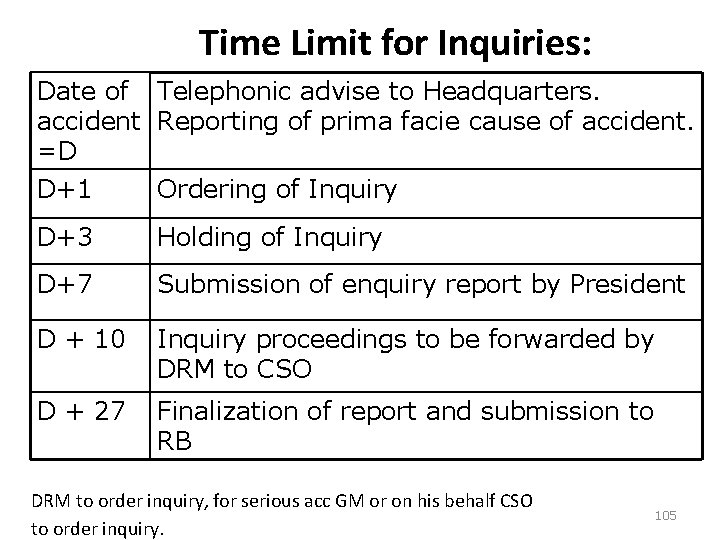
Time Limit for Inquiries: Date of Telephonic advise to Headquarters. accident Reporting of prima facie cause of accident. =D D+1 Ordering of Inquiry D+3 Holding of Inquiry D+7 Submission of enquiry report by President D + 10 Inquiry proceedings to be forwarded by DRM to CSO D + 27 Finalization of report and submission to RB DRM to order inquiry, for serious acc GM or on his behalf CSO to order inquiry. 105
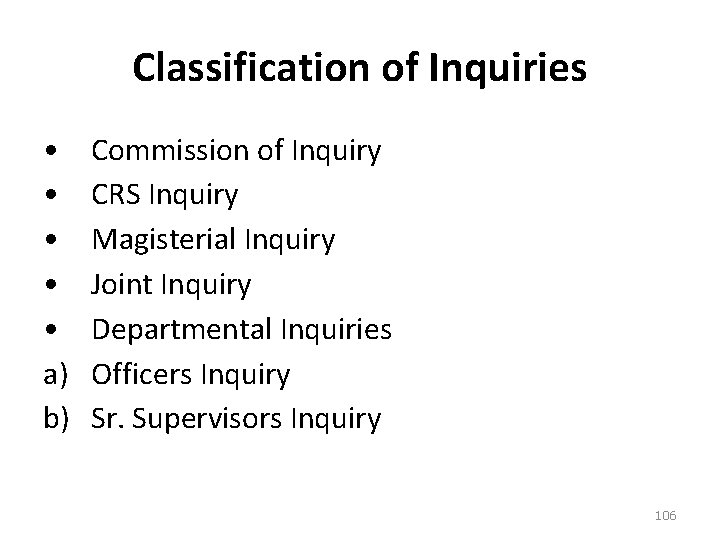
Classification of Inquiries • • • a) b) Commission of Inquiry CRS Inquiry Magisterial Inquiry Joint Inquiry Departmental Inquiries Officers Inquiry Sr. Supervisors Inquiry 106
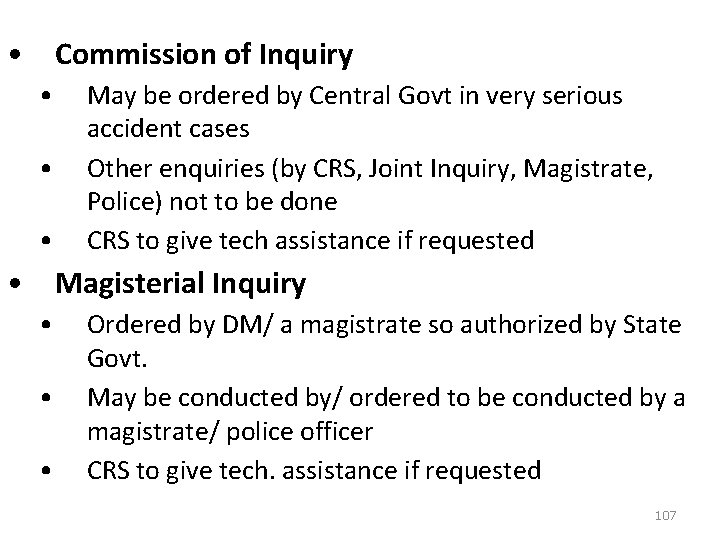
• Commission of Inquiry • • May be ordered by Central Govt in very serious accident cases Other enquiries (by CRS, Joint Inquiry, Magistrate, Police) not to be done CRS to give tech assistance if requested Magisterial Inquiry • • • Ordered by DM/ a magistrate so authorized by State Govt. May be conducted by/ ordered to be conducted by a magistrate/ police officer CRS to give tech. assistance if requested 107
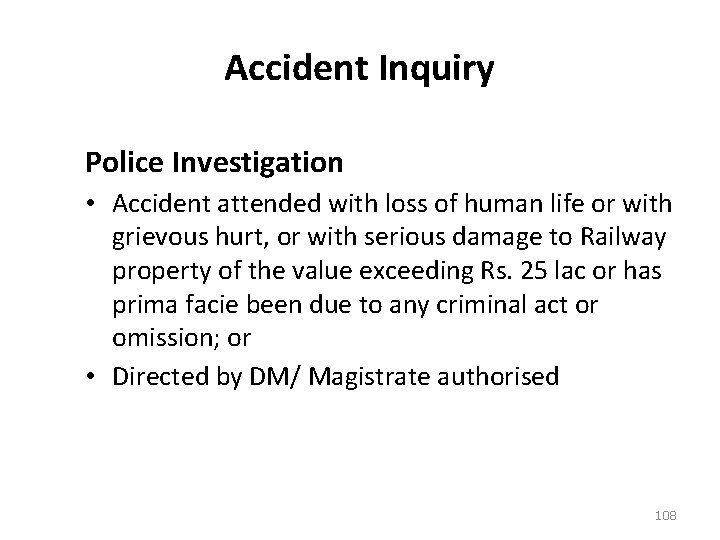
Accident Inquiry Police Investigation • Accident attended with loss of human life or with grievous hurt, or with serious damage to Railway property of the value exceeding Rs. 25 lac or has prima facie been due to any criminal act or omission; or • Directed by DM/ Magistrate authorised 108
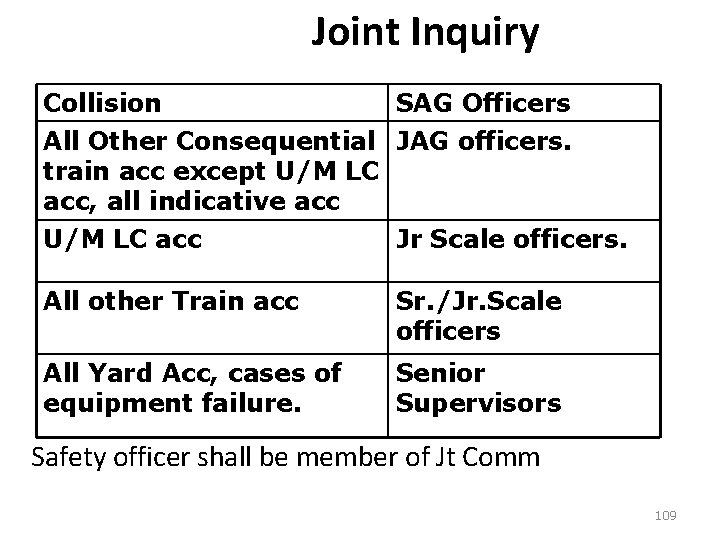
Joint Inquiry Collision SAG Officers All Other Consequential JAG officers. train acc except U/M LC acc, all indicative acc U/M LC acc Jr Scale officers. All other Train acc Sr. /Jr. Scale officers All Yard Acc, cases of equipment failure. Senior Supervisors Safety officer shall be member of Jt Comm 109
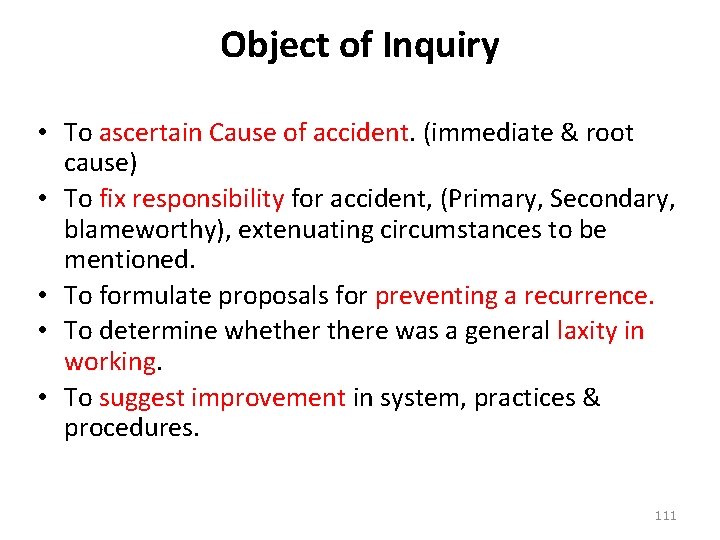
Object of Inquiry • To ascertain Cause of accident. (immediate & root cause) • To fix responsibility for accident, (Primary, Secondary, blameworthy), extenuating circumstances to be mentioned. • To formulate proposals for preventing a recurrence. • To determine whethere was a general laxity in working. • To suggest improvement in system, practices & procedures. 111
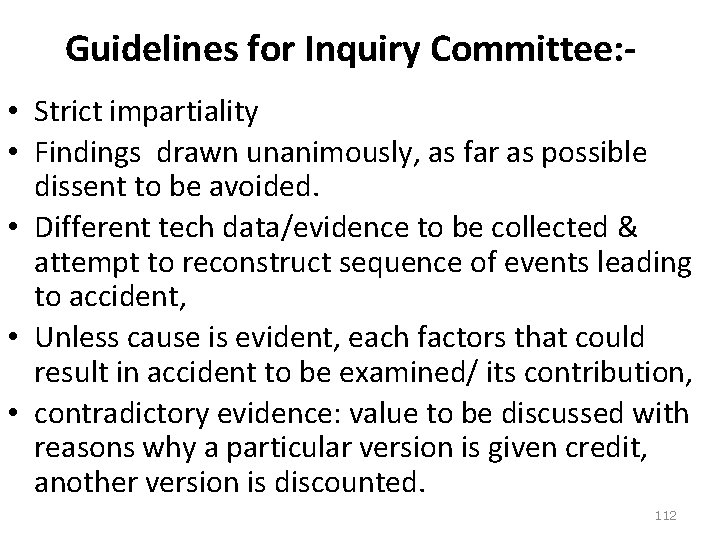
Guidelines for Inquiry Committee: • Strict impartiality • Findings drawn unanimously, as far as possible dissent to be avoided. • Different tech data/evidence to be collected & attempt to reconstruct sequence of events leading to accident, • Unless cause is evident, each factors that could result in accident to be examined/ its contribution, • contradictory evidence: value to be discussed with reasons why a particular version is given credit, another version is discounted. 112
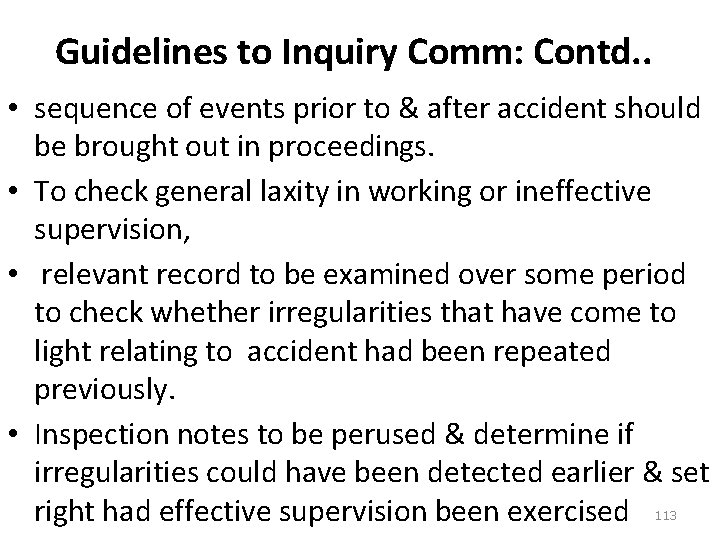
Guidelines to Inquiry Comm: Contd. . • sequence of events prior to & after accident should be brought out in proceedings. • To check general laxity in working or ineffective supervision, • relevant record to be examined over some period to check whether irregularities that have come to light relating to accident had been repeated previously. • Inspection notes to be perused & determine if irregularities could have been detected earlier & set right had effective supervision been exercised 113
Inquiry Committee to also examine : • Whether staff have passed prescribed medical examination. • In case of staff having glasses whether using them at time of the accident or not, • Hrs of work & previous rest of staff concerned & compliance of rostered duties/hrs of employment regulations, • Whether staff acquainted with rules pertaining to their duties and possessed necessary competency certificates, • Whether staff possessing prescribed Rule Books. 114
Finding of Inquiry : • To consist of a simple statement of opinion of Committee as to what caused the accident, mentioning staff responsible, if any, & rules violated or offence committed by them. • Also mention under which of the following categories accident falls • (a)Failure of Railway staff; (b)Failure of other than Railway staff; (c) Failure of locomotive or Rolling Stock; (d) Failure of permanent way; (e) Failure of electrical, signaling and other equipment; (f) Fires; (g) Accidental or act of God; (h) Not definitely determinable 115
Finding of Inquiry : • If a Member does not agree with findings, he can record his note of Dissent with reasons which must be drawn up on the spot & to accompany the proceedings. • Committee must state fully reasons to arrive at their findings. • Committee to bear in mind that proceedings have to be considered by those who have not had advantage of hearing evidence & reviewing circumstances on spot. 116
Finding of Inquiry: - Contd… • Description & remarks should, therefore, be complete & knowledge on the part of others, who have to peruse proceeding, of conditions obtaining at the time & place of occurrence should not be assumed. • The value of evidence of each witness should be commented upon. 117
• Recommendations : - of proposals for prevention of such accidents. • Committee to examine system of working & may suggest improvements in system, which, would prevent such accidents in future. Rules & procedures which can not be implemented/ difficult to implement to be commented upon. • Other matters brought to light : - highlight observations which have not contributed directly in cause of accident but are of a serious nature. Any alertness shown by any staff/other persons to prevent accident should also be highlighted. 118
Norms of punishments to be imposed in accident cases: • The norms of punishments prescribed by railway board as per App. XXII. should be followed rigidly. • Sr. DSO shall personally monitor that punishment awarded to the defaulters is as per the norms. • If it is inadequate, he will put the case to the DRM for review. • A monthly summary of such cases shall be sent by Sr. DSO to CSO. 119

THANKS 120
121
Human Attributes • Be Cool, Calm, Composed. • Behave decently with -Passengers, Fellow Officers, Staff • Take personal care of staff- Conveyance , Keeping Belonging at site, Keeping Tools at sites • Arrange food for staff • Take care of injured staff • Arrange Medical Team at site 122
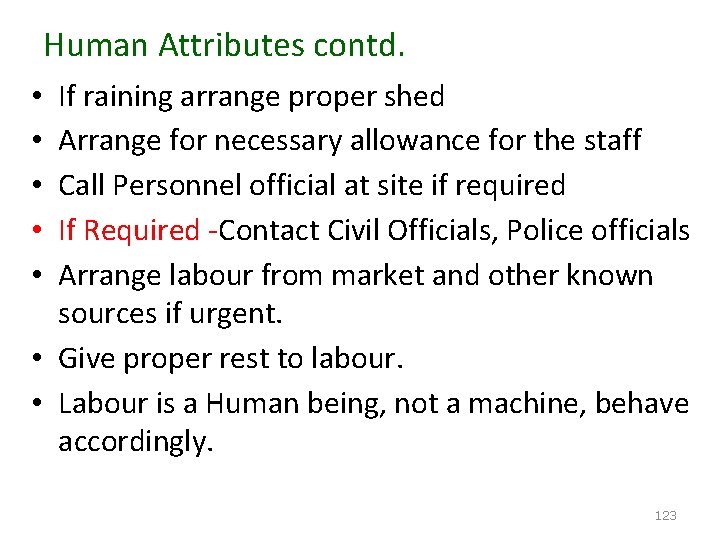
Human Attributes contd. If raining arrange proper shed Arrange for necessary allowance for the staff Call Personnel official at site if required If Required -Contact Civil Officials, Police officials Arrange labour from market and other known sources if urgent. • Give proper rest to labour. • Labour is a Human being, not a machine, behave accordingly. • • • 123
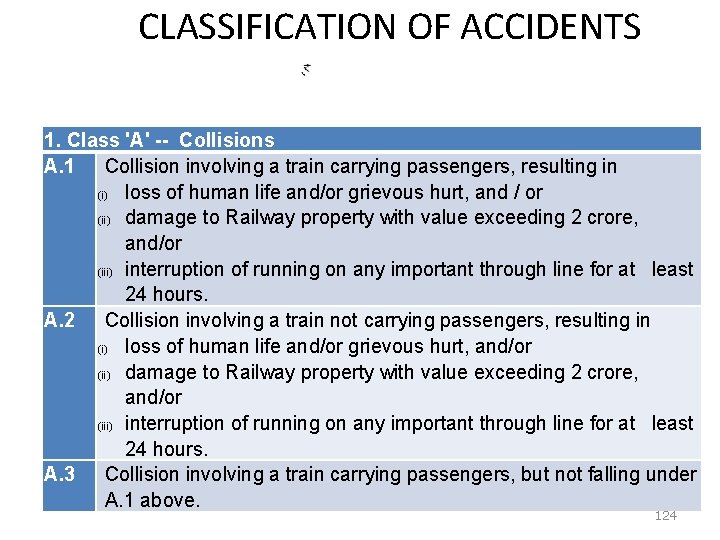
CLASSIFICATION OF ACCIDENTS 1. Class 'A' -- Collisions A. 1 Collision involving a train carrying passengers, resulting in (i) loss of human life and/or grievous hurt, and / or (ii) damage to Railway property with value exceeding 2 crore, and/or (iii) interruption of running on any important through line for at least 24 hours. A. 2 Collision involving a train not carrying passengers, resulting in (i) loss of human life and/or grievous hurt, and/or (ii) damage to Railway property with value exceeding 2 crore, and/or (iii) interruption of running on any important through line for at least 24 hours. A. 3 Collision involving a train carrying passengers, but not falling under A. 1 above. 124
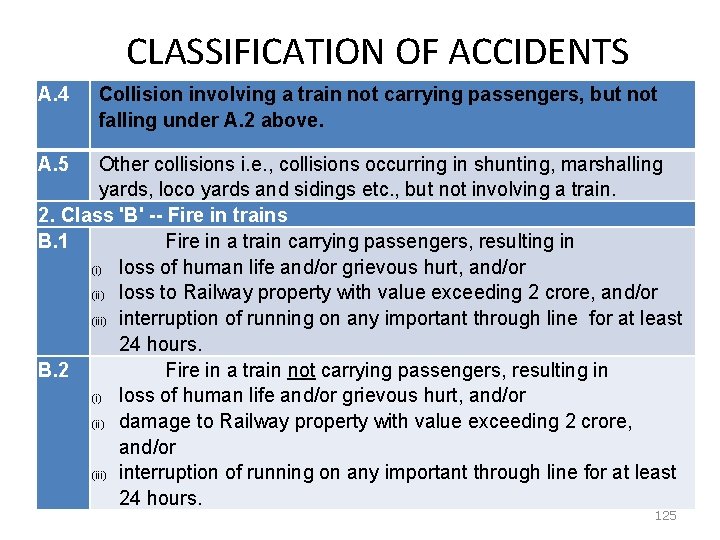
CLASSIFICATION OF ACCIDENTS A. 4 Collision involving a train not carrying passengers, but not falling under A. 2 above. A. 5 Other collisions i. e. , collisions occurring in shunting, marshalling yards, loco yards and sidings etc. , but not involving a train. 2. Class 'B' -- Fire in trains B. 1 Fire in a train carrying passengers, resulting in (i) loss of human life and/or grievous hurt, and/or (ii) loss to Railway property with value exceeding 2 crore, and/or (iii) interruption of running on any important through line for at least 24 hours. B. 2 Fire in a train not carrying passengers, resulting in (i) loss of human life and/or grievous hurt, and/or (ii) damage to Railway property with value exceeding 2 crore, and/or (iii) interruption of running on any important through line for at least 24 hours. 125
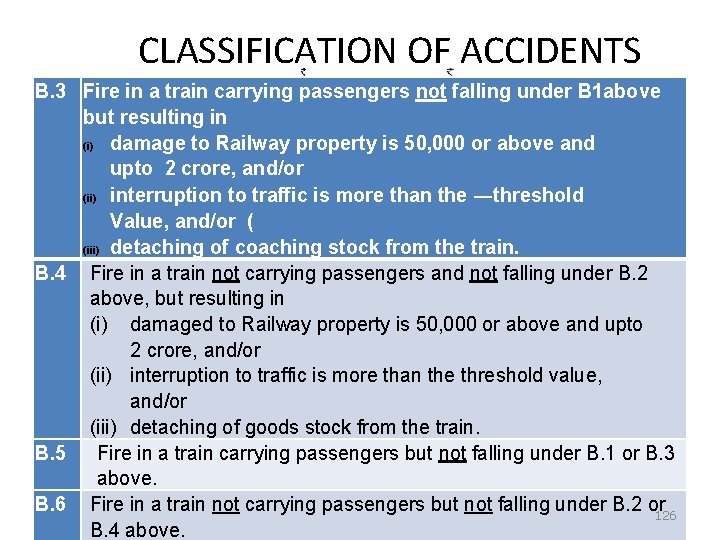
CLASSIFICATION OF ACCIDENTS B. 3 Fire in a train carrying passengers not falling under B 1 above but resulting in (i) damage to Railway property is 50, 000 or above and upto 2 crore, and/or (ii) interruption to traffic is more than the ―threshold Value, and/or ( (iii) detaching of coaching stock from the train. B. 4 Fire in a train not carrying passengers and not falling under B. 2 above, but resulting in (i) damaged to Railway property is 50, 000 or above and upto 2 crore, and/or (ii) interruption to traffic is more than the threshold value, and/or (iii) detaching of goods stock from the train. B. 5 Fire in a train carrying passengers but not falling under B. 1 or B. 3 above. B. 6 Fire in a train not carrying passengers but not falling under B. 2 or 126 B. 4 above.
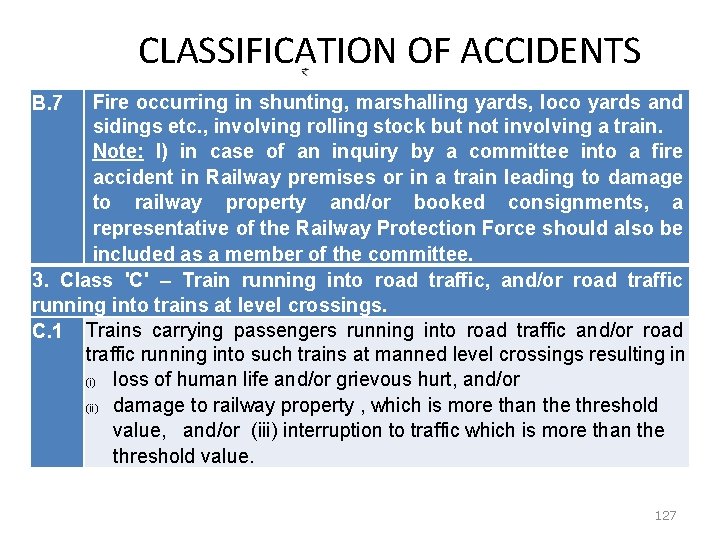
CLASSIFICATION OF ACCIDENTS Fire occurring in shunting, marshalling yards, loco yards and sidings etc. , involving rolling stock but not involving a train. Note: I) in case of an inquiry by a committee into a fire accident in Railway premises or in a train leading to damage to railway property and/or booked consignments, a representative of the Railway Protection Force should also be included as a member of the committee. 3. Class 'C' – Train running into road traffic, and/or road traffic running into trains at level crossings. C. 1 Trains carrying passengers running into road traffic and/or road traffic running into such trains at manned level crossings resulting in (i) loss of human life and/or grievous hurt, and/or (ii) damage to railway property , which is more than the threshold value, and/or (iii) interruption to traffic which is more than the threshold value. B. 7 127
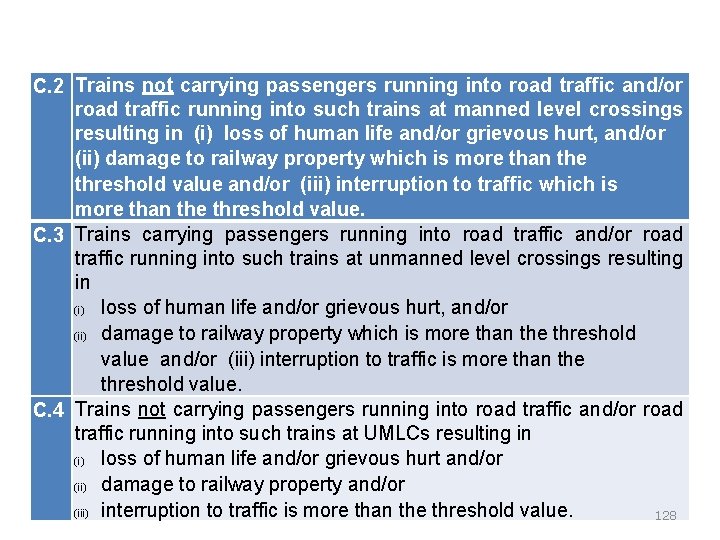
C. 2 Trains not carrying passengers running into road traffic and/or road traffic running into such trains at manned level crossings resulting in (i) loss of human life and/or grievous hurt, and/or (ii) damage to railway property which is more than the threshold value and/or (iii) interruption to traffic which is more than the threshold value. C. 3 Trains carrying passengers running into road traffic and/or road traffic running into such trains at unmanned level crossings resulting in (i) loss of human life and/or grievous hurt, and/or (ii) damage to railway property which is more than the threshold value and/or (iii) interruption to traffic is more than the threshold value. C. 4 Trains not carrying passengers running into road traffic and/or road traffic running into such trains at UMLCs resulting in (i) loss of human life and/or grievous hurt and/or (ii) damage to railway property and/or (iii) interruption to traffic is more than the threshold value. 128
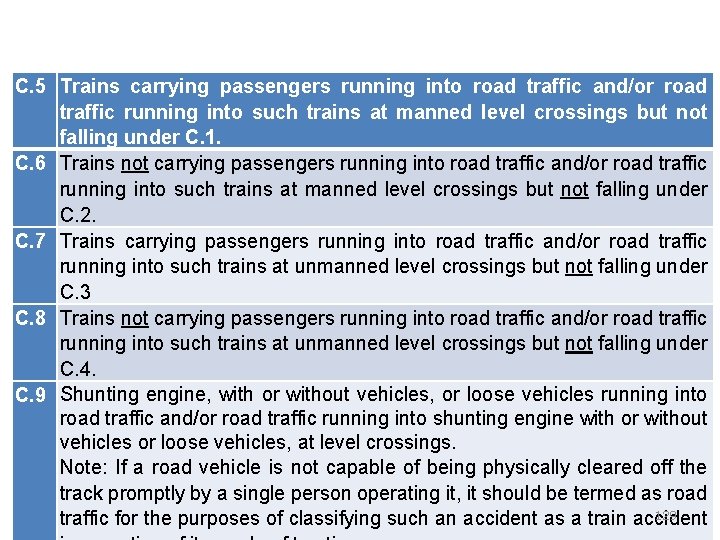
C. 5 Trains carrying passengers running into road traffic and/or road traffic running into such trains at manned level crossings but not falling under C. 1. C. 6 Trains not carrying passengers running into road traffic and/or road traffic running into such trains at manned level crossings but not falling under C. 2. C. 7 Trains carrying passengers running into road traffic and/or road traffic running into such trains at unmanned level crossings but not falling under C. 3 C. 8 Trains not carrying passengers running into road traffic and/or road traffic running into such trains at unmanned level crossings but not falling under C. 4. C. 9 Shunting engine, with or without vehicles, or loose vehicles running into road traffic and/or road traffic running into shunting engine with or without vehicles or loose vehicles, at level crossings. Note: If a road vehicle is not capable of being physically cleared off the track promptly by a single person operating it, it should be termed as road 129 traffic for the purposes of classifying such an accident as a train accident
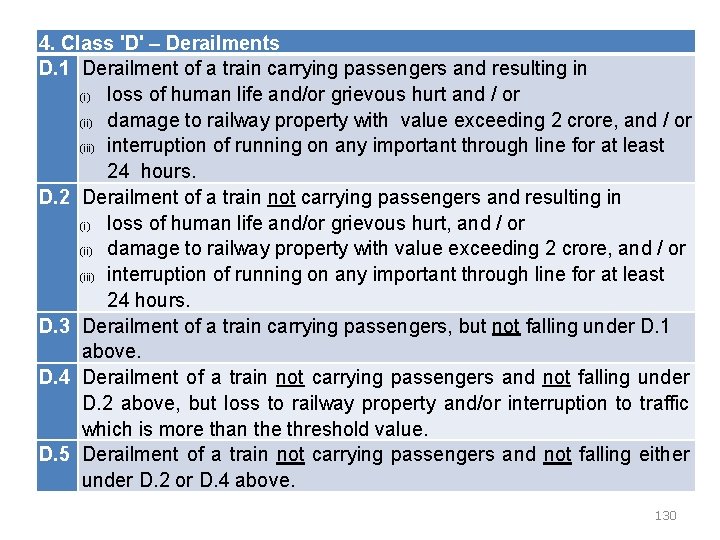
4. Class 'D' – Derailments D. 1 Derailment of a train carrying passengers and resulting in (i) loss of human life and/or grievous hurt and / or (ii) damage to railway property with value exceeding 2 crore, and / or (iii) interruption of running on any important through line for at least 24 hours. D. 2 Derailment of a train not carrying passengers and resulting in (i) loss of human life and/or grievous hurt, and / or (ii) damage to railway property with value exceeding 2 crore, and / or (iii) interruption of running on any important through line for at least 24 hours. D. 3 Derailment of a train carrying passengers, but not falling under D. 1 above. D. 4 Derailment of a train not carrying passengers and not falling under D. 2 above, but loss to railway property and/or interruption to traffic which is more than the threshold value. D. 5 Derailment of a train not carrying passengers and not falling either under D. 2 or D. 4 above. 130
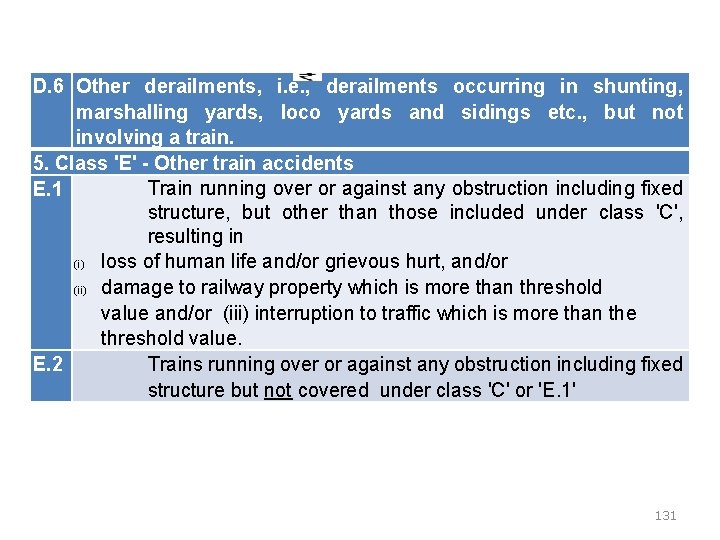
D. 6 Other derailments, i. e. , derailments occurring in shunting, marshalling yards, loco yards and sidings etc. , but not involving a train. 5. Class 'E' - Other train accidents Train running over or against any obstruction including fixed E. 1 structure, but other than those included under class 'C', resulting in (i) loss of human life and/or grievous hurt, and/or (ii) damage to railway property which is more than threshold value and/or (iii) interruption to traffic which is more than the threshold value. E. 2 Trains running over or against any obstruction including fixed structure but not covered under class 'C' or 'E. 1' 131
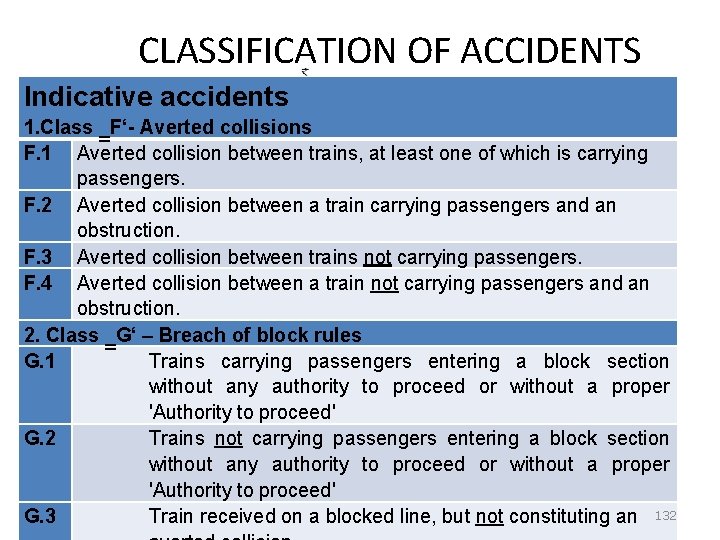
CLASSIFICATION OF ACCIDENTS Indicative accidents 1. Class ‗F‘- Averted collisions F. 1 Averted collision between trains, at least one of which is carrying passengers. F. 2 Averted collision between a train carrying passengers and an obstruction. F. 3 Averted collision between trains not carrying passengers. F. 4 Averted collision between a train not carrying passengers and an obstruction. 2. Class ‗G‘ – Breach of block rules G. 1 Trains carrying passengers entering a block section without any authority to proceed or without a proper 'Authority to proceed' G. 2 Trains not carrying passengers entering a block section without any authority to proceed or without a proper 'Authority to proceed' G. 3 Train received on a blocked line, but not constituting an 132
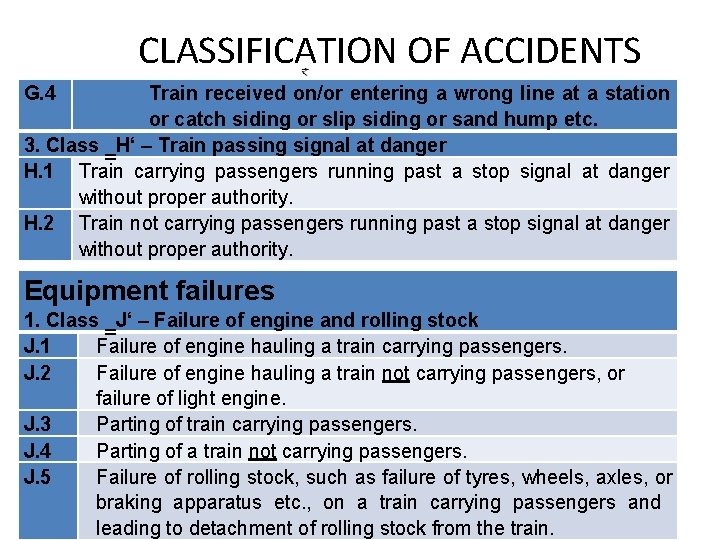
CLASSIFICATION OF ACCIDENTS G. 4 Train received on/or entering a wrong line at a station or catch siding or slip siding or sand hump etc. 3. Class ‗H‘ – Train passing signal at danger H. 1 Train carrying passengers running past a stop signal at danger without proper authority. H. 2 Train not carrying passengers running past a stop signal at danger without proper authority. Equipment failures 1. Class ‗J‘ – Failure of engine and rolling stock J. 1 Failure of engine hauling a train carrying passengers. J. 2 Failure of engine hauling a train not carrying passengers, or failure of light engine. J. 3 Parting of train carrying passengers. J. 4 Parting of a train not carrying passengers. J. 5 Failure of rolling stock, such as failure of tyres, wheels, axles, or braking apparatus etc. , on a train carrying passengers and 133 leading to detachment of rolling stock from the train.
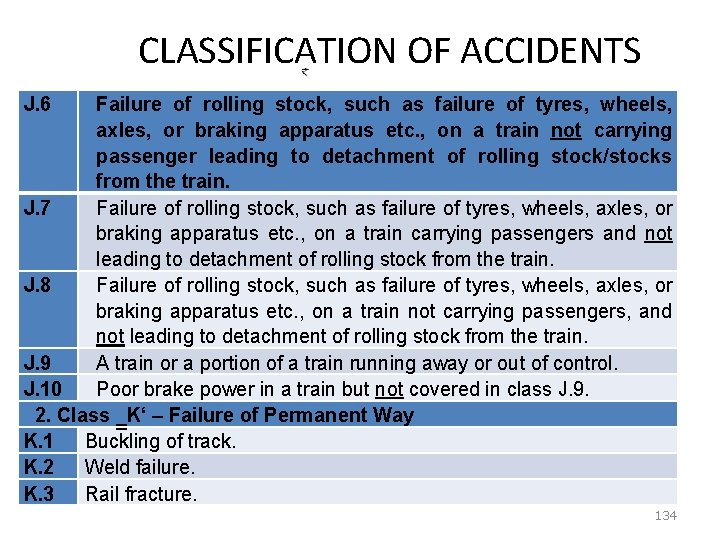
CLASSIFICATION OF ACCIDENTS J. 6 Failure of rolling stock, such as failure of tyres, wheels, axles, or braking apparatus etc. , on a train not carrying passenger leading to detachment of rolling stock/stocks from the train. J. 7 Failure of rolling stock, such as failure of tyres, wheels, axles, or braking apparatus etc. , on a train carrying passengers and not leading to detachment of rolling stock from the train. J. 8 Failure of rolling stock, such as failure of tyres, wheels, axles, or braking apparatus etc. , on a train not carrying passengers, and not leading to detachment of rolling stock from the train. J. 9 A train or a portion of a train running away or out of control. J. 10 Poor brake power in a train but not covered in class J. 9. 2. Class ‗K‘ – Failure of Permanent Way K. 1 Buckling of track. K. 2 Weld failure. K. 3 Rail fracture. 134
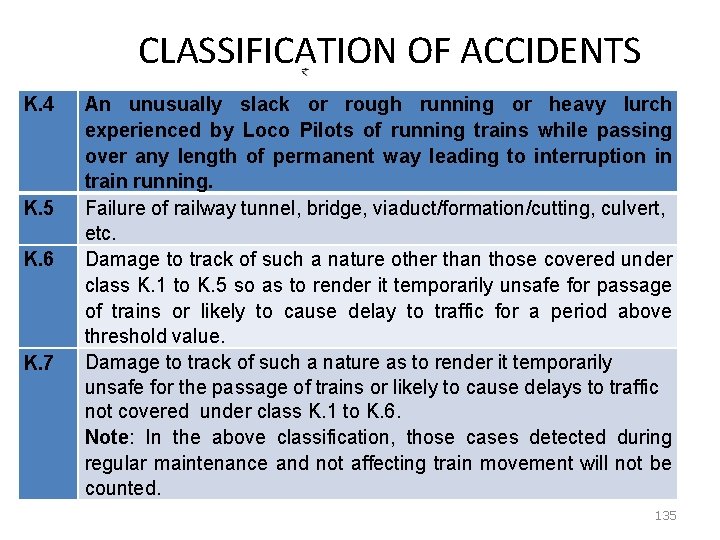
CLASSIFICATION OF ACCIDENTS K. 4 K. 5 K. 6 K. 7 An unusually slack or rough running or heavy lurch experienced by Loco Pilots of running trains while passing over any length of permanent way leading to interruption in train running. Failure of railway tunnel, bridge, viaduct/formation/cutting, culvert, etc. Damage to track of such a nature other than those covered under class K. 1 to K. 5 so as to render it temporarily unsafe for passage of trains or likely to cause delay to traffic for a period above threshold value. Damage to track of such a nature as to render it temporarily unsafe for the passage of trains or likely to cause delays to traffic not covered under class K. 1 to K. 6. Note: In the above classification, those cases detected during regular maintenance and not affecting train movement will not be counted. 135
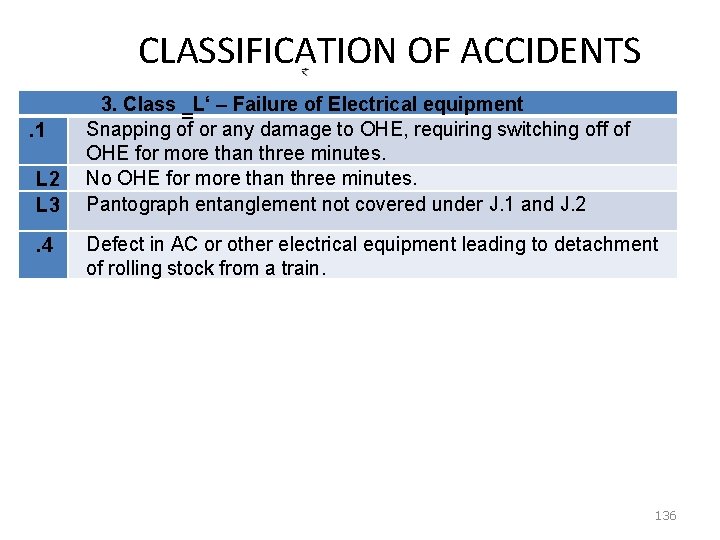
CLASSIFICATION OF ACCIDENTS. 1 L 2 L 3. 4 3. Class ‗L‘ – Failure of Electrical equipment Snapping of or any damage to OHE, requiring switching off of OHE for more than three minutes. No OHE for more than three minutes. Pantograph entanglement not covered under J. 1 and J. 2 Defect in AC or other electrical equipment leading to detachment of rolling stock from a train. 136
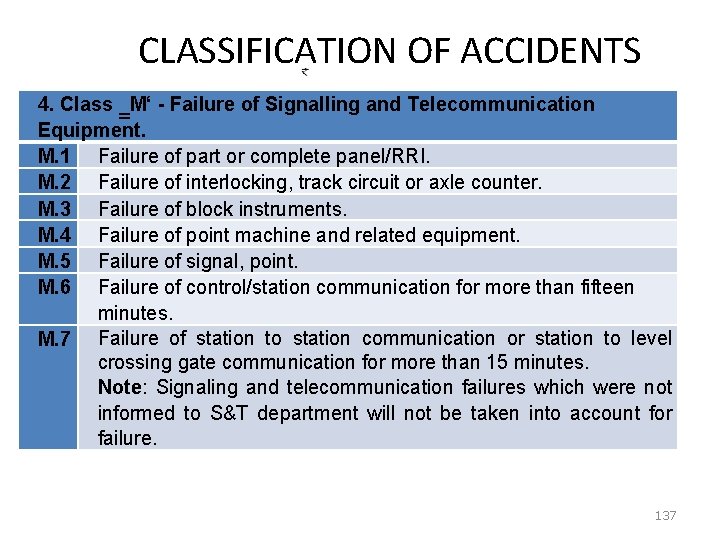
CLASSIFICATION OF ACCIDENTS 4. Class ‗M‘ - Failure of Signalling and Telecommunication Equipment. M. 1 Failure of part or complete panel/RRI. M. 2 Failure of interlocking, track circuit or axle counter. M. 3 Failure of block instruments. M. 4 Failure of point machine and related equipment. M. 5 Failure of signal, point. M. 6 Failure of control/station communication for more than fifteen minutes. M. 7 Failure of station to station communication or station to level crossing gate communication for more than 15 minutes. Note: Signaling and telecommunication failures which were not informed to S&T department will not be taken into account for failure. 137
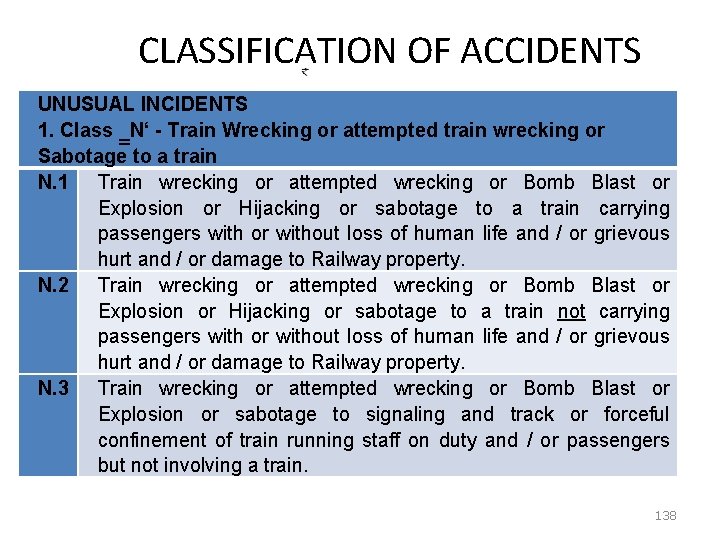
CLASSIFICATION OF ACCIDENTS UNUSUAL INCIDENTS 1. Class ‗N‘ - Train Wrecking or attempted train wrecking or Sabotage to a train N. 1 Train wrecking or attempted wrecking or Bomb Blast or Explosion or Hijacking or sabotage to a train carrying passengers with or without loss of human life and / or grievous hurt and / or damage to Railway property. N. 2 Train wrecking or attempted wrecking or Bomb Blast or Explosion or Hijacking or sabotage to a train not carrying passengers with or without loss of human life and / or grievous hurt and / or damage to Railway property. N. 3 Train wrecking or attempted wrecking or Bomb Blast or Explosion or sabotage to signaling and track or forceful confinement of train running staff on duty and / or passengers but not involving a train. 138
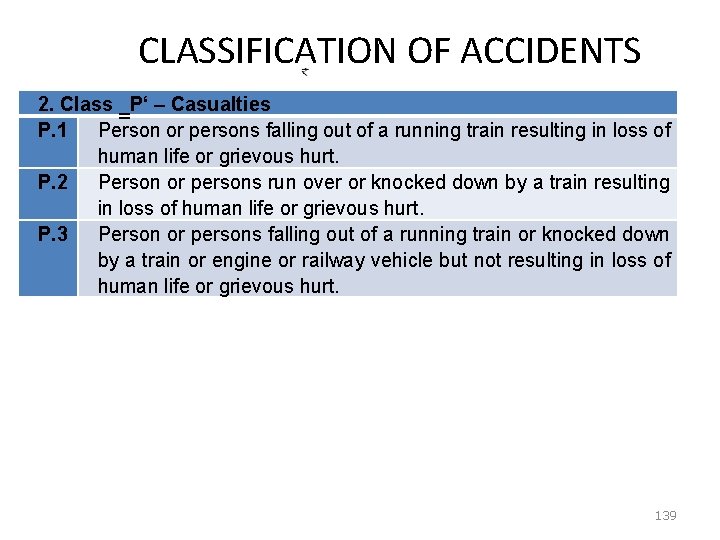
CLASSIFICATION OF ACCIDENTS 2. Class ‗P‘ – Casualties P. 1 Person or persons falling out of a running train resulting in loss of human life or grievous hurt. P. 2 Person or persons run over or knocked down by a train resulting in loss of human life or grievous hurt. P. 3 Person or persons falling out of a running train or knocked down by a train or engine or railway vehicle but not resulting in loss of human life or grievous hurt. 139
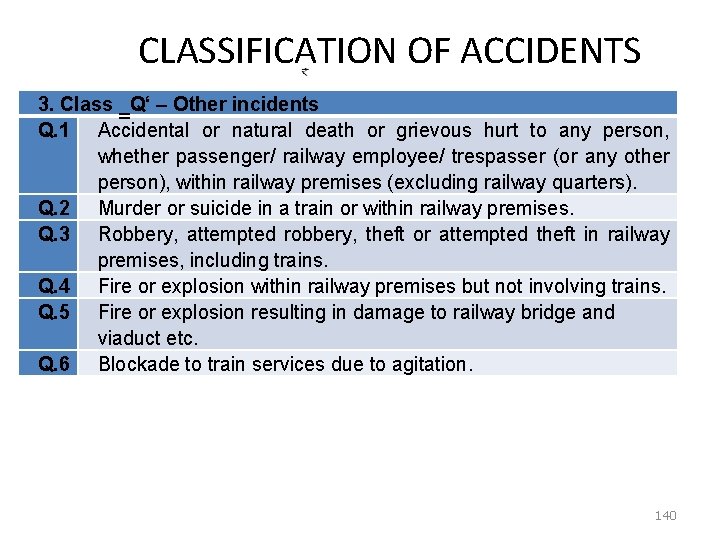
CLASSIFICATION OF ACCIDENTS 3. Class ‗Q‘ – Other incidents Q. 1 Accidental or natural death or grievous hurt to any person, whether passenger/ railway employee/ trespasser (or any other person), within railway premises (excluding railway quarters). Q. 2 Murder or suicide in a train or within railway premises. Q. 3 Robbery, attempted robbery, theft or attempted theft in railway premises, including trains. Q. 4 Fire or explosion within railway premises but not involving trains. Q. 5 Fire or explosion resulting in damage to railway bridge and viaduct etc. Q. 6 Blockade to train services due to agitation. 140
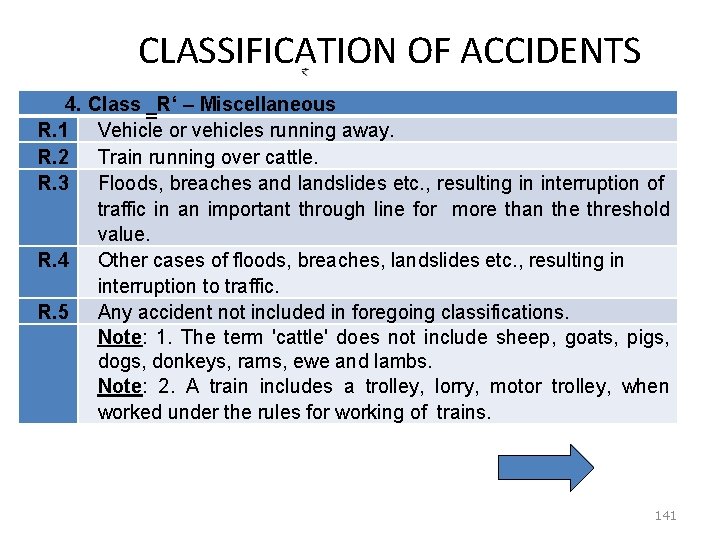
CLASSIFICATION OF ACCIDENTS 4. Class ‗R‘ – Miscellaneous R. 1 Vehicle or vehicles running away. R. 2 Train running over cattle. R. 3 Floods, breaches and landslides etc. , resulting in interruption of traffic in an important through line for more than the threshold value. R. 4 Other cases of floods, breaches, landslides etc. , resulting in interruption to traffic. R. 5 Any accident not included in foregoing classifications. Note: 1. The term 'cattle' does not include sheep, goats, pigs, donkeys, rams, ewe and lambs. Note: 2. A train includes a trolley, lorry, motor trolley, when worked under the rules for working of trains. 141
- Slides: 128