
BRIDGE PHASE VI1 3 PART4 CRS Sanction 1
BRIDGE PHASE VI_1. 3 PART-4 CRS Sanction 1
CRS - BRIEF HISTORY �First passenger train – 1853 �Consulting engineers were appointed under the govt. of India to exercise effective control over the construction & operation of the first railways in India, which were entrusted to private companies, . �Later, when the govt. undertook the construction of railways, the consulting engineers were designated as government Inspectors. 2
�In 1883, Their position was statutorily recognized. Later on, the Rly. Inspectorate was placed under the Rly. Board which was established in 1905. �In 1940, Inspectorates were placed under the ministry of transport and communication. �In 1961 an attempt to give better status, Rly. Inspectorate was re-designated as Commissioner of Rly. Safety. �Present position is that there is a CRS organization headed by CCRS Hq. @ Lucknow, under the ministry of civil aviation. 3
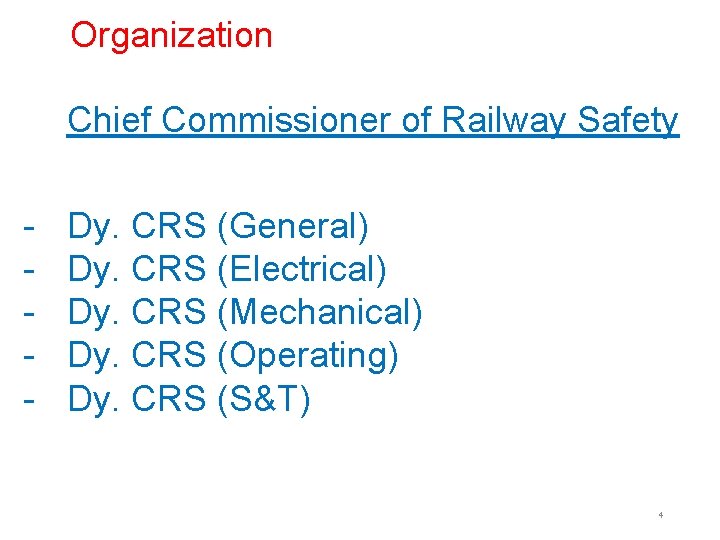
Organization Chief Commissioner of Railway Safety - Dy. CRS (General) Dy. CRS (Electrical) Dy. CRS (Mechanical) Dy. CRS (Operating) Dy. CRS (S&T) 4

Organisation CRS Circles Jurisdiction Northern Circle, New Delhi NR, DMRC North Eastern Circle, Lucknow NER, NCR North East Frontier Circle, Kolkata NEFR, Kolkata Metro Eastern Circle, Kolkata ER, ECR South Eastern Circle, Kolkata SER, SECR, ECo. R South Central Circle, Secunderabad SCR Southern Circle, Bangalore SR, SWR Central Circle, Mumbai CR, WCR, KRCL Western Circle, Mumbai WR, NWR 5
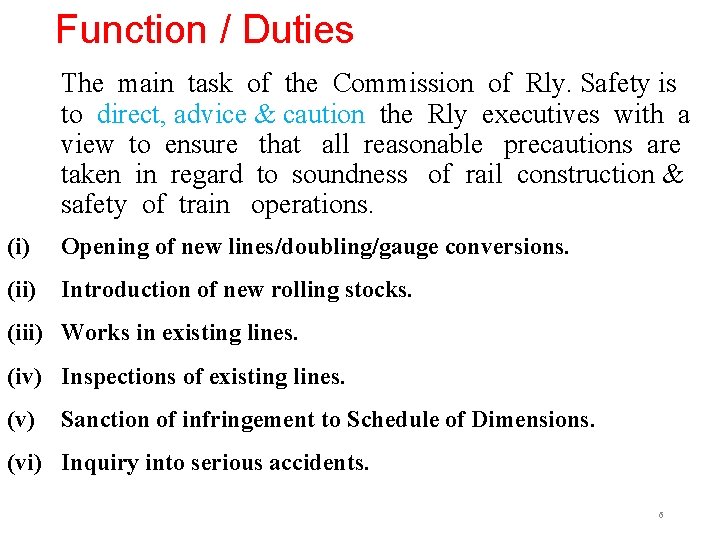
Function / Duties The main task of the Commission of Rly. Safety is to direct, advice & caution the Rly executives with a view to ensure that all reasonable precautions are taken in regard to soundness of rail construction & safety of train operations. (i) Opening of new lines/doubling/gauge conversions. (ii) Introduction of new rolling stocks. (iii) Works in existing lines. (iv) Inspections of existing lines. (v) Sanction of infringement to Schedule of Dimensions. (vi) Inquiry into serious accidents. 6
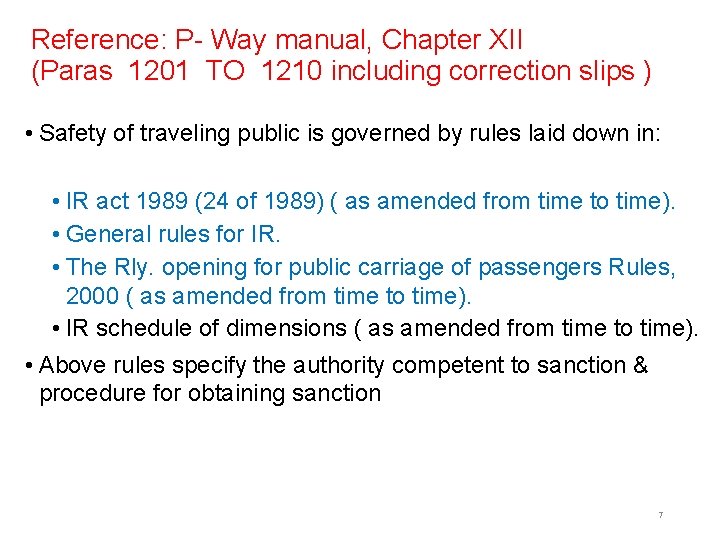
Reference: P- Way manual, Chapter XII (Paras 1201 TO 1210 including correction slips ) • Safety of traveling public is governed by rules laid down in: • IR act 1989 (24 of 1989) ( as amended from time to time). • General rules for IR. • The Rly. opening for public carriage of passengers Rules, 2000 ( as amended from time to time). • IR schedule of dimensions ( as amended from time to time). • Above rules specify the authority competent to sanction & procedure for obtaining sanction 7

Works requiring sanction of CRS Sanction of CRS is required for execution of any work on open line which will affect running of trains carrying passengers & any temporary arrangement necessary for carrying it out except in emergency. In addition to it following works require CRS sanction. 1. Opening a new line, doubling/tripling, gauge conversion etc. 2. Running of new rolling stock 3. Raising of speed sectional or specific train 8
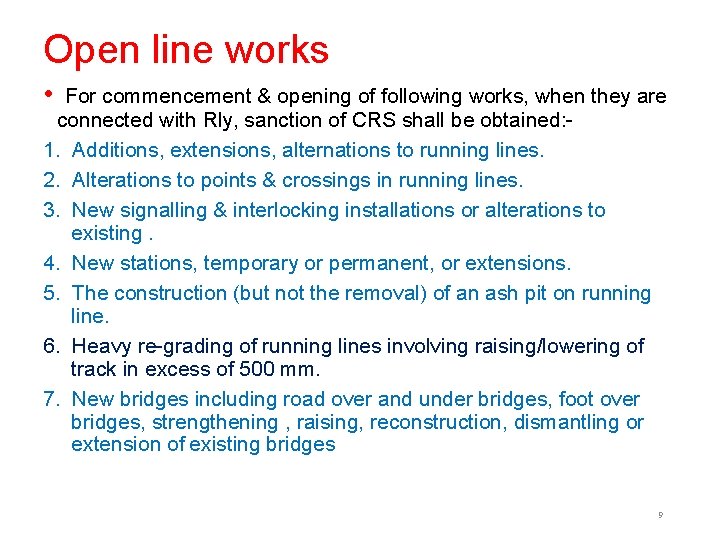
Open line works • For commencement & opening of following works, when they are connected with Rly, sanction of CRS shall be obtained: 1. Additions, extensions, alternations to running lines. 2. Alterations to points & crossings in running lines. 3. New signalling & interlocking installations or alterations to existing. 4. New stations, temporary or permanent, or extensions. 5. The construction (but not the removal) of an ash pit on running line. 6. Heavy re-grading of running lines involving raising/lowering of track in excess of 500 mm. 7. New bridges including road over and under bridges, foot over bridges, strengthening , raising, reconstruction, dismantling or extension of existing bridges 9
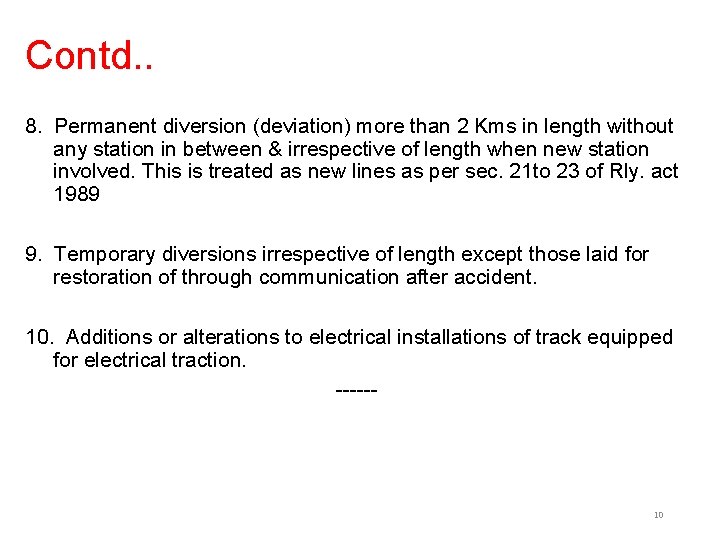
Contd. . 8. Permanent diversion (deviation) more than 2 Kms in length without any station in between & irrespective of length when new station involved. This is treated as new lines as per sec. 21 to 23 of Rly. act 1989 9. Temporary diversions irrespective of length except those laid for restoration of through communication after accident. 10. Additions or alterations to electrical installations of track equipped for electrical traction. ------ 10
New lines, doubling etc. . • CRS sanction is required for all new lines, Doubling, Gauge Conversions etc. • Application to CRS is to be made in proper proforma as circulated by Railway Board 11
Application for sanction of works 1. Application for sanction made 30 days in advance of expected commencement of work. 2. If work not taken up within 12 months from date of sanction, CRS approached for renewal of sanction. 3. In case of divisional works, application made by Sr. DEN and /or Sr. DSTE for track, bridge & signalling/ interlocking works as the case may be DRM/ADRM should sign the application. 4. In case of works of construction organization, whether civil engg or S & T application will be signed by SA grade officer, CE/C or CSTE/C as the case may be. 12
Contd. . • In case of works involving civil engg & S&T both, application shall be signed jointly by SAG officers of S&T and Engg. • Name & designation of signatory should invariably be mentioned. • Works being executed by RVNL and IRCON are coordinated by CE/CON for preparation of application and taking CRS Sanction. 13
Documents to accompany application • Documents to accompany application are detailed in annexure 12/1 • The documents are: 1. A track certificate, indicating that track is suitable for maximum axle load there in, shall be given along with application, signed by Dy. CE (track) counter signed by CTE/CE 2. Bridge certificate indicating that bridge is designed to carry axle loads proposed to run, along with application. This certificate is also signed by Dy CE/BRIDGE and counter signed by CBE /CE. For the purpose of track & bridge certificates as per annexure 12/2 & 12/3, COM should also be consulted in regard to types of locomotives & rolling stock to be used, their axle loads & speeds. 14
Documents … • 3. OHE certificate • 4. S&T certificate. • 5. C&W certificate • 6. other certificate in various forms I to for XVIII • Final certificate is signed by GM of the Railway. 15
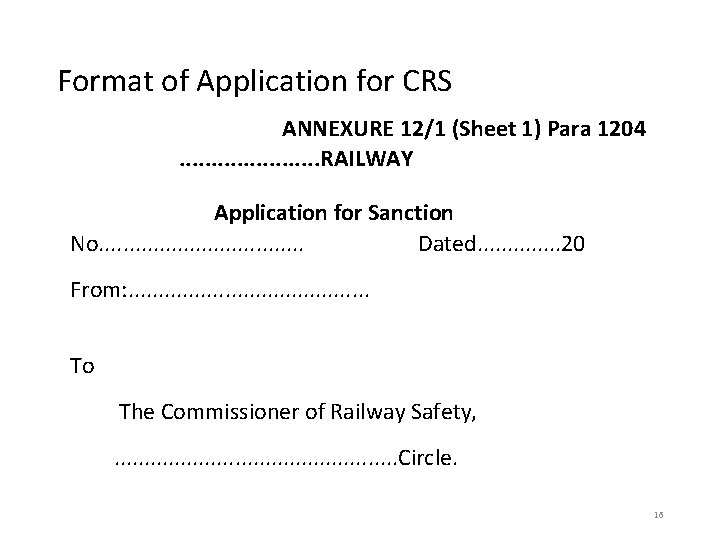
Format of Application for CRS ANNEXURE 12/1 (Sheet 1) Para 1204. . . . . RAILWAY Application for Sanction No. . . . Dated. . . 20 From: . . To The Commissioner of Railway Safety, . . . Circle. 16
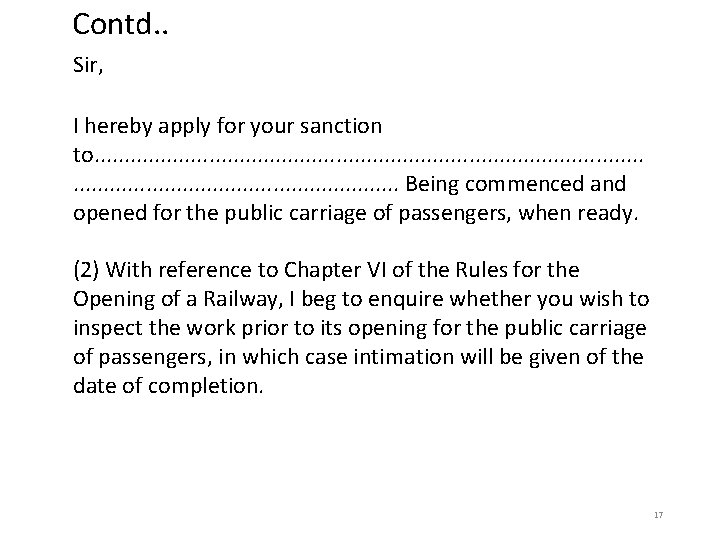
Contd. . Sir, I hereby apply for your sanction to. . . . . . . . . Being commenced and opened for the public carriage of passengers, when ready. (2) With reference to Chapter VI of the Rules for the Opening of a Railway, I beg to enquire whether you wish to inspect the work prior to its opening for the public carriage of passengers, in which case intimation will be given of the date of completion. 17
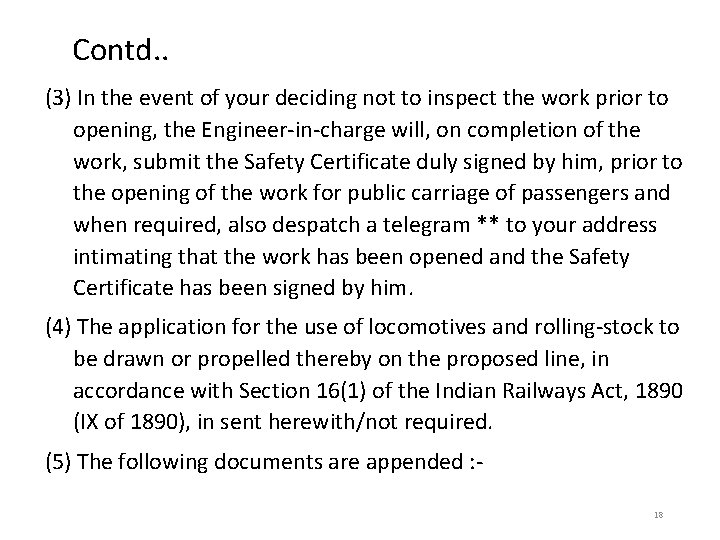
Contd. . (3) In the event of your deciding not to inspect the work prior to opening, the Engineer-in-charge will, on completion of the work, submit the Safety Certificate duly signed by him, prior to the opening of the work for public carriage of passengers and when required, also despatch a telegram ** to your address intimating that the work has been opened and the Safety Certificate has been signed by him. (4) The application for the use of locomotives and rolling-stock to be drawn or propelled thereby on the proposed line, in accordance with Section 16(1) of the Indian Railways Act, 1890 (IX of 1890), in sent herewith/not required. (5) The following documents are appended : 18
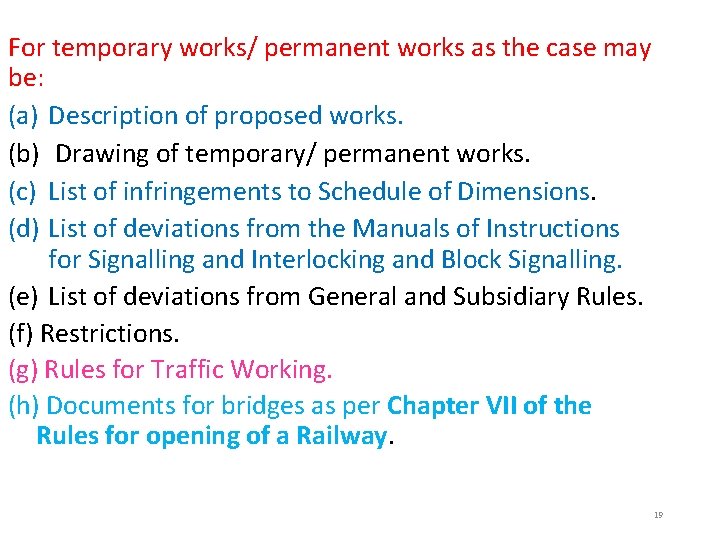
For temporary works/ permanent works as the case may be: (a) Description of proposed works. (b) Drawing of temporary/ permanent works. (c) List of infringements to Schedule of Dimensions. (d) List of deviations from the Manuals of Instructions for Signalling and Interlocking and Block Signalling. (e) List of deviations from General and Subsidiary Rules. (f) Restrictions. (g) Rules for Traffic Working. (h) Documents for bridges as per Chapter VII of the Rules for opening of a Railway. 19
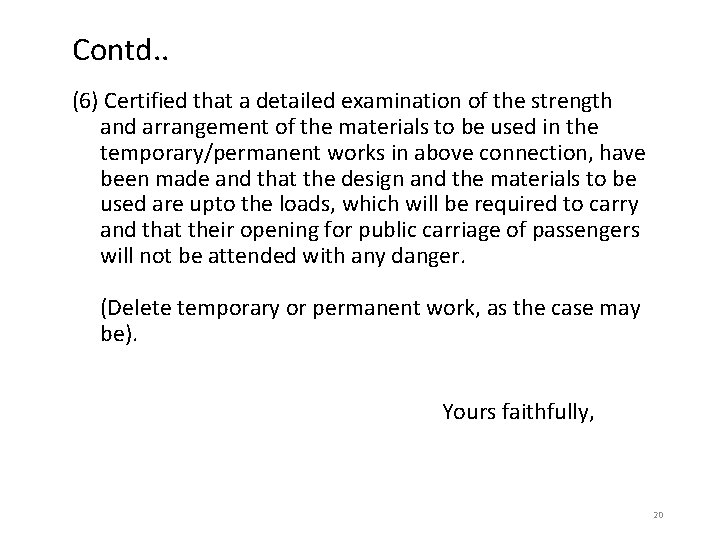
Contd. . (6) Certified that a detailed examination of the strength and arrangement of the materials to be used in the temporary/permanent works in above connection, have been made and that the design and the materials to be used are upto the loads, which will be required to carry and that their opening for public carriage of passengers will not be attended with any danger. (Delete temporary or permanent work, as the case may be). Yours faithfully, 20
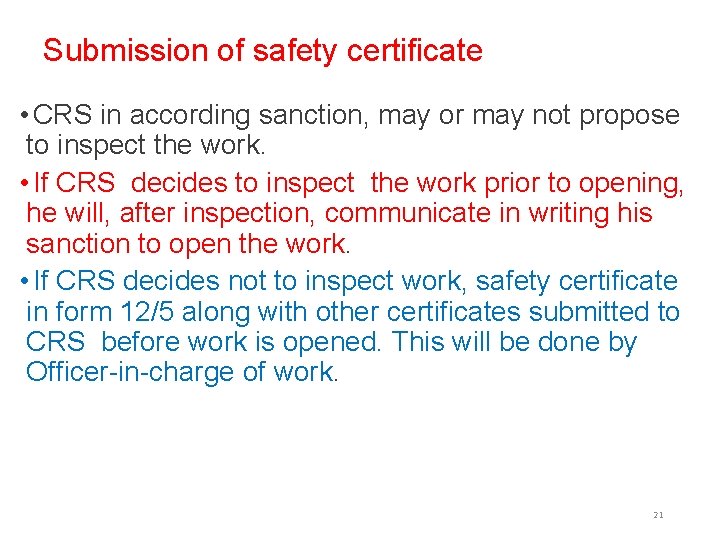
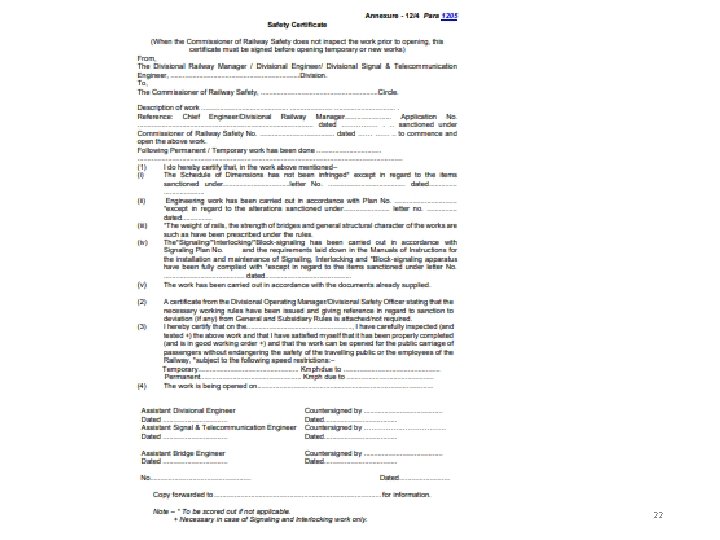
Submission of safety certificate • CRS in according sanction, may or may not propose to inspect the work. • If CRS decides to inspect the work prior to opening, he will, after inspection, communicate in writing his sanction to open the work. • If CRS decides not to inspect work, safety certificate in form 12/5 along with other certificates submitted to CRS before work is opened. This will be done by Officer-in-charge of work. 21
22
Deviations from plans approved by CRS • Prior approval of CRS is necessary, if plans already approved by CRS have any deviations, especially, which affects layout of lines or arrangements of signals or working rules. 23
Notification to Rly officials when opening works • No new work affecting running of trains or traffic working at stations should be brought into use until staff of all departments have been notified by means of a circular issued by DSO / DOM 24
Works arising out of accidents including breaches • Abbreviated procedure as laid down in section 24 of IR act 1989 is reproduced below; • When accident has occurred resulting in temporary suspension of traffic, and either the original line and work has been rapidly restored to original standard, or a temporary diversion has been laid in absence of CRS, it should be opened for public carriage of passengers, subject to following conditions; 25
Contd. . 1. a)Rly servant in-charge of work has certified in writing that opening of restored line and work or temporary diversion, will not, in his opinion be attended with danger to public. . b) a notice of the opening of the lines or rails and works or the diversion shall be sent immediately to CRS 2. The officer-in-charge, as soon as possible give intimation and certificate in form 13/6 to CRS by telegraph, of opening of line & work or diversion followed by confirmatory copies by letter. 26
• Contd. . 3. Engineering representative shall hand over a copy of certificate to representative of operating department at site of accident The optg officer at site should not allow the passage of traffic over restored road, until he gets this certificate. 4. Diversions should be tested by running a material train or light engines before opening to public traffic. 5. Certificate & telegraph advice need not be sent to CRS if line is restored for through communication within 24 hours. If use of temp diversion is likely for more than 3 days, CRS may take earliest opportunity to inspect it. 27
THANKS 28
- Slides: 28