
BRICKS BMC 3 A WHAT IS BRICK A
BRICKS BMC 3 A
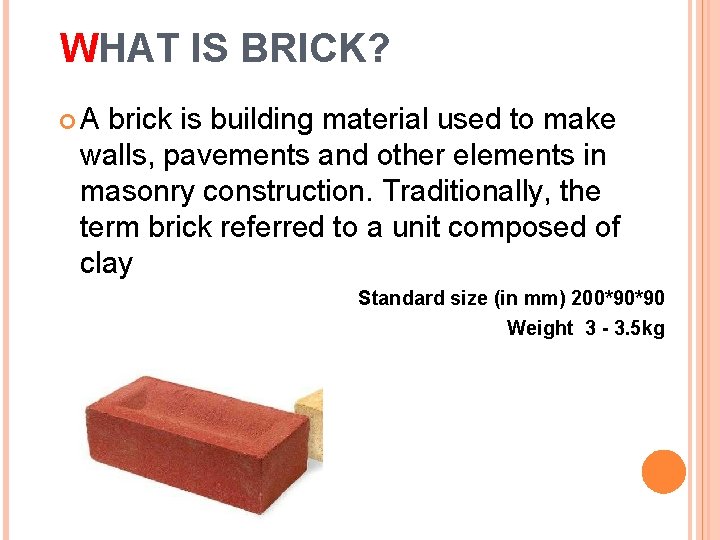
WHAT IS BRICK? A brick is building material used to make walls, pavements and other elements in masonry construction. Traditionally, the term brick referred to a unit composed of clay Standard size (in mm) 200*90*90 Weight 3 - 3. 5 kg
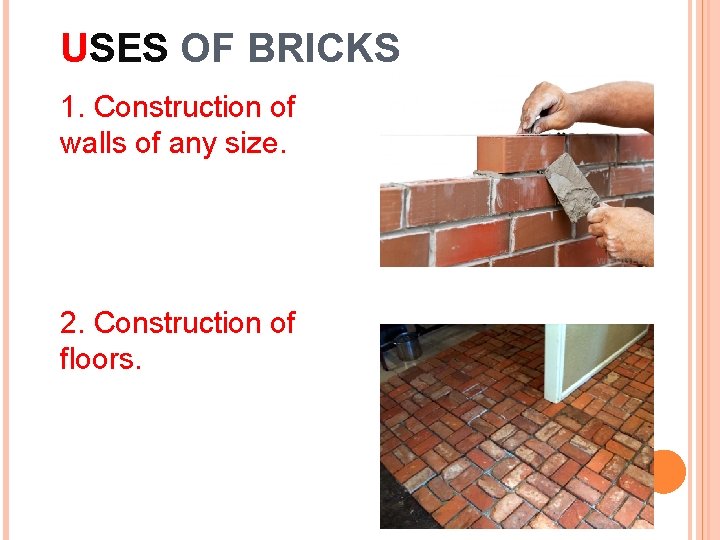
USES OF BRICKS 1. Construction of walls of any size. 2. Construction of floors. 3
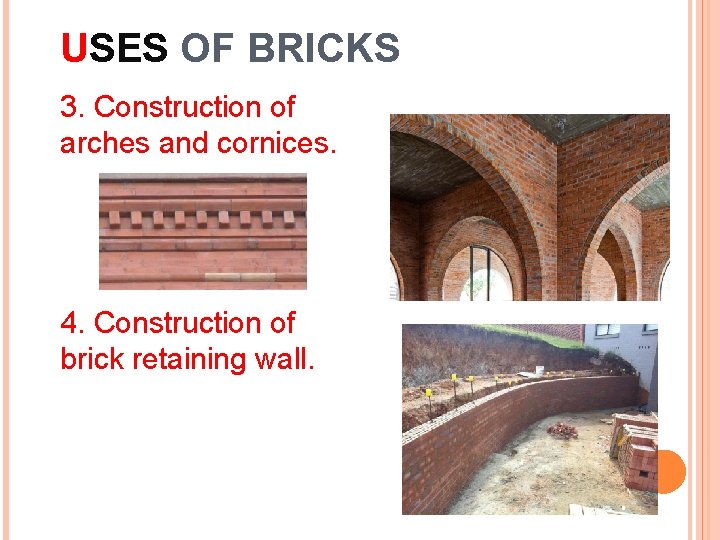
USES OF BRICKS 3. Construction of arches and cornices. 4. Construction of brick retaining wall. 4
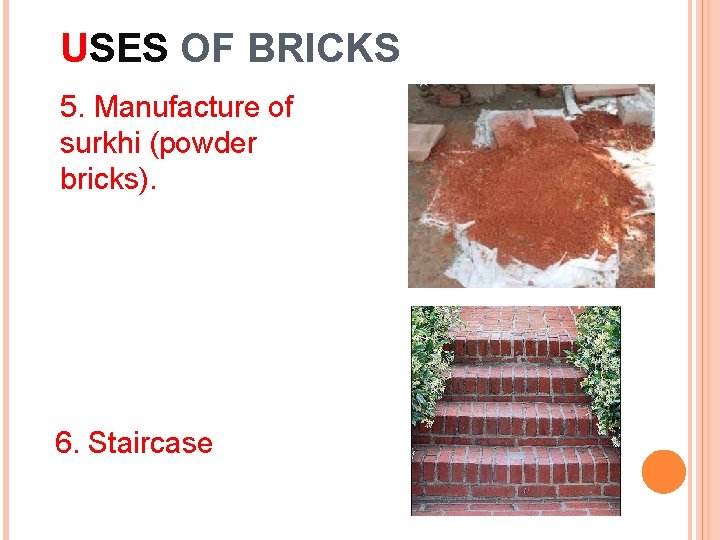
USES OF BRICKS 5. Manufacture of surkhi (powder bricks). 6. Staircase 5
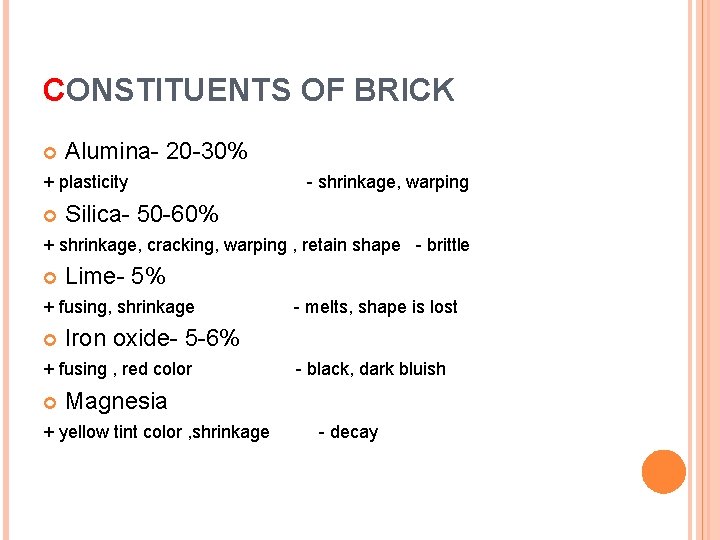
CONSTITUENTS OF BRICK Alumina- 20 -30% + plasticity - shrinkage, warping Silica- 50 -60% + shrinkage, cracking, warping , retain shape - brittle Lime- 5% + fusing, shrinkage Iron oxide- 5 -6% + fusing , red color - melts, shape is lost - black, dark bluish Magnesia + yellow tint color , shrinkage - decay
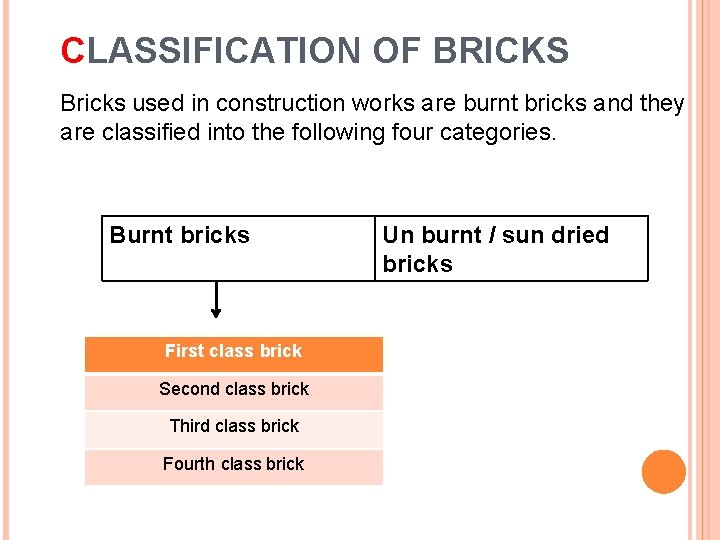
CLASSIFICATION OF BRICKS Bricks used in construction works are burnt bricks and they are classified into the following four categories. Burnt bricks First class brick Second class brick Third class brick Fourth class brick Un burnt / sun dried bricks
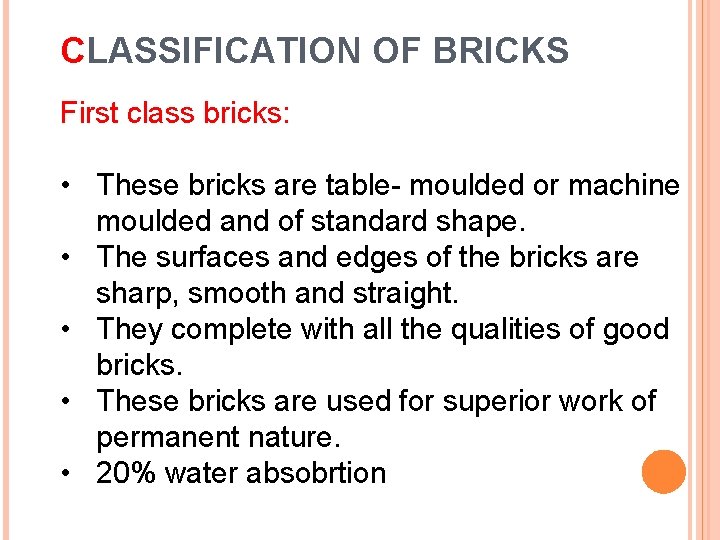
CLASSIFICATION OF BRICKS First class bricks: • These bricks are table- moulded or machine moulded and of standard shape. • The surfaces and edges of the bricks are sharp, smooth and straight. • They complete with all the qualities of good bricks. • These bricks are used for superior work of permanent nature. • 20% water absobrtion 8
CLASSIFICATION OF BRICKS Second class bricks: • These bricks are ground moulded and they are burnt in kilns. • The surface of these bricks is some what rough and shape is also slightly irregular. • These bricks are commonly used at places where brickwork is to be provided with a coat of plaster. • 22% water absorbtion 9
CLASSIFICATION OF BRICKS Third class bricks: • These bricks are ground moulded and they are burnt in clamps. • These bricks are not hard and they have rough surfaces with irregular and distorted edges. • These bricks gives dull sound when stuck together. • They are used for unimportant and temporary structures and it places where rainfall is not heavy. • 25% water absorption 10
CLASSIFICATION OF BRICKS Fourth class bricks: These bricks are used as aggregate for concrete in foundation, floors, roads etc. These bricks are over burnt with irregular shape and dark in colour. Because of the fact that the overburnt bricks have a compact structure and hence, they are sometimes found to be stronger than even the first class bricks. 11
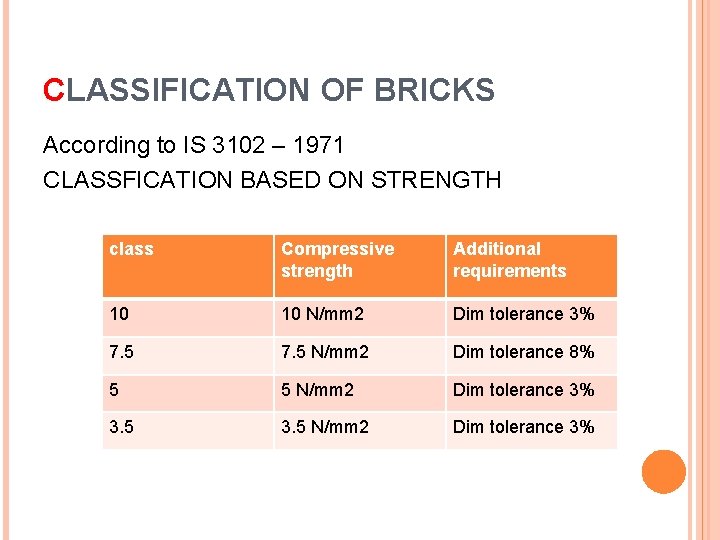
CLASSIFICATION OF BRICKS According to IS 3102 – 1971 CLASSFICATION BASED ON STRENGTH class Compressive strength Additional requirements 10 10 N/mm 2 Dim tolerance 3% 7. 5 N/mm 2 Dim tolerance 8% 5 5 N/mm 2 Dim tolerance 3% 3. 5 N/mm 2 Dim tolerance 3%
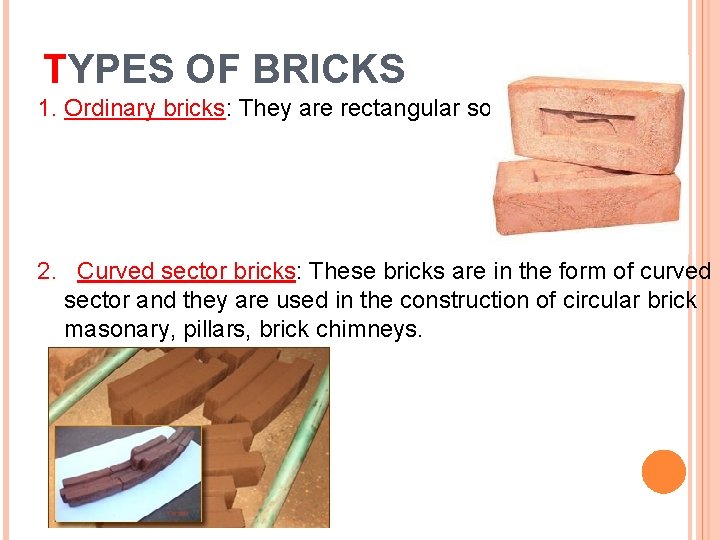
TYPES OF BRICKS 1. Ordinary bricks: They are rectangular solids. 2. Curved sector bricks: These bricks are in the form of curved sector and they are used in the construction of circular brick masonary, pillars, brick chimneys. 13
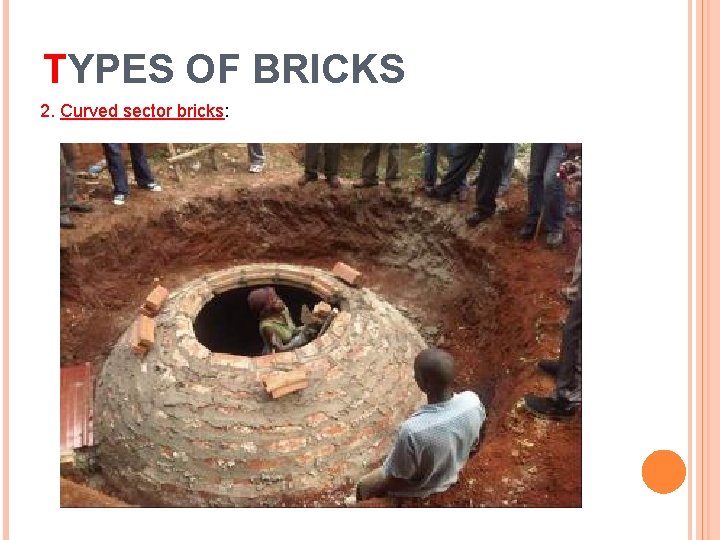
TYPES OF BRICKS 2. Curved sector bricks: 14
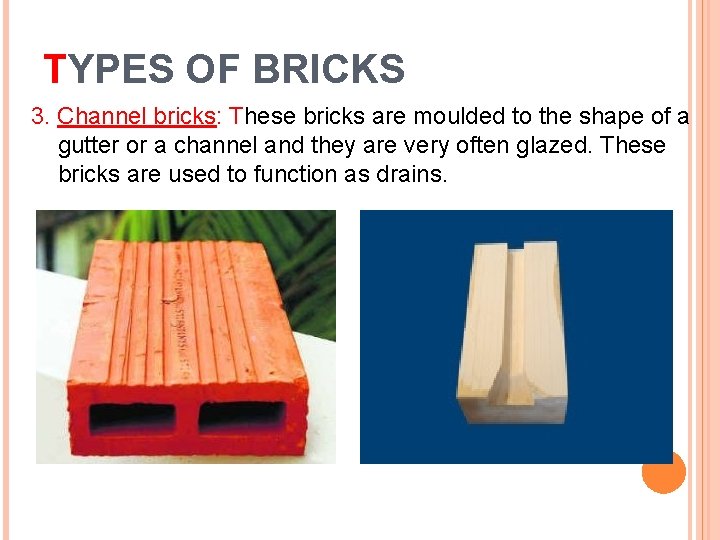
TYPES OF BRICKS 3. Channel bricks: These bricks are moulded to the shape of a gutter or a channel and they are very often glazed. These bricks are used to function as drains. 15
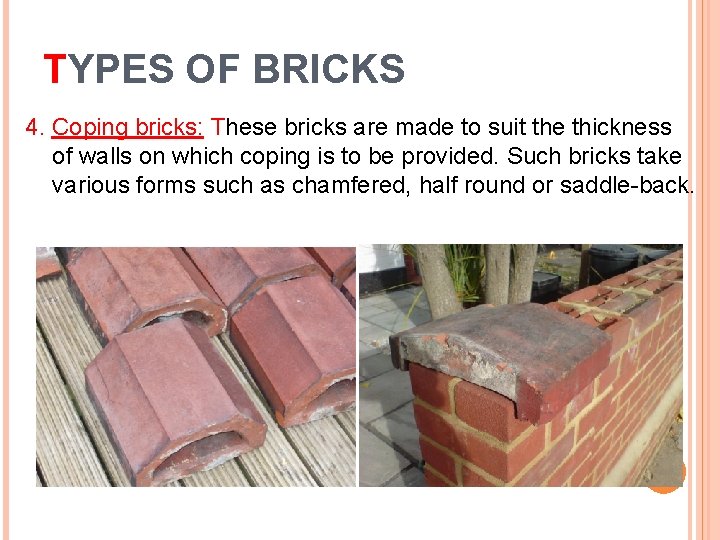
TYPES OF BRICKS 4. Coping bricks: These bricks are made to suit the thickness of walls on which coping is to be provided. Such bricks take various forms such as chamfered, half round or saddle-back. 16
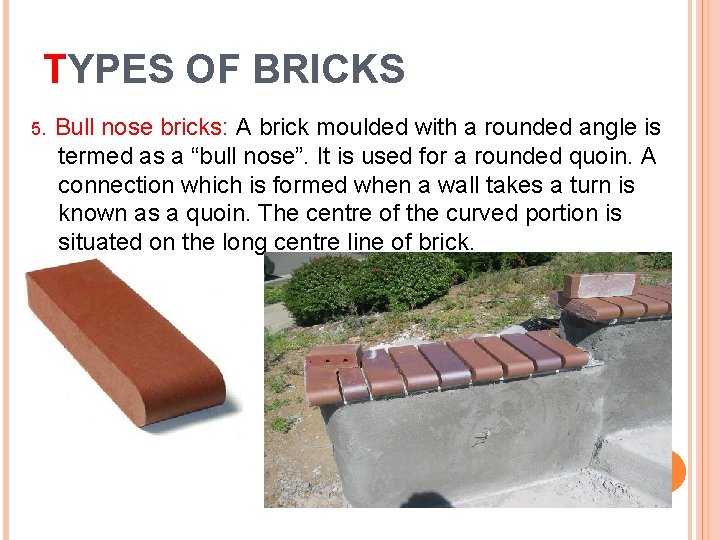
TYPES OF BRICKS 5. Bull nose bricks: A brick moulded with a rounded angle is termed as a “bull nose”. It is used for a rounded quoin. A connection which is formed when a wall takes a turn is known as a quoin. The centre of the curved portion is situated on the long centre line of brick. 17
TYPES OF BRICKS 6. Hollow bricks: • These are also known as cellular or cavity bricks. • Such bricks have wall thickness of about 20 cm to 25 cm. • They are prepared from special homogeneous clay. • They are light in weight about one-third the weight of the ordinary brick of the same Size. • These bricks can be laid almost about four times as fast as they ordinary bricks and thus the use of such bricks leads to speedy construction. • They also reduce the transmission of heat, sound and damp. They are used in the construction of brick partitioning. 18
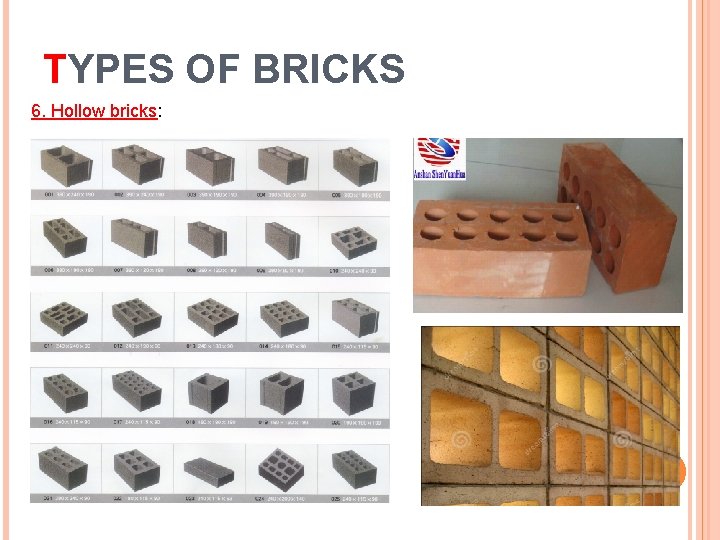
TYPES OF BRICKS 6. Hollow bricks: 19
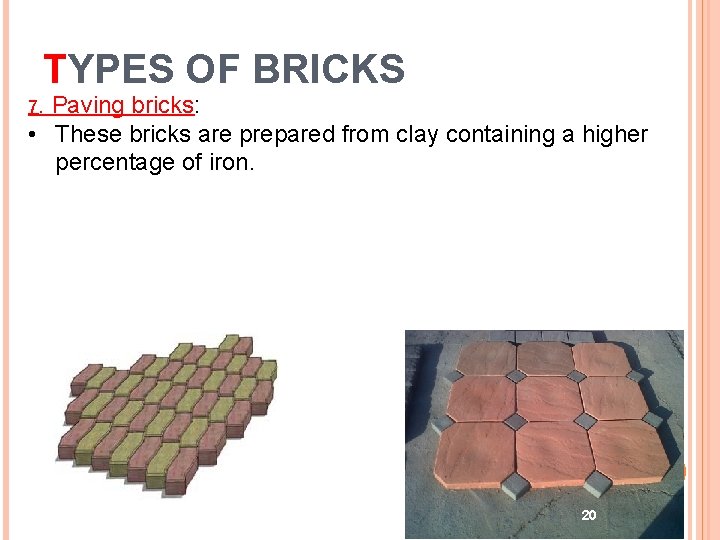
TYPES OF BRICKS 7. Paving bricks: • These bricks are prepared from clay containing a higher percentage of iron. 20
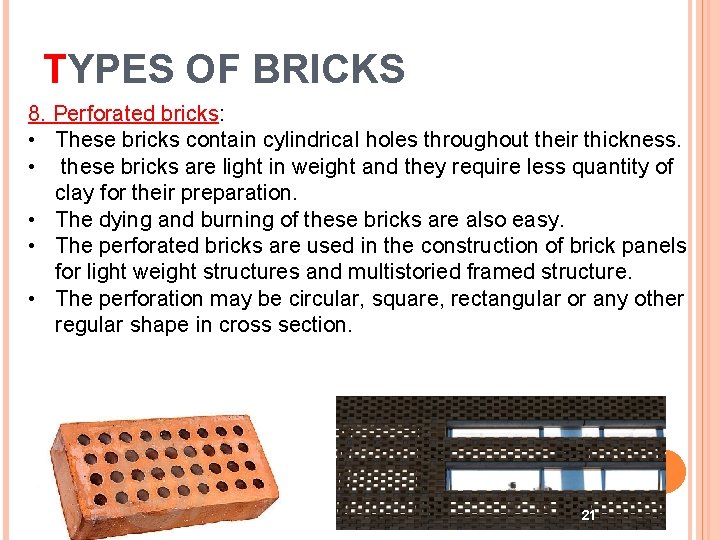
TYPES OF BRICKS 8. Perforated bricks: • These bricks contain cylindrical holes throughout their thickness. • these bricks are light in weight and they require less quantity of clay for their preparation. • The dying and burning of these bricks are also easy. • The perforated bricks are used in the construction of brick panels for light weight structures and multistoried framed structure. • The perforation may be circular, square, rectangular or any other regular shape in cross section. 21
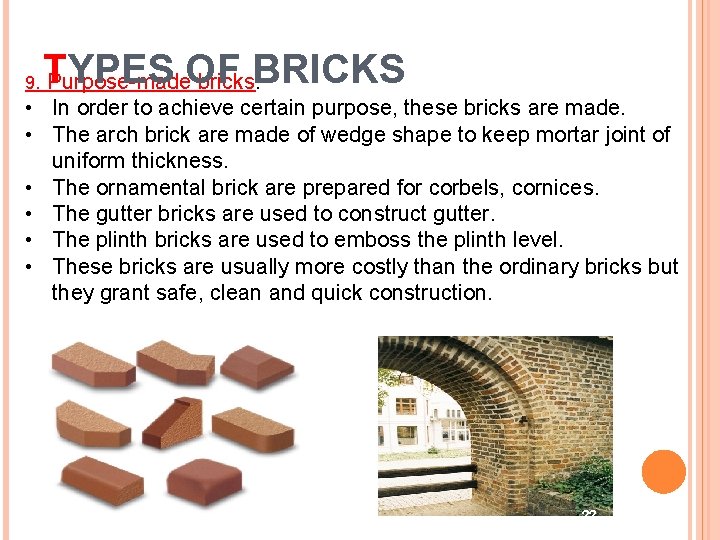
9. TYPES Purpose-made. OF bricks: BRICKS • In order to achieve certain purpose, these bricks are made. • The arch brick are made of wedge shape to keep mortar joint of uniform thickness. • The ornamental brick are prepared for corbels, cornices. • The gutter bricks are used to construct gutter. • The plinth bricks are used to emboss the plinth level. • These bricks are usually more costly than the ordinary bricks but they grant safe, clean and quick construction. 22
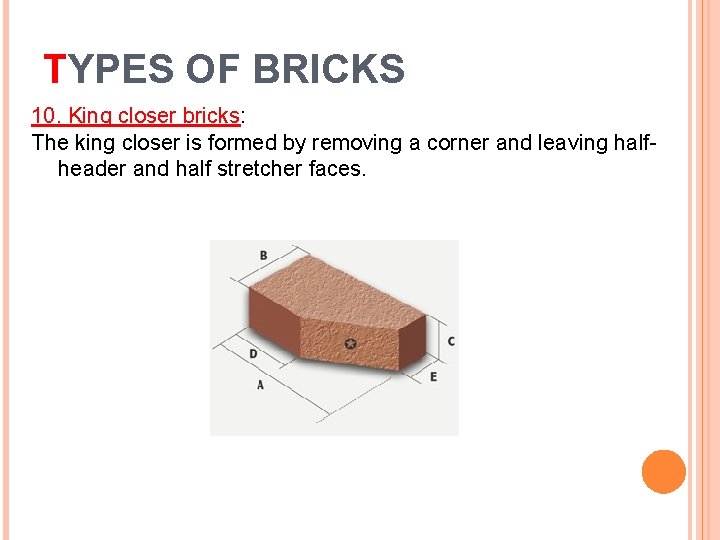
TYPES OF BRICKS 10. King closer bricks: The king closer is formed by removing a corner and leaving halfheader and half stretcher faces. 23
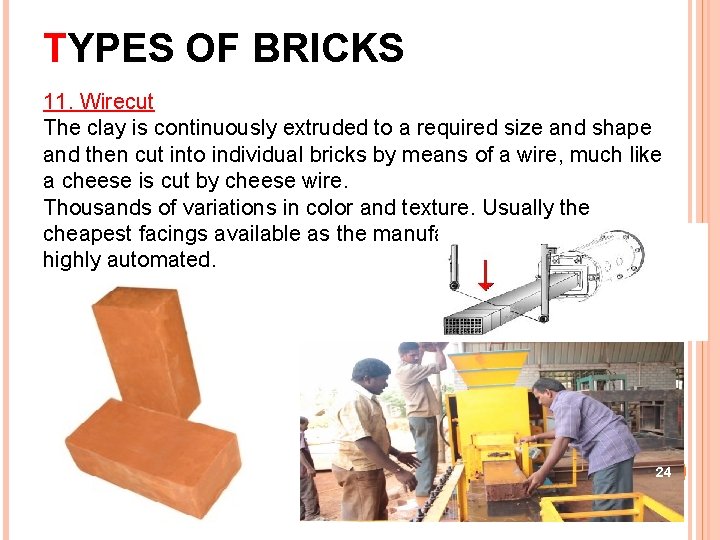
TYPES OF BRICKS 11. Wirecut The clay is continuously extruded to a required size and shape and then cut into individual bricks by means of a wire, much like a cheese is cut by cheese wire. Thousands of variations in color and texture. Usually the cheapest facings available as the manufacturing process is highly automated. 24
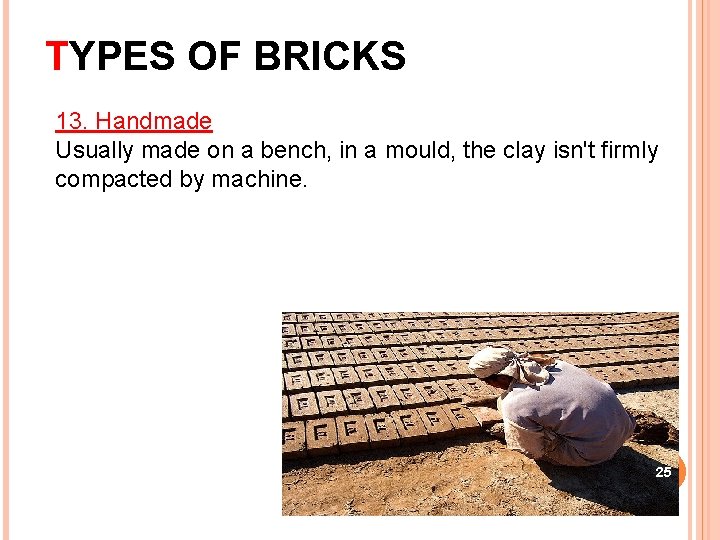
TYPES OF BRICKS 13. Handmade Usually made on a bench, in a mould, the clay isn't firmly compacted by machine. 25
REQUIREMENTS OF GOOD BRICKS • Good bricks should be thoroughly burnt, this makes them hard and durable • A hard ringing sound emitted when two bricks are stuck together indicates that they have been brunt satisfactorily. • Bricks should be true to size and shape, with straight edges and even surfaces. • They should be free from cracks, chips, and larger particles of lime. • Brick when broken should show a bright homogeneous and compact structure free from voids. • Brick should not absorb water more than 20% by weight for 1 st Classbrick and 22% by weight from 2 nd class brick, when soaked in cold water for a period of 24 hours. 26
REQUIREMENTS OF GOOD BRICKS • No impression should be left on brick surface when it is scratched with finger nail. • Brick should not break when dropped flat on hard ground from a height of about 1 m. • Bricks should have low thermal conductivity and they should be sound proof. • Brick when soaked in water for 24 hours should not deposited of white salt when allowed to dry in shape. 27
TEST ON BRICK 1. 2. 3. 4. 5. 6. 7. Absorption Crushing strength Hardness Presence of soluble salts Shape and size Soundness Structure 28
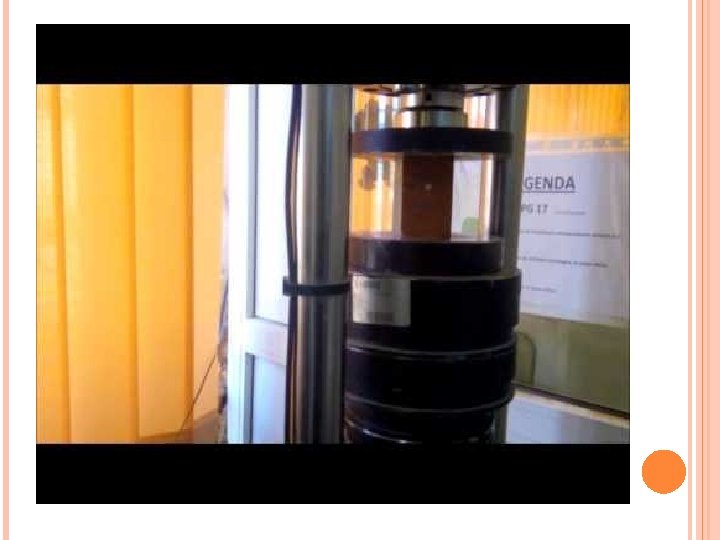
TEST ON BRICK Absorption • • • Water absorption is brick is carried out by immersing it in water for 24 hours. It is again weighed and the different is in indicated the amount of water absorbed by brick. It should not in any case exceed 20% of its weight. Crushing Strength • • • Crushing strength of brick is found out by placing it in compressive test machine. It is pressed till it breaks The minimum crushing strength of brick is 3. 5 N/mm 2 Hardness • In this test, a stretch is made on brick surface with the help of finger nail. • If no impression is left on surface, the brick is treated to be sufficiently hard.
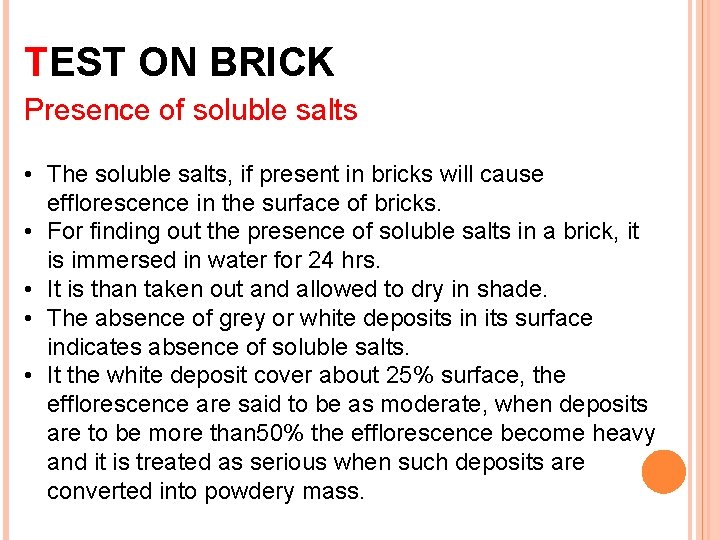
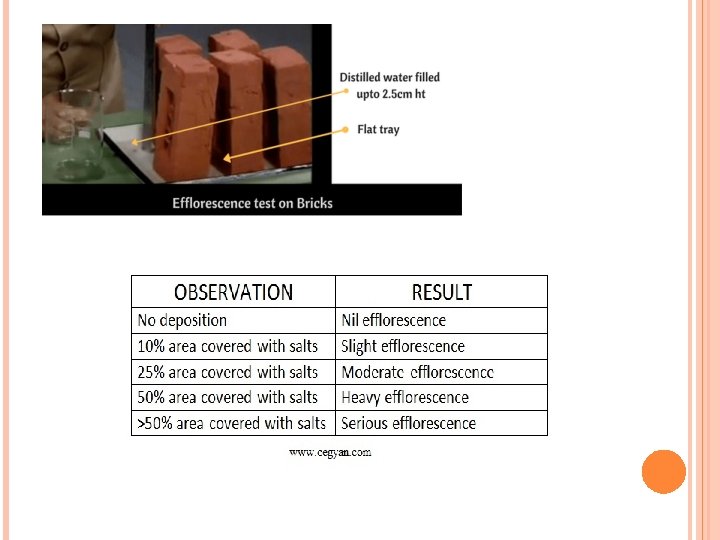
TEST ON BRICK Presence of soluble salts • The soluble salts, if present in bricks will cause efflorescence in the surface of bricks. • For finding out the presence of soluble salts in a brick, it is immersed in water for 24 hrs. • It is than taken out and allowed to dry in shade. • The absence of grey or white deposits in its surface indicates absence of soluble salts. • It the white deposit cover about 25% surface, the efflorescence are said to be as moderate, when deposits are to be more than 50% the efflorescence become heavy and it is treated as serious when such deposits are converted into powdery mass. 31
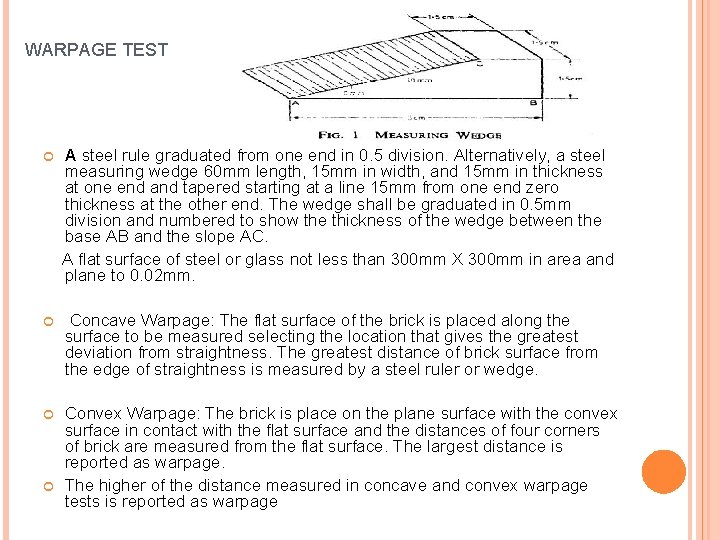
WARPAGE TEST A steel rule graduated from one end in 0. 5 division. Alternatively, a steel measuring wedge 60 mm length, 15 mm in width, and 15 mm in thickness at one end and tapered starting at a line 15 mm from one end zero thickness at the other end. The wedge shall be graduated in 0. 5 mm division and numbered to show the thickness of the wedge between the base AB and the slope AC. A flat surface of steel or glass not less than 300 mm X 300 mm in area and plane to 0. 02 mm. Concave Warpage: The flat surface of the brick is placed along the surface to be measured selecting the location that gives the greatest deviation from straightness. The greatest distance of brick surface from the edge of straightness is measured by a steel ruler or wedge. Convex Warpage: The brick is place on the plane surface with the convex surface in contact with the flat surface and the distances of four corners of brick are measured from the flat surface. The largest distance is reported as warpage. The higher of the distance measured in concave and convex warpage tests is reported as warpage
MANUFACTURING PROCESS 34
MANUFACTURING PROCESS 35
MANUFACTURING PROCESS 36
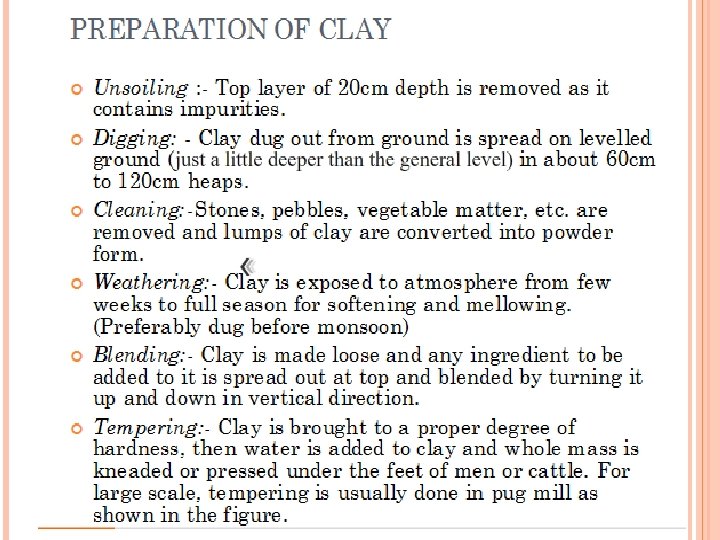
37
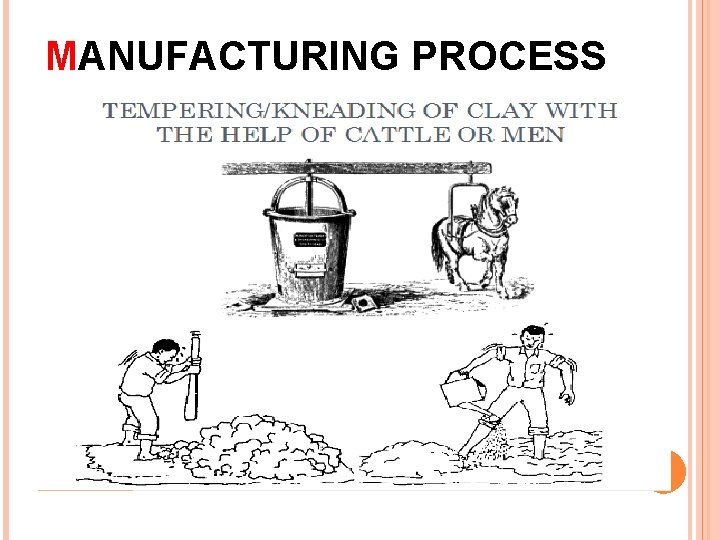
MANUFACTURING PROCESS 38
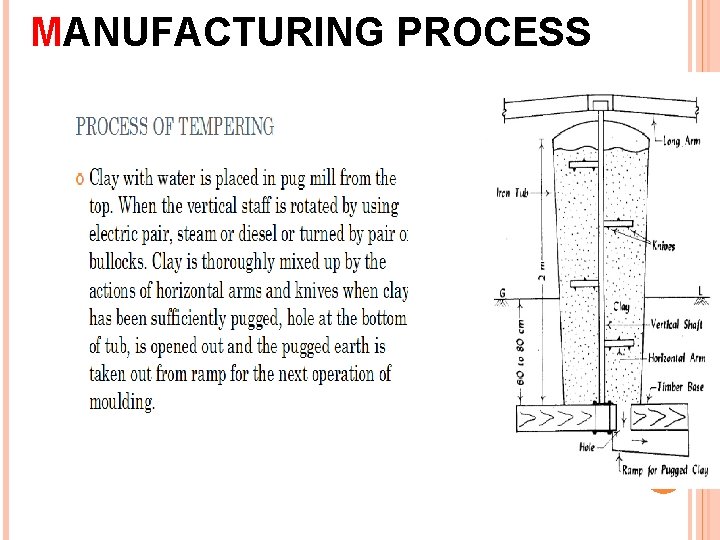
MANUFACTURING PROCESS 39
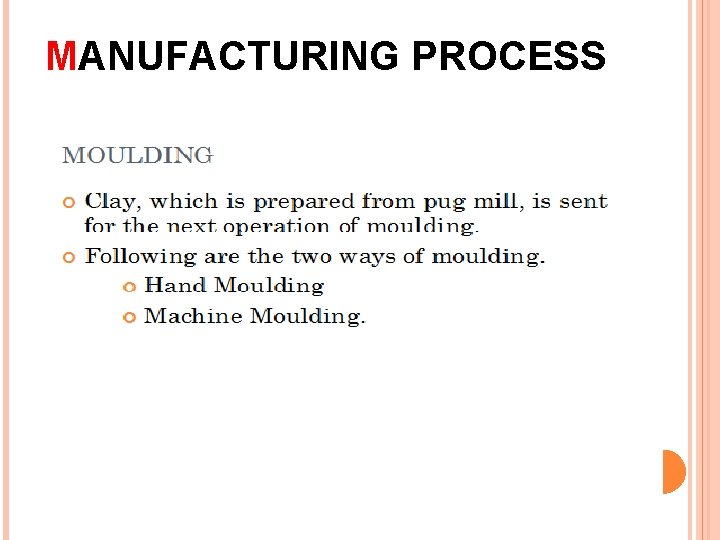
MANUFACTURING PROCESS 40
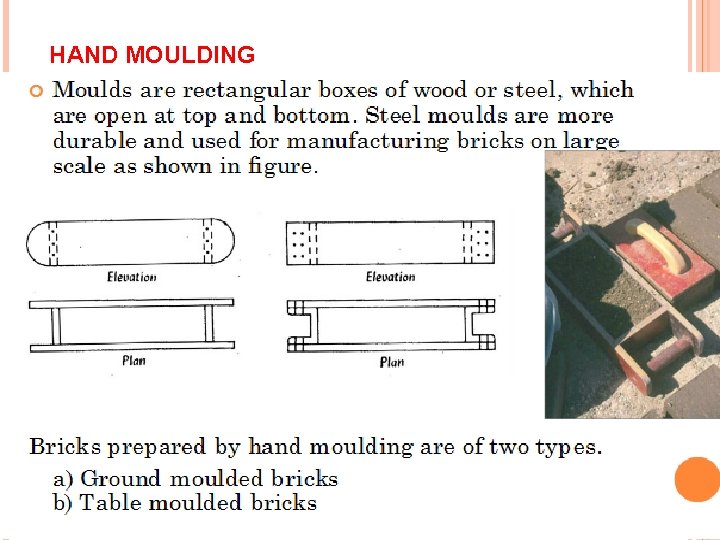
HAND MOULDING 41
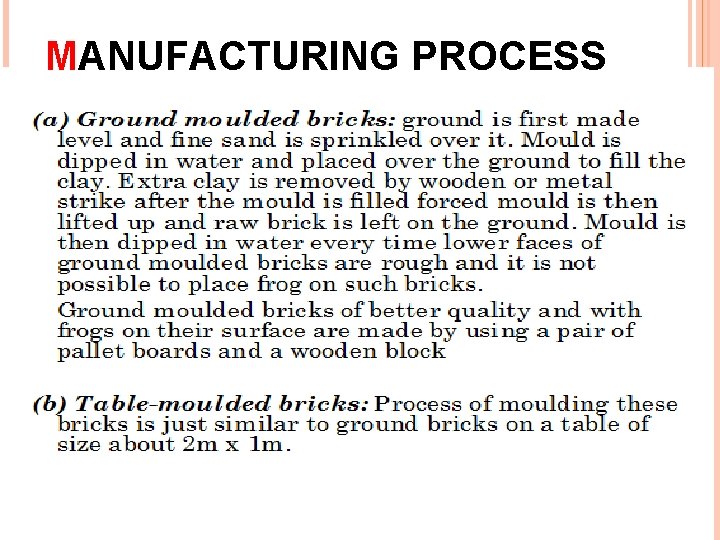
MANUFACTURING PROCESS 42
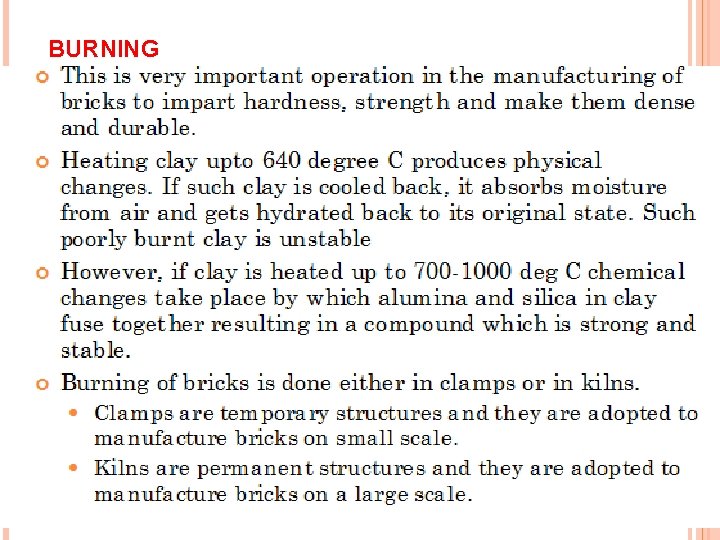
BURNING 43
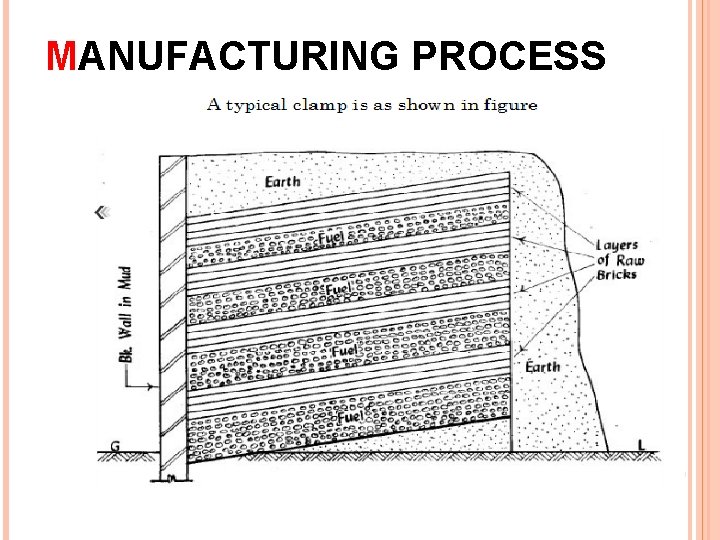
MANUFACTURING PROCESS 44
45
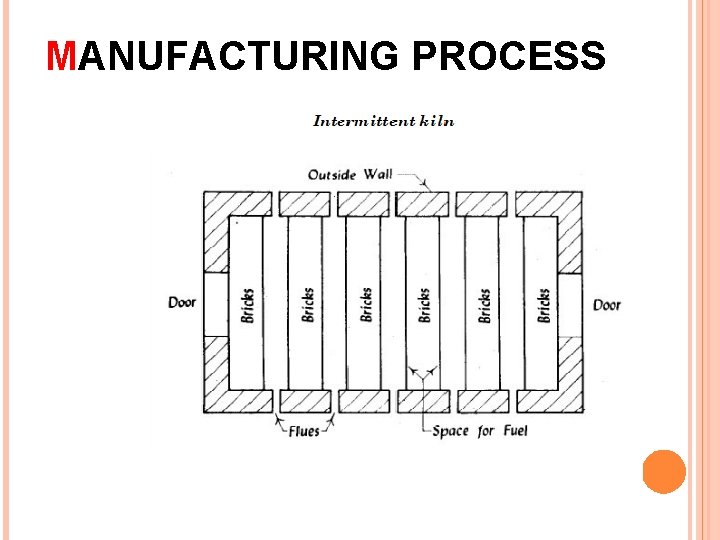
MANUFACTURING PROCESS 46
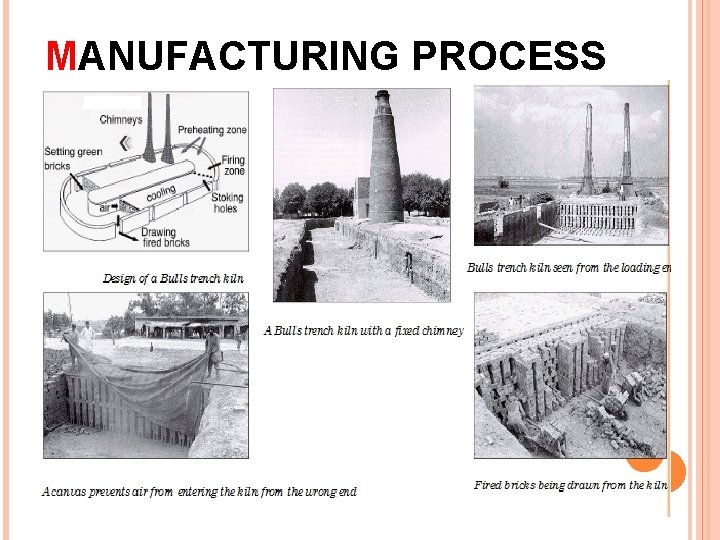
MANUFACTURING PROCESS 47
TEST ON BRICK Soundness • In this test, two bricks are taken and than struck together with each other, the bricks should not break and a clear ringing sound should be produced. Structure • A brick is broken and its structure is examined. • It should be homogeneous, compact and free from any defects. • Dimensional tolerance. Twenty whole bricks are selected at random to check measurement of length, width, height, etc. These dimensions are to be measured in one or two from lots. Variations in dimensions are allowed only within narrow limits, ± 3 % for class one and ± 8% for other classes
- Slides: 48