
Brewing Water Residual Alkalinity and Mash p H

Brewing Water, Residual Alkalinity, and Mash p. H Beer and Loafing NHC 2004 Las Vegas, NV
The First Rule ©Know what your local water chemistry is!
The Second Rule ©Know WHY you want to adjust your water!

The Third Rule ©If it’s not broken, Don’t Fix It!
Local Water And Beer © Beer Styles came from local brewing water ©Burton Ale came from hard, high carbonate water ©Vienna Lager came from hard, medium carbonate water ©Guinness Stout came from medium hard, high carbonate water ©Oktoberfest came from medium hard, medium carbonate water. ©Pilsner came from very soft, low carbonate water
Hard vs. Soft Water ©“Hard water” refers to the scale that forms on pipes, and being “hard” for soap to lather. ©“Hardness” is a function of Calcium, Magnesium, Iron, Mangenese, etc. ©“Soft” just means that there is low Calcium and Magnesium. ©Hard and Soft are only half the story, the other half is the Alkalinity.
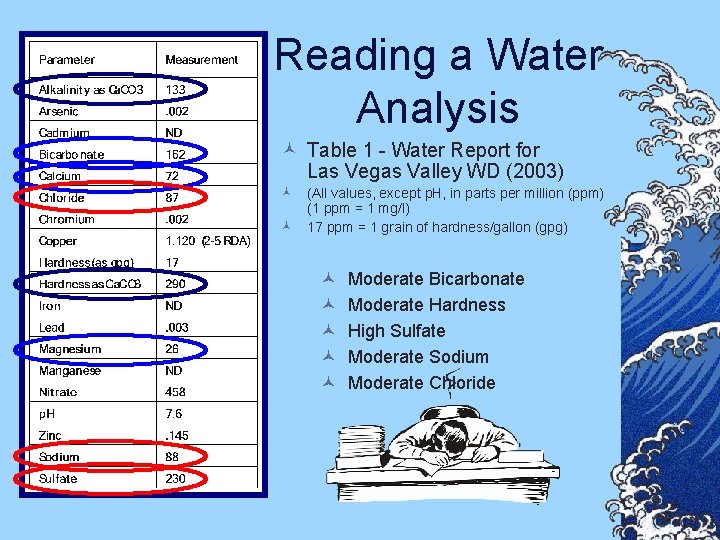
Reading a Water Analysis © Table 1 - Water Report for Las Vegas Valley WD (2003) © (All values, except p. H, in parts per million (ppm) (1 ppm = 1 mg/l) © 17 ppm = 1 grain of hardness/gallon (gpg) © © © Moderate Bicarbonate Moderate Hardness High Sulfate Moderate Sodium Moderate Chloride
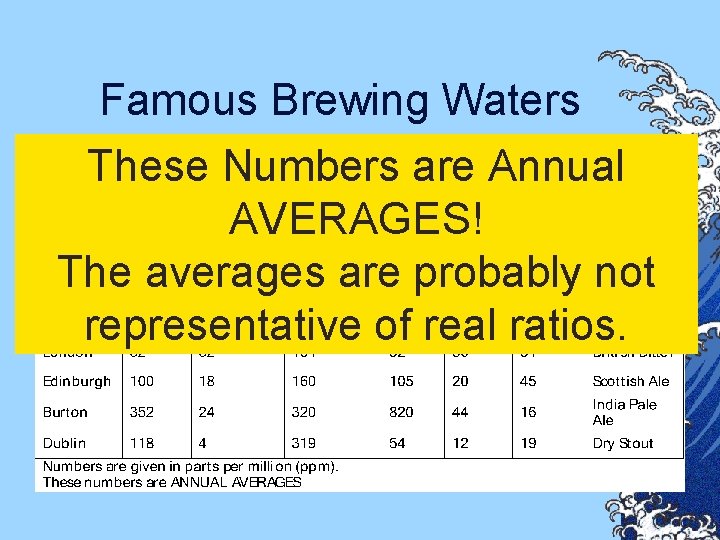
Famous Brewing Waters These Numbers are Annual AVERAGES! The averages are probably not representative of real ratios.
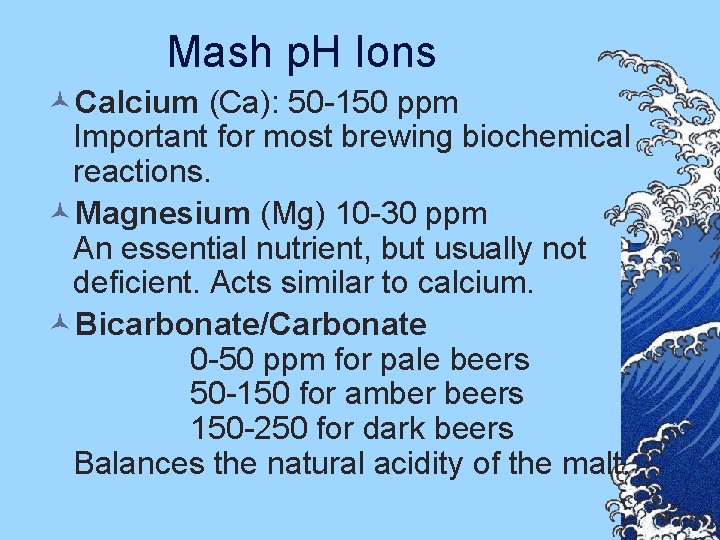
Mash p. H Ions ©Calcium (Ca): 50 -150 ppm Important for most brewing biochemical reactions. ©Magnesium (Mg) 10 -30 ppm An essential nutrient, but usually not deficient. Acts similar to calcium. ©Bicarbonate/Carbonate 0 -50 ppm for pale beers 50 -150 for amber beers 150 -250 for dark beers Balances the natural acidity of the malt.
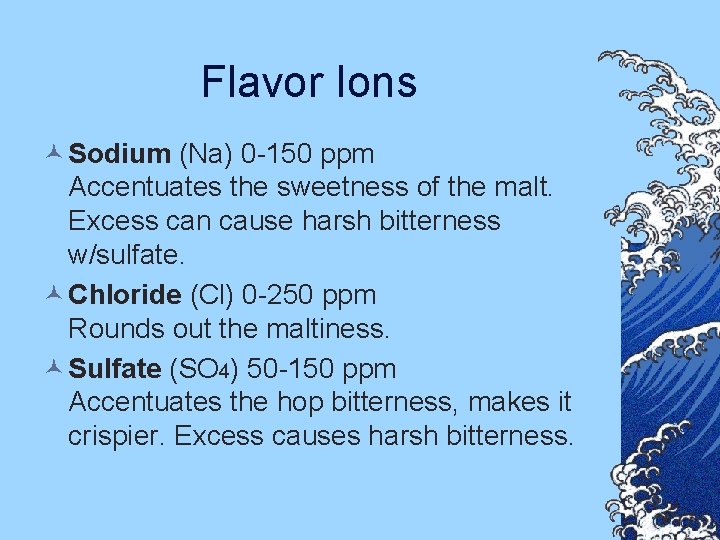
Flavor Ions © Sodium (Na) 0 -150 ppm Accentuates the sweetness of the malt. Excess can cause harsh bitterness w/sulfate. © Chloride (Cl) 0 -250 ppm Rounds out the maltiness. © Sulfate (SO 4) 50 -150 ppm Accentuates the hop bitterness, makes it crispier. Excess causes harsh bitterness.
Water Adjustment for Extract Brewing © Pre-treatment ©Odors/tastes: Chlorine, Iron, Sulfur, metallic, etc. ©Carbon Filters, Campden Tablets, Water Softeners, Green Sand © Flavor Tweaking ©Sulfate for hop bitterness ©Sodium/Chloride for Malt accentuation © Fermentation Issues (Rare) © Zn, Ca, Mn, Mg = Yeast Nutrition, Beer Haze © 30 Years ago, malt extract was for baking ©Now, mineral levels for mash chemistry fermentability have been done for you.
Water Adjustment for Steeping © (Na, Cl, SO 4) Same as for Extract © (Ca, Mg, HCO 3) Steeping p. H ©If your water is very high in bicarbonate, you may need calcium. ©Use a steeping ratio similar to mash 2 -4 qts/lb. ©Ratio can be more dilute with darker malts ©Astringency is usually due to being too hot.
Water Adjustment for All-Grain ©(Ca, Mg, HCO 3) Mash p. H ©Calcium, Magnesium, and Bicarbonate control the Residual Alkalinity. ©Residual Alkalinity combines with the grain bill to determine the mash p. H ©Mash p. H determines fermentability, clarity, flavor, etc. ©(Na, Cl, SO 4) Same as for Extract Brewing
Residual Alkalinity ©Mash p. H is the net effect of the hardness, alkalinity, and the grainbill. ©Residual Alkalinity = alkalinity - (Ca/3. 5 + Mg/7) ©High RA means you should brew dark beers ©Low RA means you should brew light beers
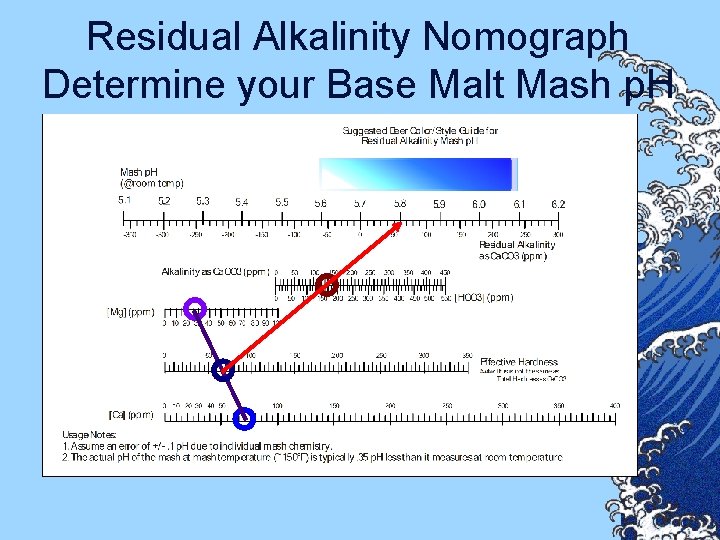
Residual Alkalinity Nomograph Determine your Base Malt Mash p. H
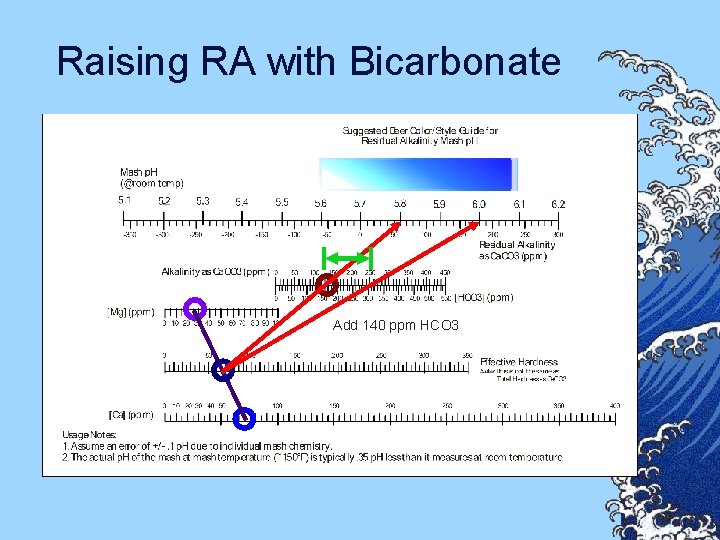
Raising RA with Bicarbonate Add 140 ppm HCO 3
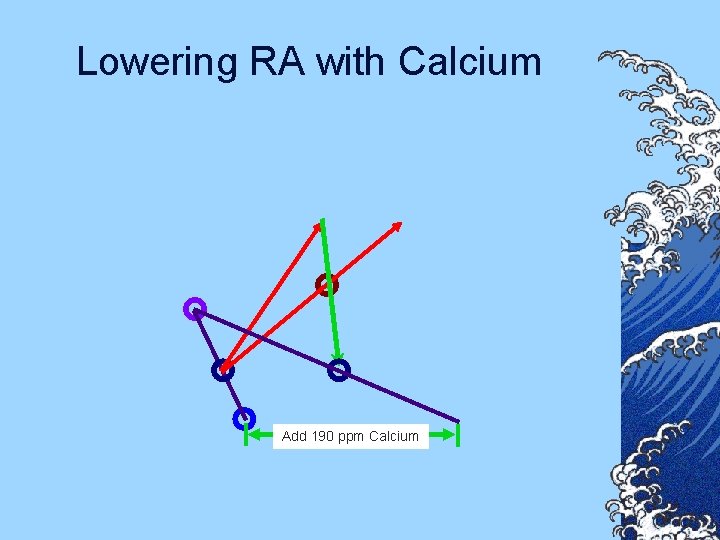
Lowering RA with Calcium Add 190 ppm Calcium
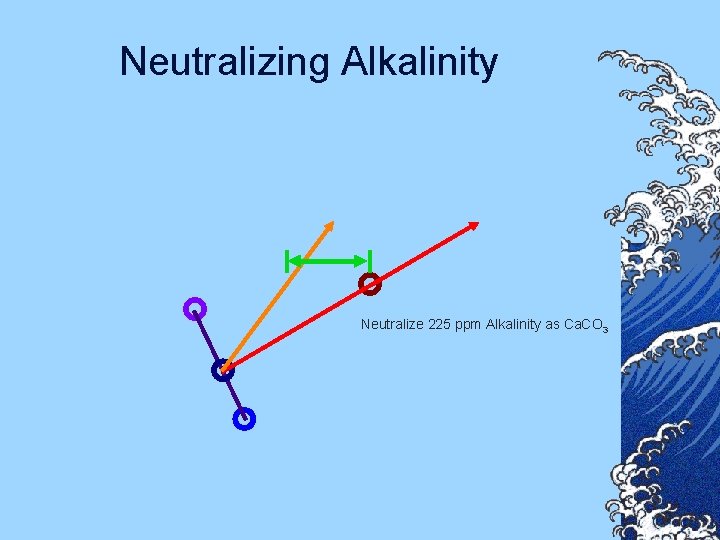
Neutralizing Alkalinity Neutralize 225 ppm Alkalinity as Ca. CO 3
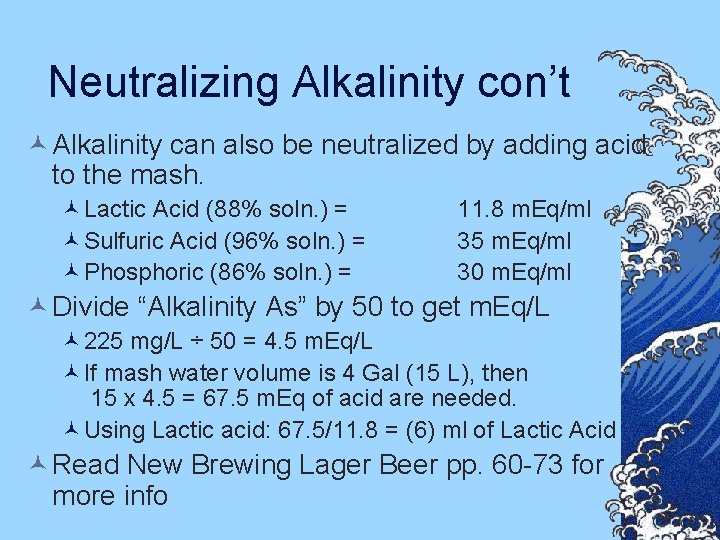
Neutralizing Alkalinity con’t © Alkalinity can also be neutralized by adding acid to the mash. ©Lactic Acid (88% soln. ) = ©Sulfuric Acid (96% soln. ) = ©Phosphoric (86% soln. ) = 11. 8 m. Eq/ml 35 m. Eq/ml 30 m. Eq/ml © Divide “Alkalinity As” by 50 to get m. Eq/L © 225 mg/L ÷ 50 = 4. 5 m. Eq/L ©If mash water volume is 4 Gal (15 L), then 15 x 4. 5 = 67. 5 m. Eq of acid are needed. ©Using Lactic acid: 67. 5/11. 8 = (6) ml of Lactic Acid © Read New Brewing Lager Beer pp. 60 -73 for more info
Acidifying the Sparge © Usually Unnecessary! © Malts have a lot of buffering power, which lasts until runnings fall below 1. 008 © Acidifying the mash water or sparge to 5. 5 or 6 p. H can cause the mash p. H to be less than 4. 5, which inhibits beta amylase and will affect the taste. © Batch Sparge and No-sparge techniques can ensure that runnings never fall below 1. 016
Summary ©You can adjust your brewing water chemistry if: ©You know where you are going ©You know how to get there ©For more info, see ©How To Brew (Palmer) – Chapter 15 ©New Brewing Lager Beer (Noonan) – Chapter 3
- Slides: 21