
BREEDING HOGS AGRI 1419 LABORATORY BREEDS OF SWINE
BREEDING HOGS AGRI 1419 LABORATORY
BREEDS OF SWINE Things to Know Description 2. Ear Carriage (Down or Erect) 3. Type (Sire or Dam) 1.
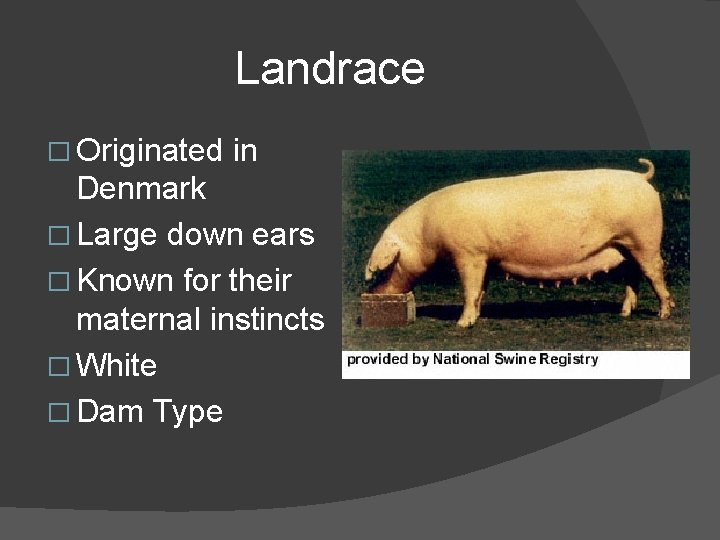
Landrace � Originated in Denmark � Large down ears � Known for their maternal instincts � White � Dam Type
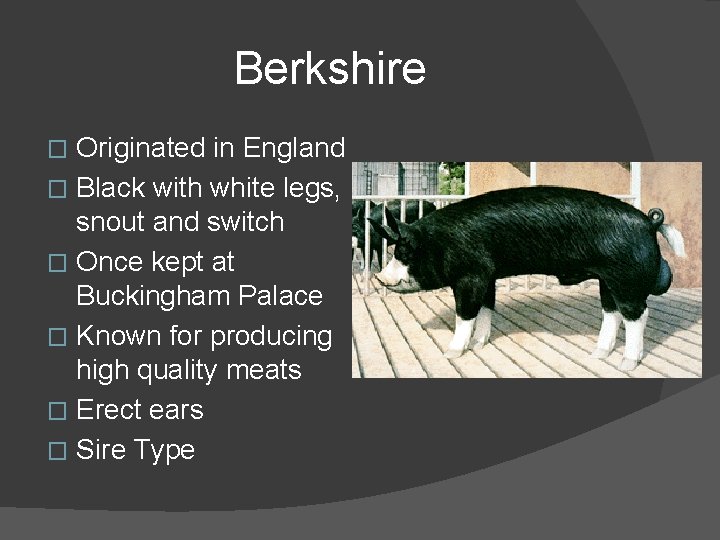
Berkshire Originated in England � Black with white legs, snout and switch � Once kept at Buckingham Palace � Known for producing high quality meats � Erect ears � Sire Type �
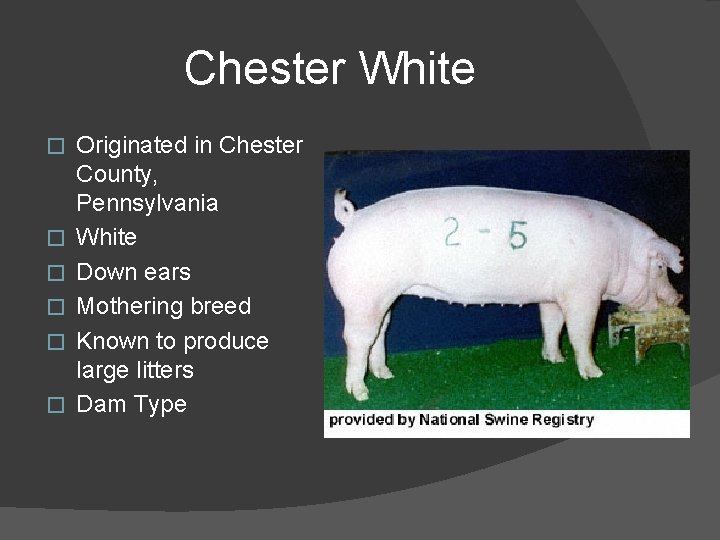
Chester White � � � Originated in Chester County, Pennsylvania White Down ears Mothering breed Known to produce large litters Dam Type
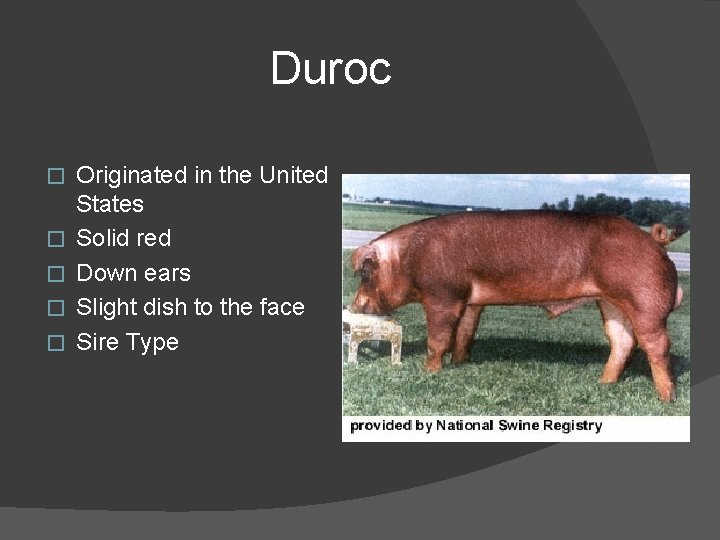
Duroc � � � Originated in the United States Solid red Down ears Slight dish to the face Sire Type
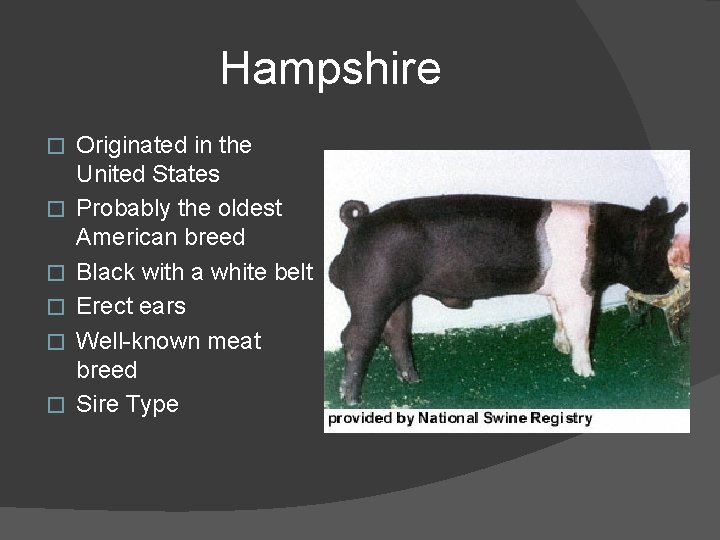
Hampshire � � � Originated in the United States Probably the oldest American breed Black with a white belt Erect ears Well-known meat breed Sire Type
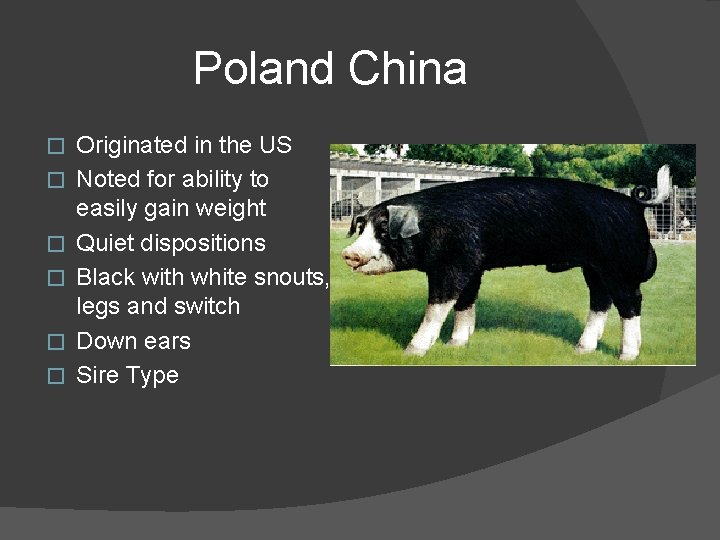
Poland China � � � Originated in the US Noted for ability to easily gain weight Quiet dispositions Black with white snouts, legs and switch Down ears Sire Type
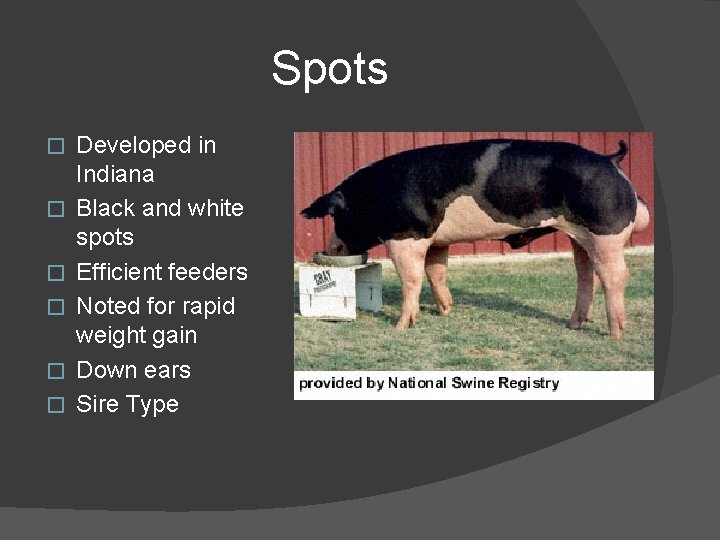
Spots � � � Developed in Indiana Black and white spots Efficient feeders Noted for rapid weight gain Down ears Sire Type
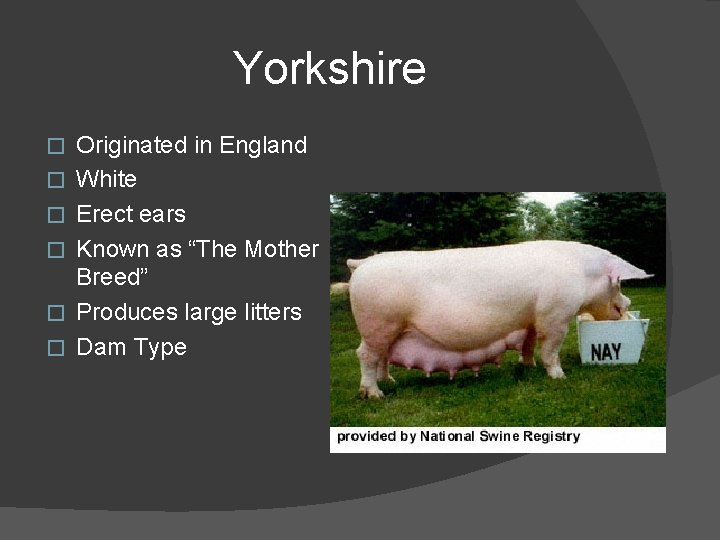
Yorkshire � � � Originated in England White Erect ears Known as “The Mother Breed” Produces large litters Dam Type
Key Terms � � � � � Porcine – Scientific term referring to domesticated swine Barrow – Male pig that has been castrated before reaching sexual maturity Gilt – Female swine that has not given birth to piglets Boar – Intact male pig, any age Sow – Female pig that has given birth to piglets Farrow – The act of giving birth Litter – Term used for the offspring of a sow at one delivery Parity – number assigned to litters, i. e. second parity = second litter Whiteline- Progeny resulting in crossing Yorkshire, Chester White and/or Landrace
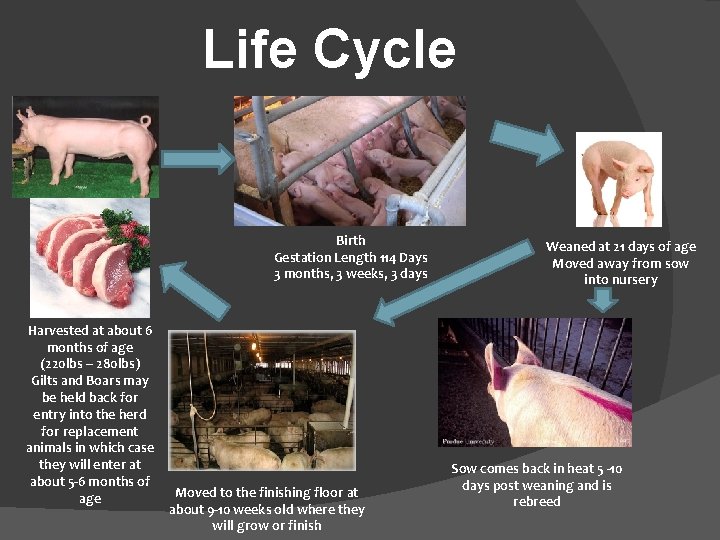
Life Cycle Birth Gestation Length 114 Days 3 months, 3 weeks, 3 days Harvested at about 6 months of age (220 lbs – 280 lbs) Gilts and Boars may be held back for entry into the herd for replacement animals in which case they will enter at about 5 -6 months of age Moved to the finishing floor at about 9 -10 weeks old where they will grow or finish Weaned at 21 days of age Moved away from sow into nursery Sow comes back in heat 5 -10 days post weaning and is rebreed
Why does parity matter? ü ü ü q Litter size (NBA) Weaning (NW) Milk Production Farrowing Ease Profitable Life When are most sows removed from commercial swine operations?

27’s 9’s 81 9’s 3’s 1’s Right Ear Left Ear Litter Number Pig Number Ø When referring to right and left we always do so from the pigs perspective! Ø No more that 2 notches in one quadrant Ø Identification nomenclatureØ Litter Number- Individual Number

Phenotypic Evaluation � Structure �Skeletal �Reproductive � Volume � Muscle � Condition � Balance
Skeletal Structure � Determines longevity within operation � Majority of large swine operations utilize concrete flooring � Evaluate how skeleton is organized �Flexibility of joints �Mobility

Skeletal Structure Undesirable Desirable Notice the angularity in the joints. She is laid back in her shoulder, has flex to her forelimbs, is level spined, and cranked higher in her tailsetting Notice how this gilt is straight shouldered, straight fronted, and she consequently roaches in her spine. She also is straight hocked and round hipped.
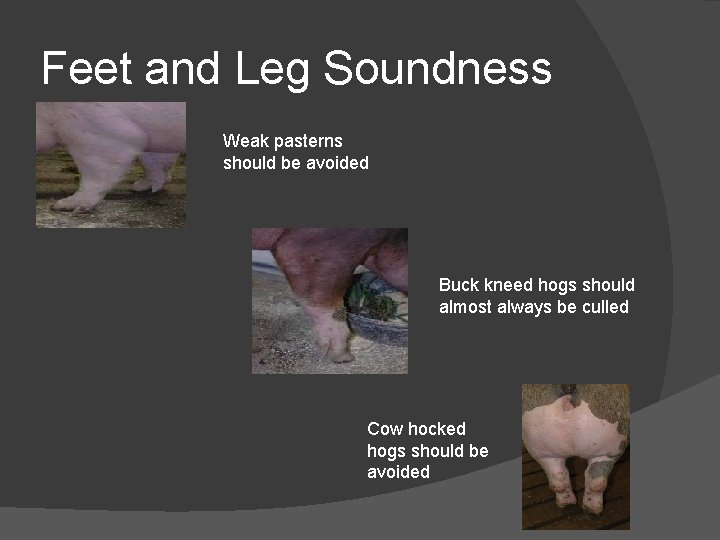
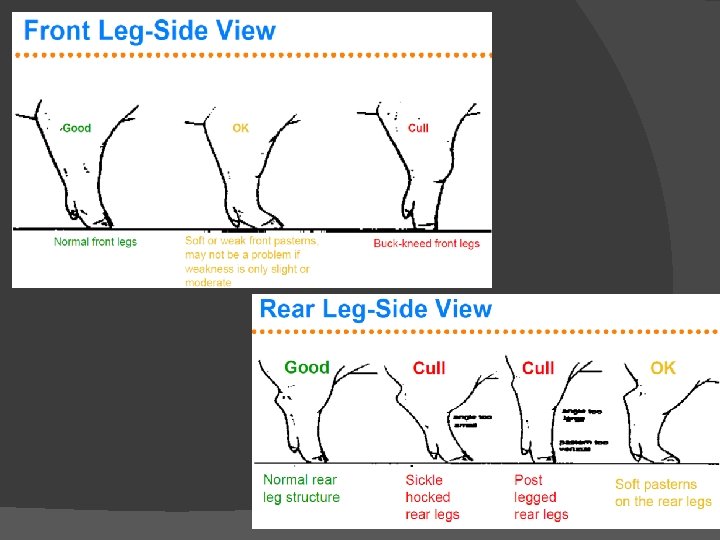
Feet and Leg Soundness Weak pasterns should be avoided Buck kneed hogs should almost always be culled Cow hocked hogs should be avoided
Reproductive Structure � Vulva � Underline � Scrotum (Boars)
Vulva � Proper � Too size and placement small- infintile �Usually do not conceive �Difficulty during breeding � Avoid upturned vulvas �Hinder penetration during natural service
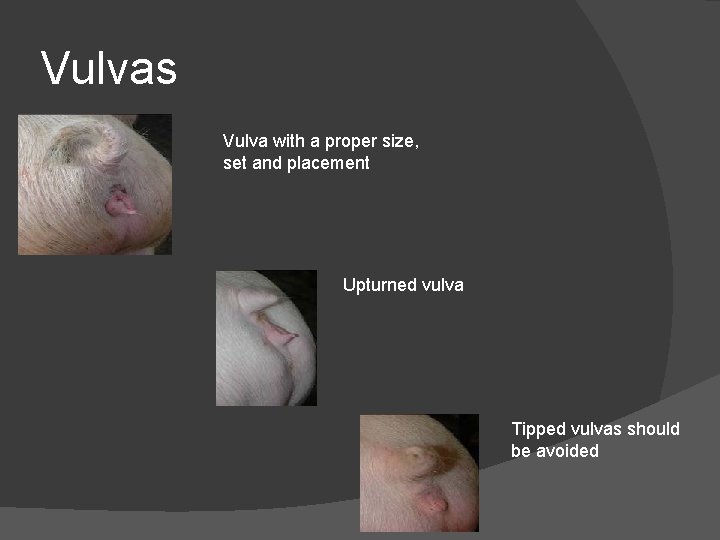
Vulvas Vulva with a proper size, set and placement Upturned vulva Tipped vulvas should be avoided
Underlines � At least six pairs of functional teats � Start as far forward as possible � Refined underlines are desired � Evenly spaced � Free of blunt or pin nipples
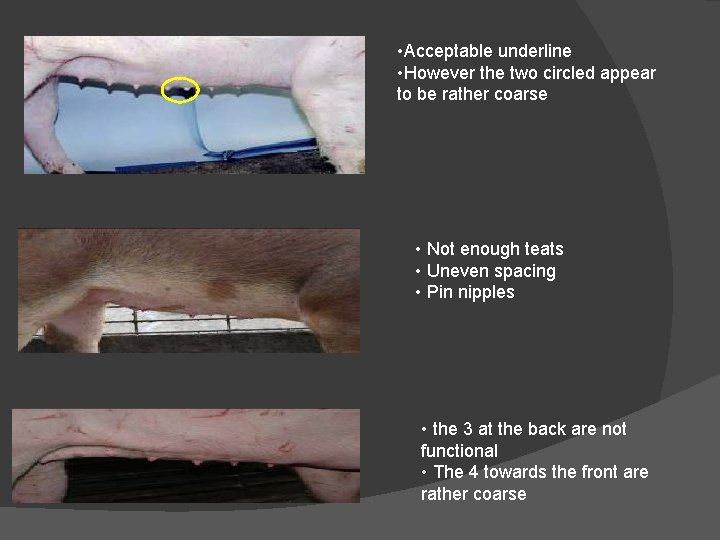
• Acceptable underline • However the two circled appear to be rather coarse • Not enough teats • Uneven spacing • Pin nipples • the 3 at the back are not functional • The 4 towards the front are rather coarse
Volume � Length of Body � Depth of Body � Rib Shape �Study how the rib turns out of the topline �Crate adaptability � Higher volumed swine will better maintain their body condition
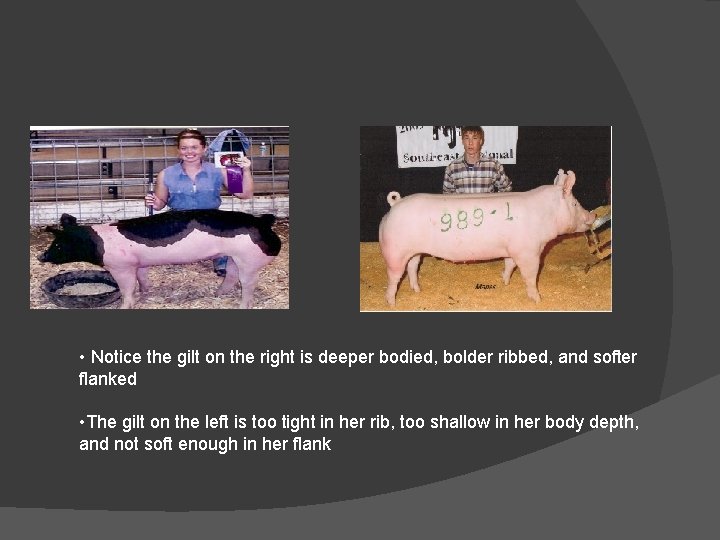
• Notice the gilt on the right is deeper bodied, bolder ribbed, and softer flanked • The gilt on the left is too tight in her rib, too shallow in her body depth, and not soft enough in her flank
Muscle � Want heavy muscled sows �Flatter, smoother muscle pattern than boars or market hogs �Base width is best indicator, especially as sows get older
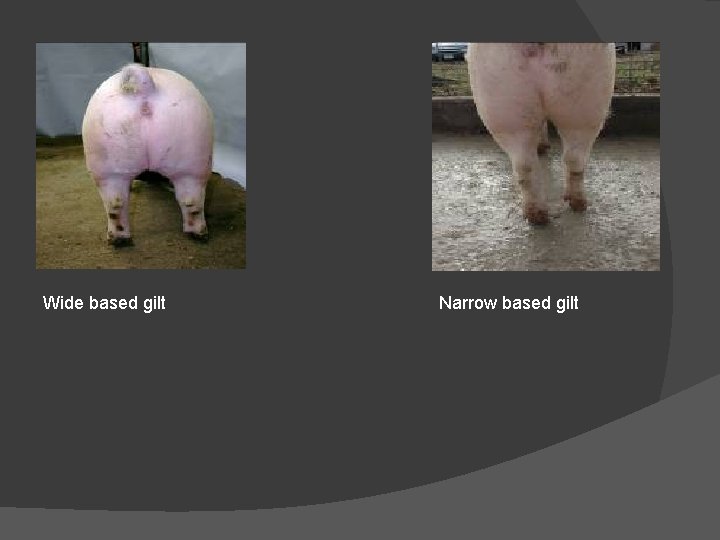
Wide based gilt Narrow based gilt
Condition � Want females that can maintain their BCS �Length, Depth, and shape of rib � Sows too fat �Have trouble conceiving � Sows too thin �Abnormal cycling patterns �Will not milk as well
Balance � Want gilts that are feminine, and eye appeal �Traditionally higher fertility rate � Blends pieces together smoothly
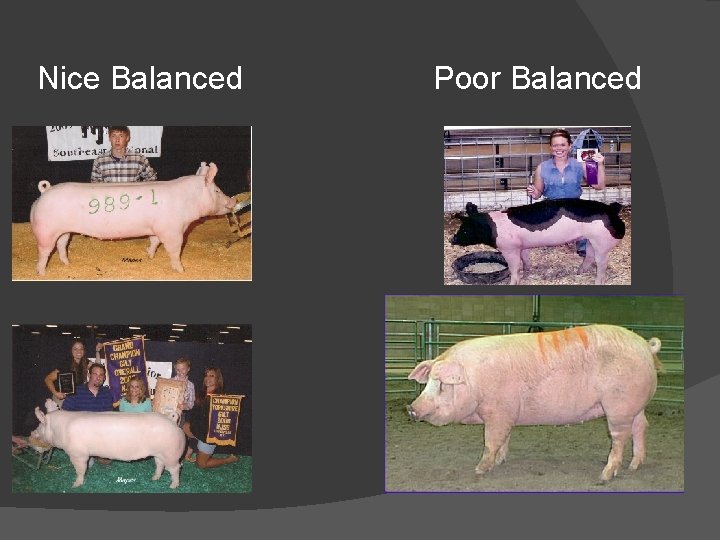
Nice Balanced Poor Balanced
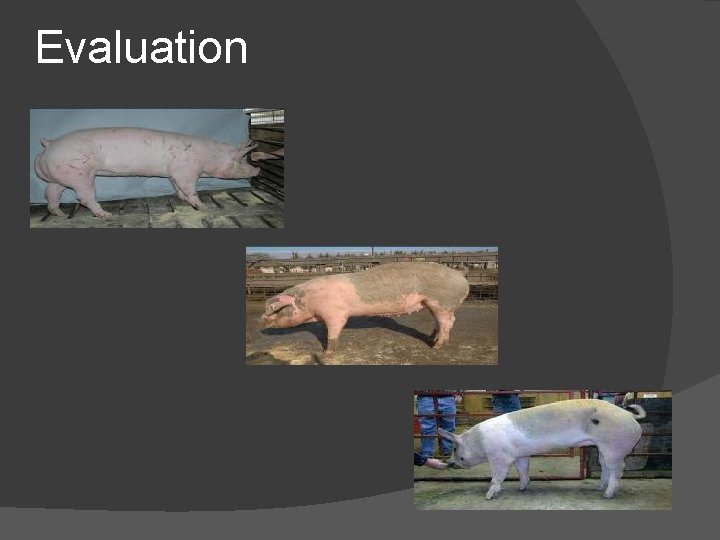
Evaluation

Evaluation • Weak pastern • Round hipped • Tight ribbed • Straight shoulder • Broken topped • Buck kneed • Sickle hocked • Shallow bodied • Extremely tight ribbed and shallow bodied • Steep hip • Low fronted
Performance Selection Actual vs. EPD’s or (Expected Progeny Differences) Carcass/Growth - Days to 250 lbs. - LEA (loin eye area) - FT or BF (fat thickness/back fat) - LBS- Pounds Fat Free Lean per day of age Maternal - NBA (number born alive) - NW (number weaned) - 21 day weight - Parity Indexes - SPI (Sow Productivity Index) Maternal - MLI (Maternal Line Index) Growth/Maternal - TSI (Terminal Sire Index) Growth/Carcass
- Slides: 34