
Breeding Better Wheat The role of plant genetics
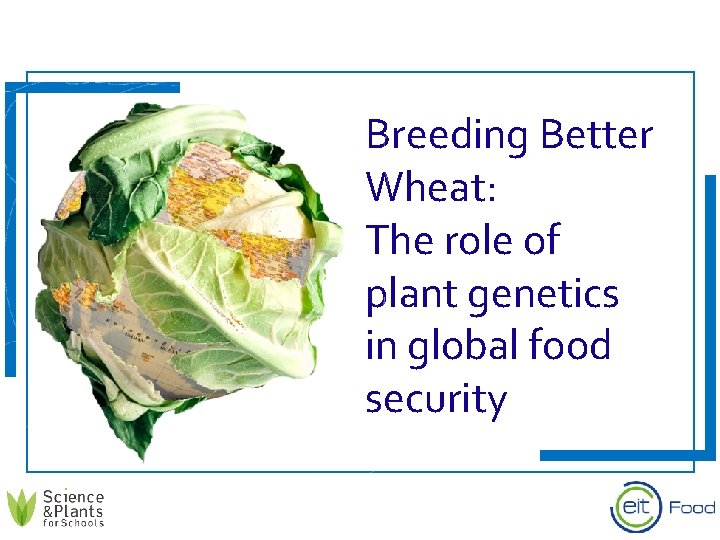
Breeding Better Wheat: The role of plant genetics in global food security
We are what we eat. . . but how much do you know about wheat?
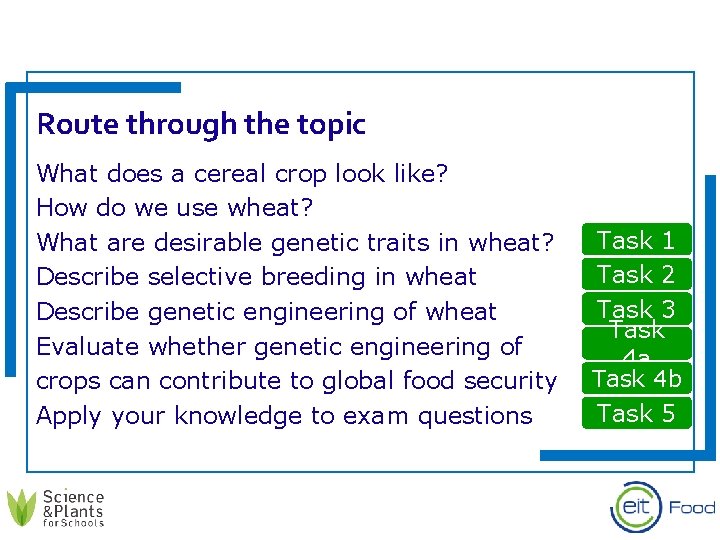
Route through the topic What does a cereal crop look like? How do we use wheat? What are desirable genetic traits in wheat? Describe selective breeding in wheat Describe genetic engineering of wheat Evaluate whether genetic engineering of crops can contribute to global food security Apply your knowledge to exam questions Task 1 Task 2 Task 3 Task 4 a Task 4 b Task 5
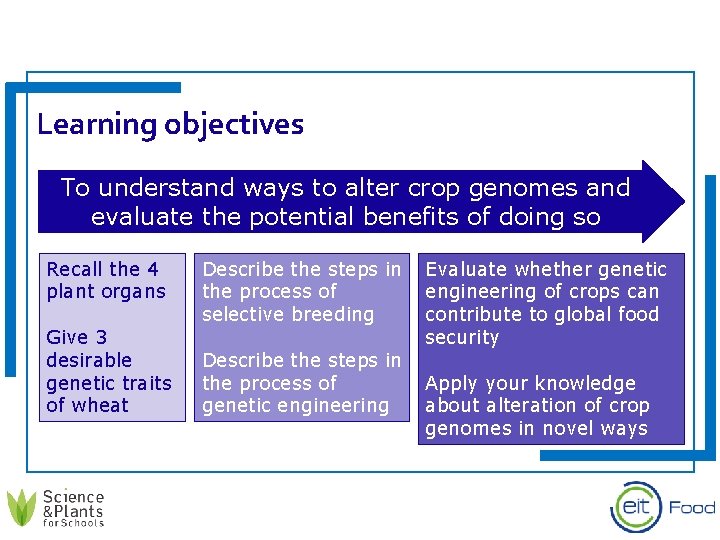
Learning objectives To understand ways to alter crop genomes and evaluate the potential benefits of doing so Recall the 4 plant organs Give 3 desirable genetic traits of wheat Describe the steps in Evaluate whether genetic the process of engineering of crops can selective breeding contribute to global food security Describe the steps in the process of Apply your knowledge genetic engineering about alteration of crop genomes in novel ways
What does a cereal crop look like? Sketching a wheat plant Cereal crops are types of grass that produce seeds, which humans use as food. Can you sketch a cereal plant, like wheat? Do you remember the 4 organs that all plants have? Which part of the cereal plant do we eat?
What does a cereal crop look like? This is barley’s life cycle From seed germination to seed production for the next year
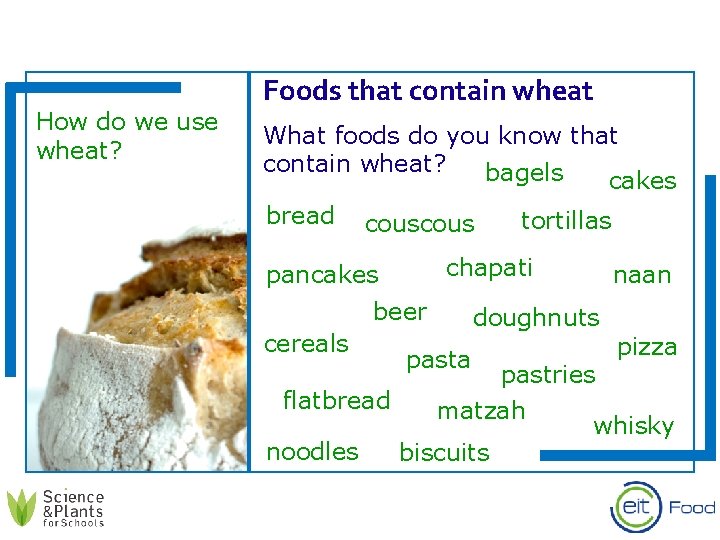
How do we use wheat? Foods that contain wheat What foods do you know that contain wheat? bagels cakes bread cous tortillas chapati pancakes beer cereals flatbread noodles naan doughnuts pasta pastries matzah biscuits pizza whisky
What are Task 1: Read the questions to desirable genetic get started. traits in wheat? Watch the video to find out about Wheat of the Future. Answer the questions about Wheat of the Future. Click here for video Click here for questions
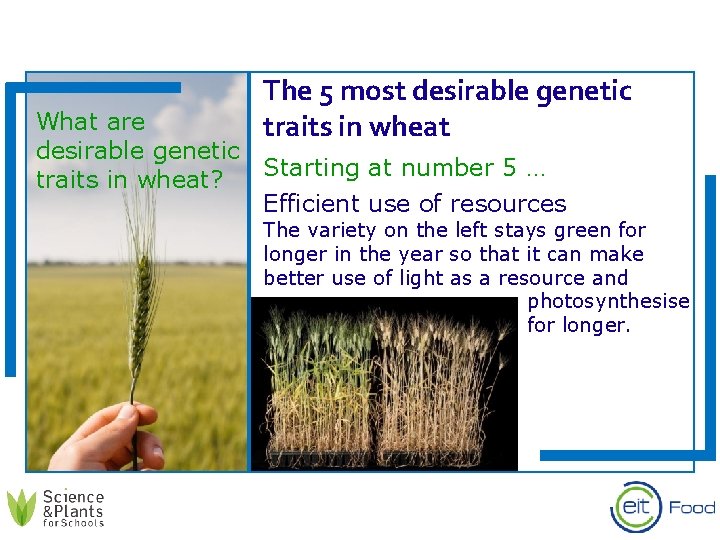
The 5 most desirable genetic traits in wheat What are desirable genetic Starting at number 5 … traits in wheat? Efficient use of resources The variety on the left stays green for longer in the year so that it can make better use of light as a resource and photosynthesise for longer.
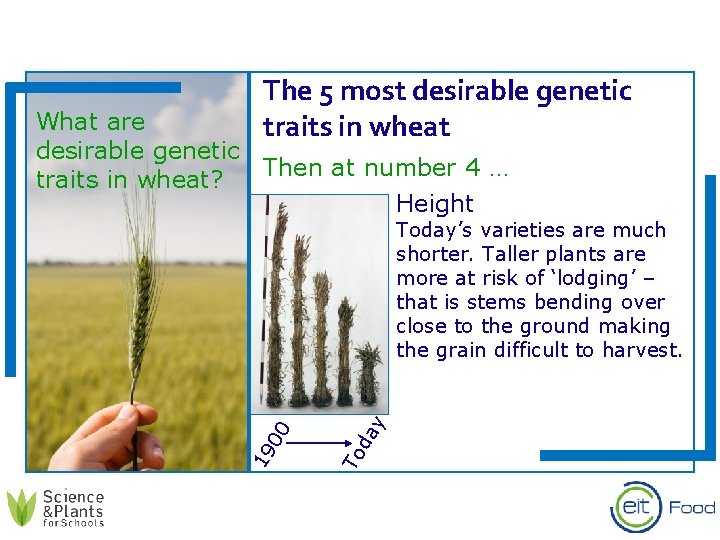
The 5 most desirable genetic traits in wheat What are desirable genetic Then at number 4 … traits in wheat? Height y To da 19 0 0 Today’s varieties are much shorter. Taller plants are more at risk of ‘lodging’ – that is stems bending over close to the ground making the grain difficult to harvest.
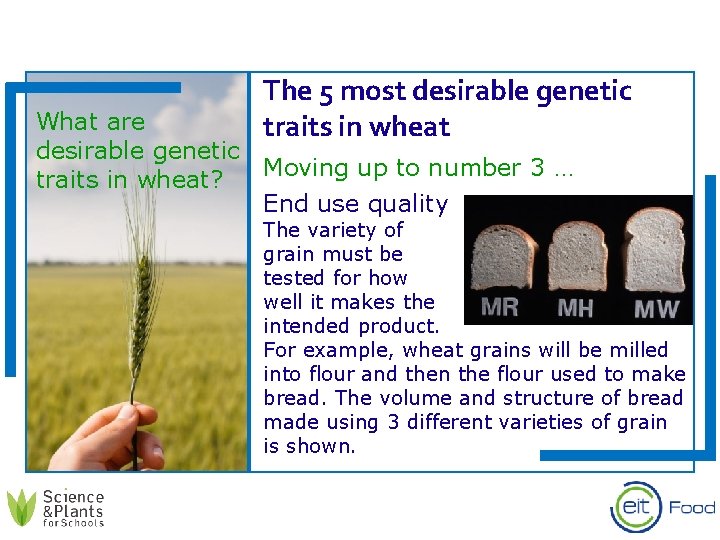
The 5 most desirable genetic traits in wheat What are desirable genetic Moving up to number 3 … traits in wheat? End use quality The variety of grain must be tested for how well it makes the intended product. For example, wheat grains will be milled into flour and then the flour used to make bread. The volume and structure of bread made using 3 different varieties of grain is shown.

The 5 most desirable genetic traits in wheat What are desirable genetic At number 2 … traits in wheat? Disease resistance Being more resistant to disease means that less of the crop is lost to infections, and there is no need to apply pesticides. These leaves show different levels of genetic resistance to yellow wheat rust, a fungus.
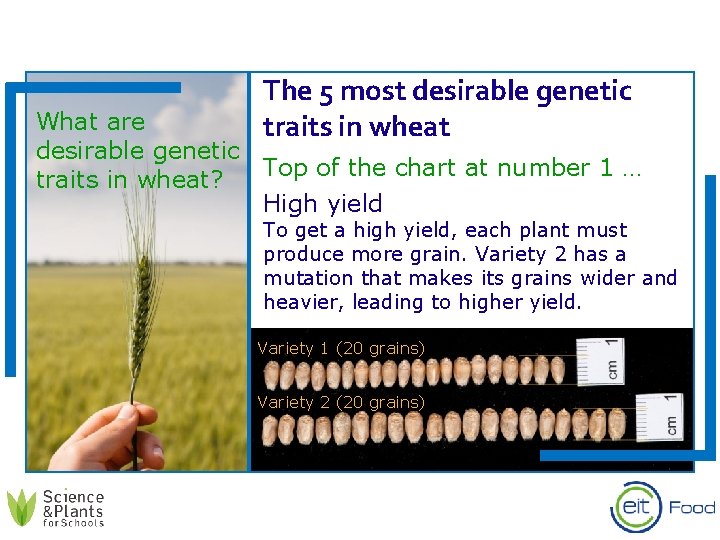
The 5 most desirable genetic traits in wheat What are desirable genetic Top of the chart at number 1 … traits in wheat? High yield To get a high yield, each plant must produce more grain. Variety 2 has a mutation that makes its grains wider and heavier, leading to higher yield. Variety 1 (20 grains) Variety 2 (20 grains)

The 5 most desirable genetic traits in wheat What are desirable genetic 1. High yield traits in wheat? 3. End use quality 2. Disease resistance 4. Not too tall
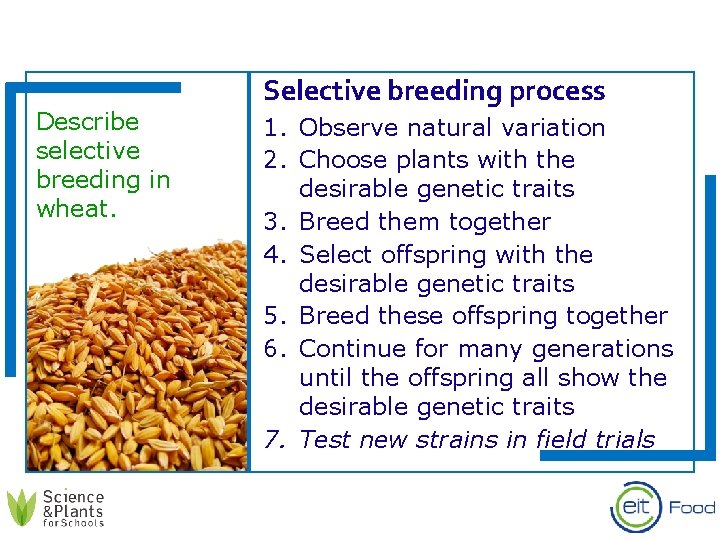
Describe selective breeding in wheat. Selective breeding process 1. Observe natural variation 2. Choose plants with the desirable genetic traits 3. Breed them together 4. Select offspring with the desirable genetic traits 5. Breed these offspring together 6. Continue for many generations until the offspring all show the desirable genetic traits 7. Test new strains in field trials
Describe selective breeding in wheat. Task 2: Design your own wheat with desirable genetic traits. Use the generation event cards to find out how it does in field trials. See whether your desirable genetic traits would have been beneficial to growers. Click here to download Task 2
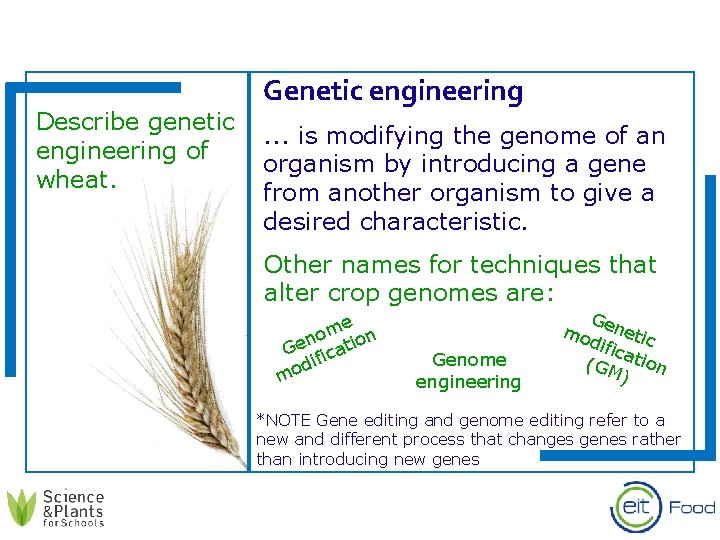
Genetic engineering Describe genetic . . . is modifying the genome of an engineering of organism by introducing a gene wheat. from another organism to give a desired characteristic. Other names for techniques that alter crop genomes are: e m no tion e G fica di o m Genome engineering G mo enetic difi cat (GM ion ) *NOTE Gene editing and genome editing refer to a new and different process that changes genes rather than introducing new genes
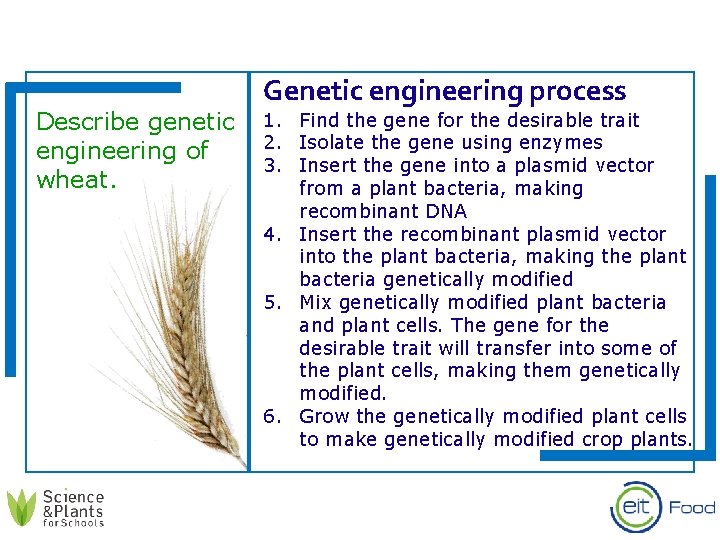
Genetic engineering process Describe genetic 1. 2. engineering of 3. wheat. Find the gene for the desirable trait Isolate the gene using enzymes Insert the gene into a plasmid vector from a plant bacteria, making recombinant DNA 4. Insert the recombinant plasmid vector into the plant bacteria, making the plant bacteria genetically modified 5. Mix genetically modified plant bacteria and plant cells. The gene for the desirable trait will transfer into some of the plant cells, making them genetically modified. 6. Grow the genetically modified plant cells to make genetically modified crop plants.
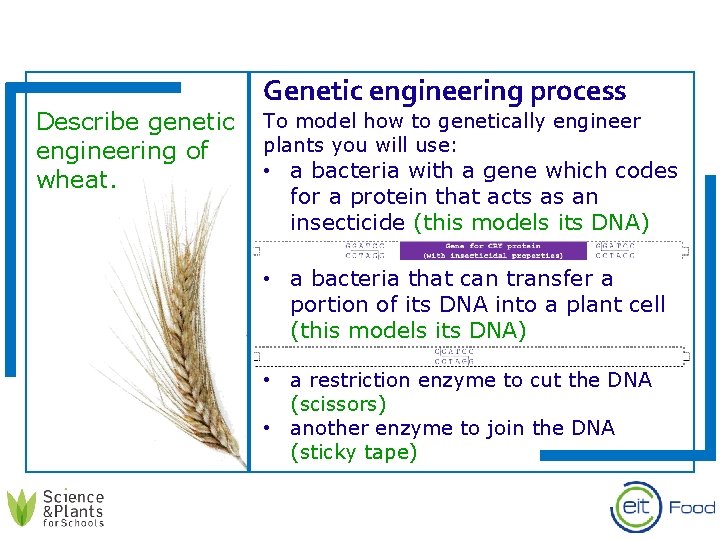
Genetic engineering process Describe genetic To model how to genetically engineer plants you will use: engineering of • a bacteria with a gene which codes wheat. for a protein that acts as an insecticide (this models its DNA) • a bacteria that can transfer a portion of its DNA into a plant cell (this models its DNA) • a restriction enzyme to cut the DNA (scissors) • another enzyme to join the DNA (sticky tape)
Describe genetic engineering of wheat. Task 3: Genetically engineer a plant so it makes an insecticide. Using instructions and DNA models, make recombinant DNA. See how successfully you can transfer your recombinant plasmid into a model plant cell. Click here to download documents 3 A and 3 B for this task
Evaluate whether genetic engineering of crops can contribute to global food security. Task 4 a: Consider the 2 genetic engineering scenarios. Stand on the Line of Agreement to show what you think. Would most people in your class support genetic engineering of crop plants or not?
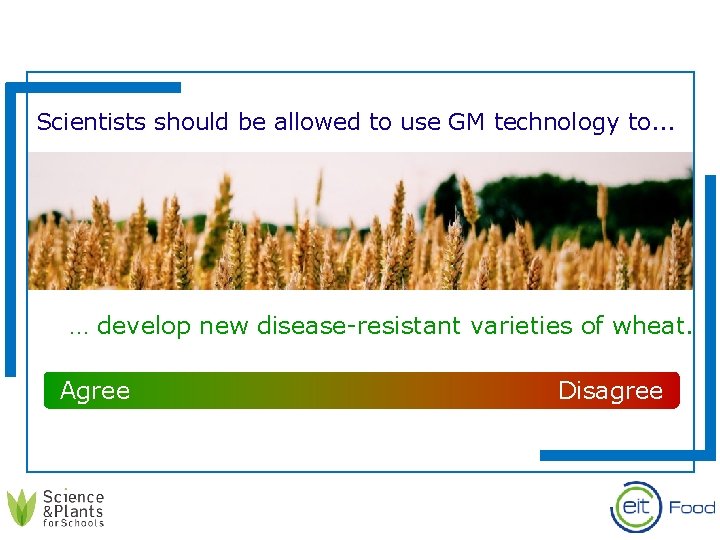
Scientists should be allowed to use GM technology to. . . … develop new disease-resistant varieties of wheat. Agree Disagree
Scientists should be allowed to use GM technology to. . . … develop new wheat varieties with higher yields. Agree Disagree
What is global food security? Food security is the ability of a population to obtain enough food and good nutrition. Global food security involves: Øgrowing enough food for everyone Ønot wasting food Øthe cost of food Øthe availability (distribution) of food Øthe nutritional value of food available
Evaluate whether genetic engineering of crops can contribute to global food security. Task 4 b: Consider the use of genetic engineering to contribute to global food security. Follow the series of activities to help you consider the bioethics. By the end you should be able to give a reasoned conclusion. Click here to download documents 4 A, 4 B, 4 C and 4 D for this task
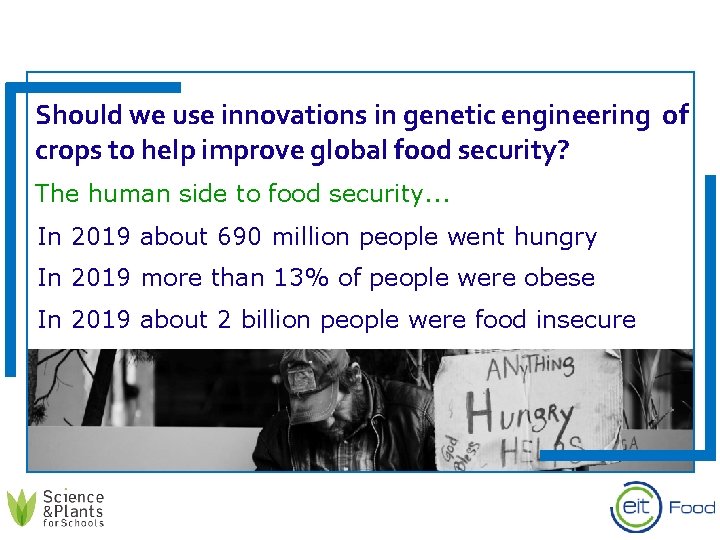
Should we use innovations in genetic engineering of crops to help improve global food security? The human side to food security. . . In 2019 about 690 million people went hungry In 2019 more than 13% of people were obese In 2019 about 2 billion people were food insecure
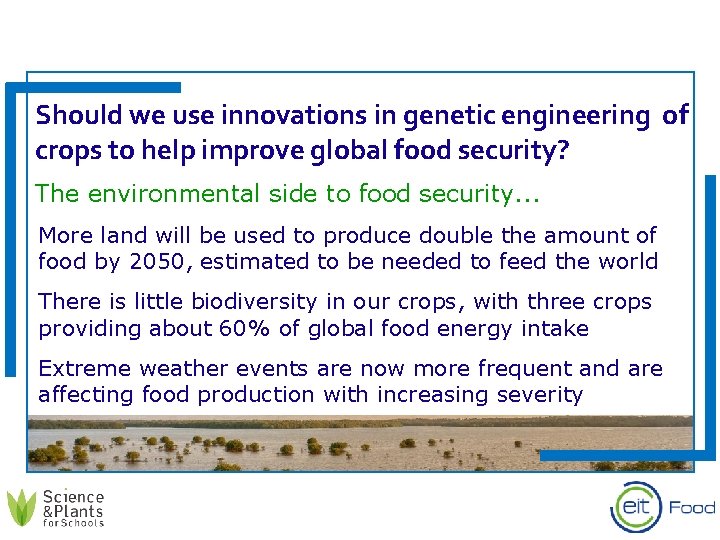
Should we use innovations in genetic engineering of crops to help improve global food security? The environmental side to food security. . . More land will be used to produce double the amount of food by 2050, estimated to be needed to feed the world There is little biodiversity in our crops, with three crops providing about 60% of global food energy intake Extreme weather events are now more frequent and are affecting food production with increasing severity
Should we use innovations in genetic engineering of crops to help improve global food security? What genetic engineering offers to food security. . . Without the crop yield gains offered by genetically engineered crops it has been calculated that there would need to be 3. 1 million hectares of additional global cropland ‘We cannot afford to discard GM as one of a range of options for improving food security’ World Vision Australia
Evaluate whether genetic engineering of crops can contribute to global food security. What’s the story? Read the card. Think about the issue. Do you feel that we should use genetic engineering to help improve global food security?
Evaluate whether genetic engineering of crops can contribute to global food security. What’s the story? Ø At this point you will probably have a feeling about what is right based on your emotions and personal values. Ø For some people this will be a strong feeling. Ø This is a valid opinion. Ø However, scientific discussion is more structured.
Evaluate whether genetic engineering of crops can contribute to global food security. Bioethical framework The bioethical framework for Food and Nutrition professionals requires them to consider: 1. Beneficence (doing good) 2. Nonmaleficence (not doing harm) 3. Justice (treating others equally and fairly) 4. Autonomy (giving other people the options of choice)
Evaluate whether genetic engineering of crops can contribute to global food security. Bioethical framework The bioethical framework used at GCSE is simpler than this and requires you to consider: 1. Personal 2. Social 3. Economic 4. Environmental implications and to decide which are most important so you can draw a conclusion.
Evaluate whether genetic engineering of crops can contribute to global food security. What’s your issue? Read the cards of opinions. Write the topic for discussion at the top of A 3 paper: ‘We should use innovative genetic engineering of crops to improve global food security’. Divide the rest of the A 3 page in half and write ‘For’ on one side and ‘Against’ on the other.
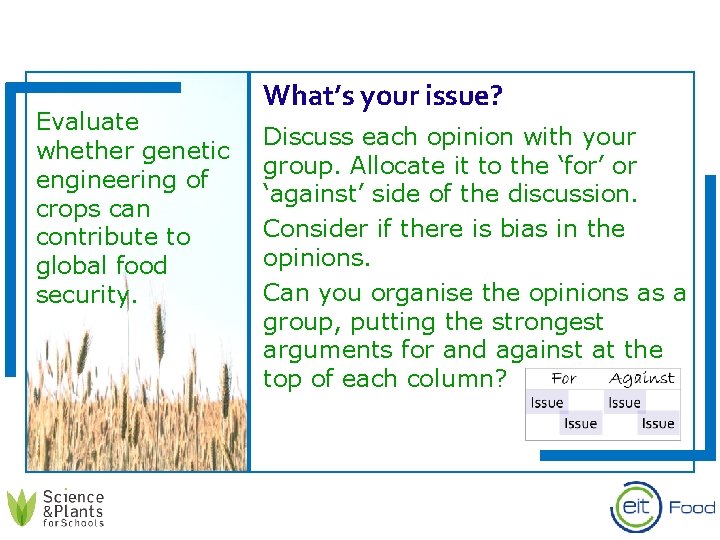
Evaluate whether genetic engineering of crops can contribute to global food security. What’s your issue? Discuss each opinion with your group. Allocate it to the ‘for’ or ‘against’ side of the discussion. Consider if there is bias in the opinions. Can you organise the opinions as a group, putting the strongest arguments for and against at the top of each column?
Evaluate whether genetic engineering of crops can contribute to global food security. What’s your issue? Ø At this point you are starting to assemble a range of opinions on the issue and to rank them by the strength of their arguments Ø Scientific discussion also uses facts to support opinions and arguments.
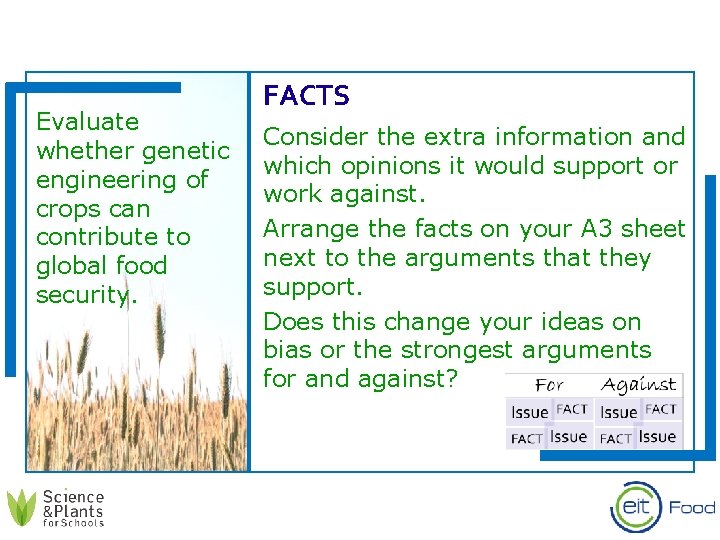
Evaluate whether genetic engineering of crops can contribute to global food security. FACTS Consider the extra information and which opinions it would support or work against. Arrange the facts on your A 3 sheet next to the arguments that they support. Does this change your ideas on bias or the strongest arguments for and against?
Evaluate whether genetic engineering of crops can contribute to global food security. FACTS Ø On your A 3 sheet you have laid out a scientific discussion, with opinions and facts. Ø By talking about the opinions and facts you have been evaluating their strengths and weaknesses. Ø This may or may not have changed your original opinion.
Evaluate whether genetic engineering of crops can contribute to global food security. Decision time Now you need to make a decision about the original topic, based on your evaluation of the evidence and arguments. Use the writing frame to construct your scientific evaluation of the question and to draw a conclusion.
Evaluate whether genetic engineering of crops can contribute to global food security. Decision time Now you need to make a decision about the original topic, based on your evaluation of the evidence and arguments. Use the line of agreement to show what your opinion is now.
Evaluate whether genetic engineering of crops can contribute to global food security. Task 4 c: Consider the 2 genetic engineering scenarios. Stand on the Line of Agreement to show what you think. Would most people in your class support genetic engineering of crop plants or not? Has anyone changed their opinion?
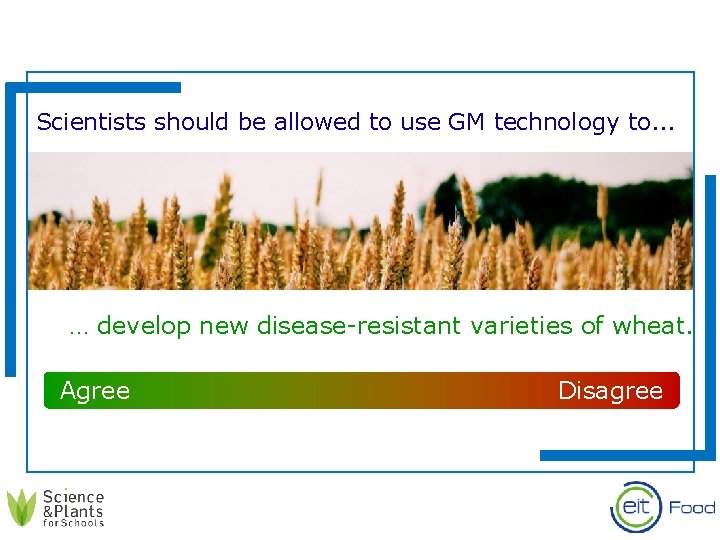
Scientists should be allowed to use GM technology to. . . … develop new disease-resistant varieties of wheat. Agree Disagree
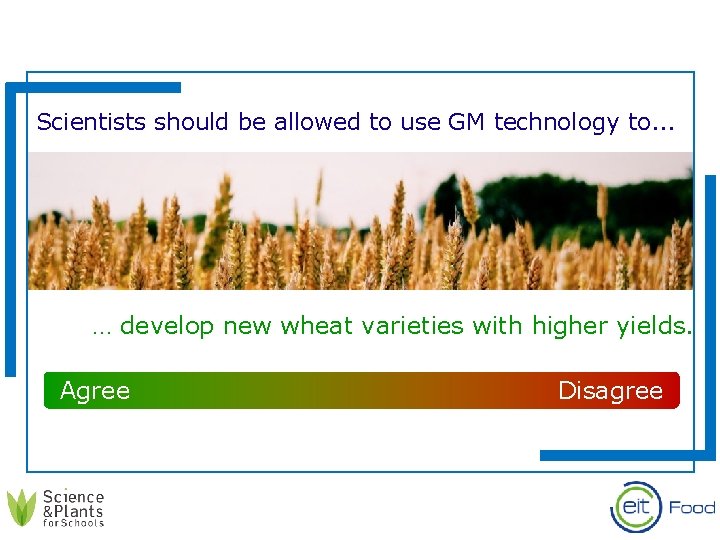
Scientists should be allowed to use GM technology to. . . … develop new wheat varieties with higher yields. Agree Disagree
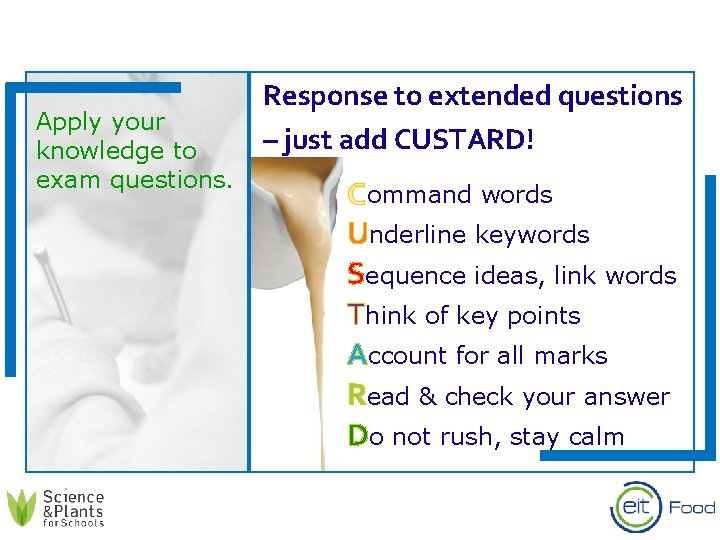
Apply your knowledge to exam questions. Response to extended questions – just add CUSTARD! Command words Underline keywords Sequence ideas, link words Think of key points Account for all marks Read & check your answer Do not rush, stay calm
Apply your knowledge to exam questions. Response to extended questions Command words … … are used in exams to tell you how to answer the question For example ‘describe’ means you need to give an account of something in words
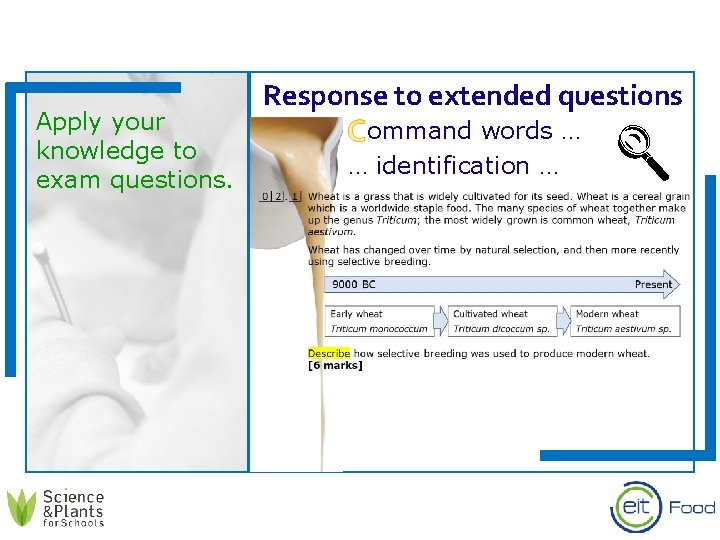
Apply your knowledge to exam questions. Response to extended questions Command words … … identification …
Apply your knowledge to exam questions. Response to extended questions C nderline keywords U Look for the words from lessons that are familiar to you and that you can discuss
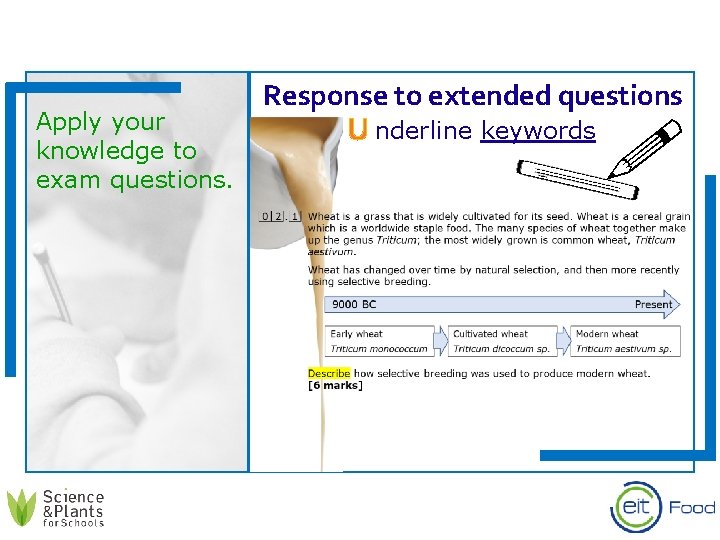
Apply your knowledge to exam questions. Response to extended questions C nderline keywords U
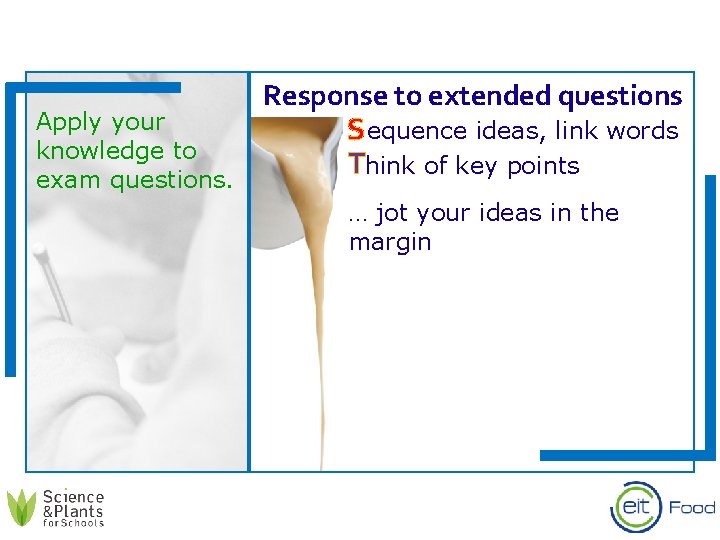
Apply your knowledge to exam questions. Response to extended questions Cequence ideas, link words S hink of key points T … jot your ideas in the margin
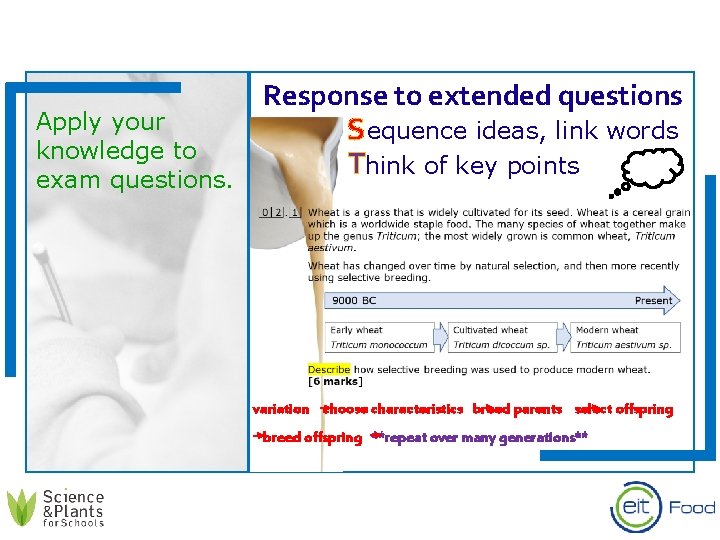
Apply your knowledge to exam questions. Response to extended questions Cequence ideas, link words S hink of key points T variation choose characteristics breed parents select offspring breed offspring **repeat over many generations**
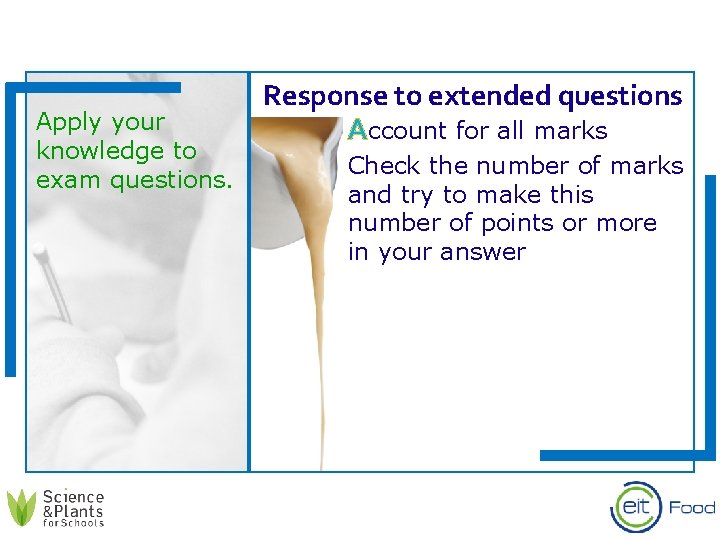
Apply your knowledge to exam questions. Response to extended questions Account for all marks Check the number of marks and try to make this number of points or more in your answer
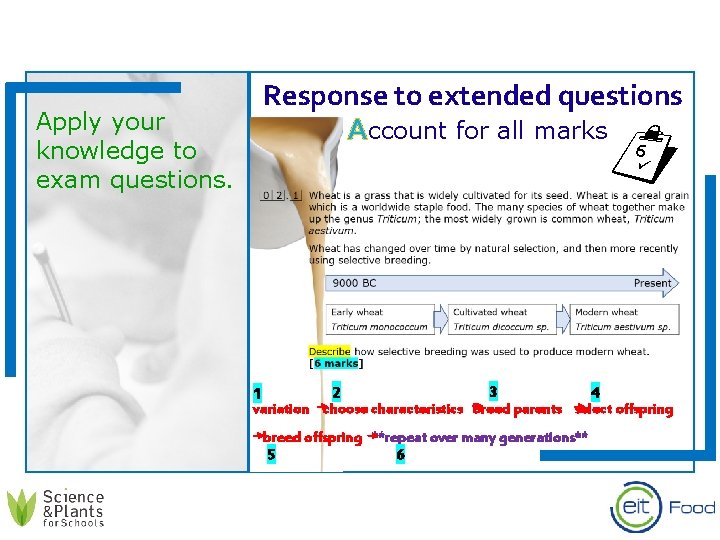
Apply your knowledge to exam questions. Response to extended questions Account for all marks 6 3 2 4 1 variation choose characteristics breed parents select offspring breed offspring **repeat over many generations** 5 6
Apply your knowledge to exam questions. Response to extended questions Read & check your answer Have you done what the command word told you to? Have you answered the question? Have you included all of your ideas in a logical sequence? Have you accounted for all marks?
Apply your knowledge to exam questions. Response to extended questions Do not rush, stay calm Take your time to read and correct your work – job done!

Apply your knowledge to exam questions. Task 5: Use the CUSTARD approach to answering questions Mark how well students did at Question 1, then try Question 2 for yourself How did you do? Having a structured approach can really help with longer responses. Click here to download Task 5
Route through the topic What does a cereal crop look like? How do we use wheat? What are desirable genetic traits in wheat? Describe selective breeding in wheat Describe genetic engineering of wheat Evaluate whether genetic engineering of crops can contribute to global food security Apply your knowledge to exam questions Task 1 Task 2 Task 3 Task 4 a Task 4 b Task 5
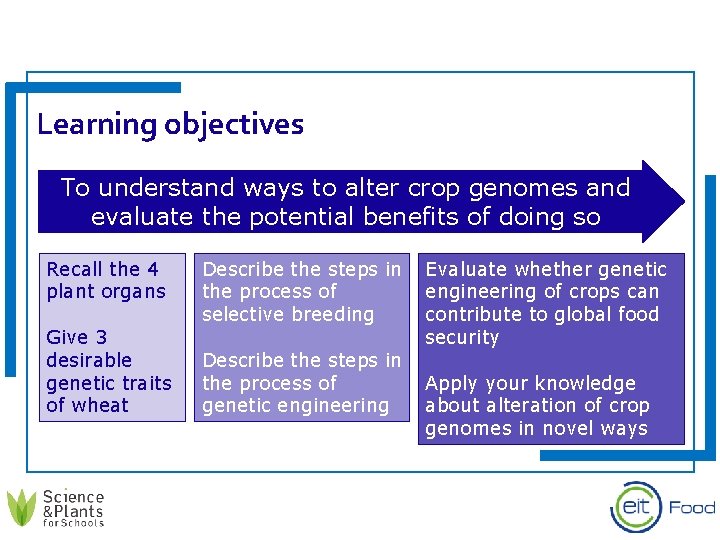
Learning objectives To understand ways to alter crop genomes and evaluate the potential benefits of doing so Recall the 4 plant organs Give 3 desirable genetic traits of wheat Describe the steps in Evaluate whether genetic the process of engineering of crops can selective breeding contribute to global food security Describe the steps in the process of Apply your knowledge genetic engineering about alteration of crop genomes in novel ways
- Slides: 56