
Breathing Emergencies Ch 6 What is breathing The
Breathing Emergencies Ch. 6
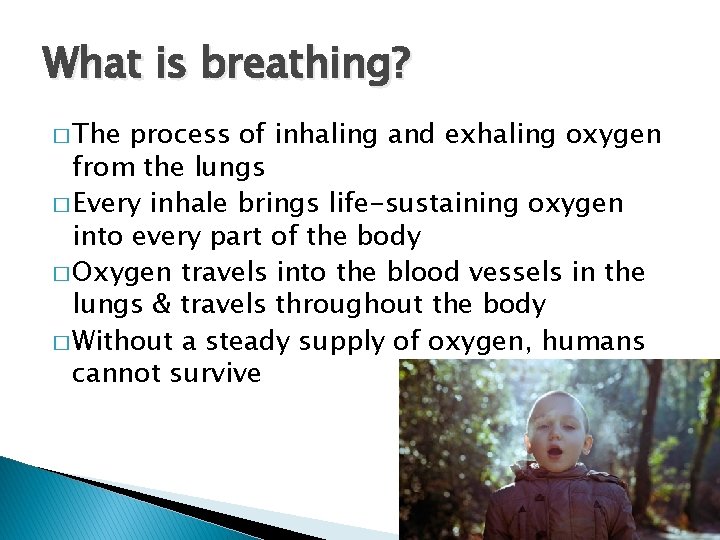
What is breathing? � The process of inhaling and exhaling oxygen from the lungs � Every inhale brings life-sustaining oxygen into every part of the body � Oxygen travels into the blood vessels in the lungs & travels throughout the body � Without a steady supply of oxygen, humans cannot survive
Without Breath… � 0 minutes: breathing stops, heart will soon stop beating � 4 -6 minutes: brain damage possible, cells begin to die � 6 -10 minutes: brain damage likely � >10 minutes: irreversible brain damage certain
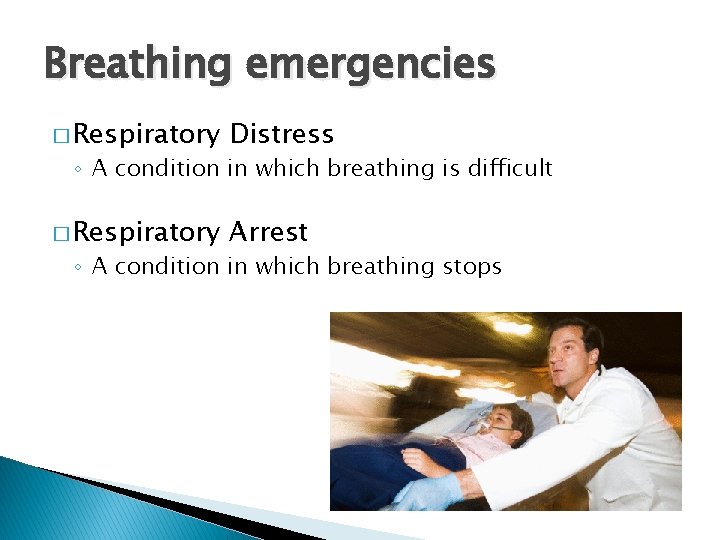
Breathing emergencies � Respiratory Distress � Respiratory Arrest ◦ A condition in which breathing is difficult ◦ A condition in which breathing stops
Respiratory Distress: Signs & Symptoms � Abnormal breathing � Slow/rapid breathing � Deep/shallow breathing � Gasping for air � Wheezing or gurgling � Moist or cool skin � Flushed, pale, ashen, or bluish skin � Dizzy/light headed � Pain in chest � Tingling in hands, feet, lips
Respiratory Distress: Causes � Chronic Conditions ◦ Asthma ◦ Emphysema � Anaphylactic Shock � Partially block airway � Illness � Drug Poisoning � Emotional distress
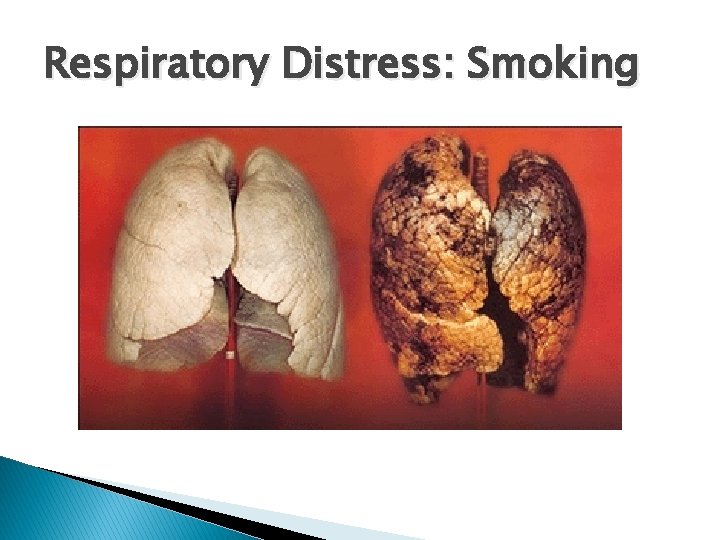
Respiratory Distress: Smoking
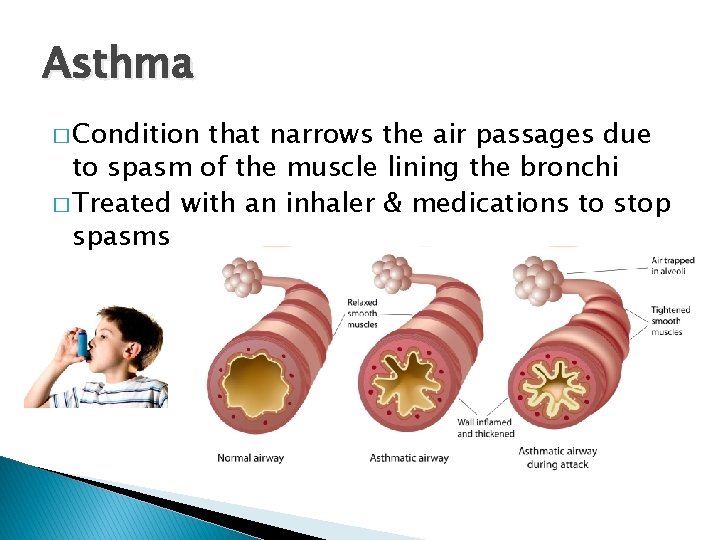
Asthma � Condition that narrows the air passages due to spasm of the muscle lining the bronchi � Treated with an inhaler & medications to stop spasms
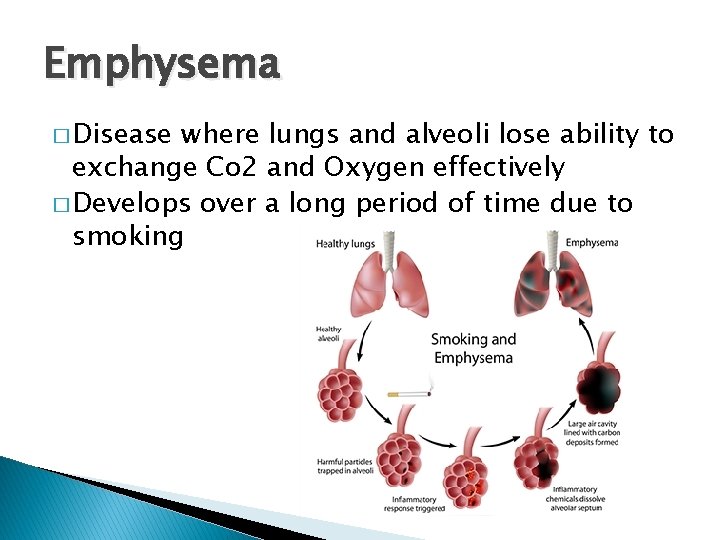
Emphysema � Disease where lungs and alveoli lose ability to exchange Co 2 and Oxygen effectively � Develops over a long period of time due to smoking
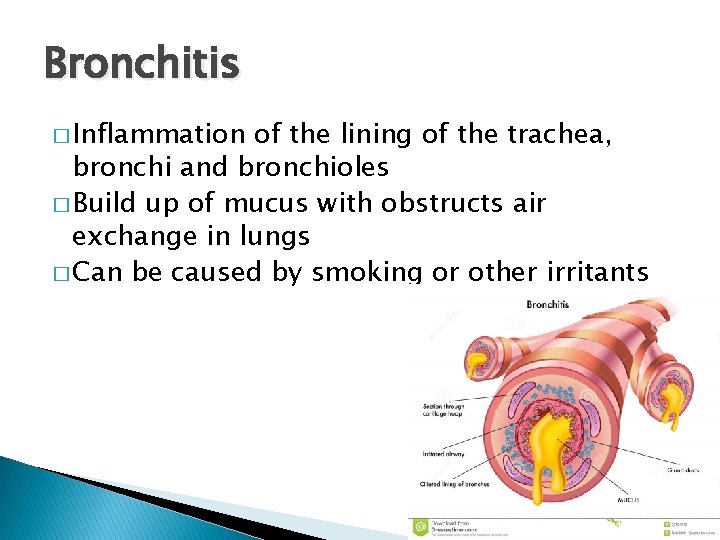
Bronchitis � Inflammation of the lining of the trachea, bronchi and bronchioles � Build up of mucus with obstructs air exchange in lungs � Can be caused by smoking or other irritants
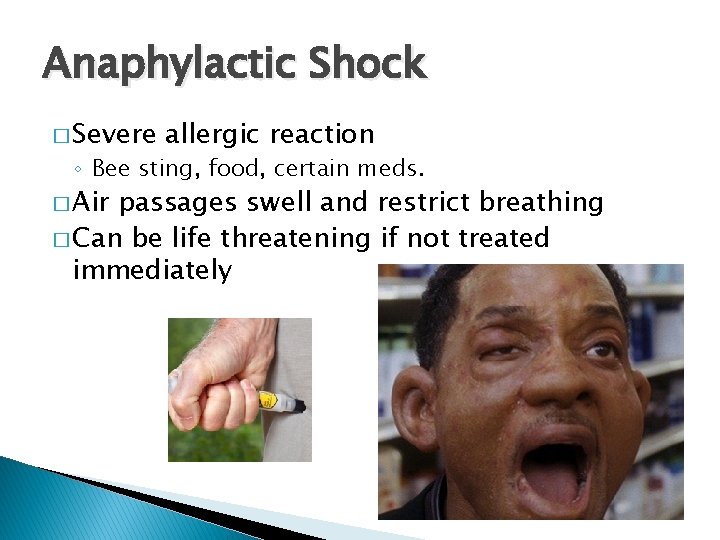
Anaphylactic Shock � Severe allergic reaction ◦ Bee sting, food, certain meds. � Air passages swell and restrict breathing � Can be life threatening if not treated immediately
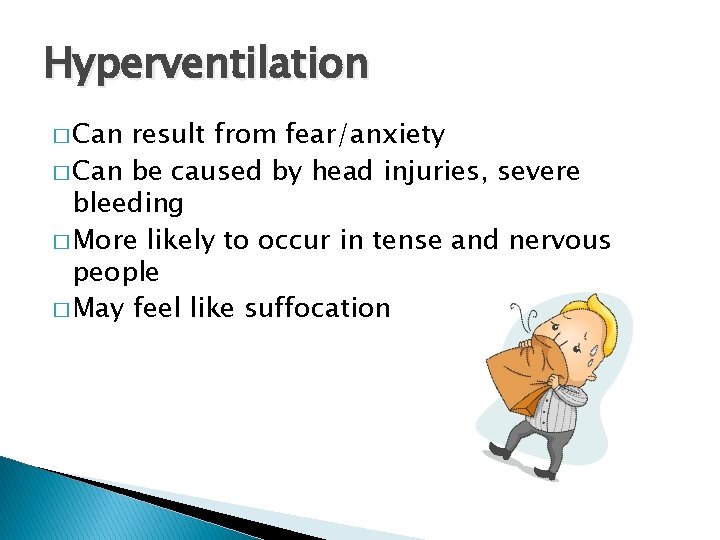
Hyperventilation � Can result from fear/anxiety � Can be caused by head injuries, severe bleeding � More likely to occur in tense and nervous people � May feel like suffocation
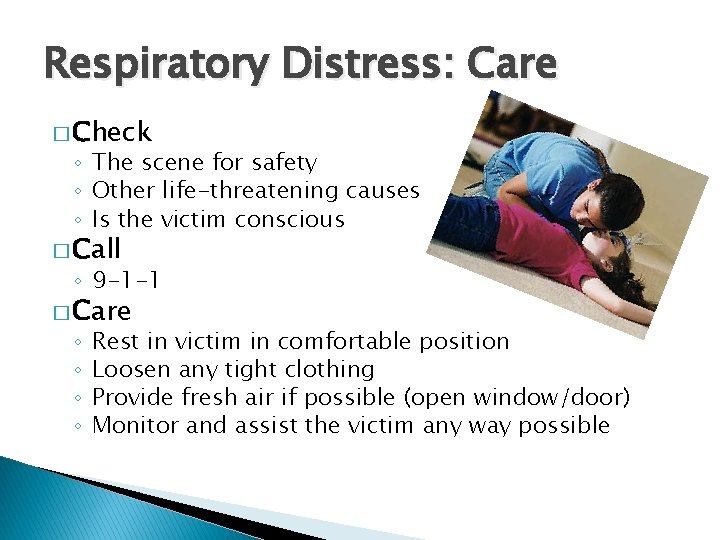
Respiratory Distress: Care � Check ◦ The scene for safety ◦ Other life-threatening causes ◦ Is the victim conscious � Call ◦ 9 -1 -1 � Care ◦ ◦ Rest in victim in comfortable position Loosen any tight clothing Provide fresh air if possible (open window/door) Monitor and assist the victim any way possible
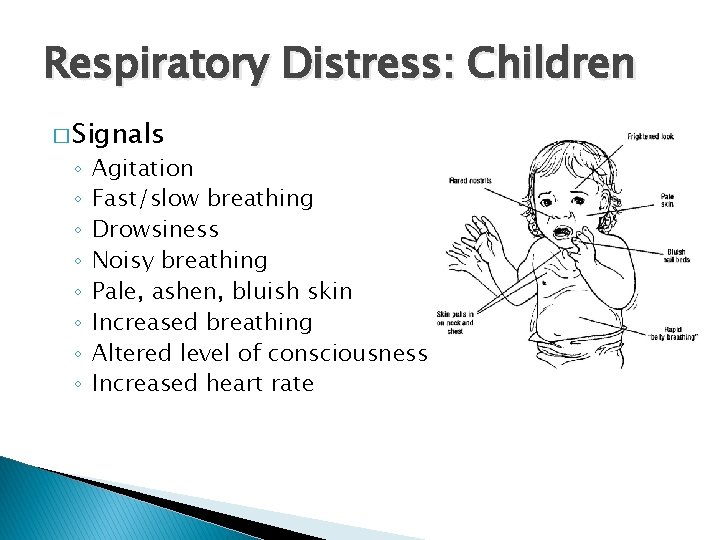
Respiratory Distress: Children � Signals ◦ ◦ ◦ ◦ Agitation Fast/slow breathing Drowsiness Noisy breathing Pale, ashen, bluish skin Increased breathing Altered level of consciousness Increased heart rate
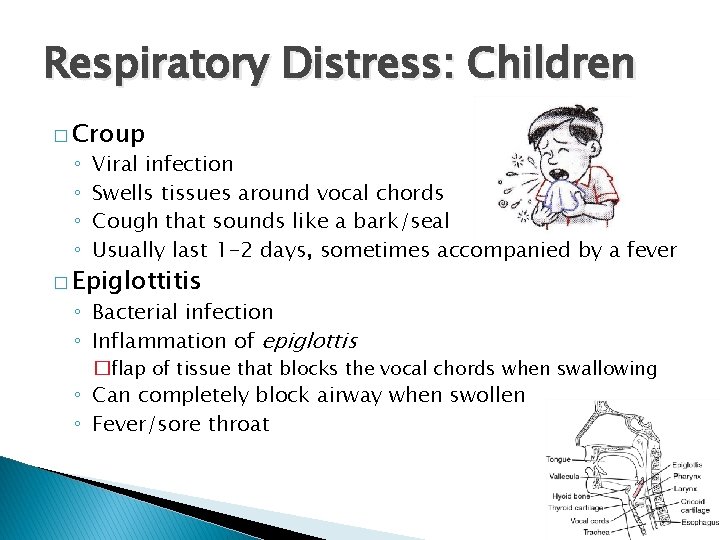
Respiratory Distress: Children � Croup ◦ ◦ Viral infection Swells tissues around vocal chords Cough that sounds like a bark/seal Usually last 1 -2 days, sometimes accompanied by a fever � Epiglottitis ◦ Bacterial infection ◦ Inflammation of epiglottis �flap of tissue that blocks the vocal chords when swallowing ◦ Can completely block airway when swollen ◦ Fever/sore throat
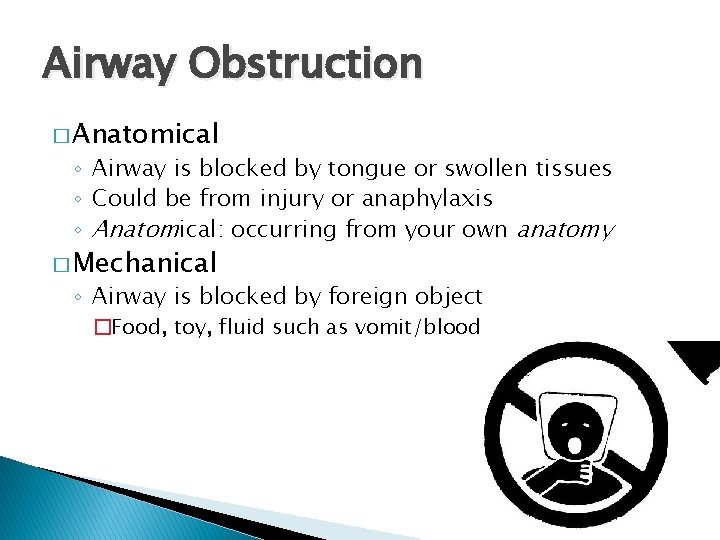
Airway Obstruction � Anatomical ◦ Airway is blocked by tongue or swollen tissues ◦ Could be from injury or anaphylaxis ◦ Anatomical: occurring from your own anatomy � Mechanical ◦ Airway is blocked by foreign object �Food, toy, fluid such as vomit/blood
What can cause airway obstruction? � Trying to swallow too large of a piece of food/poorly chewed food � Drinking alcohol before or during meals ◦ Alcohol dulls the nerves that aid in swallowing � Dentures ◦ Make sensing how well chewed food is before swallowing � Eating while talking, laughing, or eating too fast � Walking, running with food/objects in mouth
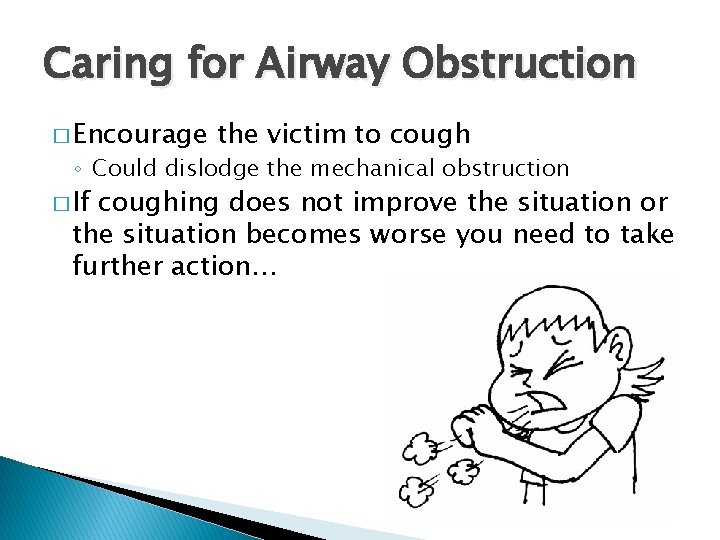
Caring for Airway Obstruction � Encourage the victim to cough ◦ Could dislodge the mechanical obstruction � If coughing does not improve the situation or the situation becomes worse you need to take further action…
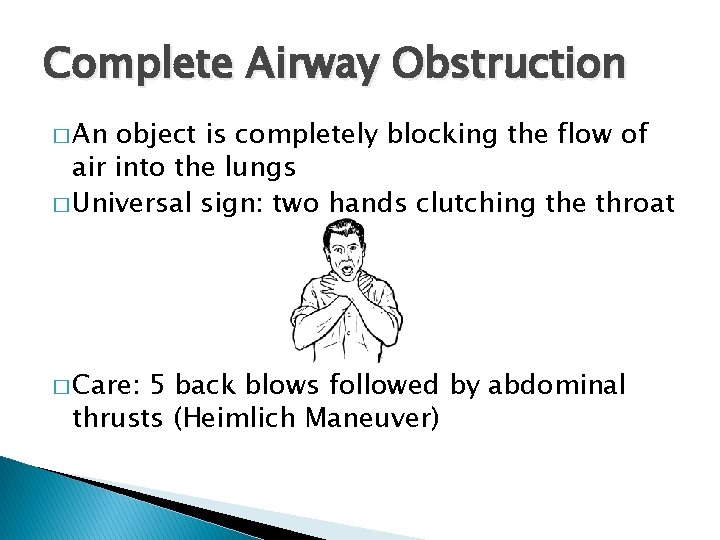
Complete Airway Obstruction � An object is completely blocking the flow of air into the lungs � Universal sign: two hands clutching the throat � Care: 5 back blows followed by abdominal thrusts (Heimlich Maneuver)
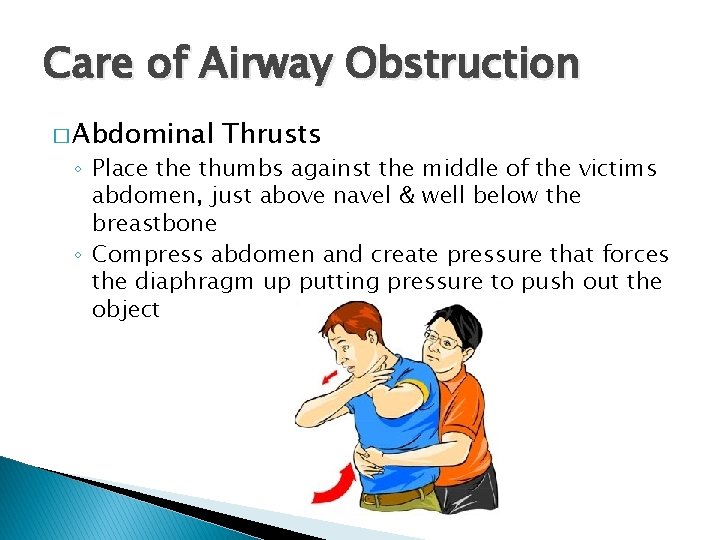
Care of Airway Obstruction � Abdominal Thrusts ◦ Place thumbs against the middle of the victims abdomen, just above navel & well below the breastbone ◦ Compress abdomen and create pressure that forces the diaphragm up putting pressure to push out the object
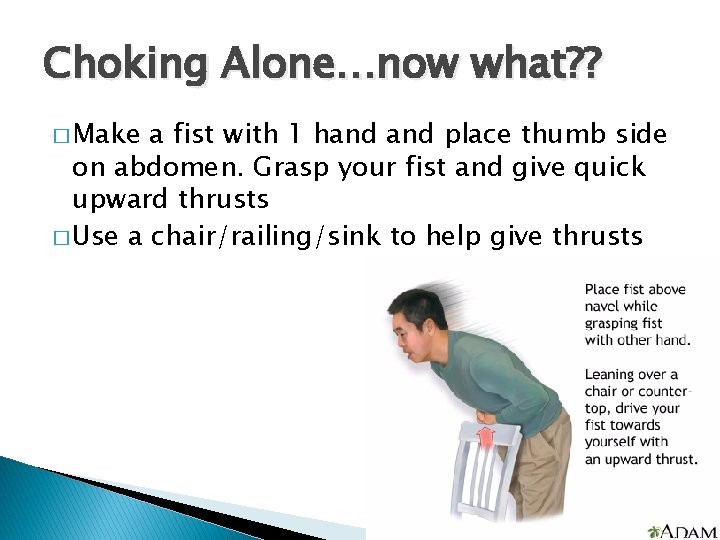
Choking Alone…now what? ? � Make a fist with 1 hand place thumb side on abdomen. Grasp your fist and give quick upward thrusts � Use a chair/railing/sink to help give thrusts
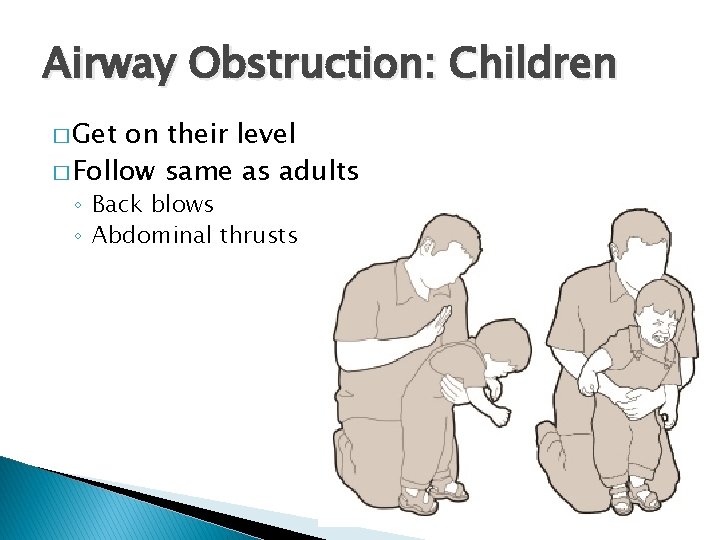
Airway Obstruction: Children � Get on their level � Follow same as adults ◦ Back blows ◦ Abdominal thrusts
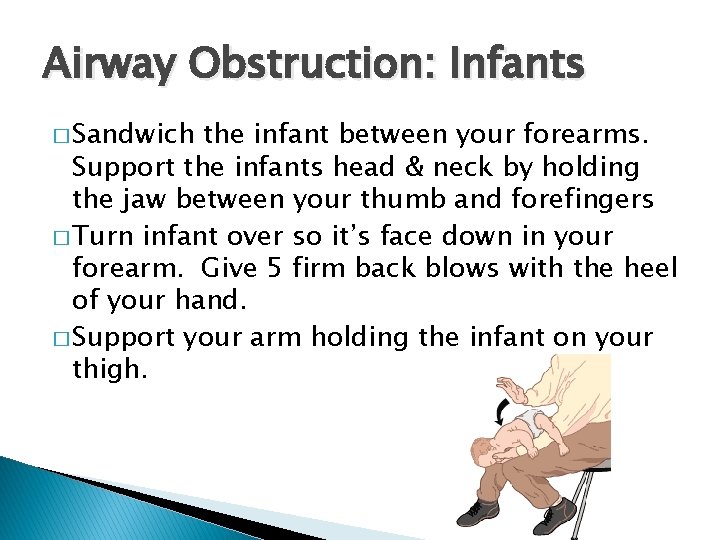
Airway Obstruction: Infants � Sandwich the infant between your forearms. Support the infants head & neck by holding the jaw between your thumb and forefingers � Turn infant over so it’s face down in your forearm. Give 5 firm back blows with the heel of your hand. � Support your arm holding the infant on your thigh.
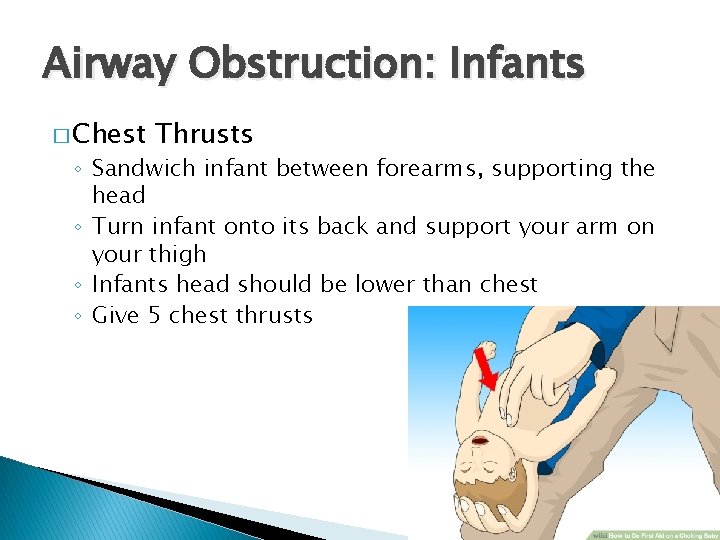
Airway Obstruction: Infants � Chest Thrusts ◦ Sandwich infant between forearms, supporting the head ◦ Turn infant onto its back and support your arm on your thigh ◦ Infants head should be lower than chest ◦ Give 5 chest thrusts
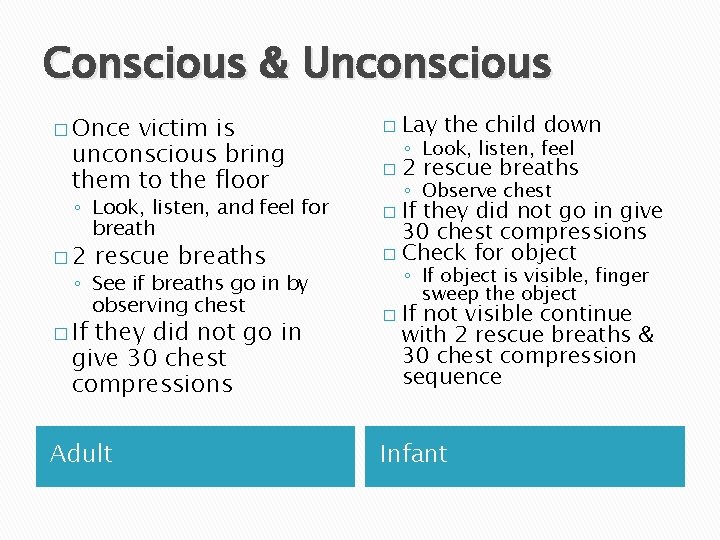
Conscious & Unconscious � Once victim is unconscious bring them to the floor ◦ Look, listen, and feel for breath � 2 rescue breaths ◦ See if breaths go in by observing chest � Lay the child down � 2 rescue breaths ◦ Look, listen, feel ◦ Observe chest If they did not go in give 30 chest compressions � Check for object � ◦ If object is visible, finger sweep the object If not visible continue with 2 rescue breaths & 30 chest compression sequence � If � Adult Infant they did not go in give 30 chest compressions
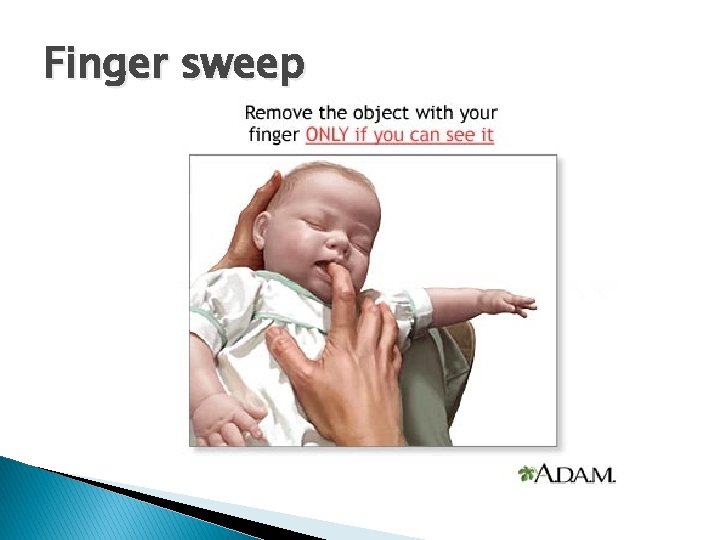
Finger sweep
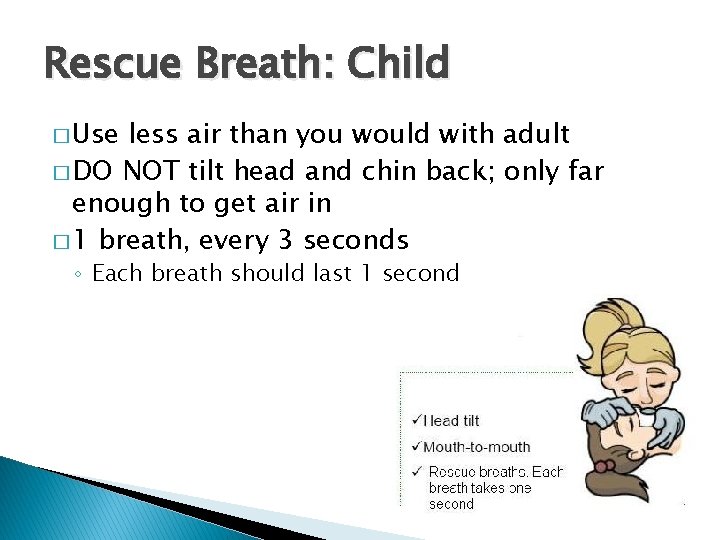
Rescue Breath: Child � Use less air than you would with adult � DO NOT tilt head and chin back; only far enough to get air in � 1 breath, every 3 seconds ◦ Each breath should last 1 second
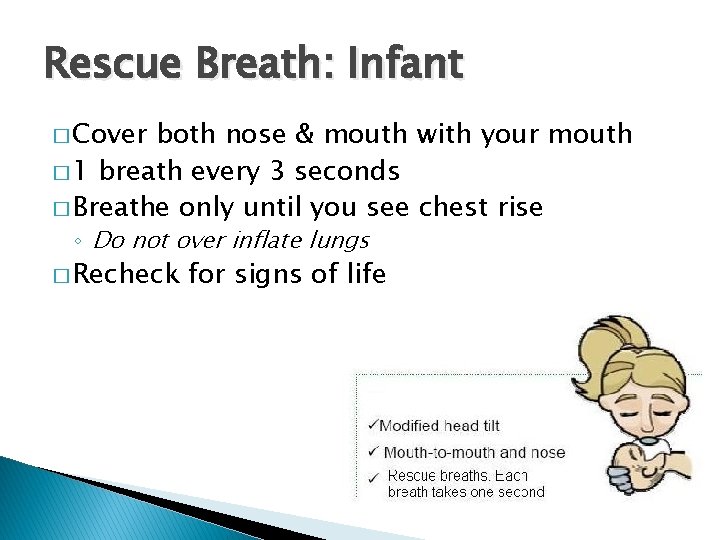
Rescue Breath: Infant � Cover both nose & mouth with your mouth � 1 breath every 3 seconds � Breathe only until you see chest rise ◦ Do not over inflate lungs � Recheck for signs of life
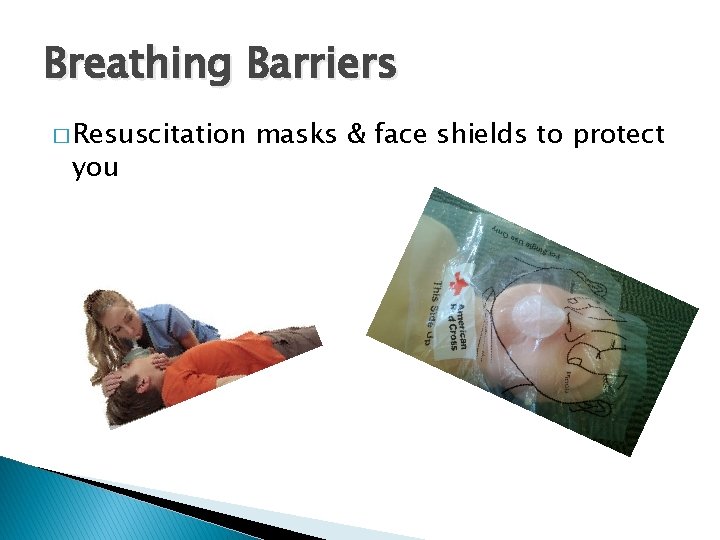
Breathing Barriers � Resuscitation you masks & face shields to protect
When to STOP � Victim begins to breathe on their own � The scene is unsafe � Another trained person can take over for you � EMS arrive � You are too exhausted to continue
- Slides: 30