
Breastfeeding and Medication Wendy Jones Bf N Drugs

Breastfeeding and Medication Wendy Jones Bf. N Drugs in Breastmilk Service Pharmacist
Welcome As a valued Friend of the Bf. N Drugs in Breastmilk Service we hope that you may be able to use some of them to highlight the resources on the website www. breastfeedingnetwork. org. uk and to educate healthcare professionals and parents that it is possible for mothers to take medication and continue to breastfeed ©Wendy Jones Ph. D MRPharm. S and The Breastfeeding Network

What is the Drugs in Breastmilk Service? The Drugs In Breastmilk (DIBM) Service is run by the Breastfeeding Network. It was set up to provide evidence based information for mothers and healthcare professionals on the safety of medication taken by mothers which might potentially pass to the baby through breastmilk. ©Wendy Jones Ph. D MRPharm. S and The Breastfeeding Network
Funding? The DIBM is a unique service for parents and health professionals and receives no external funding. The Bf. N fund it through charity reserves which are finite and fundraised income, relying on donations from general public. Bf. N operate a Friends Scheme and is actively looking to grow support to help sustain their line for the future. (www. breastfeedingnetwork. org. uk/friends-drugs-breastmilk/). ©Wendy Jones Ph. D MRPharm. S and The Breastfeeding Network
Knowledge of benefits of breastfeeding before delivery Most pregnant women are able to name the benefits of breastfeeding. So too are healthcare professionals but once we add in the need for the mother to take a medication it seems that everyone becomes anxious. We think that taking a drug during lactation is the same as in pregnancy – not possible without harm to the baby. In fact very few drugs have been proven to produce adverse effects other than temporary diarrhoea with maternal antibiotics and drowsiness with some drugs such as sedatives and painkillers. We believe that mothers should be involved in the prescribing decision and their wishes to breastfeed valued ©Wendy Jones Ph. D MRPharm. S and The Breastfeeding Network
Breastfeeding as immunisation Immunisation is preventative medicine par excellence. If a new vaccine became available that could prevent 1 million or more child deaths a year and that was moreover cheap, safe, administered orally…. . it would become an immediate public health imperative. Breastfeeding could do this and more…” (Lancet 1994) If breastfeeding did not already exist, someone who invented it today would deserve a dual Nobel Prize in medicine and economics (Lancet 2016) ©Wendy Jones Ph. D MRPharm. S and The Breastfeeding Network
Concerns Many healthcare practitioners are concerned about prescribing or recommending medication for mothers who are lactating as drugs are rarely licensed for such use. In this situation the prescriber and pharmacist bear responsibility for use. Safe use of drugs in breastfeeding mothers is possible with access to specialised texts and using knowledge of drug pharmacokinetics ©Wendy Jones Ph. D MRPharm. S and The Breastfeeding Network
Factors to consider Drug manufacturers are not required to take responsibility when they apply for a product license Even if subsequently data is available on the amount of drug transferring to the baby via breastmilk, there is currently no legal requirement to provide information. Hence the British National Formulary (BNF) will frequently say “manufacturer advises avoid” NICE PH 11 recommends BNF information should only be taken as a guide and further data accessed before advising a mother that she should stop breastfeeding in order to take medication. Information is available in specialised texts such as Medications and Mothers Milk, Breastfeeding and Medication or the website LACTMED (see references on slide at the end) ©Wendy Jones Ph. D MRPharm. S and The Breastfeeding Network
Ideal drug to be taken by breastfeeding mother Licensed for use in children Highly plasma protein bound (>90%) Low; milk plasma ratio (<1) Poor oral bio-availability Subject to first pass metabolism Large molecular weight Low relative infant dose (<10%) (Jones 2013) This information is not always easy to find or interpret ©Wendy Jones Ph. D MRPharm. S and The Breastfeeding Network

Cough and Cold Remedies Breastfeeding mothers should avoid oral decongestants as one dose can reduce milk supply by 24% They should avoid any cough mixture containing a sedative antihistamine They can take a simple linctus, expectorant and/or nasal spray/drops as well as analgesics and importantly use steam inhalation https: //breastfeedingnetwork. org. uk/wpcontent/dibm/cough%20 and%20 cold%20 remedies%20 and%20 br ©Wendy Jones Ph. D MRPharm. S and The eastfeeding%202018. pdf Breastfeeding Network
Head lice treatment Mothers with older children may need to use head lice treatment Absorption of the active ingredients is likely to be low Use of protective gloves if treating several children as well as herself would be a sensible precaution If using lotions use in a well ventilated room https: //breastfeedingnetwork. org. uk/wpcontent/dibm/head%20 lice%20 and%20 breastfeeding. pdf ©Wendy Jones Ph. D MRPharm. S and The Breastfeeding Network

Analgesics Paracetamol and Non steroidal Anti Inflammatory Drugs (Ibuprofen, Naproxen and Diclofenac) reach breastmilk in small quantities Aspirin should be avoided in analgesic doses although there are no reports of Reye’s syndrome resulting from exposure of a child to aspirin via breastmilk. If a single dose of aspirin is taken accidentally breastfeeding can still continue Codeine should be avoided and dihydrocodeine used in preference https: //breastfeedingnetwork. org. uk/wpcontent/dibm/analgesics%20 and%20 breastfeeding. pdf ©Wendy Jones Ph. D MRPharm. S and The Breastfeeding Network
Threadworm treatment Mothers who develop threadworm infection or whose older children have picked it up, can take mebendazole preparations as the drug is poorly absorbed from the gastro- intestinal tract Piperazine medication is licensed for use in babies over 3 months https: //breastfeedingnetwork. org. uk/wpcontent/dibm/threadworms%20 and%20 breastfeeding. pdf ©Wendy Jones Ph. D MRPharm. S and The Breastfeeding Network
Antibiotics There is no reason for a mother to stop breastfeeding if she is taking antibiotics Babies exposed to antibiotics via their mothers milk may develop temporary lactose intolerance resulting in loose bowel motions and colicky symptoms. However breastfeeding can continue. Breastmilk contains all the factors necessary to restore the gut balance and there is no evidence that probiotics are necessary although mothers may benefit. https: //breastfeedingnetwork. org. uk/wpcontent/dibm/antibiotics%20 and%20 breastfeeding. pdf ©Wendy Jones Ph. D MRPharm. S and The Breastfeeding Network
Antihistamines Sedating antihistamines if taken for more than 3 days may cause lowered milk supply due to drowsiness and less frequent feeding by the baby Non sedating antihistamines can be taken by breastfeeding women outside of license application. Most are licensed for paediatric doses e. g. loratadine and cetirizine Eye drops and nasal sprays reach low levels in breastmilk and can be used as normal https: //www. breastfeedingnetwork. org. uk/wpcontent/dibm/antihistamines%20 and%20 breastfeeding% ©Wendy Jones Ph. D MRPharm. S and The Breastfeeding Network 20 June%202018%20%281%29. pdf
Constipation In breastfeeding mother constipation can be treated by bulk and osmotic laxatives first line. If necessary stimulant laxatives can be used. There are unlikely to be any effects on the breastfed baby (Hale, Jones). Constipation is rare in a breastfed baby. Infrequent bowel motions in a young baby should be referred to expert breastfeeding help in case there is a poor breastmilk transfer. Older breastfed babies may not pass bowel motions daily. Increased frequency of feeds may help. Medication is not normally required. https: //breastfeedingnetwork. org. uk/wpcontent/dibm/constipation%20 and%20 breastfeeding. pdf ©Wendy Jones Ph. D MRPharm. S and The Breastfeeding Network
Diarrhoea in breastfeeding mother can be treated with loperamide and rehydration salts. Loperamide is minimally absorbed from the gut so only small amounts reach breastmilk. The mother will produce antibodies to the infection which will be passed via breastmilk to protect the baby (Hale, Jones) Diarrhoea is rare in breastfed baby due to the protective immunological factors in breastmilk. Should it occur, breastfeeding should be continued as normal. https: //breastfeedingnetwork. org. uk/wp©Wendy Jones Ph. D MRPharm. S and The Breastfeeding Network content/dibm/diarrhoea%20 and%20 breastfeeding. pdf
Contact Bf. N Drugs in Breastmilk Service There are several ways to contact the Bf. N DIBM Service: Email druginformation@breastfeedingnetwork. org. uk Wendy. jones@breastfeedingnetwork. org. uk Facebook And there are lots more fact sheets on the website www. breastfeedingnetwork. org. uk/drugs-factsheets/ ©Wendy Jones Ph. D MRPharm. S and The Breastfeeding Network
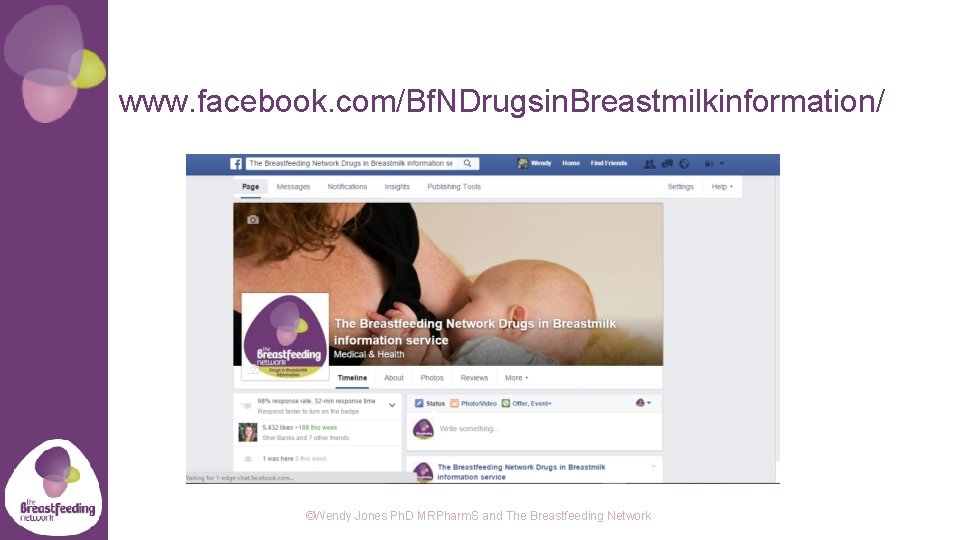
www. facebook. com/Bf. NDrugsin. Breastmilkinformation/ ©Wendy Jones Ph. D MRPharm. S and The Breastfeeding Network
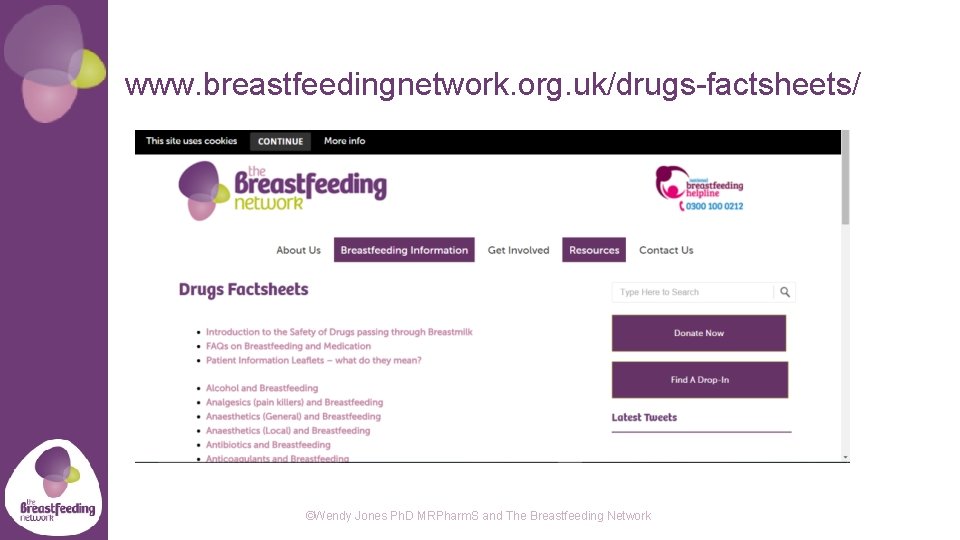
www. breastfeedingnetwork. org. uk/drugs-factsheets/ ©Wendy Jones Ph. D MRPharm. S and The Breastfeeding Network
Who will answer my query? On the Facebook page we have a small admin team of very experienced Bf. N supporters. They cannot comment on the drugs but do signpost to fact sheets and flag up messages that are urgent. They can also support breastfeeding issues There is another pharmacist, Amanda, who has a very similar background to me who is available when time from work and young children allow Emails are answered by me. ©Wendy Jones Ph. D MRPharm. S and The Breastfeeding Network
Reference Sources Hale TW Medications and Mother’s Milk 2014 Jones W Breastfeeding and Medication 2 nd Ed 2018 Routledge Lactmed http: //toxnet. nlm. nih. gov/cgi-bin/sis/htmlgen? LACT ©Wendy Jones Ph. D MRPharm. S and The Breastfeeding Network
Evaluation PLEASE would you complete this survey to help us to evaluate and further develop this resource: www. surveymonkey. co. uk/r/YN 762 FS ©Wendy Jones Ph. D MRPharm. S and The Breastfeeding Network
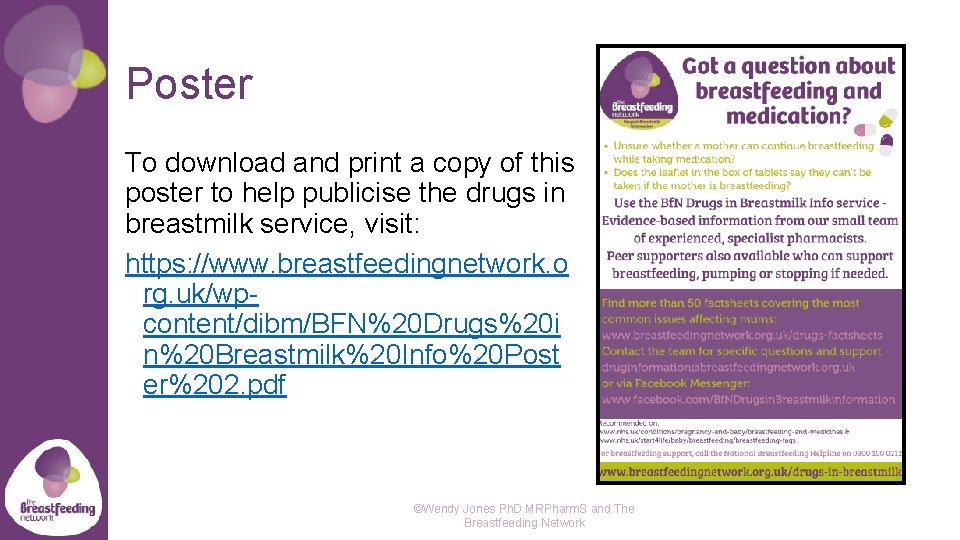
Poster To download and print a copy of this poster to help publicise the drugs in breastmilk service, visit: https: //www. breastfeedingnetwork. o rg. uk/wpcontent/dibm/BFN%20 Drugs%20 i n%20 Breastmilk%20 Info%20 Post er%202. pdf ©Wendy Jones Ph. D MRPharm. S and The Breastfeeding Network
LICENCE AGREEMENT The online training plan (“the Plan”) created by the Breastfeeding Network (“Bf. N”) is distributed subject to the following terms and conditions. The Plan must only be used by the intended recipient as a tool for learning and to facilitate one-off training with others. It must not be shared or copied for any other reason. The Plan must not be modified in any way or incorporated into any other training materials. All intellectual property rights in the Plan remain with Bf. N and Wendy Jones. The copyright notice must appear on any copies that are made of the Plan as follows ©Wendy Jones Ph. D MRPharm. S and The Breastfeeding Network The Plan must not be uploaded to any publicly available websites or social media sites. It is a condition of the Plan being provided that recipients complete the evaluation shortly after using the Plan in order to support its development. You must supervise and control use of the Plan and ensure that it is used by your employees in accordance with the terms of this Licence. Bf. N may terminate this Licence at any time and require any hard copies of the Plan to be returned any electronic copies to be deleted. ©Wendy Jones Ph. D MRPharm. S and The Breastfeeding Network
- Slides: 25