
Breast perineum and peritoneum mamma breast Structurescontains skin
Breast, perineum and peritoneum 泰山医学院解剖教研室 赵振美
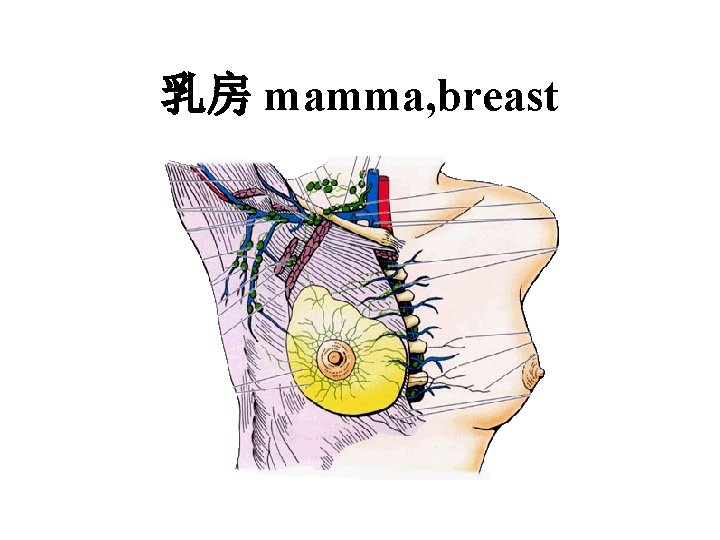
乳房 mamma, breast
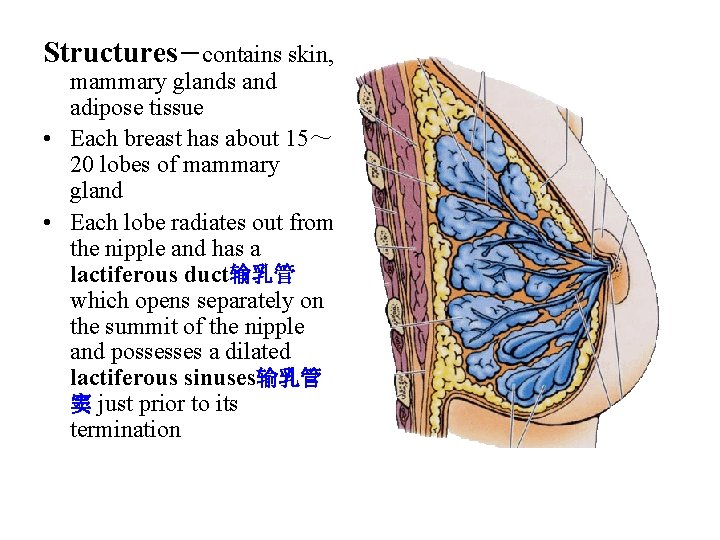
Structures-contains skin, mammary glands and adipose tissue • Each breast has about 15~ 20 lobes of mammary gland • Each lobe radiates out from the nipple and has a lactiferous duct输乳管 which opens separately on the summit of the nipple and possesses a dilated lactiferous sinuses输乳管 窦 just prior to its termination
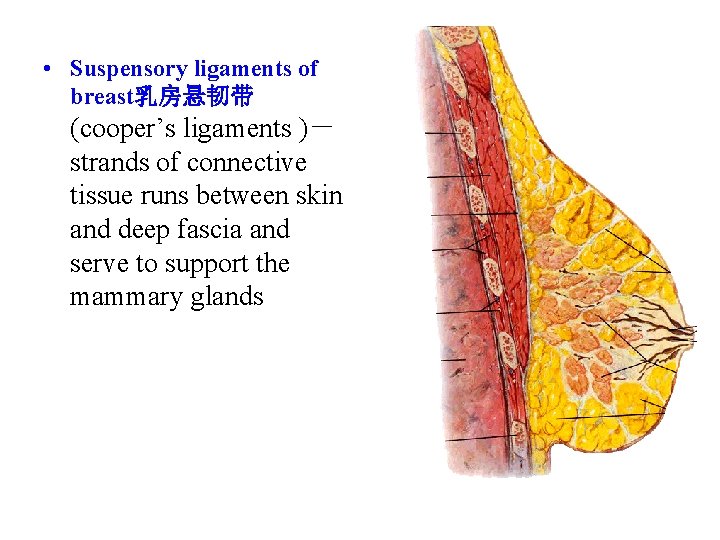
• Suspensory ligaments of breast乳房悬韧带 (cooper’s ligaments )- strands of connective tissue runs between skin and deep fascia and serve to support the mammary glands
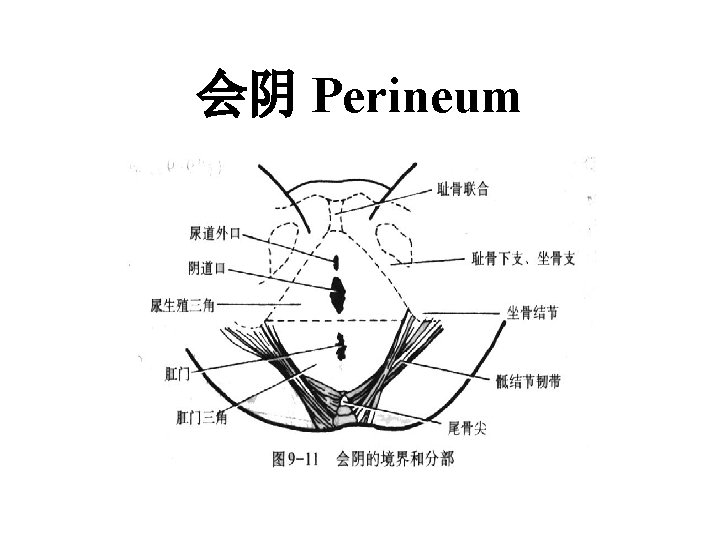
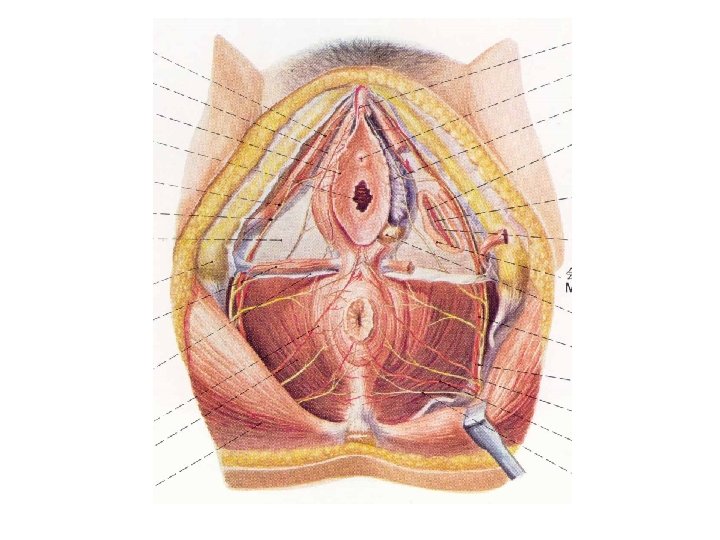
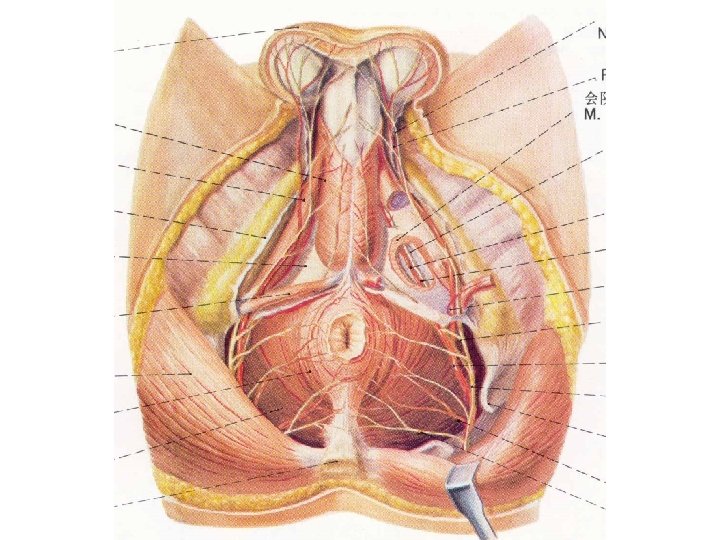
会阴 Perineum
The peritoneum 腹膜
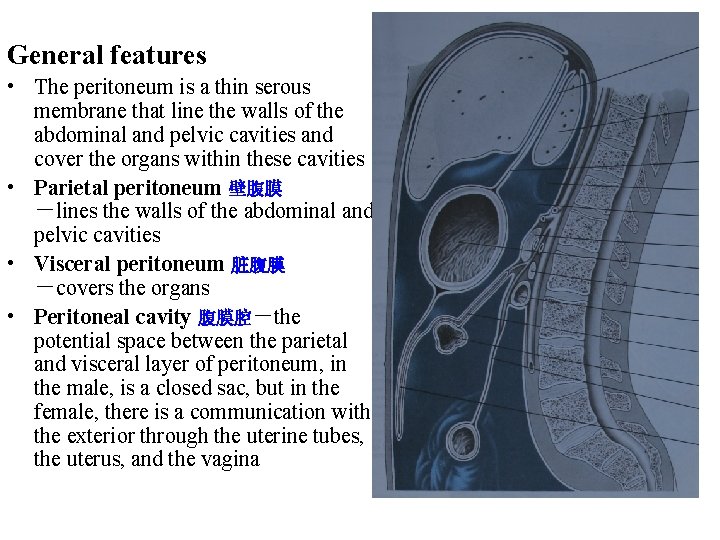
General features • The peritoneum is a thin serous membrane that line the walls of the abdominal and pelvic cavities and cover the organs within these cavities • Parietal peritoneum 壁腹膜 -lines the walls of the abdominal and pelvic cavities • Visceral peritoneum 脏腹膜 -covers the organs • Peritoneal cavity 腹膜腔-the potential space between the parietal and visceral layer of peritoneum, in the male, is a closed sac, but in the female, there is a communication with the exterior through the uterine tubes, the uterus, and the vagina
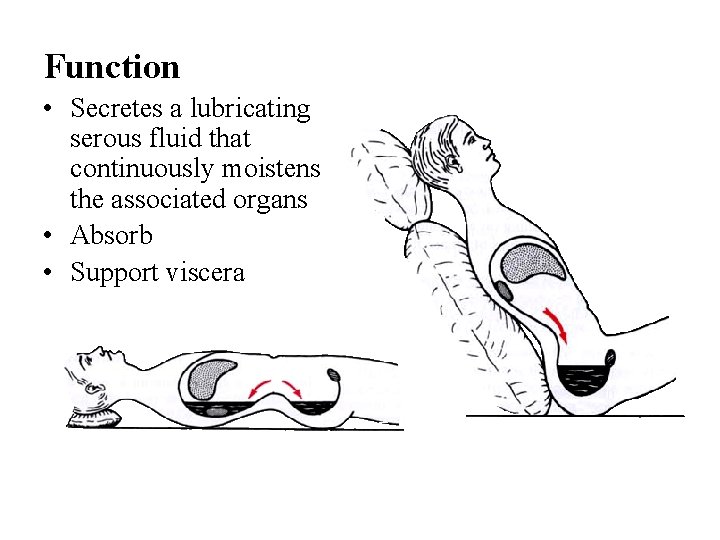
Function • Secretes a lubricating serous fluid that continuously moistens the associated organs • Absorb • Support viscera
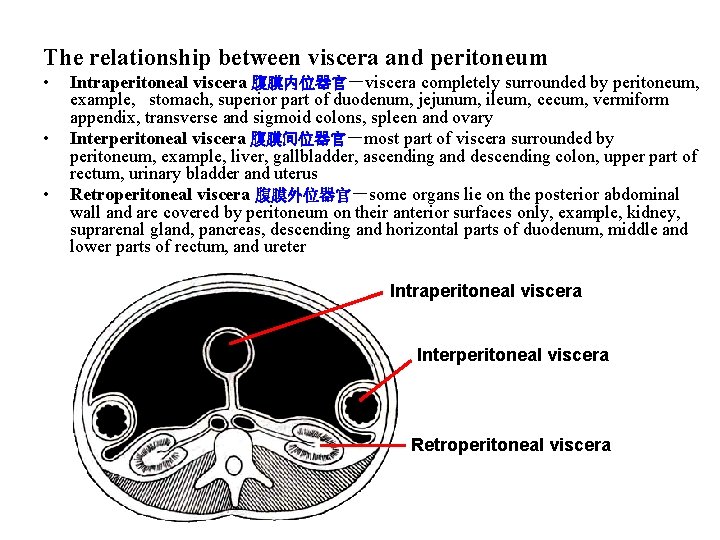
The relationship between viscera and peritoneum • • • Intraperitoneal viscera 腹膜内位器官-viscera completely surrounded by peritoneum, example, stomach, superior part of duodenum, jejunum, ileum, cecum, vermiform appendix, transverse and sigmoid colons, spleen and ovary Interperitoneal viscera 腹膜间位器官-most part of viscera surrounded by peritoneum, example, liver, gallbladder, ascending and descending colon, upper part of rectum, urinary bladder and uterus Retroperitoneal viscera 腹膜外位器官-some organs lie on the posterior abdominal wall and are covered by peritoneum on their anterior surfaces only, example, kidney, suprarenal gland, pancreas, descending and horizontal parts of duodenum, middle and lower parts of rectum, and ureter Intraperitoneal viscera Interperitoneal viscera Retroperitoneal viscera
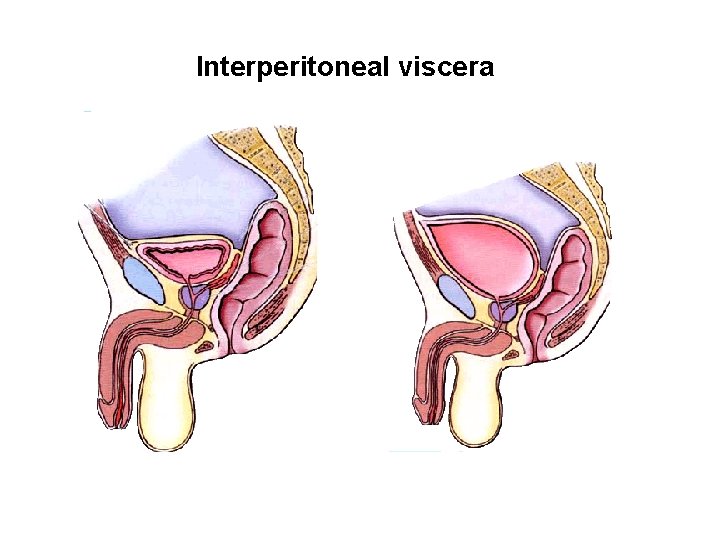
Interperitoneal viscera
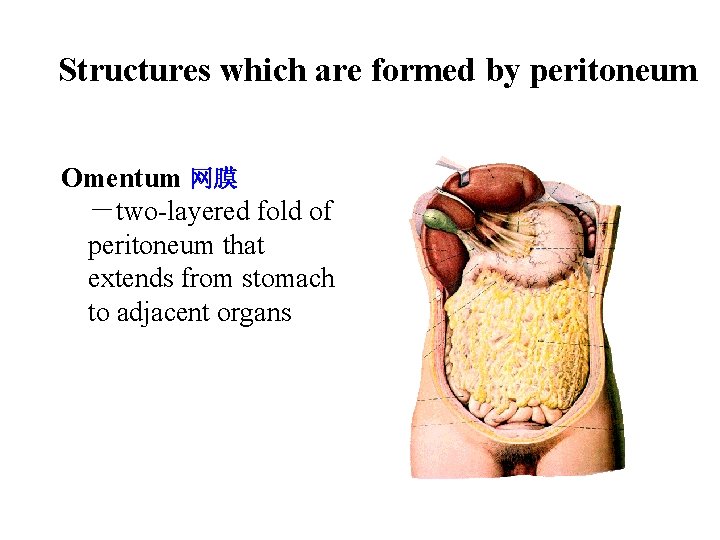
Structures which are formed by peritoneum Omentum 网膜 -two-layered fold of peritoneum that extends from stomach to adjacent organs
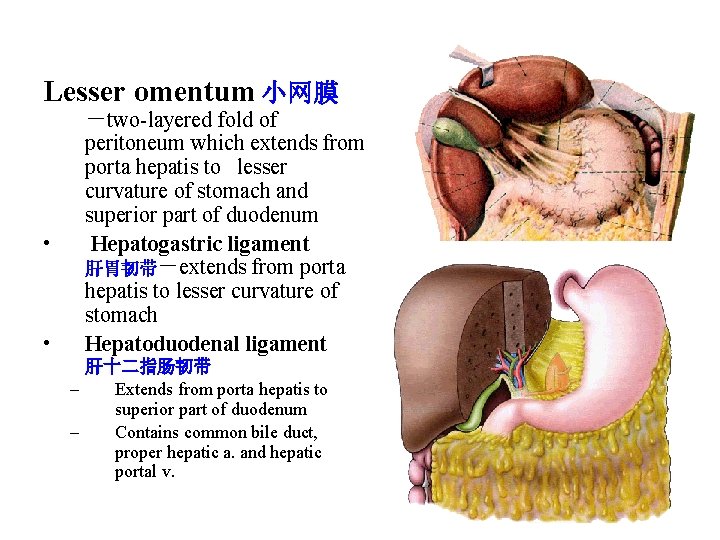
Lesser omentum 小网膜 • • -two-layered fold of peritoneum which extends from porta hepatis to lesser curvature of stomach and superior part of duodenum Hepatogastric ligament 肝胃韧带-extends from porta hepatis to lesser curvature of stomach Hepatoduodenal ligament 肝十二指肠韧带 – Extends from porta hepatis to superior part of duodenum – Contains common bile duct, proper hepatic a. and hepatic portal v.

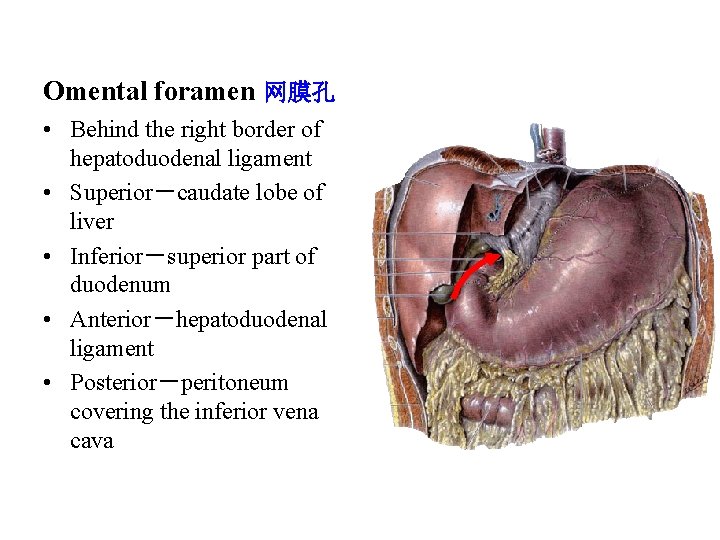
Omental foramen 网膜孔 • Behind the right border of hepatoduodenal ligament • Superior-caudate lobe of liver • Inferior-superior part of duodenum • Anterior-hepatoduodenal ligament • Posterior-peritoneum covering the inferior vena cava
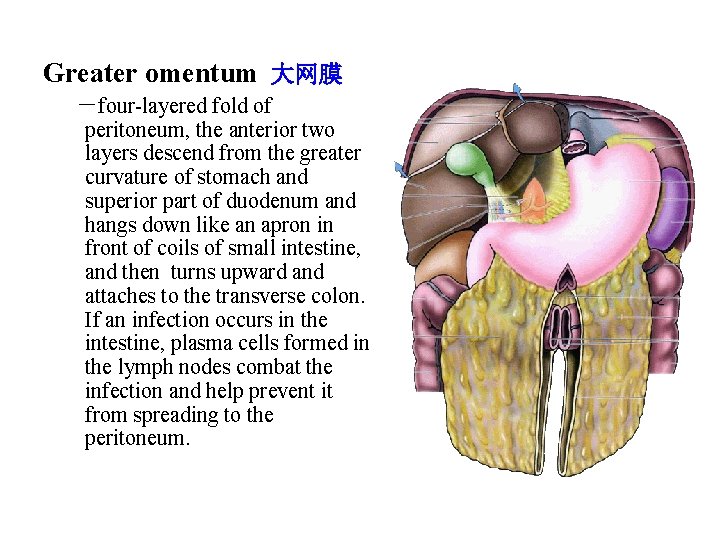
Greater omentum 大网膜 -four-layered fold of peritoneum, the anterior two layers descend from the greater curvature of stomach and superior part of duodenum and hangs down like an apron in front of coils of small intestine, and then turns upward and attaches to the transverse colon. If an infection occurs in the intestine, plasma cells formed in the lymph nodes combat the infection and help prevent it from spreading to the peritoneum.
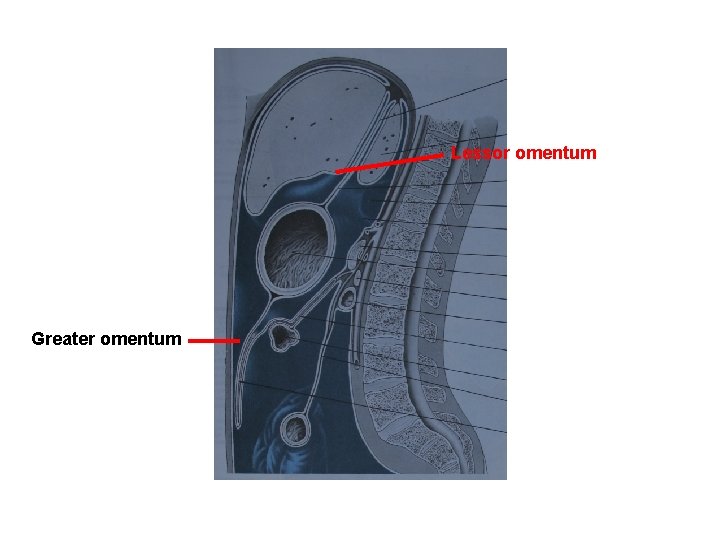
Lessor omentum Greater omentum
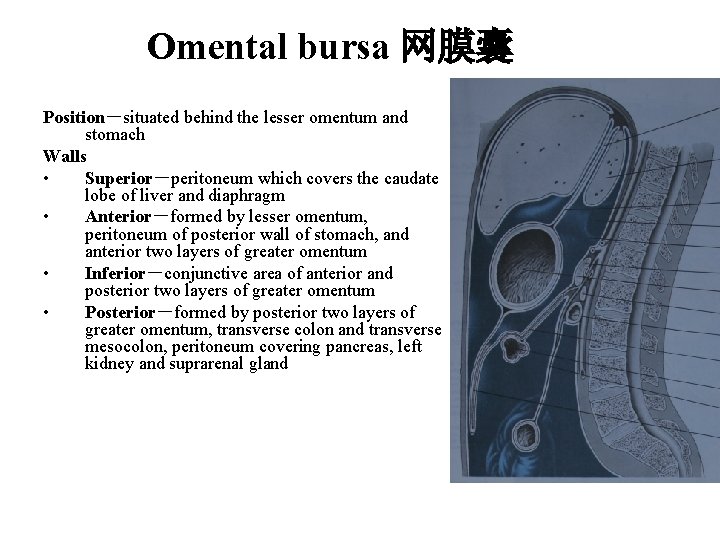
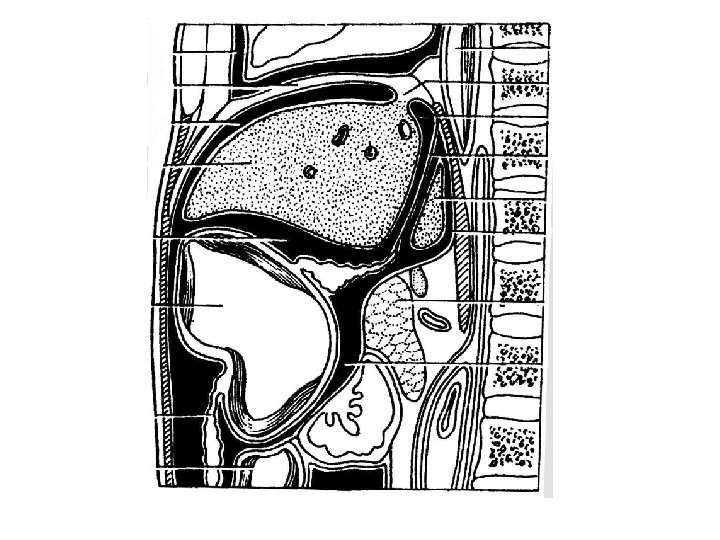
Omental bursa 网膜囊 Position-situated behind the lesser omentum and stomach Walls • Superior-peritoneum which covers the caudate lobe of liver and diaphragm • Anterior-formed by lesser omentum, peritoneum of posterior wall of stomach, and anterior two layers of greater omentum • Inferior-conjunctive area of anterior and posterior two layers of greater omentum • Posterior-formed by posterior two layers of greater omentum, transverse colon and transverse mesocolon, peritoneum covering pancreas, left kidney and suprarenal gland
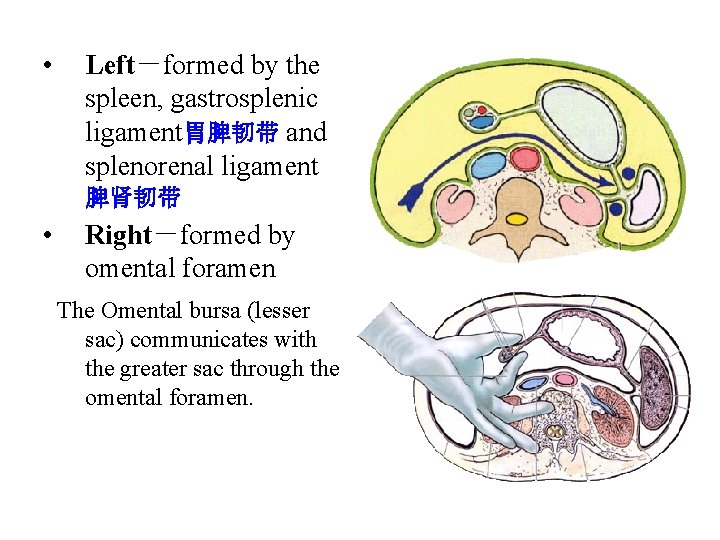
• Left-formed by the spleen, gastrosplenic ligament胃脾韧带 and splenorenal ligament 脾肾韧带 • Right-formed by omental foramen The Omental bursa (lesser sac) communicates with the greater sac through the omental foramen.
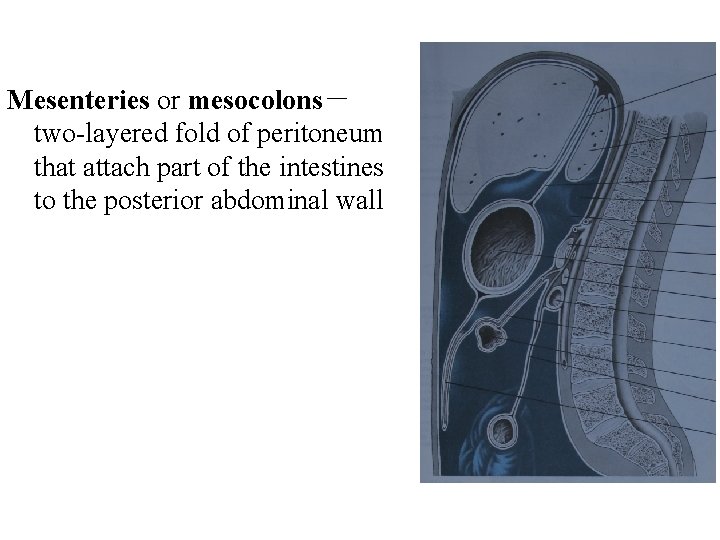
Mesenteries or mesocolons- two-layered fold of peritoneum that attach part of the intestines to the posterior abdominal wall
- Slides: 24