
Breaking the Cycle of Employee Dissatisfaction Hyejun Johanna
Breaking the Cycle of Employee Dissatisfaction Hyejun Johanna Kim Valerie Owolo Margo Stein Jason Vitorillo Ding Wang
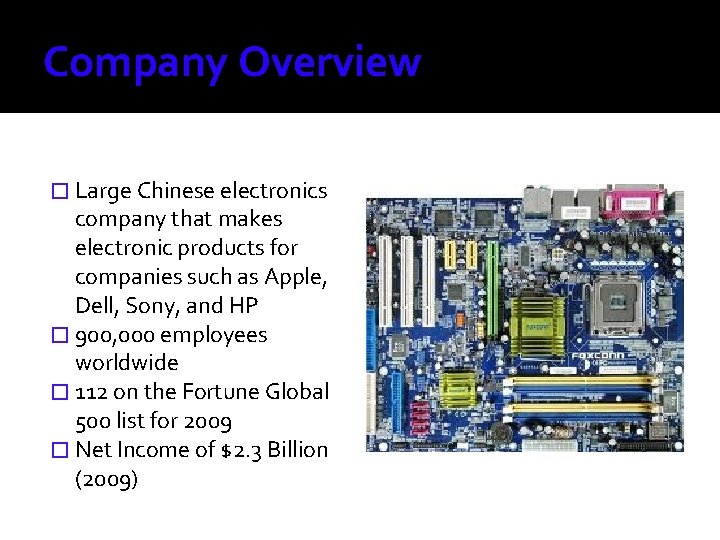
Company Overview � Large Chinese electronics company that makes electronic products for companies such as Apple, Dell, Sony, and HP � 900, 000 employees worldwide � 112 on the Fortune Global 500 list for 2009 � Net Income of $2. 3 Billion (2009)
Presenting Issue � 12 factory employees have committed suicide and 4 attempted to commit suicide off a main Foxconn building in China �Have strung nets to try to catch any additional jumpers as well as blocking windows and locking doors to roofs and balconies
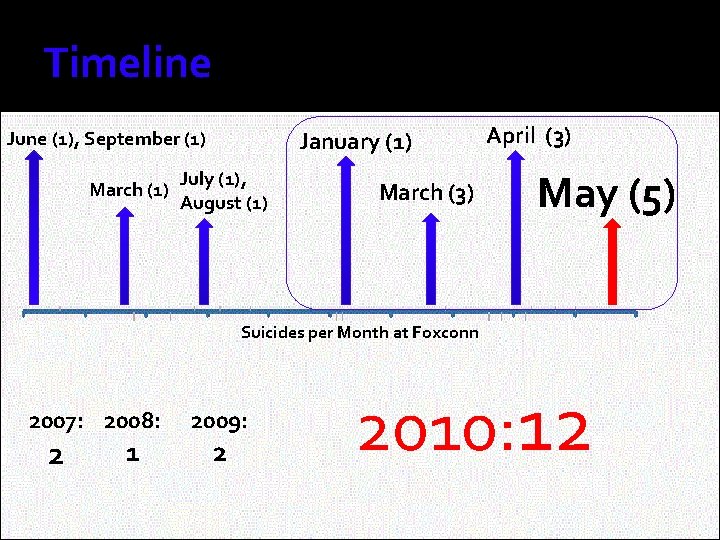
Timeline January (1) June (1), September (1) March (1) July (1), August (1) March (3) April (3) May (5) Suicides per Month at Foxconn 2007: 2008: 2 1 2009: 2 2010: 12
Life at Foxconn �Facilities with swimming pools, libraries, gyms and computers, but no time to enjoy these amenities �Each employee signs a 'voluntary overtime affidavit, ' in order to waive the 36 -hour legal limit on monthly overtime hours �Foxconn has long come under fire from labor activists, who say the factory is little more than an electronics sweatshop
Consequences �Inhumane atmosphere �Bad media coverage �Potential for Apple, Dell, HP, Sony, etc. to move their business to competitors if conditions do not change �High turnover

Diagnosis � The core of the problem is employee job dissatisfaction � Poor work conditions, workflow problems, and inadequate pay and benefits all contribute to worker stress � Work conditions look nice from an outsider’s perspective � Reality is not as nice
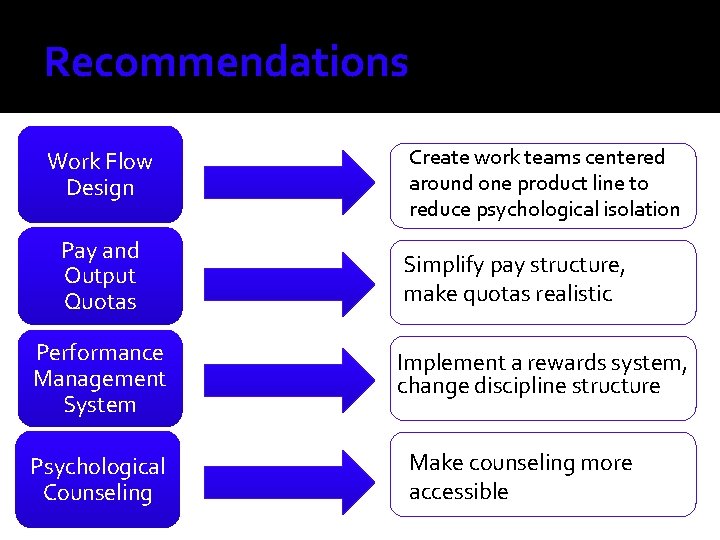
Recommendations Work Flow Design Pay and Output Quotas Performance Management System Psychological Counseling Create work teams centered around one product line to reduce psychological isolation Simplify pay structure, make quotas realistic Implement a rewards system, change discipline structure Make counseling more accessible
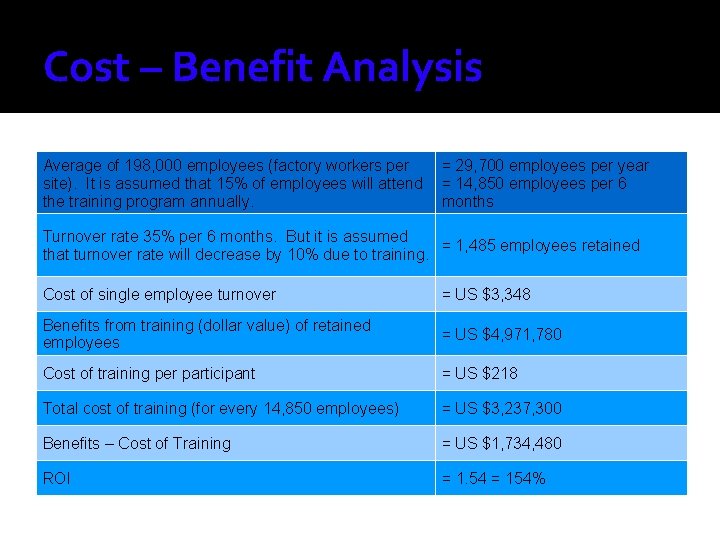
Cost – Benefit Analysis Average of 198, 000 employees (factory workers per site). It is assumed that 15% of employees will attend the training program annually. = 29, 700 employees per year = 14, 850 employees per 6 months Turnover rate 35% per 6 months. But it is assumed = 1, 485 employees retained that turnover rate will decrease by 10% due to training. Cost of single employee turnover = US $3, 348 Benefits from training (dollar value) of retained employees = US $4, 971, 780 Cost of training per participant = US $218 Total cost of training (for every 14, 850 employees) = US $3, 237, 300 Benefits – Cost of Training = US $1, 734, 480 ROI = 1. 54 = 154%
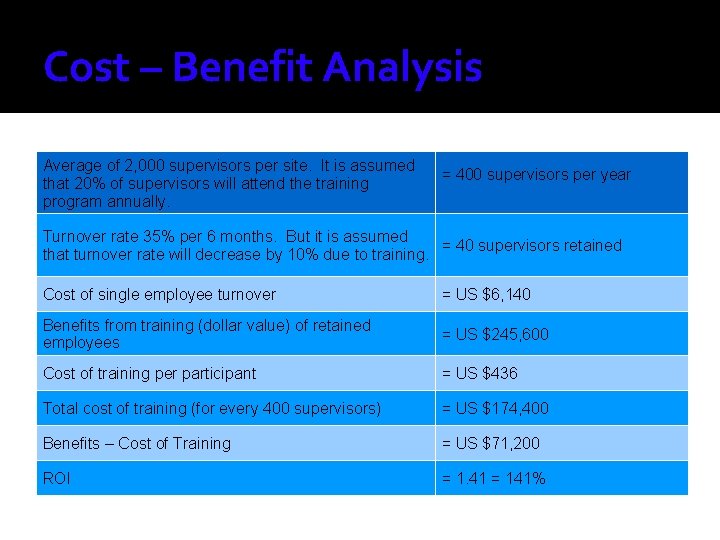
Cost – Benefit Analysis Average of 2, 000 supervisors per site. It is assumed that 20% of supervisors will attend the training program annually. = 400 supervisors per year Turnover rate 35% per 6 months. But it is assumed = 40 supervisors retained that turnover rate will decrease by 10% due to training. Cost of single employee turnover = US $6, 140 Benefits from training (dollar value) of retained employees = US $245, 600 Cost of training per participant = US $436 Total cost of training (for every 400 supervisors) = US $174, 400 Benefits – Cost of Training = US $71, 200 ROI = 1. 41 = 141%
Questions?
- Slides: 11