
Breaking LTE on Layer 2 IEEE SP 19

Breaking LTE on Layer 2 IEEE S&P’ 19 – David Rupprecht, Katharina Kohls, Thorsten Holz, Christina Pöpper Presenter: David Ha
Introduction • Problem: Existing work focus on layer 1 and 3 of the LTE stack protocol • Goal: Perform analysis and vulnerability exploitation in layer 2 • Contributions LTE Layer 2 analysis: control plane leakage and user plane missing integrity 3 attacks: 2 passive attacks and 1 active attack
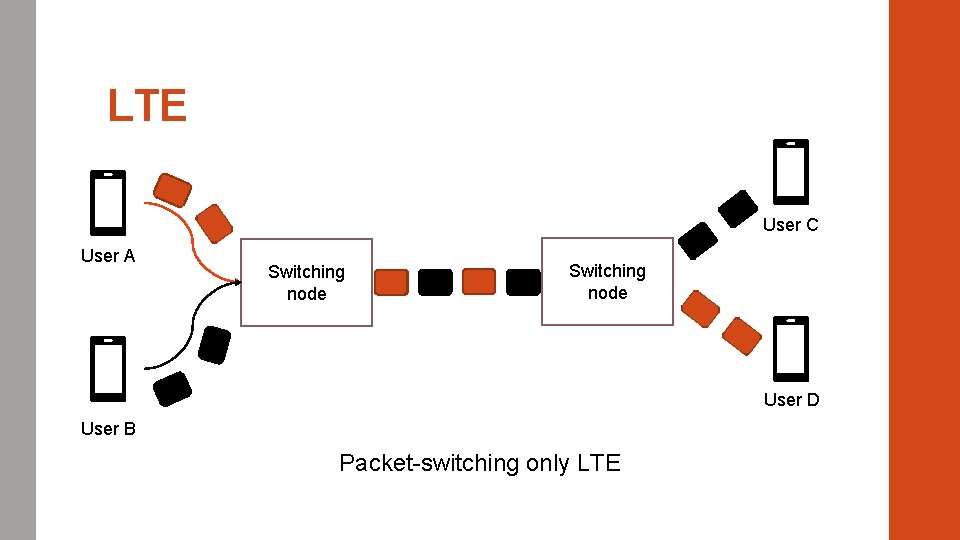
LTE User C User A Switching node User D User B Packet-switching only LTE
LTE components • User Equipment (UE) End device providing services to the user IMSI, RNTI • Evolved Node B (e. Node. B) Base stations Radio resource management, user data encryption, paging messages, etc • Evolved Packet Core (EPC) Core Network Authentication, mobility management, forwarding of user data
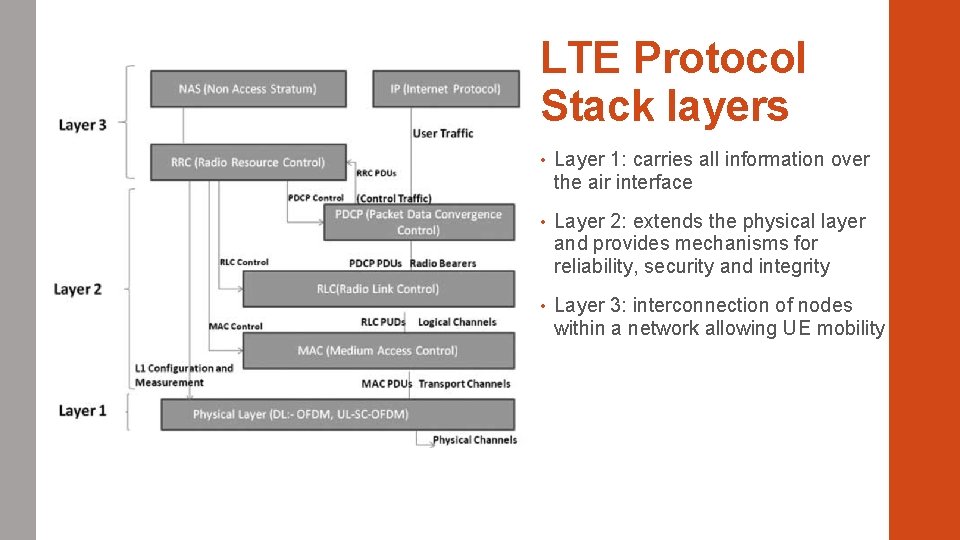
LTE Protocol Stack layers • Layer 1: carries all information over the air interface • Layer 2: extends the physical layer and provides mechanisms for reliability, security and integrity • Layer 3: interconnection of nodes within a network allowing UE mobility
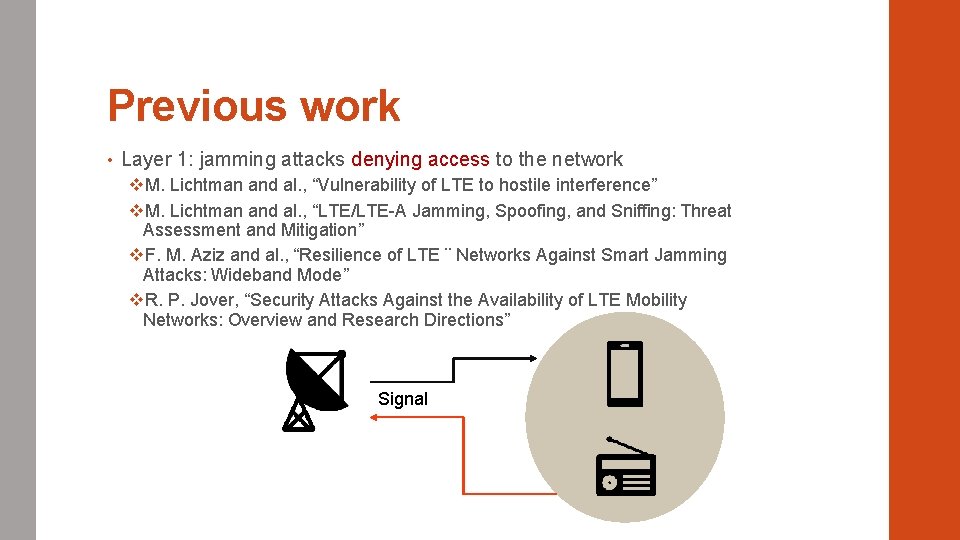
Previous work • Layer 1: jamming attacks denying access to the network v. M. Lichtman and al. , “Vulnerability of LTE to hostile interference” v. M. Lichtman and al. , “LTE/LTE-A Jamming, Spoofing, and Sniffing: Threat Assessment and Mitigation” v. F. M. Aziz and al. , “Resilience of LTE ¨ Networks Against Smart Jamming Attacks: Wideband Mode” v. R. P. Jover, “Security Attacks Against the Availability of LTE Mobility Networks: Overview and Research Directions” Signal

Previous work • Layer 3: attackers can localize an user or deny access to the network v. A. Shaik and al. , “Practical Attacks Against Privacy and Availability in 4 G/LTE Mobile Communication Systems” v. R. P. Jover, “LTE Security, Protocol Exploits and Location Tracking Experimentation with Low-Cost Software Radio” v. S. F. Mjølsnes and R. F. Olimid, “Easy 4 G/LTE IMSI Catchers for Non Programmers” • Localization attack C-RNTI: physical layer identifier not encrypted Mapping TMSI or MSISDN to C-RNTI • Do. S attack Rogue e. Node. B Downgrade UE to GSM What about Layer 2?
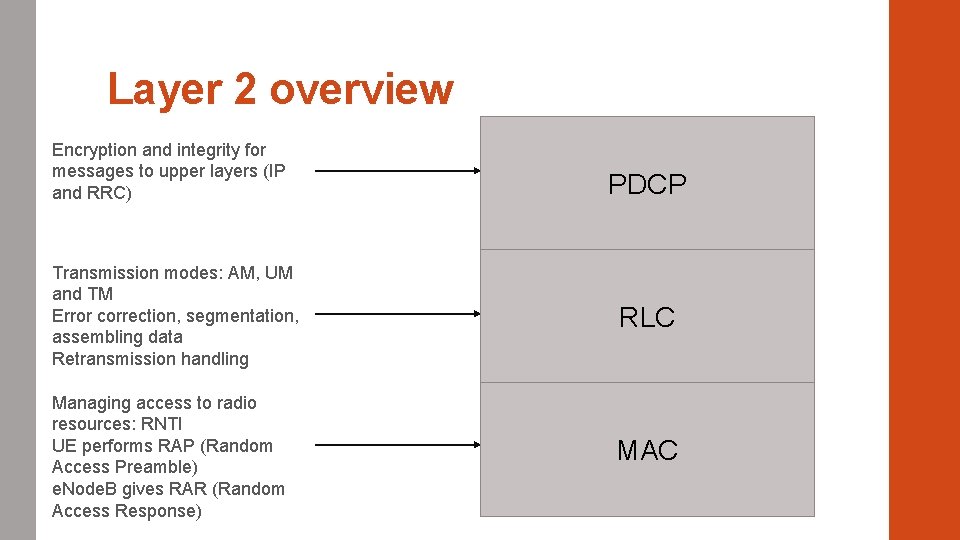
Layer 2 overview Encryption and integrity for messages to upper layers (IP and RRC) PDCP Transmission modes: AM, UM and TM Error correction, segmentation, assembling data Retransmission handling RLC Managing access to radio resources: RNTI UE performs RAP (Random Access Preamble) e. Node. B gives RAR (Random Access Response) MAC
Attacking layer 2
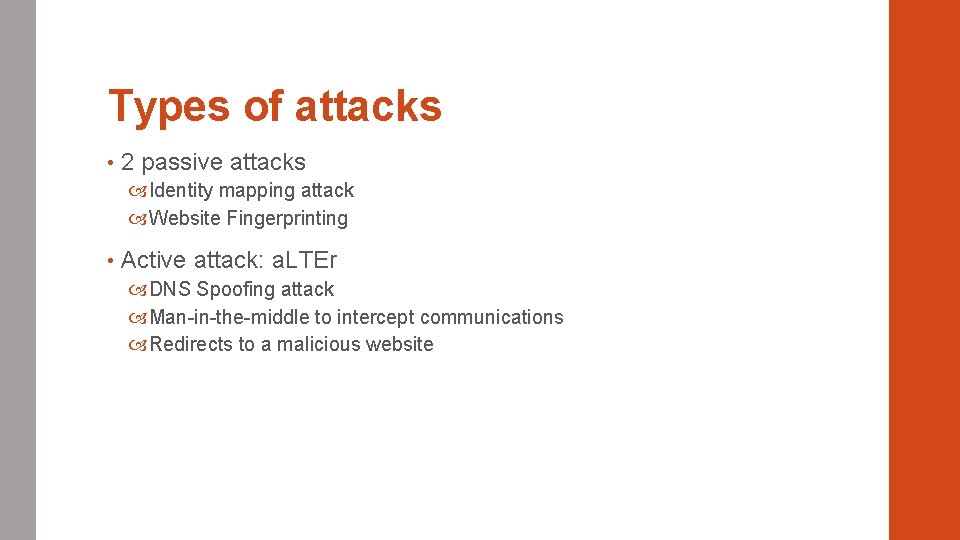
Types of attacks • 2 passive attacks Identity mapping attack Website Fingerprinting • Active attack: a. LTEr DNS Spoofing attack Man-in-the-middle to intercept communications Redirects to a malicious website
Identity mapping attack • What is the goal? Infer the identity of a user by eavesdropping the radio connection establishment (MAC sublayer) • Attacker Ignores the TMSI 1 and RNTI 2 of the victim Learns the identity during the radio layer connection establishment 1 TMSI: Temporary Mobile Subscriber Identity 2 RNTI: Radio Network Temporary Identifier
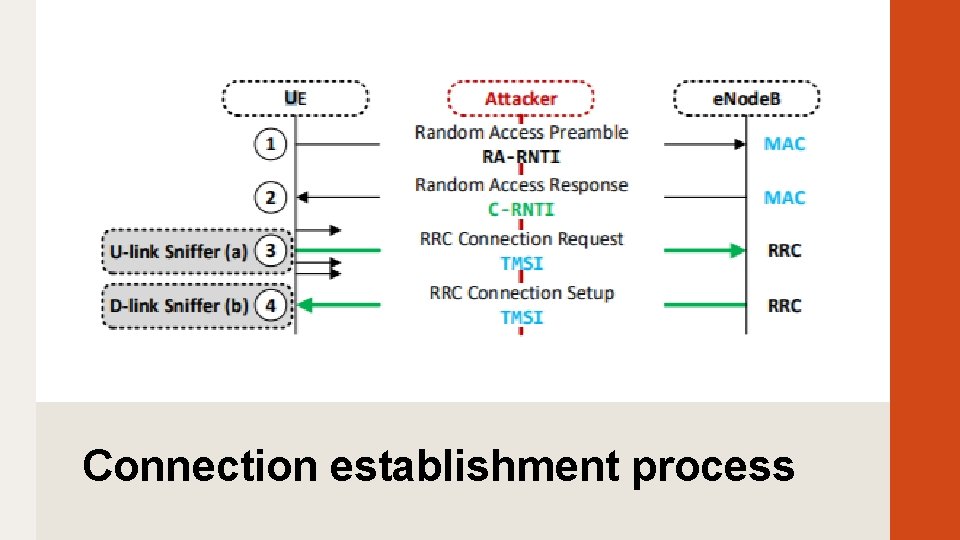
Connection establishment process
The attack • UE is identified by C-RNTI on the MAC layer • Only 10 possible RA-RNTIs RA-RNTI = 1 + t_id (0 <= t_id <= 9), t_id is the index of the first subframe of the physical channel Possible to monitor all RAR and infer the C-RNTI • Matching C-RNTI and TMSI with 2 methods: The uplink sniffer Exploiting the contention-based resolution of the RRC connection setup
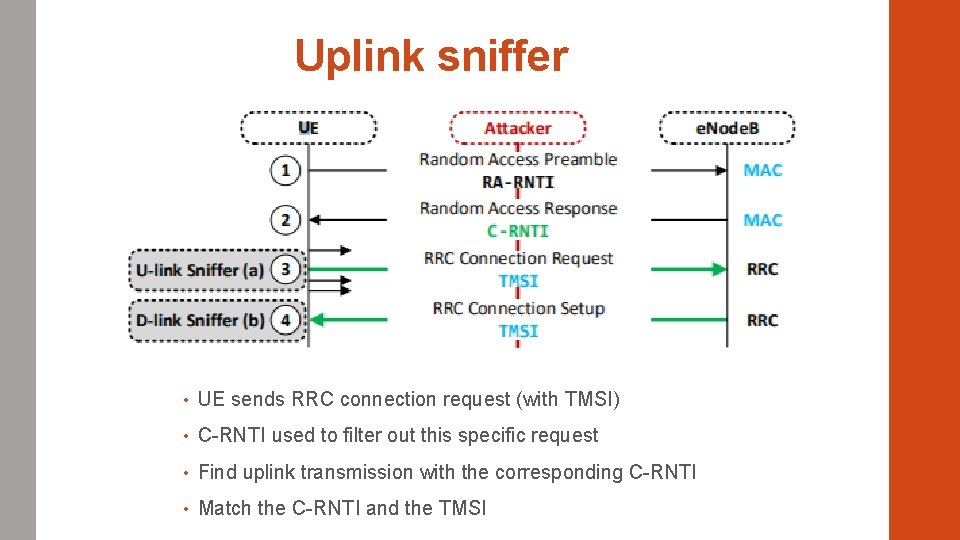
Uplink sniffer • UE sends RRC connection request (with TMSI) • C-RNTI used to filter out this specific request • Find uplink transmission with the corresponding C-RNTI • Match the C-RNTI and the TMSI
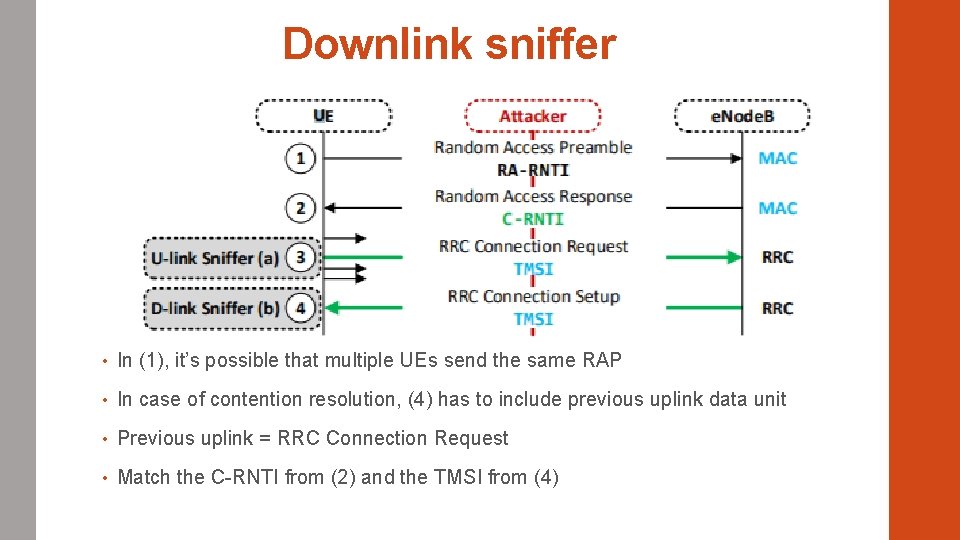
Downlink sniffer • In (1), it’s possible that multiple UEs send the same RAP • In case of contention resolution, (4) has to include previous uplink data unit • Previous uplink = RRC Connection Request • Match the C-RNTI from (2) and the TMSI from (4)
Experiment • Two Software Defined Radios (SDRs) The UE The Downlink sniffer • Target UE Implements srs. UE (all layers) Can connect to a commercial network • Downlink sniffer Implements srs. LTE Listens to broadcast channels of e. Node. B • All traces at the UL and DL sniffers are recorded to evaluate the attack
Experiment: Attack steps 1. TCP connection to trigger radio connection establishment process 2. Downlink sniffer eavesdrops RARs of e. Node. B and get all C-RNTIs 3. e. Node. B sends TMSI in RRC connection setup within the contentionbased resolution which is eavesdropped by DL sniffer 4. Match the set of C-RNTIs with the eavesdropped TMSI from 3.
Identity Mapping Results • Attack successfully performed 3 times with downlink sniffer • TMSI and C-RNTI mapping information from arbitrary UE but no a specific UE • 96 911 connection establishment procedures recorded in 5 days • 96. 85% contained contention-based resolution • 91. 75% contain TMSI Real-world applicability?
Website fingerprinting attack • What is the goal? Learning the destination of a connection • MAC layer schedules data transmission of a connection (DCI) Data allocation for uplink and downlink for each user Sends the data allocation to each UE in a DCI message DCI information is not encrypted
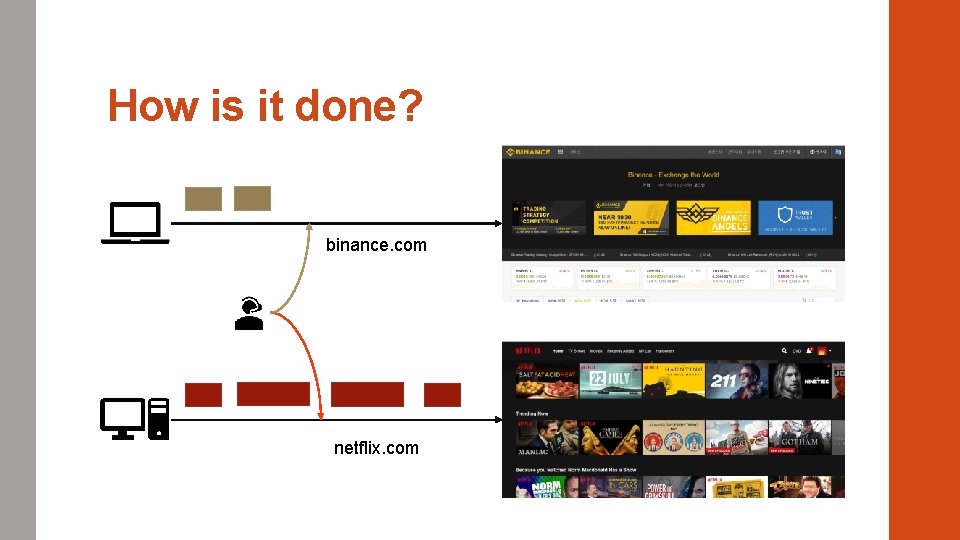
How is it done? binance. com netflix. com
How is it done? • Attacker records a corpus of traces corresponding to a set of websites (before the attack) • Analyze the previous traces that were eavesdropped and compare them to the records • Try to match the metadata features to the recorded traces
Experiment • LTE network setup Modified version of srs. LTE e. Node. B Open. Air. Interface Evolved Packet Core (EPC) • Connect Commercial-of-the-shelf (COTS) phone to the LTE network • 3 Android phones: LG Nexus 5, Huawei P 9 Lite, Motorola Moto G 4 • pcap traces from visiting Alexa top 50 websites 100 times per phone • Extract only user plane traffic: RNTI, PDCP direction (up/down), PDCP sequence number, PDCP length and timestamp of each packet
Experiment • Classify unknown traces Compare all captured traces using Fast. DTW for similarity measurement Decision with k-NN • How do you know it is successful? Average success and standard deviation False positive matches for each site
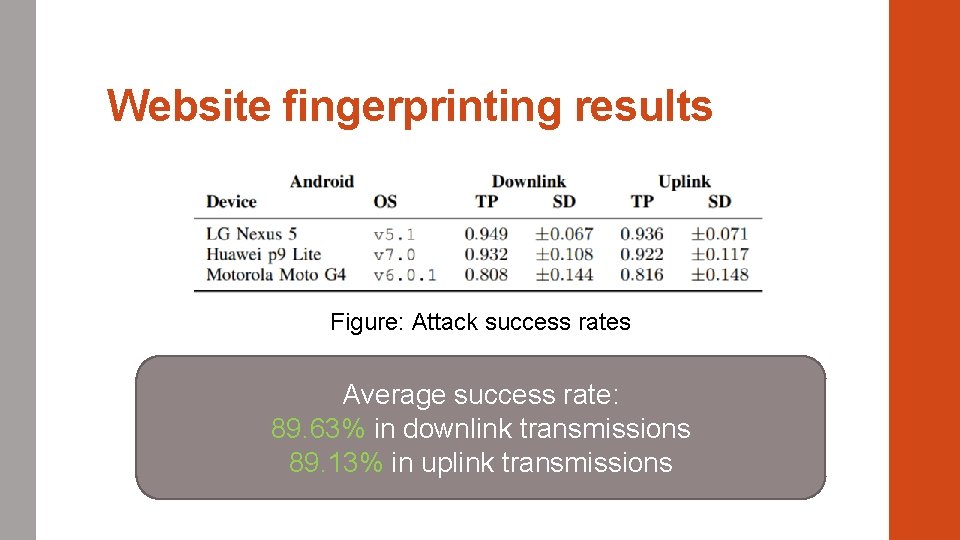
Website fingerprinting results Figure: Attack success rates Average success rate: 89. 63% in downlink transmissions 89. 13% in uplink transmissions
Website fingerprinting results • Closed-world setup Mobile networks configuration changes a lot Impossible to monitor uplink transmissions on PDCP layer on real LTE network • Limited to Alexa Top 50 websites ~2 billions websites Real-world applicability?
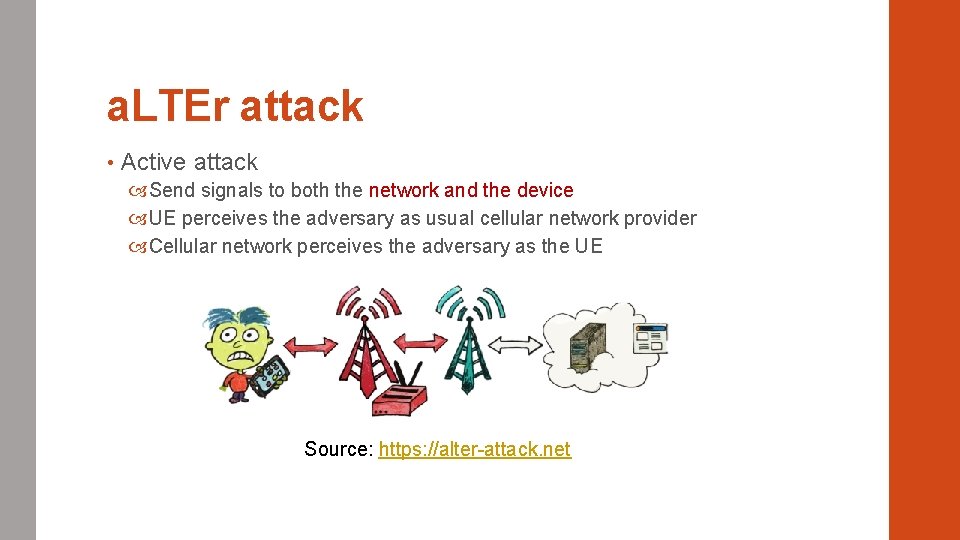
a. LTEr attack • Active attack Send signals to both the network and the device UE perceives the adversary as usual cellular network provider Cellular network perceives the adversary as the UE Source: https: //alter-attack. net
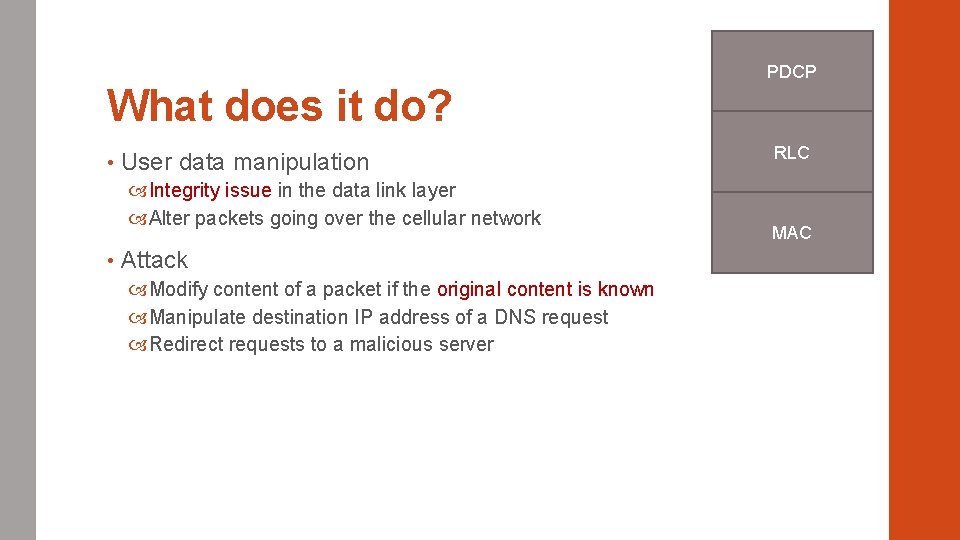
What does it do? • User data manipulation Integrity issue in the data link layer Alter packets going over the cellular network • Attack Modify content of a packet if the original content is known Manipulate destination IP address of a DNS request Redirect requests to a malicious server PDCP RLC MAC
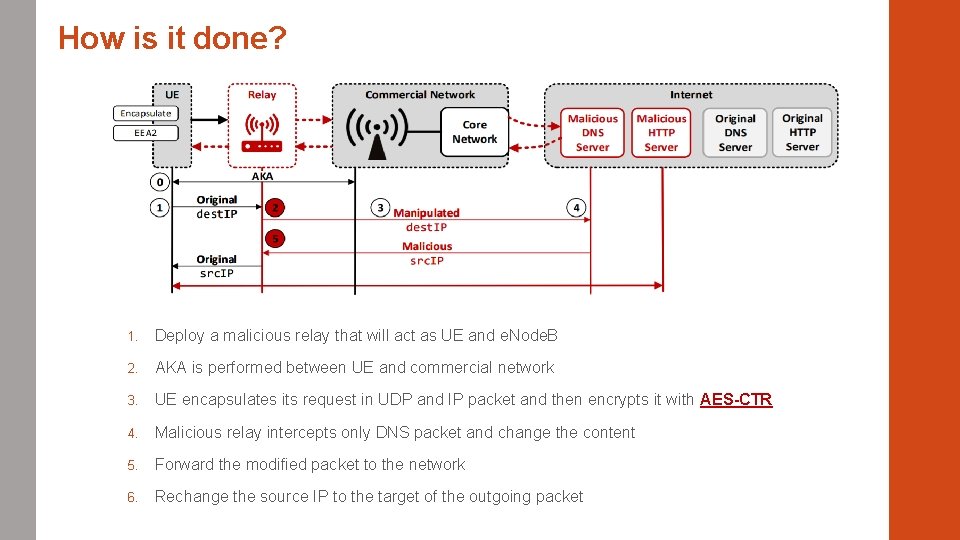
How is it done? 1. Deploy a malicious relay that will act as UE and e. Node. B 2. AKA is performed between UE and commercial network 3. UE encapsulates its request in UDP and IP packet and then encrypts it with AES-CTR 4. Malicious relay intercepts only DNS packet and change the content 5. Forward the modified packet to the network 6. Rechange the source IP to the target of the outgoing packet
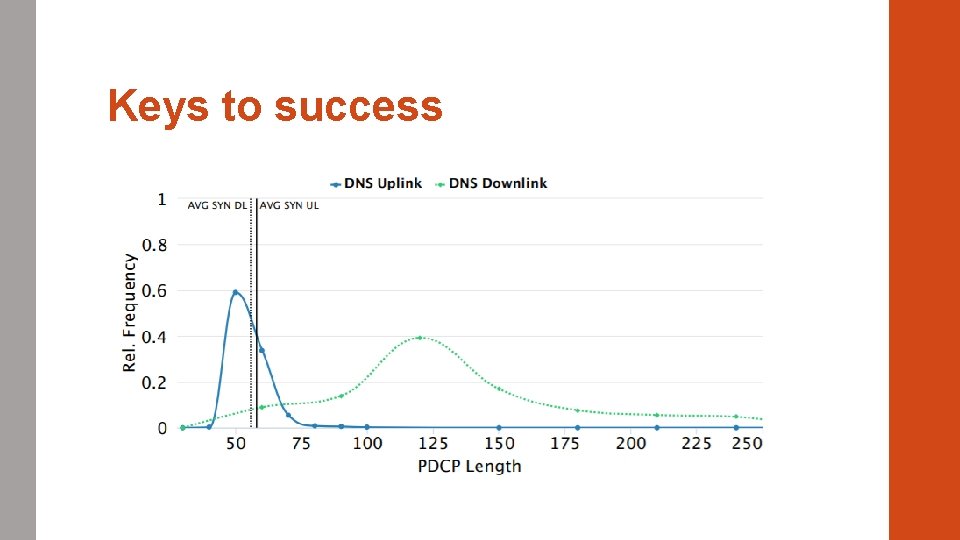
Keys to success • Stable Malicious Relay Key for the a. LTEr attack Make the user connect to the malicious e. Node. B by transmitting at higher frequencies than the commercial network Set correct configuration parameters (data bearer, RLC, etc) • DNS requests and responses Only altering DNS requests Reliable way to distinguish DNS requests from all the traffic (encrypted) DNS packet length is usually smaller than other TCP packets
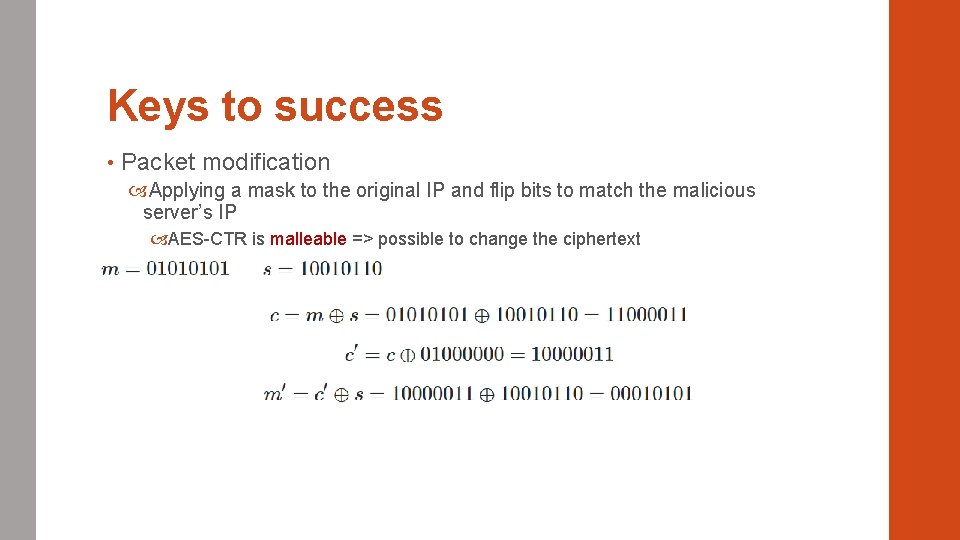
Keys to success • Packet modification Applying a mask to the original IP and flip bits to match the malicious server’s IP AES-CTR is malleable => possible to change the ciphertext
Consequence of bit manipulation • Checksum modified Original payload changed Packet dropped • How to keep the same checksum after manipulation? Changing other bits besides the target IP
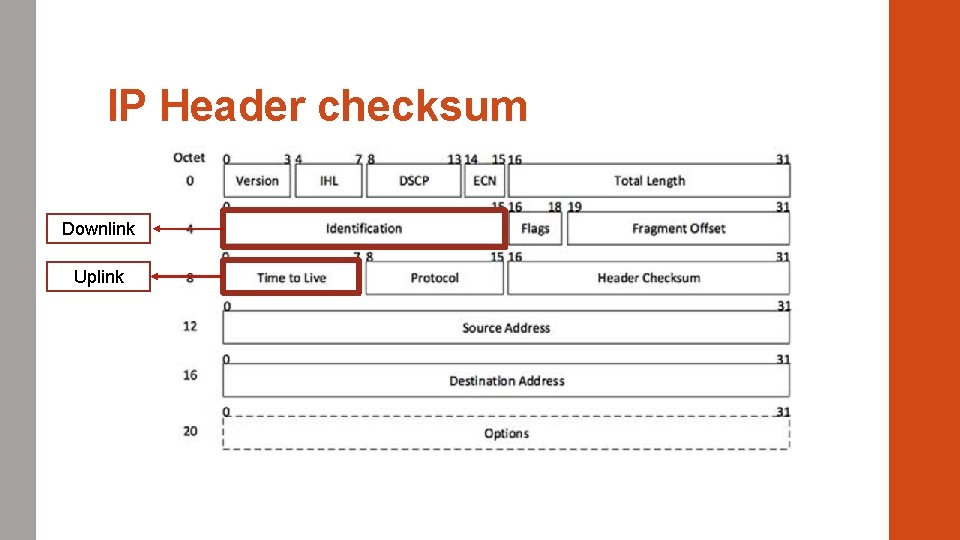
IP Header checksum Downlink Uplink
UDP Header checksum • Also affected by packet bit manipulation • Easier to bypass Set the UDP checksum to 0
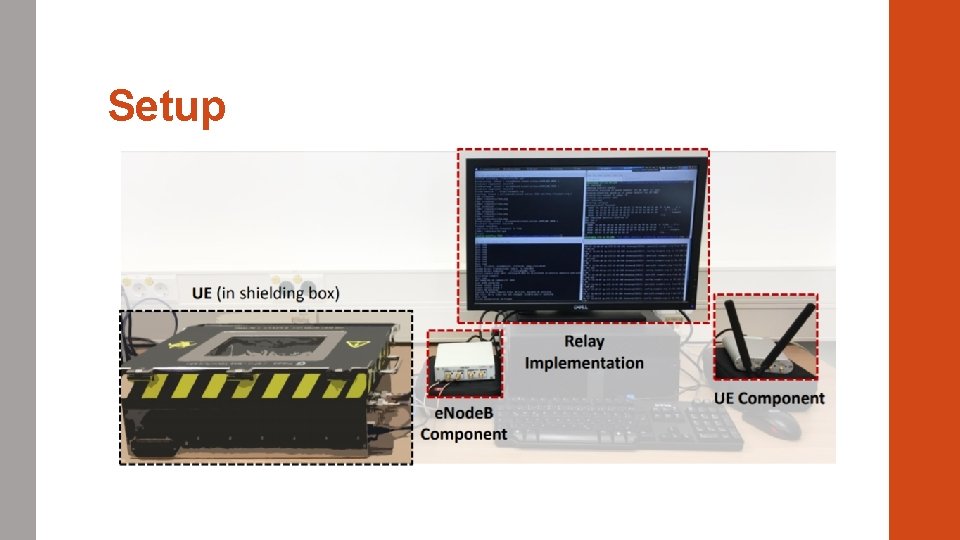
Setup
Experiment
a. LTEr attack results • Airplane mode before the experiment • Delete all cache (DNS & HTTP) • Placed inside a shielding box Real-world applicability?
Defenses • Update the specifications: encryption protocol with authentication Devices must implement such protocol High financial and organization effort • HSTS: prevents redirection to a malicious website Site wants to communicate only using SSL/TLS
Conclusion • Identity mapping attack Match TMSI to RNTI Localize and identify user within a cell • Website fingerprinting attack Learn transmission characteristics from a user Distinguish accessed websites • a. LTEr attack Lack of integrity protection AES-CTR is malleable DNS spoofing by changing the payload
Future work • Will this work on 5 G? AT&T and Verizon started implementing 5 G Complicated to update specifications • D. Basin and al. , “A Formal Analysis of 5 G Authentication”, CCS’ 18 Analysis of 5 G specifications (722 pages across 4 documents) Identify missing security goals and flaws Focusing on AKA in 5 G

Questions
- Slides: 40