
Breaking Down Barriers An Intro to GPU Synchronization
Breaking Down Barriers: An Intro to GPU Synchronization Matt Pettineo Lead Engine Programmer Ready At Dawn Studios

Who am I? ● Ready At Dawn for 9 years ● ● ● Lead Engine Programmer for 5 I like GPUs and APIs! Lots of blogging, Twitter, and Git. Hub ● You may know me as MJP!
What is this talk about? ● ● ● GPU Synchronization! What is it? Why do you need it? How does it work? How does it affect performance?
Barriers in D 3 D 12/Vulkan ● ● New concept! Annoying ● ● Difficult ● ● D 3 D 11 didn’t need them! People keep talking about them Affects performance ● But why? And how?
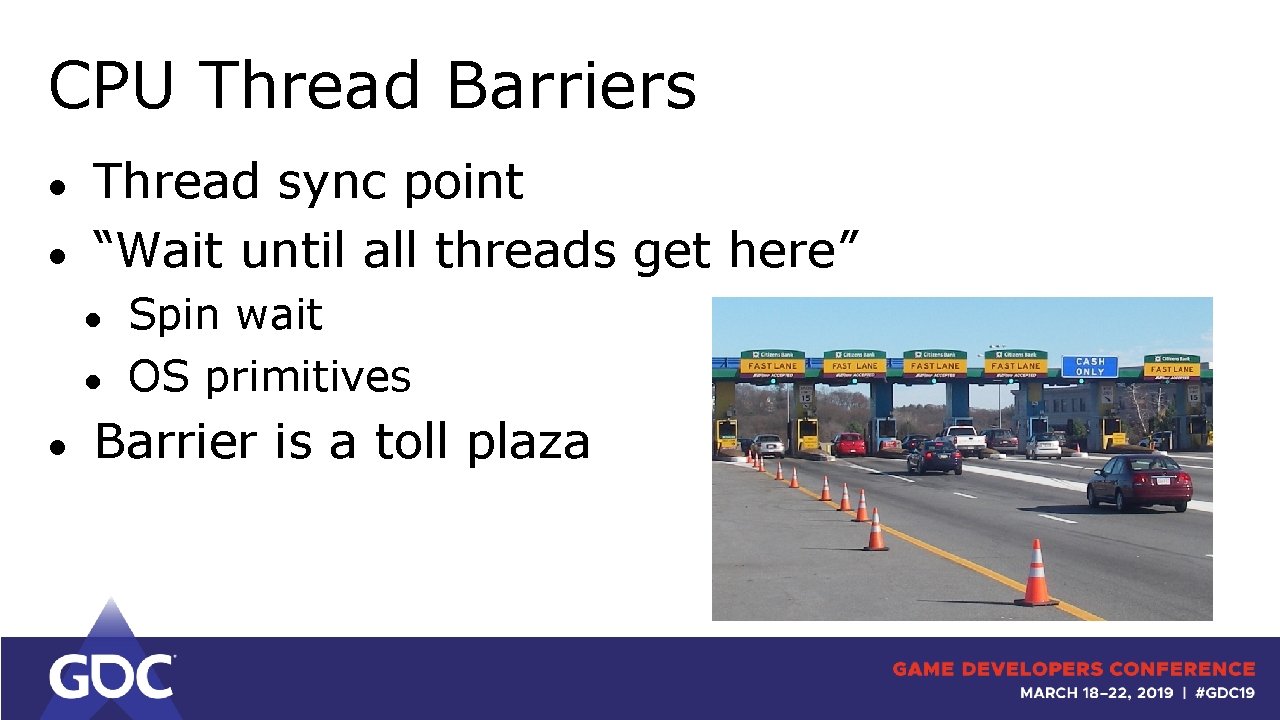
CPU Thread Barriers ● ● Thread sync point “Wait until all threads get here” ● ● ● Spin wait OS primitives Barrier is a toll plaza

CPU Memory Barriers ● Ensure correct order of reads/writes ● ● Affects CPU memory ops ● ● Ex: write finishes before barrier, read happens after and compiler ordering! Barrier is a doggie gate
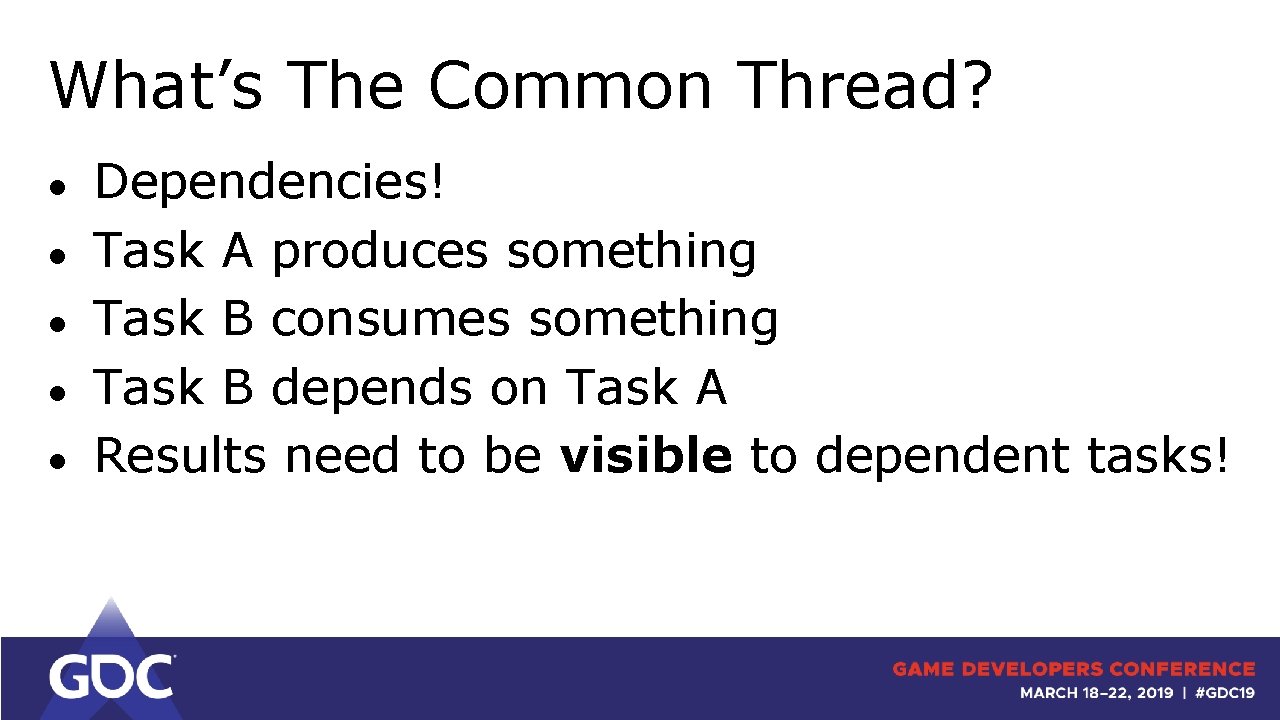
What’s The Common Thread? ● ● ● Dependencies! Task A produces something Task B consumes something Task B depends on Task A Results need to be visible to dependent tasks!
![Single-Threaded Dependencies ● ● int a = Get. Offset(); int b = my. Array[a];](http://slidetodoc.com/presentation_image_h2/d6650391ada4c87535e66c957ddb6434/image-8.jpg "Single-Threaded Dependencies ● ● int a = Get. Offset(); int b = my. Array[a];")
Single-Threaded Dependencies ● ● int a = Get. Offset(); int b = my. Array[a]; The compiler + CPU have your back! ● ● Automatic dependency analysis No need for manual barriers Expected ordering on a single core Easy mode
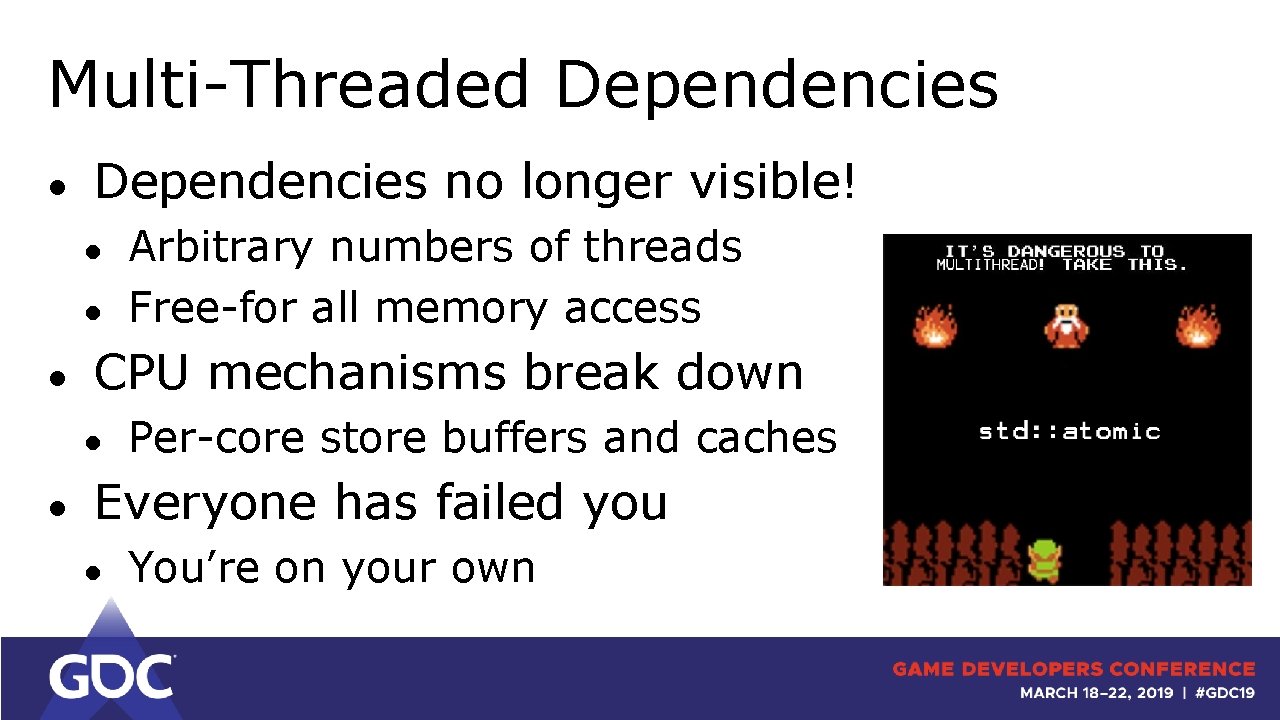
Multi-Threaded Dependencies ● Dependencies no longer visible! ● ● ● CPU mechanisms break down ● ● Arbitrary numbers of threads Free-for all memory access Per-core store buffers and caches Everyone has failed you ● You’re on your own
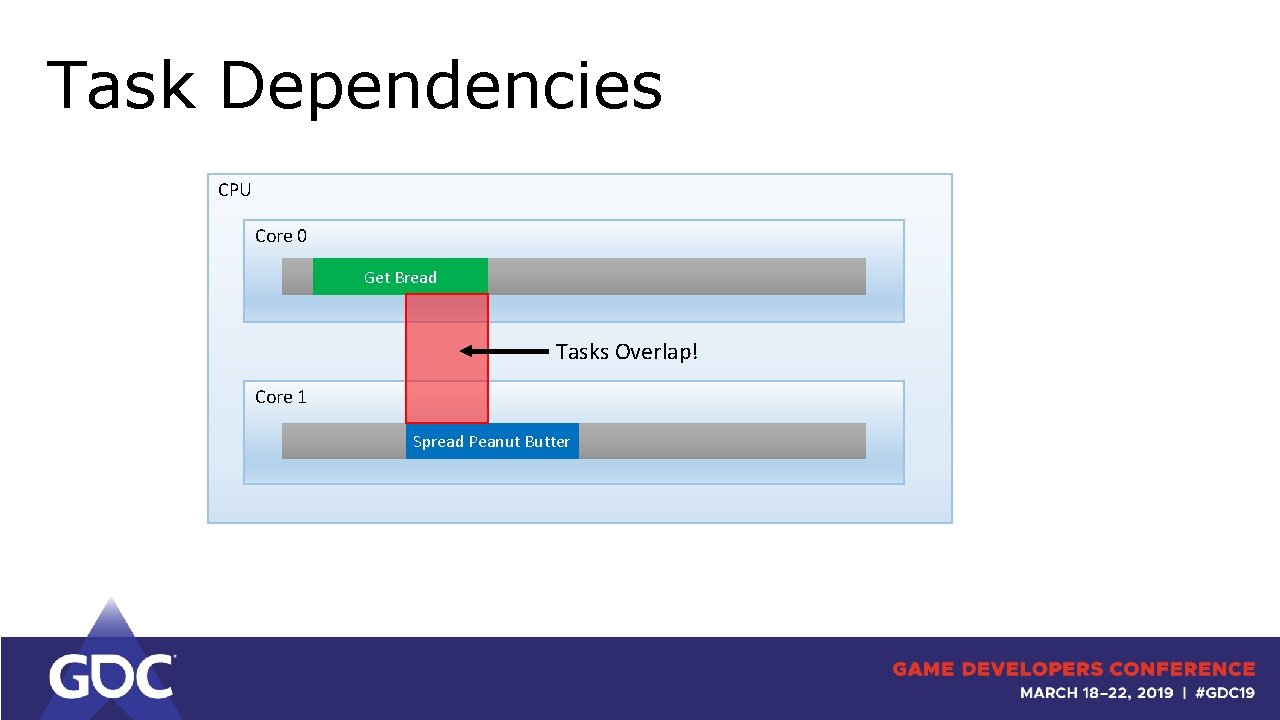
Task Dependencies CPU Core 0 Get Bread Tasks Overlap! Core 1 Spread Peanut Butter
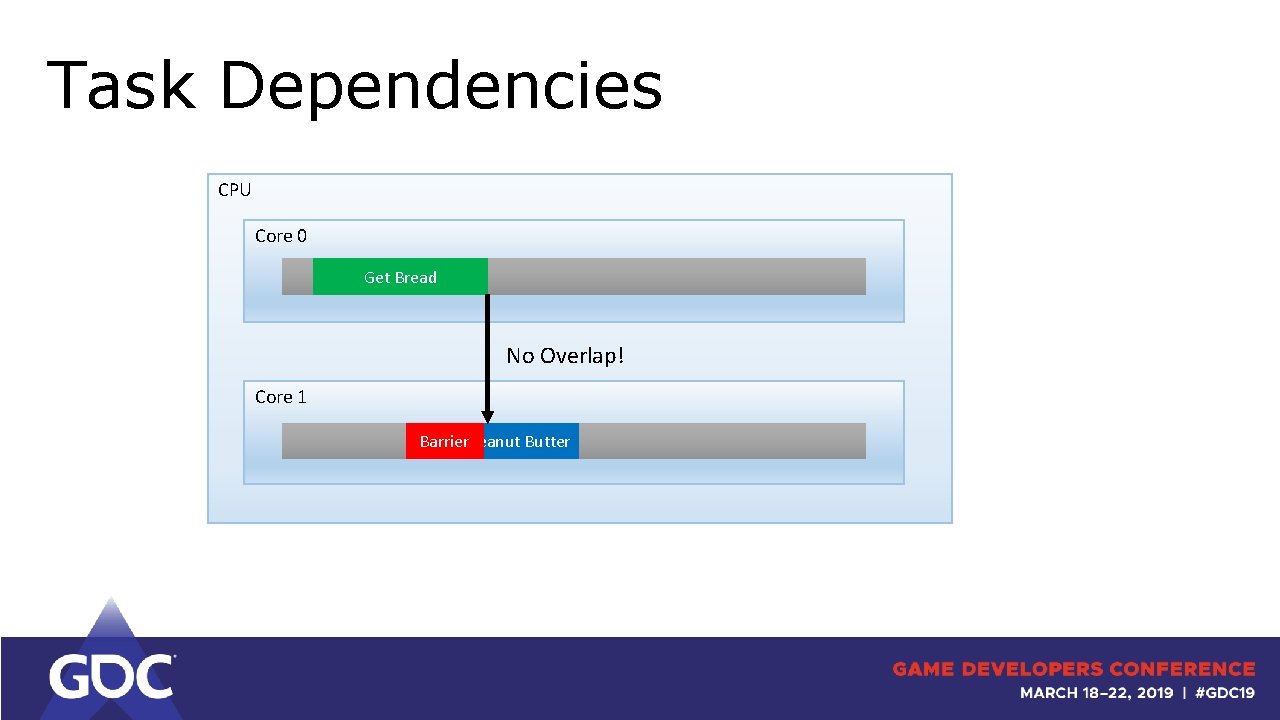
Task Dependencies CPU Core 0 Get Bread No Overlap! Core 1 Spread Barrier. Peanut Butter

GPU Parallelism ● GPU is not a serial machine! ● ● Looks are deceiving HW and drivers help you out
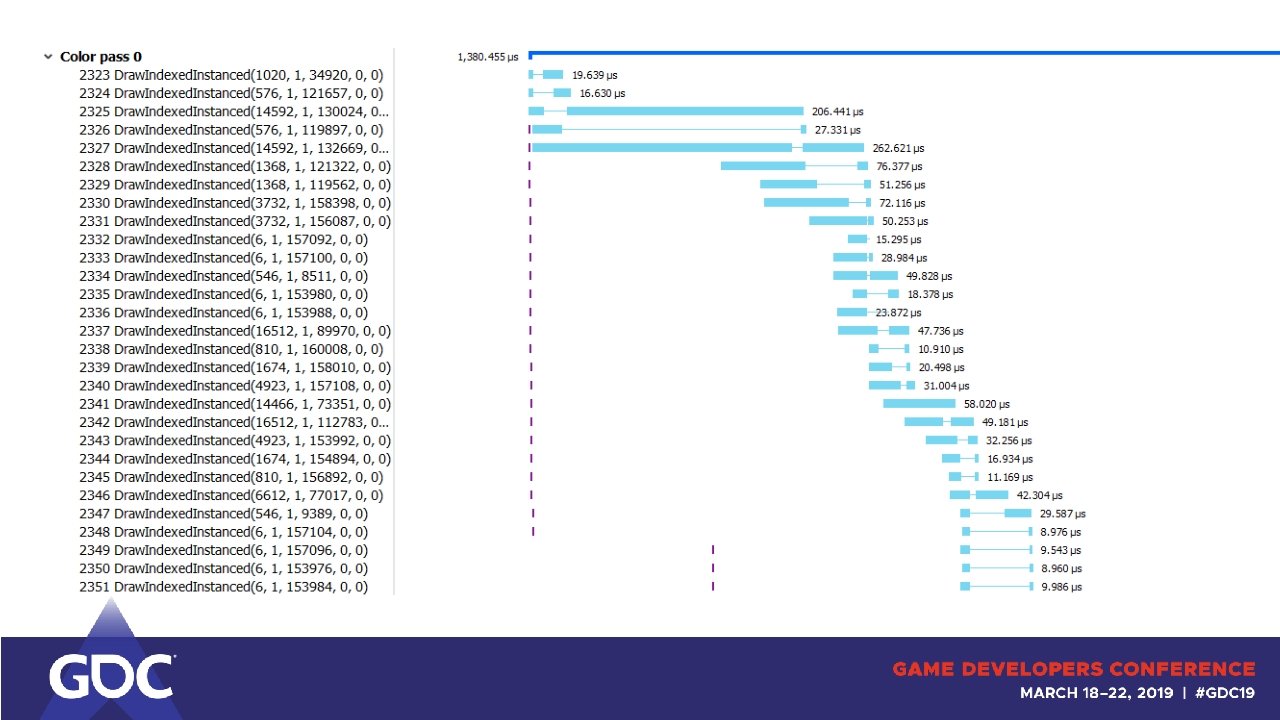
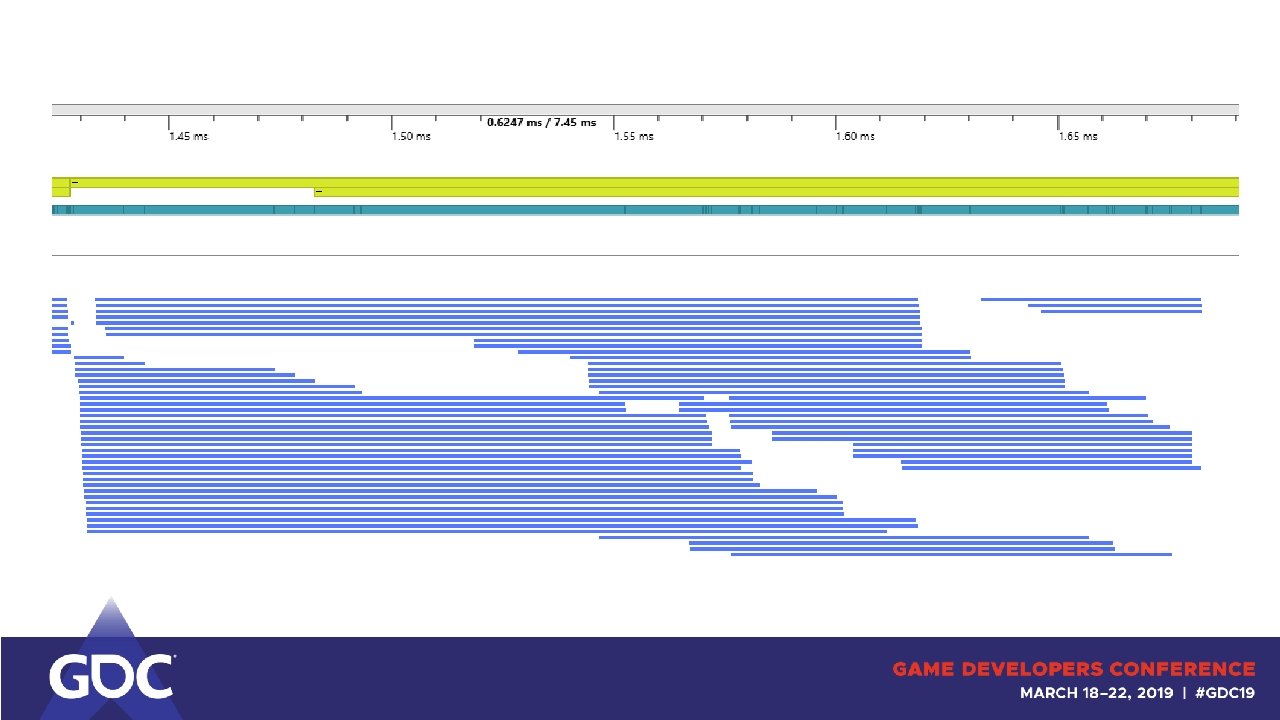

GPUs are Thread Monsters!
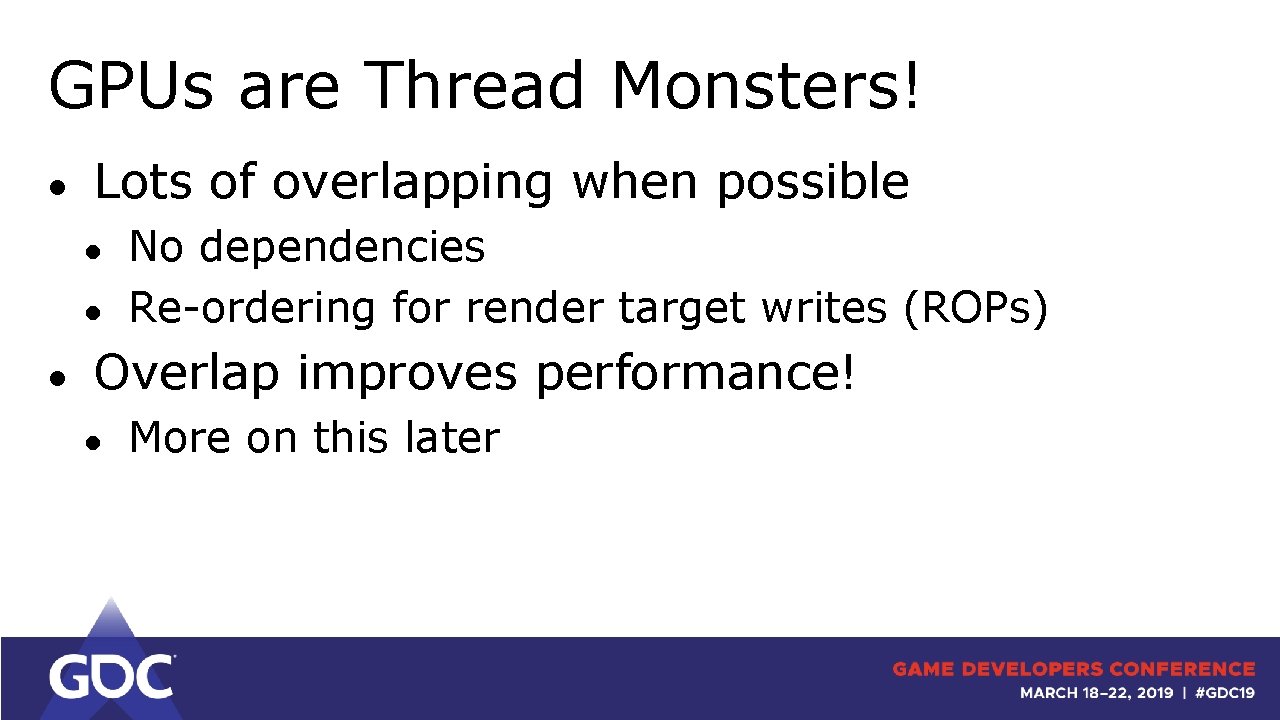
GPUs are Thread Monsters! ● Lots of overlapping when possible ● ● ● No dependencies Re-ordering for render target writes (ROPs) Overlap improves performance! ● More on this later
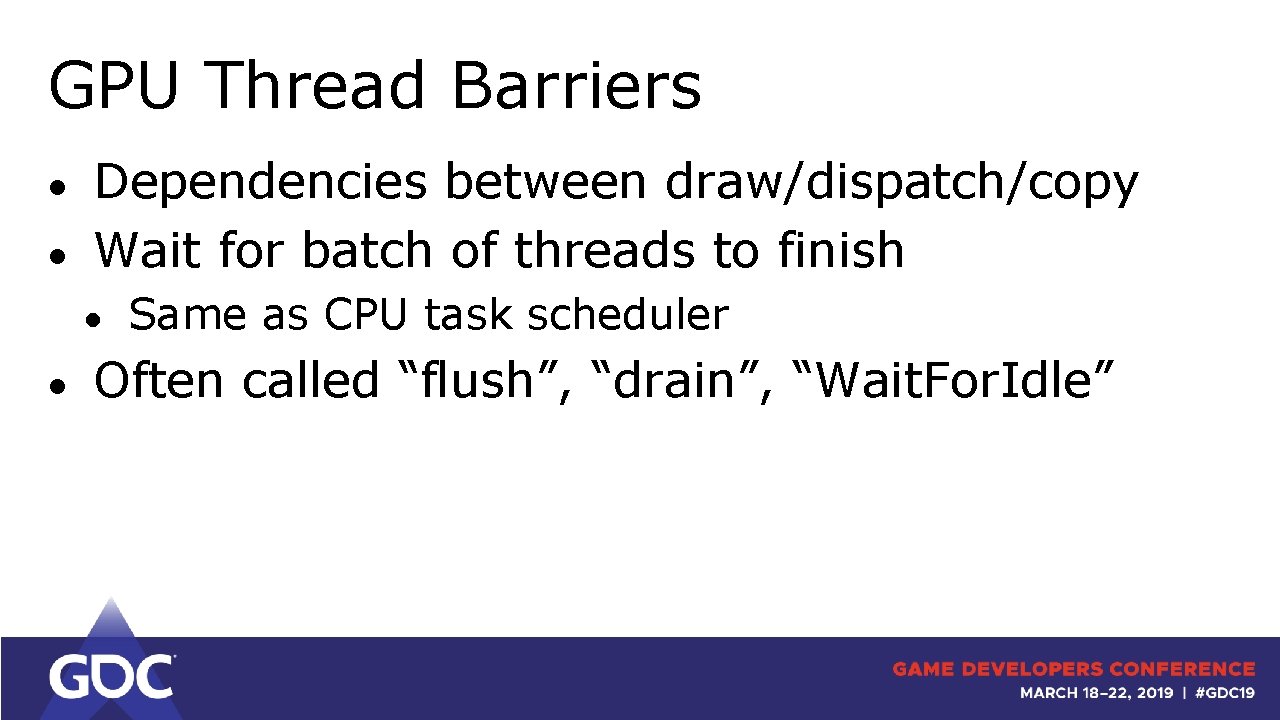
GPU Thread Barriers ● ● Dependencies between draw/dispatch/copy Wait for batch of threads to finish ● ● Same as CPU task scheduler Often called “flush”, “drain”, “Wait. For. Idle”

GPU Cache Barriers ● ● Lots of caches! Not always coherent! ● ● ● Different from CPU’s Flush and/or invalidate to ensure visibility Batch your barriers! Uh oh
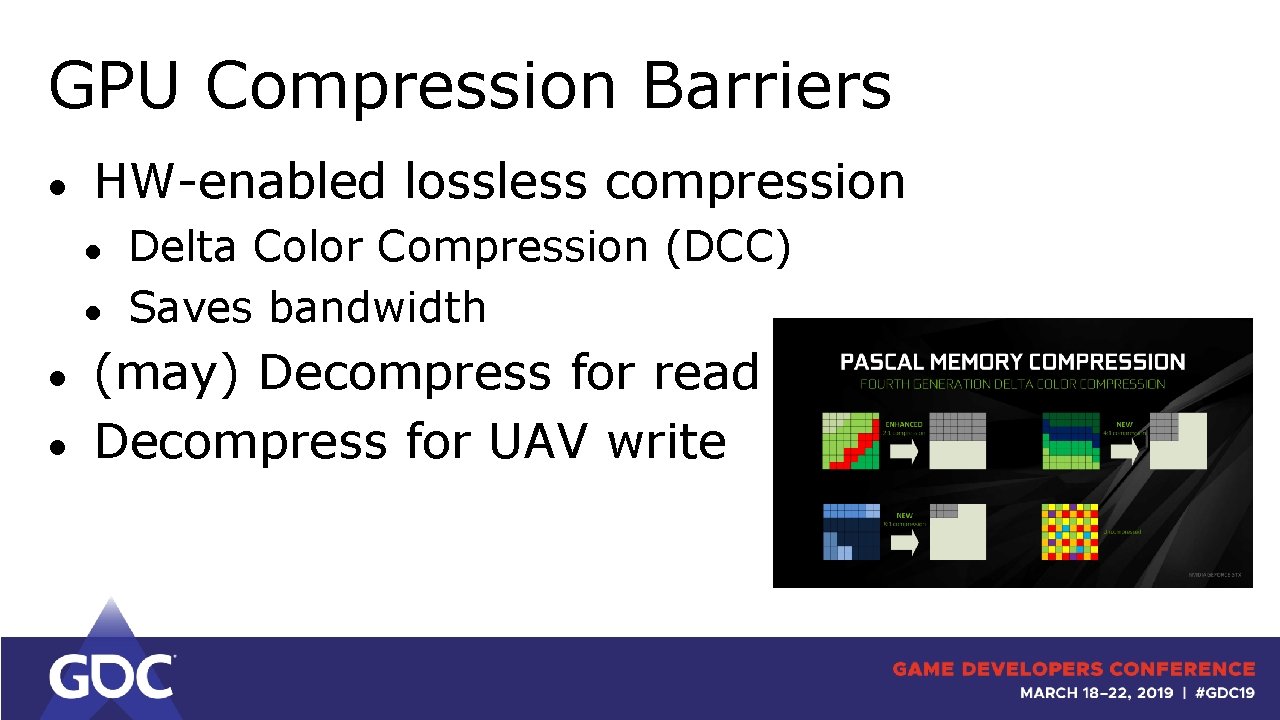
GPU Compression Barriers ● HW-enabled lossless compression ● ● Delta Color Compression (DCC) Saves bandwidth (may) Decompress for read Decompress for UAV write
D 3 D 12 Barriers ● Higher level - “resource state” abstraction ● ● ● Texture is in an SRV read state Buffer is in a UAV write state Mostly describes resource visibility Implicit dependencies from state transition Layout/compression also implied
Vulkan Barriers ● ● More explicit (verbose) than D 3 D 12 Specifies ● ● ● Producing/consuming GPU stage Read/write state Texture layout
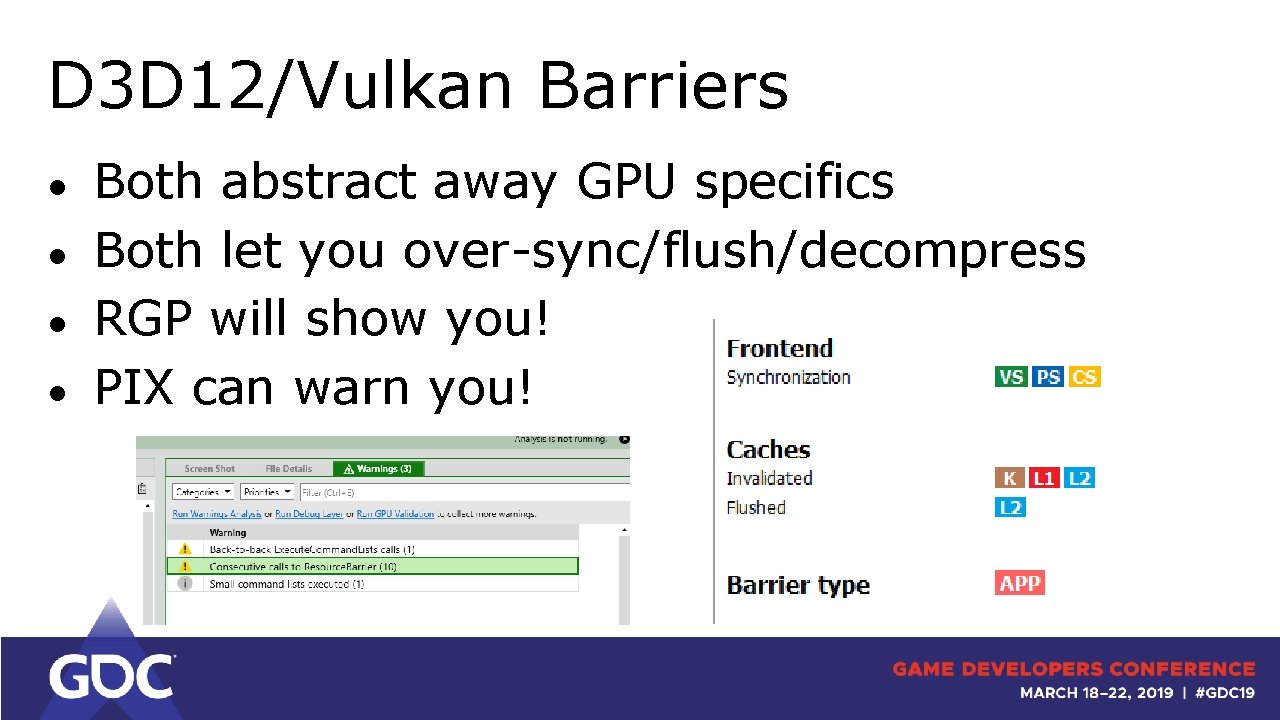
D 3 D 12/Vulkan Barriers ● ● Both abstract away GPU specifics Both let you over-sync/flush/decompress RGP will show you! PIX can warn you!
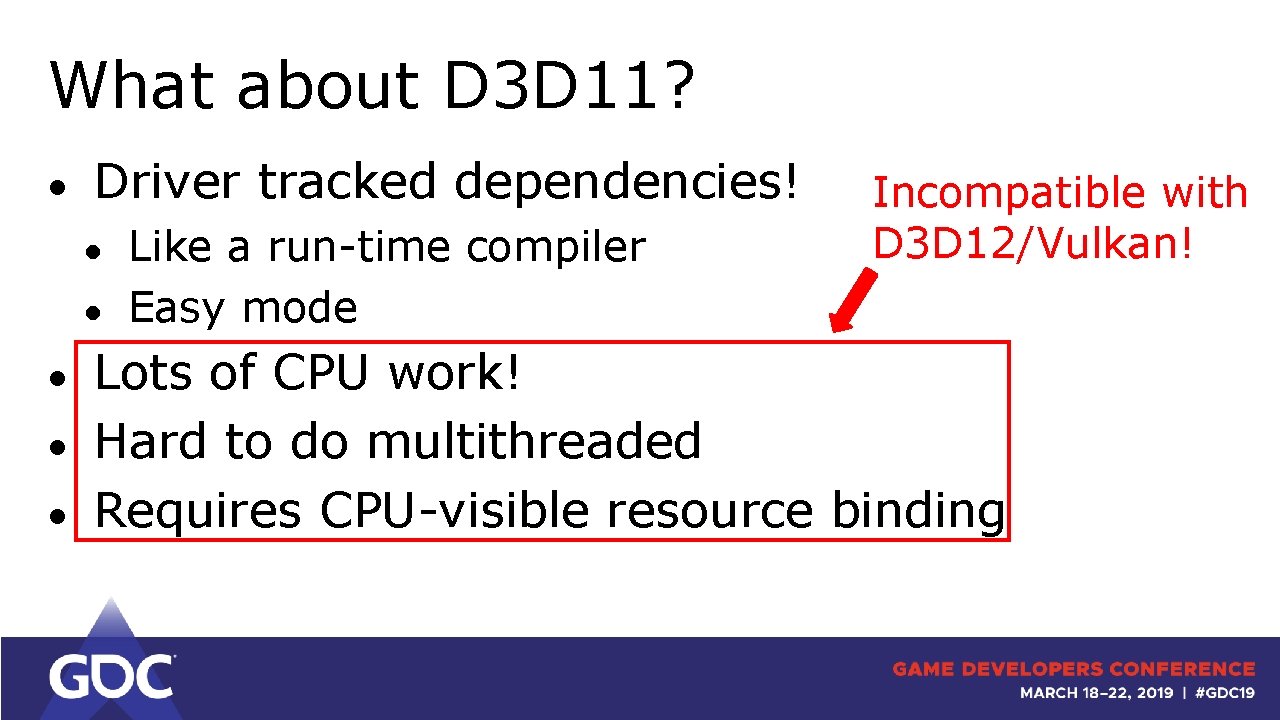
What about D 3 D 11? ● Driver tracked dependencies! ● ● ● Like a run-time compiler Easy mode Incompatible with D 3 D 12/Vulkan! Lots of CPU work! Hard to do multithreaded Requires CPU-visible resource binding
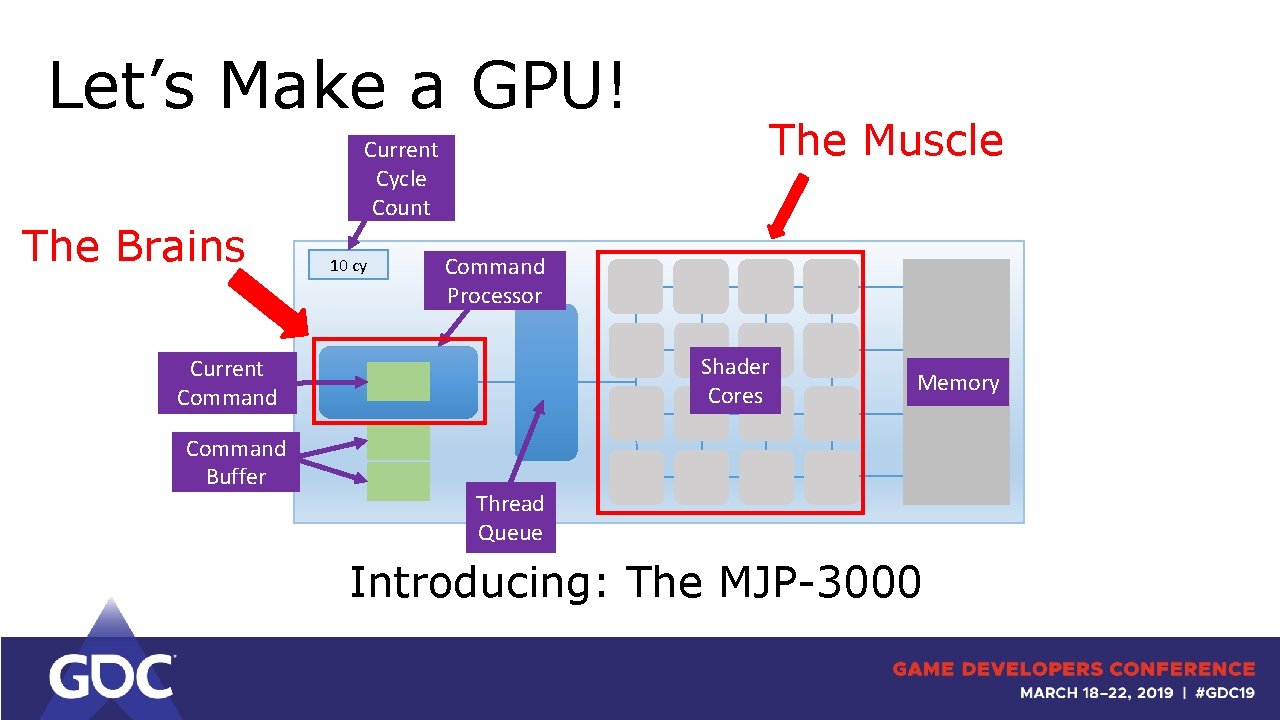
Let’s Make a GPU! The Brains Current Cycle Count 10 cy Command Processor Shader Cores Current Command Buffer The Muscle Memory Thread Queue Introducing: The MJP-3000
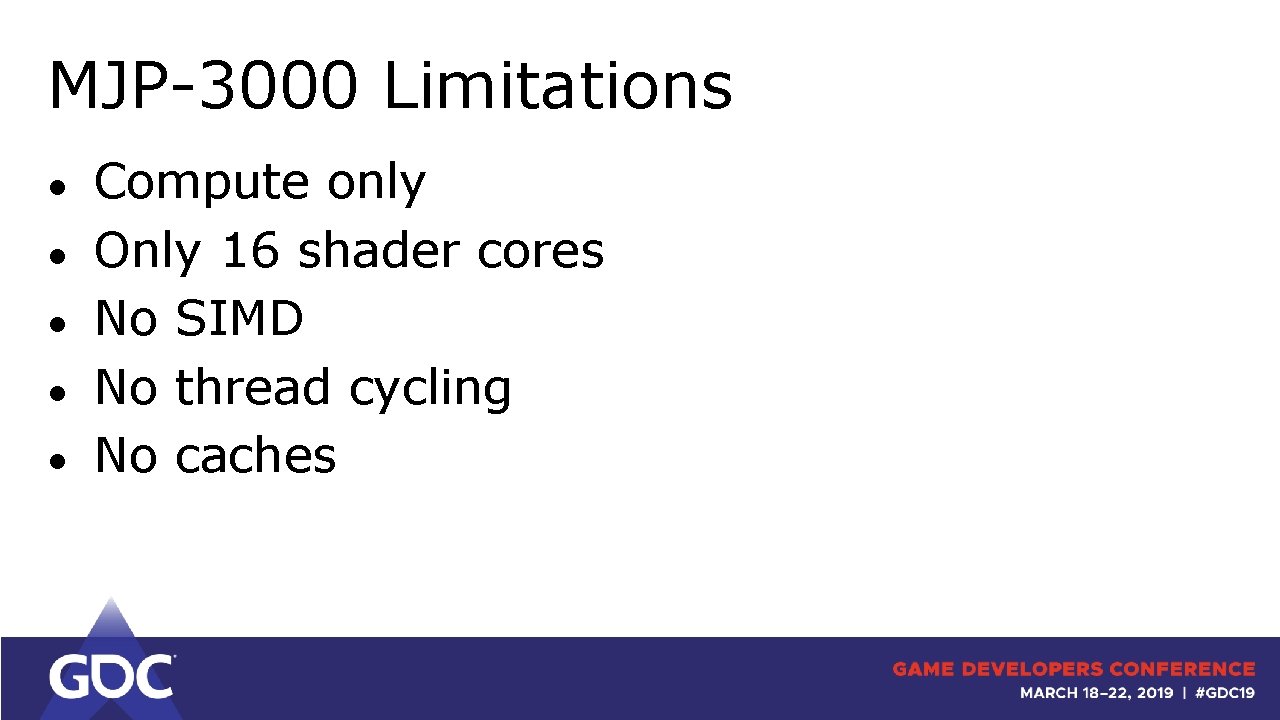
MJP-3000 Limitations ● ● ● Compute only Only 16 shader cores No SIMD No thread cycling No caches
Simple Dispatch Example ● ● Dispatch 32 threads Each thread writes 1 element to memory
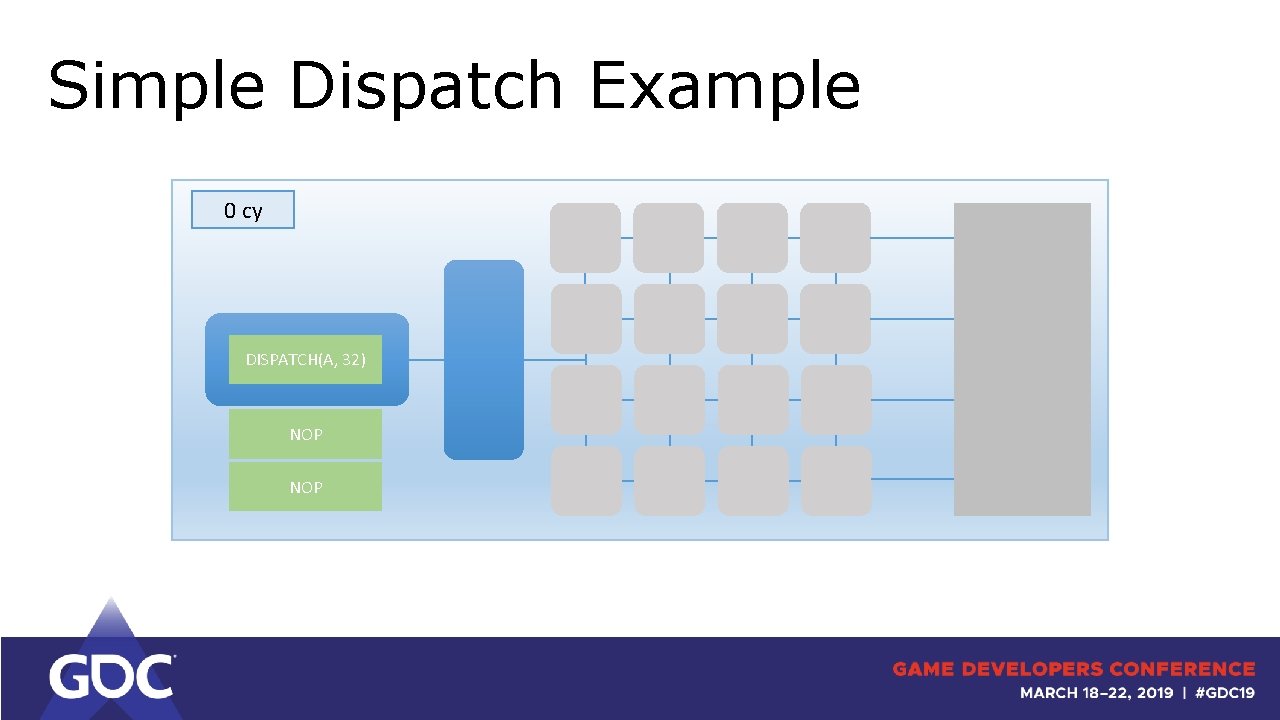
Simple Dispatch Example 0 cy DISPATCH(A, 32) NOP
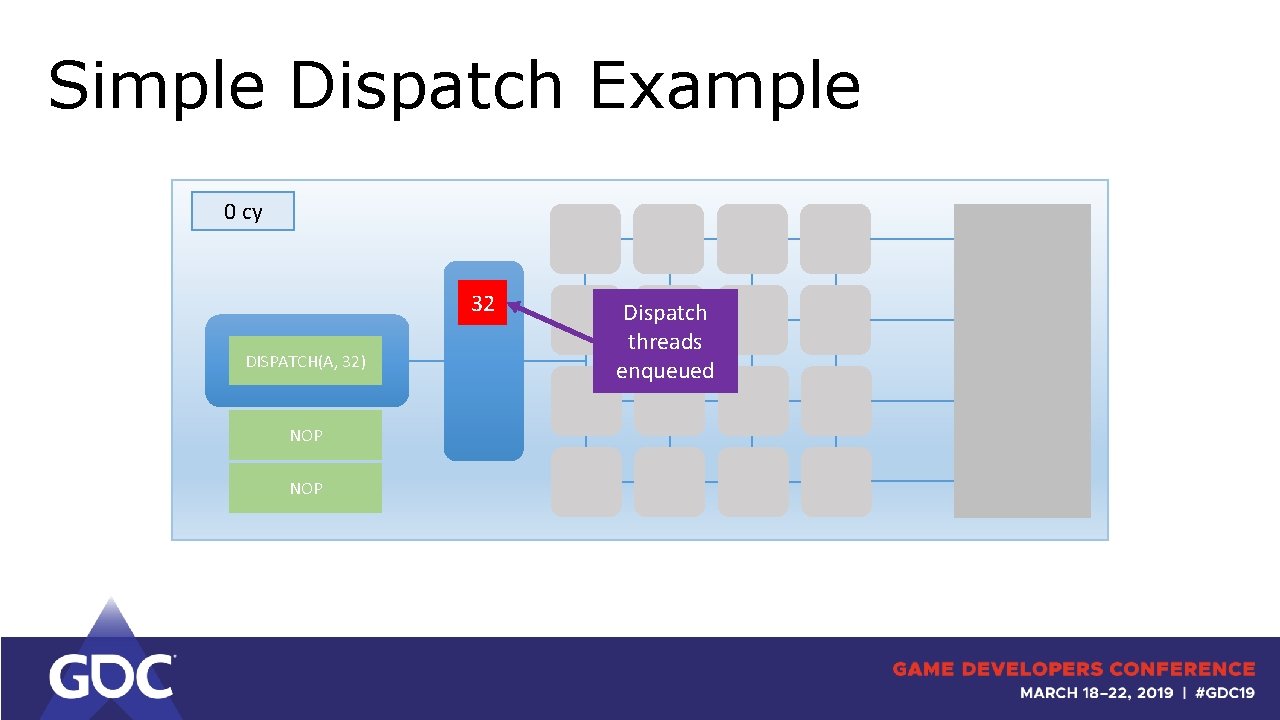
Simple Dispatch Example 0 cy 32 DISPATCH(A, 32) NOP Dispatch threads enqueued
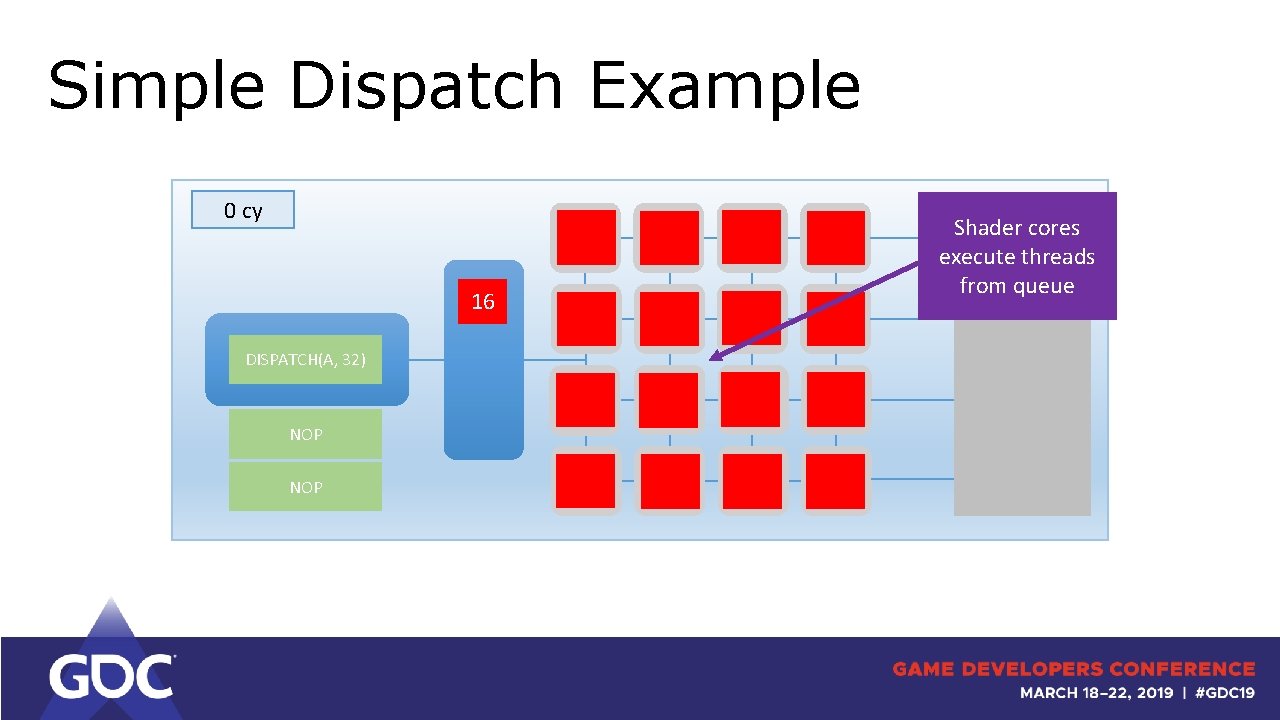
Simple Dispatch Example 0 cy 16 DISPATCH(A, 32) NOP Shader cores execute threads from queue
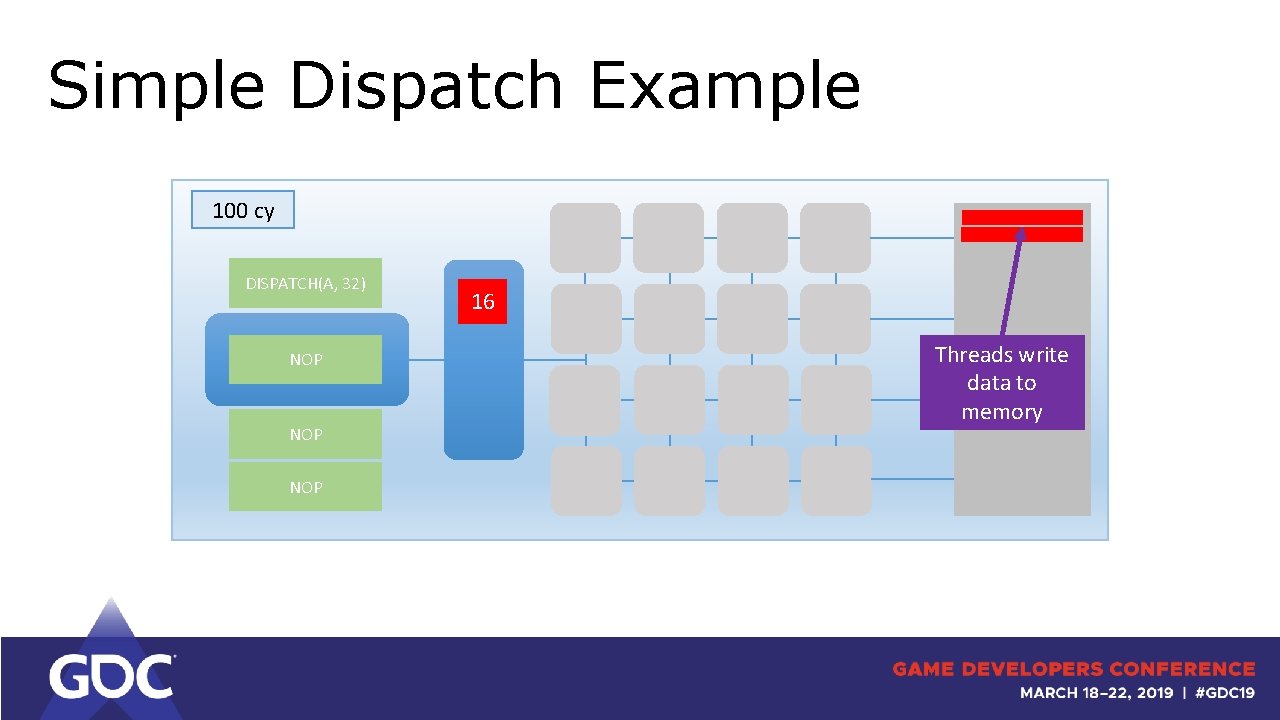
Simple Dispatch Example 100 cy DISPATCH(A, 32) NOP NOP 16 Threads write data to memory
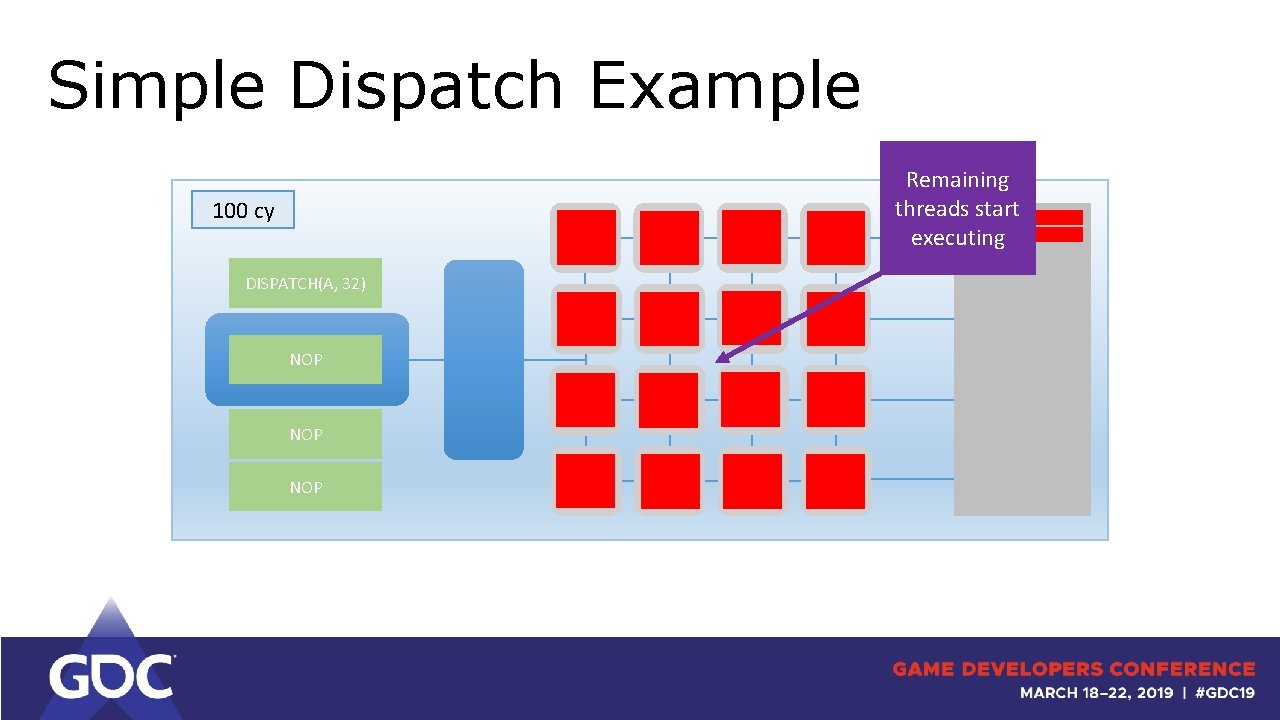
Simple Dispatch Example Remaining threads start executing 100 cy DISPATCH(A, 32) NOP NOP
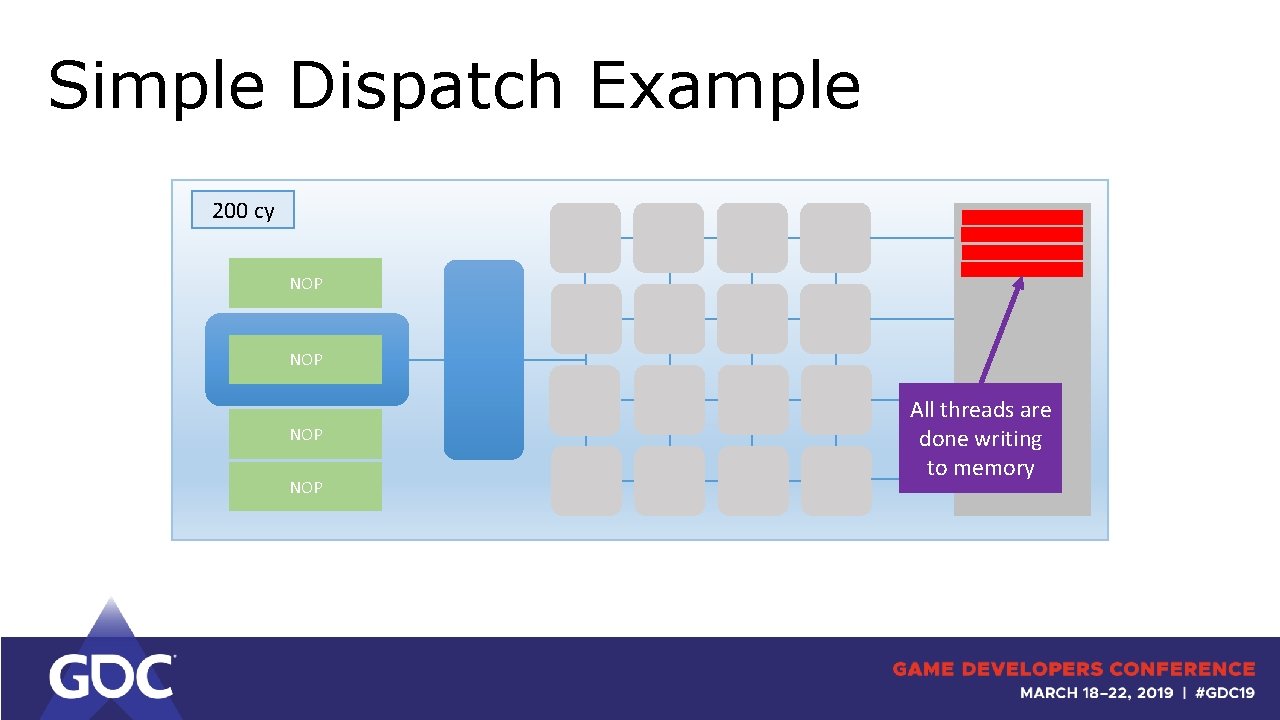
Simple Dispatch Example 200 cy NOP NOP All threads are done writing to memory
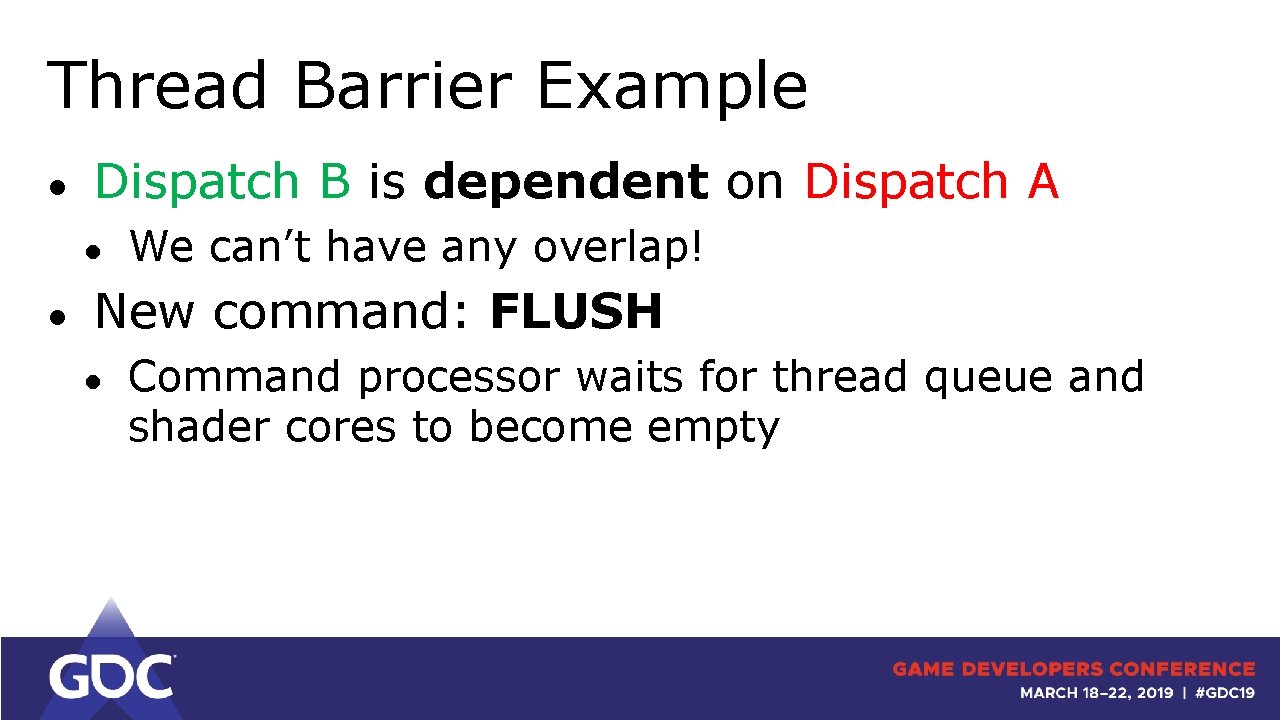
Thread Barrier Example ● Dispatch B is dependent on Dispatch A ● ● We can’t have any overlap! New command: FLUSH ● Command processor waits for thread queue and shader cores to become empty
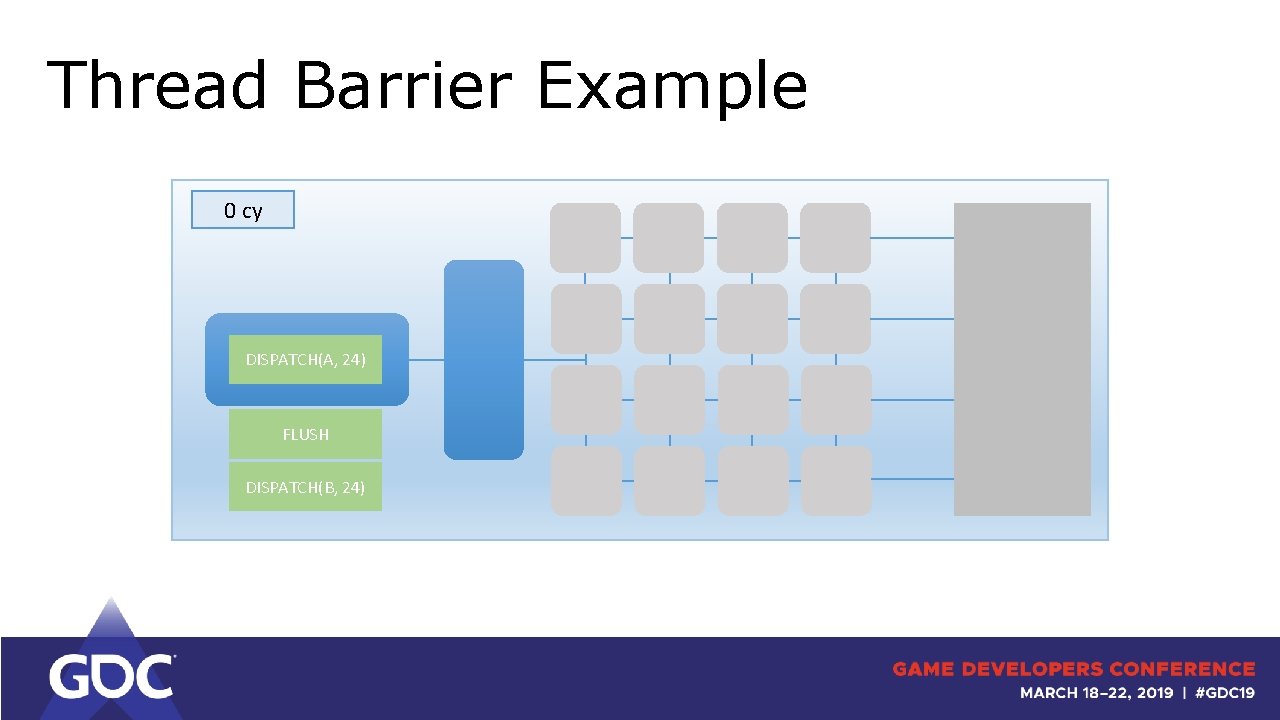
Thread Barrier Example 0 cy DISPATCH(A, 24) FLUSH DISPATCH(B, 24)
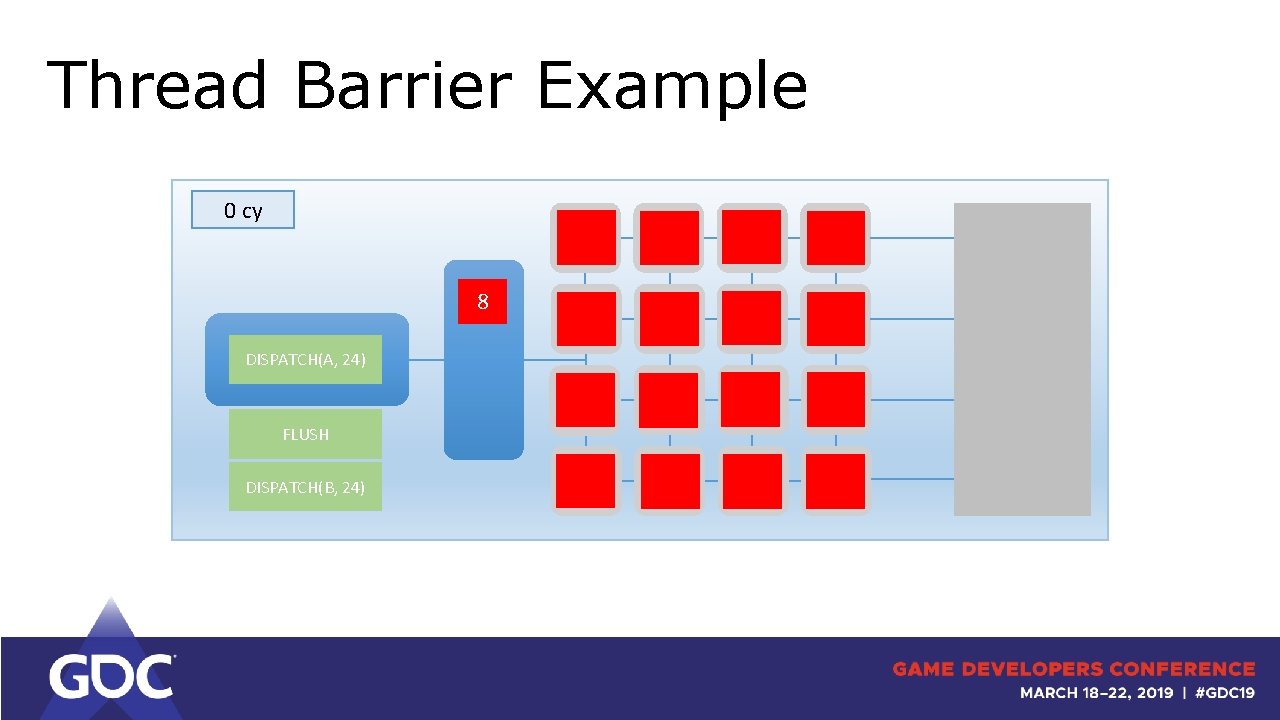
Thread Barrier Example 0 cy 8 DISPATCH(A, 24) FLUSH DISPATCH(B, 24)
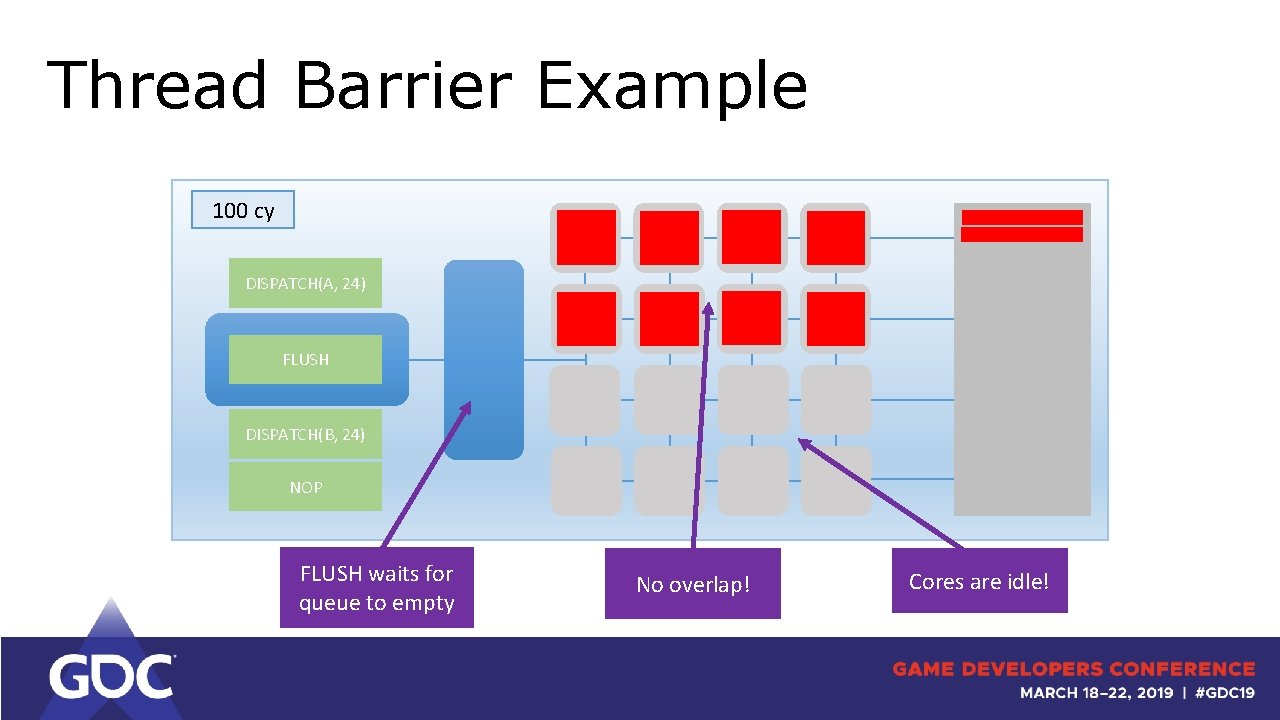
Thread Barrier Example 100 cy DISPATCH(A, 24) FLUSH DISPATCH(B, 24) NOP FLUSH waits for queue to empty No overlap! Cores are idle!
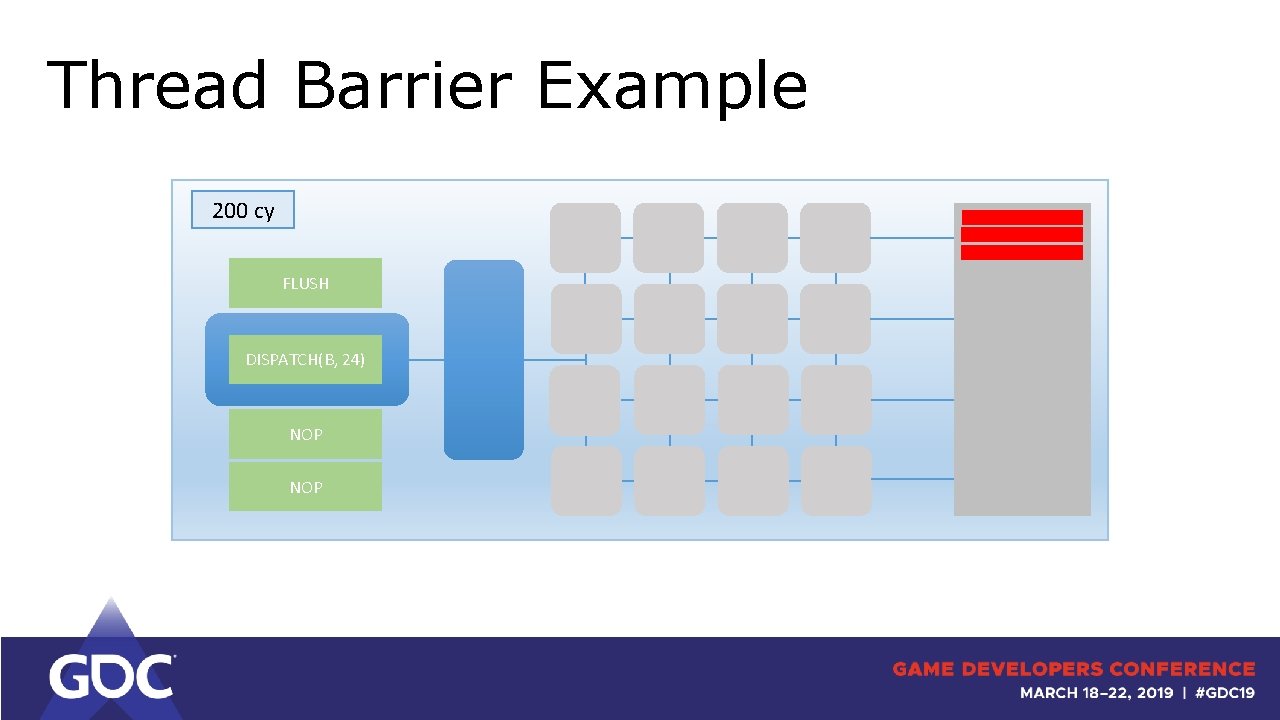
Thread Barrier Example 200 cy FLUSH DISPATCH(B, 24) NOP
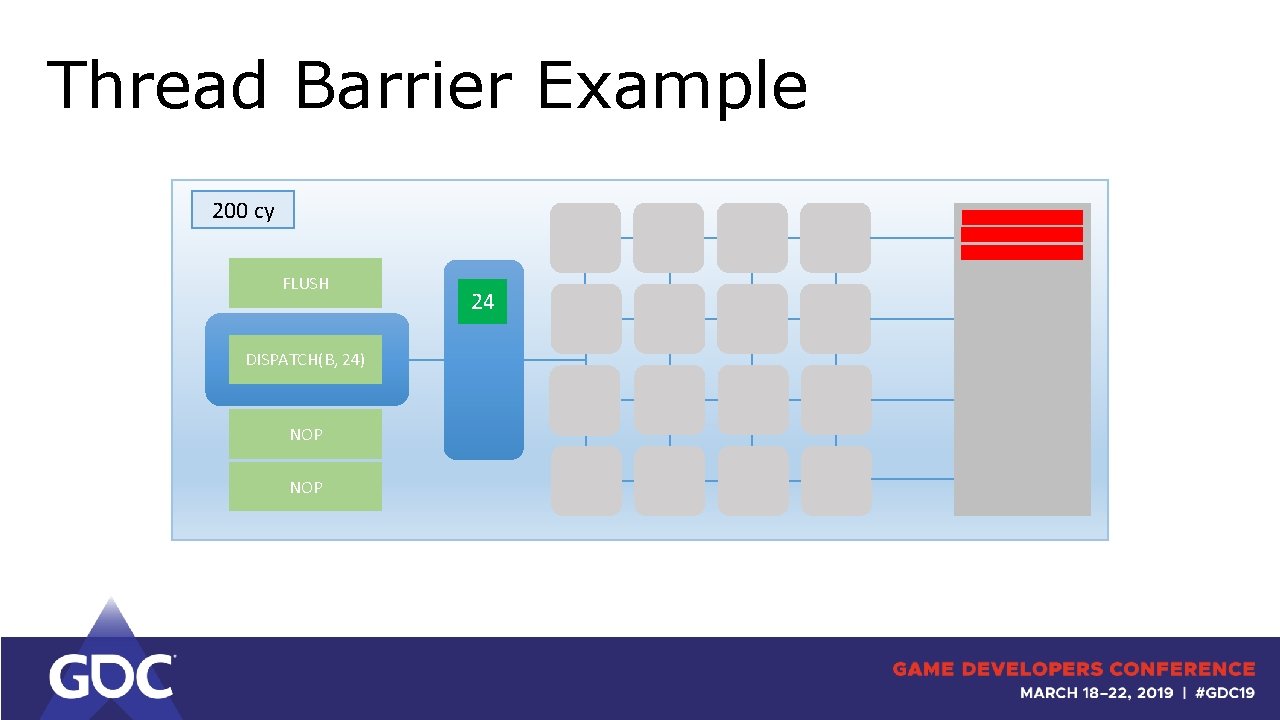
Thread Barrier Example 200 cy FLUSH DISPATCH(B, 24) NOP 24
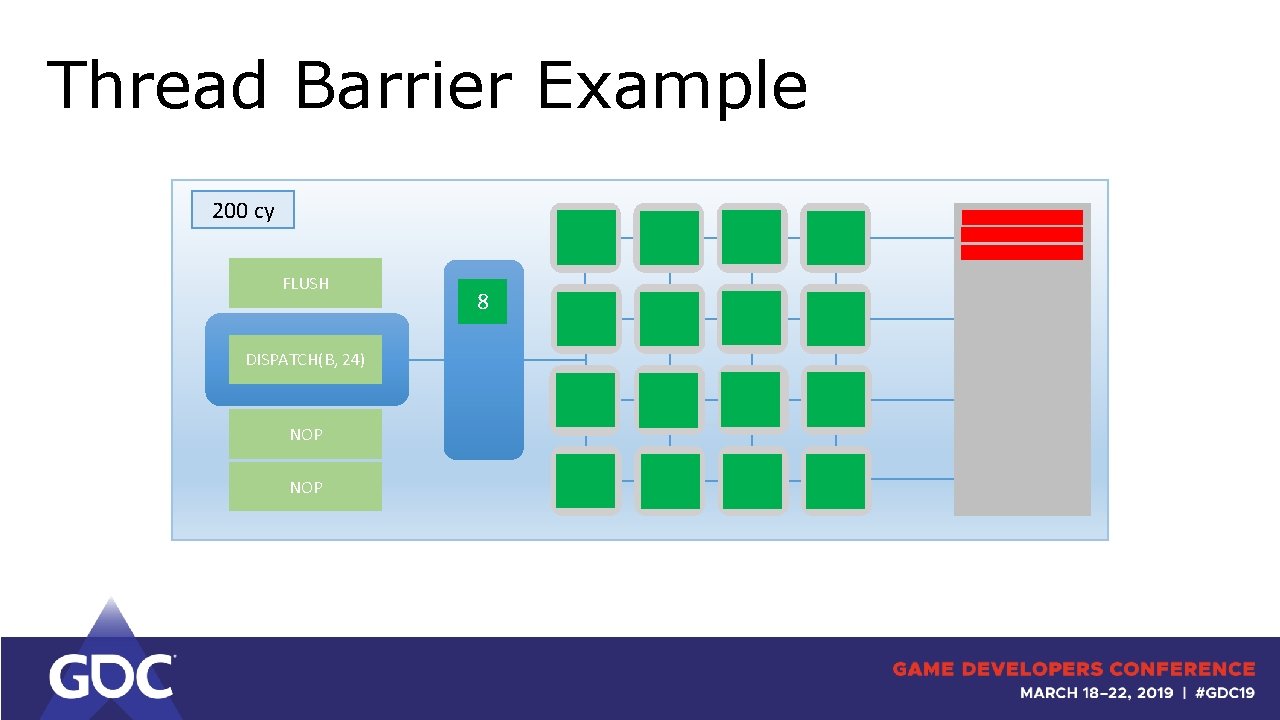
Thread Barrier Example 200 cy FLUSH DISPATCH(B, 24) NOP 8
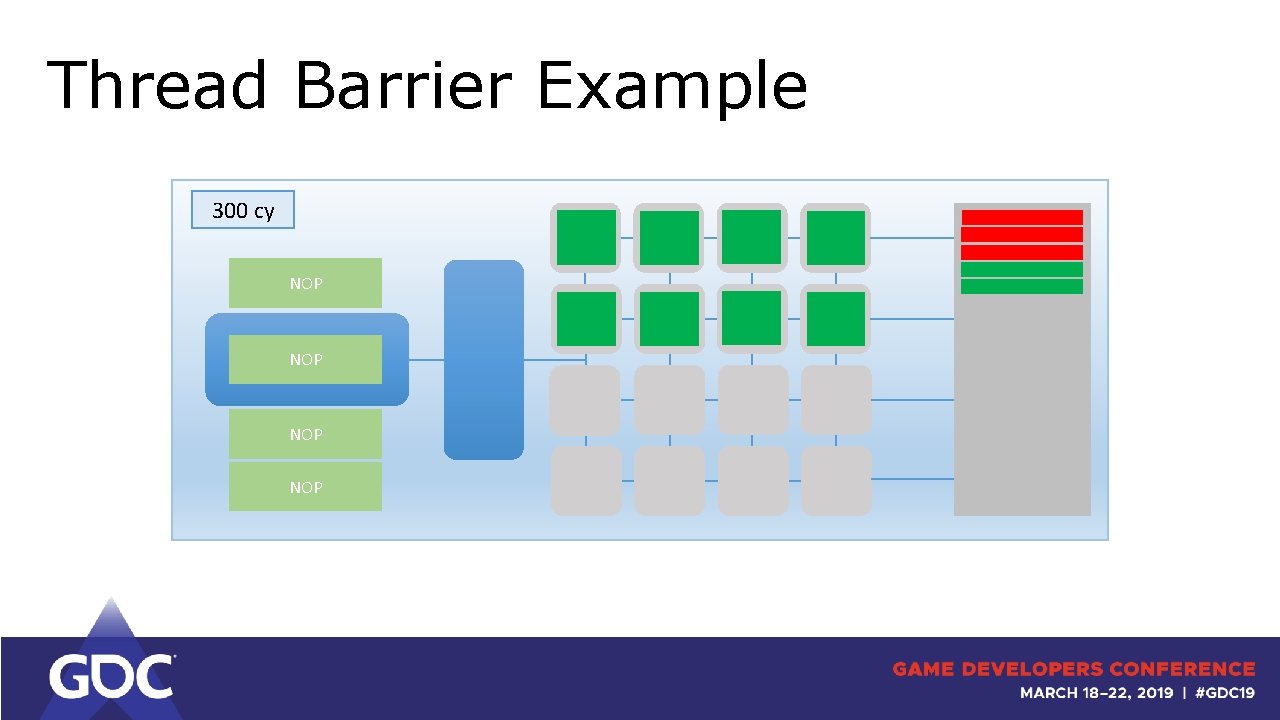
Thread Barrier Example 300 cy NOP NOP
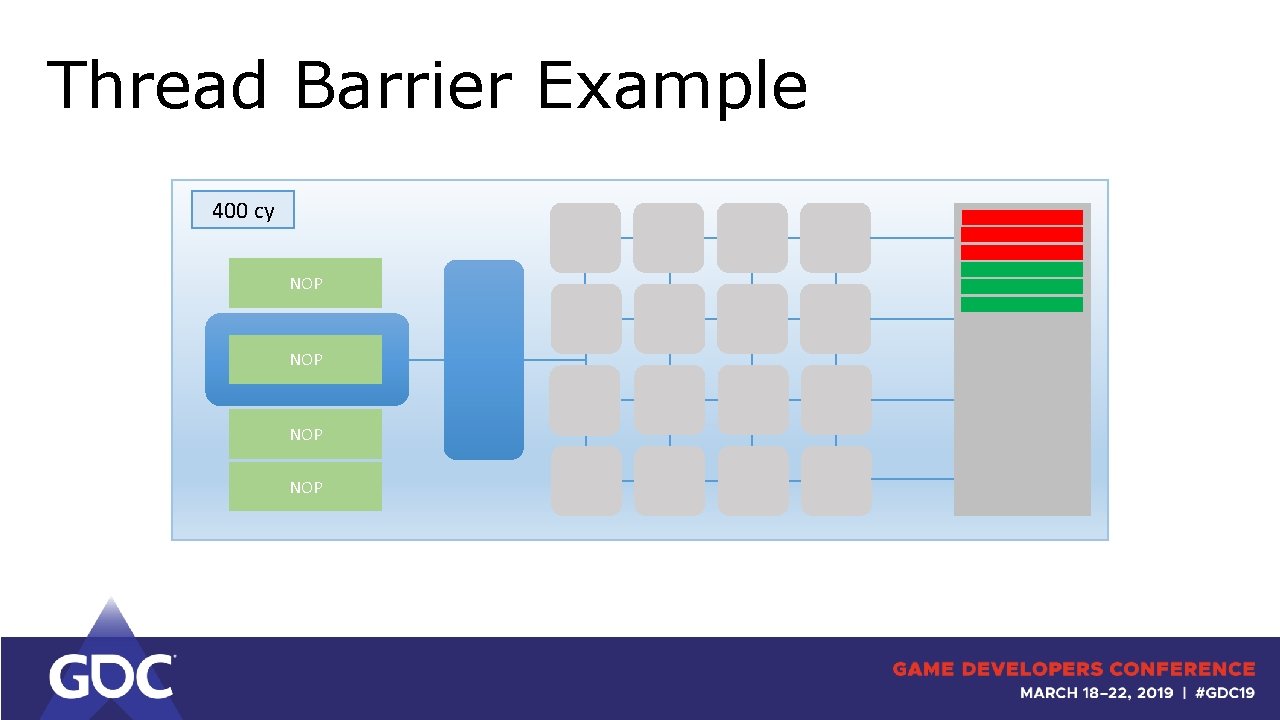
Thread Barrier Example 400 cy NOP NOP
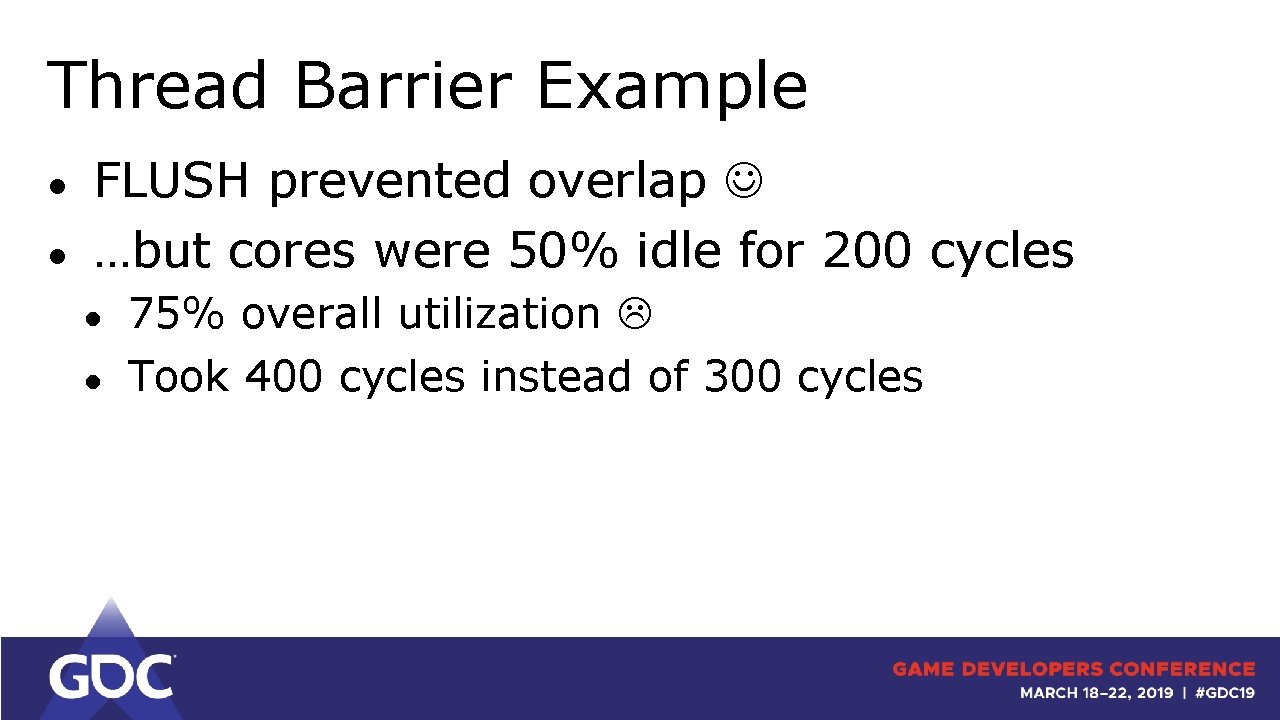
Thread Barrier Example ● ● FLUSH prevented overlap …but cores were 50% idle for 200 cycles ● ● 75% overall utilization Took 400 cycles instead of 300 cycles
The Cost of a Barrier ● ● Barrier cost is relative to the drop in utilization! Gain from removing a barrier is relative to % of idle shader cores Larger dispatches => better utilization Longer running threads => high flush cost ● Amdahl’s Law
D 3 D 12/Vulkan Barriers are Flushes! ● ● Expect a thread flush for a transition/pipeline barrier between draws/dispatches Same for a D 3 D 12_RESOURCE_UAV_BARRIER Try to group non-dependent draws/dispatches between barriers May not be true for future GPUs!
Overlapping Dispatches Example ● ● ● Dispatch B still dependent on Dispatch A Dispatch C dependent on neither Let’s try to recover some perf from idle cores
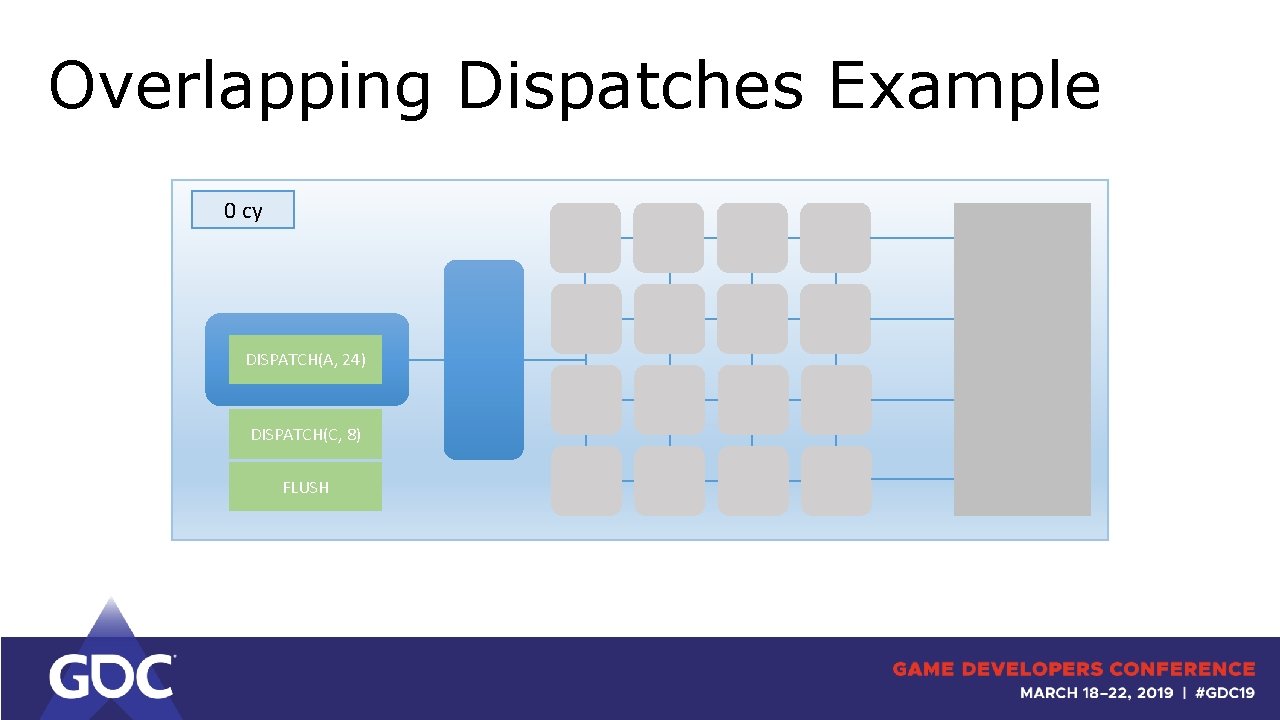
Overlapping Dispatches Example 0 cy DISPATCH(A, 24) DISPATCH(C, 8) FLUSH
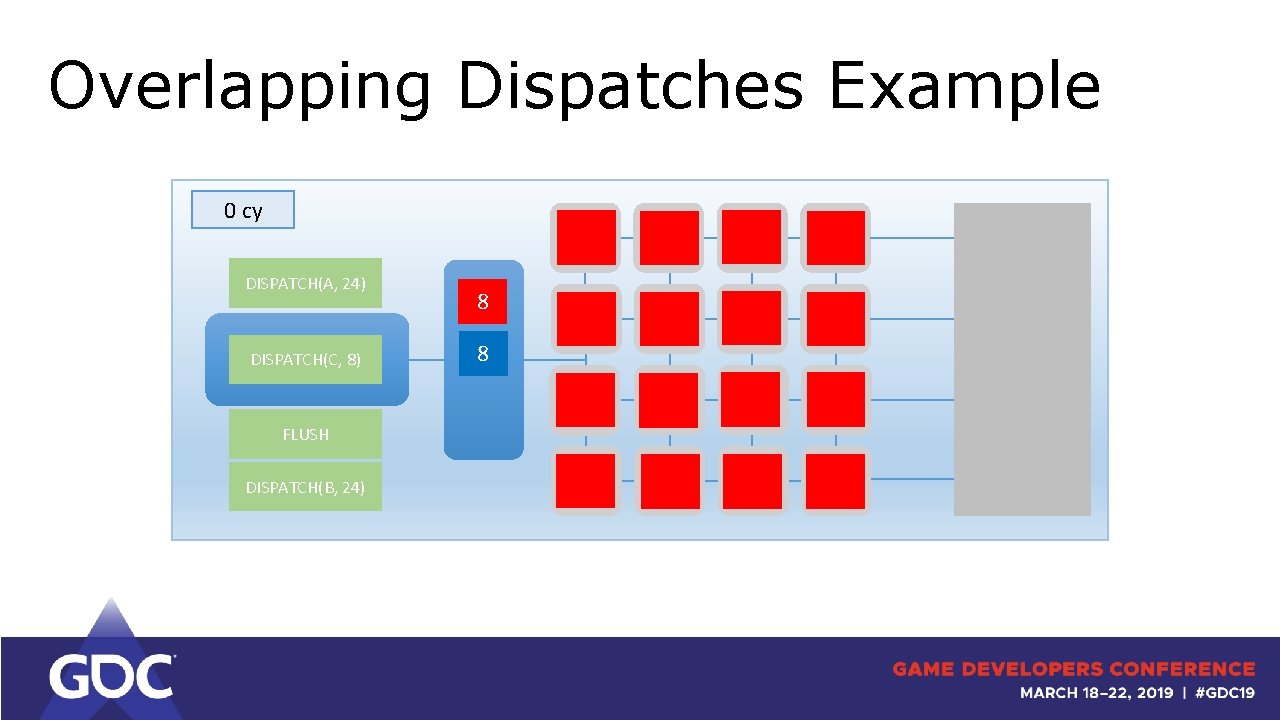
Overlapping Dispatches Example 0 cy DISPATCH(A, 24) DISPATCH(C, 8) FLUSH DISPATCH(B, 24) 8 8
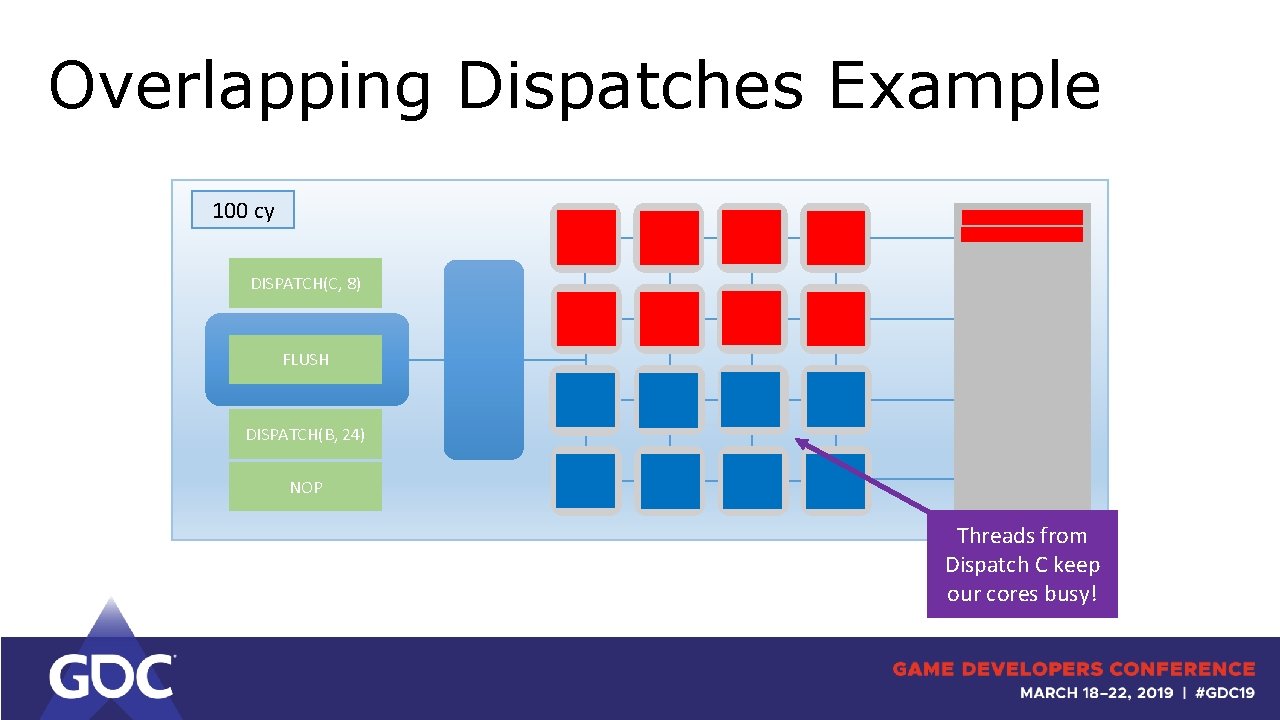
Overlapping Dispatches Example 100 cy DISPATCH(C, 8) FLUSH DISPATCH(B, 24) NOP Threads from Dispatch C keep our cores busy!
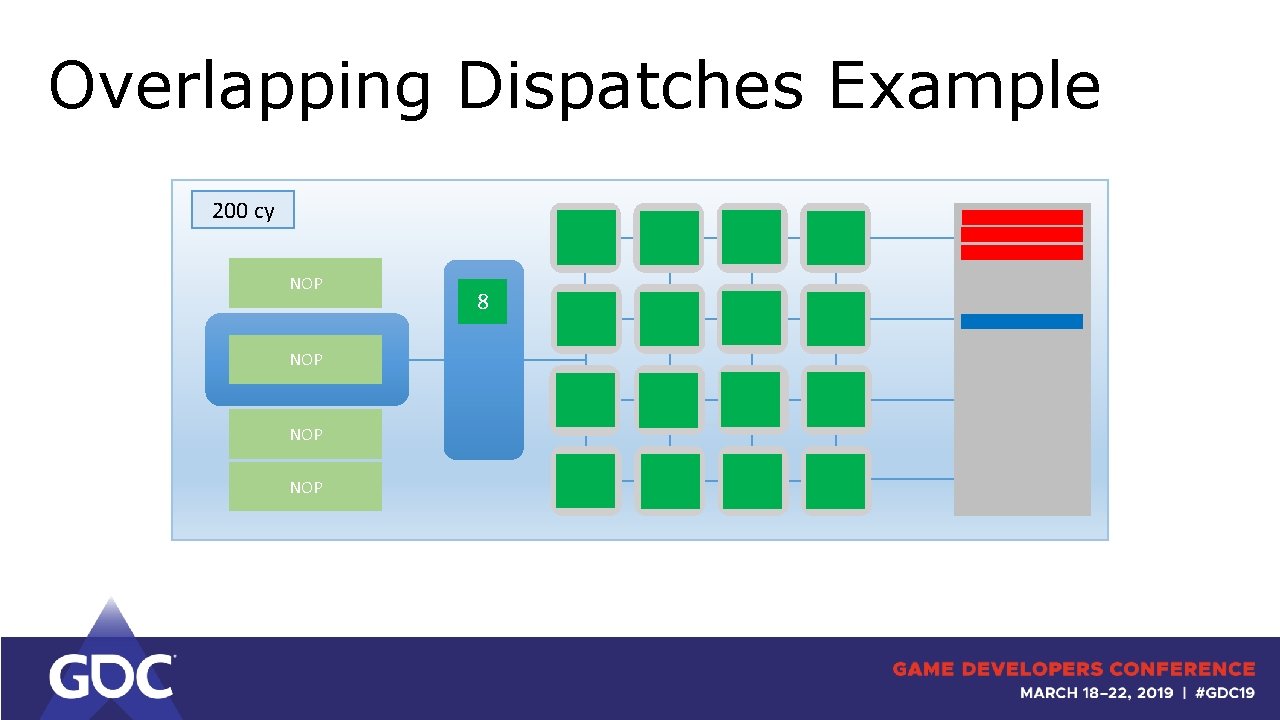
Overlapping Dispatches Example 200 cy NOP NOP 8
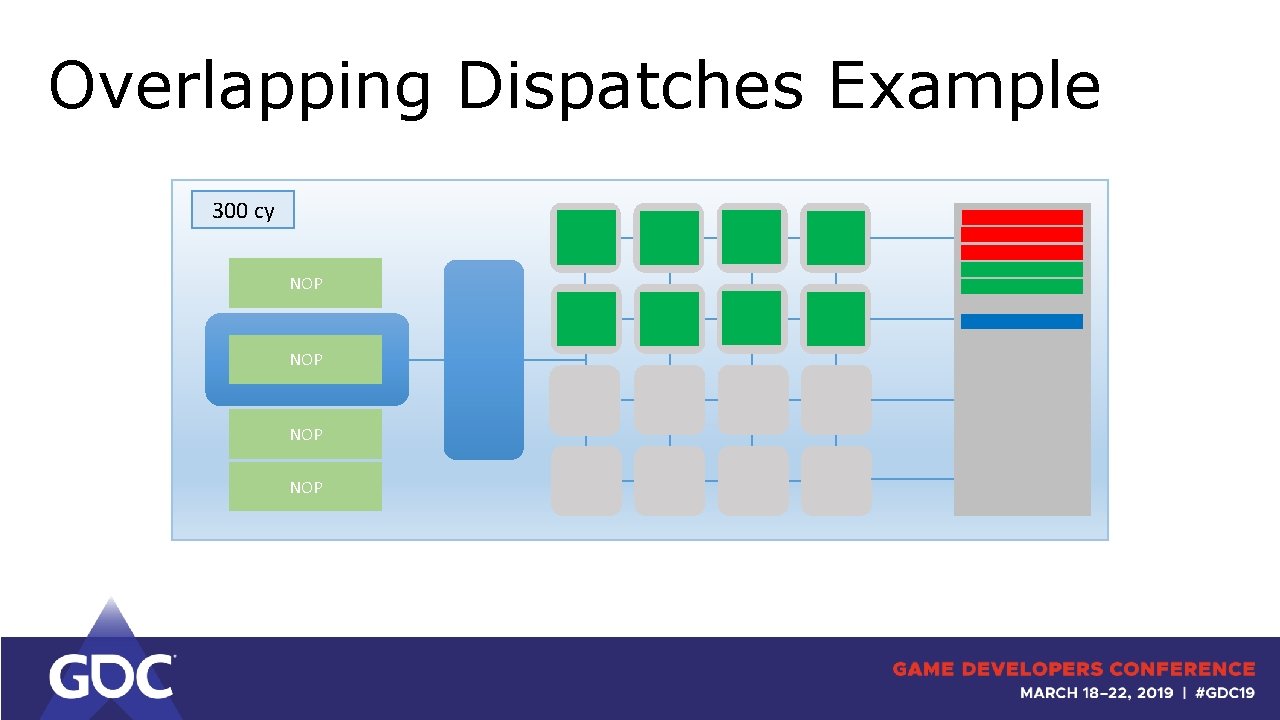
Overlapping Dispatches Example 300 cy NOP NOP
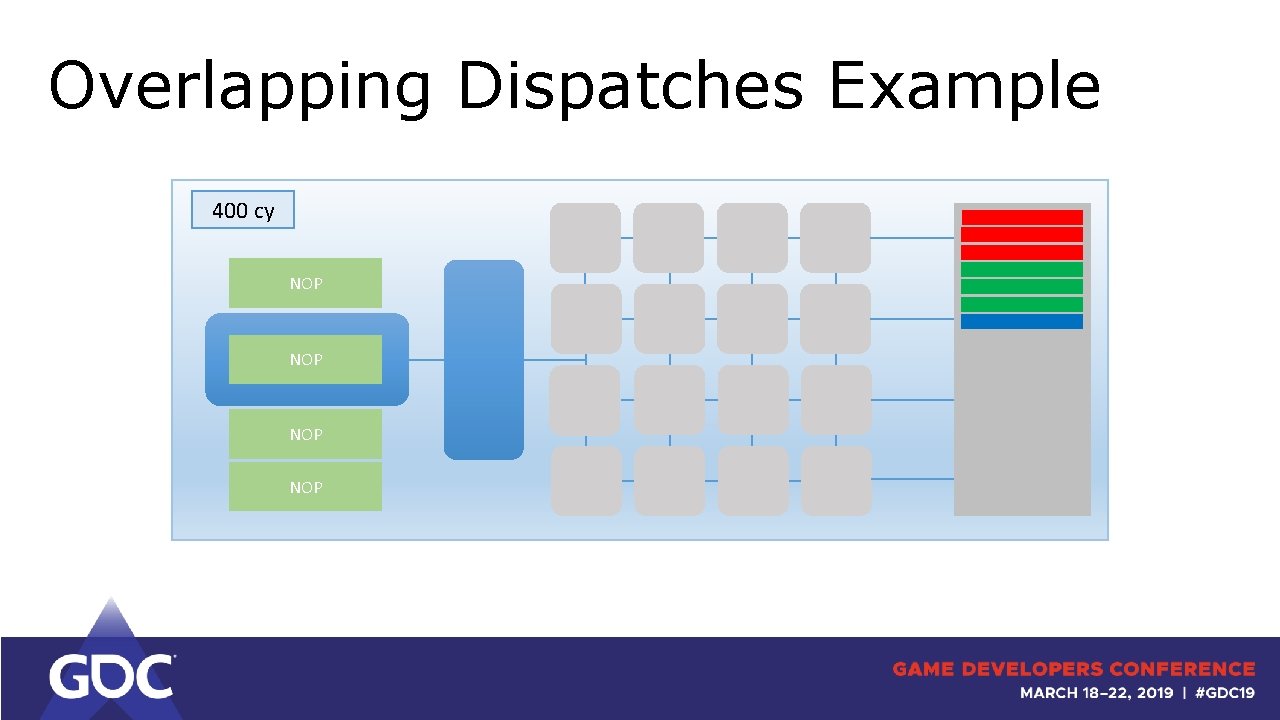
Overlapping Dispatches Example 400 cy NOP NOP
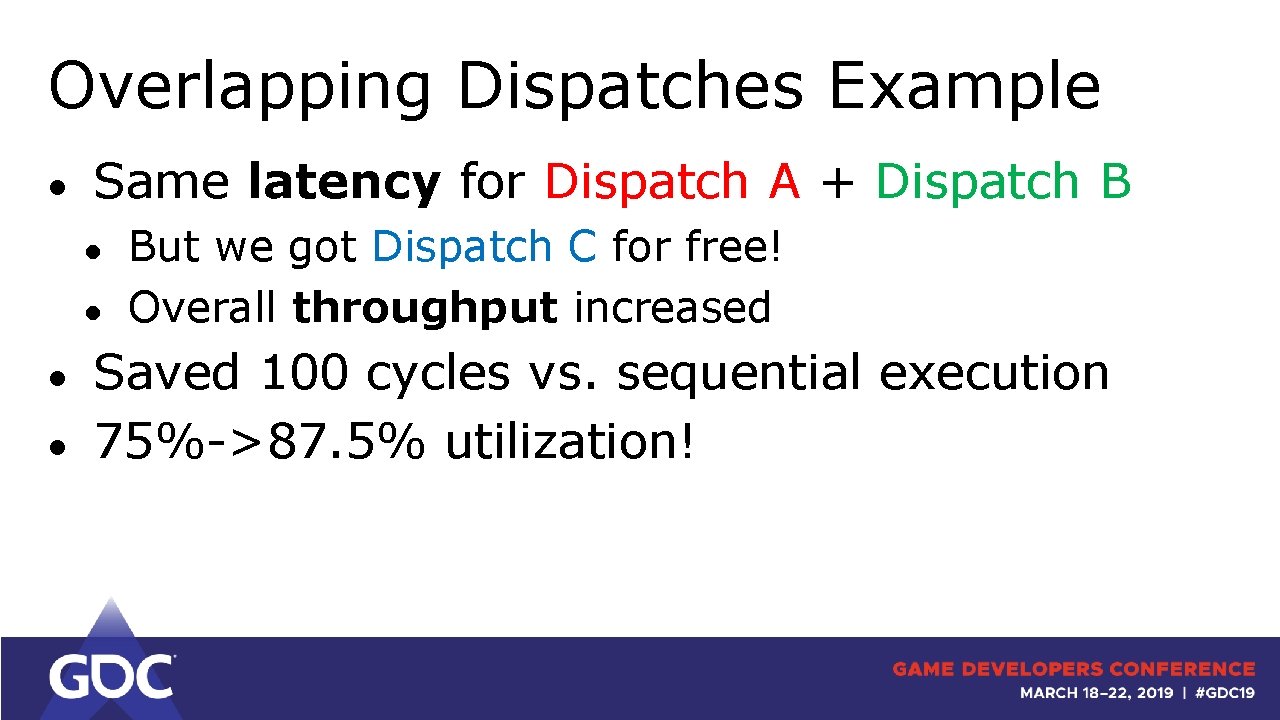
Overlapping Dispatches Example ● Same latency for Dispatch A + Dispatch B ● ● But we got Dispatch C for free! Overall throughput increased Saved 100 cycles vs. sequential execution 75%->87. 5% utilization!
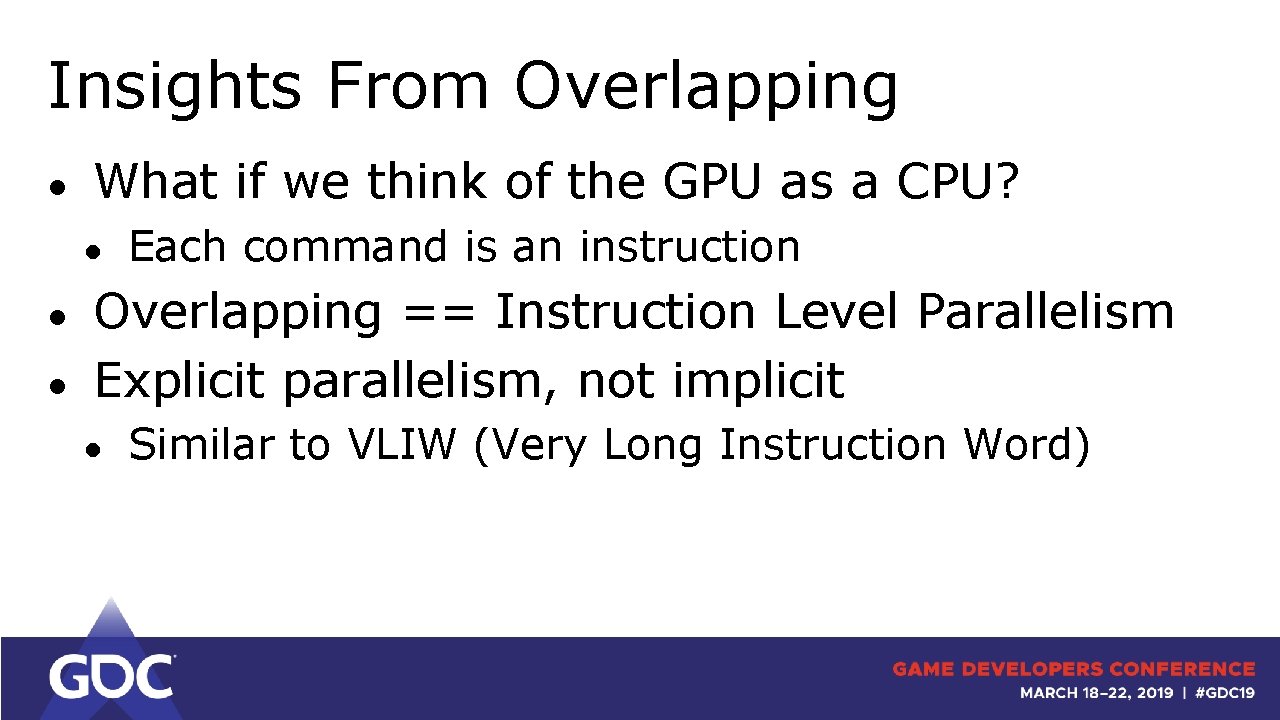
Insights From Overlapping ● What if we think of the GPU as a CPU? ● ● ● Each command is an instruction Overlapping == Instruction Level Parallelism Explicit parallelism, not implicit ● Similar to VLIW (Very Long Instruction Word)
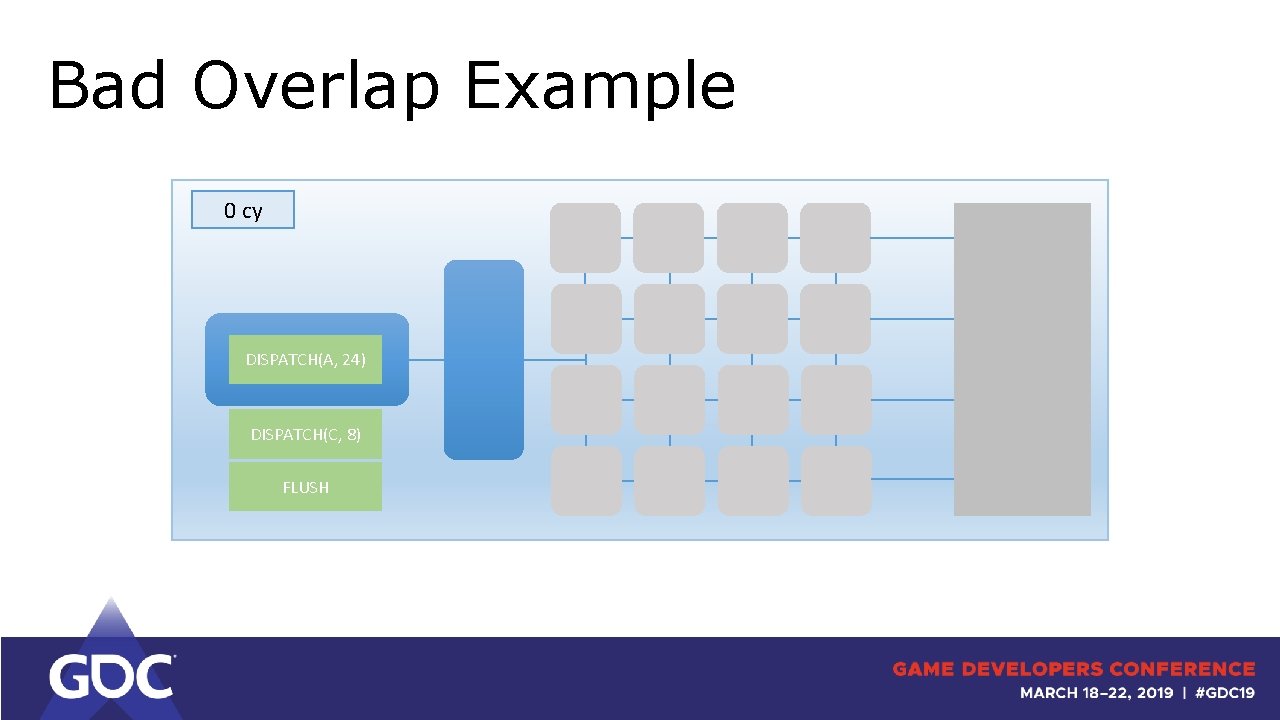
Bad Overlap Example 0 cy DISPATCH(A, 24) DISPATCH(C, 8) FLUSH
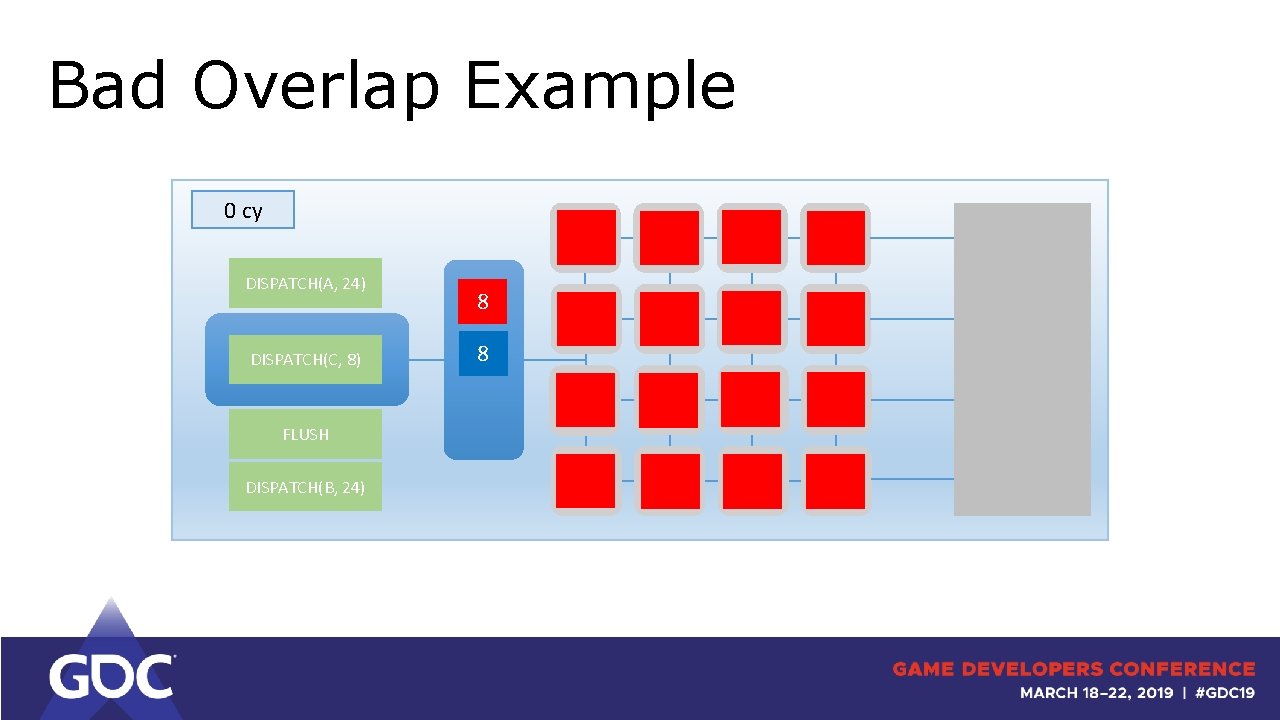
Bad Overlap Example 0 cy DISPATCH(A, 24) DISPATCH(C, 8) FLUSH DISPATCH(B, 24) 8 8
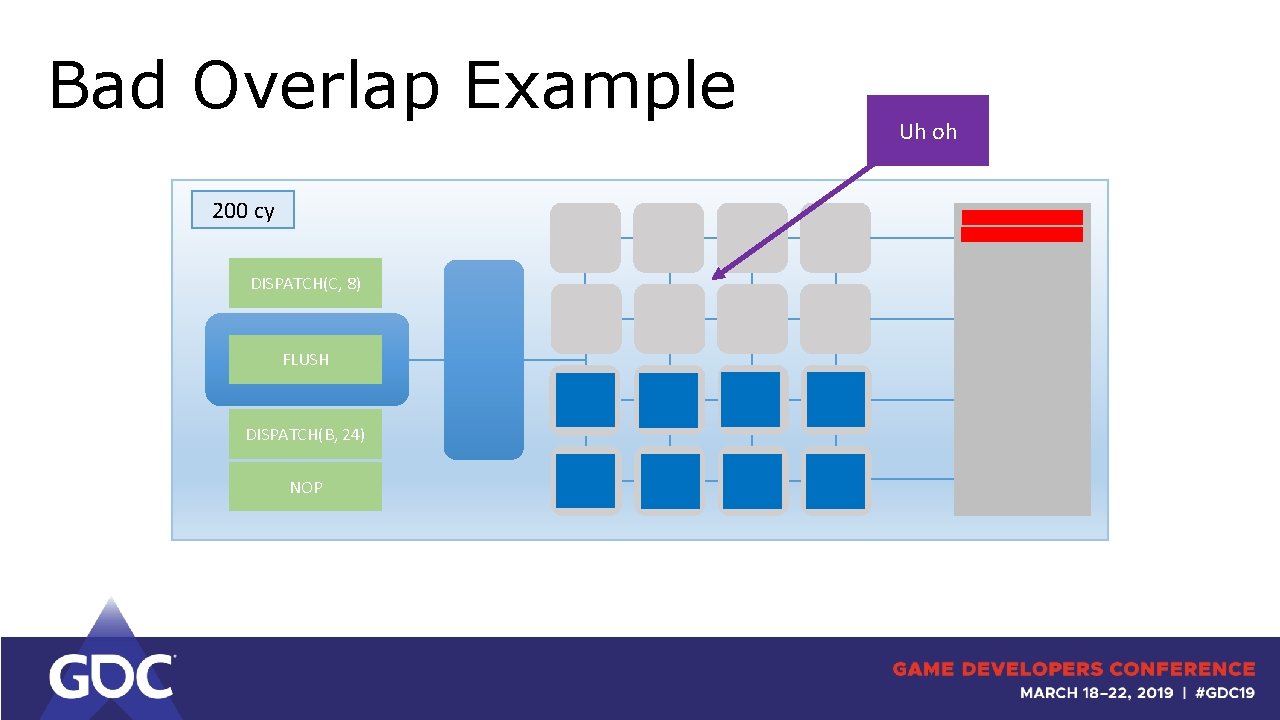
Bad Overlap Example 200 cy DISPATCH(C, 8) FLUSH DISPATCH(B, 24) NOP Uh oh
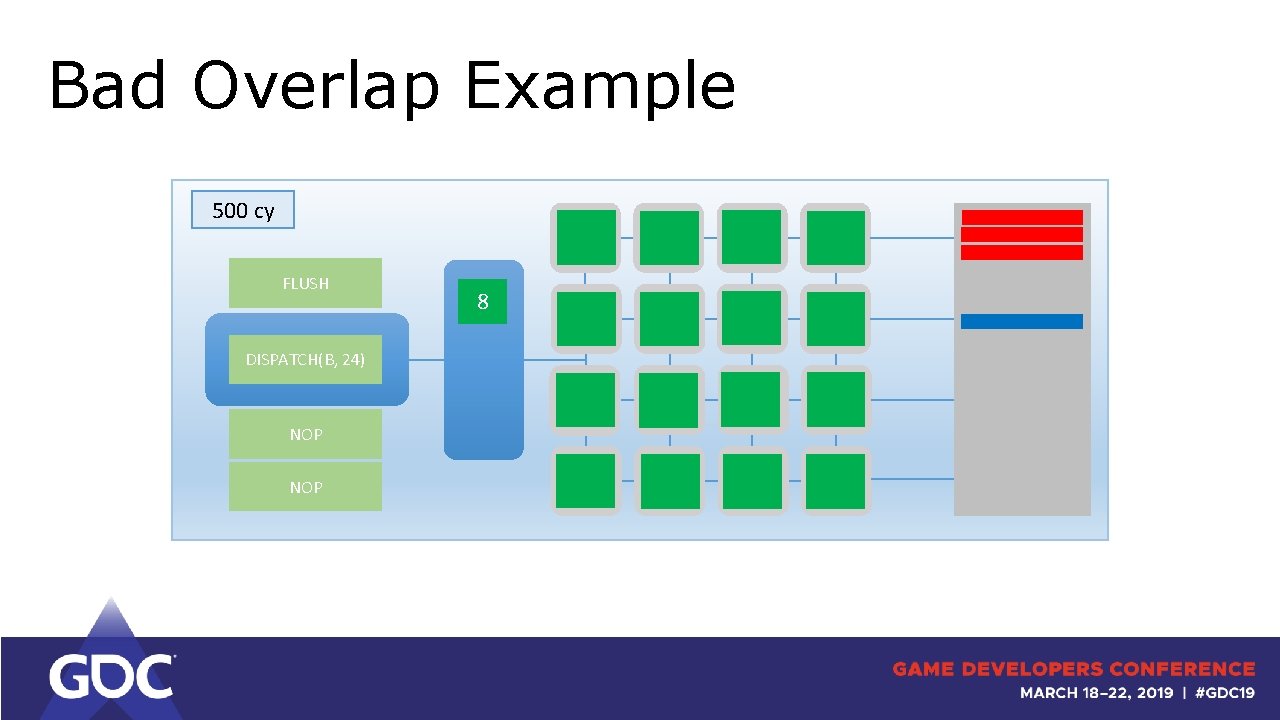
Bad Overlap Example 500 cy FLUSH DISPATCH(B, 24) NOP 8
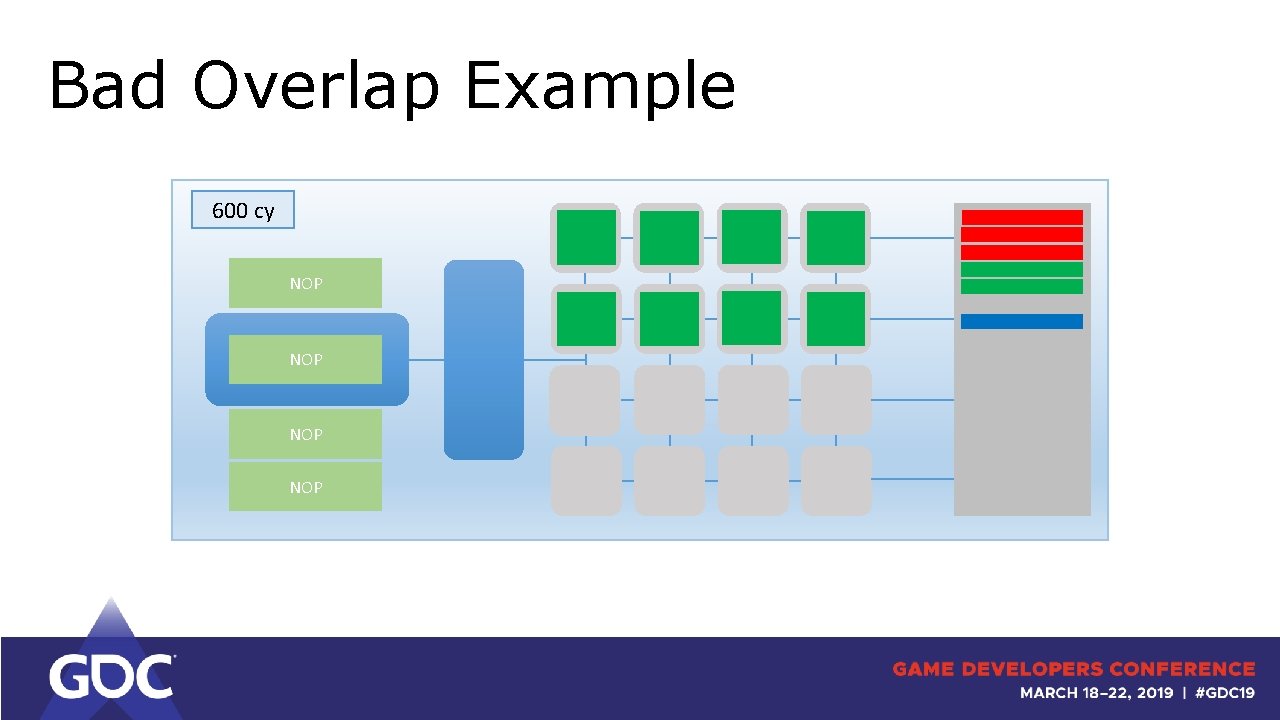
Bad Overlap Example 600 cy NOP NOP
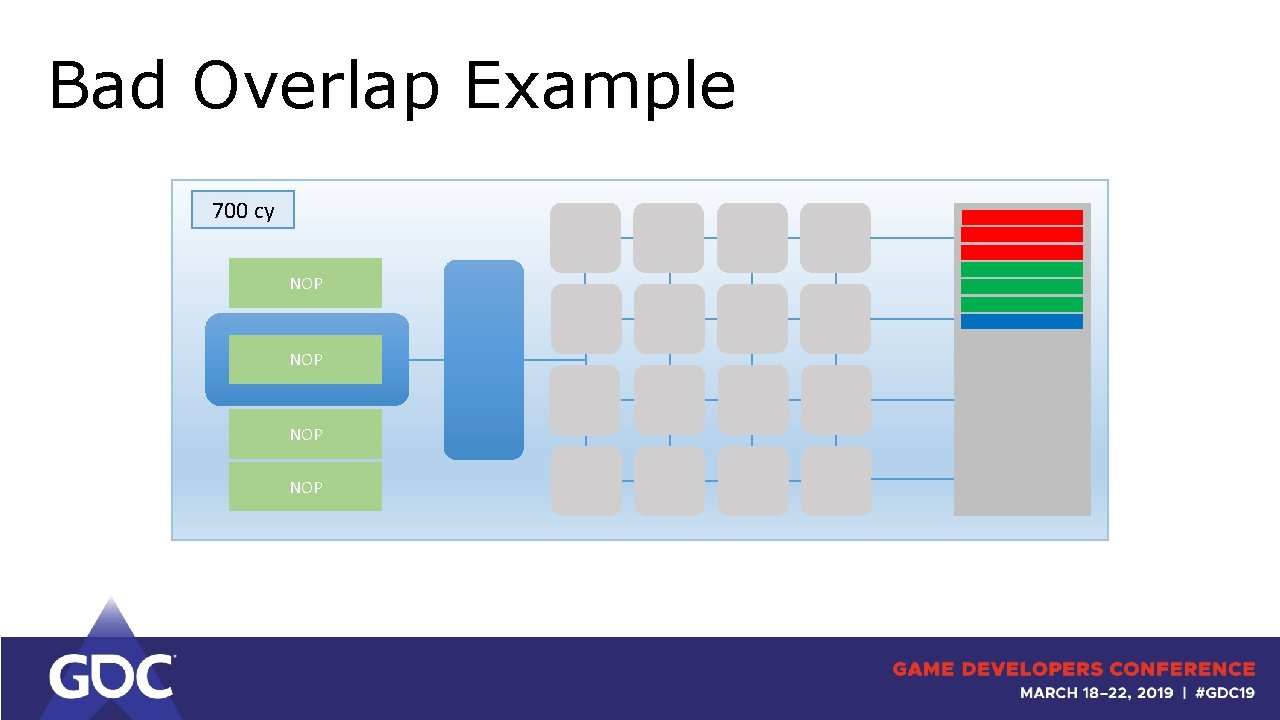
Bad Overlap Example 700 cy NOP NOP
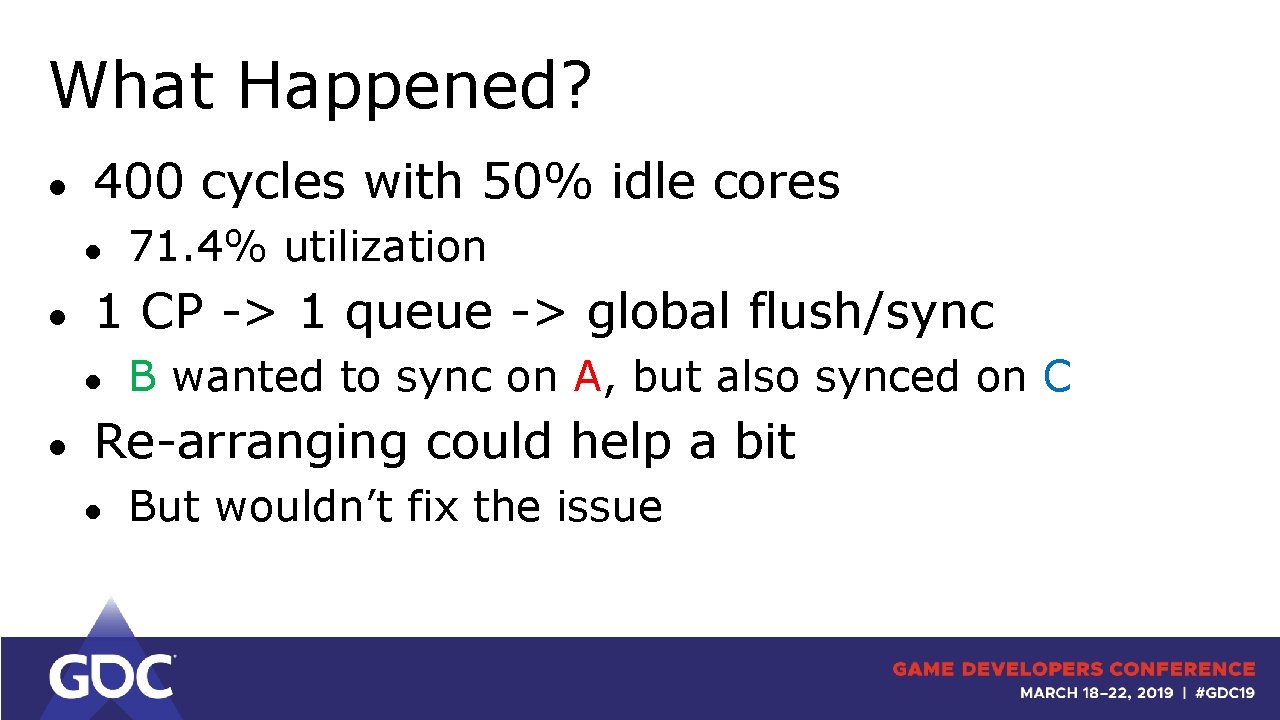
What Happened? ● 400 cycles with 50% idle cores ● ● 1 CP -> 1 queue -> global flush/sync ● ● 71. 4% utilization B wanted to sync on A, but also synced on C Re-arranging could help a bit ● But wouldn’t fix the issue

Why Not Two Command Processors?
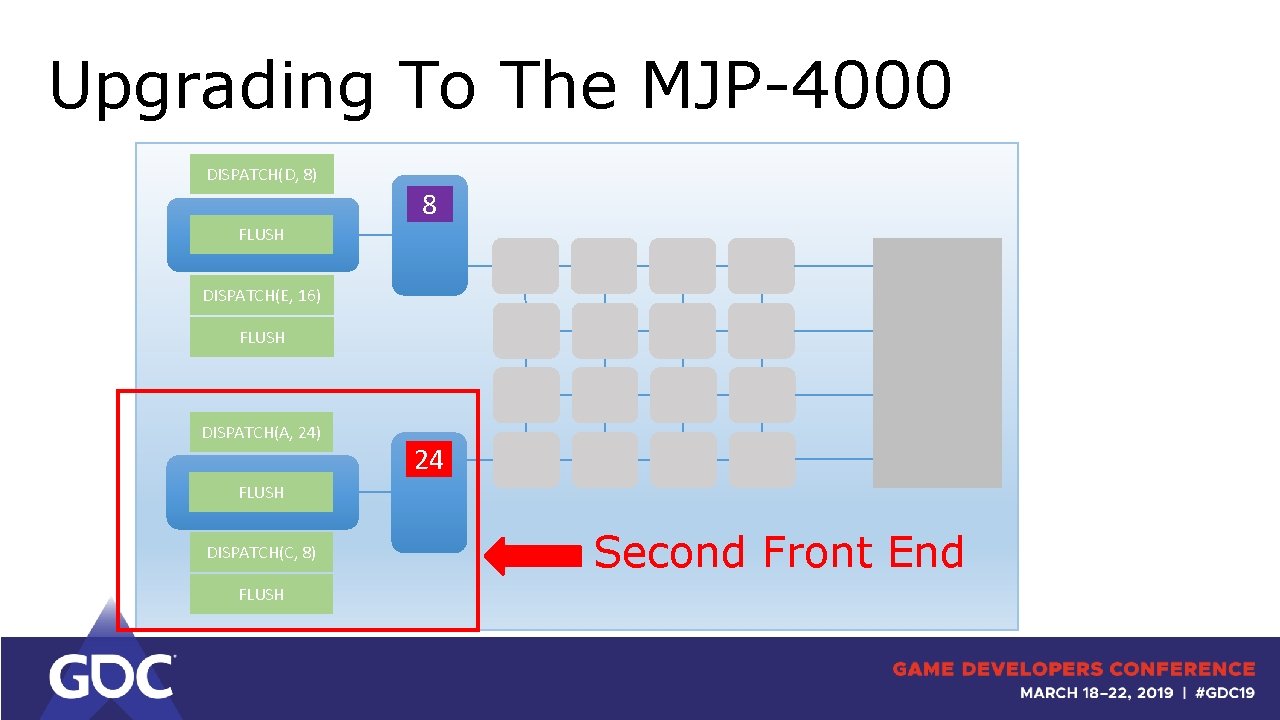
Upgrading To The MJP-4000 DISPATCH(D, 8) 24 8 FLUSH DISPATCH(E, 16) FLUSH DISPATCH(A, 24) 24 FLUSH DISPATCH(C, 8) FLUSH Second Front End
Introducing The MJP-4000 ● Two front-ends ● ● Two command processors for syncing Two thread queues Two independent command streams Still 16 shader cores ● ● Max throughput same as MJP-3000 First-come first-serve for thread queues
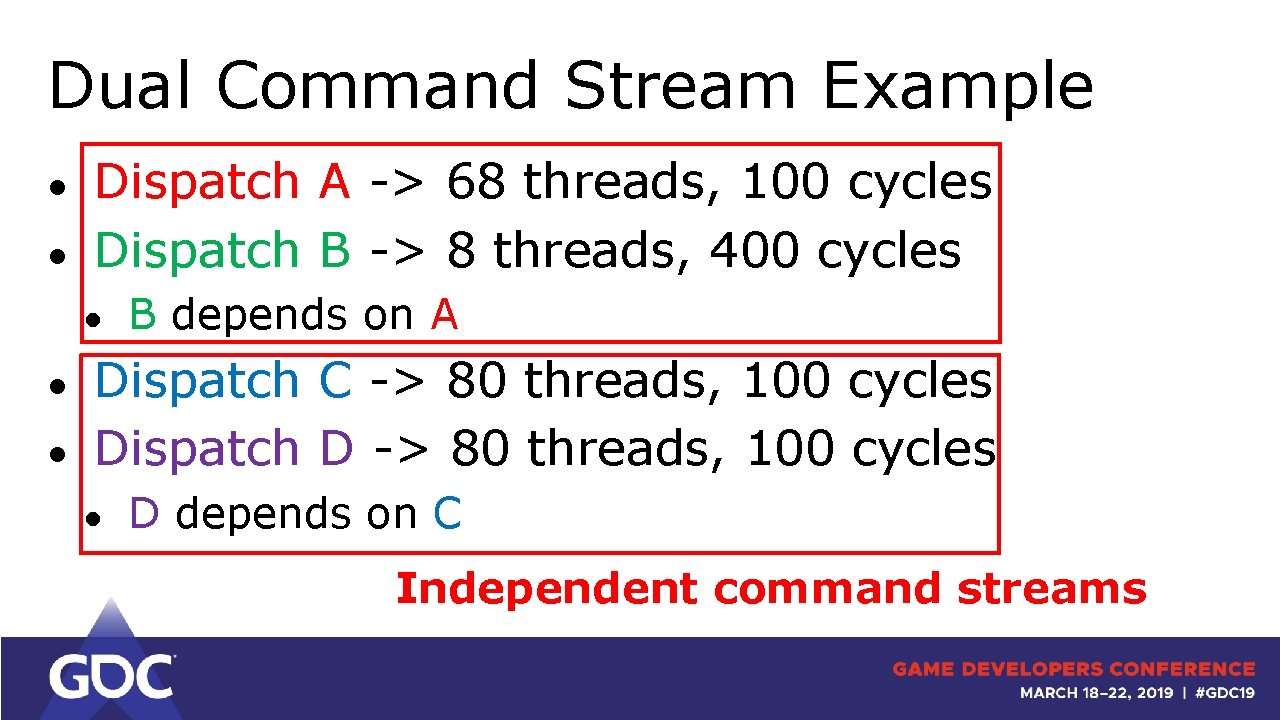
Dual Command Stream Example ● ● Dispatch A -> 68 threads, 100 cycles Dispatch B -> 8 threads, 400 cycles ● ● ● B depends on A Dispatch C -> 80 threads, 100 cycles Dispatch D -> 80 threads, 100 cycles ● D depends on C Independent command streams
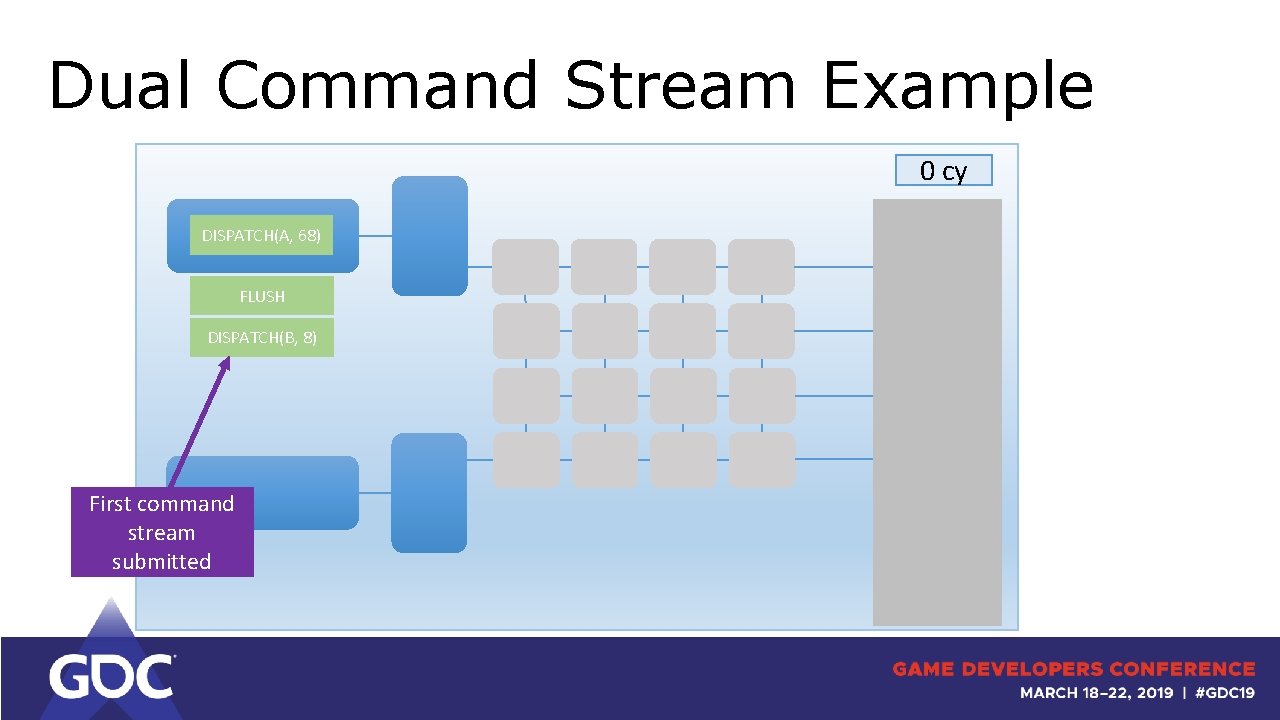
Dual Command Stream Example 24 DISPATCH(A, 68) FLUSH DISPATCH(B, 8) First command stream submitted 0 cy
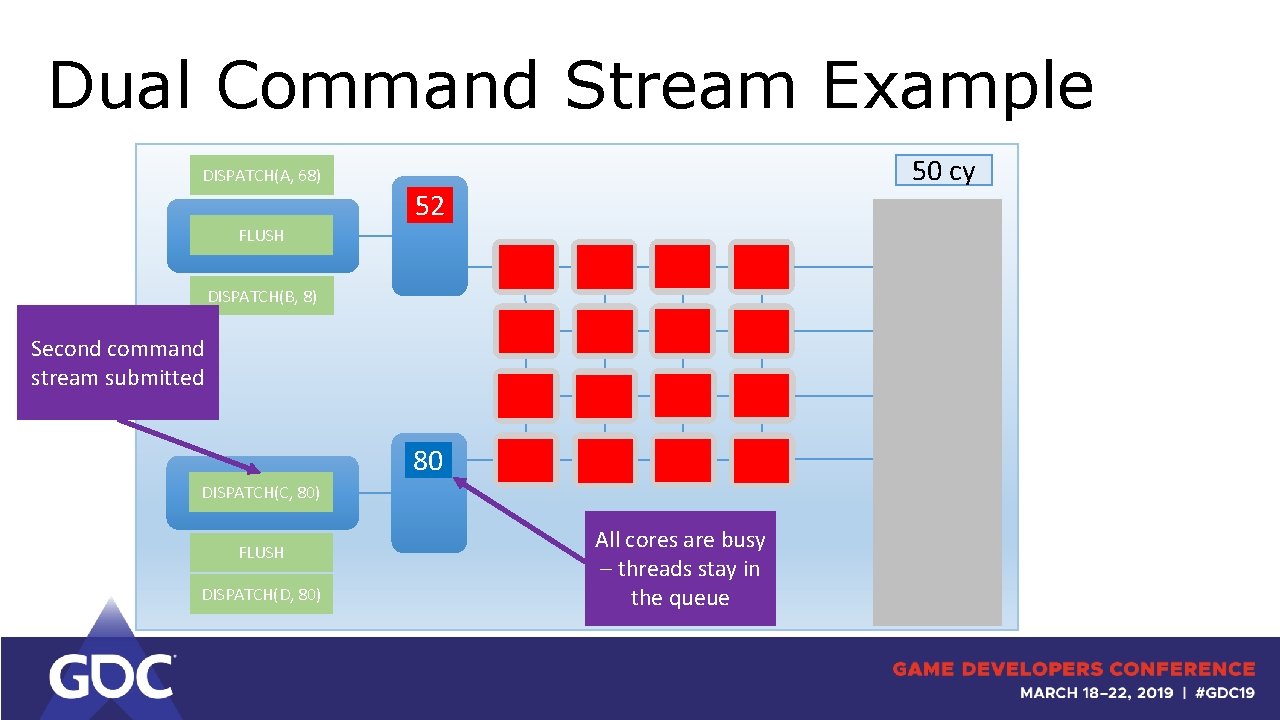
Dual Command Stream Example DISPATCH(A, 68) 50 cy 24 52 FLUSH DISPATCH(B, 8) Second command stream submitted 80 DISPATCH(C, 80) FLUSH DISPATCH(D, 80) All cores are busy – threads stay in the queue
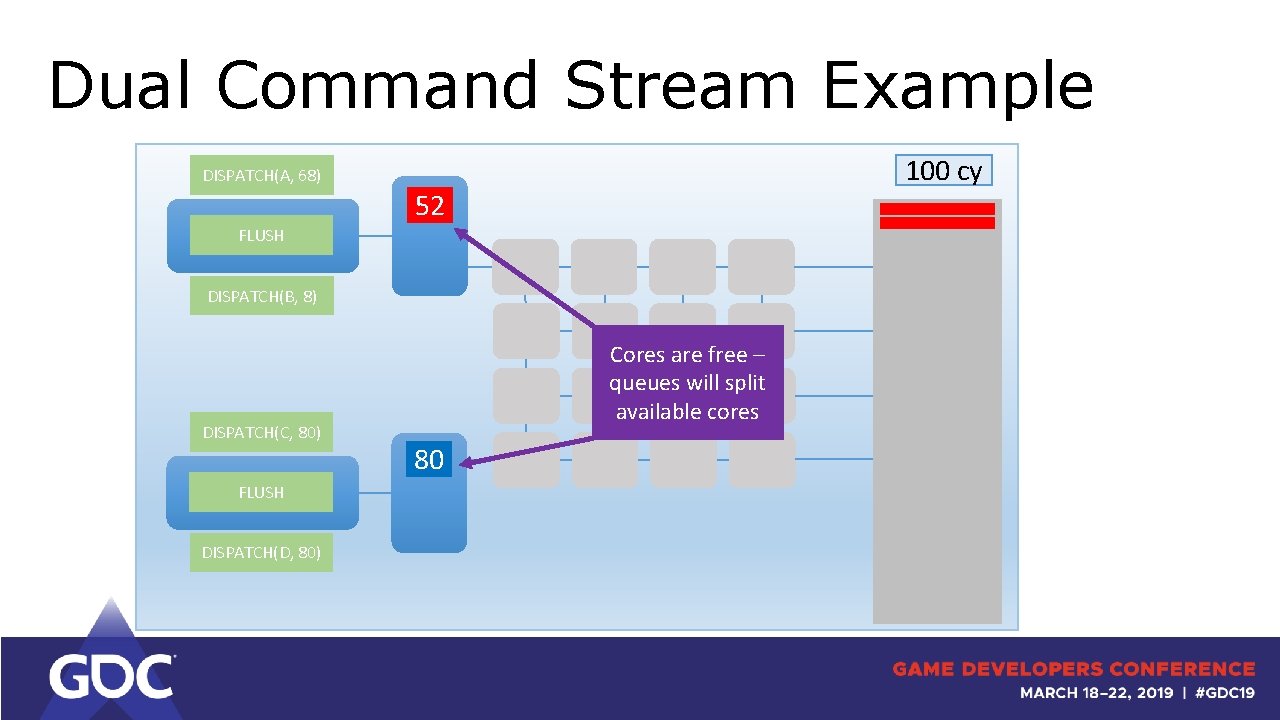
Dual Command Stream Example DISPATCH(A, 68) 100 cy 24 52 FLUSH DISPATCH(B, 8) DISPATCH(C, 80) FLUSH DISPATCH(D, 80) Cores are free – queues will split available cores 80
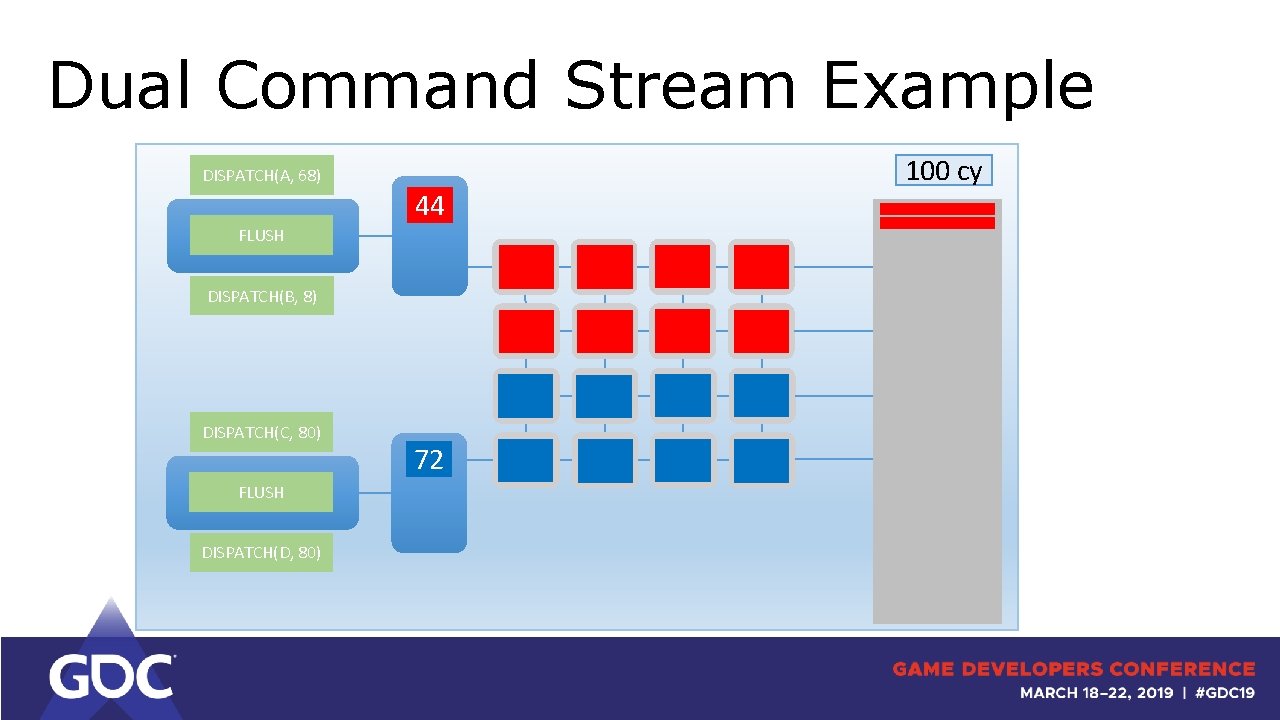
Dual Command Stream Example DISPATCH(A, 68) 24 44 FLUSH DISPATCH(B, 8) DISPATCH(C, 80) FLUSH DISPATCH(D, 80) 72 100 cy
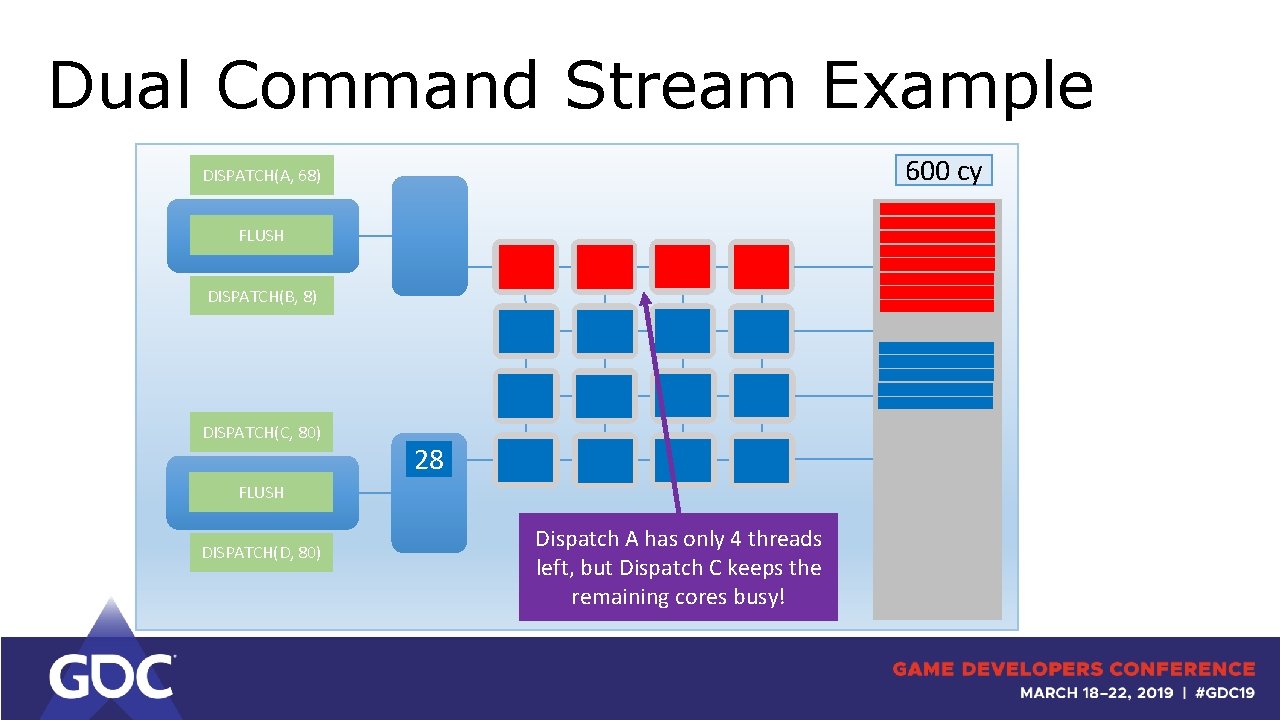
Dual Command Stream Example DISPATCH(A, 68) 600 cy 24 FLUSH DISPATCH(B, 8) DISPATCH(C, 80) 28 FLUSH DISPATCH(D, 80) Dispatch A has only 4 threads left, but Dispatch C keeps the remaining cores busy!
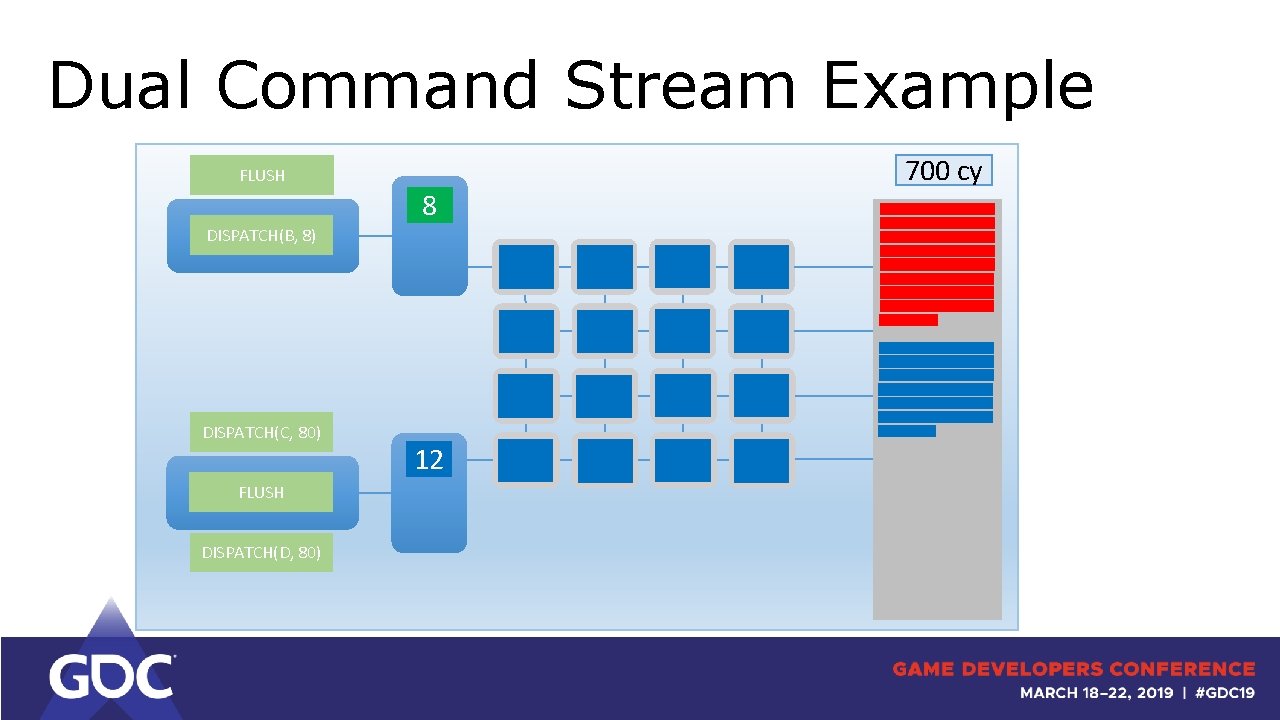
Dual Command Stream Example FLUSH 24 8 DISPATCH(B, 8) DISPATCH(C, 80) FLUSH DISPATCH(D, 80) 12 700 cy
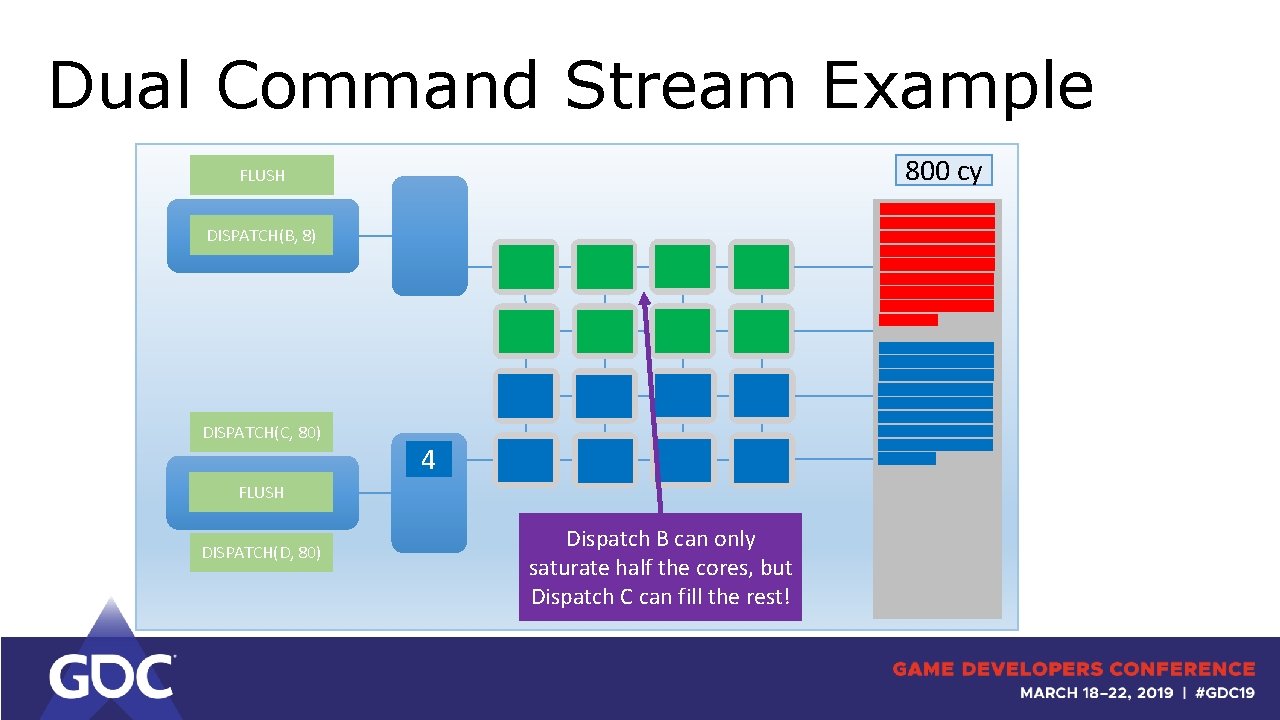
Dual Command Stream Example FLUSH 800 cy 24 DISPATCH(B, 8) DISPATCH(C, 80) 4 FLUSH DISPATCH(D, 80) Dispatch B can only saturate half the cores, but Dispatch C can fill the rest!
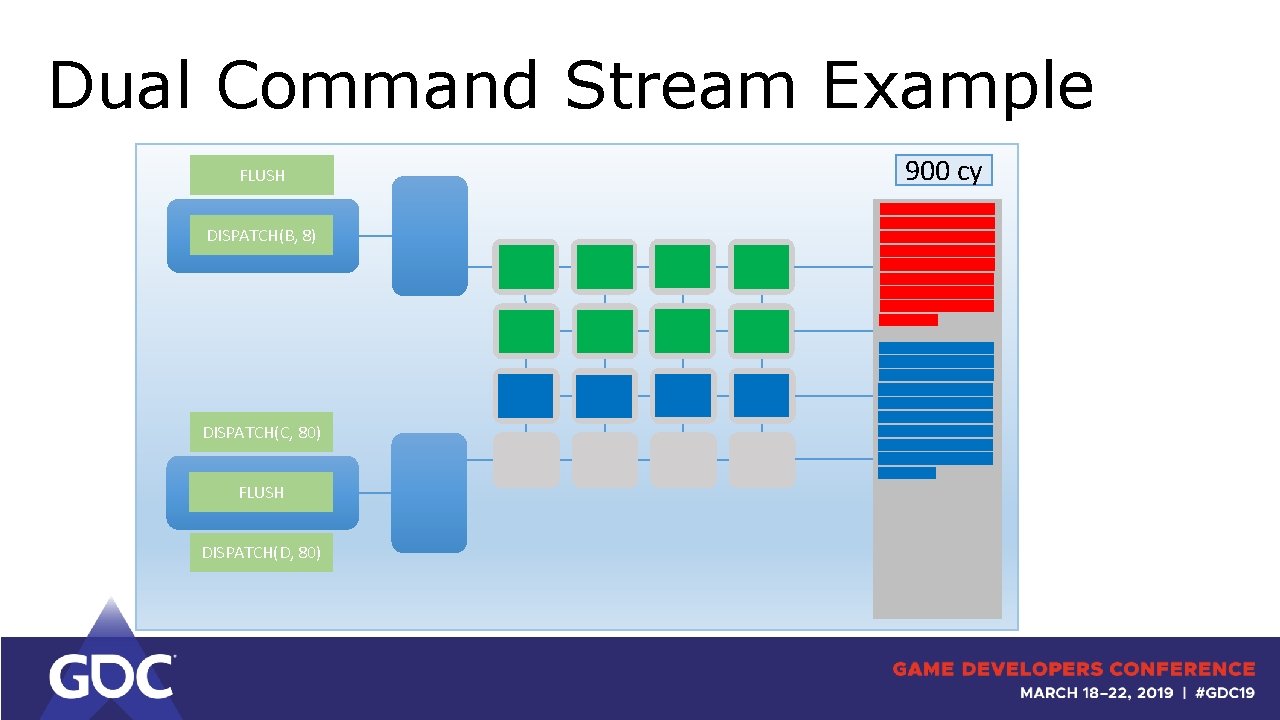
Dual Command Stream Example FLUSH DISPATCH(B, 8) DISPATCH(C, 80) FLUSH DISPATCH(D, 80) 24 900 cy
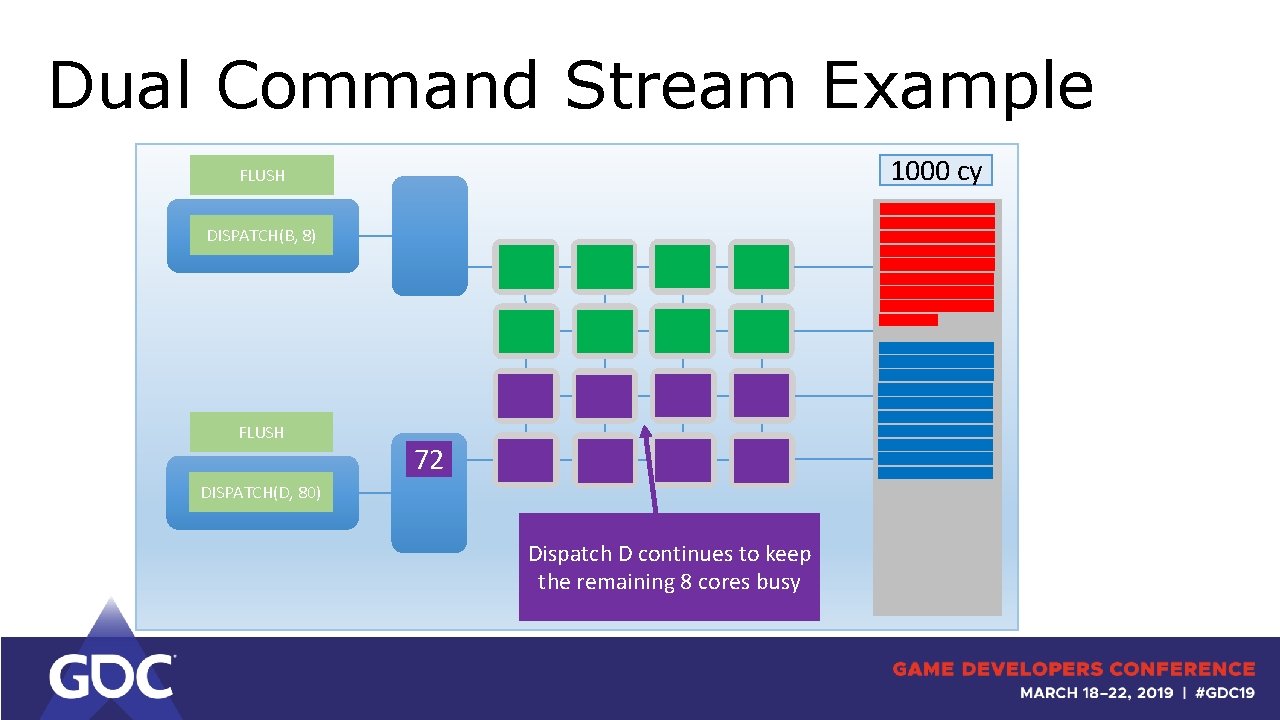
Dual Command Stream Example FLUSH 1000 cy 24 DISPATCH(B, 8) FLUSH 72 DISPATCH(D, 80) Dispatch D continues to keep the remaining 8 cores busy
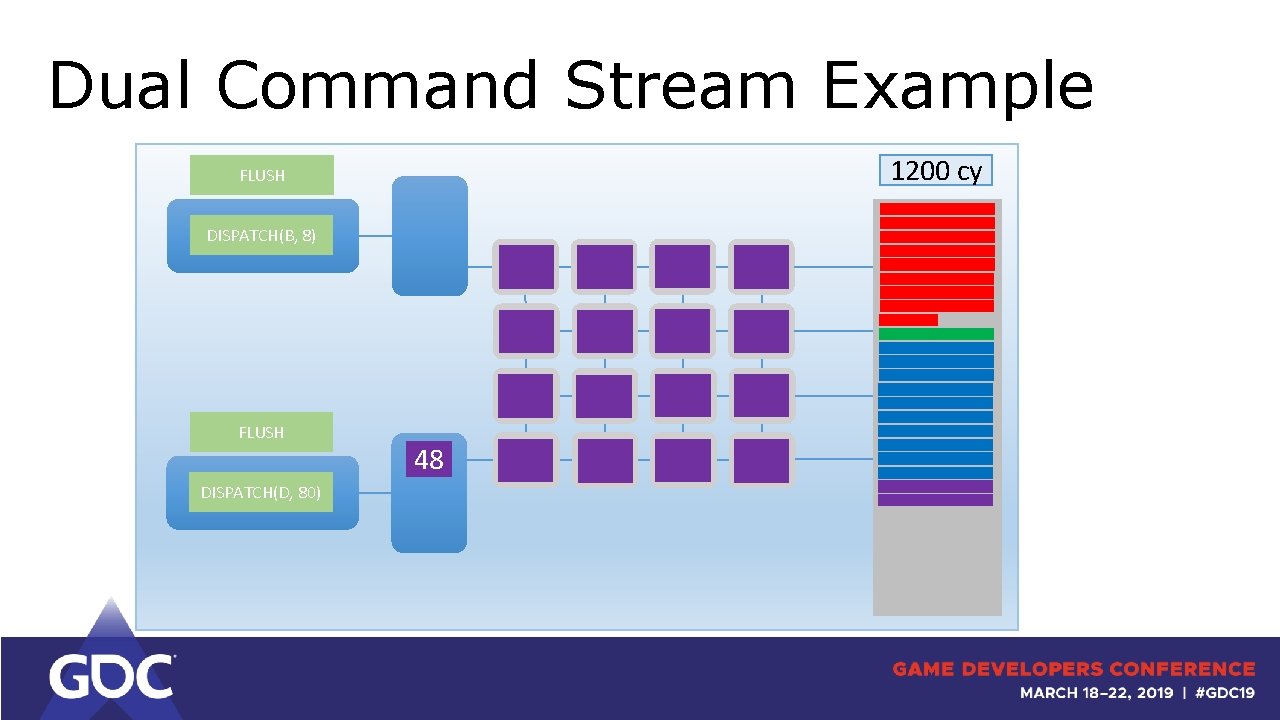
Dual Command Stream Example FLUSH 24 DISPATCH(B, 8) FLUSH DISPATCH(D, 80) 48 1200 cy
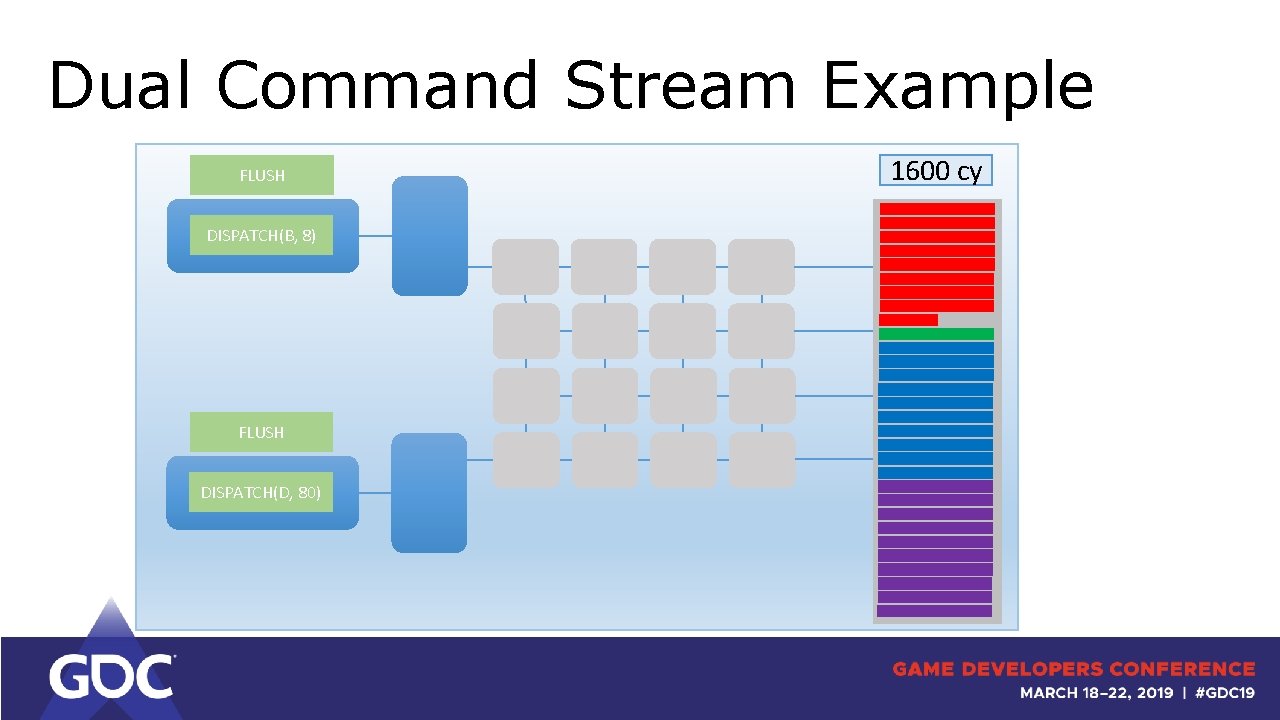
Dual Command Stream Example FLUSH DISPATCH(B, 8) FLUSH DISPATCH(D, 80) 24 1600 cy
Did Two Front-Ends Help? ● It sure did! ● ● ~98% utilization! No additional cores Lower total execution time for A+B+C+D Higher latency for A+B or C+D submitted individually
Even Better For Real GPUs! ● Threads stalled on memory access ● ● ● Real GPU’s will cycle threads on cores Idle time from cache flushes Tasks with limited shader core usage ● ● ● Depth-only rasterization On-Chip Tessellation/GS DMA
Thinking in CPU Terms ● Multiple front-ends ≈ SMT ● ● ● Simultaneous Multithreading (Hyperthreading) Interleave two instruction streams that share execution resources Similar goal: reduce idle time from stalls
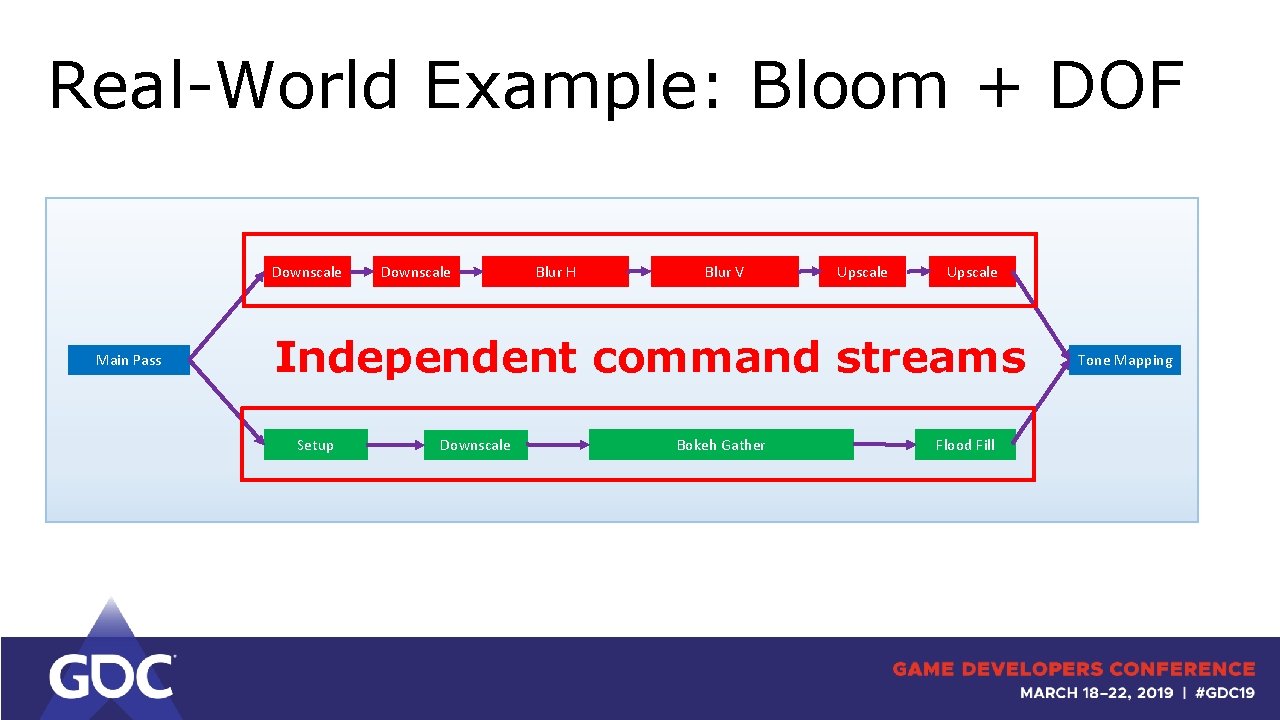
Real-World Example: Bloom + DOF Downscale Main Pass Downscale Blur H Blur V Upscale Independent command streams Setup Downscale Bokeh Gather Flood Fill Tone Mapping
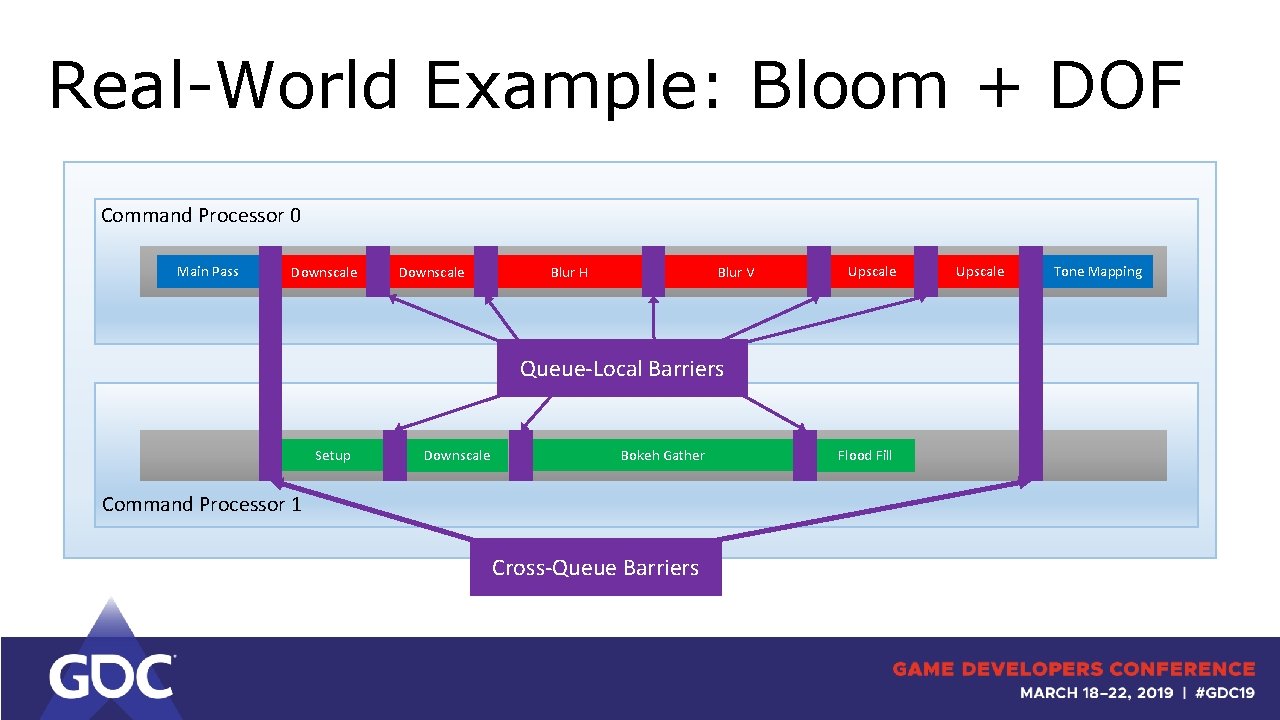
Real-World Example: Bloom + DOF Command Processor 0 Main Pass Downscale Blur H Blur V Upscale Queue-Local Barriers Setup Downscale Bokeh Gather Command Processor 1 Cross-Queue Barriers Flood Fill Upscale Tone Mapping
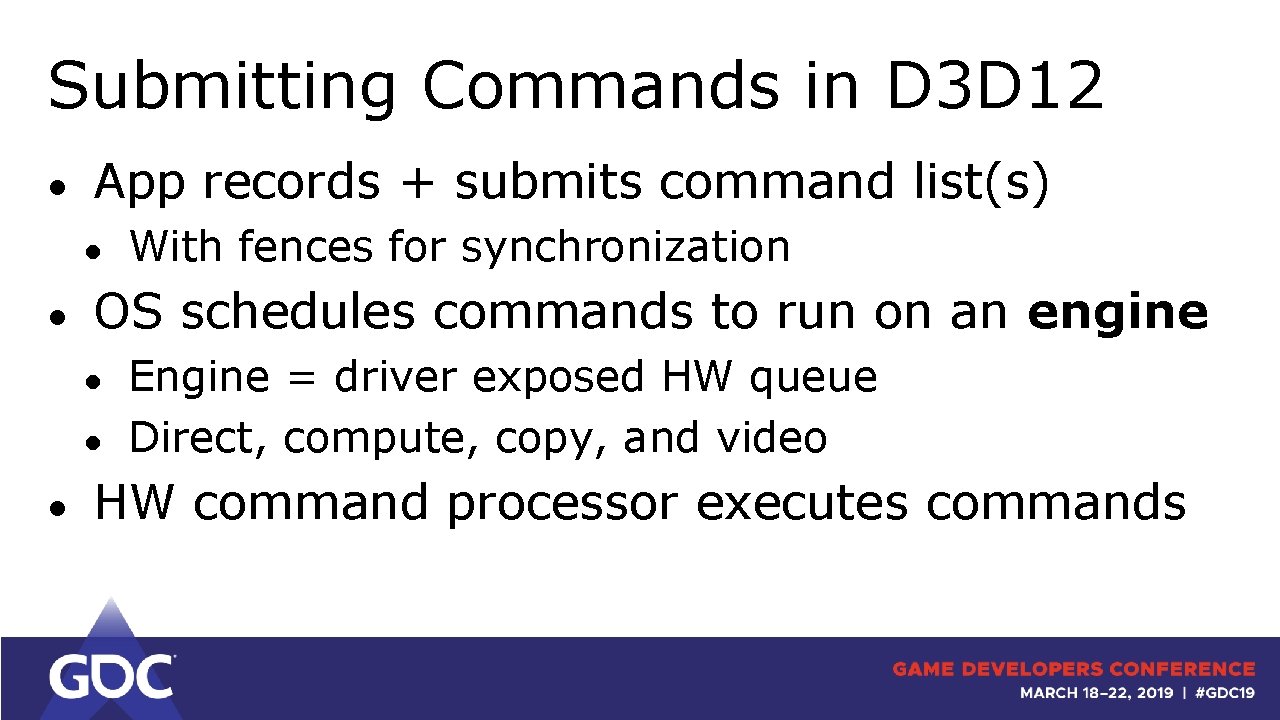
Submitting Commands in D 3 D 12 ● App records + submits command list(s) ● ● OS schedules commands to run on an engine ● ● ● With fences for synchronization Engine = driver exposed HW queue Direct, compute, copy, and video HW command processor executes commands
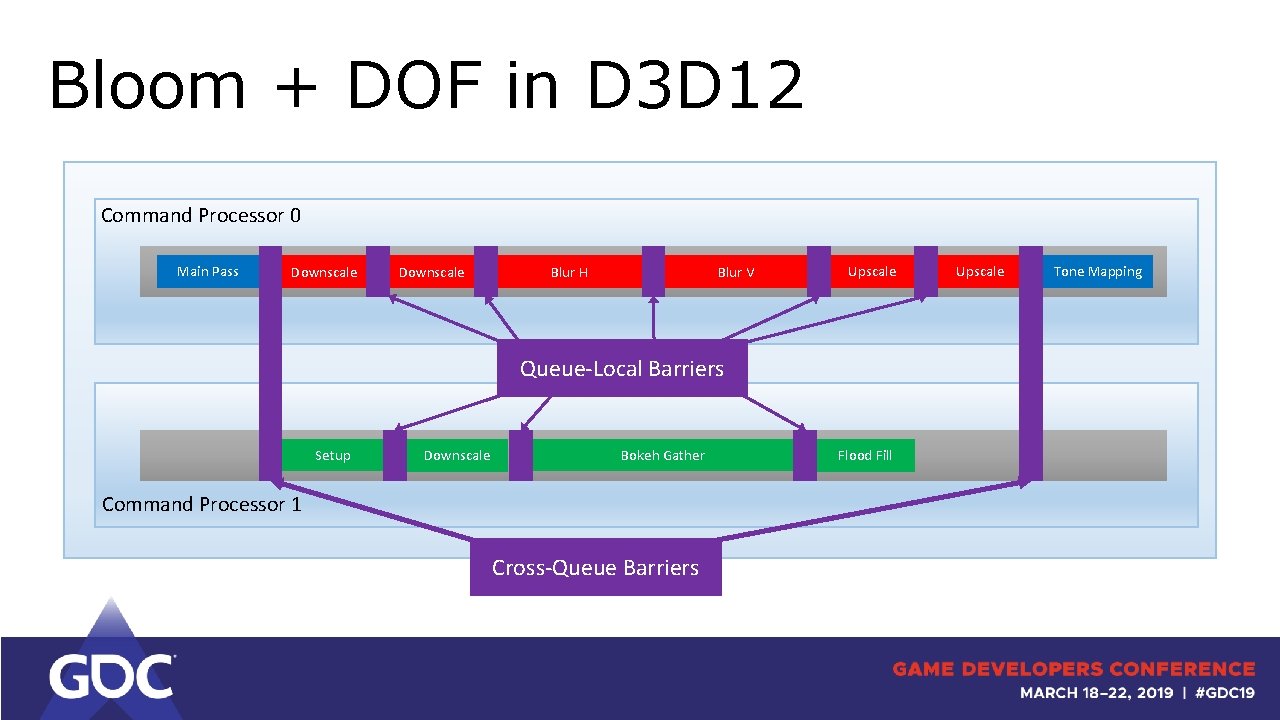
Bloom + DOF in D 3 D 12 Command Processor 0 Main Pass Downscale Blur H Blur V Upscale Queue-Local Barriers Setup Downscale Bokeh Gather Command Processor 1 Cross-Queue Barriers Flood Fill Upscale Tone Mapping
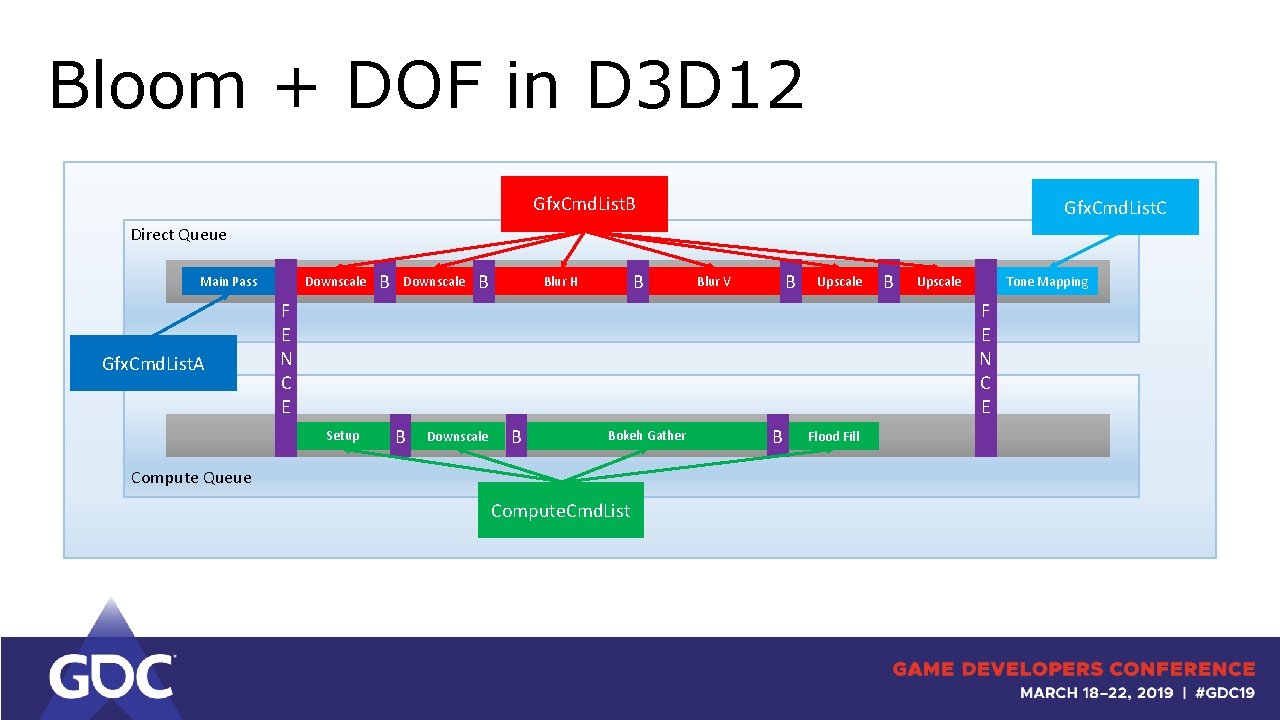
Bloom + DOF in D 3 D 12 Gfx. Cmd. List. B Gfx. Cmd. List. C Direct Queue Main Pass Gfx. Cmd. List. A Downscale B B Blur H B Blur V Upscale F E N C E B Upscale Tone Mapping F E N C E Setup B Downscale B Bokeh Gather Compute Queue Compute. Cmd. List B Flood Fill
D 3 D 12 Multi-Queue Submission ● Submissions to multiple command queues will possibly execute concurrently ● ● ● Depends on the OS scheduler Depends on the GPU Depends on the driver Depends on the queue/command list type Similar to threads on a CPU
D 3 D 12 Virtualizes Queues ● ● ● D 3 D 12 command queues ≠ hardware queues Hardware may have many queues, or only 1! The OS/scheduler will figure it out for you ● ● ● Flattening of parallel submissions Dependencies visible to scheduler via fences Check GPUView/PIX/RGP/Nsight to see what’s going on!
Vulkan Queues Are Different! ● They’re not virtualized! ● ● Query at runtime for “queue families” ● ● …or at least not in the same way Vk queue family ≈ D 3 D 12 engine Explicit bind to exposed queue ● Still not guaranteed to be a HW queue
Using Async Compute ● Fills in idle shader cores ● ● Identify independent command streams ● ● Just like our MJP-4000 example! …and submit them on separate queues Works best when lots of cores are idle ● ● Depth-only rendering Lots of barriers

Recap
GPU Barriers Ensure Data Visibility ● ● ● Probably involves GPU thread sync Maybe involves cache flushes Maybe involves data transformation ● ● Decompression API barriers describe visibility + dependencies ● Think about your dependencies! (or visualize them!)
GPUs Aren’t That Different ● ● ● Command processor = task scheduler Shader cores = worker cores Multi-core CPU’s have similar problems! ● ● Parallel operations Coherency issues
Barriers = Idle Cores ● Keep the thread monster fed! ● ● Waits/stalls decrease utilization Careful barrier use => higher utilization Watch out for long-running threads! Batch your barriers! ● Flushing cache once >>> flushing multiple times
Using Multiple Queues ● Parallel submissions may increase utilization ● ● ● Not guaranteed! – check your tools! Won’t magically increase the core count Look for independent command streams ● Don’t go crazy with D 3 D 12 fences
That’s It! ● Thanks to… ● ● ● Ste Tovey Rys Sommefeldt Nick Thibieroz Andrei Tatarinov Everyone at Ready At Dawn

Contact Info ● ● ● matt@readyatdawn. com mpettineo@gmail. com @mynameismjp https: //mynameismjp. wordpress. com/ https: //github. com/The. Real. MJP/GDC 2019_Public ● Includes pptx and PDF with full speaker notes
- Slides: 94