
Breakfast Meeting 15 th Oct 2015 Agenda Fellows
Breakfast Meeting 15 th Oct 2015
Agenda Fellows testing and probation, • Benchmark jobs project update, • Recruitment policy (diplomas) • Career structure (remaining loose ends). •
Fellow applicant assessment (computing) & probation (all)
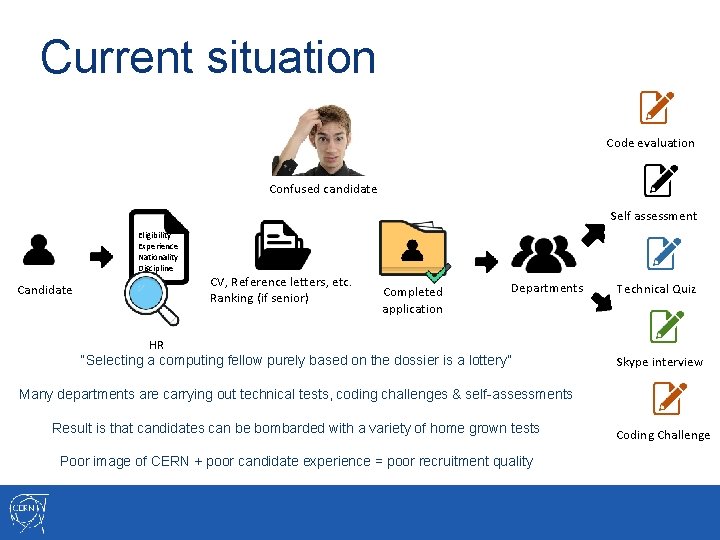
Current situation Code evaluation Confused candidate Self assessment Eligibility Experience Nationality Discipline Candidate CV, Reference letters, etc. Ranking (if senior) Completed application Departments HR “Selecting a computing fellow purely based on the dossier is a lottery” Technical Quiz Skype interview Many departments are carrying out technical tests, coding challenges & self-assessments Result is that candidates can be bombarded with a variety of home grown tests Poor image of CERN + poor candidate experience = poor recruitment quality Coding Challenge
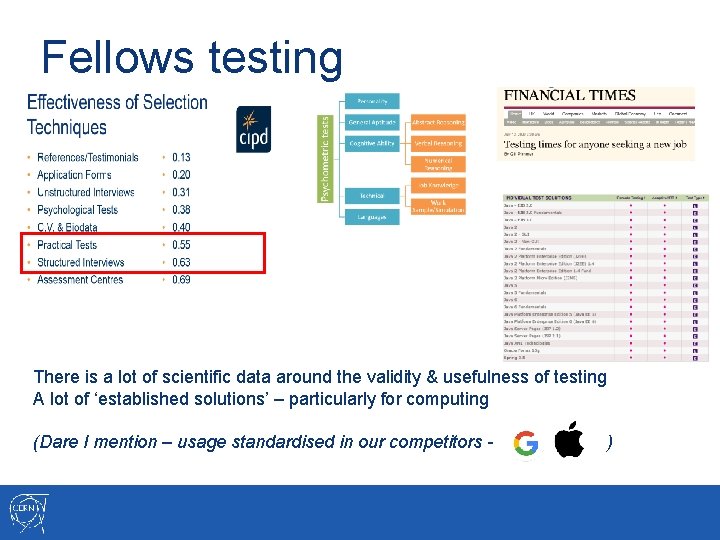
Fellows testing There is a lot of scientific data around the validity & usefulness of testing A lot of ‘established solutions’ – particularly for computing (Dare I mention – usage standardised in our competitors - )
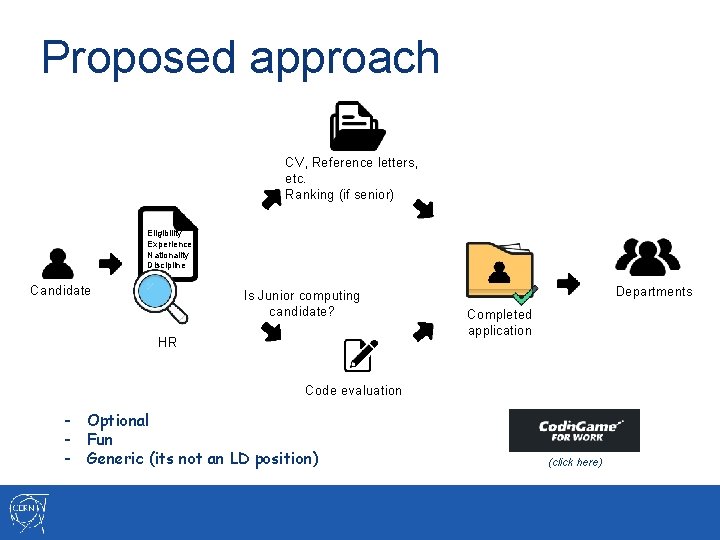
Proposed approach CV, Reference letters, etc. Ranking (if senior) Eligibility Experience Nationality Discipline Candidate Is Junior computing candidate? HR Departments Completed application Code evaluation - Optional - Fun - Generic (its not an LD position) (click here)
And if they cheat? Of course they do! …. statistically 10% Usual approach is “testing party” Some of the metrics can already raise suspicion (e. g. >90% in under 60%t) Plagiarism detection and copy/paste detection built-in to some platforms Validate with followup (skype, tel)
And if we don’t test? We risk sticking to ‘people we know’ (last two AFCs 78% of fellows selected had previous CERN status) • Risk of localised unofficial testing may continue • Risk of selecting candidate poor candidate which doesn’t match profile/project (example last week) •
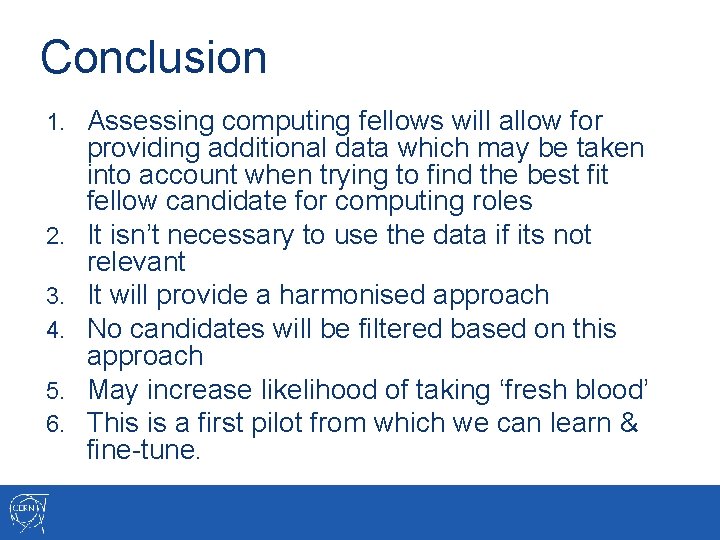
Conclusion 1. 2. 3. 4. 5. 6. Assessing computing fellows will allow for providing additional data which may be taken into account when trying to find the best fit fellow candidate for computing roles It isn’t necessary to use the data if its not relevant It will provide a harmonised approach No candidates will be filtered based on this approach May increase likelihood of taking ‘fresh blood’ This is a first pilot from which we can learn & fine-tune.
Fellows Probation period
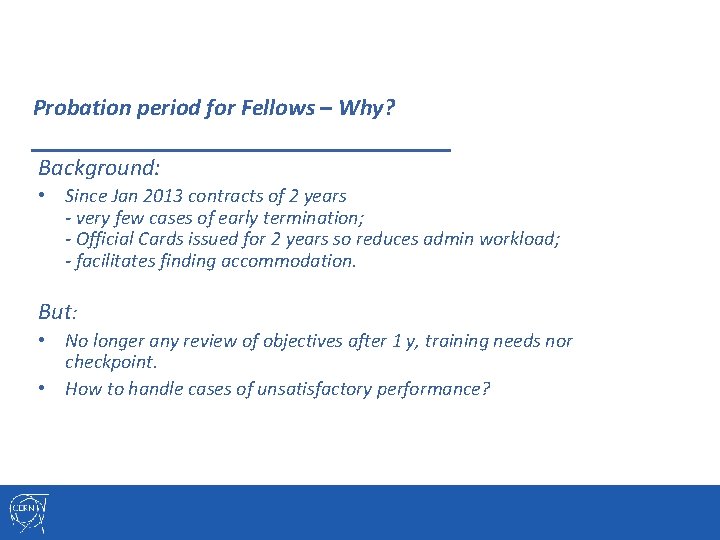
Probation period for Fellows – Why? Background: • Since Jan 2013 contracts of 2 years - very few cases of early termination; - Official Cards issued for 2 years so reduces admin workload; - facilitates finding accommodation. But: • No longer any review of objectives after 1 y, training needs nor checkpoint. • How to handle cases of unsatisfactory performance?
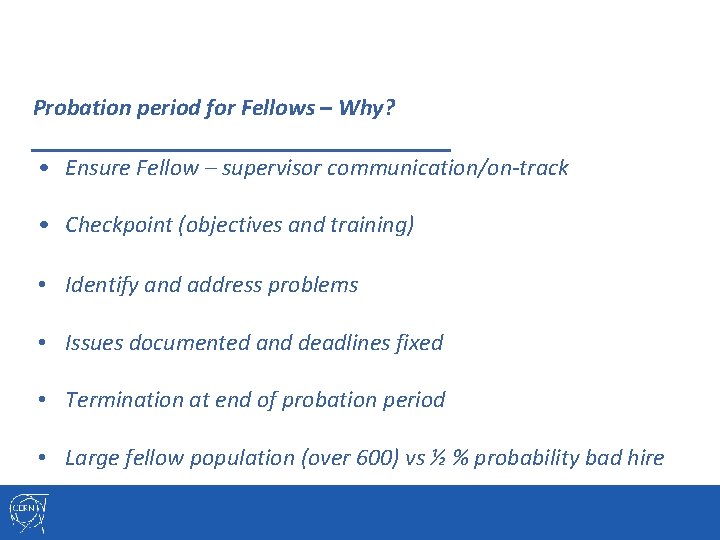
Probation period for Fellows – Why? • Ensure Fellow – supervisor communication/on-track • Checkpoint (objectives and training) • Identify and address problems • Issues documented and deadlines fixed • Termination at end of probation period • Large fellow population (over 600) vs ½ % probability bad hire
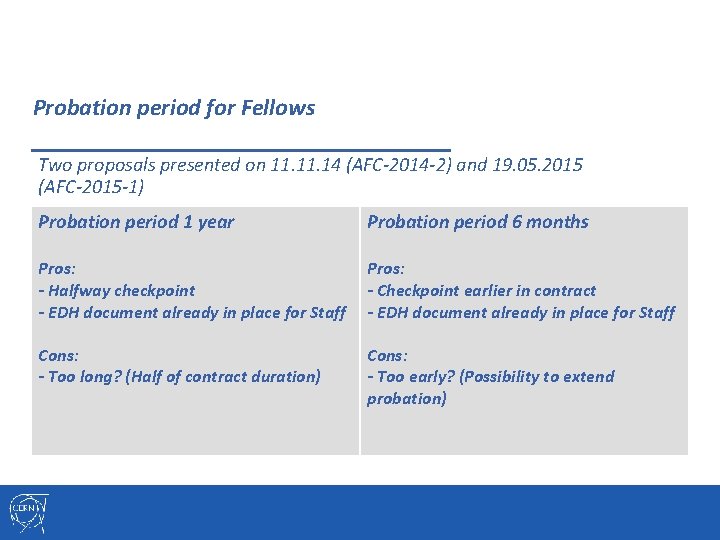
Probation period for Fellows Two proposals presented on 11. 14 (AFC-2014 -2) and 19. 05. 2015 (AFC-2015 -1) Probation period 1 year Probation period 6 months Pros: - Halfway checkpoint - EDH document already in place for Staff Pros: - Checkpoint earlier in contract - EDH document already in place for Staff Cons: - Too long? (Half of contract duration) Cons: - Too early? (Possibility to extend probation)
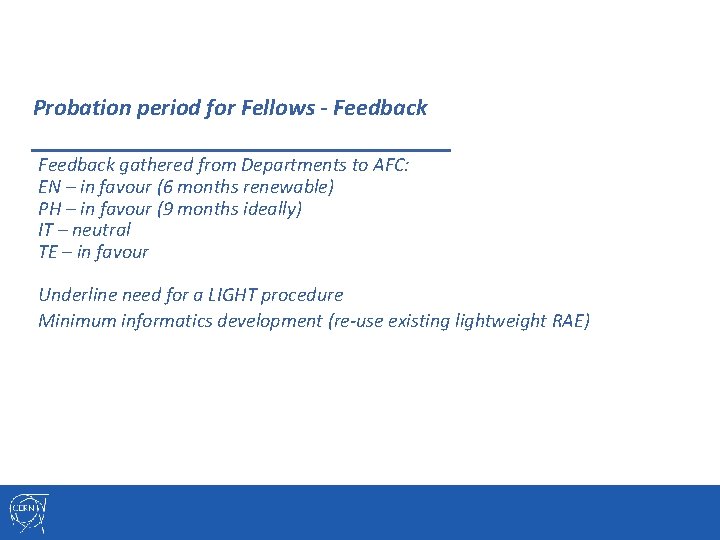
Probation period for Fellows - Feedback gathered from Departments to AFC: EN – in favour (6 months renewable) PH – in favour (9 months ideally) IT – neutral TE – in favour Underline need for a LIGHT procedure Minimum informatics development (re-use existing lightweight RAE)
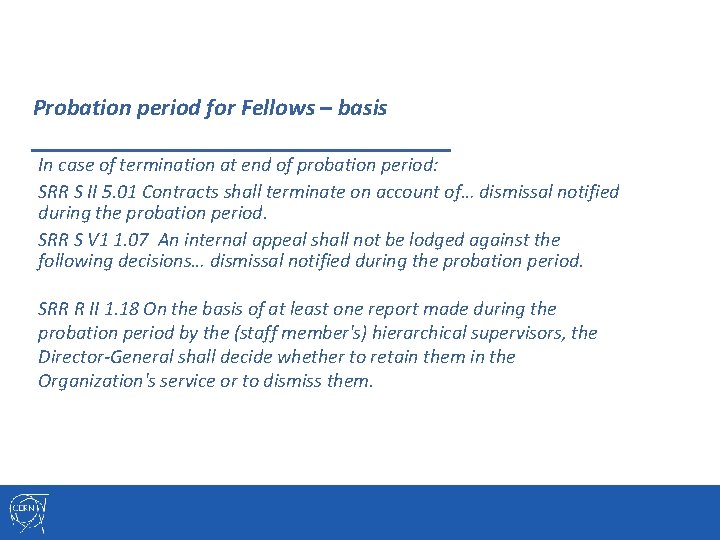
Probation period for Fellows – basis In case of termination at end of probation period: SRR S II 5. 01 Contracts shall terminate on account of… dismissal notified during the probation period. SRR S V 1 1. 07 An internal appeal shall not be lodged against the following decisions… dismissal notified during the probation period. SRR R II 1. 18 On the basis of at least one report made during the probation period by the (staff member's) hierarchical supervisors, the Director-General shall decide whether to retain them in the Organization's service or to dismiss them.
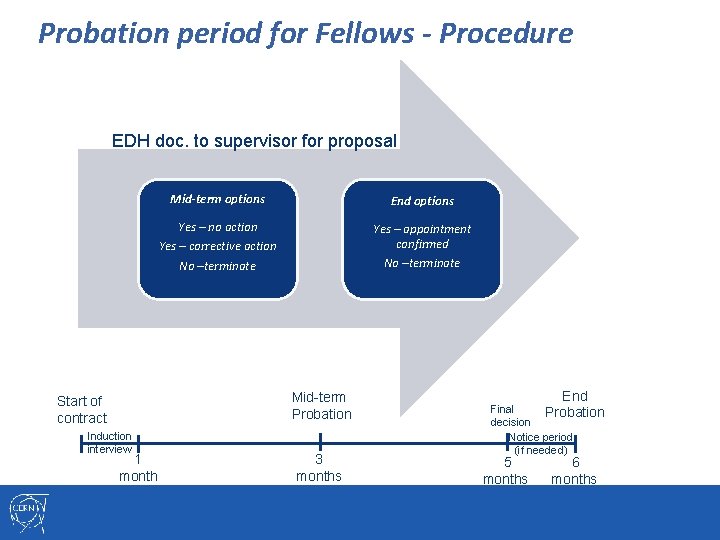
Probation period for Fellows - Procedure EDH doc. to supervisor for proposal Mid-term options End options Yes – no action Yes – corrective action Yes – appointment confirmed No –terminate Mid-term Probation Start of contract Induction interview 1 month 3 months End Final Probation decision Notice period (if needed) 5 months 6 months
Career Grid & Recruitment policy
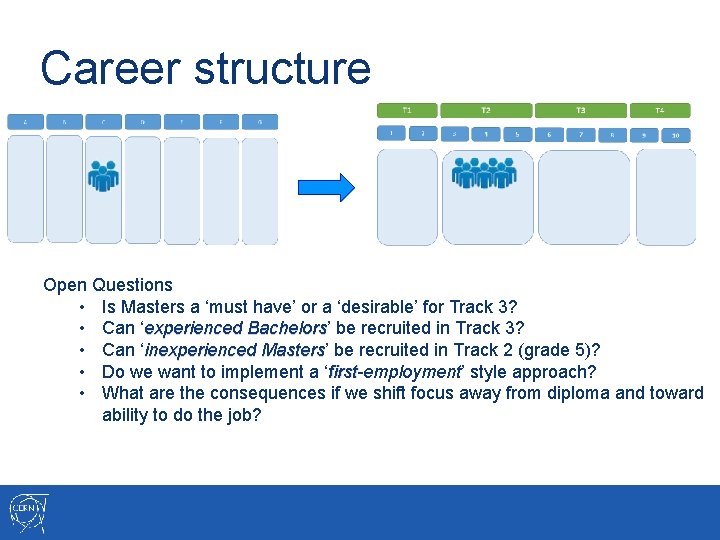
Career structure Open Questions • Is Masters a ‘must have’ or a ‘desirable’ for Track 3? • Can ‘experienced Bachelors’ Bachelors be recruited in Track 3? • Can ‘inexperienced Masters’ Masters be recruited in Track 2 (grade 5)? • Do we want to implement a ‘first-employment’ first-employment style approach? • What are the consequences if we shift focus away from diploma and toward ability to do the job?
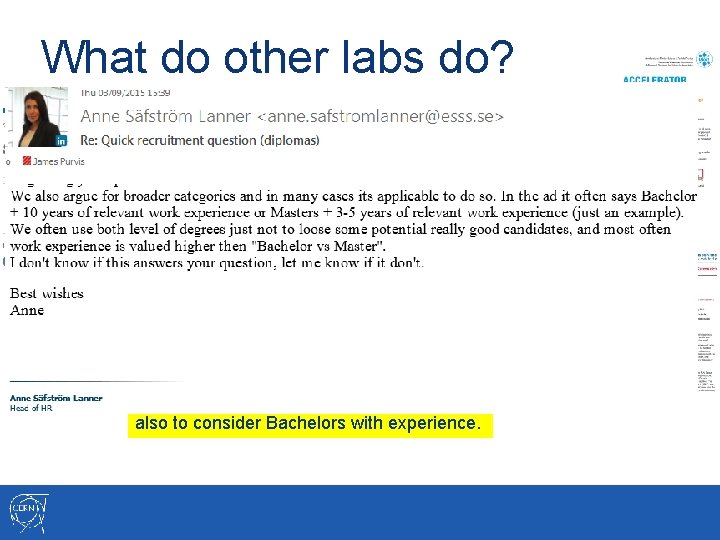
What do other labs do? • • • DESY – ‘graduate degree’ STFC (RAL, Cockroft, Diamond) – Master ‘desirable but not essential’ ESS – Master/Bachelor – weighted differently. Ideal candidate has : • Masters with 3 -5 years experience, OR • Bachelors with 10 years relevant experience • • ITER, CEA, ESRF (FR based labs) – requires Masters ESO – ‘university degree’ • • Masters preferred, but accept bachelors with experience Salary position not same ESA – Masters degree EMBL – varies from ‘degree-level qualification’ to ‘postgraduate’ Trend seems to be to prefer Masters, but also to consider Bachelors with experience.
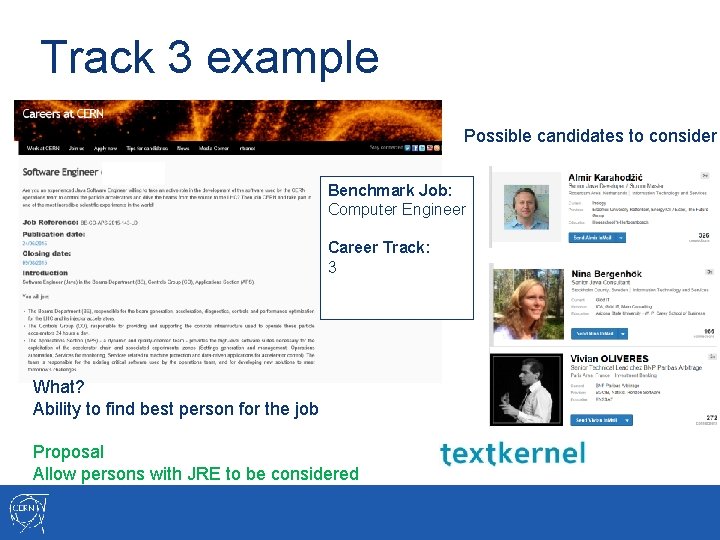
Track 3 example Possible candidates to consider Benchmark Job: Computer Engineer Career Track: 3 What? Ability to find best person for the job Proposal Allow persons with JRE to be considered
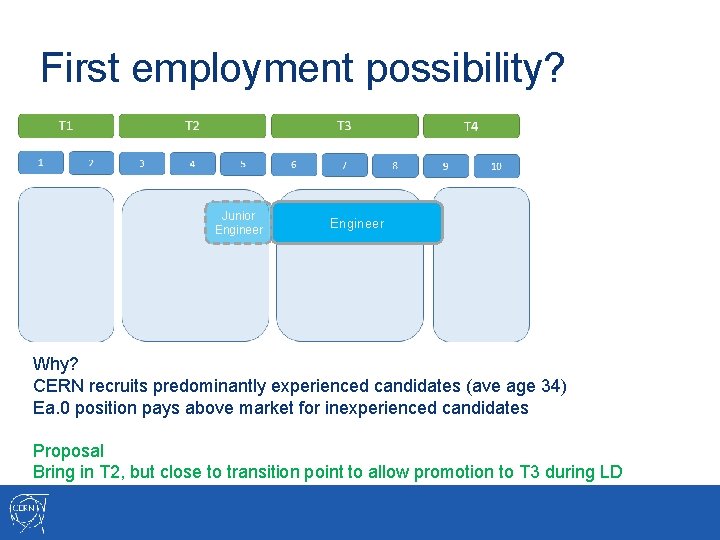
First employment possibility? Junior Engineer Why? CERN recruits predominantly experienced candidates (ave age 34) Ea. 0 position pays above market for inexperienced candidates Proposal Bring in T 2, but close to transition point to allow promotion to T 3 during LD
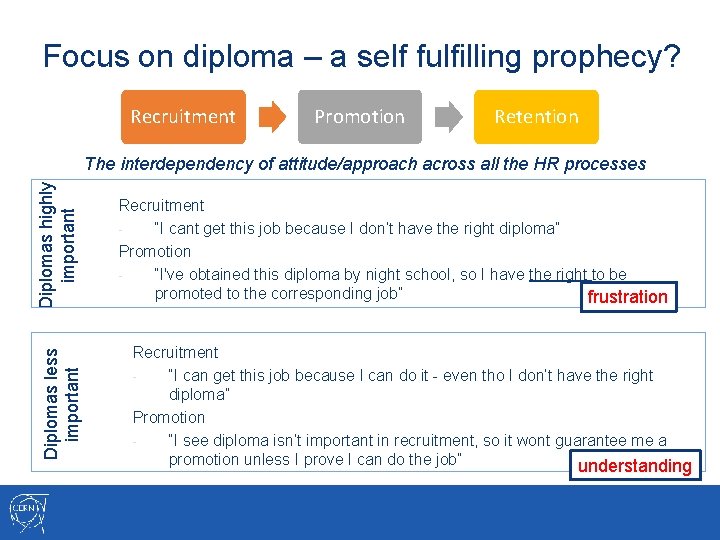
Focus on diploma – a self fulfilling prophecy? Recruitment Promotion Retention Diplomas less important Diplomas highly important The interdependency of attitude/approach across all the HR processes Recruitment “I cant get this job because I don’t have the right diploma” Promotion “I've obtained this diploma by night school, so I have the right to be promoted to the corresponding job” frustration Recruitment “I can get this job because I can do it - even tho I don’t have the right diploma” Promotion “I see diploma isn’t important in recruitment, so it wont guarantee me a promotion unless I prove I can do the job” understanding
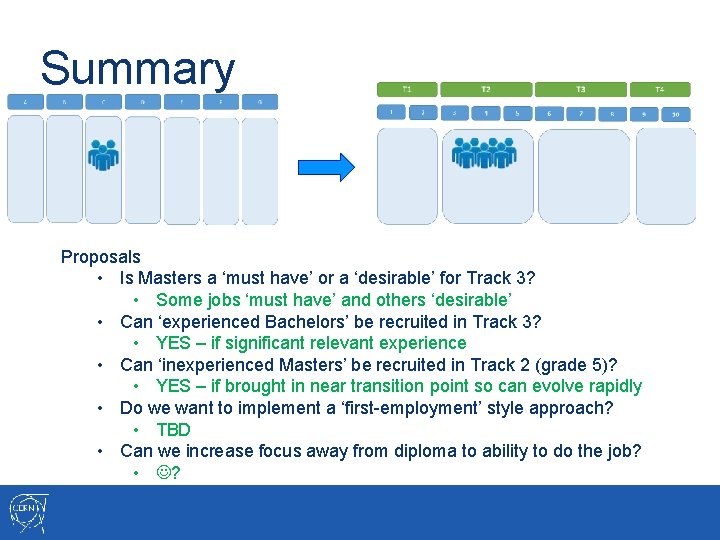
Summary Proposals • Is Masters a ‘must have’ or a ‘desirable’ for Track 3? • Some jobs ‘must have’ and others ‘desirable’ • Can ‘experienced Bachelors’ be recruited in Track 3? • YES – if significant relevant experience • Can ‘inexperienced Masters’ be recruited in Track 2 (grade 5)? • YES – if brought in near transition point so can evolve rapidly • Do we want to implement a ‘first-employment’ style approach? • TBD • Can we increase focus away from diploma to ability to do the job? • ?

- Slides: 24