
BreakEven Analysis Council for Economic Education Terms Start
Break-Even Analysis © Council for Economic Education
Terms • Start Up Costs- The expenses that any business must pay before it can produce and distribute goods and services • Variable Cost- Costs of production that change as a firm's output level changes. • Fixed Cost- Costs of production that do not change as a firm's output level changes; costs that must be paid whether the firm produces or not. • Total Cost- All costs associated with producing a good or service; the sum of total fixed costs plus total variable costs. • Operating Costs - The expenses of doing business • Profit- the sum of money a company makes that is above their operating costs © Council for Economic Education
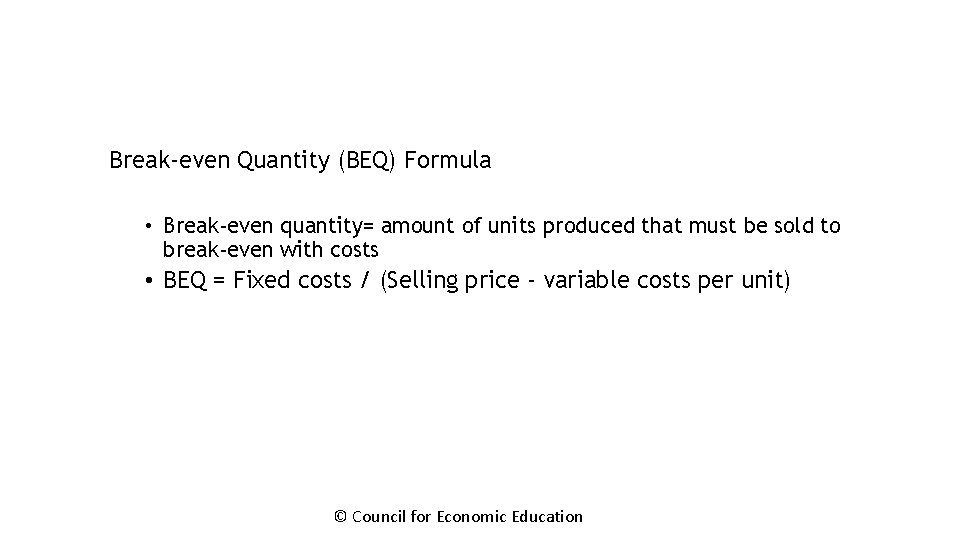
Break-even Quantity (BEQ) Formula • Break-even quantity= amount of units produced that must be sold to break-even with costs • BEQ = Fixed costs / (Selling price - variable costs per unit) © Council for Economic Education

In its simplest form, the break-even chart is a graphical representation of costs at various levels of activity shown on the same chart as the variation of income (or sales, revenue) with the same variation in activity. The point at which neither profit nor loss is made is known as the "break-even point" and is represented on the chart below by the intersection of the two lines: A B In the diagram above, the line A represents the variation of income at varying levels of production activity ("output"). B represents the total fixed costs in the business. As output increases, variable costs are incurred, meaning that total costs (variable) also increase. At low levels of output, Costs are greater than Income. At the point of intersection, P, costs are exactly equal to income, and hence neither profit nor loss is made. © Council for Economic Education
- Slides: 4