
BreadthFirst Search of Graphs Analysis of Algorithms Week

Breadth-First Search of Graphs Analysis of Algorithms Week 9, Lecture 1 Prepared by John Reif, Ph. D. Distinguished Professor of Computer Science Duke University

Applications of Breadth-First Search of Graphs a) Single Source Shortest Path b) Graph Matching

Reading on Breadth-First Search of Graphs • Reading Selection: – CLR, Chapter 24
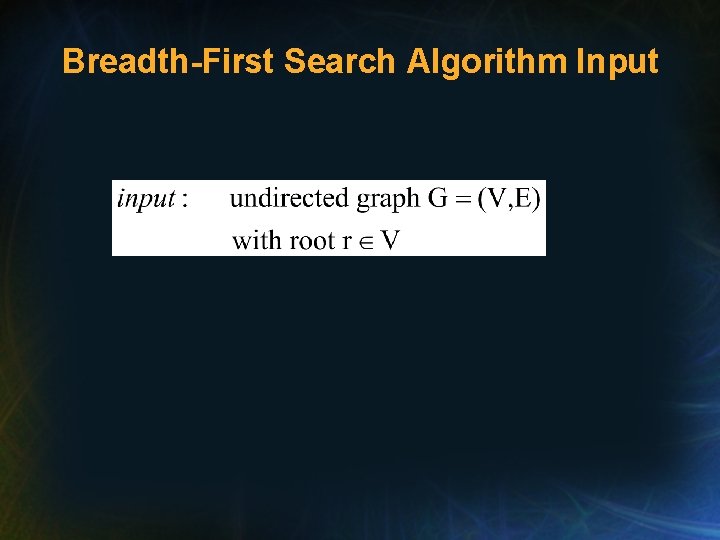
Breadth-First Search Algorithm Input
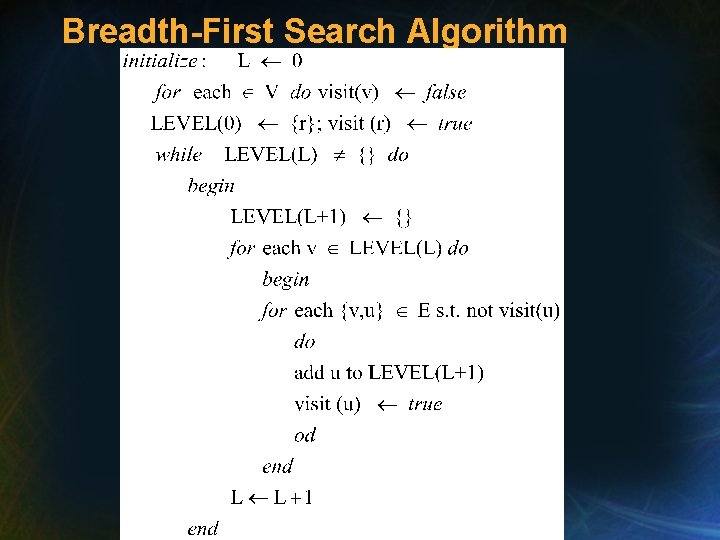
Breadth-First Search Algorithm

Breadth-First Search Algorithm Output
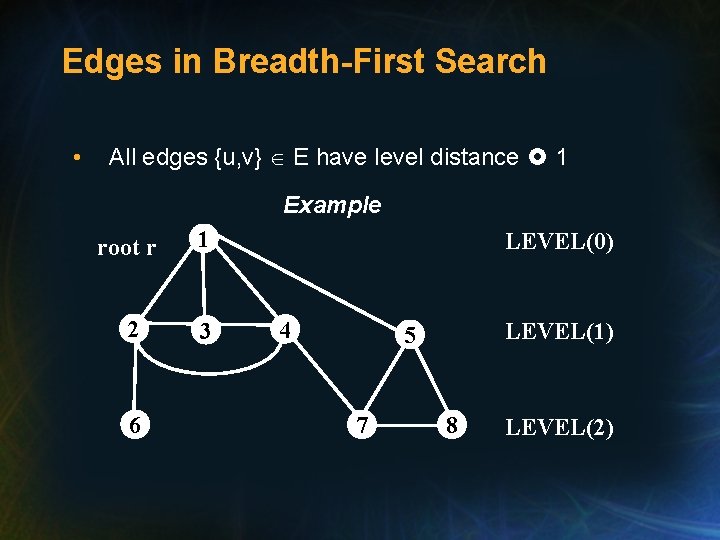
Edges in Breadth-First Search • All edges {u, v} E have level distance 1 Example root r 1 2 3 6 LEVEL(0) 4 LEVEL(1) 5 7 8 LEVEL(2)
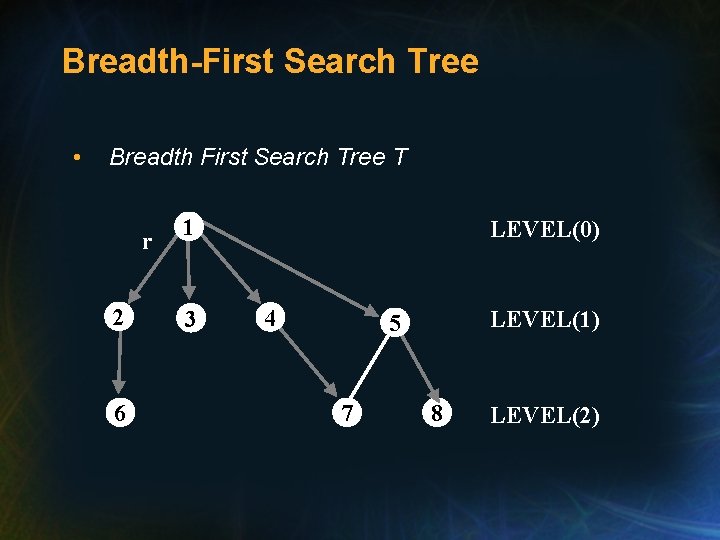
Breadth-First Search Tree • Breadth First Search Tree T r 2 6 1 3 LEVEL(0) 4 LEVEL(1) 5 7 8 LEVEL(2)
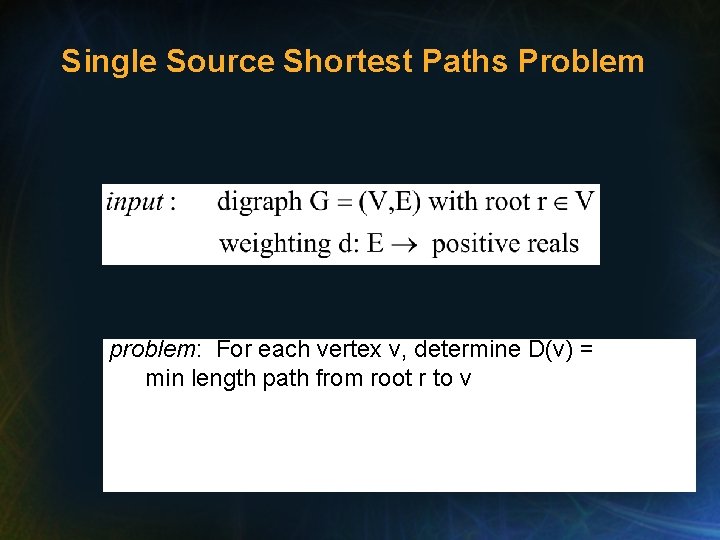
Single Source Shortest Paths Problem problem: For each vertex v, determine D(v) = min length path from root r to v

Dijkstra’s Algorithm for Single Source Shortest Paths
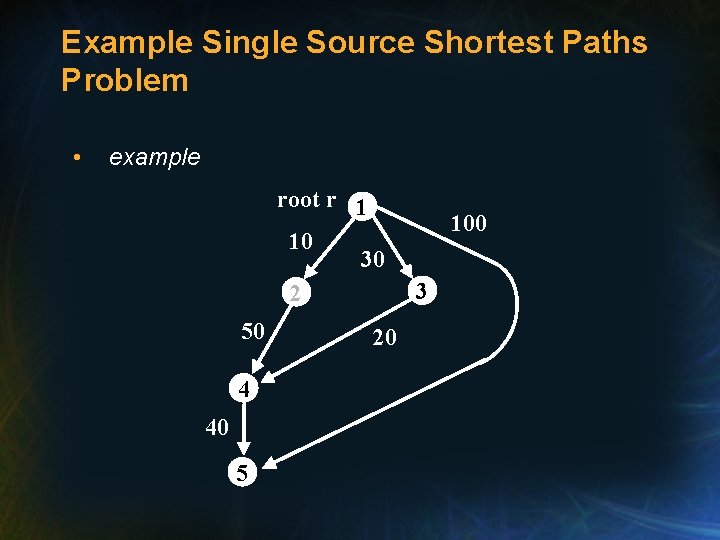
Example Single Source Shortest Paths Problem • example root r 1 10 30 2 50 4 40 5 20 100 3
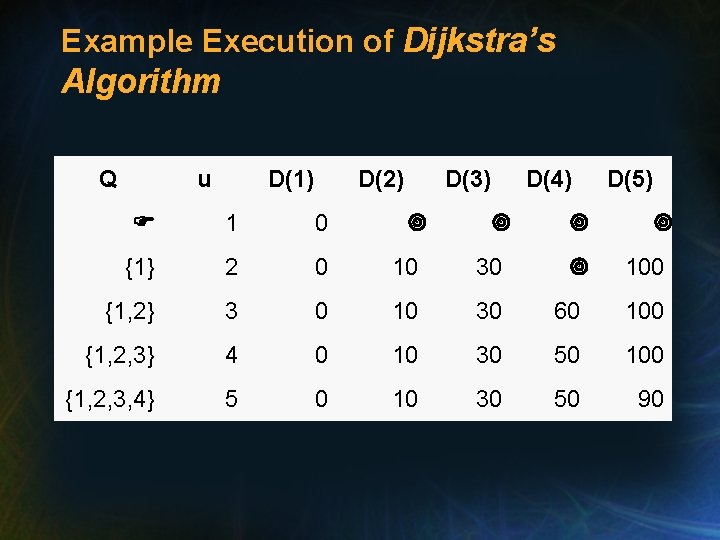
Example Execution of Dijkstra’s Algorithm Q u D(1) D(2) D(3) D(4) D(5) F 1 0 {1} 2 0 10 30 {1, 2} 3 0 10 30 60 100 {1, 2, 3} 4 0 10 30 50 100 {1, 2, 3, 4} 5 0 10 30 50 90 ¥ ¥ ¥ 100
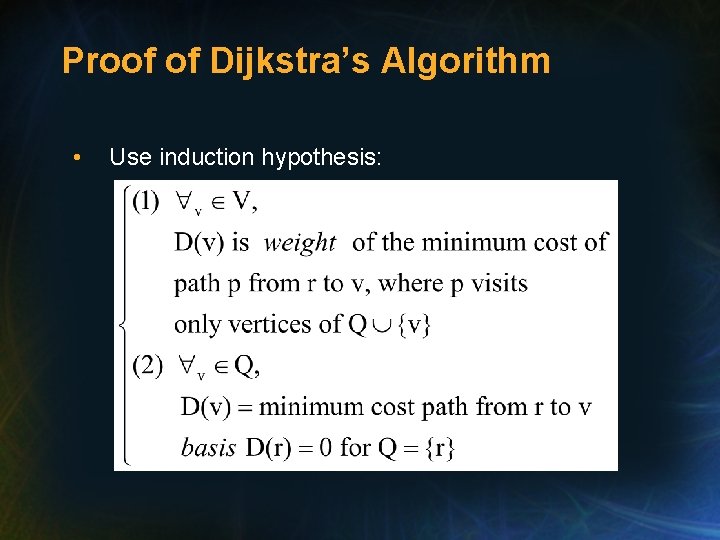
Proof of Dijkstra’s Algorithm • Use induction hypothesis:
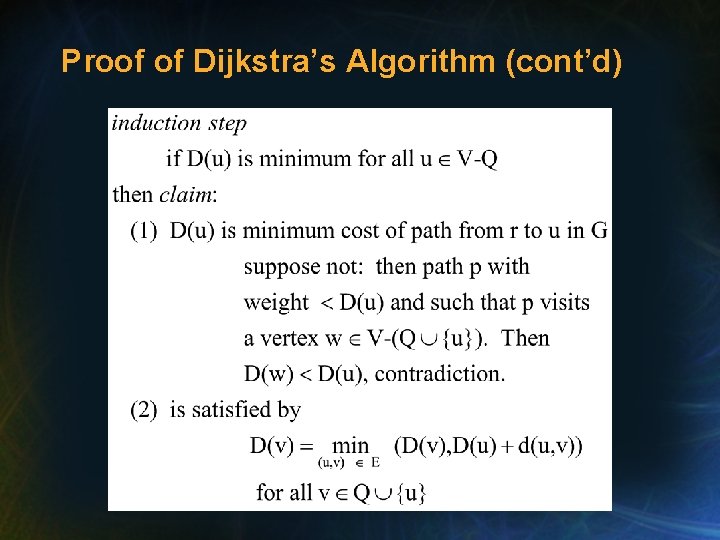
Proof of Dijkstra’s Algorithm (cont’d)
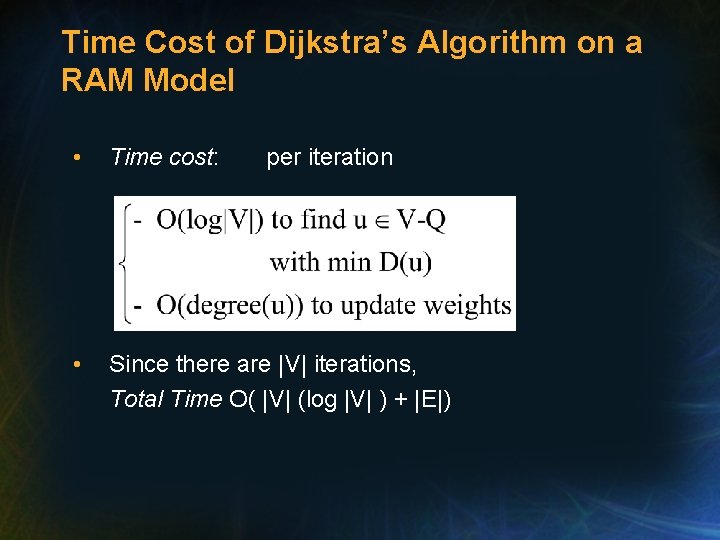
Time Cost of Dijkstra’s Algorithm on a RAM Model • Time cost: • Since there are |V| iterations, Total Time O( |V| (log |V| ) + |E|) per iteration
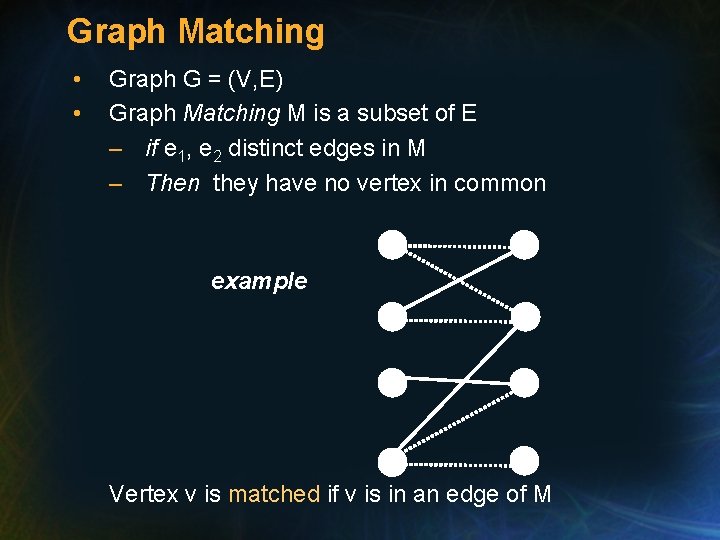
Graph Matching • • Graph G = (V, E) Graph Matching M is a subset of E – if e 1, e 2 distinct edges in M – Then they have no vertex in common example Vertex v is matched if v is in an edge of M
Graph Matching Problem: Find a maximum size matching • Suppose: – G = (V, E) has matching M Goal: – find a larger matching
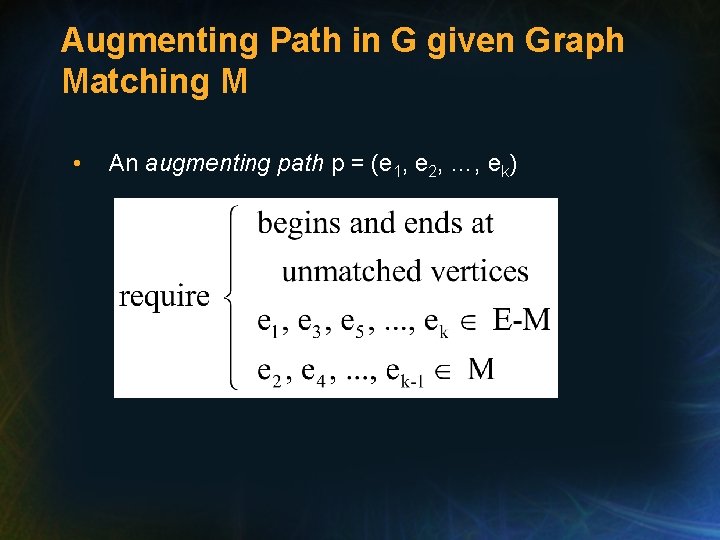
Augmenting Path in G given Graph Matching M • An augmenting path p = (e 1, e 2, …, ek)
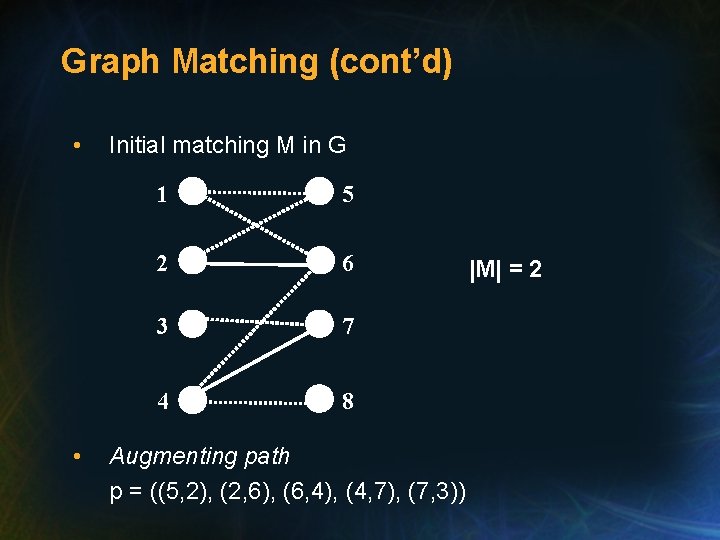
Graph Matching (cont’d) • • Initial matching M in G 1 5 2 6 3 7 4 8 Augmenting path p = ((5, 2), (2, 6), (6, 4), (4, 7), (7, 3)) |M| = 2
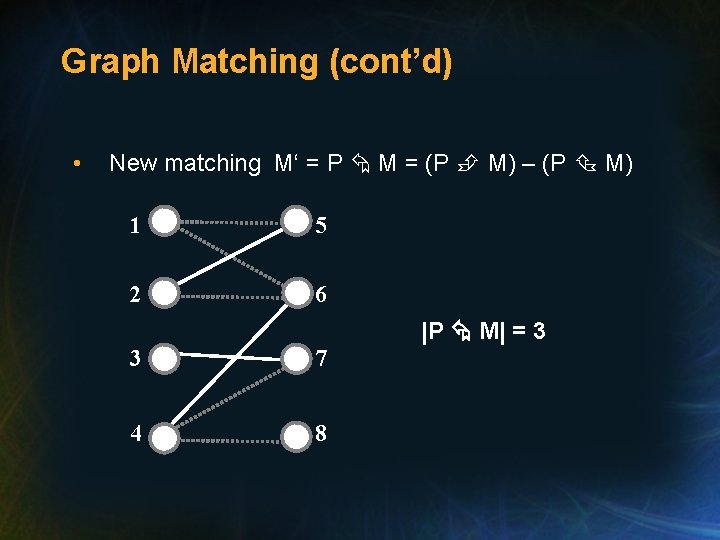
Graph Matching (cont’d) • New matching M‘ = P M = (P M) – (P M) 1 5 2 6 |P M| = 3 3 7 4 8

Characterization of a Maximum Graph Matching via Lack of Augmented Path • Theorem M is maximum matching iff there is no augmenting path relative to M
Proof of Characterization of Maximum Graph Matching (cont’d) • Proof (1) If M is smaller matching and p is an augmenting path for M, then M P is a matching size > |M| (2) If M, M ' are matchings with |M| < |M '|
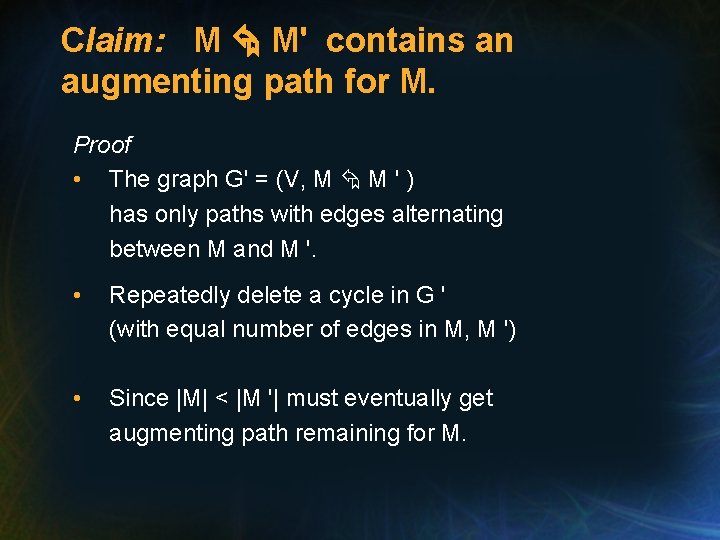
Claim: M M' contains an augmenting path for M. Proof • The graph G' = (V, M M ' ) has only paths with edges alternating between M and M '. • Repeatedly delete a cycle in G ' (with equal number of edges in M, M ') • Since |M| < |M '| must eventually get augmenting path remaining for M.

Maximum Matching Algorithm • Algorithm
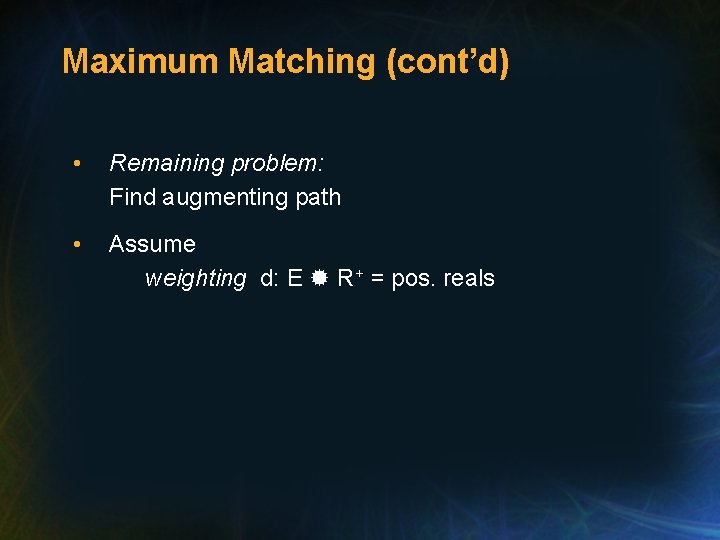
Maximum Matching (cont’d) • Remaining problem: Find augmenting path • Assume weighting d: E R+ = pos. reals
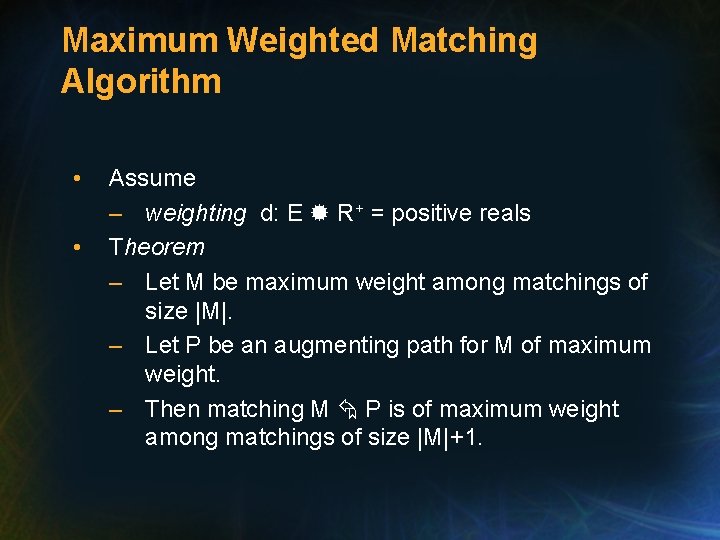
Maximum Weighted Matching Algorithm • • Assume – weighting d: E R+ = positive reals Theorem – Let M be maximum weight among matchings of size |M|. – Let P be an augmenting path for M of maximum weight. – Then matching M P is of maximum weight among matchings of size |M|+1.
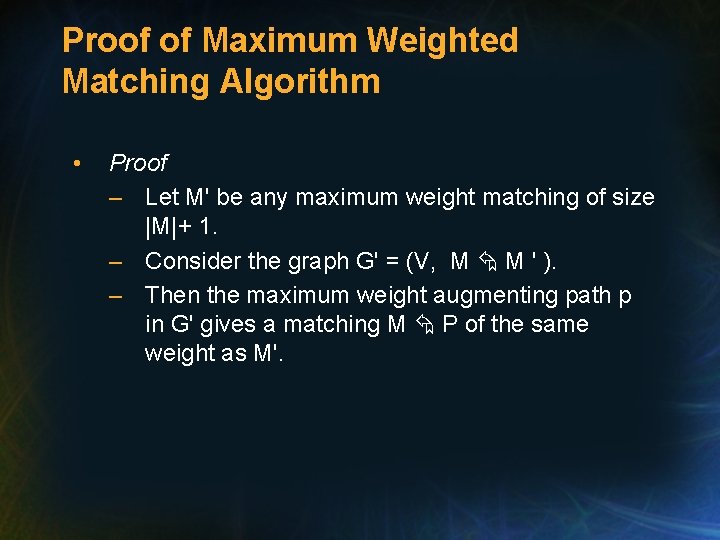
Proof of Maximum Weighted Matching Algorithm • Proof – Let M' be any maximum weight matching of size |M|+ 1. – Consider the graph G' = (V, M M ' ). – Then the maximum weight augmenting path p in G' gives a matching M P of the same weight as M'.

Bipartite Graph • Bipartite Graph G = (V, E) V 1 V 2
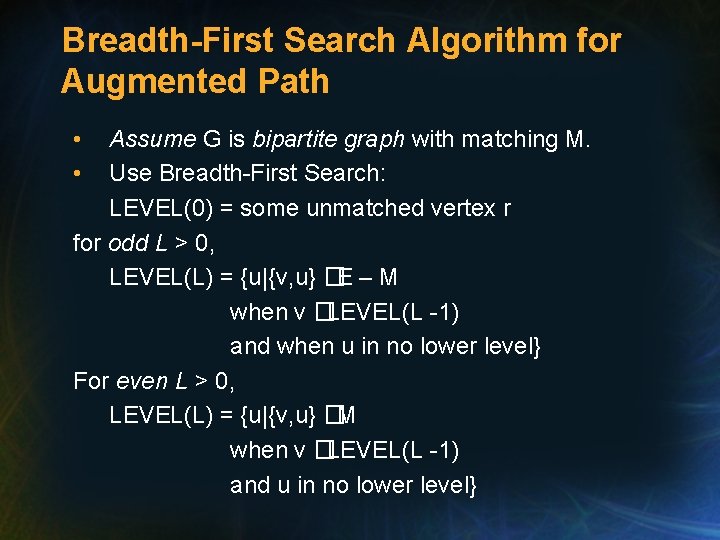
Breadth-First Search Algorithm for Augmented Path • • Assume G is bipartite graph with matching M. Use Breadth-First Search: LEVEL(0) = some unmatched vertex r for odd L > 0, LEVEL(L) = {u|{v, u} �E – M when v �LEVEL(L -1) and when u in no lower level} For even L > 0, LEVEL(L) = {u|{v, u} �M when v �LEVEL(L -1) and u in no lower level}

Proof of Breadth-First Search Algorithm for Augmented Path • Cases (1) If for some odd L >0, LEVEL(L) contains an unmatched vertex u then the Breadth First Search tree T has an augmenting path from r to u (2) Otherwise no augmenting path exists, so M is maximal.
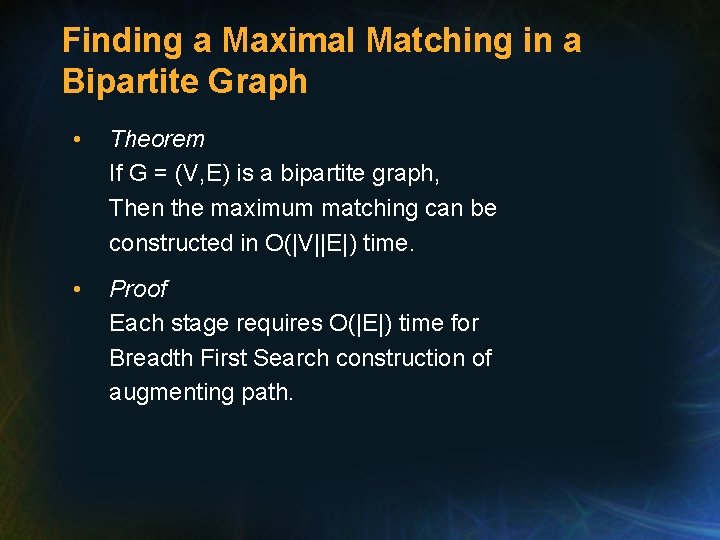
Finding a Maximal Matching in a Bipartite Graph • Theorem If G = (V, E) is a bipartite graph, Then the maximum matching can be constructed in O(|V||E|) time. • Proof Each stage requires O(|E|) time for Breadth First Search construction of augmenting path.
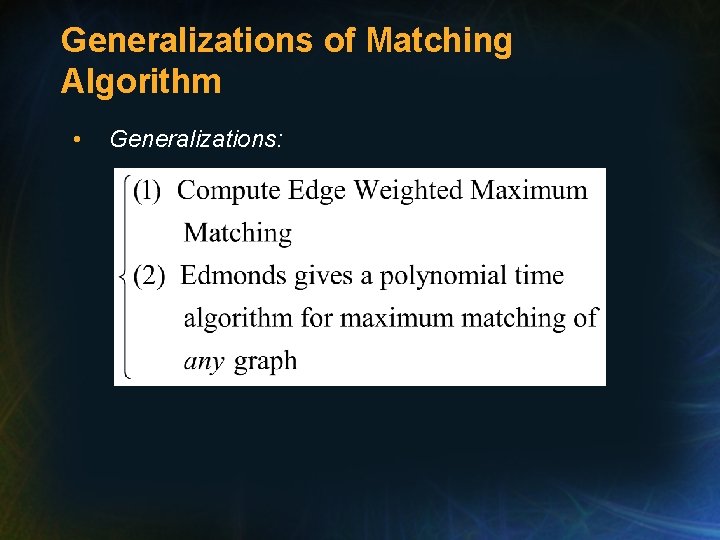
Generalizations of Matching Algorithm • Generalizations:

Computing Augmented Paths in General Graphs • • Let M be matching in general graph G Fix starting vertex r to be an unmatched vertex

Why Algorithm for Augmented Paths in Bipartite Graphs does not work for General Graphs
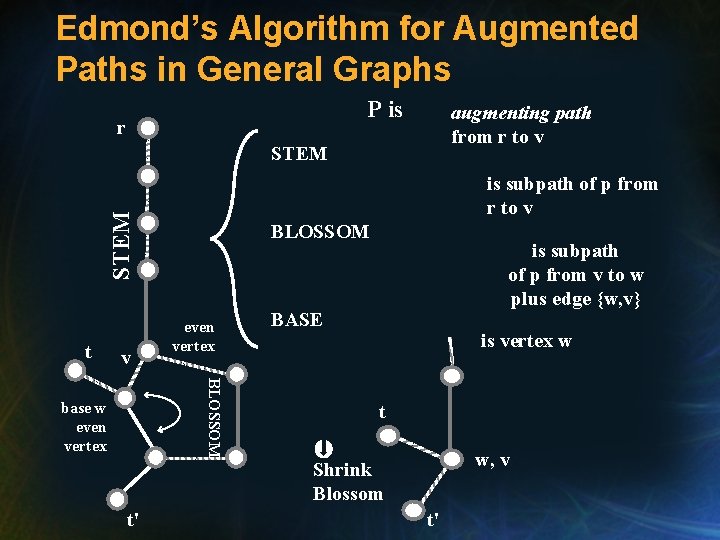
Edmond’s Algorithm for Augmented Paths in General Graphs P is r augmenting path from r to v STEM is subpath of p from r to v t v BLOSSOM even vertex BLOSSOM base w even vertex is subpath of p from v to w plus edge {w, v} BASE is vertex w t w, v Shrink Blossom t' t'
Blossom Shrinking Maintains the Existence of Augmented Paths • Theorem If G' is formed from G by shrinking of blossom B, then G contains an augmenting path iff G' does.
Proof of Blossom Shrinking • Proof (1) If G' contains an augmenting path p, then if p visits blossom B we can insert an augmenting subpath p' within blossom into p to get a new augmenting path for G (2) If G contains an augmenting path, then apply Edmond’s blossom shrinking algorithm to find an augmenting path in G'.
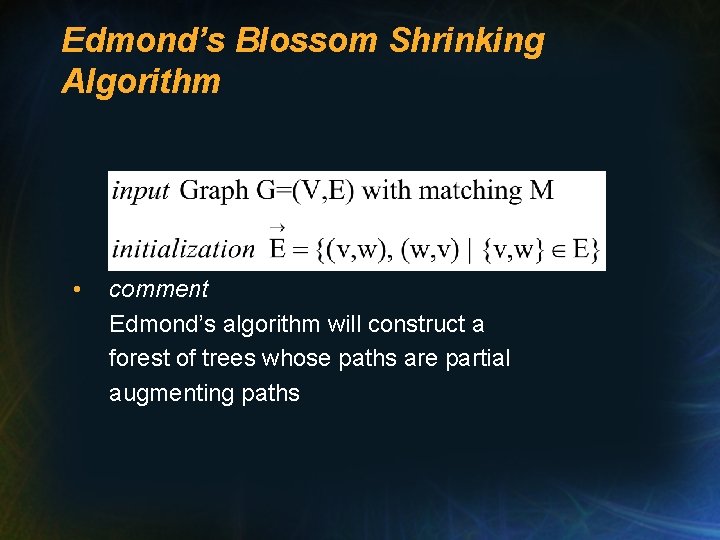
Edmond’s Blossom Shrinking Algorithm • comment Edmond’s algorithm will construct a forest of trees whose paths are partial augmenting paths
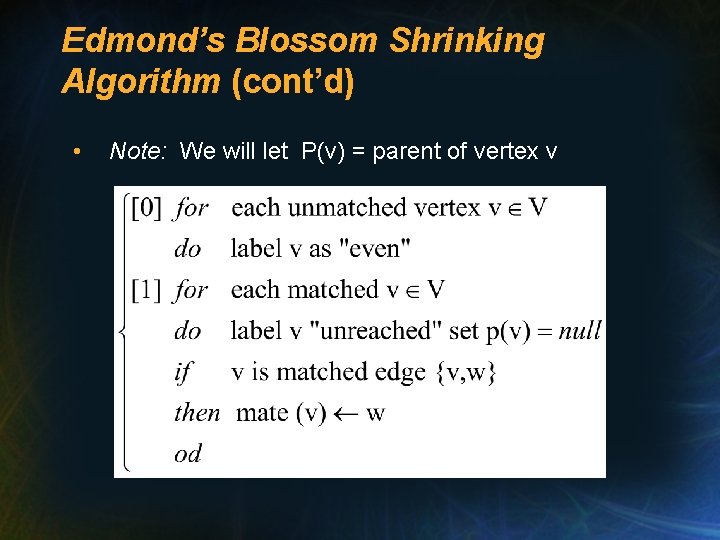
Edmond’s Blossom Shrinking Algorithm (cont’d) • Note: We will let P(v) = parent of vertex v
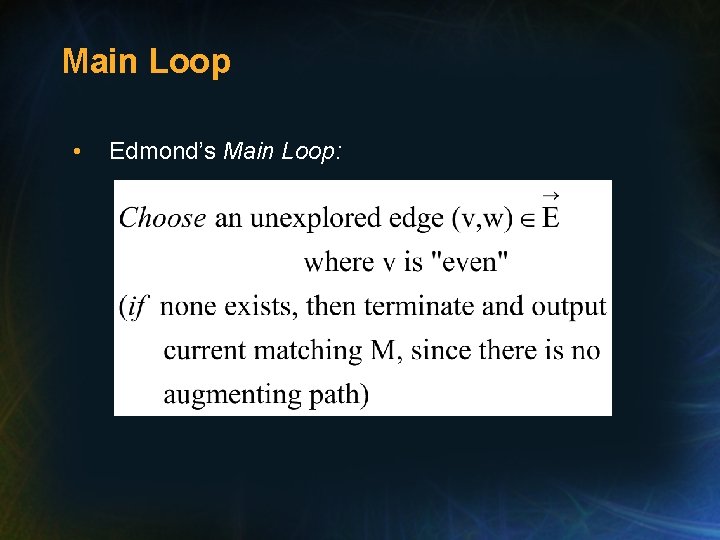
Main Loop • Edmond’s Main Loop:
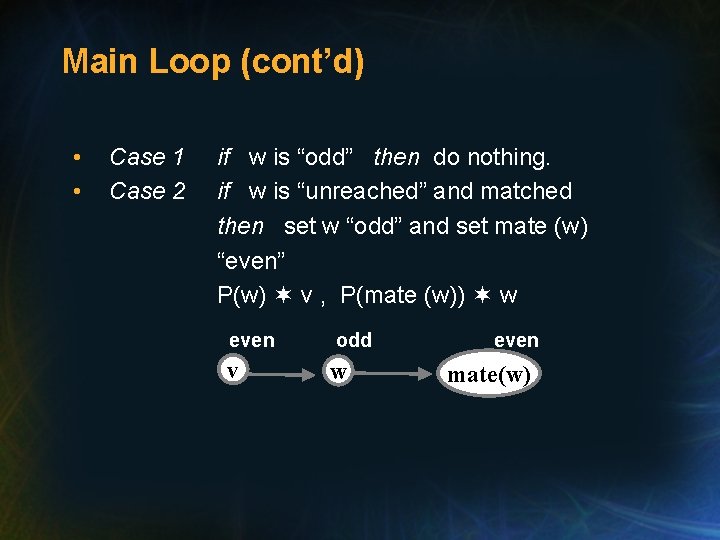
Main Loop (cont’d) • • Case 1 Case 2 if w is “odd” then do nothing. if w is “unreached” and matched then set w “odd” and set mate (w) “even” P(w) v , P(mate (w)) w even odd v w even mate(w)
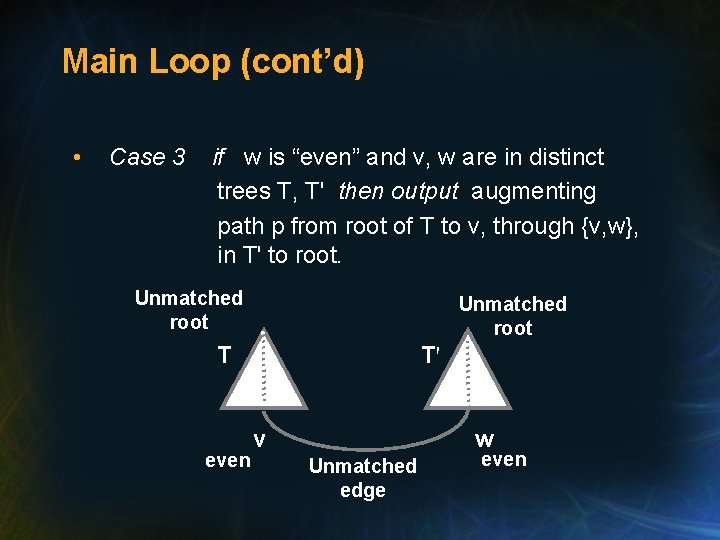
Main Loop (cont’d) • Case 3 if w is “even” and v, w are in distinct trees T, T' then output augmenting path p from root of T to v, through {v, w}, in T' to root. Unmatched root T' T even v w Unmatched edge even
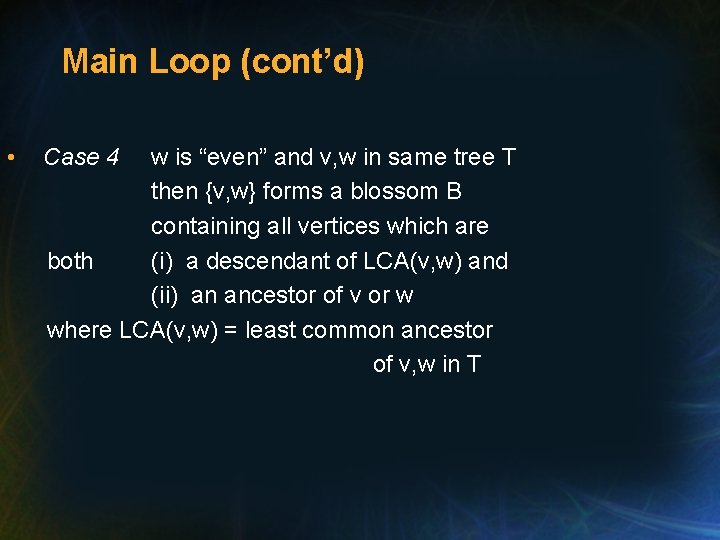
Main Loop (cont’d) • Case 4 w is “even” and v, w in same tree T then {v, w} forms a blossom B containing all vertices which are both (i) a descendant of LCA(v, w) and (ii) an ancestor of v or w where LCA(v, w) = least common ancestor of v, w in T
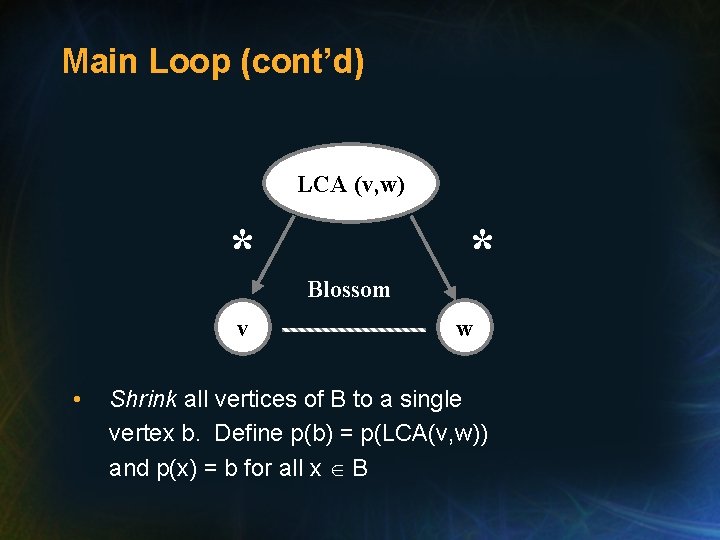
Main Loop (cont’d) LCA (v, w) * v • Blossom * w Shrink all vertices of B to a single vertex b. Define p(b) = p(LCA(v, w)) and p(x) = b for all x B
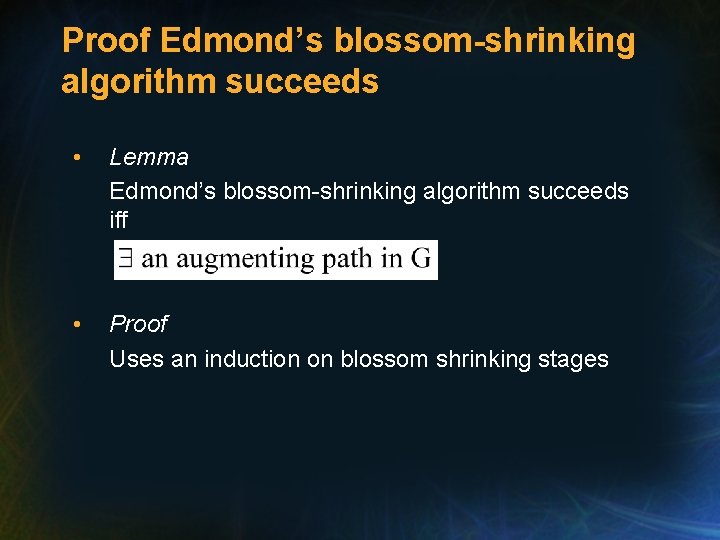
Proof Edmond’s blossom-shrinking algorithm succeeds • Lemma Edmond’s blossom-shrinking algorithm succeeds iff • Proof Uses an induction on blossom shrinking stages
Time Bounds for Matching in General Graphs • Edmond’s blossom-shrinking algorithm costs time O(n 4) • [Gabow and Tarjan] implement in time O(nm) all O(n) stages of matching algorithmtaking O(m) time per stage for blossom shrinking • [Micali and Vazirani] using network flow to find augmented paths and reduce time to O( n m) for unweighted matching in general graphs

Breadth-First Search of Graphs Analysis of Algorithms Week 9, Lecture 1 Prepared by John Reif, Ph. D. Distinguished Professor of Computer Science Duke University
- Slides: 47