
BRC Science Highlight Perennial Biofuel Crops Use Water
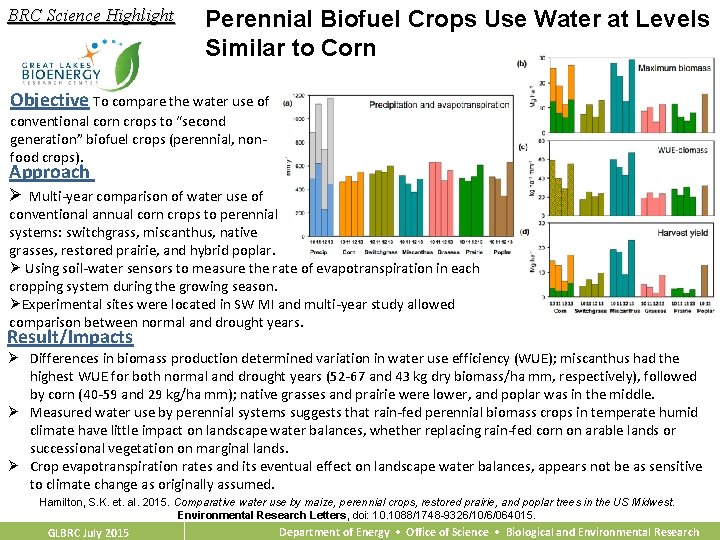
BRC Science Highlight Perennial Biofuel Crops Use Water at Levels Similar to Corn Objective To compare the water use of conventional corn crops to “second generation” biofuel crops (perennial, nonfood crops). Approach Ø Multi-year comparison of water use of conventional annual corn crops to perennial systems: switchgrass, miscanthus, native grasses, restored prairie, and hybrid poplar. Ø Using soil-water sensors to measure the rate of evapotranspiration in each cropping system during the growing season. ØExperimental sites were located in SW MI and multi-year study allowed comparison between normal and drought years. Result/Impacts Ø Differences in biomass production determined variation in water use efficiency (WUE); miscanthus had the highest WUE for both normal and drought years (52 -67 and 43 kg dry biomass/ha mm, respectively), followed by corn (40 -59 and 29 kg/ha mm); native grasses and prairie were lower, and poplar was in the middle. Ø Measured water use by perennial systems suggests that rain-fed perennial biomass crops in temperate humid climate have little impact on landscape water balances, whether replacing rain-fed corn on arable lands or successional vegetation on marginal lands. Ø Crop evapotranspiration rates and its eventual effect on landscape water balances, appears not be as sensitive to climate change as originally assumed. Hamilton, S. K. et. al. 2015. Comparative water use by maize, perennial crops, restored prairie, and poplar trees in the US Midwest. Environmental Research Letters, doi: 10. 1088/1748 -9326/10/6/064015. GLBRC July 2015 Department of Energy • Office of Science • Biological and Environmental Research
- Slides: 1