
BRAZILIAN IONOSPHERIC MODEL APPLIED TO DIFFERENTIAL GPS Luiz
BRAZILIAN IONOSPHERIC MODEL APPLIED TO DIFFERENTIAL GPS Luiz Fernando Antonio Dalbelo (MSc Student) Daniele Barroca Marra Alves (Ph. D Student) Prof. Dr. João Francisco Galera Monico Prof. Dr. Paulo de Oliveira Camargo Faculty of Science and Technology (FCT) - São Paulo State University (UNESP) FCT/UNESP - Pres. Prudente, São Paulo, Brazil FCT/UNESP
CONTENTS OF THE PRESENTATION Ø Ø Introduction; Basics concept of the Ionospheric Model used (Mod_Ion); Ø DGPS and modified DGPS concepts; Ø Experiments and analysis; Ø Conclusions.
Introduction n A positioning method that has received great attention in the area of navigation is the Differential GPS (DGPS). This method has been used in several applications such as: navigation, surveying, precision agriculture and others. In the basic concept of DGPS it is assumed a high correlation of the errors involved in the base and rover stations.
Introduction n Therefore, it is possible to generate corrections in the base stations to be applied in the rover one (pseudorange observable corrections). DGPS provides a reasonable accuracy for short distances. However, the accuracy decreases with distances growth due to spatial decorrelation of the errors.
Introduction n n Therefore, to obtain a better positioning quality, an adequate modeling of these errors is necessary. The aim of this presentation is to evaluate the performance of the Ionospheric Model (Mod_Ion) for reducing DGPS errors.
Ionospheric Model n n n The Ionospheric model (Mod_Ion) was developed at São Paulo State University (FCT/UNESP). This model uses GPS double frequency data from a regional network of reference stations to compute the ionospheric parameters using a Fourier series. The model is based on the difference between the two original pseudoranges ( ) or pseudoranges filtered by the carrier phase (CAMARGO, 1999; CAMARGO et al. , 2000).
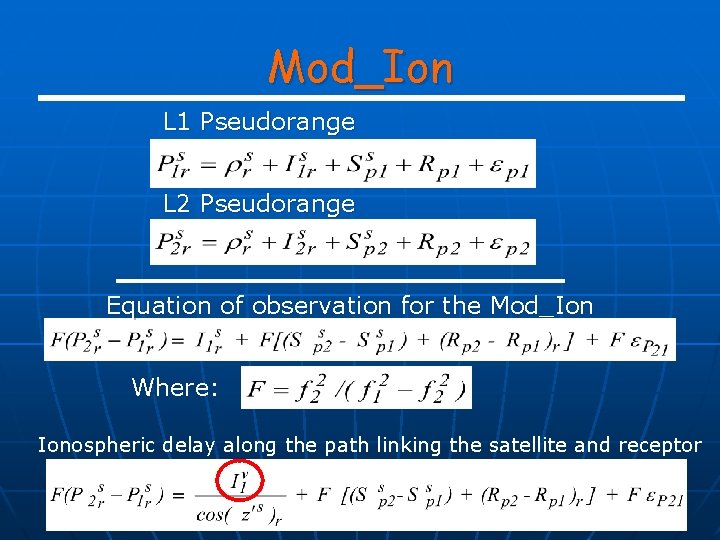
Mod_Ion L 1 Pseudorange L 2 Pseudorange Equation of observation for the Mod_Ion Where: Ionospheric delay along the path linking the satellite and receptor
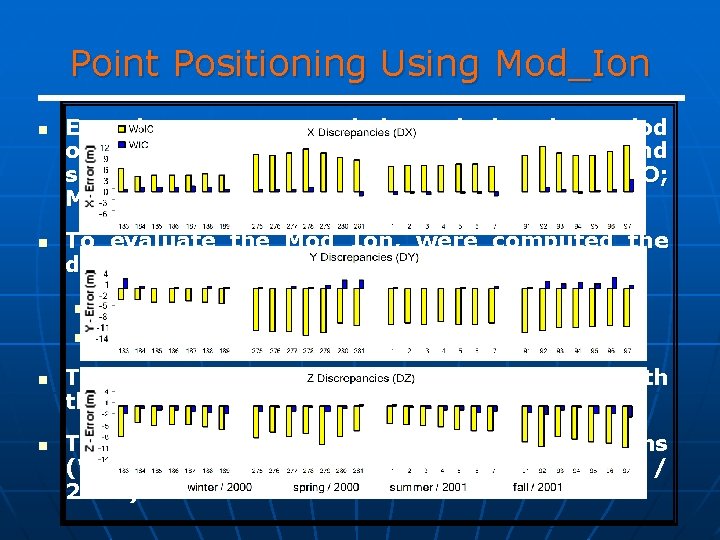
Point Positioning Using Mod_Ion n n Experiments were carried out during the period of maximum solar activity (2000 - 2001) and solar explosions (CAMARGO; MONICO; MATSUOKA and DAL POS, 2001). To evaluate the Mod_Ion, were computed the discrepancies: n n Without Ionospheric Corrections (Wo. IC) With Ionospheric Corrections (WIC) The estimated values were compared daily with the “ground truth”. The data series correspond to the four seasons (Winter and Spring / 2000, Summer and Fall / 2001).
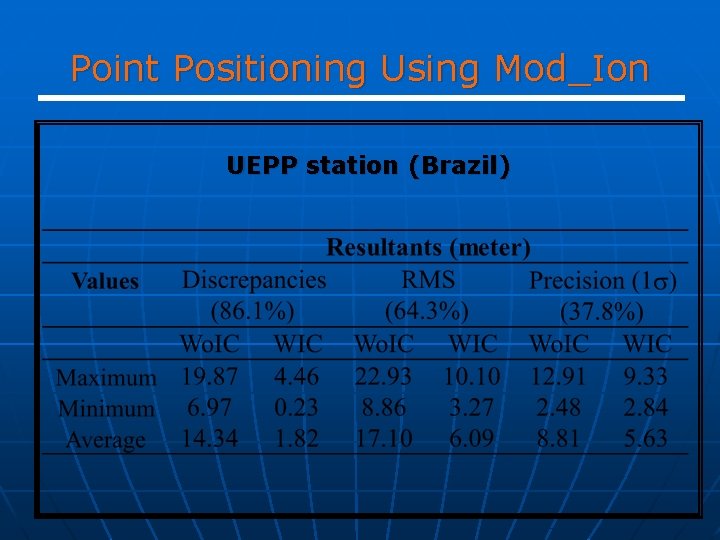
Point Positioning Using Mod_Ion UEPP station (Brazil)
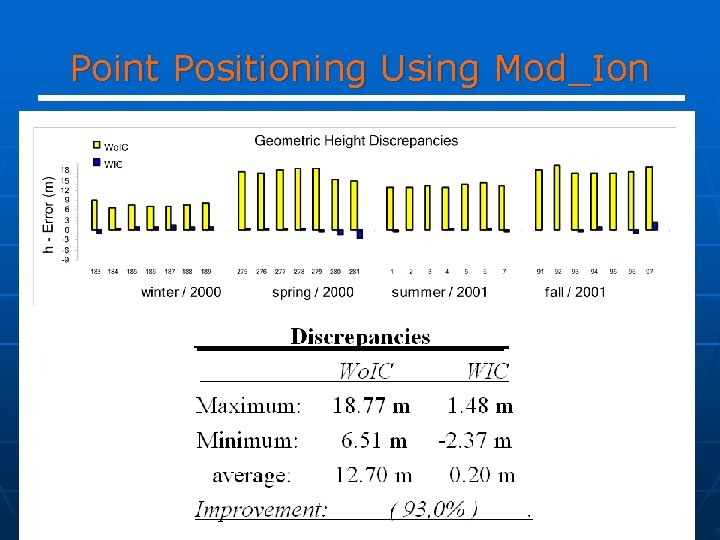
Point Positioning Using Mod_Ion
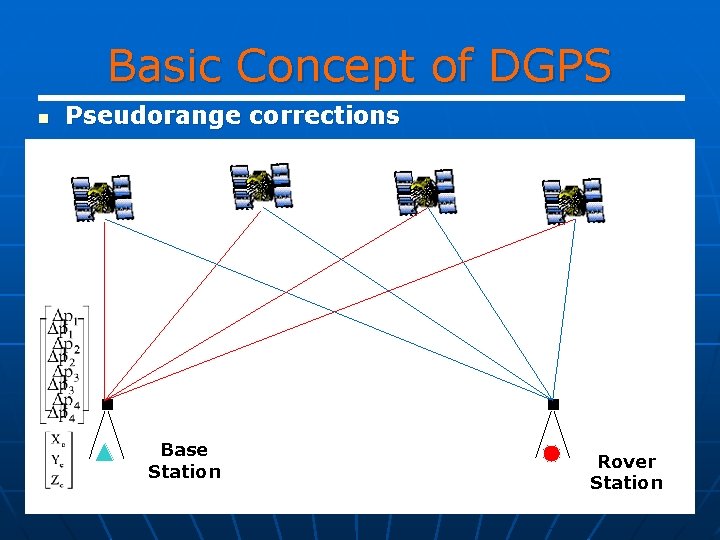
Basic Concept of DGPS n Pseudorange corrections Base Station Rover Station
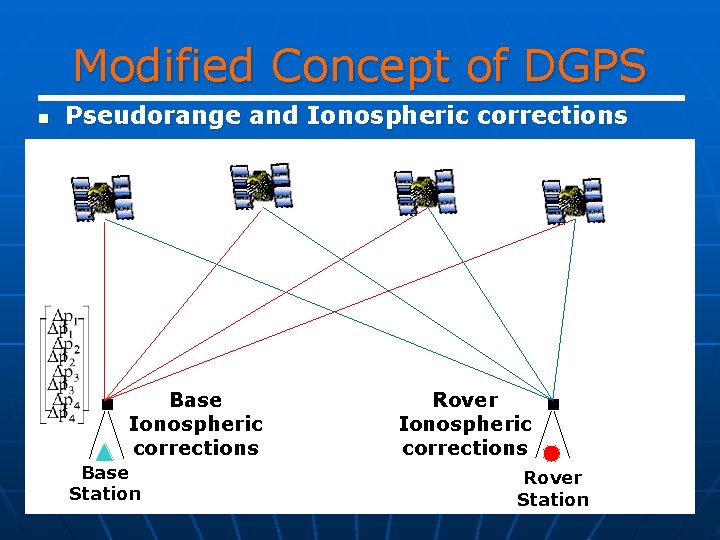
Modified Concept of DGPS n Pseudorange and Ionospheric corrections Base Station Rover Ionospheric corrections Rover Station
Experiments n n n Some DGPS experiments were carried out using Mod_Ion. The stations used are from RBMC (Brazilian Continuous Network of Monitoring GPS Satellites). This stations are: UEPP, PARA, VICO and SALV. UEPP was used as base station, and the others as rover.
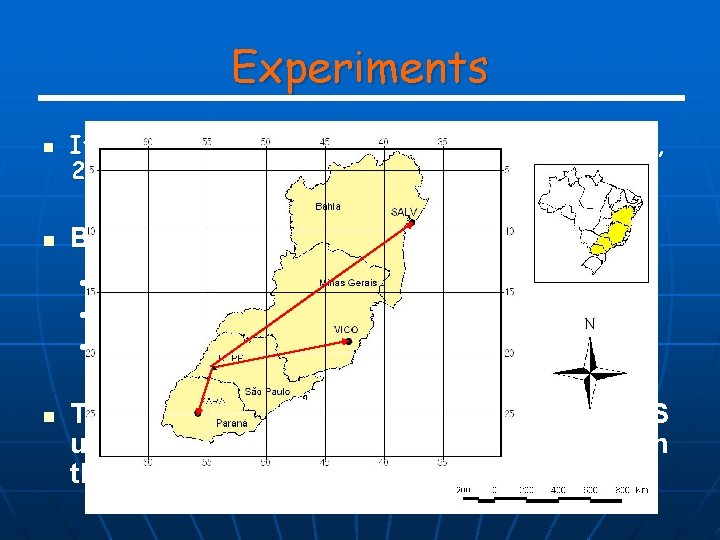
Experiments n n It was processed 22 hours of data on April 04, 2005. Baseline • • • n UEPP – PARA (430 km); UEPP – VICO (897 km); UEPP – SALV (1693 km). The results obtained by DGPS and DGPS using Mod_Ion (DGPS+I) were compared with the “ground truth” coordinates.
Experiments n The next figures present: • Horizontal Resulting (HR) for DGPS (HR_DGPS) and for DGPS using Mod_Ion (HR_DGPS+I); • Altimetric Resulting (AR) for DGPS (AR_DGPS) and for DGPS using Mod_Ion (AR_DGPS+I);
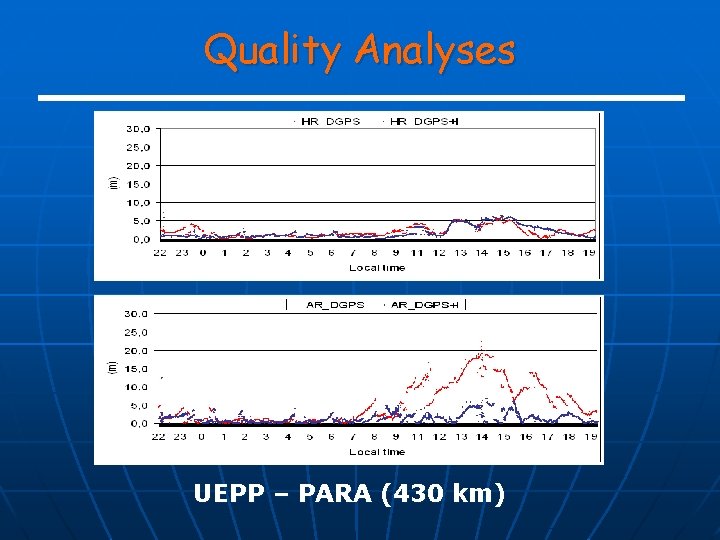
Quality Analyses UEPP – PARA (430 km)
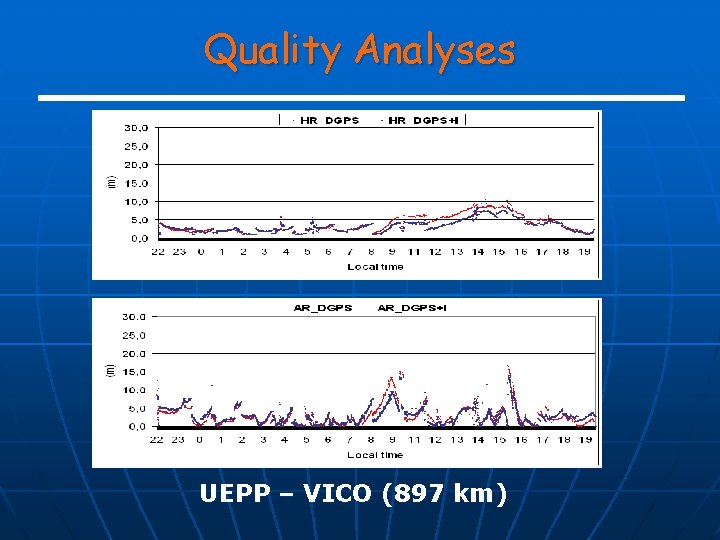
Quality Analyses UEPP – VICO (897 km)
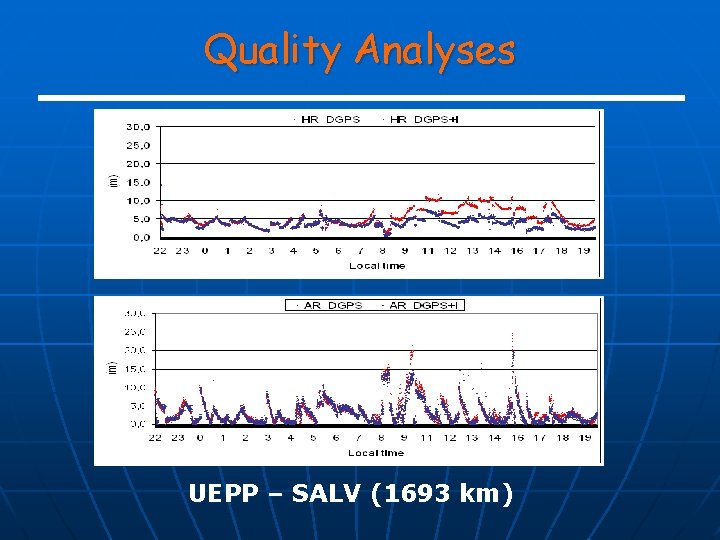
Quality Analyses UEPP – SALV (1693 km)

Quality Analyses UEPP – PARA (DGPS) UEPP – PARA (DGPS+I) (m) HR AR R AV 1. 933 5. 169 5. 715 1, 819 1. 423 2. 499 SD 1. 410 5. 278 5. 257 1. 636 1. 288 1. 851 RMS 2. 392 7. 387 7. 765 2. 446 1. 920 3. 110 (m) UEPP – VICO (DGPS+I) HR AR R AV 3. 760 2. 812 5. 050 3. 224 2. 900 4. 634 SD 2. 263 2. 757 3. 045 1. 682 2. 289 2. 324 RMS 4. 388 3. 938 5. 897 3. 636 3. 694 5. 184 (m) UEPP – SALV (DGPS+I) HR AR R AV 5. 269 3. 418 6. 737 3. 829 3. 045 5. 275 SD 2. 324 3. 373 3. 292 1. 226 2. 915 2. 473 RMS 5. 759 4. 802 7. 498 4. 021 4. 216 5. 825
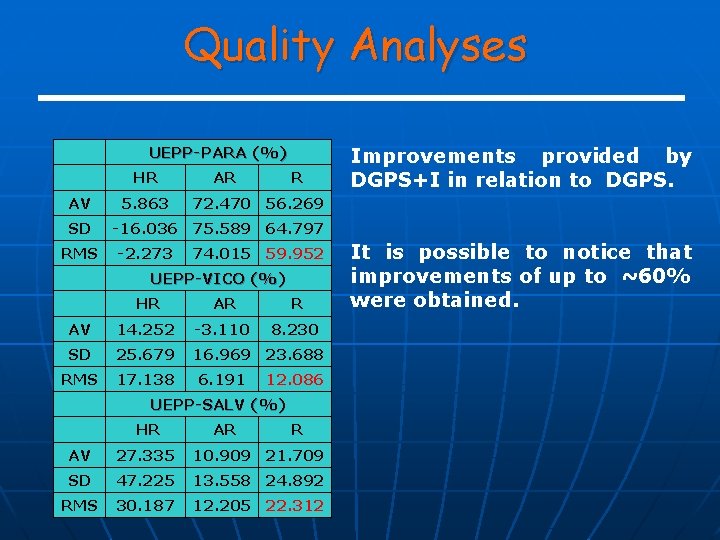
Quality Analyses UEPP-PARA (%) HR AV SD RMS 5. 863 AR R Improvements provided by DGPS+I in relation to DGPS. 72. 470 56. 269 -16. 036 75. 589 64. 797 -2. 273 74. 015 59. 952 UEPP-VICO (%) HR AR R AV 14. 252 -3. 110 8. 230 SD 25. 679 16. 969 23. 688 RMS 17. 138 6. 191 12. 086 UEPP-SALV (%) HR AR R AV 27. 335 10. 909 21. 709 SD 47. 225 13. 558 24. 892 RMS 30. 187 12. 205 22. 312 It is possible to notice that improvements of up to ~60% were obtained.
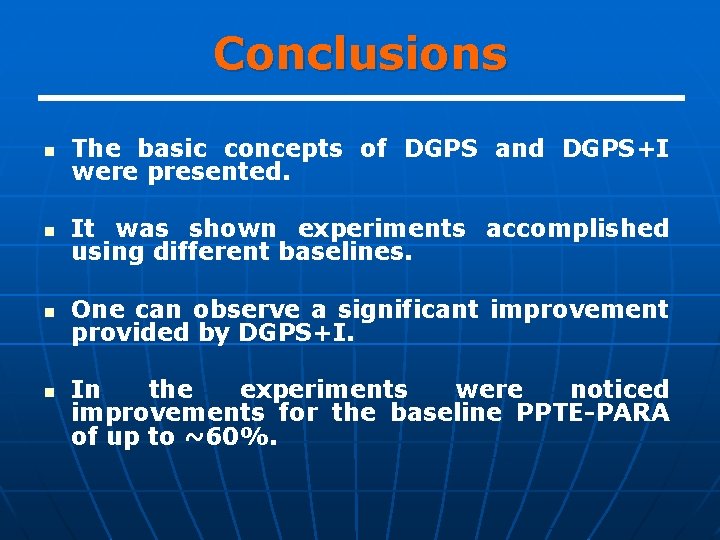
Conclusions n The basic concepts of DGPS and DGPS+I were presented. n It was shown experiments accomplished using different baselines. n One can observe a significant improvement provided by DGPS+I. n In the experiments were noticed improvements for the baseline PPTE-PARA of up to ~60%.

Conclusions n n For the baselines PPTE-VICO and PPTE-SALV the improvement were of up to ~12% and were ~22% respectively. So, the Mod_Ion may be a good possibility to be used together the DGPS.

Thank you !
- Slides: 23