
BrandRelated Twitter Sentiment Analysis using Feature Engineering and

Brand-Related Twitter Sentiment Analysis using Feature Engineering and the Dynamic Architecture for Artificial Neural Networks Yan Zhu
Agenda Ø Overview Ø Objective Ø Twitter sentiment analysis Ø Experiments And Results Ø Conclusion
Overview Ø Twitter has emerged as a major social media platform, with more than 100 million users generating over 500 million tweets per day Ø Tweets often express a user's perspective and opinion on a topic of interest Ø Twitter sentiment analysis approaches continue to perform poorly, with classification accuracies frequently below 70%
Overview Ø These poor performances may be attributed to several properties of tweets Ø limited to 140 characters in length Ø characterized by diverse, evolving language with frequent use of slang, abbreviations, and emoticons Ø the sentiment class distribution of the tweets of interest
Objective Ø In this research, we present an approach to brand-related Twitter sentiment analysis that addresses the challenges associated with the unique characteristics of the Twitter language and the recall of mild sentiment expressions. Ø In our approach we carefully craft the tweet feature representation through supervised feature engineering, resulting in a final representation consisting of only seven dimensions.
Objective Ø This tweet feature representation is coupled with the Dynamic Architecture for Artificial Neural Networks (DAN 2) for sentiment analysis and classification to distinguish mild sentiment expressions in tweets Ø In our experimentation with a Starbucks brand-related Twitter data set, we perform both three-class and five-class sentiment classification
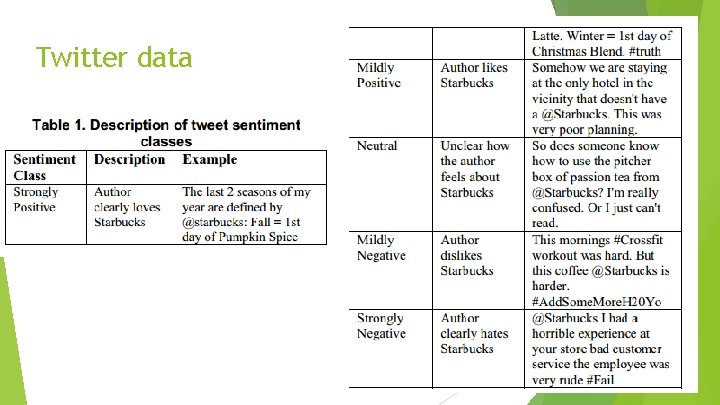
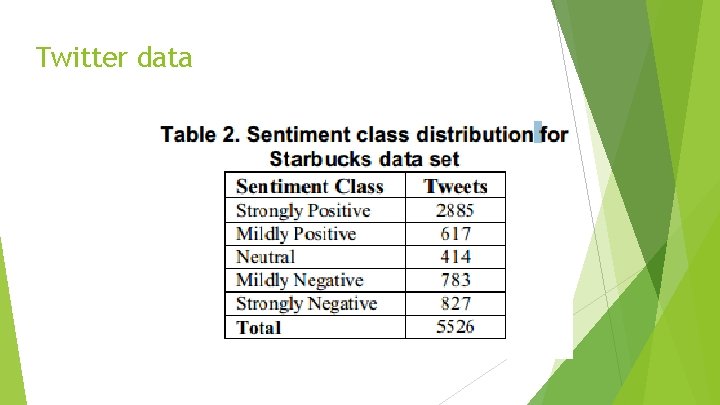
Twitter data Ø We collected tweets containing the '@Starbucks' handle from the Twitter API for three months from August - October 2013, resulting in 442, 443 tweets. Ø Retweets were removed, 254, 196 tweets remained. Ø Five sentiment classes were used in the classification Ø The final Starbucks data set consisted of 5, 526 tweets.
Twitter data
Twitter data
Twitter sentiment analysis Ø Develop the tweet feature representation through supervised feature engineering. Ø Include a sufficient number of features that will provide coverage over the tweet data set. Ø Reduce the number of dimensions in the feature space to create a denser representation and alleviate sparsity. Ø Present the DAN 2 model for sentiment analysis and classification.
Twitter sentiment analysis Ø Our approach to feature engineering consists of five stages: Ø frequency analysis Ø affinity analysis Ø negation and valence shifter analysis Ø feature sentiment scoring Ø aspect categorization.
Feature engineering: frequency analysis Ø Focuses on the unigrams used in tweets. Ø 178 emoticons and emoji were included Ø Examined the frequencies of word unigrams, and removed infrequently occurring unigrams (1, 300 word unigrams) Ø Manually developed synonym groups of word unigrams and apply the frequency threshold at the group level instead of the word level.
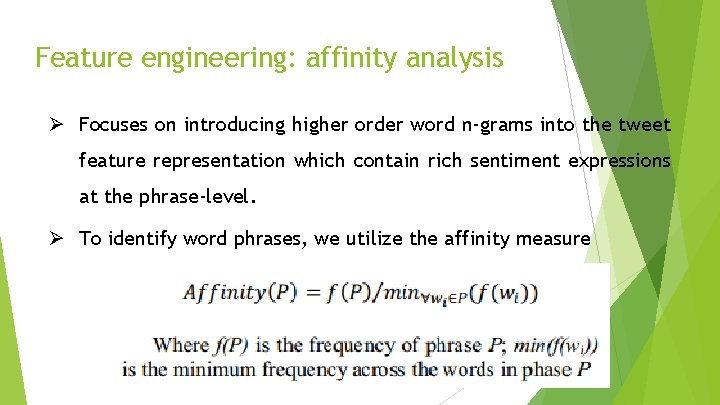
Feature engineering: affinity analysis Ø Focuses on introducing higher order word n-grams into the tweet feature representation which contain rich sentiment expressions at the phrase-level. Ø To identify word phrases, we utilize the affinity measure
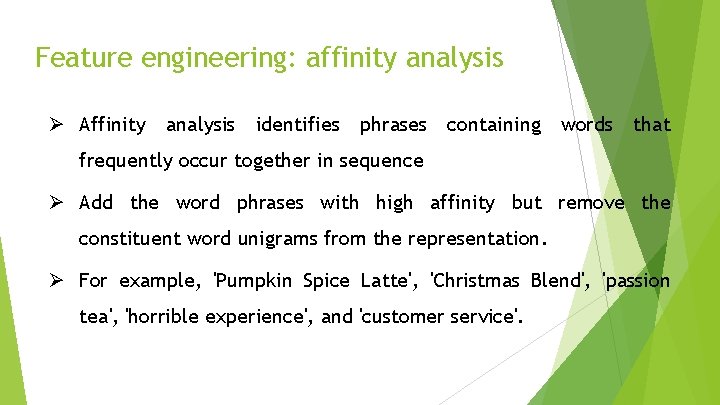
Feature engineering: affinity analysis Ø Affinity analysis identifies phrases containing words that frequently occur together in sequence Ø Add the word phrases with high affinity but remove the constituent word unigrams from the representation. Ø For example, 'Pumpkin Spice Latte', 'Christmas Blend', 'passion tea', 'horrible experience', and 'customer service'.
Feature engineering: negation and valence shifter analysis Ø Focuses on adding negated, intensified, and diminished forms of the word gram features Ø Manually examined the occurrences of negation of the word grams already included in the representation, and added any frequently occurring negated forms as additional features.
Feature engineering: negation and valence shifter analysis Ø The General Inquirer dictionary of overstatement and understatement words was then used as reference to identify sentiment intensification or diminishment Ø The data set were scanned for occurrences of these words used to intensify or diminish the word grams already included in the representation. Ø Frequently occurring intensified or diminished forms of the word grams were added to the tweet representation as additional features.
Feature engineering: feature sentiment scoring Ø Focuses on assigning sentiment polarity and intensity scores to the terms included in the tweet feature representation. Ø The Information Gain for each feature and tweet sentiment class was calculated, and based upon these values features were assigned to one of seven sentiment groups: extremely positive, very positive, somewhat positive, neutral, somewhat negative, very negative, and extremely negative.
Feature engineering: feature sentiment scoring Ø Features from these groups were weighted with 16, 8, 4, 0, -4. 1, 8. 1, -20. 1 intensities, respectively. Ø The additional intensity weight and offset assigned to terms in negative sentiment groups is designed to ensure that negative tweets requiring the intervention of brand managers are not mistakenly classified.
Feature engineering: aspect categorization Ø Focuses on reducing the dimensions of the tweet feature representation using a brand aspect ontology. Ø Based upon Starbucks data set, seven aspect categories were defined. Ø desire, interjections, quality, review, transactional, domain-specific, and ancillary
Feature engineering: aspect categorization Ø Map each of the features in the tweet feature representation to an aspect category, collapsing the final representation to seven dimensions. Ø Sentiment scores were summed across features within an aspect category, and these values were then provided as input to the machinelearned sentiment classifiers. Ø The aspect categorization yields a representation with greater feature density.
Sentiment analysis Ø The tweet feature representation values are provided as input to the Dynamic Architecture for Artificial Neural Networks (DAN 2) for sentiment analysis and classification Ø The general philosophy of the DAN 2 model is based upon the principle of learning and accumulating knowledge at each layer, propagating and adjusting this knowledge forward to the next layer, and repeating these steps until the desired network performance criteria are reached. Ghiassi, M. and Saidane, H. (2005). A Dynamic Architecture for Artificial Neural Network. Neurocomputing, 63.
Sentiment analysis Ø DAN 2 architecture is composed of an input layer, hidden layers, and an output layer. Ø The input layer accepts external data to the model. Ø Unlike classical neural networks, in DAN 2 the number of hidden layers is not fixed a priori. Ø They are sequentially and dynamically generated until a level of performance accuracy is reached.
Sentiment analysis Ø DAN 2 uses a fixed number of hidden nodes (four) in each hidden layer. Ø At each hidden layer, the network is trained using all observations in the training set simultaneously, so as to minimize a stated training accuracy measure such as mean squared error (MSE)
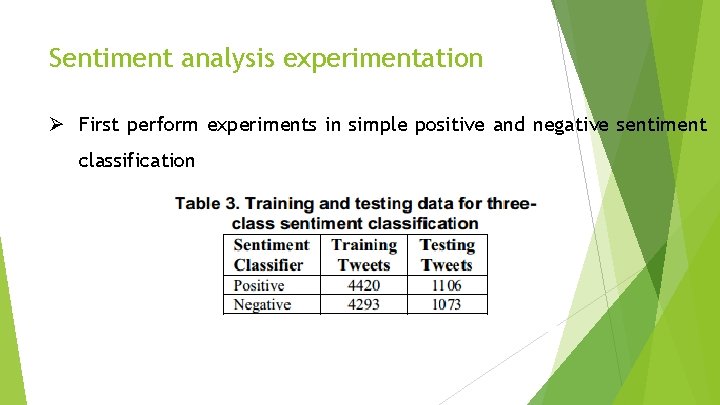
Sentiment analysis experimentation Ø First perform experiments in simple positive and negative sentiment classification
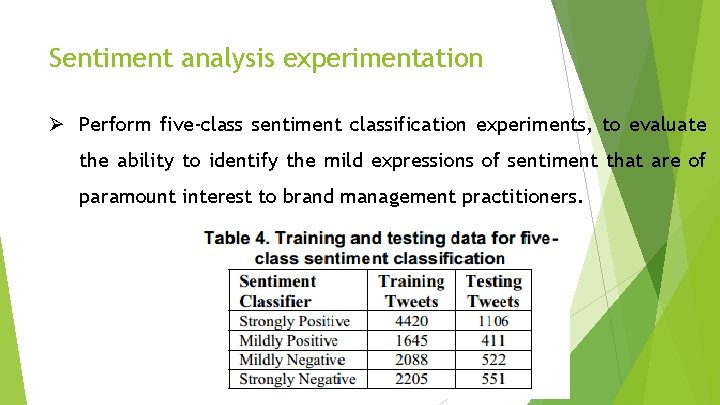
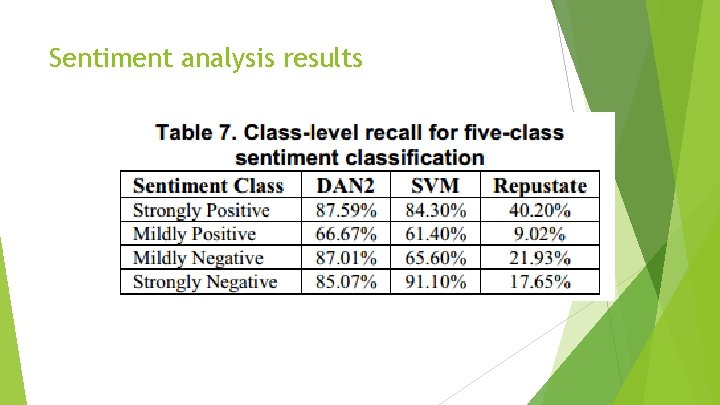
Sentiment analysis experimentation Ø Perform five-class sentiment classification experiments, to evaluate the ability to identify the mild expressions of sentiment that are of paramount interest to brand management practitioners.
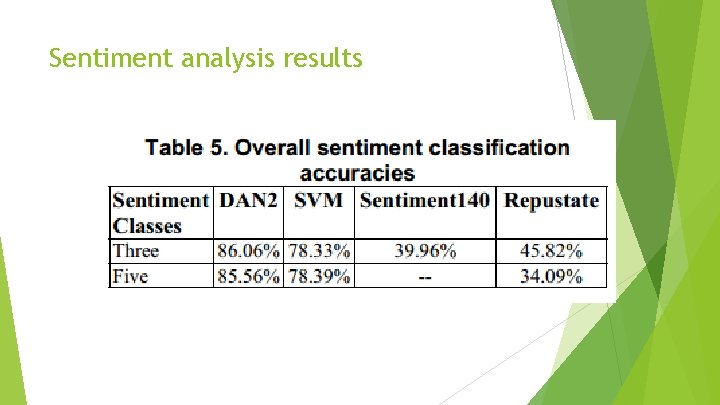
Sentiment analysis experimentation Ø Compare the proposed approach to the performances of two state-ofthe-art Twitter sentiment analysis systems, Sentiment 140 from the academic domain and the commercial system Repustate. Ø Compare with Support Vector Machine (SVM) models that are provided the very same features and instances as input.
Sentiment analysis results
Sentiment analysis results
Sentiment analysis results
Conclusion Ø We presented an approach to brand-related Twitter sentiment analysis using feature engineering and the Dynamic Architecture for Artificial Neural Networks (DAN 2) Ø The approach addressed challenges associated with the unique characteristics of the Twitter language and the recall of mild sentiment expressions that are of paramount interest to brand management practitioners.
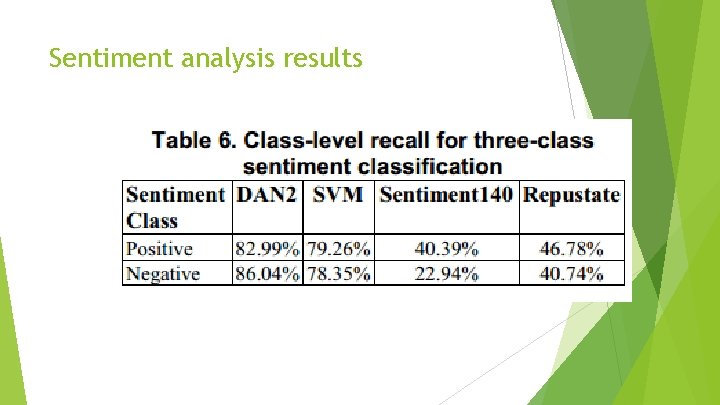
Conclusion Ø While only seven dimensions, the tweet feature representation effectively captured the expressions of sentiments in Starbucks brand-related tweets. Ø The DAN 2 and SVM models performed very well, and outperformed the stateof-the-art systems Ø The performances of the DAN 2 models were superior to the SVM models across all experiments and sentiment classes
Limitations Ø This feature selection process requires lot of human work, which may not be applied to bigger dataset
Reference Zimbra, D. , Ghiassi, M. , & Lee, S. (2016, January). Brand-Related Twitter Sentiment Analysis Using Feature Engineering and the Dynamic Architecture for Artificial Neural Networks. In 2016 49 th Hawaii International Conference on System Sciences (HICSS) (pp. 1930 -1938). IEEE.
- Slides: 33