
BRAND LOYALTY BRAND COMMUNITY IDENTIFICATION AND SELFBRAND CONNECTION
BRAND LOYALTY, BRAND COMMUNITY IDENTIFICATION AND SELF-BRAND CONNECTION AS ANTECEDENTS TO OPPOSITIONAL BRAND REFERRALS François Marticotte, Professor of Marketing Manon Arcand, Professor of Marketing Damien Baudry, M. Sc. Student
CONTEXT Strong positive CBR -> repeated purchases, willingness to pay a premium (Grégoire & Fisher, 2006), positive WOM promoting the brand, higher brand loyalty and creation of more active brand communities (Becerra & Badrinarayanan, 2013). BRAND…. devotion, love, attachment Negative CBR -> avoidance / retaliation behaviors, anti-brand communities or negative WOM (Hollenbeck & Zinkhan, 2006; Grégoire & Fisher, 2006 ; Grégoire et al. , 2009; Romani et al. , 2009) BRAND… divorce, revenge In these instances, consumers have some kind of experience with the brand Can strong positive CBR -> Negative reactions toward a rival brand? ? ?
CONTEXT AND OBJECTIVE OF THE STUDY This study’ objective is to examine how brand relationship variables (i. e. , brand loyalty, self-brand connection, and brand community identity) impact “oppositional brand referrals” (Becerra & Badrinarayanan, 2013) Oppositional brand referrals is conceptualized as a bidimensional construct: a negative intention toward the brand (i. e. , desire to harm) a negative behavior (i. e. , negative word-of-mouth). Conducted in the high-definition home videogame consoles industry (XBOX vs Playstation)
BRAND EVANGELISM “… the active behavioral and vocal support of a brand including actions such as purchasing the brand, disseminating positive brand referrals, and convincing others about a focal brand by disparaging competing brands. ” (Becerra & Badrinarayanan, 2013: p. 372).
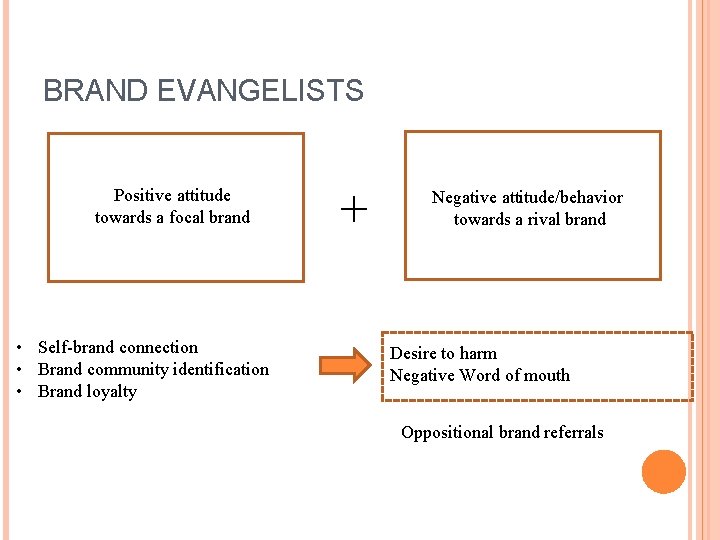
BRAND EVANGELISTS Positive attitude towards a focal brand • Self-brand connection • Brand community identification • Brand loyalty + Negative attitude/behavior towards a rival brand Desire to harm Negative Word of mouth Oppositional brand referrals
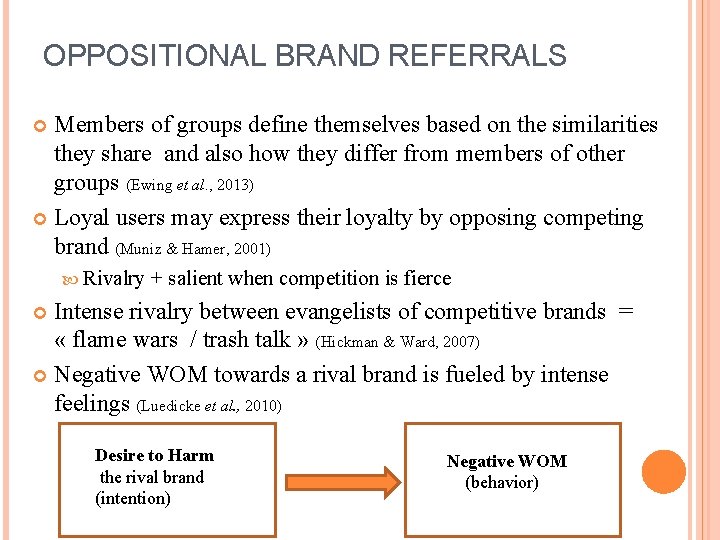
OPPOSITIONAL BRAND REFERRALS Members of groups define themselves based on the similarities they share and also how they differ from members of other groups (Ewing et al. , 2013) Loyal users may express their loyalty by opposing competing brand (Muniz & Hamer, 2001) Rivalry + salient when competition is fierce Intense rivalry between evangelists of competitive brands = « flame wars / trash talk » (Hickman & Ward, 2007) Negative WOM towards a rival brand is fueled by intense feelings (Luedicke et al. , 2010) Desire to Harm the rival brand (intention) Negative WOM (behavior)
FACTORS LEADING TO OPPOSITIONAL BRAND REFERRALS Self-brand connection Strong brand identification means that the consumer and the brand share the same identity (Ashforth & Mael, 1989), the brand is incorporated in its self-concept (Escalas & Bettman, 2003) Brand community identification towards a focal brand The “shared consciousness of kind” (Muniz & O’Guinn, 2003) Brand loyalty People who are loyal to a particular brand will tend to defend themselves against criticism of that brand (Amine, 1998)
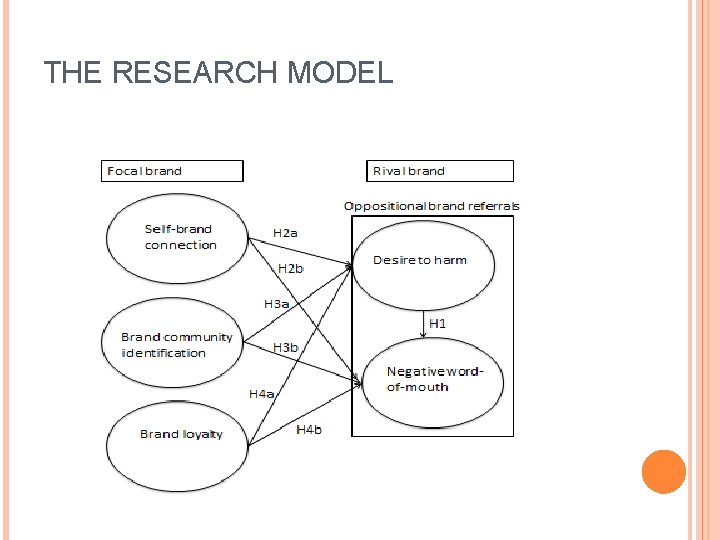
THE RESEARCH MODEL
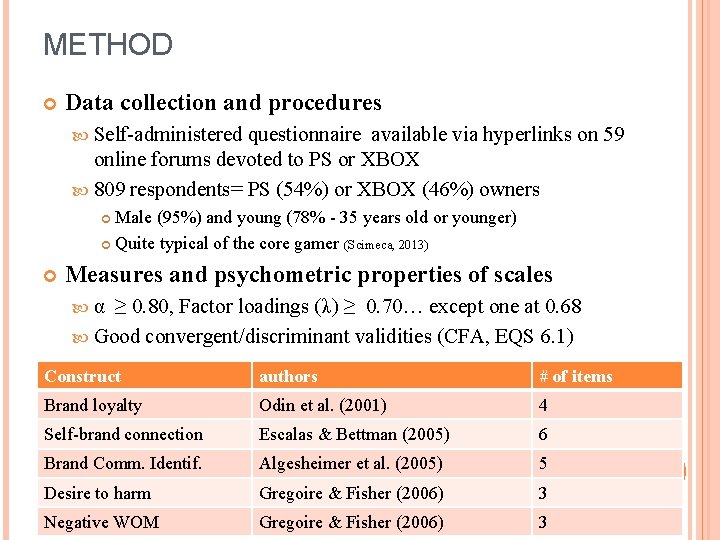
METHOD Data collection and procedures Self-administered questionnaire available via hyperlinks on 59 online forums devoted to PS or XBOX 809 respondents= PS (54%) or XBOX (46%) owners Male (95%) and young (78% - 35 years old or younger) Quite typical of the core gamer (Scimeca, 2013) Measures and psychometric properties of scales α ≥ 0. 80, Factor loadings (λ) ≥ 0. 70… except one at 0. 68 Good convergent/discriminant validities (CFA, EQS 6. 1) Construct authors # of items Brand loyalty Odin et al. (2001) 4 Self-brand connection Escalas & Bettman (2005) 6 Brand Comm. Identif. Algesheimer et al. (2005) 5 Desire to harm Gregoire & Fisher (2006) 3 Negative WOM Gregoire & Fisher (2006) 3
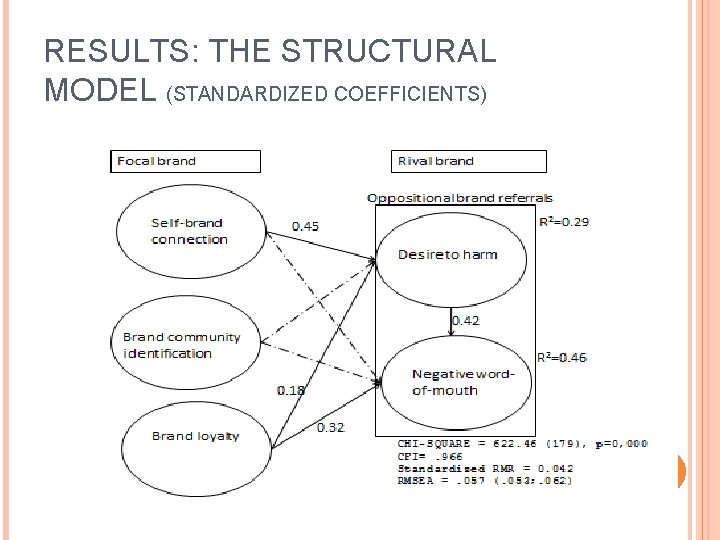
RESULTS: THE STRUCTURAL MODEL (STANDARDIZED COEFFICIENTS)
DISCUSSION The gamers’ involvement in a brand community does not influence their oppositional brand referral The dynamics within the brand community might be focused more on technical aspects (sharing information, tips and game play experiences) than on sharing of core values that could give rise to brand identification and foster emotional discussions, passion leading to oppositional brand referral behavior (Schmitt, 2013). This study is among the firsts to identify factors influencing consumers with no direct experience of a competing brand to engage in negative WOM against that brand. Desire for retaliation -> Negative WOM (unsatisfaction exper. ) Desire to harm -> Negative WOM (rival brands)
DISCUSSION – MANAGERIAL CONTRIBUTIONS In their branding efforts, manufacturers of consoles could place more emphasis on creating / transmitting brand images and emotions (vs technical aspects). For first time buyers, the choice between two brands (PS vs XBOX) may be difficult, both products = similar specs, same repertoire of games, same price range and sold in same stores. This study provides a framework to brand managers Develop strong and meaningful relationships with customers who, if they become brand evangelists, may participate in strategies focusing on competing brands.
LIMITS AND FUTURE RESEARCH Convenience sample focusing on a specific industry Brand connection and brand loyalty to what? XBOX and PS or Microsoft and Sony? ? ? Explore the effect of size of the communities and identification to the community (Scarpi, 2010) Examine the dynamics within brand communities to determine if they are conducive to the « we-ness » ambiance (Muniz and Hamer, 2001)
THANK YOU QUESTIONS? @manonarcand. manon@uqam. ca http: //professeurs. uqam. ca/savrepertoireprofesseurs/professeurs
- Slides: 14