
Branching Machine control Instructions Microprocessor 8085 unit I
Branching & Machine control Instructions Microprocessor 8085 - unit I
Branching Instructions �There are three types �JUMP (JMP) �CALL �RETURN (RET)
�JUMP i) Unconditional ii) Conditional �CALL i) Unconditional ii) Conditional �RETURN i) Unconditional ii) Conditional
JUMP �JMP addr 16 PC addr 16 It is unconditional jump instruction. When the instruction is executed, the address given in the instruction is moved to the program counter. Now, the processor starts executing the instruction stored in this address.
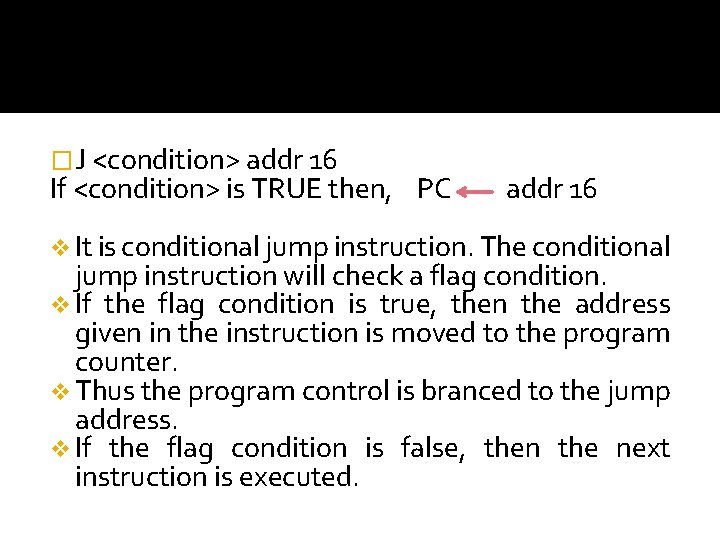
�J <condition> addr 16 If <condition> is TRUE then, PC addr 16 v It is conditional jump instruction. The conditional jump instruction will check a flag condition. v If the flag condition is true, then the address given in the instruction is moved to the program counter. v Thus the program control is branced to the jump address. v If the flag condition is false, then the next instruction is executed.
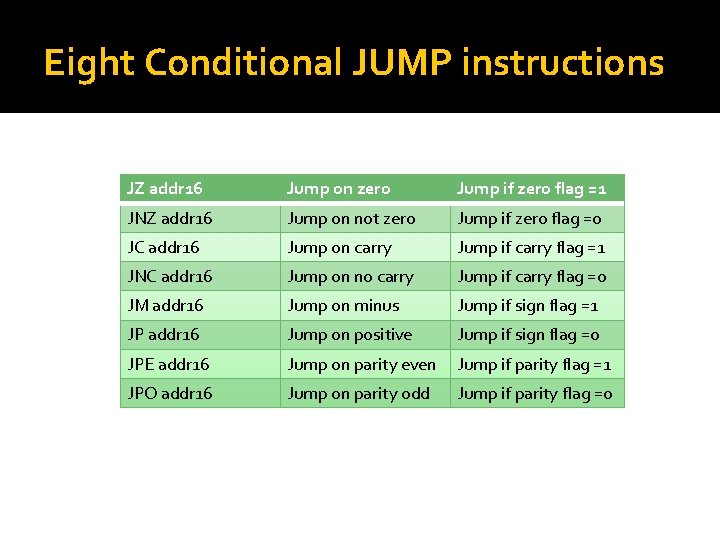
Eight Conditional JUMP instructions JZ addr 16 Jump on zero Jump if zero flag =1 JNZ addr 16 Jump on not zero Jump if zero flag =0 JC addr 16 Jump on carry Jump if carry flag =1 JNC addr 16 Jump on no carry Jump if carry flag =0 JM addr 16 Jump on minus Jump if sign flag =1 JP addr 16 Jump on positive Jump if sign flag =0 JPE addr 16 Jump on parity even Jump if parity flag =1 JPO addr 16 Jump on parity odd Jump if parity flag =0
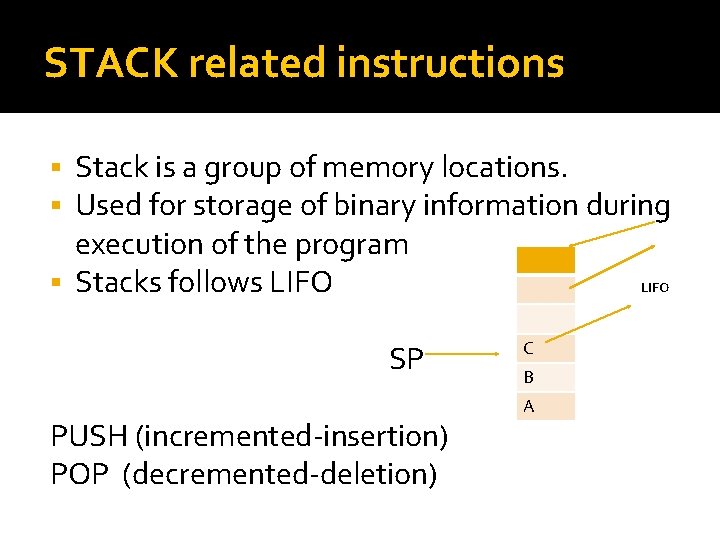
STACK related instructions Stack is a group of memory locations. Used for storage of binary information during execution of the program § Stacks follows LIFO § § SP PUSH (incremented-insertion) POP (decremented-deletion) C B A
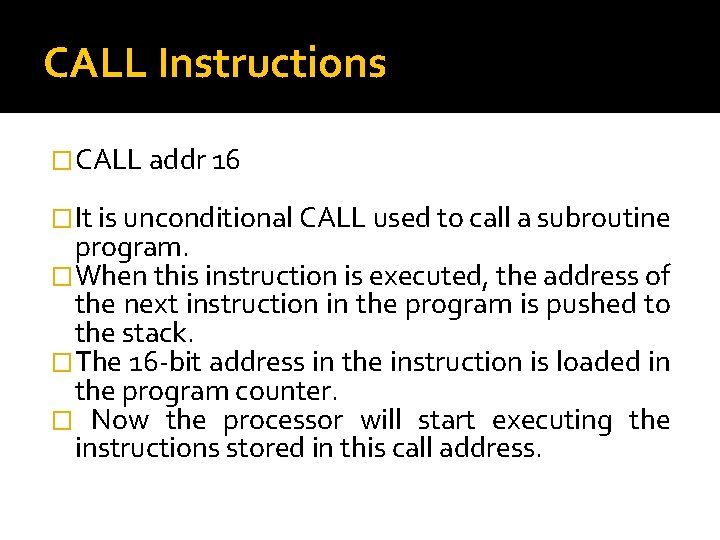
CALL Instructions �CALL addr 16 �It is unconditional CALL used to call a subroutine program. �When this instruction is executed, the address of the next instruction in the program is pushed to the stack. �The 16 -bit address in the instruction is loaded in the program counter. � Now the processor will start executing the instructions stored in this call address.
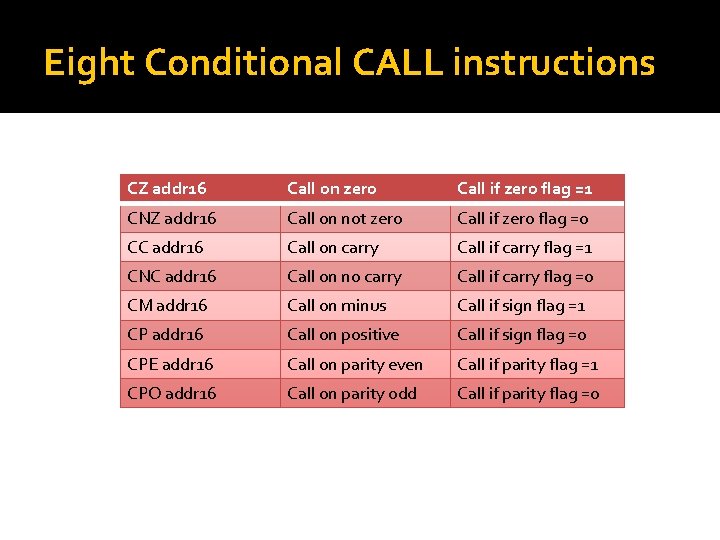
Eight Conditional CALL instructions CZ addr 16 Call on zero Call if zero flag =1 CNZ addr 16 Call on not zero Call if zero flag =0 CC addr 16 Call on carry Call if carry flag =1 CNC addr 16 Call on no carry Call if carry flag =0 CM addr 16 Call on minus Call if sign flag =1 CP addr 16 Call on positive Call if sign flag =0 CPE addr 16 Call on parity even Call if parity flag =1 CPO addr 16 Call on parity odd Call if parity flag =0
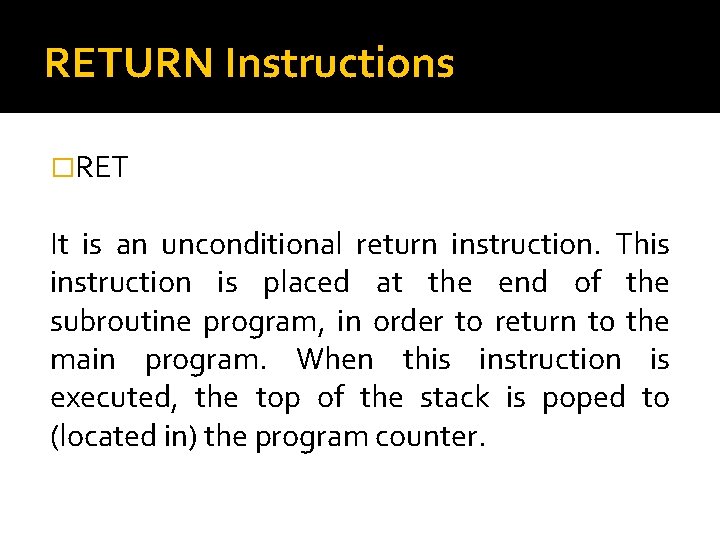
RETURN Instructions �RET It is an unconditional return instruction. This instruction is placed at the end of the subroutine program, in order to return t 0 the main program. When this instruction is executed, the top of the stack is poped to (located in) the program counter.
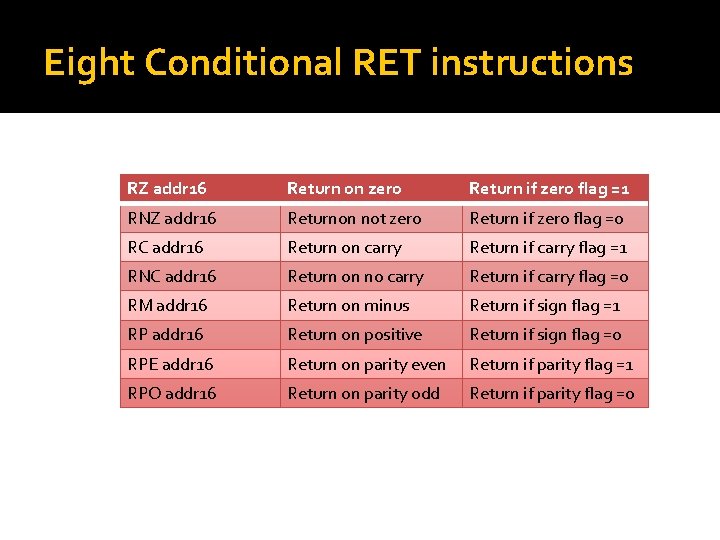
Eight Conditional RET instructions RZ addr 16 Return on zero Return if zero flag =1 RNZ addr 16 Returnon not zero Return if zero flag =0 RC addr 16 Return on carry Return if carry flag =1 RNC addr 16 Return on no carry Return if carry flag =0 RM addr 16 Return on minus Return if sign flag =1 RP addr 16 Return on positive Return if sign flag =0 RPE addr 16 Return on parity even Return if parity flag =1 RPO addr 16 Return on parity odd Return if parity flag =0
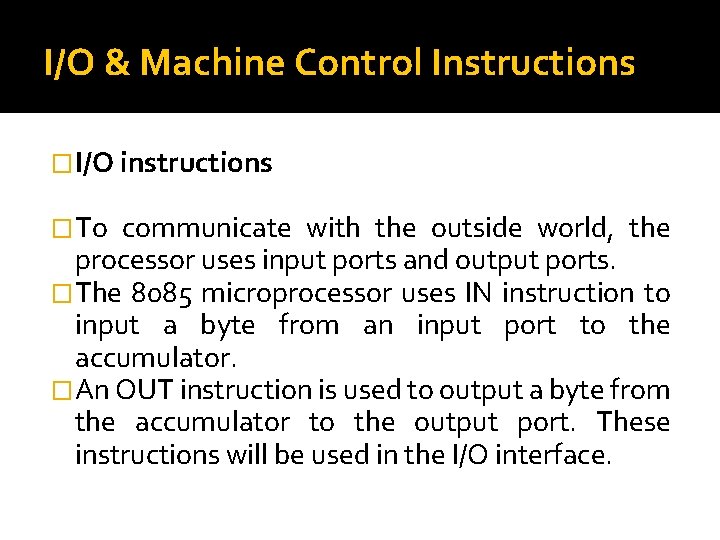
I/O & Machine Control Instructions �I/O instructions �To communicate with the outside world, the processor uses input ports and output ports. �The 8085 microprocessor uses IN instruction to input a byte from an input port to the accumulator. �An OUT instruction is used to output a byte from the accumulator to the output port. These instructions will be used in the I/O interface.
� Machine control instructions only control the processor operations and do not perform any operation on data. They are all single byte instructions. � Halt instructions (HLT) � No operation instruction (NOP) � Interrupt related instructions ▪ ▪ EI-enable interrupt DI-disable interrupt SIM-set interrupt mask RIM-read interrupt mask
HLT � This instruction is placed at the end of the program. � When this instruction is executed the processor suspends program execution and bus will be in idle state. � It is 1 -byte instruction. NOP � The instruction NOP performs no operation. It is a dummy operation. � This is an useful instruction for producing software delay and reserve memory spaces for future software modifications. DI � When this instruction is executed all the interrupts except TRAP are disabled. EI � This instruction is used (or executed) to allow the interrupts after disabling. � The interrupts except TRAP are disabled after processor reset or after execution of DI instruction. � When we want to allow the interrupt, we have to execute the instruction.
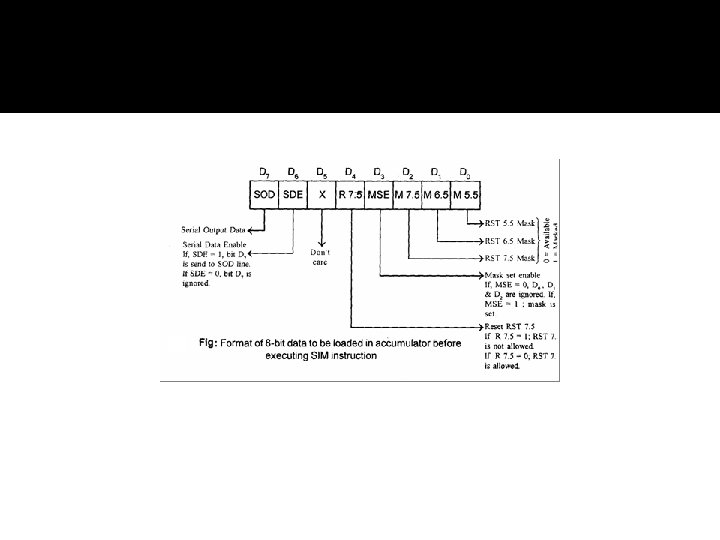
�SIM INSTRUCTION �SIM stands for set interrupt mask. This is a 1 - byte instruction. Using this instruction any one of the interrupts can be masked. It is also used to send data through SOD line. The execution of SIM instruction uses the content of the accumulator to perform the following functions. �Program the interrupt mask, for the hardware interrupts RST 5. 5, RST 6. 5 and RST 7. 5 �Reset the edge-triggered RST 7. 5 input latch. �Load the SOD output latch.
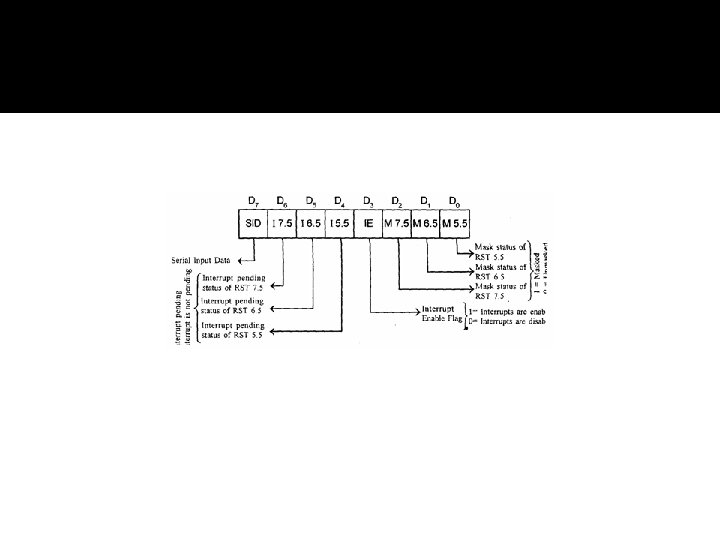
�RIM INSTRUCTION �The RIM instruction is used to check whether an interrupt is masked or not. It is also used read data from SID line. �When RIM instruction is executed the accumulator is loaded with 8 -bit data.
- Slides: 18