
Branches of Science and Inquiry AIM How do
Branches of Science and Inquiry AIM: How do we classify science?
How many can you name? • Name all of the branches of science you can think of! • Share with the person next to you and write down anything they had that you didn’t.
Branches of Science Biological Sciences Biology – Study of living things Ecology – Study of living things & their environment Botany - Study of plants Zoology - Study of animals
Branches of Science Physical Sciences Physics – study of non-living matter & its motion Chemistry – Study of elements, compounds & their reactions
Branches of Science Earth Sciences Oceanography – study of the oceans & the ocean floor Geology - study of rocks, the earth, and its formations Meteorology - study of weather and the atmosphere Astronomy - study of stars, planets, and moons
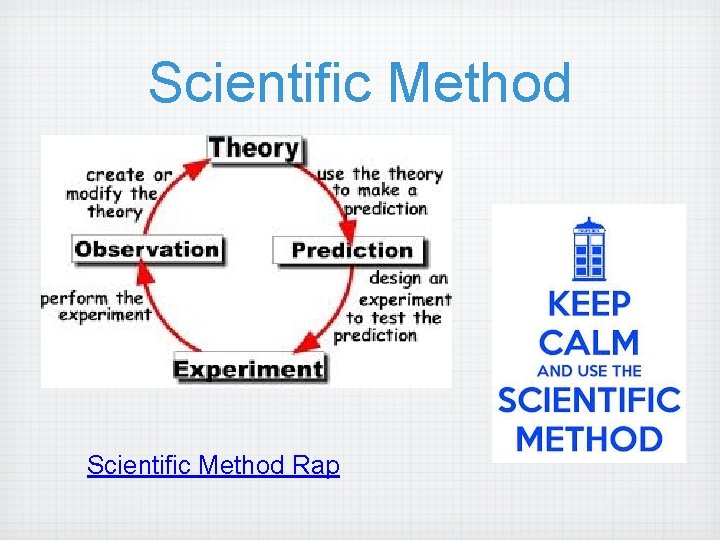
Scientific Method Rap
Name the Steps! Think, Pair, Share! Use the following acronym to name the steps of the Scientific Method. “People Recently Have Made Exceptional Oreo Cookies!”
Problem - Identify and clearly define the problem to be solved. Research - Gather background information on the topic. Were there other experiments and what have they discovered.
Hypothesis - Statement of question that determines a possible solution to a problem. Materials - List of what you will need to perform the experiment.
Experimental Procedures- Step by step instructions on how to perform the experiment. Observations & Data- Make careful observations of what is happening in the experiment using your 5 senses
Conclusion Upon repeated experimentation (3 X’s at least), results are studied that either support or disprove the hypothesis.
How can we improve an experiment? Think, Pair, Share! Can improve experiment by adding: 1. more trials 2. more test groups
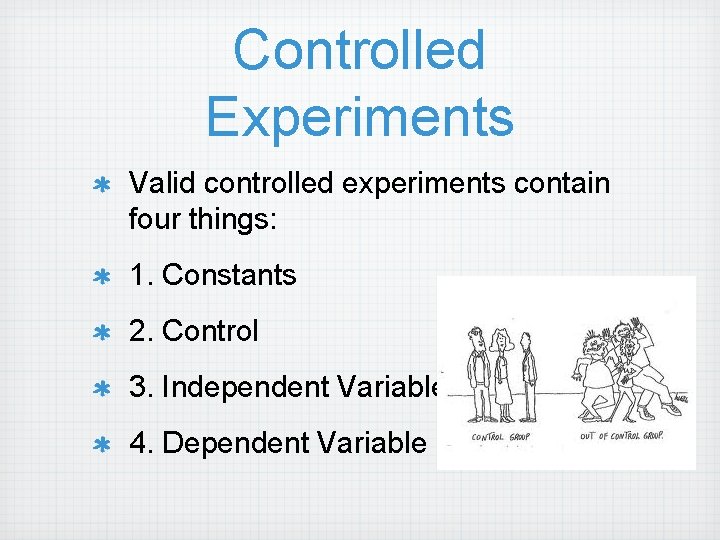
Controlled Experiments Valid controlled experiments contain four things: 1. Constants 2. Control 3. Independent Variable 4. Dependent Variable
What normally happens in Controlan experiment with no testing. Shows the results of the experiment are really due to what you were testing. Used as a comparison. Constants - Things in an experiment that remain the same throughout an experiment. Ex. Graduated cylinders, balance scale
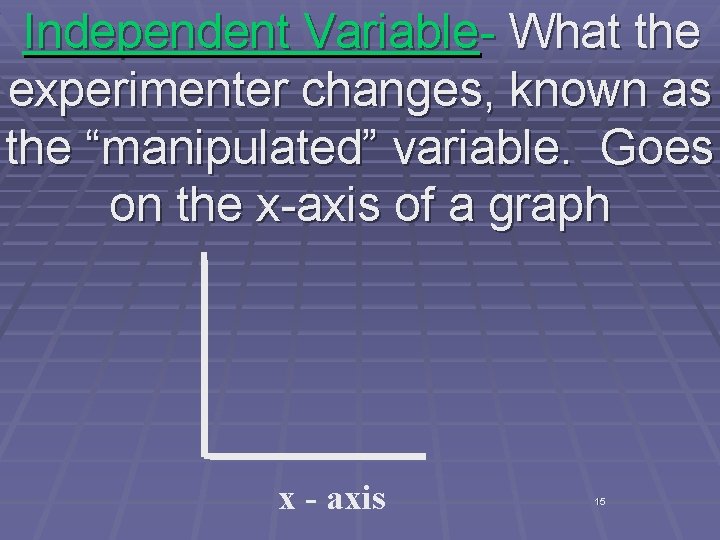
Independent Variable- What the experimenter changes, known as the “manipulated” variable. Goes on the x-axis of a graph x - axis 15
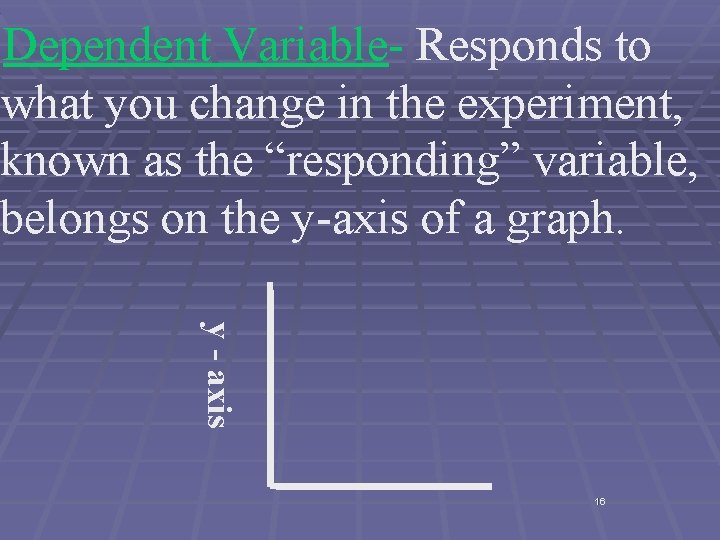
Dependent Variable- Responds to what you change in the experiment, known as the “responding” variable, belongs on the y-axis of a graph. y - axis 16
- Slides: 16