
Branches of Literature Poetry Verbal utterances that are
Branches of Literature Poetry: Verbal utterances that are composed according to metrical schemes. Non-fiction: Writing that is about real life, rather than imaginary people and events. Drama: Work that is meant to be performed on stage (theater) by actors in the form of a play. Fiction: Writing that comes from the author’s imagination and that is intended mainly to entertain.
Poetry is an imaginative awareness of experience expressed through meaning, sound, and rhythmic language choices so as to evoke an emotional response. - Poetry has been known to employ meter and rhyme, but this is by no means necessary. - Poetry is an ancient form that has gone through numerous and drastic reinvention over time. -
Poetry does more exploiting of words than other genres. Poetry relies most on the power of words. Poetry is the most literary of all branches of literature because it makes use of the raw material of literature which is words. Once upon a time, the only literature that existed was poetry. Prose was just for jotting down laws and records and scientific theories.
Historical Phases Old English: Is to be treated like a foreign language, i. e. it has to be learnt with grammar books and dictionaries. Middle English: Phase of transition. Modern English: It starts as soon as we can understand a poem or prose without the help of a grammar book or dictionary.
Old English The Britons were ruled for a few centuries by the Romans. The Romans brought their language, architects and engineers who gave Britain towns, villas with central heating, public baths and theaters. However, the Roman Empire fell and the Romans withdrew. Later people from Northwest Europe settled claiming the country for themselves. They were called Angles and Saxons.
Old English Literature (600 -1100 A. D) also known as Anglo-Saxon was the earliest form of English. Old English poems are usually long narrative epics giving accounts of great deeds of warriors and heroes. Beowulf: greatest and first Old English poem (epic) written in the 7 th century by an unknown author. Anglo-Saxon Chronicle: oldest interesting prose.
Middle English Literature (1100 - 1500 A. D) Middle English: Language used from 1100 1500 A. D. Geoffrey Chaucer was born in 1340. Chaucer’s major achievement was to create the English language we know today and to establish its literary traditions. Known as father of English poetry and the greatest poet of the time because he speaks to us today with as clear a voice as we heard in his own age. It is this living quality that makes him great.
Middle English Literature (1100 - 1500 A. D) The Canterbury Tales (17, 000 lines poem): A party of pilgrims tell stories to pass the time on their pilgrimage from London to Canterbury. Troilus and Cryseyde and The Legend of Good Women: Chaucer’s romantic poems. Sir Gwain and the Green Knight (1360): The first piece of English fiction.
Middle English Literature (1100 - 1500 A. D) Prose – mainly religious e. g. The Ancren Riwle (13 th century) First English plays: Miracle/Mystery plays. Morality Plays: characters are not people, but virtues (Truth, Honor, Greed, Revenge). Interlude: a funny play by two or three performers.
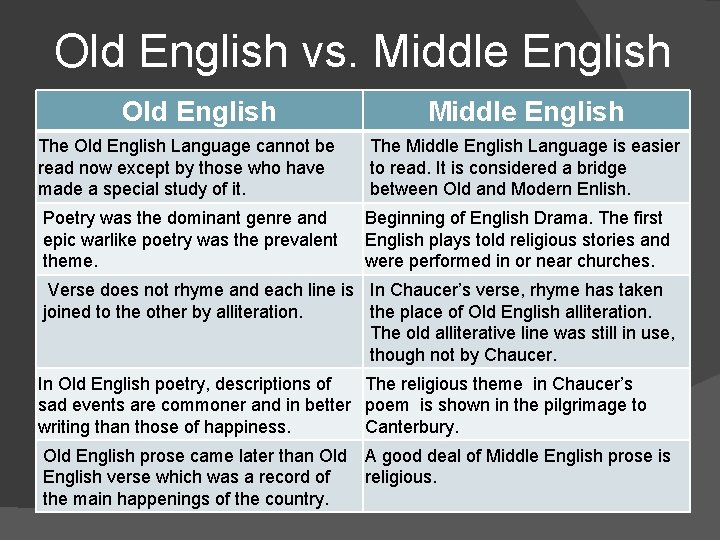
Old English vs. Middle English Old English Middle English The Old English Language cannot be read now except by those who have made a special study of it. The Middle English Language is easier to read. It is considered a bridge between Old and Modern Enlish. Poetry was the dominant genre and epic warlike poetry was the prevalent theme. Beginning of English Drama. The first English plays told religious stories and were performed in or near churches. Verse does not rhyme and each line is In Chaucer’s verse, rhyme has taken joined to the other by alliteration. the place of Old English alliteration. The old alliterative line was still in use, though not by Chaucer. In Old English poetry, descriptions of The religious theme in Chaucer’s sad events are commoner and in better poem is shown in the pilgrimage to writing than those of happiness. Canterbury. Old English prose came later than Old English verse which was a record of the main happenings of the country. A good deal of Middle English prose is religious.
Elizabethan Poetry and Prose (1558 -1603 A. D) Golden age in English History (height of the English Renaissance - the age of Shakespeare) English Renaissance was a cultural and artistic movement in England dating from the early 16 th to the early 17 th century. Imitators of Chaucer appeared but few are of great interest. Great Elizabethan literary age: 1579 Writing of poetry: part of gentlemen’s education
Elizabethan Poetry and Prose (1558 -1603 A. D) Greatest Poets: Sir Thomas Wyatt and the Earl of Surrey - wrote sonnets (taken from the Italians) Wyatt – first to bring the sonnet form to England. (Petrarch – 14 th century Italian poet) Surrey: first to write poems in blank verse. Sonnet: 14 – line lyric poem of fixed form and rhyme pattern. (Italian and Shakespearean) Blank Verse: verse without rhyme, usually in lines of five iambic feet.
Elizabethan Poetry, Prose, & Drama (1558 -1603 A. D) Edmund Spencer: first proper Elizabethan poet who wrote The Shepherd’s Calendar. (pastoral poem) Combined Shakespearean and Italian sonnet forms. The Faerie Queene (1589 -96) Lyric Poetry: gives expression and more focus to the poet’s thoughts and feelings (prominent towards the end of the Elizabethan age)
Elizabethan Poetry, Prose, & Drama (1558 -1603 A. D) Best lyrics in dramatic works are Shakespeare’s Twelfth Night (1601) and Christopher Marlowe’s The Passionate Shepherd to his Love. (1599) Jacobean era (1603 -25): Lyrical works lost its force and metaphysical poetry began. Metaphysical Poetry: poems that are less beautiful and musical, containing more tricks of style and images. John Donne: greatest metaphysical poet (Jacobean era) but it is difficult to find a complete poem by him which is faultless. Best works: Songs and Sonnets
Elizabethan Poetry, Prose, Drama & Novel (1558 -1603) John Donne: greatest metaphysical poet (Jacobean era) but it is difficult to find a complete poem by him which is faultless. Best works: Songs and Sonnets. Holy Sonnets John Donne: poems: realistic and sensual style, liveliness of language and creativity of metaphor. Metaphor: a method of describing something by saying it is like something else without using “like” and “as”. E. g. This man is a snake.
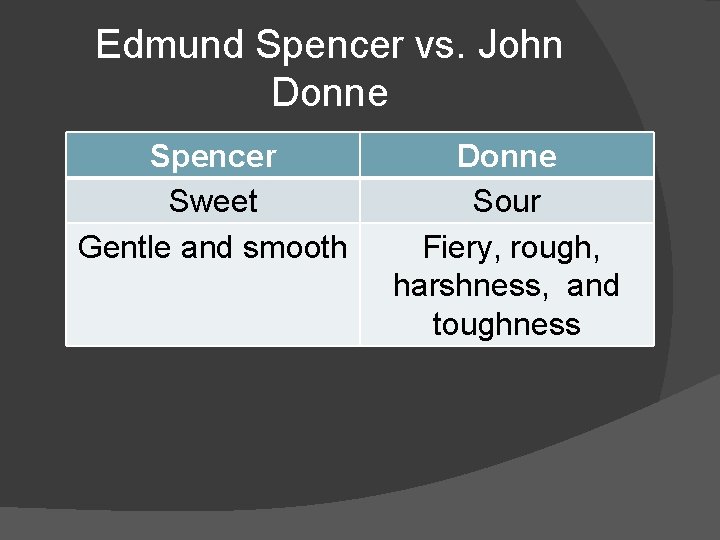
Edmund Spencer vs. John Donne Spencer Sweet Gentle and smooth Donne Sour Fiery, rough, harshness, and toughness
Elizabethan Poetry, Prose, Drama & Novel (1558 -1603) Dramatist Ben Jonson (1572 -1637): known as “Rare Ben Jonson” wrote poetry, prose, and drama To Celia: one of Jonson’s best lyrics. Known as Shakespeare’s contemporary Best known for his satirical plays: Volpone (1606) and The Alchemist (1610). Jonson influenced later younger Jacobean and Caroline playwrights and poets. Prose: Timber or Discoveries (1640)
Elizabethan Poetry, Prose, Drama & Novel (1558 -1603) Known as father of English Literary Criticism. (Poetic abilities) Judges work as whole. Criticized Shakespeare, Spenser, and Donne. Kind of Novel produced: John Lyly’s Euphues (1578 -80) Euphues: known for it’s style – alliteration and similes. Simile: A method of describing something by comparing it to something else using “like” or “as”. E. g. She looks like a red rose.
Elizabethan Poetry, Prose, Drama & Novel (1558 -1603 A. D) John Lyly’s Eupheus: impact on style. The term 'euphuism' was added to the language referring to Lyly’s style. Elizabethan Novelists: Robert Greene and Thomas Nash: Picaresque novels (Spain): novels based on adventures (in different places) of men who are wicked but lovable Elizabethan novels: little value – started false beginning, and died out.
Glossary of Literary Terms Epic: A long story in poetry of the adventures of a brave man or men. It contains a lot of action. Alliteration: Two or more words beginning with the same sound e. g. lord of language. Allegory: A story which teaches a moral lesson because the people and places in it stand for other ideas. Rhyme: Ending two or more verse lines with the same sounds. Two lines rhyme when each has the same vowel sound bearing the last stress e. g. pay and day. Lyric: a poem – originally one meant to be sung – which expresses the poet’s thoughts and feelings. Prose: The ordinary written language, not specially controlled like verse.
Glossary of Literary Terms Metre: the number and kinds of feet in the lines of poetry. Sonnet: A 14 –line lyric poem of fixed form and rhyme pattern. Blank verse: Verse without rhyme, usually in lines of five iambic feet. Feet: small groups of syllables. Iambic: unstressed syllable followed by a stressed syllable e. g. da dum - da dum.
- Slides: 21