
Branches of Government Branches of Government In most
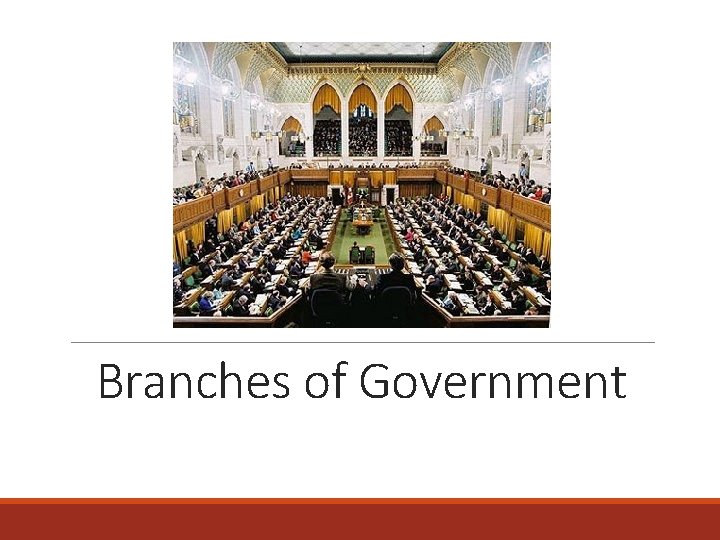
Branches of Government
Branches of Government In most democracies, government powers are separated into branches v Montesquieu (French political thinker) thought that by separating government powers into branches, each would be checked and balanced by the others v Most democratic governments (including Canada, U. S. , Britain) have a three-branched structure
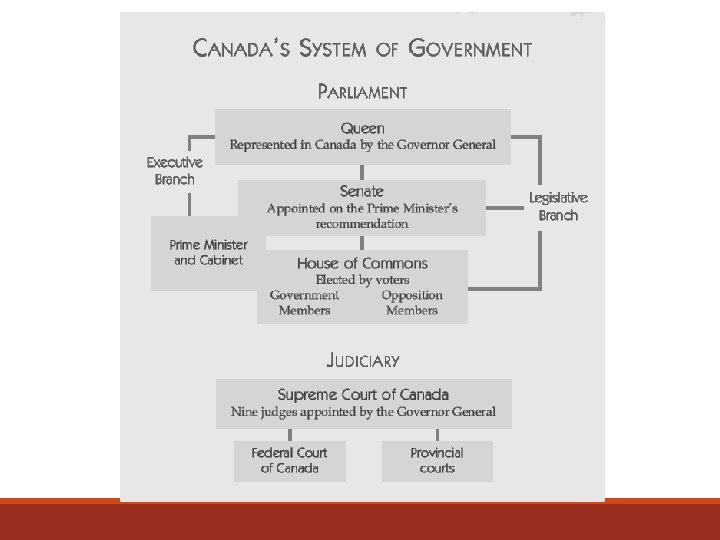
Branches of Canadian Gov’t Three branches: v Executive: To carry out the business of government v Legislative: To make laws v Judicial: To interpret and enforce laws Note: v The term “branch of government” is usually used only at the federal and provincial levels v Local governments have branches to make and enforce laws; they just don’t call them that

Executive Branch
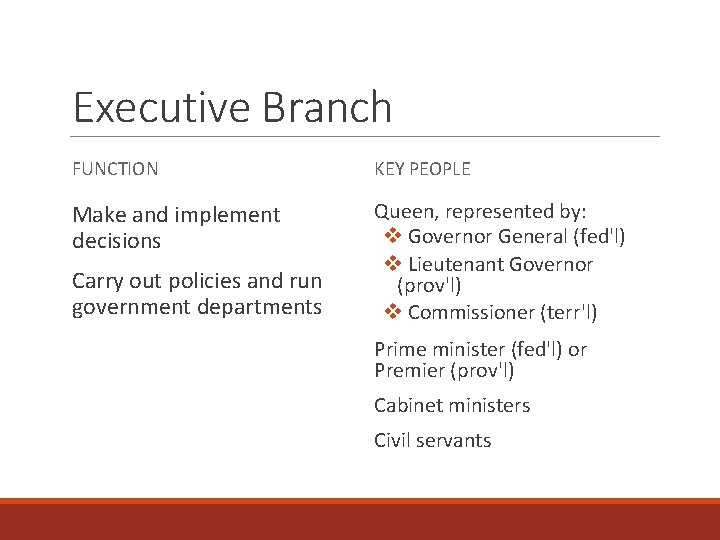
Executive Branch FUNCTION KEY PEOPLE Make and implement decisions Queen, represented by: v Governor General (fed'l) v Lieutenant Governor (prov'l) v Commissioner (terr'l) Carry out policies and run government departments Prime minister (fed'l) or Premier (prov'l) Cabinet ministers Civil servants
The Governor General Remember that Canada is a constitutional monarchy v v v British monarch = official head of state (Queen Elizabeth II) The Constitution limits the monarch’s power Because the monarch lives in Britain, she is represented in Canada by the governor general (GG), who is head of government GG is a figurehead: v v Position, like the monarch’s, is symbolic Meant to reflect and represent the best traditions rooted in Canada’s past
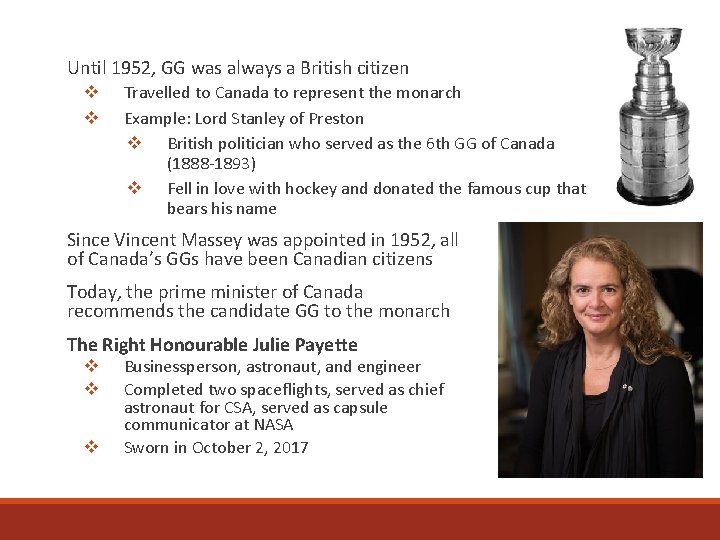
Until 1952, GG was always a British citizen v v Travelled to Canada to represent the monarch Example: Lord Stanley of Preston v British politician who served as the 6 th GG of Canada (1888 -1893) v Fell in love with hockey and donated the famous cup that bears his name Since Vincent Massey was appointed in 1952, all of Canada’s GGs have been Canadian citizens Today, the prime minister of Canada recommends the candidate GG to the monarch The Right Honourable Julie Payette v v v Businessperson, astronaut, and engineer Completed two spaceflights, served as chief astronaut for CSA, served as capsule communicator at NASA Sworn in October 2, 2017
GG Responsibilities v Usually serves a term for 5 years v Signs all bills into law (known as giving royal assent) v Officially appoints the PM and dissolves Parliament (especially important in situations of a minority government) v Officially welcomes representatives of foreign governments to Canada v Reads the Speech from the Throne (government plans in a new session of Parliament) v Promotes pride in and awareness of Canada
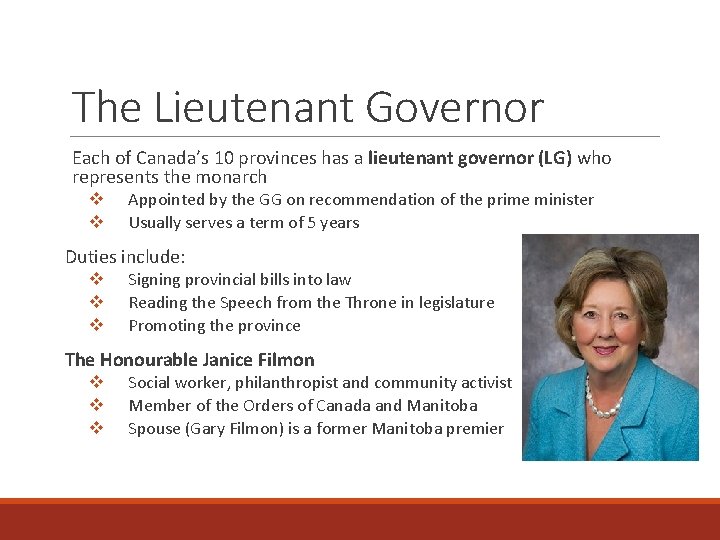
The Lieutenant Governor Each of Canada’s 10 provinces has a lieutenant governor (LG) who represents the monarch v v Appointed by the GG on recommendation of the prime minister Usually serves a term of 5 years Duties include: v v v Signing provincial bills into law Reading the Speech from the Throne in legislature Promoting the province The Honourable Janice Filmon v v v Social worker, philanthropist and community activist Member of the Orders of Canada and Manitoba Spouse (Gary Filmon) is a former Manitoba premier
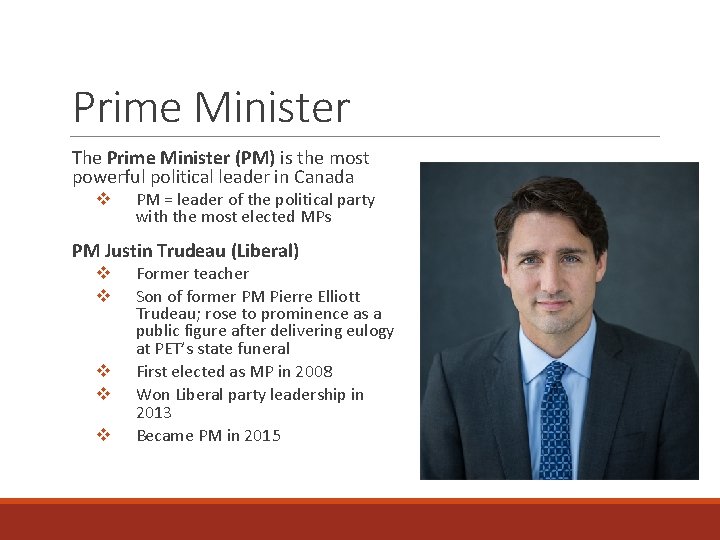
Prime Minister The Prime Minister (PM) is the most powerful political leader in Canada v PM = leader of the political party with the most elected MPs PM Justin Trudeau (Liberal) v v v Former teacher Son of former PM Pierre Elliott Trudeau; rose to prominence as a public figure after delivering eulogy at PET’s state funeral First elected as MP in 2008 Won Liberal party leadership in 2013 Became PM in 2015
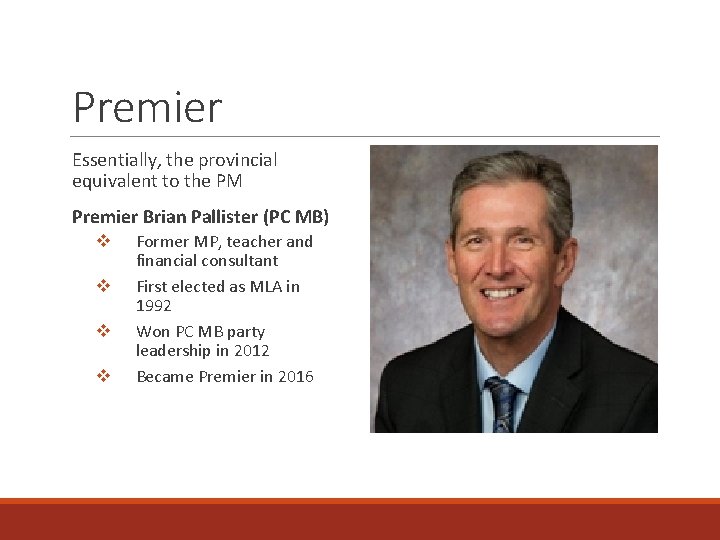
Premier Essentially, the provincial equivalent to the PM Premier Brian Pallister (PC MB) v v Former MP, teacher and financial consultant First elected as MLA in 1992 Won PC MB party leadership in 2012 Became Premier in 2016
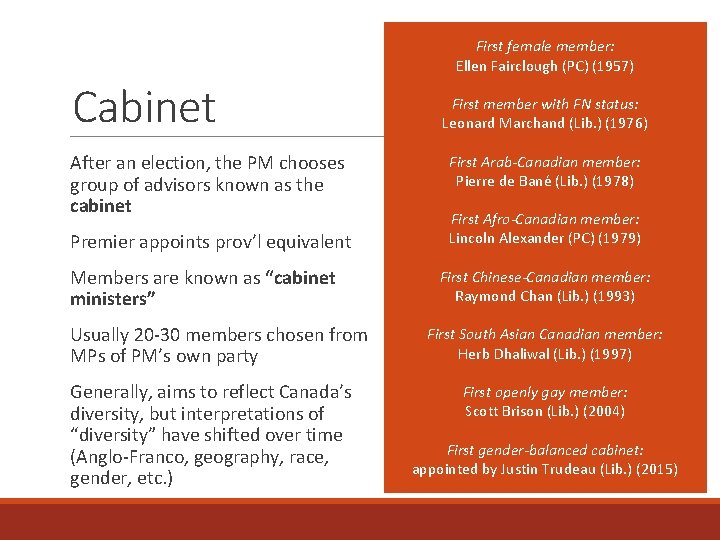
First female member: Ellen Fairclough (PC) (1957) Cabinet After an election, the PM chooses group of advisors known as the cabinet Premier appoints prov’l equivalent Members are known as “cabinet ministers” Usually 20 -30 members chosen from MPs of PM’s own party Generally, aims to reflect Canada’s diversity, but interpretations of “diversity” have shifted over time (Anglo-Franco, geography, race, gender, etc. ) First member with FN status: Leonard Marchand (Lib. ) (1976) First Arab-Canadian member: Pierre de Bané (Lib. ) (1978) First Afro-Canadian member: Lincoln Alexander (PC) (1979) First Chinese-Canadian member: Raymond Chan (Lib. ) (1993) First South Asian Canadian member: Herb Dhaliwal (Lib. ) (1997) First openly gay member: Scott Brison (Lib. ) (2004) First gender-balanced cabinet: appointed by Justin Trudeau (Lib. ) (2015)
Cabinet Responsibilities v Advise the PM v Lead and oversee departments (or “portfolios”) such as Finance, Justice, Health, and Defence v Set departmental priorities v Determine bureaucratic organization v Serve as the “public face” of the government and department v Note: The non-partisan employees of government departments are called “civil servants” v Demonstrate cabinet solidarity – all members of cabinet are expected to publicly support all cabinet decisions or resign from cabinet
Legislative Branch
Legislative Branch FUNCTION KEY PEOPLE Propose, debate, and pass laws (called bills) Queen, represented by: v GG (federal) v LG (prov'l) v Commissioner (territorial) House of Commons (fed'l) or Legislative Assembly (prov'l) Senate
Parliament Remember that Canada is a parliamentary democracy Our parliament (the official title of the legislative branch) consists of: v The monarch as represented by the GG v Senate (the “Upper House”) v House of Commons (the “Lower House”) Because there are two “houses, ” our parliament is known as a bicameral parliament
The House of Commons THE LOWER HOUSE OF THE LEGISLATIVE BRANCH
The House of Commons v 338 MPs elected in to represent ridings across Canada (2015) v Each MP represents the interests of the constituents (voters and non-voters) in their riding v HGI is located in Winnipeg South, currently represented by MP Terry Duguid (Lib. ) v Most MPs belong to a political party; if not, the MP is called an independent
Majority, Minority, and Coalition Governments v Majority government: The government has 170 or more seats in the Ho. C v Can generally pass bills as they see fit sit they have the majority of seats v Minority gov’t: The government has less than 170 seats v To pass bills, they have to get other parties to vote with them v Compromises must be made to avoid defeat v Coalition gov’t: Two or more parties agree to join together to form the government
Losing Confidence v Exec. Branch must resign if it loses the support of Ho. C v For the government to maintain confidence, it needs the support of “one-half plus one” of total MPs (338/2+1=170) v When the gov’t loses an important vote in Ho. C, it has lost the confidence of the House v Opposition parties may introduce confidence motions to take down the government v Budget votes automatically considered confidence votes
v After government is defeated, the GG may: v Call a new election v Invite the Official Opposition (the party with the next largest number of seats) or a coalition to form a government v Regardless of matters of confidence, a federal election must be held at least every five years
Confidence Motions Article 1. Who first formed the BC government after the election? How long did it last? 2. Who was invited to form the next government? 3. What is a confidence vote? 4. When do confidence votes normally happen? 5. What happens when a government loses a confidence motion? 6. What triggered the last non-confidence vote at the federal level? What was the outcome?
Cabinet and Shadow Cabinet v Recall that the PM and the Cabinet are part of the Executive branch; they are also part of the Legislative branch because they are all MPs in the Ho. C v The Leader of the Official Opposition appoints a “shadow cabinet” from MPs from their own party v Members each take on a different cabinet area in which to take the lead as “critic” of the government (e. g. Health critic, Justice critic)
Backbenchers v Cabinet ministers and shadow cabinet members have significant political power v Reflected in their location in Ho. C front seats v Majority of MPs sit behind the cabinet/shadow cabinet, therefore known as “backbenchers” v Some key responsibilities: v Represent the interests of their constituents v Introduce private members’ bill v May exert influence, especially when majority is slim or when an issue is controversial
Where do bills come from? Ideas for new bills are usually introduced by cabinet ministers, although any MP may introduce a private members’ bill To become a law, a bill must be approved by a majority of MPs (regardless of party affiliation)
The Speaker of the House is an MP who acts like a referee to enforce rules of parliamentary debate v Elected by all MPs by secret ballot v Expected to be non-partisan (not side with any party) v Job was once very dangerous v 9 British parliament speakers were executed after their reports upset the monarch v Still ritually dragged to the Speaker’s chair
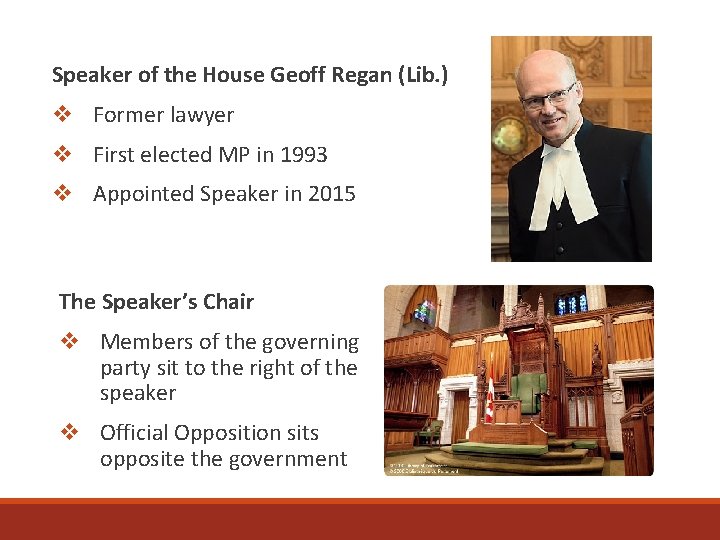
Speaker of the House Geoff Regan (Lib. ) v Former lawyer v First elected MP in 1993 v Appointed Speaker in 2015 The Speaker’s Chair v Members of the governing party sit to the right of the speaker v Official Opposition sits opposite the government
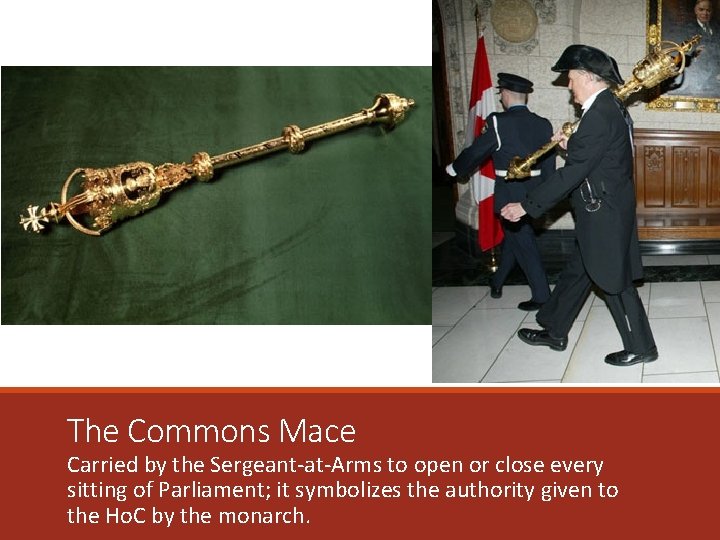
The Commons Mace Carried by the Sergeant-at-Arms to open or close every sitting of Parliament; it symbolizes the authority given to the Ho. C by the monarch.
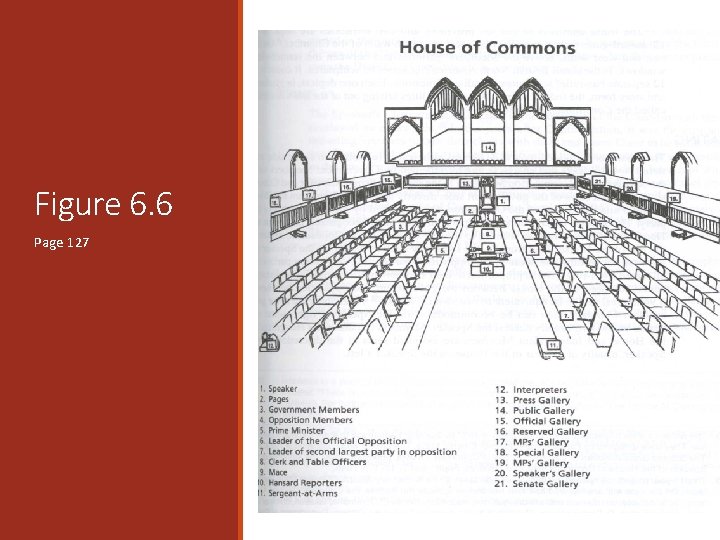
Figure 6. 6 Page 127
Question Period v Takes place each day when the House is in session v 45 minutes when opposition members can question the PM and cabinet v Often cabinet ministers do not answer questions directly; may also criticize the opposition v Full of political posturing and theatrics on both sides v E. g. heckling
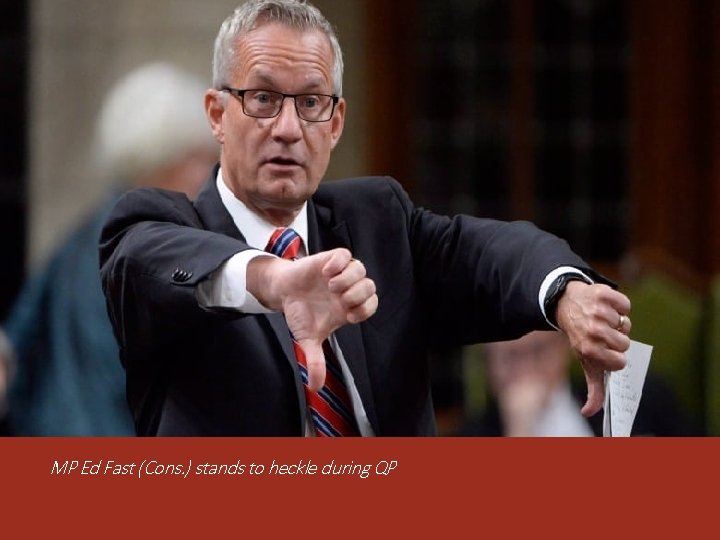
MP Ed Fast (Cons. ) stands to heckle during QP
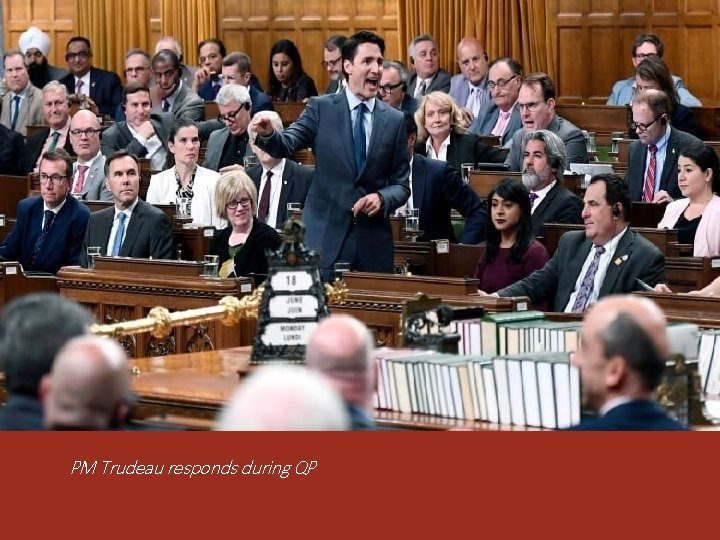
PM Trudeau responds during QP
v Everything said during QP is recorded and published in an official document called Hansard v MPs cannot speak directly to one another v Must address their remarks through the Speaker v Must refer to one another as “the Honourable member from [Riding]” v If an MP uses “unparliamentary language” (e. g. calling another MP a liar or swearing), the Speaker can insist that the MP apologize v If the MP refuses, he or she can be ejected from the House. https: //www. youtube. com/watch? v=Ti. Da 2 x. E-wl 8
Heckling Article 1. Who is the Speaker of the House? What has he been doing that is unusual? 2. Have the Speaker’s actions been effective? 3. Where is the House sitting now? Why? 4. How are heckles recorded in Hansard? 5. Who has been heckling the most? Why might that be? 6. Who has been heckled the most? Why might that be?
The Legislative Assembly v Essentially, the provincial equivalent of the Ho. C v Manitoba has 57 MLAs v Speaker, government party, official opposition, QP, mace, parliamentary etiquette, etc. just like in the Ho. C
Vote Video http: //www. youtube. com/watch? v=k. FN 01 e. Hw 6 IM&noredirect=1 Homework: Read the article titled “Iraq war resisters who fled to Canada ask Justin Trudeau to allow them to stay” and answer the questions: 1. Summarize the article in full sentences. 2. What are 3 issues presented in the article about the aftermath of the decision made to let US Iraq War resisters stay? 3. How does this article show the effects of decisions made in parliament? 4. Do the ideas represented in the article embody a choice made for the “common good”? Explain your ideas using your knowledge and the article.
The Senate THE UPPER HOUSE OF THE LEGISLATIVE BRANCH
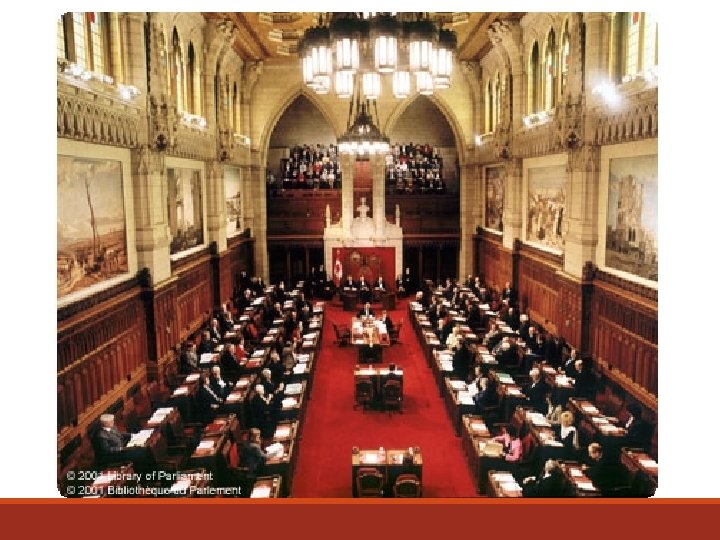
The Senate v Upper house of the legislative branch v “The Red Chamber” v Consists of 105 senators v Appointed by the GG on advice from the PM v Must retire at age 75 v Only exists at the federal level (no MB Senate)
v Historically, a major purpose of the Senate was to veto (block) “irresponsible” bills passed by the Ho. C v Thinking was that democratically elected Ho. C could not be trusted to run the government on its own and had to be overseen by the upper classes v All bills must pass both Ho. C and Senate (and receive GG’s royal assent) to become law v In practice, the Senate rarely vetoes bills received from the Ho. C instead, they often suggest improvements to bills v Senators may introduce their own bills, but usually they consider bills already passed by the Ho. C “sober second thought”
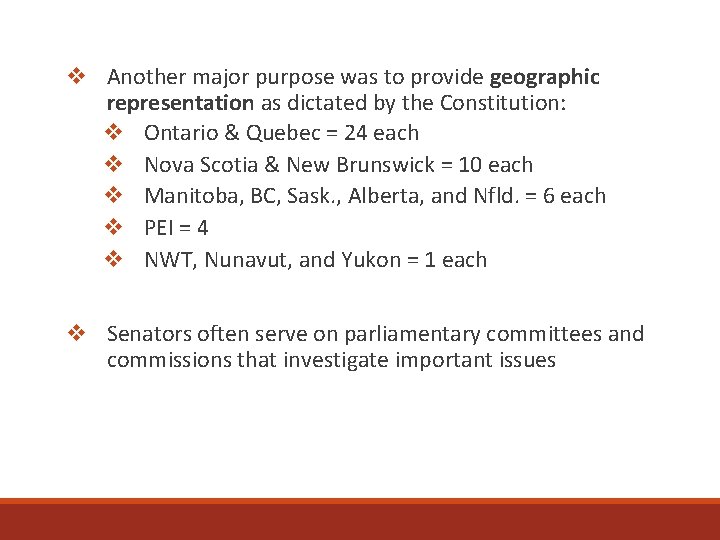
v Another major purpose was to provide geographic representation as dictated by the Constitution: v Ontario & Quebec = 24 each v Nova Scotia & New Brunswick = 10 each v Manitoba, BC, Sask. , Alberta, and Nfld. = 6 each v PEI = 4 v NWT, Nunavut, and Yukon = 1 each v Senators often serve on parliamentary committees and commissions that investigate important issues
Senate Reform v Senate reform has been controversial since the Senate was created v Should the Senate be elected? v Former PM Stephen Harper v Should the Senate be abolished? v Federal NDP v Should the geographic distribution/formula be changed? v Western Canada under-represented under current formula compared to population size
v Should the appointment process and/or party affiliation system be changed? v Historically, Senate appointments have often been based on political patronage (the granting of political favours) v PM may recommend appointment of an individual to reward political support v In 2014, PM Trudeau announced that Liberal senators would no longer be members of the party’s caucus and that future Senators would be appointed as independents v Historically, each party’s caucus included all senators and MPs from that party v Many Liberal senators chose to designate themselves as “Senate Liberals” and continue their own Senate caucus v In 2015, non-partisan advisory board created to make recommendations for Senate appointments
Judicial Branch
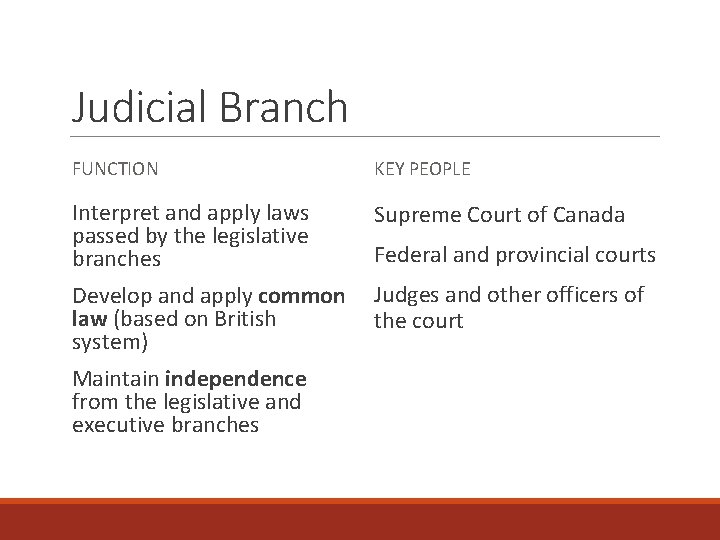
Judicial Branch FUNCTION KEY PEOPLE Interpret and apply laws passed by the legislative branches Supreme Court of Canada Develop and apply common law (based on British system) Judges and other officers of the court Maintain independence from the legislative and executive branches Federal and provincial courts
The Independent Judiciary v The judicial branch considers and answers contentious questions surrounding: v Constitutionality of laws (e. g. Is a law banning assisted suicide unconstitutional? ) v The interpretation of rights and freedoms (e. g. What is meant by “freedom of expression” or “unreasonable search or seizure”? ) v Government powers and disputes (e. g. Does government have the right to regulate tobacco advertising? Does a province have the right to separate from Canada? ) v Criminal or civil law decisions by lower courts
v To grapple with these issues in a consistent, nonpartisan, impartial manner they must be independent of the other branches of government v The independence of our judiciary must be carefully guarded and maintained v Example: Provincial court judges have refused to rule on certain cases because of the possible perception that they are not independent of the provincial government which appoints and pays them v Perception of political patronage appointments undermines public faith in the independent judiciary v The perception of independence is vital!
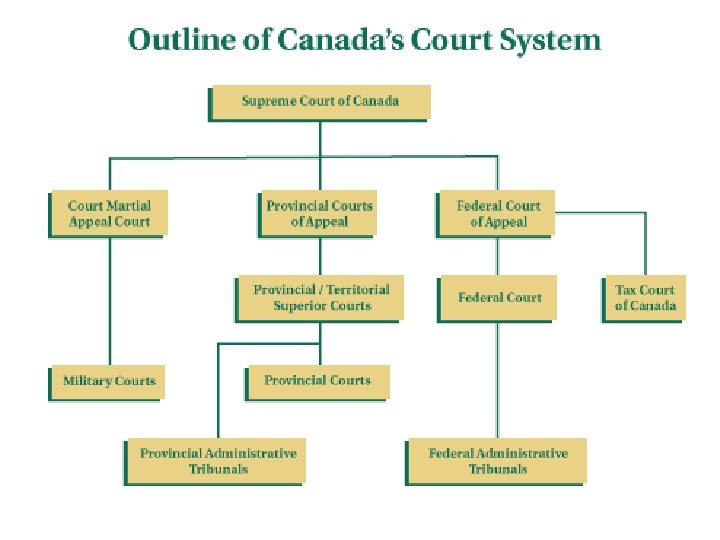
Federal Courts v Federal courts deal primarily with matters concerning the federal government v Judges are appointed by the federal government
Provincial/Territorial Courts v Each province/territory has its own lower court v They preside over summary offences (i. e. less serious criminal offences like trespassing, public nudity, etc. ) and minor civil claims (“small claims court”) v In MB, this court is called the Provincial Court v Judges are appointed by the provincial/territorial government
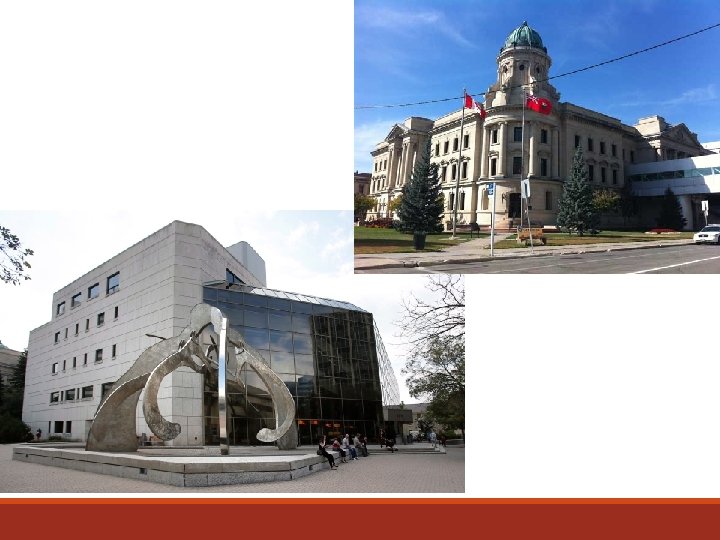
v Each province also has a superior court v They review the decisions of the lower court, hear more serious civil lawsuits, and conduct trials for indictable offences (i. e. serious criminal offences like murder) v Judges are appointed by the federal government v In MB: Court of Queen’s Bench v The highest court in each province is the court of appeal v They review decisions made by the superior court and interpret the Constitution v Don’t normally conduct trials v Judges are appointed by the federal government v In MB: Manitoba Court of Appeal
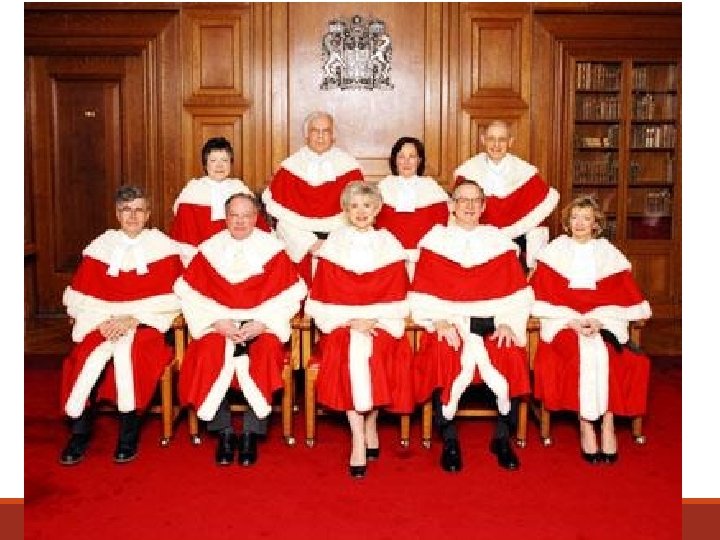
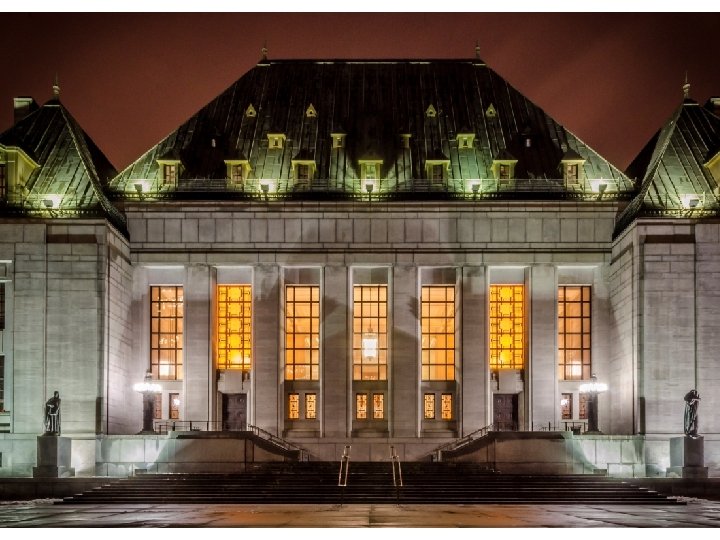
The Supreme Court v The highest court in Canada v Court of last appeal v Rulings are final v Chief Justice + 8 other judges v Must be 3 from Quebec v Convention is to appoint 3 from Ontario, 2 from the West/North, and 1 from the Maritimes v Appointed by GG on advice from PM/cabinet v Since 2016, a non-partisan advisory board has provided the short-list of candidates
v Mandatory retirement at age 75 v Justices must maintain “good behavior” v Can only be removed by Parliament after review by the Canadian Judicial Council (made up of senior judges and justices) v No judge has ever been removed (those facing potential removal have resigned)
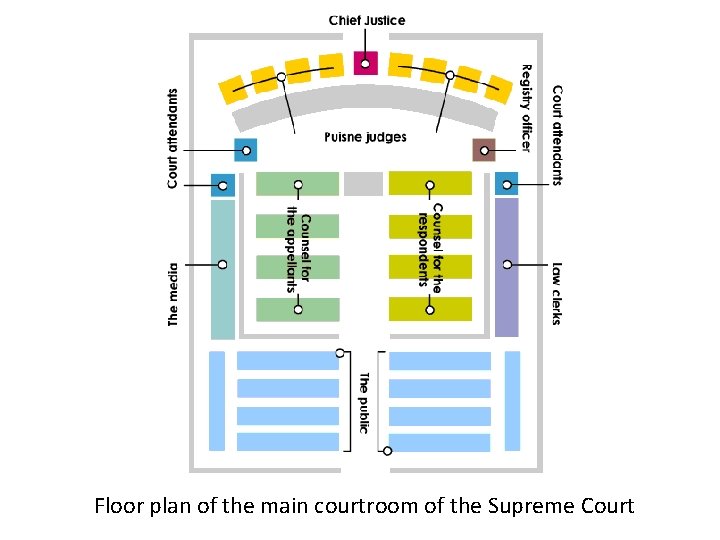
Floor plan of the main courtroom of the Supreme Court
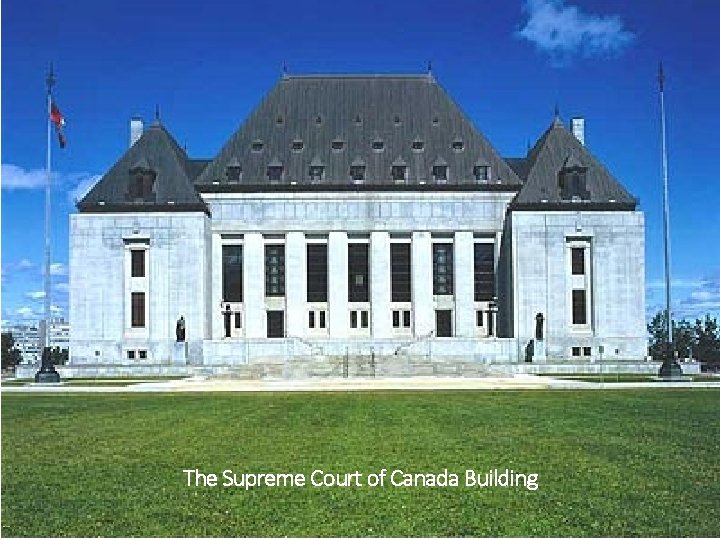
The Supreme Court of Canada Building
- Slides: 59